Sample Category Title
Dollar Turbocharged by “Goldilocks” Jobs Report
Appetite towards the Dollar sweetened on Friday afternoon as investors digested the mixed US jobs report for June.
The Dollar appreciated against every single G10 currency as markets cheered the fact that the United States added an impressive 224,000 jobs to its economy last month.
However, with the unemployment rate slightly up at 3.7% and average earnings disappointing by rising 0.2% in June, below the expected 0.3% - the jobs data is certainly a mixed bag. Today’s report is likely to complicate the Federal Reserve’s decision to cut interest rates this month, especially if economic conditions in the United States continue to stabilize leading up to the Fed policy meeting.
This sentiment is reflected in the Dollar’s appreciation with further upside expected as investors start to re-evaluate whether the Fed will pull the rate cut trigger. Taking a look at the technical picture, the Dollar Index is trading marginally above 97.10 as of writing. A weekly close above 97.00 may inspire an incline towards 97.50.
Canada: No Net New Jobs Created in June but Wage Growth Surges
- Canadian employment remained broadly unchanged in June. On net, employment edged lower by 2.2k. With a steady participation rate and few new jobs created, labour force growth helped to push the unemployment rate up a tenth of a point to 5.5%.
- The details of the report show that 24.1k full-time jobs were created in the month. However, 26.2k part-time jobs were lost, resulting in the small (statistically insignificant) decline of 2.2k jobs in June. Both private and public sector added jobs in the month, but were more than offset by a decline in self-employed.
- Service industries added all the jobs (+30.6k), with health care and social assistance, educational services, and transportation and warehousing recording strongest gains. In contrast, the goods sector lost 32.8k jobs, with about half of that loss occurring in the manufacturing sector.
- Among the provinces, employment gains were recorded in Alberta (+10.4k) and Saskatchewan (+2.5k), Quebec (+1.8k), New Brunswick (+1.1k) and PEI (+0.4k). Small employment declines were recorded in the remaining provinces.
- Wage growth for permanent employees surged to 3.6% year-on-year in June from 2.6% pace in the preceding two months.
Key Implications
- No new jobs were created in June, but the surge in wage growth is sure to catch the attention of the Bank of Canada. One of the issues puzzling policymakers over the last few years has been the lack of pickup in wage growth despite historically low unemployment rates. In Canada, oil industry woes has been blamed for depressing national wage growth. With the June data this no longer seems to be a factor. Moreover, favourable base year effects (i.e. flat wage growth in the second half of 2018) should help keep wage growth buoyant near current levels in the second half of this year.
- With inflation at target, low unemployment, and wage gains more in line with expectations of policymakers at this point in the cycle, there is little motivation for the Bank of Canada to change course. Unlike our southern neighbour, interest rate "insurance" cuts remain unlikely this year. That said, the prolonged period of elevated trade policy uncertainty may keep the Bank of Canada from considering moving rates higher even if the data continues to prove modestly stronger than expected.
USD/JPY Mid-Day Outlook
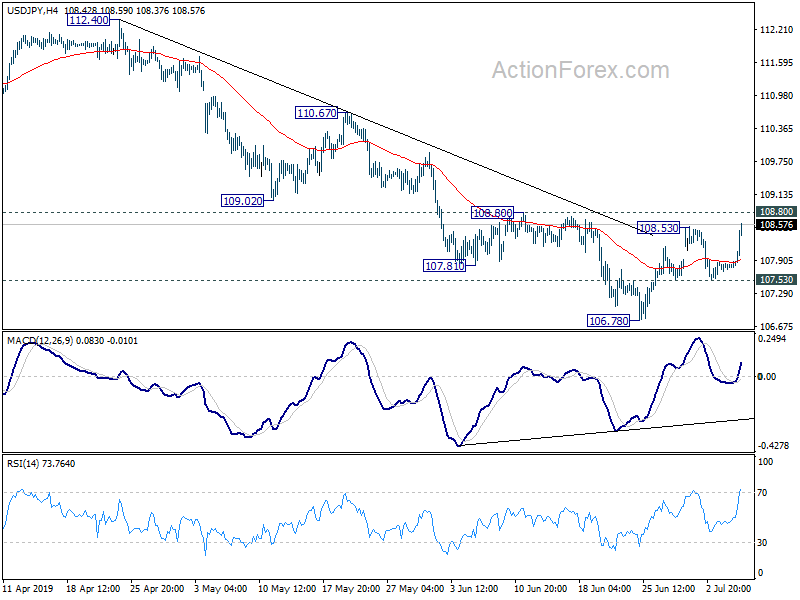
Daily Pivots: (S1) 107.75; (P) 107.79; (R1) 107.88; More...
USD/JPY's rebound from 106.78 resumed by breaking 108.53. Focus is back on 108.80 resistance. Break will confirm short term bottoming at 106.78. Further rise should then been seen to 110.67 resistance next. On the downside, break of 107.53 will turn bias to the downside for retesting 106.78 low..
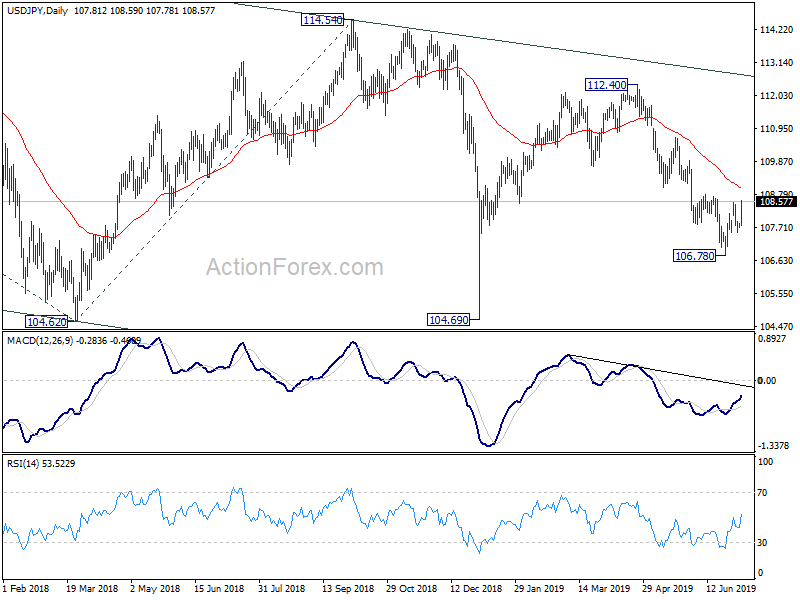
In the bigger picture, decline from 118.65 (Dec 2016) is still in progress, with the pair staying inside long term falling channel. Break of 104.62 will target 100% projection of 118.65 to 104.62 from 114.54 at 100.51. For now, we'd expect strong support above 98.97 (2016 low) to contain downside to bring rebound. In any case, break of 112.40 is needed to the first serious sign of medium term bullishness. Otherwise, further decline will remain in favor in case of rebound.
USD/CHF Mid-Day Outlook
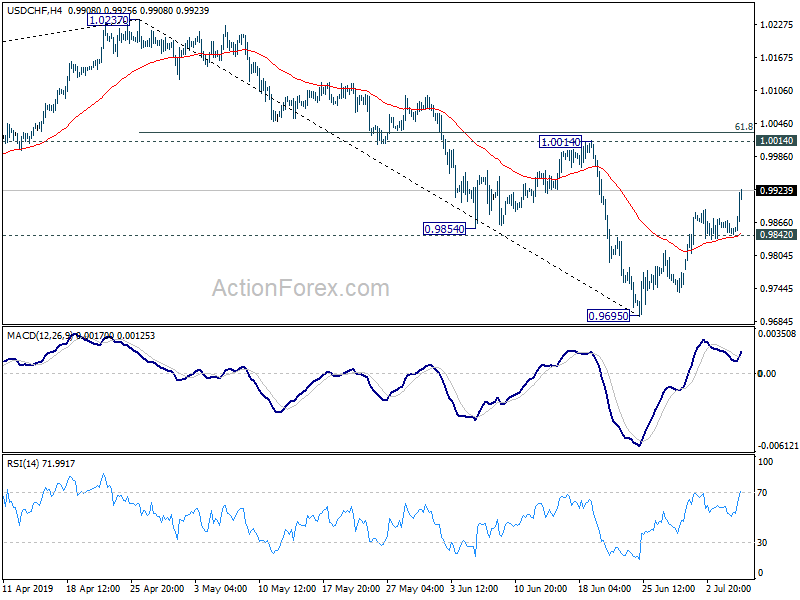
Daily Pivots: (S1) 0.9841; (P) 0.9856; (R1) 0.9864; More...
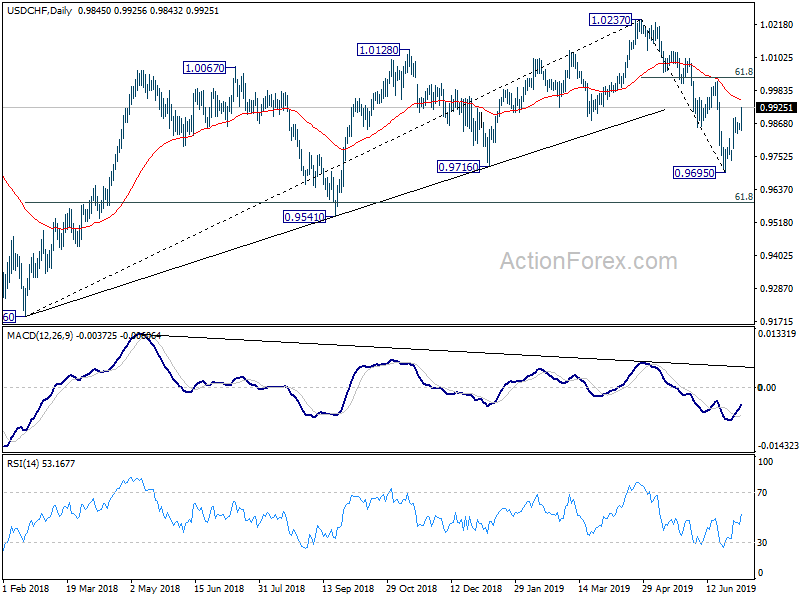
USD/CHF's rally extends to as high as 0.9925 so far. Intraday bias stays on the upside for 1.0014 resistance. Upside could be limited by 61.8% retracement of 1.0237 to 0.9695 at 1.0030. On the downside, below 0.9842 minor support will turn bias back to the downside for retesting 0.9695 low instead. However, sustained break of 1.0030 will pave the way back to retest 1.0237 high.
In the bigger picture, current development suggests that up trend from 0.9186 (2018 low) has completed at 1.0237 already. Deeper decline would be seen to 61.8% retracement of 0.9186 to 1.0237 at 0.9587 and below. For now, USD/CHF is seen as in long term range pattern between 0.9186 and 1.0342. Hence, we'd pay attention to bottoming signal below 0.9587. However, sustained break of 1.0014 will revive medium term bullishness and turn focus back to 1.0237 high.
EUR/USD Mid-Day Outlook
Daily Pivots: (S1) 1.1274; (P) 1.1284; (R1) 1.1296; More...
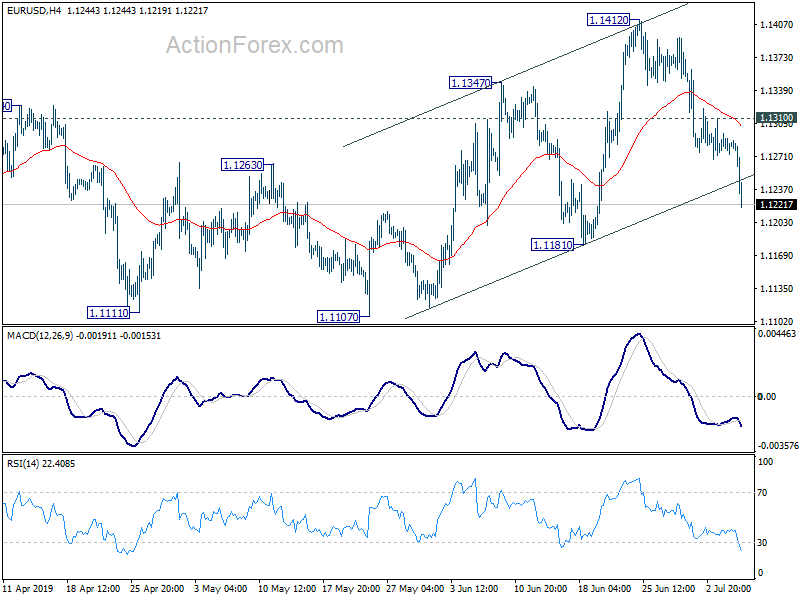
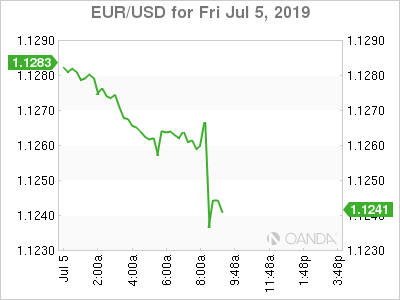
EUR/USD drops sharply to as low as 1.1219. Intraday bias stays on the downside for 1.1181 support. Break will confirm completion of rebound from 1.1107 at 1.1412. Retest of 1.1107 low should be seen next. Though, above 1.1310 minor resistance will turn bias back to the upside to resume the rebound from 1.1107 through 1.1412 instead.
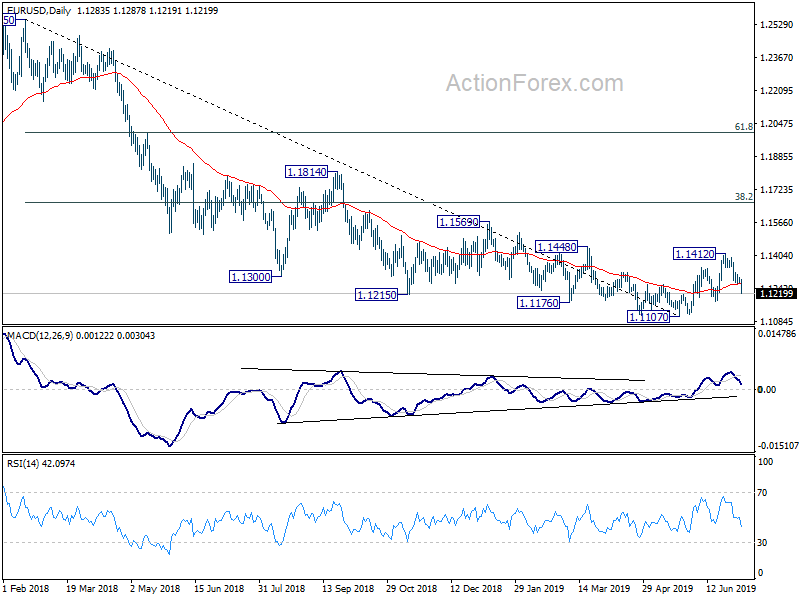
In the bigger picture, considering bullish convergence condition in daily and weekly MACD, a medium term bottom should be in place at 1.1107 after hitting 61.8% retracement of 1.0339 (2016 low) to 1.2555 (2018 high) at 1.1186. Further rise should be seen to 38.2% retracement of 1.2555 to 1.1107 at 1.1660. Reactions from there could indicate whether rebound from 1.1107 is a corrective rise or reversing medium term trend. In any case, risk will stay mildly on the upside as long as 1.1107 low remains intact.
EURGBP Uptrend Hits Obstacle; Starts Losing Momentum
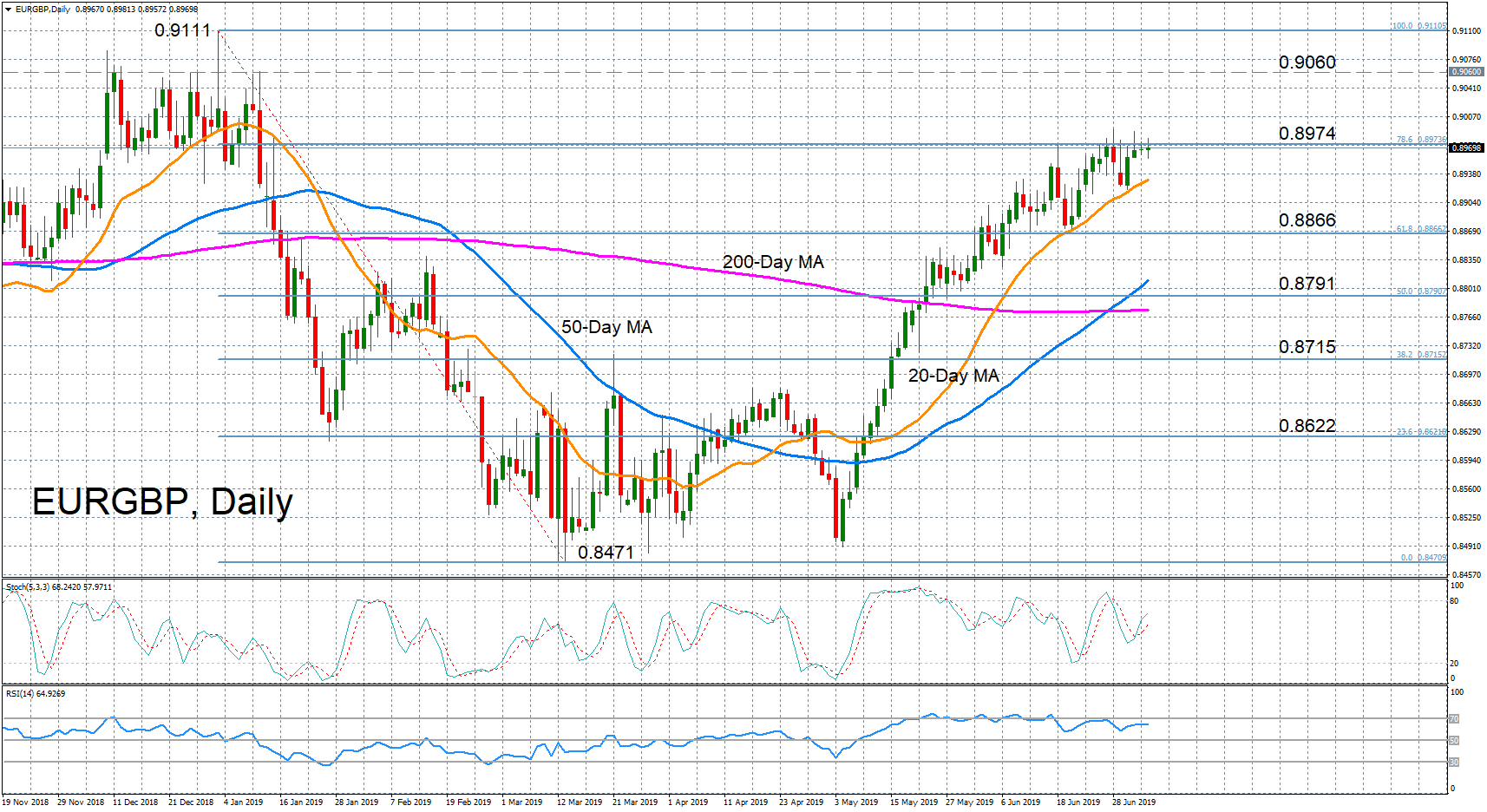
EURGBP has hit a strong wall at the 78.6% Fibonacci retracement of the downleg from 0.9111-0.8471 around 0.8974. Momentum indicators remain in bullish territory but are sending out mixed signals for the near-term picture. The stochastics are pointing upwards, suggesting further advances are possible in the coming days. However, the RSI has flatlined, indicating the latest upleg may have run its course.
If the positive momentum holds and prices manage to break above immediate resistance at the 78.6% Fibonacci, the 0.9060 level is likely to come into focus – a previous resistance area – before the bulls challenge the 0.91 handle. Above 0.91, the main target is January’s near 16-month high of 0.9111. If successfully broken, this would confirm the start of a longer-term uptrend for EURGBP and shift the outlook to a more convincingly bullish one.
At the moment, the bullish structure is still in its infancy, with the 50-day moving average having only recently crossed above the 200-day one.
However, if the pair continues to lose steam and prices reverse lower, the nearest support to watch is the 20-day MA at 0.8930. Dropping below the 20-day (MA) would open the way for the 61.8% Fibonacci at 0.8866, while a steeper slide towards the 50% Fibonacci at 0.8791 would erase the bullish bias and switch the short-term view to a more neutral one.
U.S. Job Market Regains its Stride in June
- Non-farm payrolls rose by 224k in June, well ahead of expectations for 160k. Private-sector hiring expanded by 191k and government payrolls kicked in 33k.
- Goods-producing employment rose 37k, with 21k in construction and 17k in manufacturing. Services employment, meanwhile, rose 154k, more than double the 72k created in May.
- Revisions were relatively minor, with 11k fewer jobs created over the previous two months relative to the previous estimate.
- The unemployment rate edged up to 3.7% from 3.6% May, due to relatively strong labor force growth (335k) and an increasing participation rate (62.9% from 62.8%). Household survey employment rose 224k.
- Average hourly earnings were up 0.2% month-on-month, but the trend for growth over the past year edged lower to 3.1% (from 3.2%).
Key Implications
- So much for the slowing job market narrative. After a scare in May, job growth returned to form in June. Continued above-trend growth belies concerns that the American economy is turning over.
- At 3.7%, unemployment is low, but don't expect Fed officials to get too excited about it as long as inflation is soft and nominal wage growth is showing little signs of accelerating. Still, while an insurance cut may be on the table, this isn't the kind of data that portends the start of an easing cycle.
Canada Employment Held onto Earlier Gains in June
- Employment slipped 2k in June – but was still up 421k from a year ago
- The unemployment rate ticked up to a still-low 5.5%
- Hourly wage growth jumped to 3.8% year-over-year
The tiny dip in employment – given the size of ‘normal’ swings in this notoriously volatile report – does nothing to change the narrative that Canadian labour markets still look relatively solid. Employment is still up 421k from a year ago. The unemployment rate ticked up to 5.5%, but from a new multi-decade low of 5.4% in May, and labour force participation rates are still sitting around all-time highs once controlling for population aging.
Probably more importantly, wage growth jumped to 3.8% in June from 2.8% in May. The wage numbers, like the headline employment count, are notoriously volatile, so we would take the latest surge higher with a big grain of salt. Still, other wage measures have also shown signs of ticking a little higher in Q2. Recent readings provide perhaps some reason for optimism that underlying wage trends are picking up to closer to the 3% or higher rate that we would ordinarily expect at this point in the economic cycle. In any case, the labour market data will only reinforce the expectation that the Bank of Canada will not follow the US Fed with what are now widely-expected rate cuts south of the border.
Solid US Payrolls Won’t Deter Calls for a Cut
- Employment growth rebounded to 224k in June
- The unemployment rate ticked higher to 3.7%
- Wage growth was steady at 3.1% year-over-year
A nice rebound in US payroll growth will do little to change market calls for the Fed to cut rates later this month, though a 50 basis point move looks less likely. It’s not that the jobs backdrop is weak. Despite some soft payroll reports in recent months, employment growth is tracking 172k year-to-date. That’s down from 223k in 2018 but still well above the ~100k pace of labour force growth. So while unemployment ticked up to 3.7% in June, it is still down from last year. Wage growth has been a bit less impressive though, losing momentum in recent months and remaining just above the 3% mark—not enough to generate significant inflationary pressure.
Those looking for the impact of tariffs and trade uncertainty will find some evidence in job growth. Relative to last year, the most significant slowing in monthly payroll growth has been in manufacturing. Transportation and warehousing—also trade-exposed—isn’t far behind. Rather than clear evidence of a slowing US economy, it’s the Fed’s concern about the impact of trade policy (and, relatedly, slowing global growth) that makes them more likely to ease monetary policy in the coming months.
Dollar Rallies Following Blockbuster NFP Report; Markets Still Pricing in Fed Rate Cuts in July
Today’s non-farm payroll shows labor market is still getting tighter despite the unemployment rate ticking higher from the 49-year low as the participation rate rose. Trade tensions are not really hitting the labor market yet, but lack of international investment in the US will eventually hit the data points. The Fed never makes a decision off of one economic data point and the narrative remains inflation is subdued, and global growth concerns are heightened.
Despite the strong rebound in jobs and steady wages, the Fed will still likely deliver a 25-basis point insurance cut at the end of the month. For the Fed to consider a 50 basis point cut, we will need to see the July 26th second quarter advance GDP reading deliver a sub-2% reading.
The dollar rallied across the board and the 10-year Treasury yield extended its gains above 2.00%. Manufacturing, Services and construction all showed strength and that should ultimately support the argument to remain with US equities.
Oil
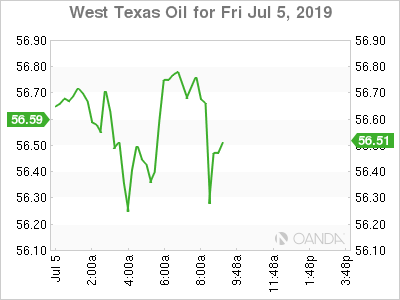
The fluctuations post non-farm payroll will do little to disrupt the overall trend of slower economic activity globally. The US consumer weekly earnings growth held steady and that is a bright spot for oil as consumption is not seen as collapsing.
The effects of OPEC led production cuts are waning, likely suggesting this is the last cut we will see from the 24-oil producing countries. It is difficult to muster up an argument for higher prices in the short-term, US production is still on an upward trajectory, global demand is falling and geopolitical risk are likely to be sold into.
Gold
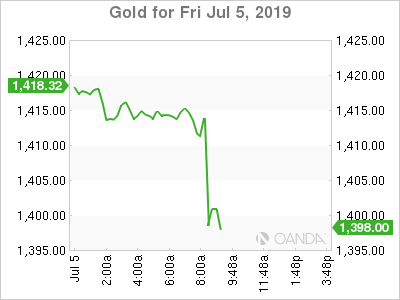
Gold prices plummeted back towards $1,400 an ounce following the better than expected labor report. The US economy rebounded strongly after last month’s eye-dropping miss. The yellow metal will likely find buyers as the global growth slowdown should keep demand strong for gold.
Bitcoin
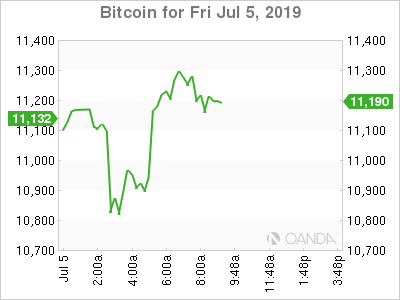
Bitcoin is down modestly following the Asia Blockchain Summit in Taipei which showed cryptocurrency fans are reinvigorated and are seeking more volatility with increased leverage trading. While digital coin enthusiasts want more extreme trading conditions, this is not what mainstream commerce and institutional investors want to see. Volatility may attract some new investors, but if Bitcoin wants to see stability and a path towards fresh record highs, volatility needs to slow down.
Much of the recent rally was attributed to the excitement of Facebook’s launch of their own stablecoin, Libra. While Libra is a long way from being used, it will try to overtake Bitcoin, a task many altcoins have failed with.