

Sample Category Title
GBP/USD Mid-Day Outlook
Daily Pivots: (S1) 1.2567; (P) 1.2579; (R1) 1.2591; More....
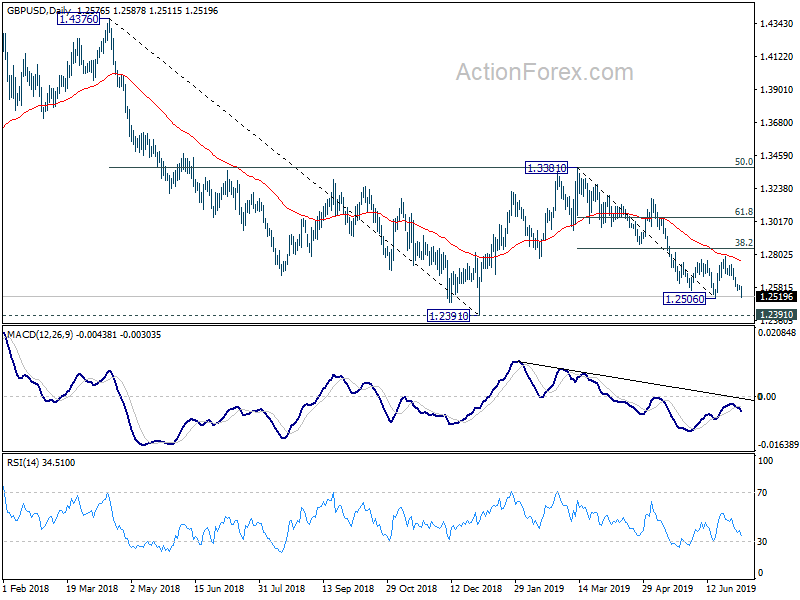
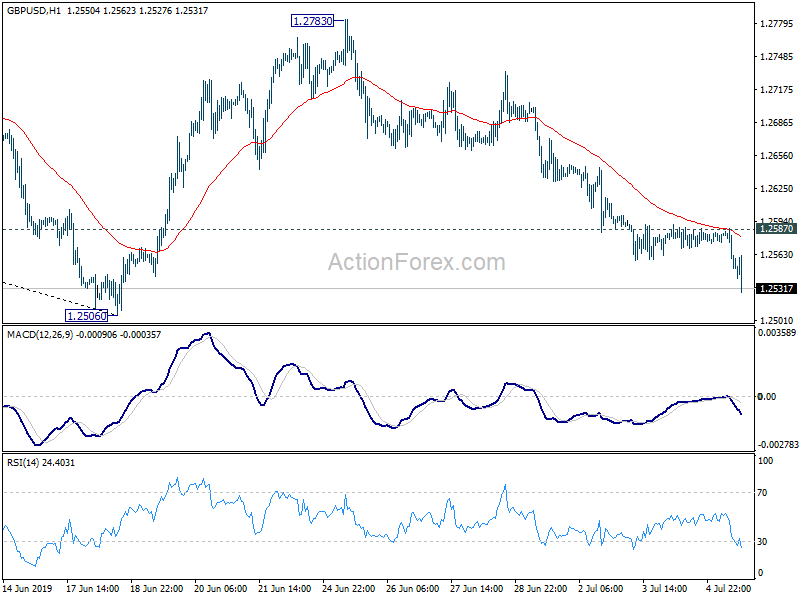
GBP/USD drops sharply today and intraday bias stays on the downside for 1.2506 support. Firm break there will resume larger decline from 1.3381 to 1.2391 low. On the upside, above 1.2587 minor resistance will extend the consolidation from 1.2506 with another rise. But upside should be limited by 38.2% retracement of 1.3381 to 1.2506 at 1.2840 to bring fall resumption eventually.
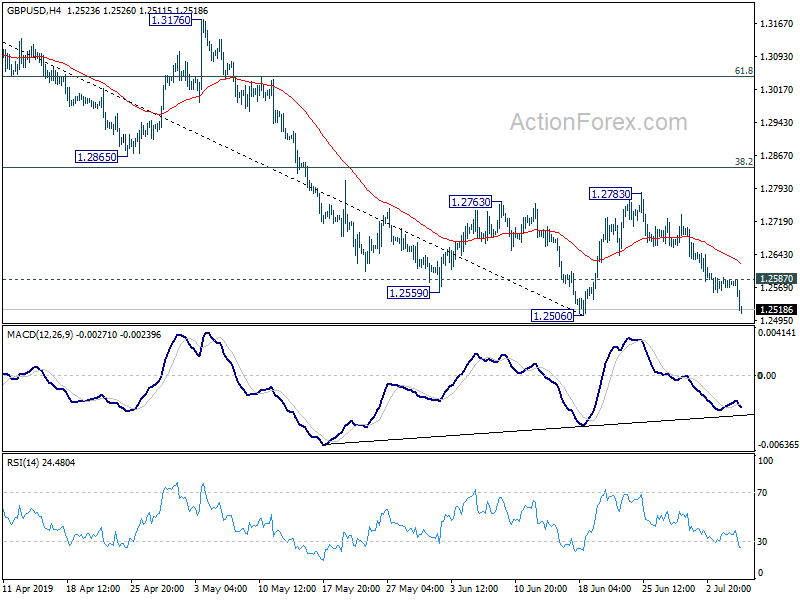
In the bigger picture, down trend from 1.4376 (2018 high) is still in progress. Break of 1.2391 would target a test on 1.1946 long term bottom (2016 low). For now, we don't expect a firm break there yet. Hence, focus will be on bottoming signal as it approaches 1.1946. In any case, medium term outlook will stay bearish as long as 1.3381 resistance holds, in case of strong rebound.
Dollar Rebounds as Strong NFP Puts Fed Cut into Question
Dollar rebound strongly today after much better than expected job data. 10-year yield also jumps sharply and is currently up 0.083 at 2.022, back above 2% level. DOW futures, on the other hand, tumble notably. Analysts reactions regarding to the data are divided. Some are more aligned with fed fund futures pricing and are still expecting a rate cut later this month. But some like us, expect that the data is enough for Fed to hold their hands first. We'd argue, with trade war escalation averted and no deep deterioration in data, Fed policymakers would better hold their bullets for now.
Technically, now, the question is whether Dollar could take out next resistance level before weekly close. Among them, break of 1.2506 support in GBP/USD will resume the fall from 1.3381. Break of 180.80 resistance in USD/JPY will indicate near term bullish reversal. Break of 1.3145 resistance will also indicate near term bottoming. Meanwhile, break of 1.1181 support will bring focus to 1.1107 low.
In Europe, currently, FTSE is down -0.53%. DAX is down -0.55%. CAC is down -0.53%. German 10-year yield is up 0.0512 at -0.345. Earlier in Asia, Nikkei rose 0.20%. Hong Kong HSI dropped -0.07%. China Shanghai SSE rose 0.19%. Singapore Strait Times dropped -0.16%. Japan 10-year JGB yield dropped -0.0067 to 0.162.
US NFP grew 224k in June, dollar jumps sharply
US non-farm payroll report showed 224k growth in the job market in June, notably above expectation of 164k. Prior month's dismal figure was revised slightly down from 75k to 72k. Employment growth has averaged 172,000 per month thus far this year, compared with an average monthly gain of 223,000 in 2018. In June, notable job gains occurred in professional and business services, in health care, and in transportation and warehousing.
Unemployment rate rose 0.1% to 3.7%, above expectation of 3.6%. Participation rate rose 0.1% to 62.9%. Average hourly earnings rose 0.2% mom, below expectation of 0.3% mom. But prior month's wage growth was revised up from 0.2% mom to 0.3% mom.
Canada employment contracted -2.2lk in June, below expectation of 10.0k. Unemployment rate rose to 5.5%, up from 5.4% but matched expectations.
German factory orders dropped -2.2%, foreign orders plunged
German factory orders dropped sharply by -2.2% mom in May, much worse than expectation of -0.1% mom. Looking at some details, domestic orders increased by 0.7% mom but foreign orders plunged -4.3% mom. New orders from Eurozone dropped -1.7% mom while orders from other countries dropped -5.7% mom.
The contraction was also broad-based. Intermediate goods orders dropped -1.5% mom. Capital goods orders dropped -2.8% mom. Consumer goods orders dropped -0.7%.
Japan household spending rose 4% yoy in May, highest in four years
Japan overall household spending rose 4.0% yoy in May, well above expectation of 1.40% yoy. That's the fastest pace in four years since May 2015. The results argued that pickup in consumption could help offset some weakness in external demand in Q2.
However, spending ahead could be weighed down by sluggish wage growth ahead. Sentiments could also weaken on uncertainty over economic outlook, due to trade war. Additionally, the scheduled sales tax hike could also have negative impacts on spending. For now, Prime Minister Shinzo Abe is holding on to the plan to raise sales tax to 10% this October.
Also released, leading indicator dropped to 95.2 in May, down from 95.9, below expectation of 95.3.
BoJ survey shows 83.4% of public expects prices to rise over five years
According to BoJ's Opinion Survey, 83.4% of public expects price level to go up over the next five years. That's up from 82.3% in March and was the highest since June 2016. Among them, 28.7% expects price level to go up significantly, up from 26.9%. 54.7% expects price to go up slightly, down from 54.7%.
On price levels one year from now, 80.5% expects prices to go up. 11.7% expects prices to go up significantly, up from 11.3%. 68.8% expects prices to go up slightly, up fro 67.4%.
BoJ Amamiya: Baseline scenario for economy unchanged
BoJ Deputy Governor Masayoshi Amamiya told a Reuters Newsmaker event today that the baseline scenario is that "economy will continue to expand moderately and gradually push up inflation to our target".
He added that "The output gap is still positive. More companies are raising prices. If this trend continues, people's perception of future price moves will change. At present, the momentum (for inflation to hit 2%) is sustained."
Though, he also warned of various downside risks. And he emphasized "if such risks hurt the economy's momentum to achieve our price target, we won't hesitate to consider easing more."
GBP/USD Mid-Day Outlook
Daily Pivots: (S1) 1.2567; (P) 1.2579; (R1) 1.2591; More....
GBP/USD drops sharply today and intraday bias stays on the downside for 1.2506 support. Firm break there will resume larger decline from 1.3381 to 1.2391 low. On the upside, above 1.2587 minor resistance will extend the consolidation from 1.2506 with another rise. But upside should be limited by 38.2% retracement of 1.3381 to 1.2506 at 1.2840 to bring fall resumption eventually.
In the bigger picture, down trend from 1.4376 (2018 high) is still in progress. Break of 1.2391 would target a test on 1.1946 long term bottom (2016 low). For now, we don't expect a firm break there yet. Hence, focus will be on bottoming signal as it approaches 1.1946. In any case, medium term outlook will stay bearish as long as 1.3381 resistance holds, in case of strong rebound.
Economic Indicators Update
| GMT | Ccy | Events | Actual | Forecast | Previous | Revised |
|---|---|---|---|---|---|---|
| 22:30 | AUD | AiG Performance of Construction Index Jun | 43 | 40.4 | ||
| 23:30 | JPY | Overall Household Spending Y/Y May | 4.00% | 1.40% | 1.30% | |
| 05:00 | JPY | Leading Index CI May P | 95.2 | 95.3 | 95.9 | |
| 06:00 | EUR | German Factory Orders M/M May | -2.20% | -0.10% | 0.30% | 0.40% |
| 07:00 | CHF | Foreign Currency Reserves (CHF) Jun | 759B | 760B | 759B | |
| 12:30 | CAD | Net Change in Employment Jun | -2.2K | 10.0K | 27.7K | |
| 12:30 | CAD | Unemployment Rate Jun | 5.50% | 5.50% | 5.40% | |
| 12:30 | USD | Change in Non-farm Payrolls Jun | 224K | 164K | 75K | 72K |
| 12:30 | USD | Unemployment Rate Jun | 3.70% | 3.60% | 3.60% | |
| 12:30 | USD | Average Hourly Earnings M/M Jun | 0.20% | 0.30% | 0.20% | 0.30% |
| 14:00 | CAD | Ivey PMI Jun | 56.2 | 55.9 |
Bitcoin: Is Consolidation Of Price A Good Sign?
Bitcoin price may make all time high if it consolidates within an important consolidation zone for a couple of weeks and break out of this to the upside.
Bitcoin price is struggling to move higher; it seems like the recent high of 13,842 is strong enough to stop the price to move higher. Well, if the price takes out the recent high in less than a month, it is highly likely that we may actually see another record high this year and this can happen as early as the end of Q3.
However, this is also dependent on major important factor, the money printing machines. We all know that the ECB (European Central Bank), the Fed and PBOC (People Bank of China) have used their money printing machines to their optimum level. However, a new war has broken out and the person who is involved in this war does not care about the consequence except getting things his way. This person is Donald Trump, president of the United States of America. His strategies are more about bending others to his will and pay less attention to consequence of these strategies on the domestic economy let alone the world economy.
During the recent G-20 meeting and in the after maths, president Trump is ready to put some extra effort in keep running the money printing machines. He thinks that the dollar is at a massive disadvantage as compared to other currencies. He wants to devalue the dollar, and one of the way is to print more dollar bills.
For Bitcoin, this is a positive aspect, its supply is fixed and as long as the regulators start to show more support, it has only one way to go- upward. Family offices, where the big money is, are not only interested in this space but are very active.
Moving away from the fundamentals and focusing on the price action for the past week, it seems like that the price has started to consolidate and it is a very healthy sign. You do not want the price to continue to move in one direction, especially to the upside, this attracts too many speculators which isn’t a good sign .
Bulls have a lot of things to cheer about: firstly, the price is well above the 50-day and 100-day moving average (on a daily time frame) which confirms the fact that up trend is strongly in place. Another factor is that the price has broken its downward trend line to the upside which is very positive.
However, not all is good when it comes to the price action, the 50-day moving average is catching up to the price fast and the RSI is still in over bought territory. But, this is not as bad it was when the price touched the high of $13,842.
To conclude, the consolidation of the price between 9,000 to 14,000 for another week or two is healthy and a break out of this consolidation zone to the upside would be very positive for the price. This would open the door for all-time high as early as the end of Q3.
Canada employment dropped -2.2k, missed expectation, USD/CAD rebound
Canada employment contracted -2.2k in June, below expectation of 10.0k. Unemployment rate rose to 5.5%, up from 5.4% but matched expectations.
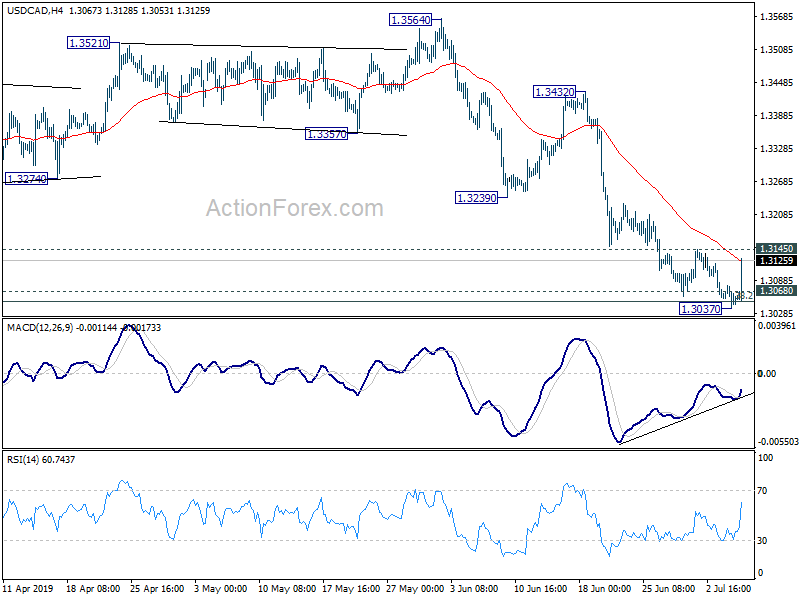
USD/CAD rebounds strongly with the contrast in today's job data from US and Canada. Focus is back on 1.3145 minor resistance immediately. Break will suggest that 1.3052/68 cluster support zone is defended for now. And a short term bottom is formed at 1.3037. Further rise could be then be seen back to 1.3239 support turned resistance next.
US NFP grew 224k in June, dollar jumps sharply
US non-farm payroll report showed 224k growth in the job market in June, notably above expectation of 164k. Prior month's dismal figure was revised slightly down from 75k to 72k. Unemployment rate rose 0.1% to 3.7%, above expectation of 3.6%. Participation rate rose 0.1% to 62.9%. Average hourly earnings rose 0.2% mom, below expectation of 0.3% mom. But prior month's wage growth was revised up from 0.2% mom to 0.3% mom.
Employment growth has averaged 172,000 per month thus far this year, compared with an average monthly gain of 223,000 in 2018. In June, notable job gains occurred in professional and business services, in health care, and in transportation and warehousing.
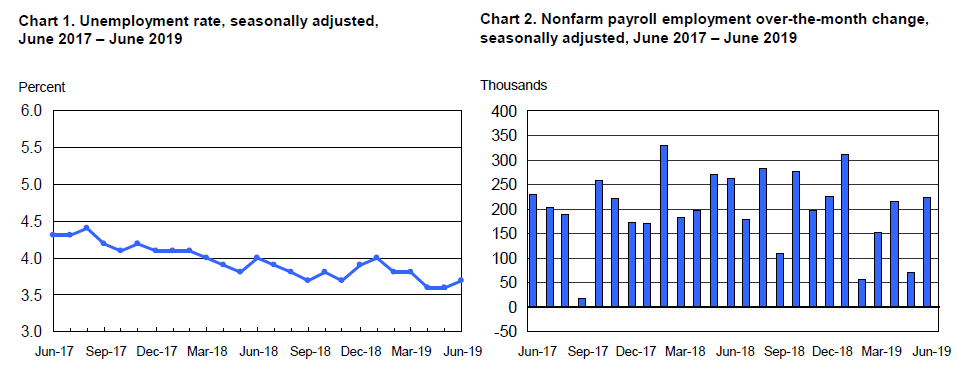
Dollar jumps sharply after the release. In particular, GBP/USD is heading to retest 1.2506 support.
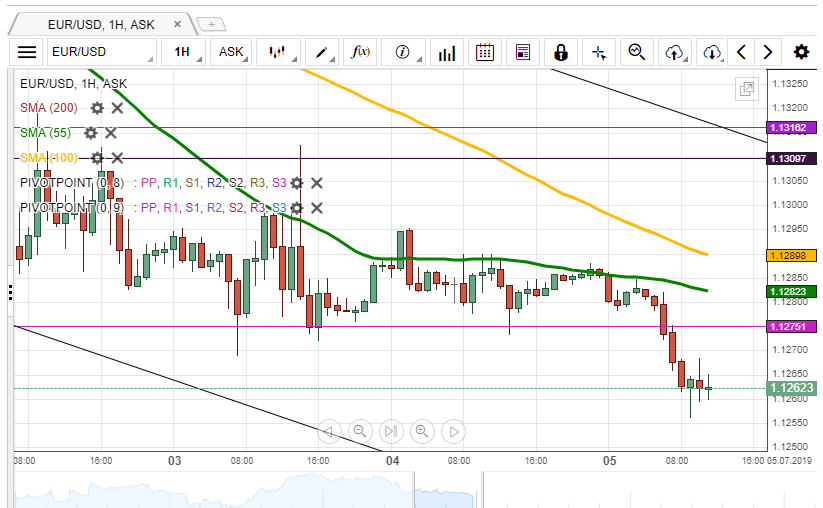
EUR/USD Could Go Downwards
Yesterday, the EUR/USD currency pair traded sideways, testing the support level formed by the weekly S3 at 1.1275. During Friday's morning, the pair breached the given support level.
Note, that the exchange rate is still pressured by the 55– and 100-hour moving averages, located circa 1.1290. Thus, it is likely, that some downside potential could prevail in the short term. The rate could decline towards the monthly S1 at the 1.1220 mark.
It is unlikely, that bulls could prevail in the market, and the Euro could exceed the 1.1310 level against the Greenback due to resistance formed by the weekly S2 and the monthly PP.
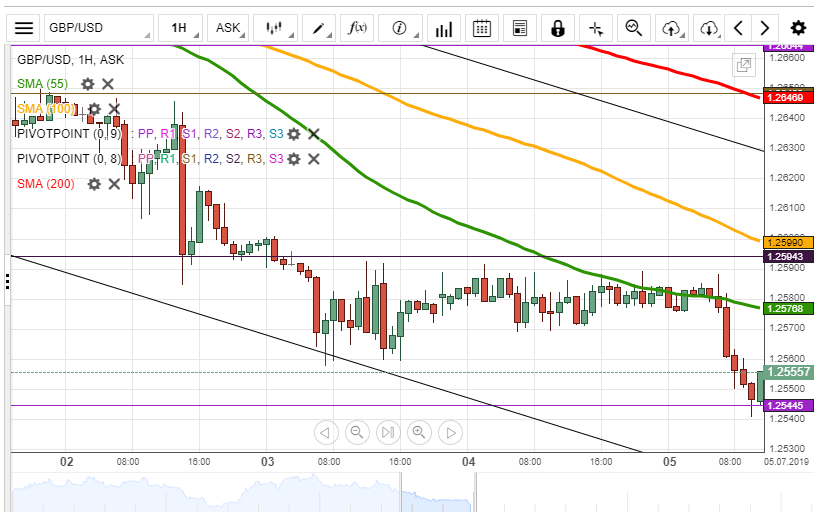
GBP/USD Might Decline In Short Term
During the previous trading session, the GBP/USD exchange rate traded sideways at the psychological level at 1.2580. During today's morning, the rate declined to the 1.2560 level.
It is expected, that the currency pair could continue to decline within the following trading session, as it is pressured by the 55– and 100-hour SMAs, currently located at 1.2578 and 1.2602 respectively. Note, that the pair has to surpass the support level—the monthly S1 at 1.2545.
If the given support level holds, it is expected, that a reversal north could occur. However, it is unlikely, that the rate could exceed the 1.2594 mark due to the resistance level formed by the weekly S2.
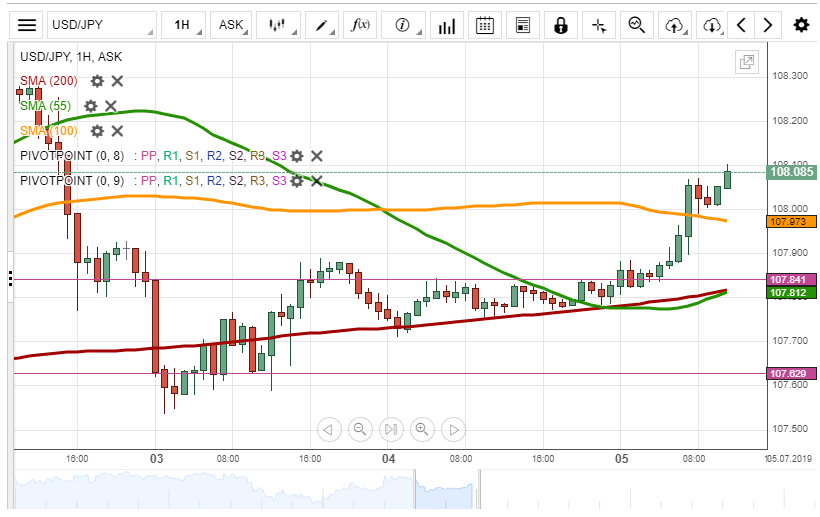
USD/JPY Reached 108.00 Mark
On Thursday, the USD/JPY currency pair traded sideways at the psychological level at 107.80. During Friday's morning, the pair jumped to the 108.00 mark.
It is likely, that the exchange rate could maintain its growth in the short run due to the support cluster formed by the 55-, 100– and 200-hour SMAs, as well the monthly PP in the 107.80/107.98 range. In this case, the rate could reach the upper boundary of the medium-term descending channel located circa 108.30.
On the other hand, the pair could reverse south in the nearest future. If the given support cluster does not hold, the pair could tumble to the weekly PP located at 107.63.
XAU/USD Likely To Trade Sideways
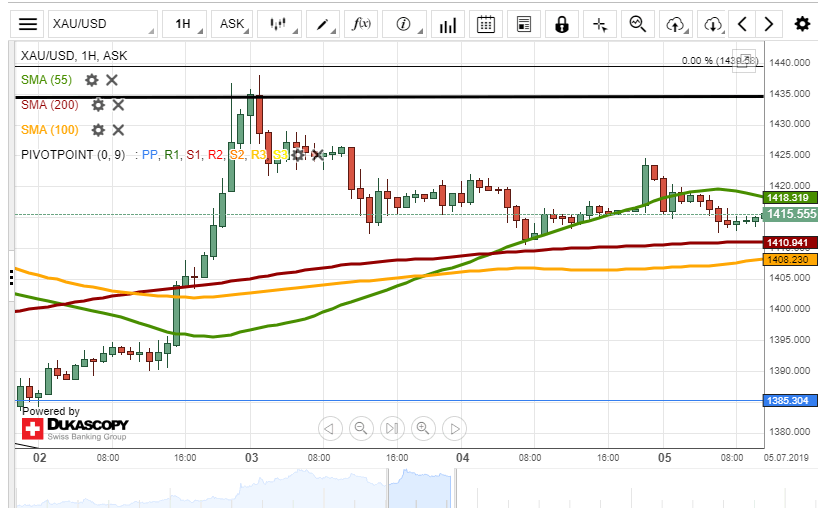
Yesterday, the XAU/USD exchange rate tried to surpass the psychological level at 1,425.00.
Note, that gold is supported by the 100– and 200-hour SMAs, currently located circa 1,410.00 mark. Thus, if the given support holds, it is expected, that a reversal north could occur within the following trading hours.
However, note, that the rate has to surpass the 55-hour moving average, currently located at 1,418.63. If the given SMA holds, it is expected, that gold could trade sideways against between the given moving averages.
Rehn’s Panic, Jobs Reports Next
Just a few words on the ECB before we cover the jobs report. Ollie Rehn, Finnish central bank governor laid out the ECB's path forward in the clearest terms yet and it could virtually ensure the ECB will ease. What's increasingly difficult to understand is the set of signals that has central banks so concerned (more below). US and Canada jobs are due up next. The Video for Premium subscribers is posted below, laying out the key technical constraints for the USD.
Markets were relatively quiet on Thursday but Rehn – Once an ECB hawk – told Boersen Zeitung that easing is needed now. He talked about forward guidance, cutting the ECB's deposit rate or resuming QE. The call was so direct and dovish that was it bordered on alarmist. In late May, Rehn said the base case was to wait longer before raising rates because there was a soft path.
In terms of economic data, there is nothing blatant to justify such a dramatic shift. It's clear this is all about the bond market. German yields are now below the ECB's deposit rate of -0.40% all the way out to 10 years. Yields have fallen dramatically, including in Italy where they have fallen more than 200 basis points since October. Yield curves everywhere are inverted.
The ECB is terrified about falling inflation expectations in markets. Easing at this point sounds like a done deal and the market is increasingly convinced that the BOE will follow and that China-US trade talks have solved nothing.
One line of thinking is that central banks know something we don't – maybe that Trump is going to ramp up the trade war against Europe. But history has shown that central banks are rarely privy to special knowledge and the Fed certainly wasn't when it was hiking in December.
There seems to have been a sea change on inflation views along with a bond-buying mania. To combat it, the ECB is willing to risk diving deeper into experimental policy to perhaps push up inflation a few ticks. Is that risk worth the reward? It's tough to see how it is.
Onto US and Canada Jobs
The day ahead will be a big one in terms of sorting out how the underlying US economy is performing. US non-farm payrolls are forecast at 160K and that leaves the market in a delicate spot. If jobs are higher than 200K, then expect a USD rally along with risk aversion as Fed cuts are questioned. If jobs are below 100K and earnings come in within expectations, expect a USD slump along with risk aversion on fear of an economic slowdown. The question becomes: "Would a string jobs report mean no July rate cut or only a 25-bp cut instead of a 50-bp cut?". Ashraf gives his assessment before answering this in today's Premium video.
In Canada, meanwhile, the country is close to the best jobs growth in a decade over the past 3, 6 and 12 month periods, while its Citi economic suprise index is at multi-decades high. Canada unemp rate seen at 5.5% from 5.4%, while Canada payrolls expected at 10K from 28K. A soft report will be brushed aside while one above the +10K consensus will emphasize that Canada is a rare spot of economic acceleration. Traders may also consider USDCAD longs in the event that US data exceeds expectations as that would weigh on risk appetite, especially if Canada jobs fail to beat.