

Sample Category Title
Sunset Market Commentary
Markets
Friday’s profit taking move didn’t continue in this week’s first trading session. The main leap higher occurred at the start of European trading without strong driver. Geopolitical concerns could have played a role with the US weighing new sanctions against Iran. On the other hand, positive momentum has been building in the run-up to Friday’s Trump/Xi Jinping meeting. Whatever the reason, we wouldn’t draw strong conclusions from today’s probably even outsized gains given extremely low volumes. Stock and oil markets don’t offer an explanation neither. The main eco event, June German Ifo business sentiment, showed a stabilization near May levels as expected and confirming the outcome of last week’s PMI’s. The head of the Ifo institute said he expected things could still get worse, but maybe not much but a little. Investors are now looking forward to this week’s first highlight, which is a speech by Fed Chair Powell tomorrow morning on the economic outlook and monetary policy. Will he be more specific on the Fed’s reaction function when it comes to the July meeting? Markets currently fully discount at least a 25 bps rate cut. The German yield curve bull steepened today with yields down 0.5 bps (2-yr) to 2.9 bps (30-yr). Changes on the US yield curve vary between -1.8 bps (5-yr) and -2.9 bps (30-yr). 10-yr yield spread changes vs Germany narrow up to 3 bps with Greece (-9 bps) outperforming. Additional Italian outperformance because of short term mercy from the EU with regard to the excessive deficit procedure didn’t last long.
EUR/USD continued last week’s uptrend, albeit at a more modest pace. On Friday, the single currency was supported by a better than expected EMU PMI. European yields rebounded a few bp and EUR/USD cleared the 1.1350 resistance. Today, follow-through euro buying continued even as news flow was less euro supportive. German IFO business climate declined further from 97.9 to 97.4, as expected. Both US and German yields declined again. The US-German yield spread for shorter maturities narrowed again and was a slight negative for the dollar. Maybe, investors were also cautious to run USD long exposure in the run-up the G20 meeting later this week. A better/less negative sentiment on the global trade war might be at least as supportive for the euro than for the dollar. At the same time, US president Trump might renew its claim of US trade partners artificially weakening their currencies resulting in an unfair disadvantage for the US. Today, Trump repeated that the Fed has it wrong and that the US needs rate cuts. The EUR/USD (1.1385 area) is trading within reach of the 1.14 big figure, but no break occurred yet. USD/JPY showed no clear trading and is trading in the 107.40 area.
There was no obvious story to inspire sterling trading today. The race for the leadership of the UK conservative party between Boris Johnson and Jeremy hunt is becoming ever more thorny. The outlook on the outcome and on the consequences for Brexit hasn’t changed in profound way. Boris Johnsons remains the most likely winner and a disorderly separation between the EU and the UK remains possible, keeping sterling in the defensive. For now, UK eco news remains of secondary significance for sterling trading. EUR/GBP is holding near recent peak levels in the mid 0.89 area. Cable moved up and down in the 1.27 big figure (currently 1.2710 area).
News Headlines
The German IFO business climate fell from 97.9 in May to 97.4 in June, the lowest level since November 2014. Even so, the number was slightly better than expected. Ifo president Fuest said that business climate deteriorated both in the manufacturing and services sectors, but Ifo doesn’t expect a recession.
German Finance Minister Scholz has cut 2020 expenditures on weaker revenues, government officials said. The country will spend about 3 bln euros less compared to the March forecasts, keeping the debt level on track to fall below 60% of GDP for the first time. The Finance ministry expects a further decrease to 51% by 2023.
USD/JPY Mid-Day Outlook
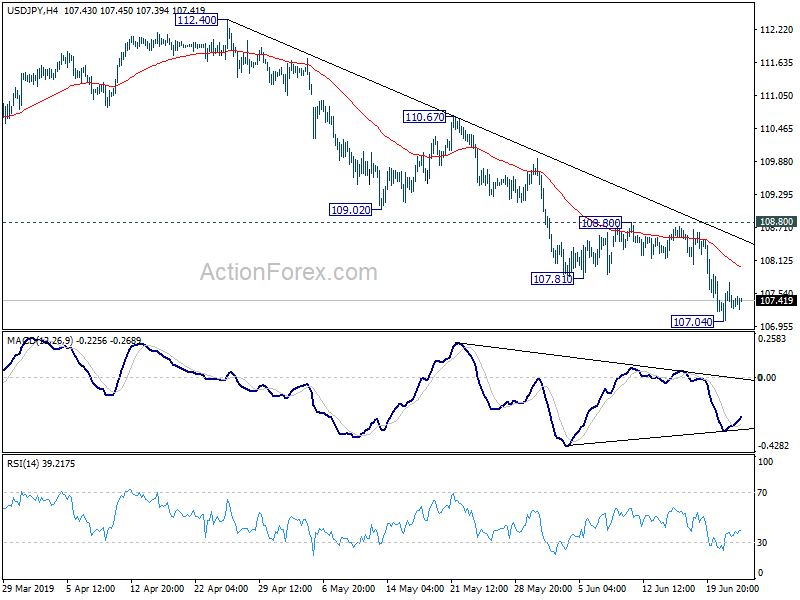
Daily Pivots: (S1) 107.00; (P) 107.36; (R1) 107.68; More...
Intraday bias in USD/JPY remains neutral for consolidation above 107.04 temporary low. Upside should be limited by 108.80 resistance to bring fall resumption. On the downside, break of 107.04 will pave the way to retest 104.69 low. Nevertheless, firm break of 108.80 will indicate short term bottoming and bring stronger rebound back to 110.67 resistance.
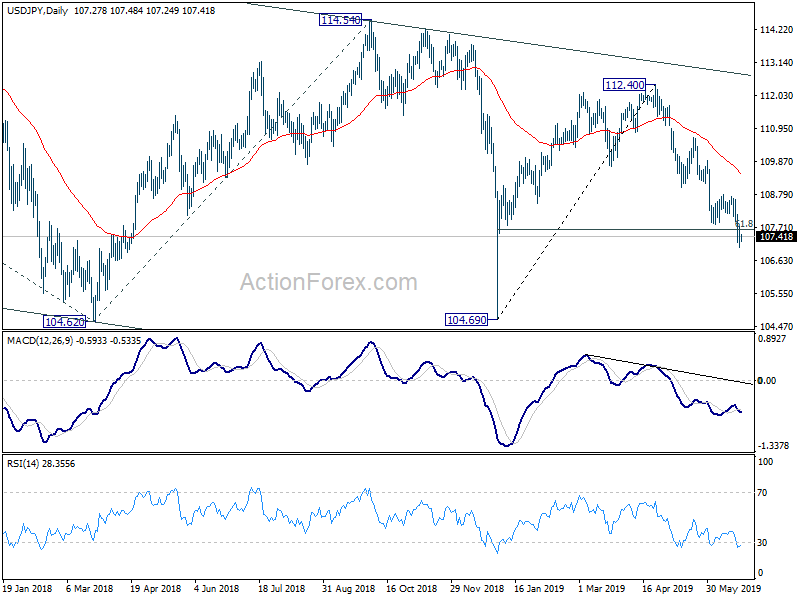
In the bigger picture, decline from 118.65 (Dec 2016) is still in progress, with the pair staying inside long term falling channel. Break of 104.62 will target 100% projection of 118.65 to 104.62 from 114.54 at 100.51. For now, we'd expect strong support above 98.97 (2016 low) to contain downside to bring rebound.
USD/CHF Mid-Day Outlook
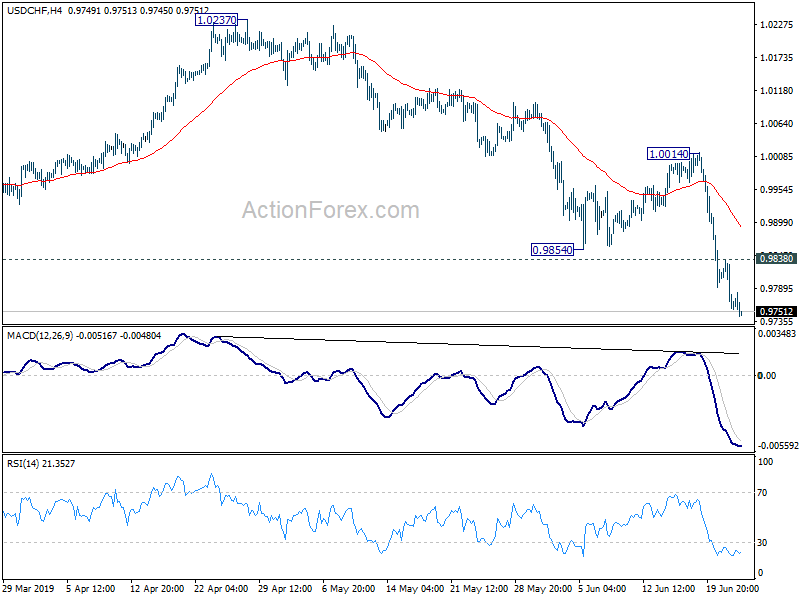
Daily Pivots: (S1) 0.9733; (P) 0.9786; (R1) 0.9816; More...
USD/CHF's fall is still in progress and intraday bias remains on the downside. Current fall should target 0.9716 support first. Break will target 0.9587 fibonacci level next. On the upside, break of 0.9838 minor resistance will turn intraday bias neutral and bring consolidations. But recovery should be limited well below 1.0014 resistance to bring fall resumption.
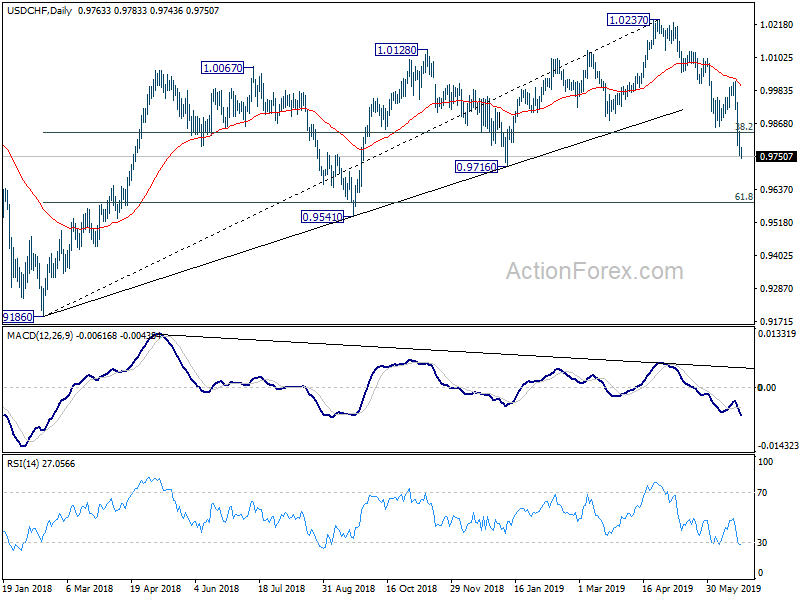
In the bigger picture, current development confirms that up trend from 0.9186 (2018 low) has completed at 1.0237 already. With 38.2% retracement of 0.9186 to 1.0237 at 0.9836 taken out, deeper fall should be seen to 61.8% retracement at 0.9587 and below. We'd pay attention to bottoming signal below 0.9587.
GBP/USD Mid-Day Outlook
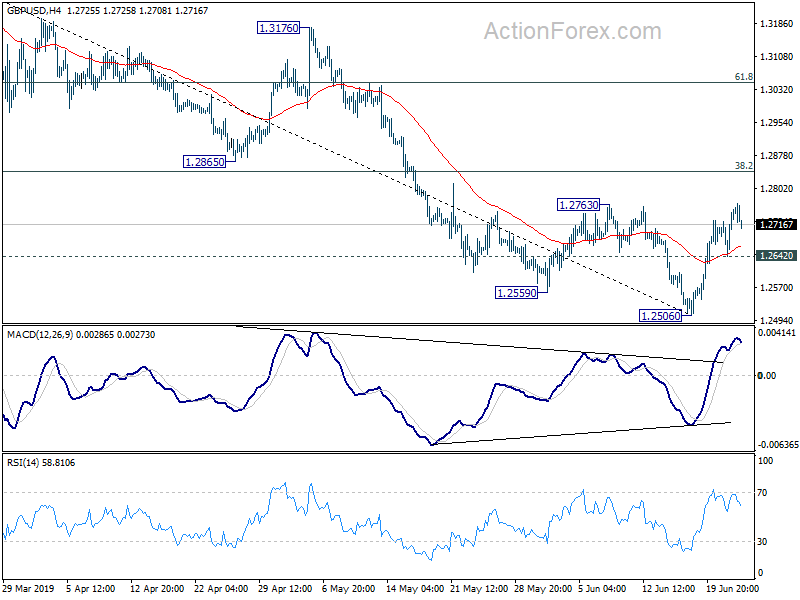
Daily Pivots: (S1) 1.2677; (P) 1.2712; (R1) 1.2783; More....
At this point, GBP/USD's recovery from 1.2506 short term bottom could extend higher. But upside should be limited by 38.2% retracement of 1.3381 to 1.2506 at 1.2840 to limit upside. On the downside break of 1.2642 minor support will turn intraday bias back to retest 1.2506 low. However, sustained break of 1.2840 will bring stronger rise to 61.8% retracement at 1.3047 next.
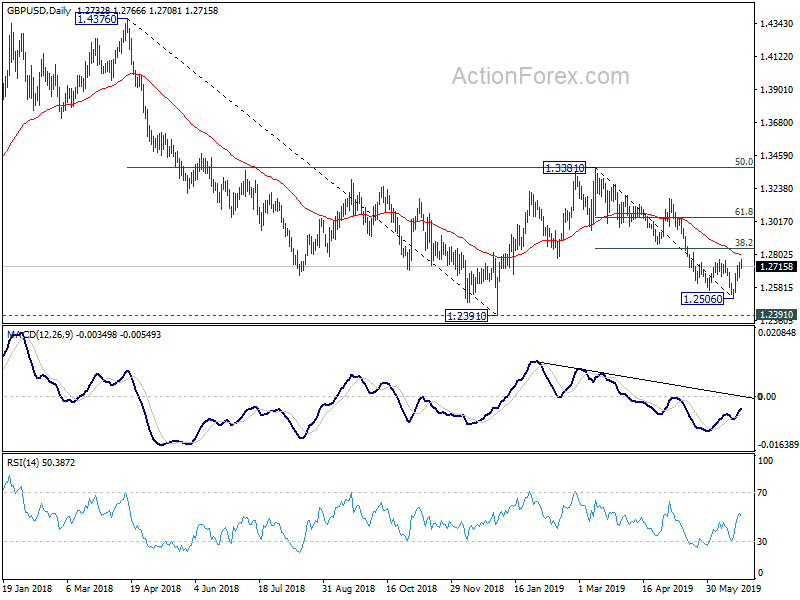
In the bigger picture, down trend from 1.4376 (2018 high) is still in progress. Break of 1.2391 would target a test on 1.1946 long term bottom (2016 low). For now, we don't expect a firm break there yet. Hence, focus will be on bottoming signal as it approaches 1.1946. In any case, medium term outlook will stay bearish as long as 1.3381 resistance holds, in case of strong rebound.
EUR/USD Mid-Day Outlook
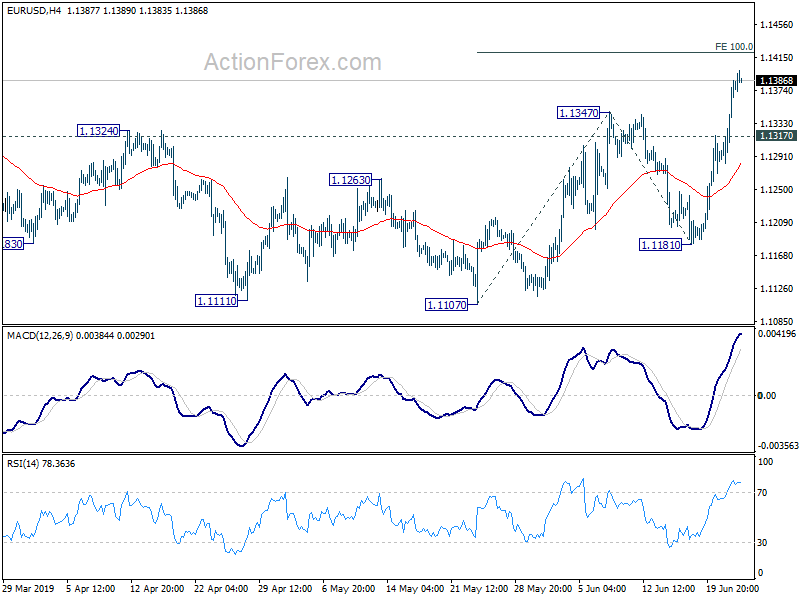
Daily Pivots: (S1) 1.1310; (P) 1.1344; (R1) 1.1405; More......
No change in EUR/USD's outlook. Intraday bias remains on the upside for the moment. Current rise from 1.1107 bottom is in progress for 100% projection of 1.1107 to 1.1347 from 1.1181 at 1.1142 first. Break will target 161.8% projection at 1.1569 next. On the downside, below 1.1317 minor support will turn intraday bias neutral and bring consolations. But outlook will stay bullish as long as 1.1181 support holds.
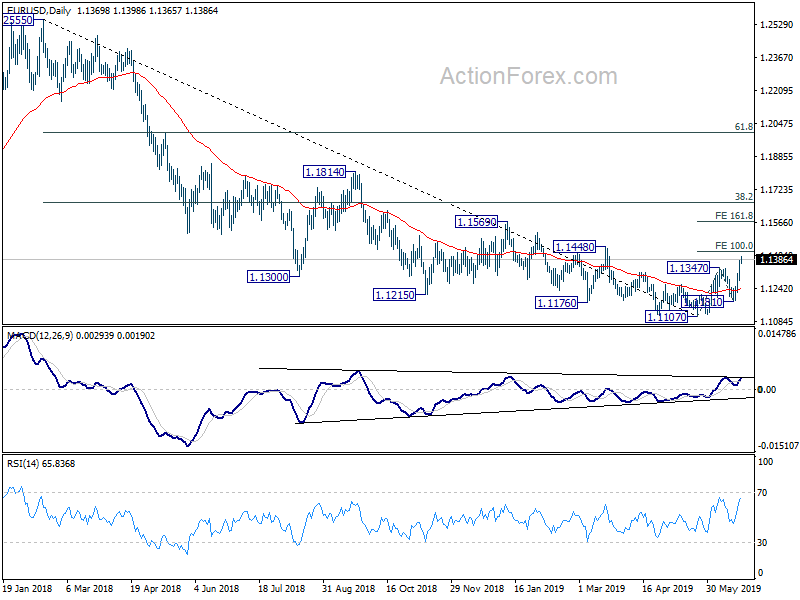
In the bigger picture, considering bullish convergence condition in daily and weekly MACD, a medium term bottom should be in place at 1.1107 after hitting 61.8% retracement of 1.0339 (2016 low) to 1.2555 (2018 high) at 1.1186. Further rise should be seen to 38.2% retracement of 1.2555 to 1.1107 at 1.1660. Reactions from there could indicate whether rebound from 1.1107 is a corrective rise or reversing medium term trend.
Dollar Ignores Trump’s Fed Attack, Euro Mixed after German IFO
Dollar stays generally soft in quiet markets but selling seems to have slowed in early US session. Trump criticizes Fed as sticking like a "stubborn child" on interest rates. Such comments are ignored by markets, sensibly, in general. The key to Fed's policy is whether Trump is able to make an agreement with China to resume trade negotiations this week. Or he'd fail again. Then there will be economic data to show how the economy are suffering from his own trade policies, starting from durables and PCE inflation this week, then ISMs and NFP next.
Staying in the currency markets, Sterling is currently the weakest one for today, followed by Yen and then Dollar. Australian Dollar leads commodity currencies higher. Euro is mixed after German Ifo business climate dropped to lowest since November 2014, without serious deterioration.
Other markets are generally steady, except that German DAX tumbles today together with 10-year bund yield. Mercedes-Benz maker Daimler leads the decline with 3% fall after it cuts 2019 earnings outlook on Sunday. 10-year bund yield hit as low as -0.314, not far from-0.326 record low.
In Europe, currently, FTSE is up 0.12%. DAX is down -0.45%. CAC is down -0.08%. German 10-year bund yield is down -0.0212 at -0.303. Earlier in Asia, Nikkei rose 0.13%. Hong Kong HSI rose 0.14%. China Shanghai SSE rose 0.21%. Singapore Strait Times dropped -0.30%. Japan 10-year JGB yield rose 0.0155 to -0.152.
Trump: Fed sticks like a stubborn child, doesn't know what it's doing
Trump complains Fed with his tweet again and said it "doesn't know what it is doing". He said Fed "raised rates far too far" and "did large scale tightening, $50 Billion/month", referring to balance sheet wind down. And, if Fed had gotten it right, "thousands of points higher on the Dow, and GDP in the 4's or even 5's". Trump also said Fed policymakers stick "like a stubborn child". And, "when we need rates cuts, & easing, to make up for what other countries are doing against us. Blew it!"
China urges US to compromise and make concessions in trade talks
At a news briefing regarding G20 summit, Chinese Vice Commerce Minister Wang Shouwen said talks are underway between China and US teams regarding trade negotiations. He gave no details on the highly anticipated meeting between Xi and Trump ahead. Though, he reiterated China's stance on mutual respect and urged US to make concessions for compromises.
Wang said, "mutual respect means each side must respect the other's sovereignty", apparently referring US demand for China to implement the trade agreement with domestic laws. Wang also said "equality and mutual benefit means the consultations have to happen on an equal basis, the agreement to be reached has to be beneficial for both sides... Meeting each other half way means both sides have to compromise and make concessions, not just one side."
Wang also noted Xi has asked Trump to treat Chinese companies fairly during last week's telephone conversation. He added "we hope that the U.S. can remove certain unilateral measures inappropriately taken against Chinese companies, in the spirit of free trade and the World Trade Organization."
German Ifo business claims dropped to 97.5, lowest since Nov 2014
Germany Ifo Business Climate dropped to 97.5 in June, slightly down from 97.9 and below expectation of 97.5. Though, that's still the lowest level since November 2014. Ifo Expectation index dropped to 94.2, down fro 95.3 and missed expectation of 04.6. Current Assessment index rose to 100.8, up from 100.6 and beat expectation of 100.3.
Ifo President Clemens Fuest noted: "Companies have grown increasingly pessimistic about the coming months. However, their assessment of the current business situation improved marginally. The German economy is heading for the doldrums."
Looking at the details, Manufacturing index dropped again from 3.9 to 1.5. It's been falling for over a year. Services index dropped from 21.0 to 20.0. Construction index dropped from 24.3 to 22.9. But Trade index improved from 5.4 to 7.9.
RBA Lowe: It legitimate to ask how effective further monetary easing would be
Australian Dollar is said to be lifted by RBA Governor Philip Lowe's question on effectiveness of further rate cuts. Lowe said in a panel discussion in Canberra today that "it's a legitimate question to ask how effective further monetary easing would be".
Lowe explained that exchange rate is an "important channel" through which easing stimulates growth. And other transmission mechanisms "are weaker at the moment." However, he added "we trade with one another, we don't trade with Mars, so if everyone's easing, the effect that we get from exchange-rate depreciation via the transmission mechanism isn't there."
Meanwhile, it's possible to ease more than other major central banks. But Lowe warned this was "quite a dangerous path to go down." Instead, he urged the country to switch focus to fiscal policy and structural reforms. Also, "governments here and around the world should have their top drawers full with ideas."
Lowe also said he didn't understand why investors were pushing stocks higher while expecting central banks to cut interest rates. He said "there are investors who think the outlook is sufficiently weak that they expect central banks right around the world to cut interest rates but they are not worried about corporate profits or credit risk."
Currently, markets are expecting RBA to cut interest rates by -50bps from 1.25% by year end. The next move could come as early as in August. To us, we also don't understand why Lowe's comments could shoot up the Aussie. He didn't indicate less need to loosen up monetary policies. Rather, he's simply suggesting that cutting interests are not enough to lift inflation back to target.
EUR/USD Mid-Day Outlook
Daily Pivots: (S1) 1.1310; (P) 1.1344; (R1) 1.1405; More......
No change in EUR/USD's outlook. Intraday bias remains on the upside for the moment. Current rise from 1.1107 bottom is in progress for 100% projection of 1.1107 to 1.1347 from 1.1181 at 1.1142 first. Break will target 161.8% projection at 1.1569 next. On the downside, below 1.1317 minor support will turn intraday bias neutral and bring consolations. But outlook will stay bullish as long as 1.1181 support holds.
In the bigger picture, considering bullish convergence condition in daily and weekly MACD, a medium term bottom should be in place at 1.1107 after hitting 61.8% retracement of 1.0339 (2016 low) to 1.2555 (2018 high) at 1.1186. Further rise should be seen to 38.2% retracement of 1.2555 to 1.1107 at 1.1660. Reactions from there could indicate whether rebound from 1.1107 is a corrective rise or reversing medium term trend.
Economic Indicators Update
| GMT | Ccy | Events | Actual | Forecast | Previous | Revised |
|---|---|---|---|---|---|---|
| 08:00 | EUR | German IFO Business Climate Jun | 97.4 | 97.5 | 97.9 | |
| 08:00 | EUR | German IFO Expectations Jun | 94.2 | 94.6 | 95.3 | |
| 08:00 | EUR | German IFO Current Assessment Jun | 100.8 | 100.3 | 100.6 |
Trump: Fed sticks like a stubborn child, doesn’t know what it’s doing
Trump complains Fed with his tweet again and said it "doesn't know what it is doing". He said Fed "raised rates far too far" and "did large scale tightening, $50 Billion/month", referring to balance sheet wind down. And, if Fed had gotten it right, "thousands of points higher on the Dow, and GDP in the 4's or even 5's".
Trump also said Fed policymakers stick "like a stubborn child". And, "when we need rates cuts, & easing, to make up for what other countries are doing against us. Blew it!"
https://twitter.com/realDonaldTrump/status/1143140106557186048
HKD’s HIBOR Soars, But With Limited Upside
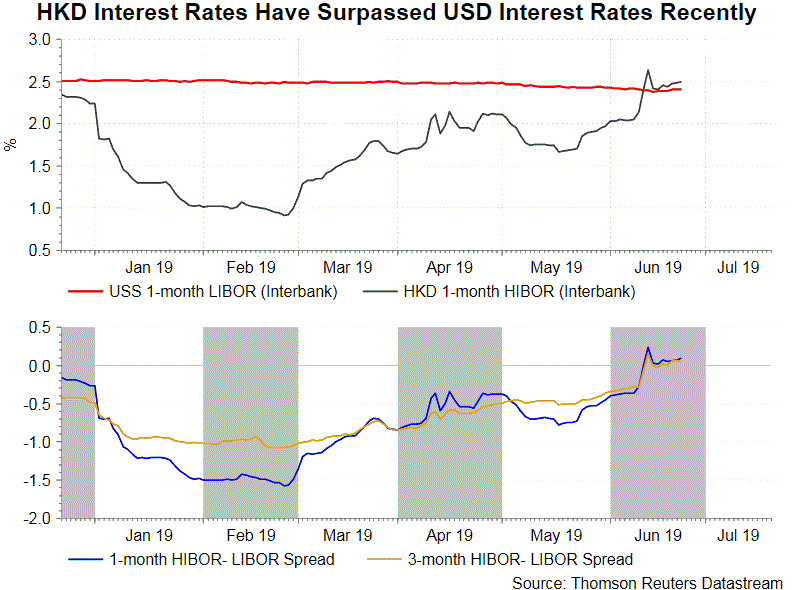
Recent spike in HIBOR has sent HIBOR-LIBOR spread to the positive territory, a situation not seen in a decade for both 1-month and 3-month spreads. In our opinion, the upside for HIBOR is limited although it could stay elevated in the near-term due to seasonal factors.
On June 13, both 1-month and 3-month HIBOR (HKD) jumped to the levels not seen since October 2018 sending the rates above the corresponding LIBOR (USD). Despite slight moderation over the past week, both 1-month and 3-month HIBOR have remained elevated. The sudden rally in HIBOR has been coincidental to the deadlock of US-China trade war and escalated political uncertainty in Hong Kong. However, as of now, we view this as mainly a catch-up with LIBOR under the linked exchange rate of HKD.
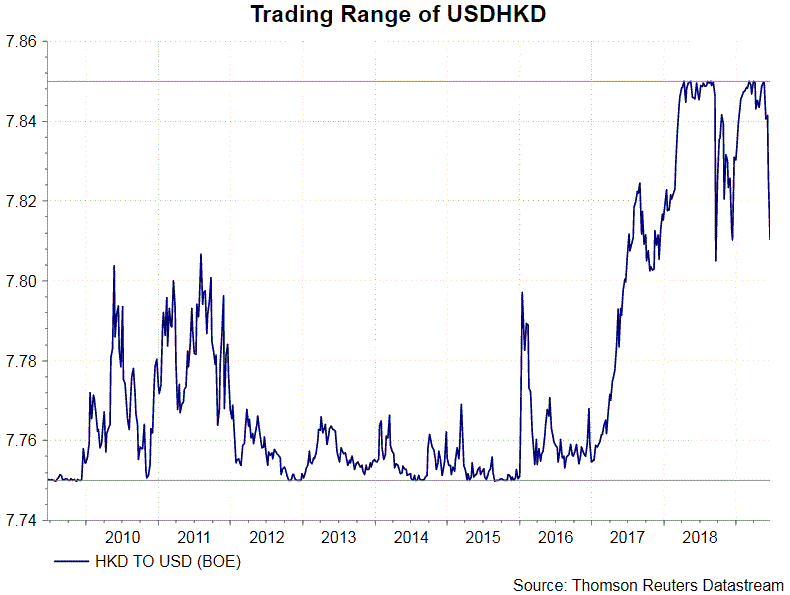
HKD has been pegged to USD for about three decades at a range of 7.75-7.85. HKMA, the de facto central bank of Hong Kong, allows the exchange rate to float within the range. It would intervene if the exchange rate breaks above (below) the boundary by selling (buying) USD in the market. HIBOR has been trading narrowly below LIBOR for most of the time in history. As HKD approaches the weak side of the trading range, investors would expect HKD to appreciate in the future. Therefore, they are willing to hold HKD although its interest rates are slightly less than those of holding USD.
HKD Less Attractive in Carry Trade
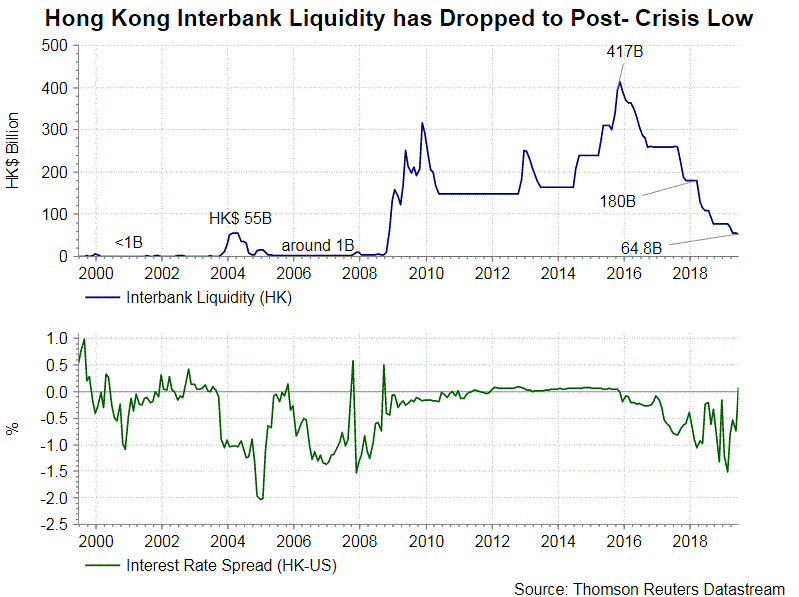
However, the HIBOR- LIBOR spread had widened markedly since 2017 before reaching the most serious level in 1Q19. This derailment from the norm was a result of the massive capital inflow, mainly from China, to Hong Kong in years after the 2007/08 global financial crisis. The abundant interbank liquidity (aggregate balance) diminished the need for commercial banks to raise interest rates, thereby suppressing HIBOR relative to LIBOR.
Widening HIBOR- LIBOR spread in 2018 made HKD an attractive funding currency in carry trade. The resulting capital outflow and selloff in HKD had triggered a number of HKMA interventions for maintaining the peg. As HIBOR increases and HIBOR- LIBOR spread narrows, HKD as a funding currency would become less attractive. This should help reduce the risk of capital outflow.
 Outlook of HIBOR
We believe the upside for HIBOR is limited, although it could continue hovering around the current level in the near-term. The room for further increase in HIBOR is limited as the Fed would likely cut the policy later this year. This could lower LIBOR and hence HIBOR. Despite the fact that HIBOR generally follows LIBOR closely, lower aggregate balance in Hong Kong’s banking system would make HIBOR’s movement more sensitive and volatile to the change in liquidity. Moreover, HIBOR would be affected by seasonal factors. For instance, half- year end (June) cash need could tighten liquidity, squeezing HIBOR higher.
The USD Remains Under Pressure
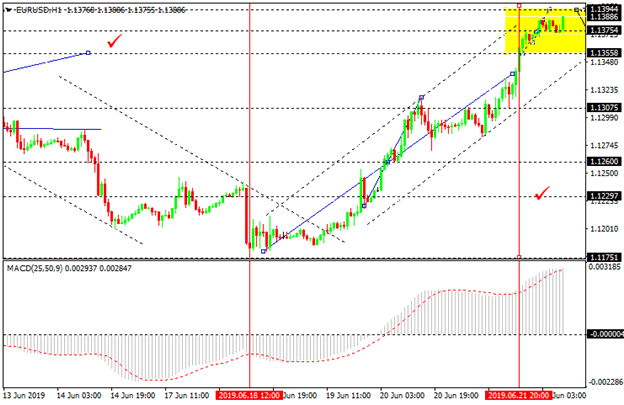
EURUSD continues rising. On Monday June 24th, the instrument is mostly trading close to 1.1376. Market players aren’t as active as usual, but it may change in a moment.
The USD still remains under significant pressure after the US Federal Reserve gave very clear signals last week that it was ready to cut the rate in case the country’s economy slowed down. On one hand, it means that the USA are ready to continue its trade wars against China and others and for this purpose they require quite soft monetary policy in the country to avoid any slowdowns in its economy and inflation. On the other hand, the USA don’t need their currency to be strong right now, so they may kill two birds with one stone.
Other members of the FOMC are also saying that it’s the high time to cut the rate, by 50 basis points. Of course, it sounds too negative for the USD.
This week, the macroeconomic calendar is quite empty. As always, all interesting reports at the end of the month are centered on Friday.
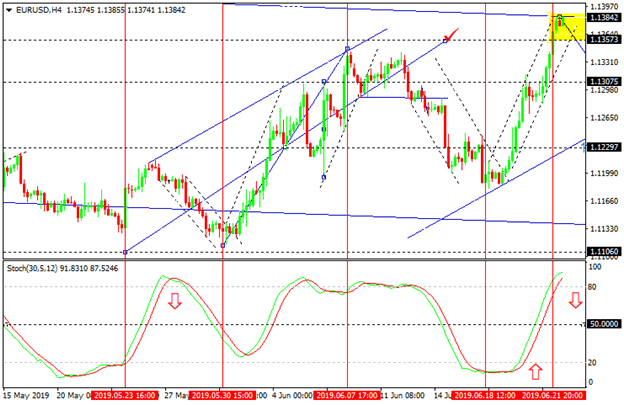
As we can see in the H4 chart, after completing the five-wave rising structure, EURUSD is consolidating at its top. Possibly, the pair may form a reversal patterns close to the highs. After breaking 1.1355, the price may start a new descending wave (as a correction) to reach 1.1222. From the technical point of view, this scenario is confirmed by Stochastic Oscillator, as its signal line is trading inside the “overbought area”. To confirm the above-mentioned wave, the indicator must leave the area.
In the H1 chart, EURUSD is consolidating around 1.1375. Possible, the pair may extend the ascending structure towards 1.1394. After reaching this level, the price may start a new decline towards 1.1355 and, as a result, break the ascending channel and start a new wave to the downside with the first target at 1.1305. From the technical point of view, this scenario is confirmed by MACD Oscillator, as its signal line is ready to move downwards and reach 0. After breaking is, the instrument may quicken its decline towards 1.1222.
Into US session: German DAX and yield down on Daimler, Euro mixed
German DAX tumbles today together with 10-year bund yield, in otherwise quiet markets. Mercedes-Benz maker Daimler leads the decline with 3% fall after it cuts 2019 earnings outlook on Sunday. 10-year bund yield hit as low as -0.314, not far from-0.326 record low. Investors elsewhere are on the sidelines though, waiting for Trump-Xi meeting at G20 later in the week. Gold is in consolidation below last week's high of 1411.82. WTI oil edged higher to 58.14 but it's losing some upside momentum. US is preparing for more sanctions against Iran but the impact is definitely much lower than a war.
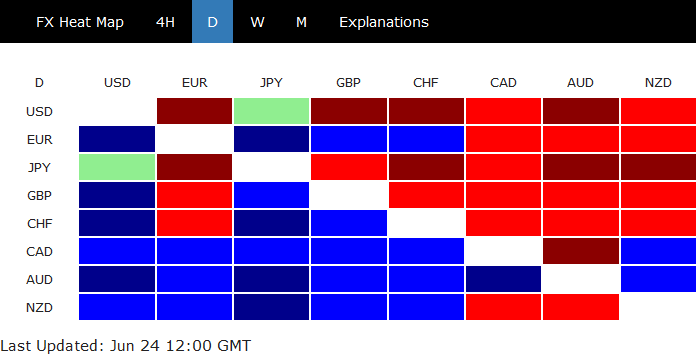
In the forex markets, Dollar remains the weakest one for today, followed by Yen and then Sterling. There is no buying in Dollar for sustainable rebound yet. Fed Chair Jerome Powell's speech on Tuesday might give some clues on how close Fed is to rate cut. But probably he's doesn't have a clue himself considering the uncertainty in trade negotiations. Also, Dollar will look into some key economic data, starting from durables and PCE inflation this week, then ISMs and NFP next. On the other hand, Australian Dollar is currently the strongest, followed by Canadian and then New Zealand. Euro is mixed after German Ifo business climate dropped to lowest since November 2014, without serious deterioration.
In Europe, currently:
- FTSE is down -0.06%.
- DAX is down -0.53%.
- CAC is down -0.13%.
- German 10-year bund yield is down -0.0276 at -0.31.
Earlier in Asia:
- Nikkei rose 0.13%.
- Hong Kong HSI rose 0.14%.
- China Shanghai SSE rose 0.21%.
- Singapore Strait Times dropped -0.30%.
- Japan 10-year JGB yield rose 0.0155 to -0.152.