

Sample Category Title
CHF On The Rise, RBNZ Rate Cut Plan
CHF rises as speculators cover short position
USD/CHF has completely collapsed last week as it fell as much as 2.60%, sliding from 1.0015 to 0.9755, following the Jerome Powell’s dovish performance during the last FOMC press conference. The fall in US interest rates has suppressed one of the last strong incentive for investors to hold the greenback, making it less expensive to short. Overall, safe havens assets have increased more than average against the buck, with the Swissie, yen and gold leading the pack. Excluding last January flash crash in the yen, USD/JPY fell to the lowest level since April 2018, while the yellow metal broke the $1,400 threshold to the upside - rising a 6-year high - which suggests that investors feel increasingly uneasy with the current economic situation and equity valuations.
Looking at speculators’ positioning, one notice that net short CHF positions continued to decrease last week, falling from 34% of total open interest to 26%. Similarly, net short JPY positions decreased to 13% from 26% a week ago.
The situation will remain tense until at least the G20 meeting that takes place on June 28-29. Investors hope that Trump and Xi will find an agreement that could put an end to the ongoing trade war between the two world’s largest economies. However, we believe that even in that case markets won’t return to normal as President Trump would bring its trade war to Europe. Be ready for a shaky summer.
RBNZ set for a second rate cut this year
The global risk-on sentiment from last week has given the kiwi a strong boost following a drag amid geopolitical developments in the Gulf of Oman and the announcement made by China to raise anti-dumping duties on seamless alloy steel tubes. Yet although the New Zealand Central Bank is not expected to move its cash rate on Wednesday, it is most likely going to confirm its dovish bias and hinting towards a 0.25% rate cut in August 2019 as inflation pressures have slowed in first quarter 2019.
The RBNZ already cut its cash rate to record low 1.50% in May while RBNZ Governor Adrian Orr is expected to confirm that further easing is likely as inflation remains below midpoint target range of 2% (1Q CPI y/y: 1.50%) and despite an uptick in 1Q GDP figures of 2.50% (prior: 2.30%) released last week. The RBNZ does not respond to domestic market deterioration since labor market is tight while wage growth showed a pick up – it rather responds to rising global uncertainties and follows the dovish trend shift of major central banks. There is however good reasons to consider a decline in NZD following the announcement on Wednesday.
Currently trading at 0.6611, NZD/USD is heading along 0.6630 as investors are waiting for developments in US – China trade discords ahead of G20 meeting in Osaka.
German Ifo business claims dropped to 97.5, lowest since Nov 2014
Germany Ifo Business Climate dropped to 97.5 in June, slightly down from 97.9 and below expectation of 97.5. Though, that's still the lowest level since November 2014. Ifo Expectation index dropped to 94.2, down fro 95.3 and missed expectation of 04.6. Current Assessment index rose to 100.8, up from 100.6 and beat expectation of 100.3.
Ifo President Clemens Fuest noted: "Companies have grown increasingly pessimistic about the coming months. However, their assessment of the current business situation improved marginally. The German economy is heading for the doldrums."
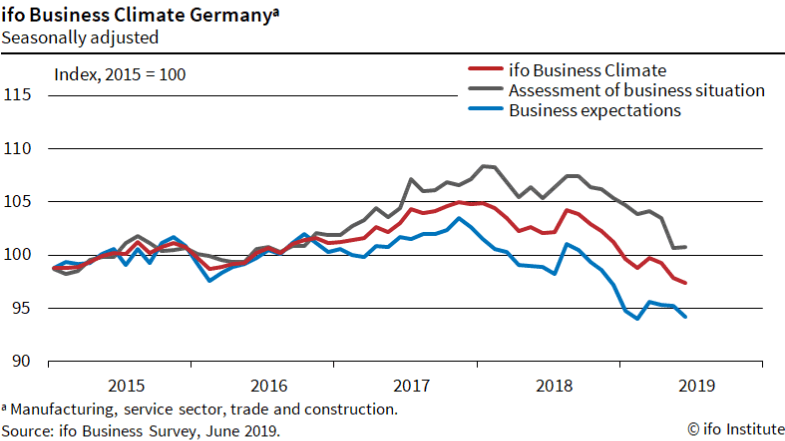
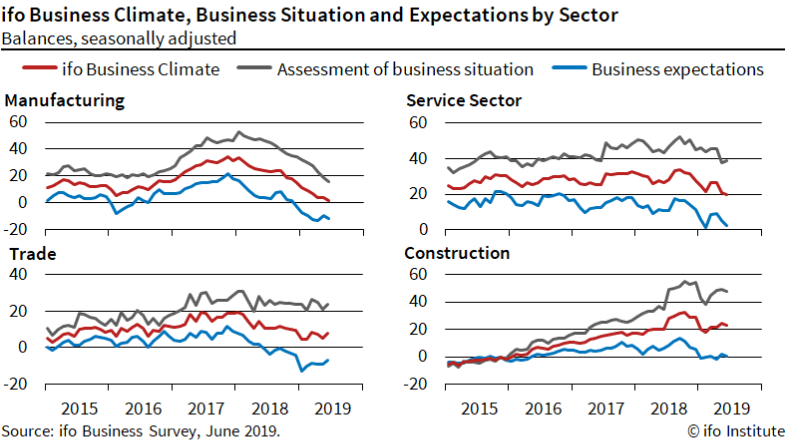
Looking at the details, Manufacturing index dropped again from 3.9 to 1.5. It's been falling for over a year. Services index dropped from 21.0 to 20.0. Construction index dropped from 24.3 to 22.9. But Trade index improved from 5.4 to 7.9.
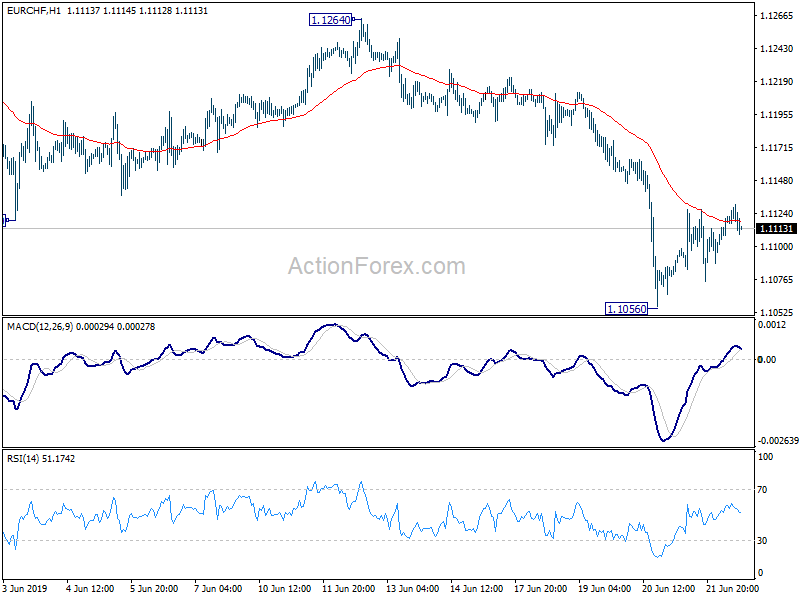
Euro remains firm against Dollar and Yen after the release. But EUR/CHF is mildly lower. For now EUR/CHF's consolidation from 1.1056 is still in progress and could extend for a while. But a break of 1.1056 is expected eventually to resume larger down trend.
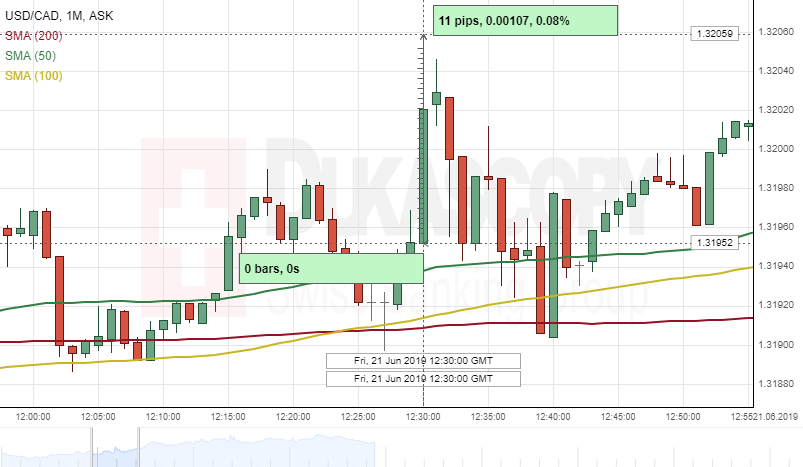
USD/CAD: Canadian Retail Sales
The US Dollar appreciated against the Canadian Dollar, following the Canadian Retail Sales data release on Friday at 12:30 GMT. The USD/CAD exchange currency rate gained 11 pips or 0.08% right after the release. The Greenback continued trading at the 1.3196 level against the Canadian Dollar.
Statistics Canada released the Canadian Core Retail Sales data, which came out worse-than-expected of 0.1% compared with forecast of 0.6%.
According to official release: "Retail sales rose for the third consecutive month, edging up 0.1% to $51.5 billion in April. Excluding sales at motor vehicle and parts dealers and gasoline stations, retail sales were down 0.1%. Sales were up in 7 of 11 subsectors, representing 74% of retail trade. Higher sales at gasoline stations and food and beverage stores were the main contributors to the gain. After removing the effects of price changes, retail sales in volume terms decreased 0.2%."
EUR/USD: French Flash Services And Manufacturing PMIs
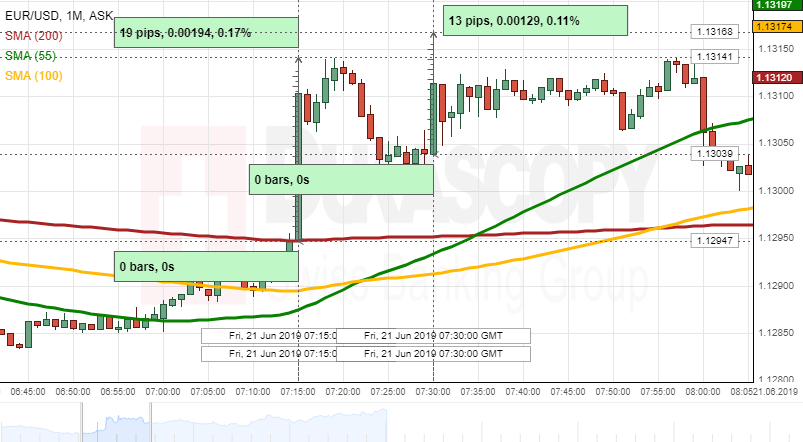
The European Common Currency appreciated against the US Dollar, following the French Flash Services and Manufacturing PMIs data release on Friday at 07:15 GMT. The EUR/USD exchange currency rate gained 19 pips or 0.17% right after the release. The Euro continued trading at the 1.1315 level against the Greenback.
Markit released the French Flash Services PMI data, which came out better-than expected of 53.1 compared with forecasted 51.6. The French Flash Manufacturing PMI data also came out better-than expected of 52.0 compared with forecast of 51.0.
Surprisingly, the Euro appreciated only 13 pips or 0.11% against the US Dollar, following the German Flash Manufacturing and Services PMIs data release on Friday at 07:30 GMT. The given data also beat expectations.
EUR/USD Analysis: Reveals Up-Trend Pattern
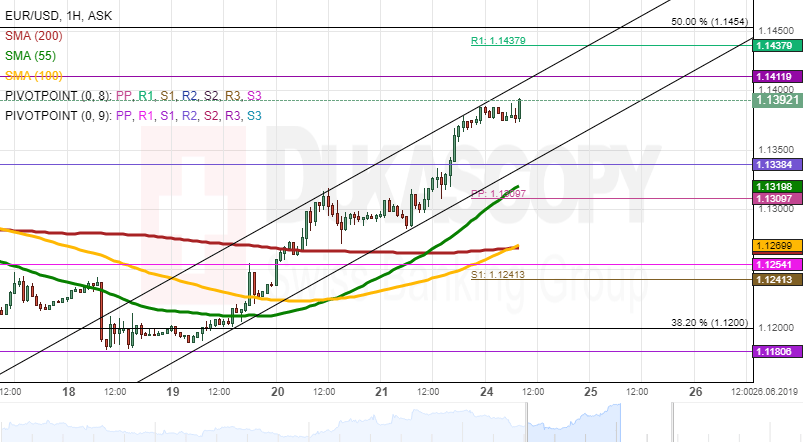
The EUR/USD continued to surge on Monday. The surge was caused by the US Federal Reserve signaling upcoming monetary easing while the ECB's policy remained less stimulating during the last week's central bank events.
Meanwhile, note that an ascending pattern can be drawn by using the low and high levels of the recent surge. It reveals that up to now the EUR/USD climb has been occurring with a certain volatility in the borders of the observable pattern.
In general, the rate is expected to reach next for the monthly pivot point at 1.1412. Afterwards, it is expected that the rate will trade sideways below this resistance until the hourly simple moving averages approach the rate from below and push the pair higher.
On the other hand, the rate could trade sideways or decline throughout Monday, as it has not support as low as 1.1350, where the lower trend line of the pattern was located at on Monday.
GBP/JPY Daily Outlook
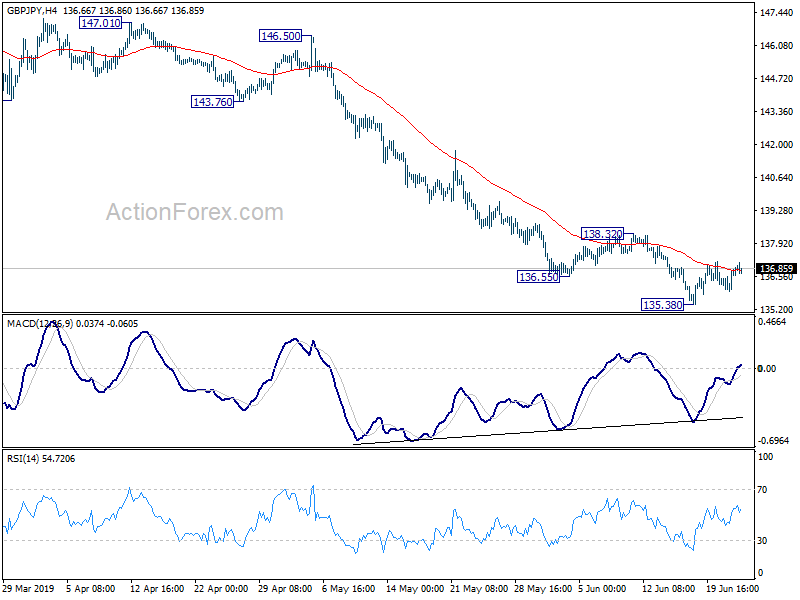
Daily Pivots: (S1) 136.20; (P) 136.53; (R1) 137.11; More...
Intraday bias in GBP/JPY remains neutral for the moment as consolidation from 135.38 is extending. Upside of recovery should be limited by 138.32 resistance to bring fall resumption. On the downside, break of 135.38 will extend recent fall from 148.87 to retest 131.51 low. Though, firm break of 135.38 will confirm short term bottoming and bring stronger rebound to 55 day EMA (now at 140.11).
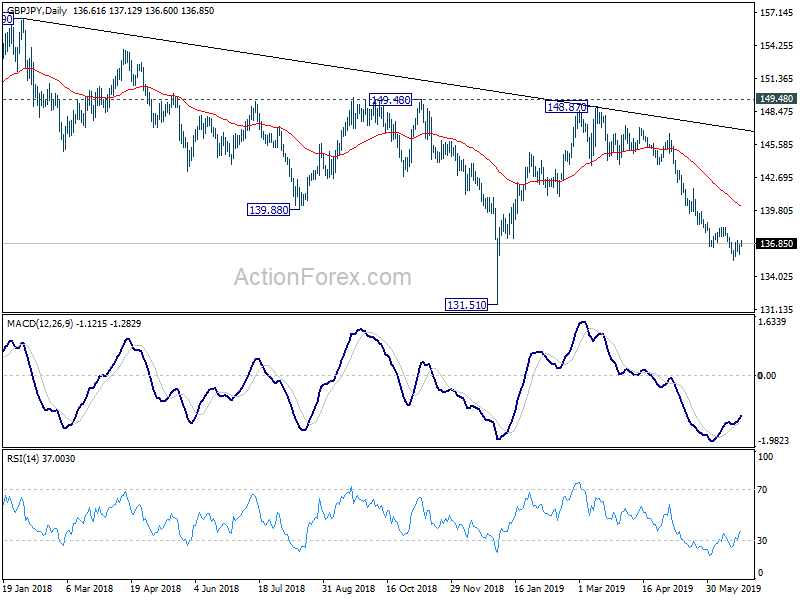
In the bigger picture, current development suggests that GBP/JPY's medium term fall from 156.59 (2018 high) is still in progress. Break of 131.51 will target 122.36 (2016 low). Structure of such decline is corrective looking so far, arguing that it's just the second leg of consolidation from 122.36. Thus, we'd expect strong support from 122.36 to contain downside to bring reversal.
EUR/JPY Daily Outlook
Daily Pivots: (S1) 121.26; (P) 121.69; (R1) 122.45; More....
Intraday bias in EUR/JPY is mildly on the upside for the moment. Consolidation from 120.78 is in progress with rise from 120.95 as the third leg. Upside should be limited below 123.73 resistance to bring fall resumption eventually. On the downside, firm break of 120.78 will resume the decline from 127.50 and target 118.62 low next.
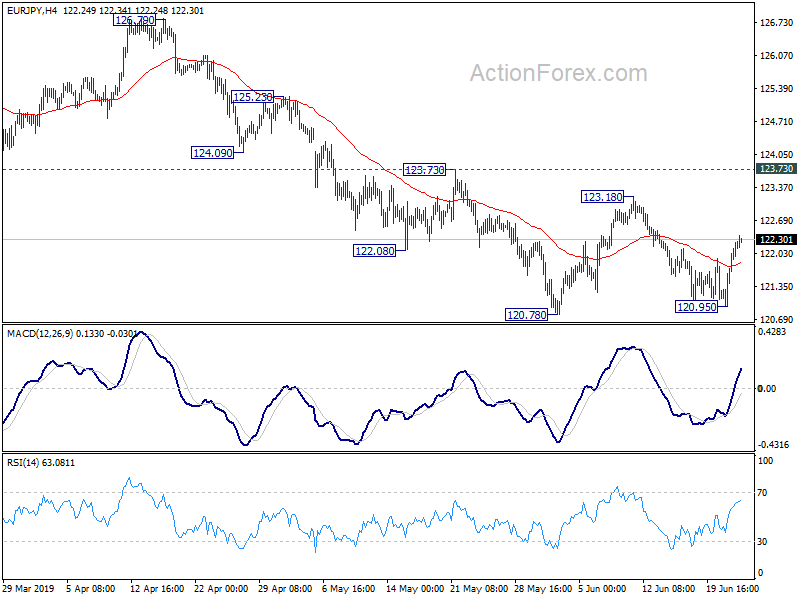
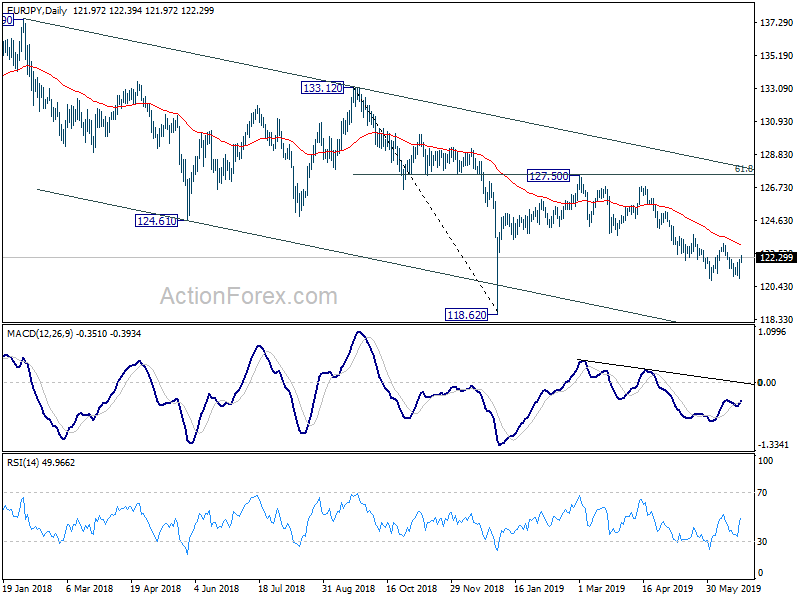
In the bigger picture, down trend from 137.49 is still in progress with the cross staying inside long term falling channel. Break of 118.62 will extend the fall to 109.48 (2016 low). On the upside, break of 127.50 resistance is needed to be the first sign of medium term reversal. Otherwise, outlook will remain bearish in case of strong rebound.
USD/JPY Analysis: Is Pushed Down By SMA
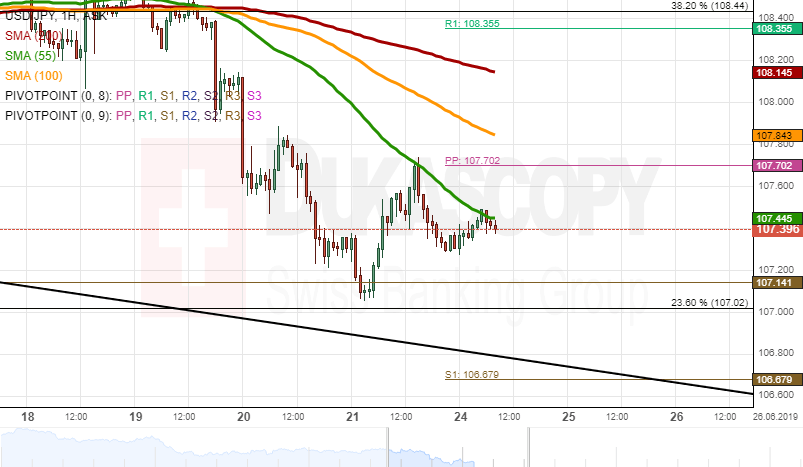
The USD/JPY recovery has been stopped by the 55-hour simple moving average at the 107.70 level. On Monday, the pair and the technical resistance level were both located near the 107.40 level.
In general, it was expected that the pair will be pushed by the simple moving average down into the support of the monthly pivot point at 107.14 level.
Meanwhile, if the 55-hour SMA fails to push the pair down and the pair breaks above it, it will face no technical resistance levels as high as the 107.70 level, where this weeks middle pivot point was located at.
GBP/USD Analysis: Reaches Above 1.2750
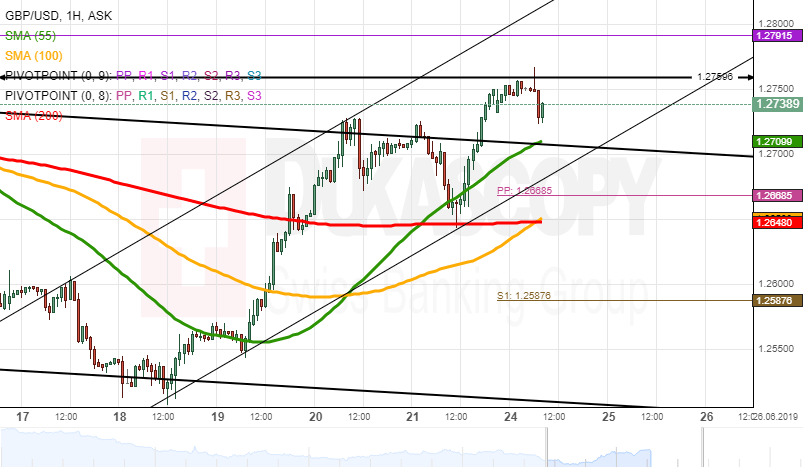
The GBP/USD has surged and reached above the 1.2750 level. The ascent of the currency exchange rate was caused by the combined support of the 1.2650 level and 200-hour simple moving average. Moreover, during the surge the rate pierced the resistance line of a dominant pattern just above 1.2700.
The pair is expected to wait for the support of the 55-hour simple moving average, which was located at the 1.2710 level during the London session's morning hours and moving upwards. It could provide the needed support to push the pair through the resistance of the 1.2750 level and the historical high level at 1.2770.
However, note that the support of the 55-hour SMA could not provide enough technical support. In that case the rate could decline down to look for the support in the 1.2700 level.
Gold Analysis: Tests 1,410.00 Level
On Monday morning, gold was again testing the resistance of the 1,410.00 level.
The metal's price was expected to pass this level, as soon as the 55-hour simple moving average approaches and pushes it higher.
On the other hand, note that the metal is massively overbought due to fundamental causes. It might retrace back down, if the fundamental environment becomes more favorable to risks.
