Sample Category Title
GBP/USD Could Reverse South
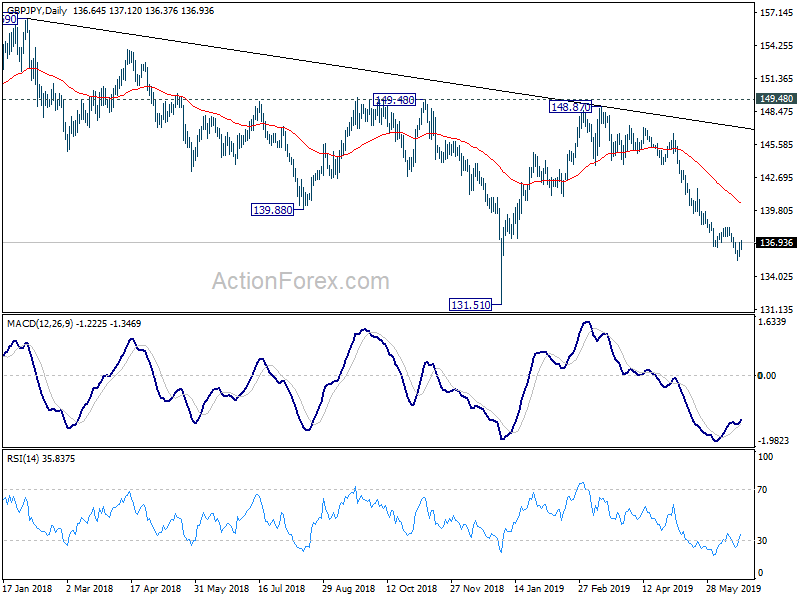
On Wednesday, the GBP/USD exchange rate skyrocketed to the upper boundary of the medium-term descending channel at 1.2720. During Thursday's morning, the rate was testing the given boundary.
From a theoretical point of view, it is expected, that a reversal south should occur within the following trading hours. A possible downside target is the support level formed by the 200-hour SMA and the weekly PP at 1.2644.
However, if the given channel does not hold, a breakout north could occur in the nearest future, and the currency pair could target the resistance level located at 1.2760.
USD/JPY Might Trade Sideways
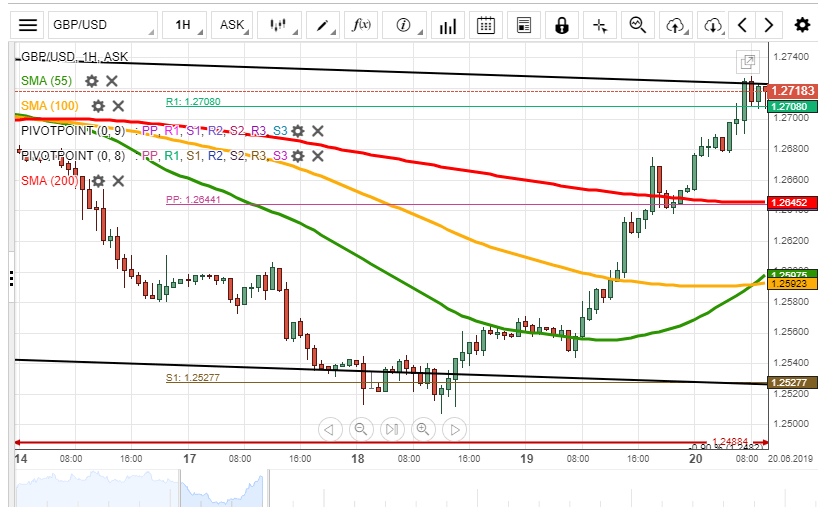
During Wednesday, the USD/JPY currency pair dropped to the support level formed by the weekly S3 at the 107.58 mark. During today's morning, the pair reversed north.
Note, that the exchange rate has to surpass the resistance level—the weekly S2 at 107.87 to maintain its decline. If the given resistance holds, it is expected, that the rate could trade sideways in the short run.
If the given resistance does not hold, it is likely, that the pair could surpass the psychological level at the 108.00 mark within the following trading hours.
XAU/USD: Two Scenarios Likely
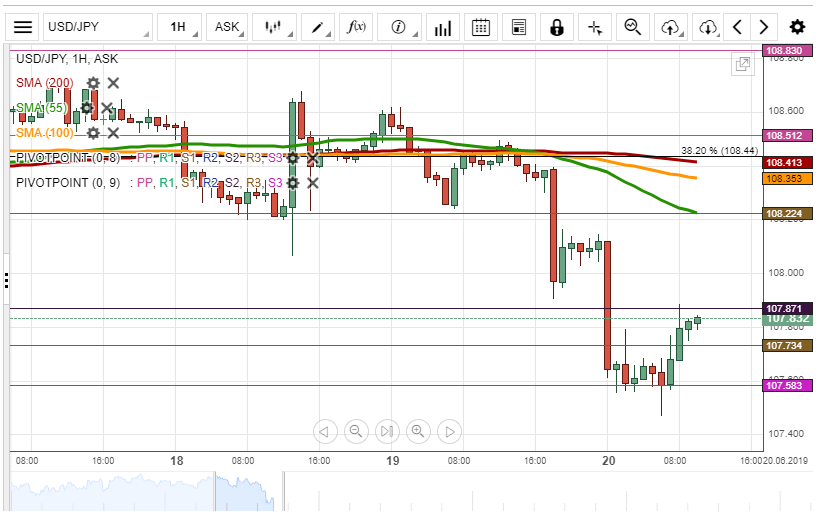
Yesterday, the XAU/USD exchange rate skyrocketed to the psychological level at 1,380.00. During today's morning, the rate was trying to surpass the 1,385.00 level.
From the one hand, gold could continue to appreciate against the US Dollar, as it is supported by the 55-, 100– and 200-hour moving averages, currently located in the 1,340.34/1,352.50 range. The price for gold could target the upper boundary of the long-term ascending channel located circa 1,404.00.
From the other hand, the exchange rate could reverse south, as technical indicators show that gold is in the overbought zone. It is unlikely, that the price for gold could drop lower than 1,360.33/1,366.90 due to the support of the monthly R3 and the Fibo 0.00%.
Powell Has The Markets’ Back
It would appear investors had nothing to be nervous about ahead of the Fed meeting on Wednesday, as the central bank stepped up and delivered the dovish message they so craved.
Decent gains across US markets on Wednesday are filtering around the globe as the continuing trend of dovish central banks distracts investors from the reality of an economic slowdown, trade war between the world's two largest economies and Brexit. Now that investors feel that the Fed has their back, it's over to Trump and Xi to deliver the news they truly desire.
All differences won't be resolved during their prolonged meeting next week but if tariffs can be avoided and a deal put back on the table in the coming weeks or months, investors will be very relieved which could be supportive for equity markets heading into the summer period. The old saying "sell in May and go away" was looking good a few weeks ago but a strong rebound in June and prospect of progress next week could rubbish that idea for another year.
BoE overshadowed by leadership race
It's not often that a central bank announcement is overshadowed by other domestic events but today is very much one of those occasions. The Conservative leadership - and therefore Prime Minister - race has understandably stolen the spotlight in the UK this week, with the number of contenders now falling to four and that will halve again today following one final vote by MPs. The next PM will then be selected from the final two by the Tory membership over the next month, at which point attention will quickly shift back to Brexit meaning the BoE may have to get used to playing second fiddle.
The meeting today is likely to be a non-event, with the central bank currently not expected to move interest rates at all over the next year and no press conference to follow. A statement is expected to accompany the decision but we can't expect much from that. What will be of far more interest to traders today is who will join Johnson in the final two. With Raab gone, there's little difference between the other three remaining contenders but Hunt may be preferable being a reformed remainer that is strongly opposed to no deal. That said, Johnson will probably win the run-off anyway so it probably doesn't actually make much of a difference.
Oil bounces on inventory data
We saw a nice bounce in oil prices on Wednesday, as EIA reported a 3.1 million barrel drawdown in inventories, a number that exceeded expectations but also broke a recent trend of builds. This may just be a one off dip, with record US production and global growth concerns weighing on demand but traders jumped on the news following a prolonged period of weakness that saw prices drop around 20% from late April to early June.
The rally has been extended today, aided by strong risk appetite across the markets, which has lifted WTI above the 10 June peak and potentially setting it up for further near-term gains. The next notable resistance for WTI may come around $58-59, a level it has currently run into issues previously.
Gold accelerates through 1380 key resistance, targeting 1450/80 next
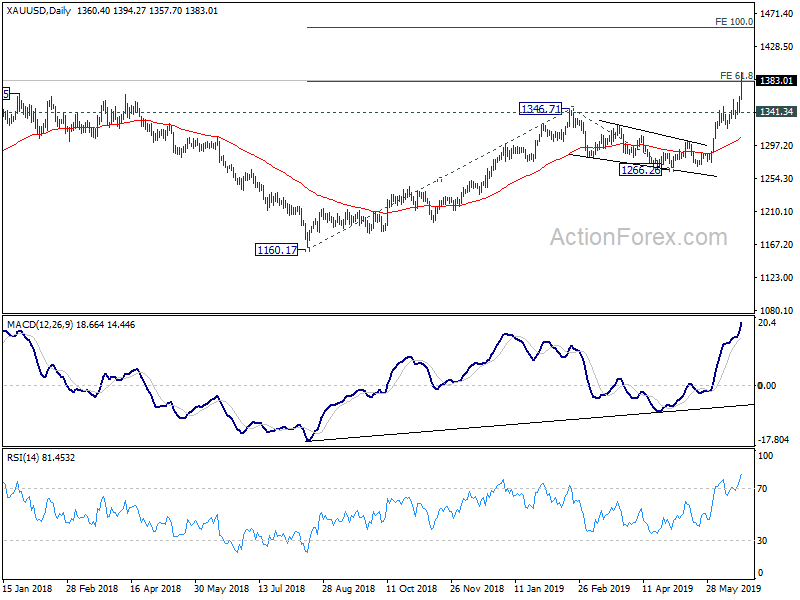
Gold's rally accelerates to as high as 1394.27 today, riding on broad based weakness in Dollar. From near term point of view, 61.8% projection of 1160.17 to 1346.71 from 1266.26 at 1381.54 is already taken out. Next target will be 100% projection at 1452.80. For now, near term outlook will remain bullish as long as 1341.34 support holds, in case of retreat.
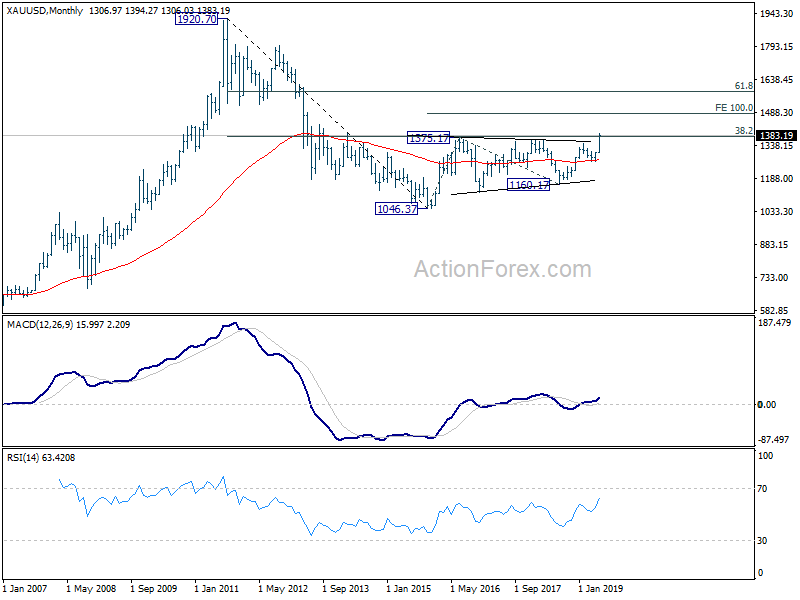
From a long term point of view, 38.2% retracement of 1920.70 (2011 high) to 1046.37 (2015 low) at 1380.36 finally broken. Sustained trading above this level will pave the way to 100% projection of 1046.37 to 1375.17 from 1160.17 at 1488.97, which is reasonably close to above mentioned 1452.80 projection level. This resistance zone will be key to decide whether the rise from 1046.37 is an up trend or just a corrective move. We'll pay attention to the reaction from there to judge at a later stage.
FOMC And BoJ Meetings
Gold Surges as Fed goes full dovish
Yesterday FOMC was unspectacular, as interest’s rate was kept unchanged, the key takeaway was clear. By removing the “patient” from the official stated, the Federal Reserve has to shift into a dovish bias. Their economic assessment was upbeat but the changes in policy direction were justified by a weak inflation outlook. The market is now pricing in the likelihood of three rate cuts in 2019. The move is coming as the market is pricing in a probability of 100% cut in July (from 80% chance prior), and two additional cuts up to 70% form 45% before the meeting. Risk appetite responds as expected as U.S. stocks rose marginally (banks stocks surpassingly lagged) and USD fell against all G10 currencies. With expectations of the US central bank further debasing the USD, gold prices surged, climbing from $1357 to $1394 high in a single session. Golds inverse correlation to US real yields is strong. As the Fed pushes the front-end yields lower (US 2-yrs yields fell sharply from 1.87% to 1.73%), Gold shine should further improve. With President Trump tweeting for a weaker USD, and Powell seemly capitating Gold might be poised to regain its title as the anti-USD (momentarily stolen by upstart bitcoin). That said, the king of crypto is head back towards $9477 range high.
BoJ cannot relieve JPY
Investors took a closer look at the US central bank's statement, confirming that rate cuts are possible solutions in order to sustain expansion. Meanwhile, the Bank of Japan monetary policy meeting did not bring anything new to the table, although Fed and ECB are shifting policy towards a dovish bias. Therefore, we should see JPY gaining traction as market uncertainties, BoJ limited room of maneuver remain key arguments.
Similarly to prior meeting in 25 April 2019, BoJ members have been voting 7 – 2 to maintain ultra-loose monetary policy, with short- and long-term interest rates -0.10% and around 0% respectively while maintaining the pledge to increase government bonds holdings by JPY 80 trillion ($742 billion) per year. The BoJ's economic assessment is unchanged, indicating that the economy is growing at a moderate pace and unlike the Cabinet Office cut from “weakening” to “worsening” two weeks ago. As the trade war is reducing Chinese demand of Japanese goods, and easing from both the ECB and the Fed would have a negative impact on the Yen and ultimately on economic growth and inflation, some analysts are expecting the BoJ to cut interest rates, even if such a reaction would have a limited impact in our view. Japanese banking sector already faces heavy margin pressures, while a further decrease in interest rates could harm the financial health of the sector. On the other hand, a stronger JPY would also become a major impediment for the Japanese exporting industry looking forward.
USD/JPY currently trades at 107.78, approaching major support at 107.68 (03/01/2019).
EUR/USD Outlook: Strong Bullish Signal On Break Above Major Resistances
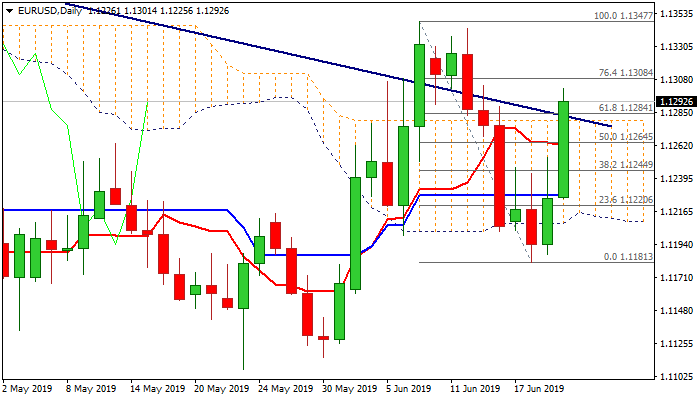
The Euro cracked psychological 1.1300 barrier in extension of strong post-Fed rally on Thursday, which broke through key barriers at 1.1279/84 (daily cloud top / broken bear-trendline / Fibo 61.8% of 1.1347/1.1181 fall).
Euro's sentiment improved strongly after Fed confirmed its dovish stance and readiness to cut interest rates.
The single currency advanced 0.9% on Wednesday and Asian / European sessions on Thursday and shows scope for further rise as studies turned positive and maintain strong bullish momentum on daily chart.
Close above daily cloud top is needed to confirm scenario and unmask key barriers at 1.1347 (7 June high / 200WMA) and 1.1353 (200SMA).
Broken daily cloud top marks strong support which should keep the downside protected and guard other pivotal supports at 1.1265 zone (10/100SMA's / daily Tenkan-sen).
Res: 1.1308; 1.1347; 1.1353; 1.1390
Sup: 1.1279; 1.1265; 1.1245; 1.1225
Leadership Race Overshadows BoE
Central bank to play second fiddle in coming months
It's already been a quite a week for the UK, with leadership elections taking place as we continue to edge towards the final two that will face the Conservative membership to become the next Prime Minister.
It's not often that the Bank of England is overshadowed but this week is certainly one of those and with Brexit on the horizon, they may have to get used to playing second fiddle. Given their experience of the last few years, I'm sure Governor Mark Carney and his colleagues will have no issue with not being in the spotlight for a while.
Still, while they may not have the leading role this week, they may still have a part to play. Granted, it's not “Super Thursday” so there's no press conference and no new economic projections but there is a statement released alongside the announcement which may contain some hints. That said, markets are currently pricing in nothing for the next 12 months at least.
- What to look out for in the leadership election
- Can we expect anything from the BoE?
- Will Sterling stay in freefall?
Where do we stand in the race to become PM?
The pound is going to continue to be volatile over the coming days, with at least one, probably two votes, still to go before we learn which candidates will make the final two. Boris Johnson looks all-but certain to make up half of the duo, leaving the remaining candidates to fight it out for the other spot.
The elimination of Dominic Raab on Tuesday will likely come as a relief. Raab had previously promised to leave on 31 October even if it meant doing so without the backing of Parliament. Johnson has also alluded to similar so a duo including the two would likely have been the worst-case scenario for the pound.
Others may not be so attached to 31 October but one thing they all have in common is they want to deliver on the referendum result, they just have their own ideas on how that will be achieved and where their own red lines are drawn, which is where sterling volatility comes back into it.
Will the pound continue to fall?
Ultimately, the pound has been on a slippery slope for the last month or so as it became perfectly clear that Boris isn't only leading but he's running away with it. From what we know about the Conservative membership – who will vote on the final two over the course of a month – he seems to fit the bill on what they want on Brexit more than anyone else.
Of course, there's always room for a surprise, especially when it comes to a binary vote. It's almost three years to the day that so many – including the markets – were convinced that the UK would in fact vote to remain in the European Union. If nothing else, it would have made the last few years more tolerable.
To bring this back to the BoE, with so much uncertainty in the UK right now and the global outlook cloudy at best, it's no wonder expectations for rate hikes or cuts are so low. This may make the BoE announcement a little dull on this occasion but there's no lack of other catalyst.
We'll also get some retail sales data on Thursday, following the release of the inflation figures on Wednesday showing CPI is running around the BoE's target. Again, this may be overshadowed but it may be a little more exciting than the BoE.
All considered, it's been a torrid time for the pound but this begs the question, what is left to be priced in, barring no deal? If there's not much left to be priced in, how much further will the pound fall? And is it primed for correction?
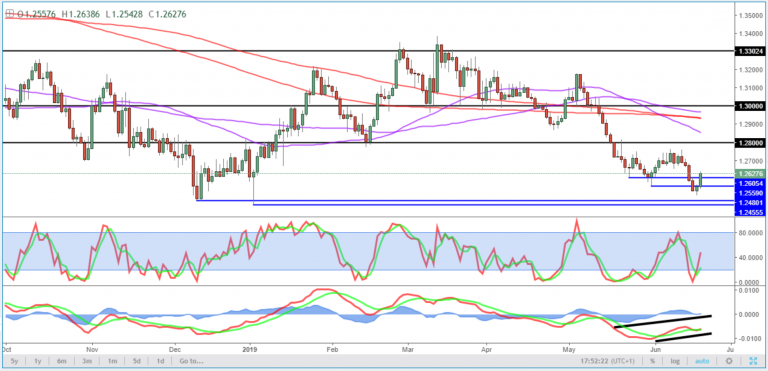
One thing all the charts below have in common is that we're starting to see divergences, with the momentum indicators – particularly the MACD histogram – no longer making new lows alongside price. While this doesn't indicate an immediate reversal, it does suggest the trend is running out of steam.
GBPUSD
EURGBP 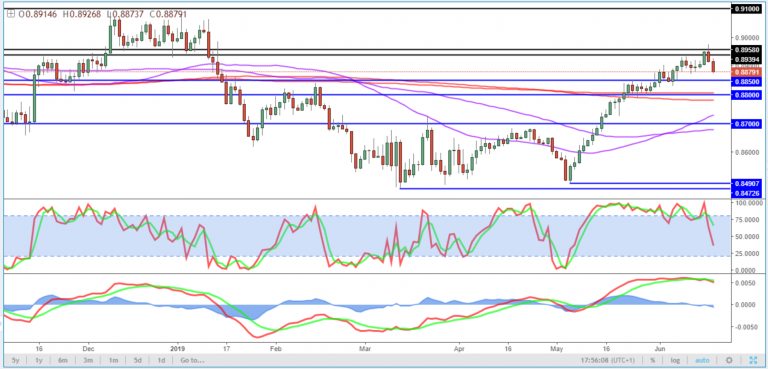
GBPCAD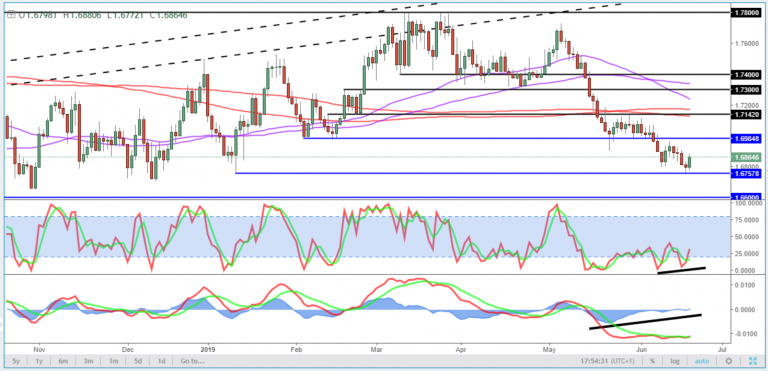
GBPJPY 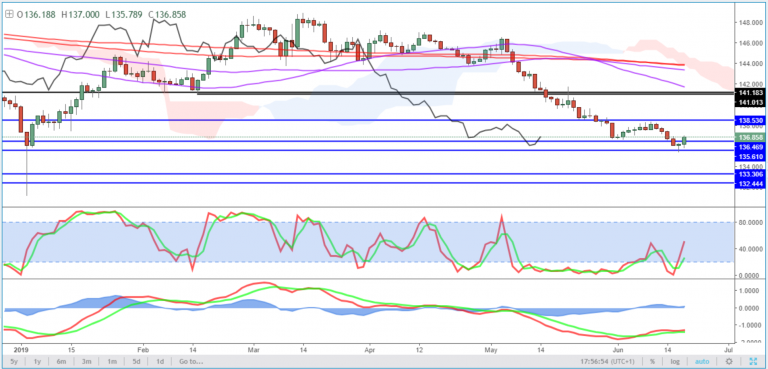
Greenback Falls After Dovish Fed Interest Rates Decision
The USD declined after the Federal Reserve delivered its interest rates decision. The bank left interest rates unchanged at a range of between 2.25% and 2.50% as was expected but hinted they would cut rates in the months ahead if the economic outlook weakens. This would be the first rate cut since 2008 and a sign that the economy was indeed slowing down. At the press conference, Jerome Powell said that with trade talks having stalled, he expected the Fed to be more accommodative in its policies. Traders are now pricing-in a rate cut in September this year.
The Japanese yen was relatively unchanged after the BOJ delivered its interest rates decision. The bank left interest rates unchanged as was expected. Officials also warned about the increasing risks of the current trade tensions and protectionism. It also pointed to additional stimulus to facilitate growth in the economy. The bank left rates unchanged at minus 0.1% and pledged to guide the 10-year government bond yields to around zero percent. It will also continue buying government bonds worth more than $738 billion a year.
Focus will now be on the Bank of England, which will release its interest rates decision later today. As with the other central banks, it is expected to leave rates unchanged at the current level of 0.75%. Members are expected to vote unanimously for this. The bank is also expected to continue with its QE program. All this is expected because the UK economy has been struggling and is currently at a crossroad, with the next Prime Minister expected to be named this week. Other important economic data expected today will be the Philadelphia Fed Manufacturing Index, US jobless claims data and UK retail sales.
EUR/USD
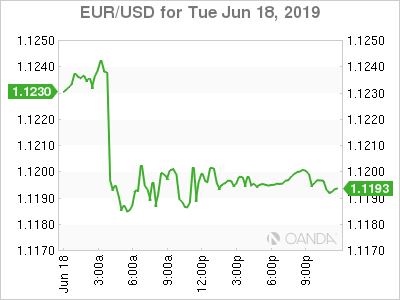
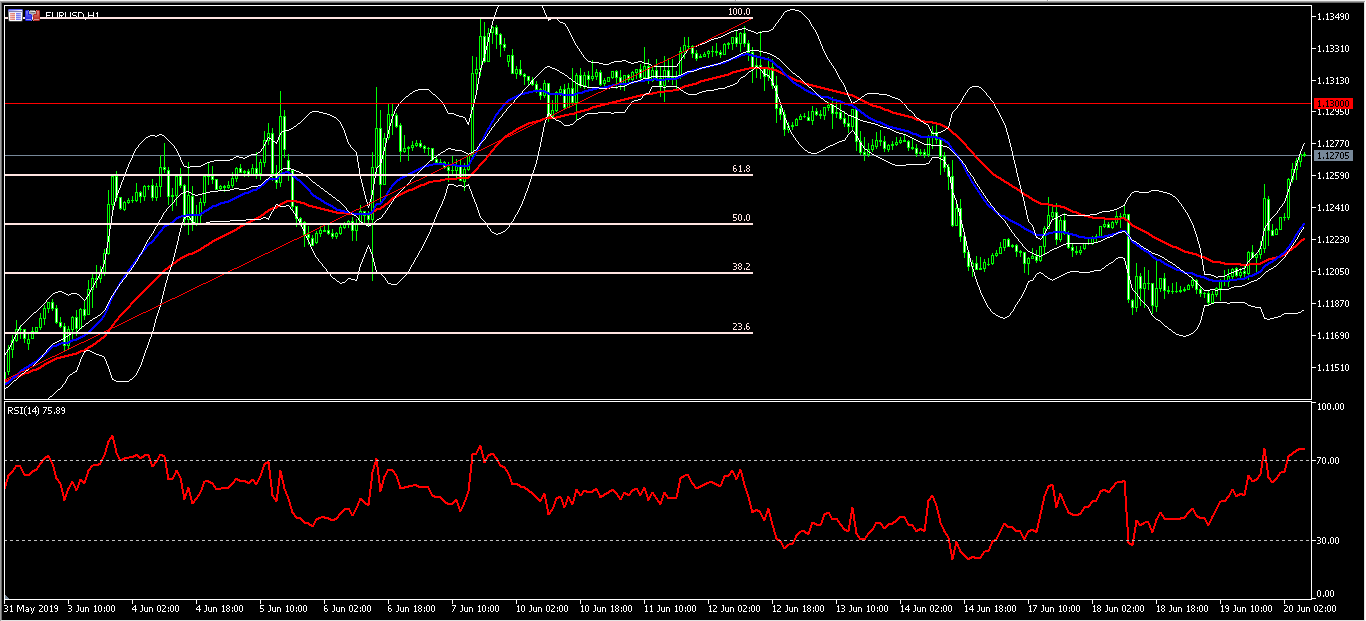
The EUR/USD pair soared in overnight trading following the decision by the Federal Reserve. The pair reached a high of 1.1273, which was higher than the week’s low of 1.1180. On the hourly chart, the pair is currently above the 50-day and 25-day moving averages while the RSI has moved above the overbought level. The price is along the upper line of the Bollinger Bands. It’s likely that the pair will test the important support of 1.1300.
GBP/USD
The GBP/USD pair continued the upward trend started on Wednesday this week when the pair started moving upwards from a low of 1.2505. It is now trading at the 1.2690 level, which is above all the shorter and longer moving averages on the hourly chart. The RSI has moved from a low of 9 on Friday to the current 75. The pair will likely react to the statement by the Bank of England later today. This will see it test either the support of 1.2600 or the resistance of 1.2700.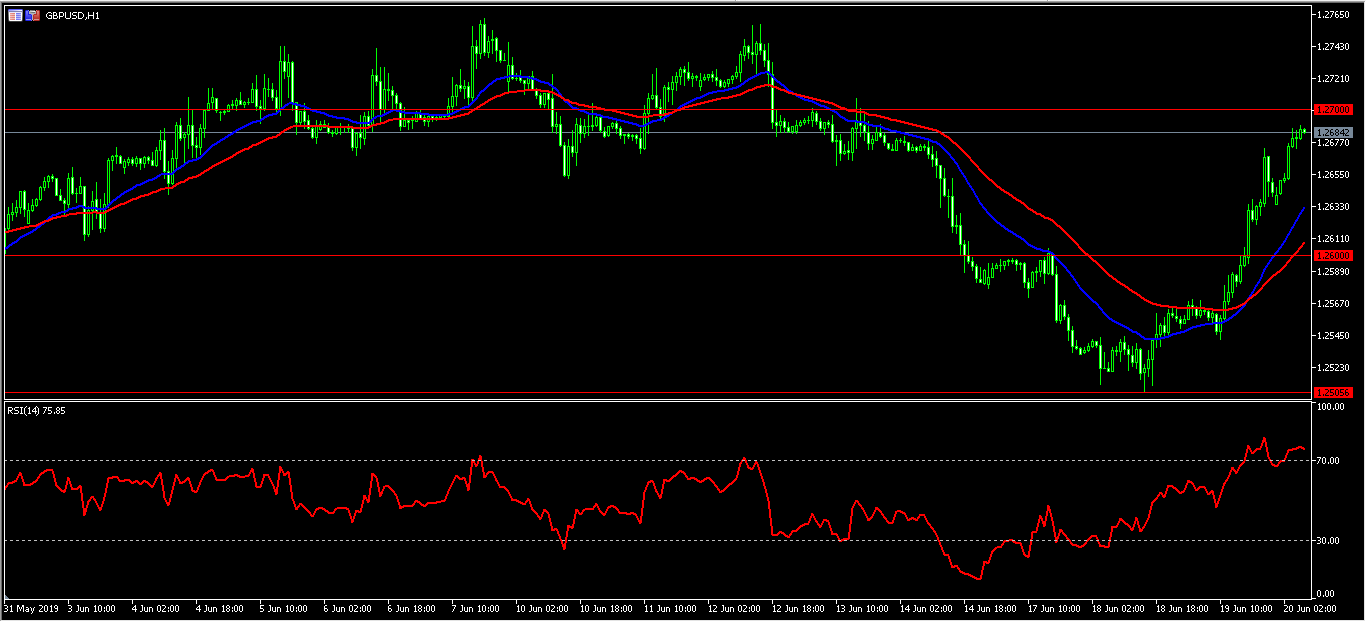
USD/JPY
The USD/JPY dropped after the Fed interest rates decision but was relatively unchanged after the BOJ decision. It reached a low of 107.55, which was the lowest level since January 8. On the daily chart, the price is below the 25-day and 50-day moving averages while the RSI has dropped to the oversold level of 30. The signal line of the stochastics oscillator declined to almost the oversold level. The pair will likely continue to decline to test the 107 support level.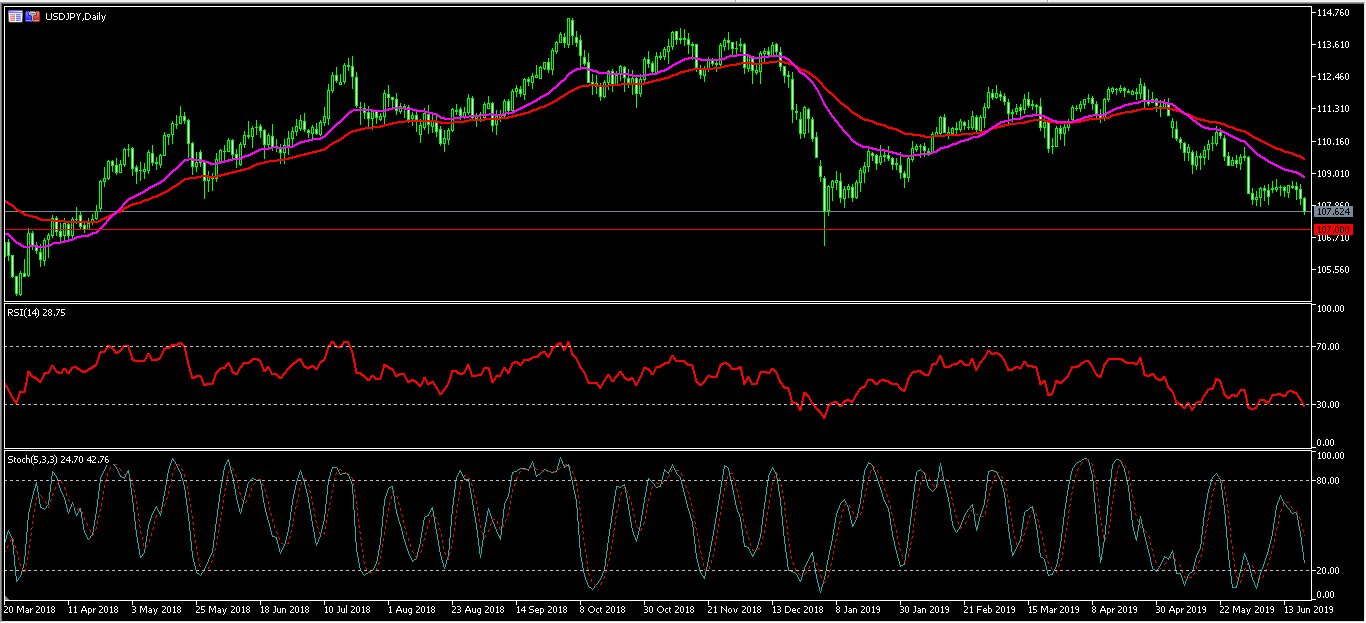
GBP/JPY Daily Outlook
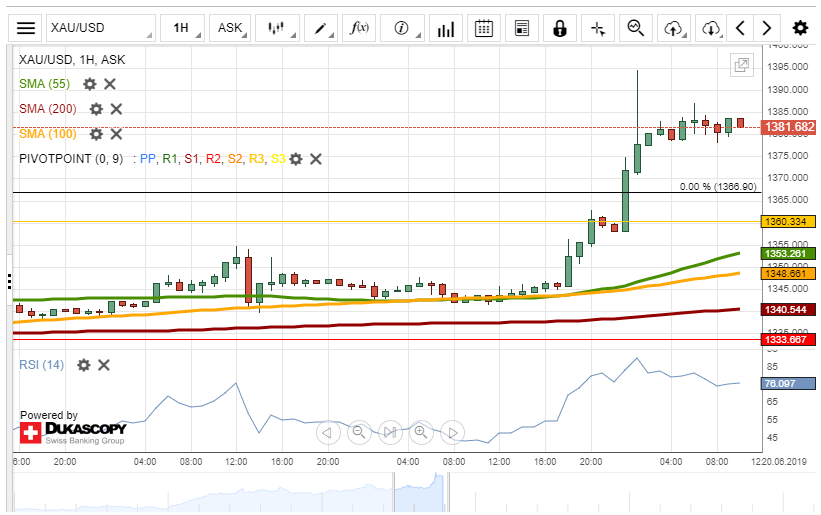
Daily Pivots: (S1) 135.98; (P) 136.49; (R1) 137.18; More...
Intraday bias in GBP/JPY remains neutral for consolidation above 135.38. Upside of recovery should be limited by 138.32 resistance to bring fall resumption. On the downside, break of 135.38 will extend recent fall from 148.87 to retest 131.51 low. Though, firm break of 135.38 will confirm short term bottoming and bring stronger rebound first.
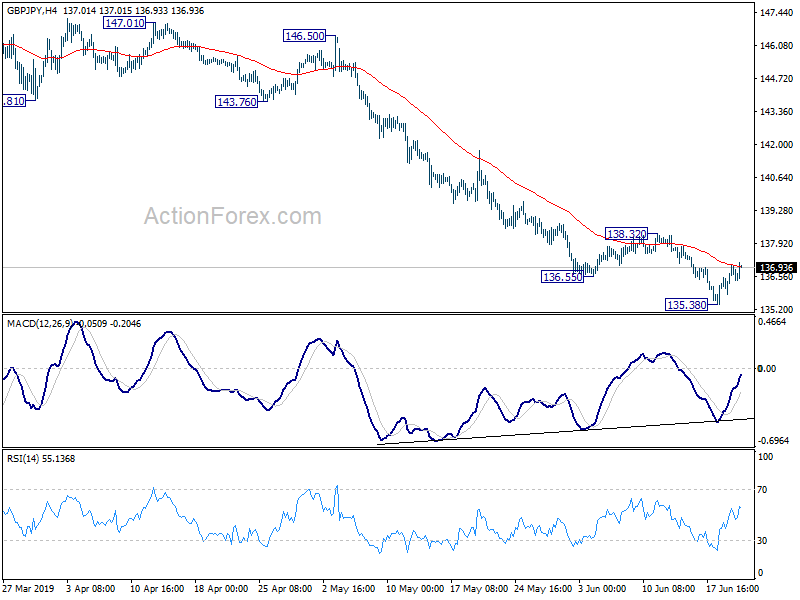
In the bigger picture, current development suggests that GBP/JPY's medium term fall from 156.59 (2018 high) is still in progress. Break of 131.51 will target 122.36 (2016 low). Structure of such decline is corrective looking so far, arguing that it's just the second leg of consolidation from 122.36. Thus, we'd expect strong support from 122.36 to contain downside to bring reversal.