

Sample Category Title
USD/CHF Mid-Day Outlook
Daily Pivots: (S1) 0.9899; (P) 0.9958; (R1) 0.9999; More...
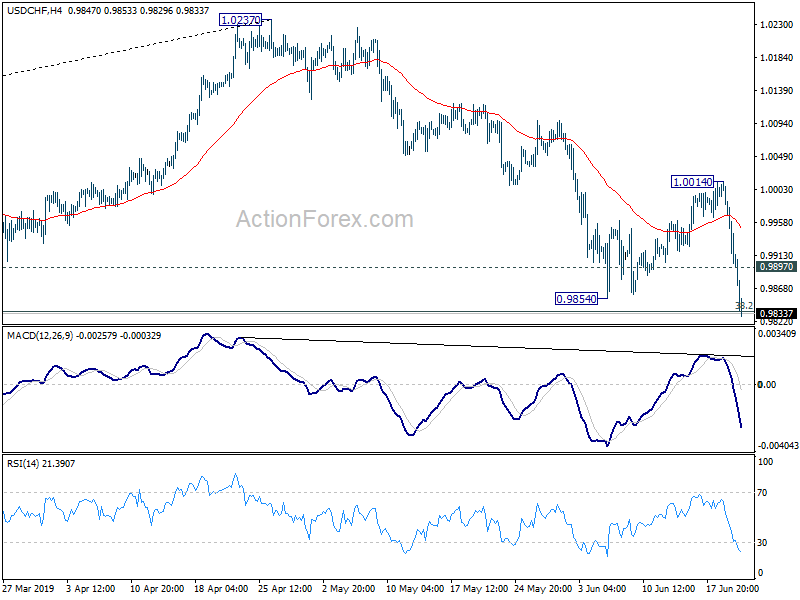
USD/CHF drops to as low as 0.9830 so far today and break of 0.9854 support confirms resumption of fall from 1.0237. Rejection by 55 day was also a clear near term bearish signal. Intraday bias remains on the downside for 0.9716 support next. On the upside, break of 0.9897 minor resistance will turn intraday bias neutral and bring consolidations. But recovery should be limited well below 1.0014 resistance to bring fall resumption.
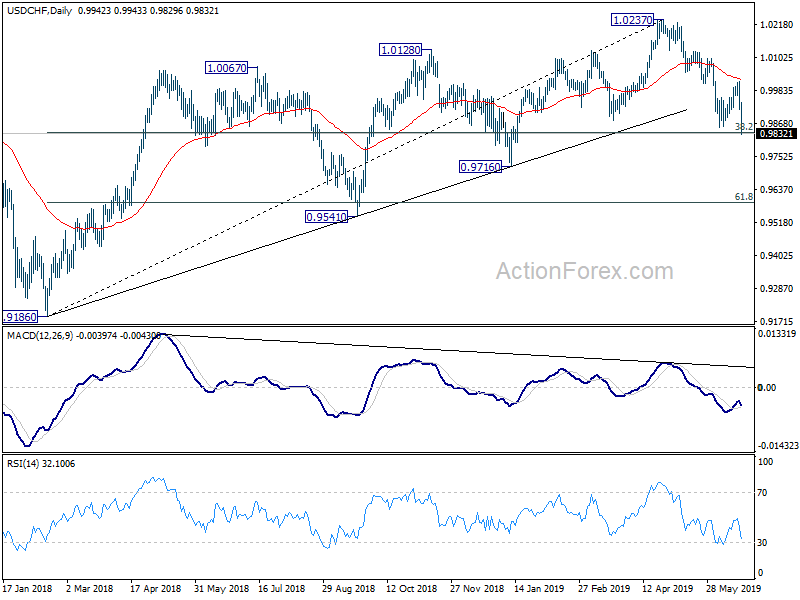
In the bigger picture, USD/CHF's break of long term trend line support is the first indication of medium term reversal. That is, rise from 0.9186 (2018 low) could have completed at 1.0237 already). Sustained break of 38.2% retracement of 0.9186 to 1.0237 at 0.9836 will confirm and target 61.8% retracement at 0.9587. However, strong rebound from 0.9836 will revive medium term bullishness for 1.0237 and above.
Middle East Tensions Overshadow Dovish Central Banks, Swiss Franc and Canadian Steal the Show
Dollar remains broadly weak, suffering heavy selling pressure after Fed turned dovish yesterday and opened the door for rate cut. Though, Swiss Franc and Canadian Dollar steal the show today on escalating middle tensions. WTI crude oil rises over 4% on news that a US drone was shot down by Iran, (in international airspace according to US, over southern Iran according to Iran). Loonie, also firm on strong inflation reading, was give further lift by oil prices. Fears over military confrontation military confrontation drove safe haven flow into Franc.
Staying in the currency markets, Sterling follows Dollar as second weakest after BoE toned down growth outlook a bit after keeping interest rate unchanged at 0.75%. Yen is the third weakest, mainly due to strong rally in stocks. Though, we might see a come back in Yen any time should major treasury yields drop further. New Zealand Dollar is the third strongest, with help from GDP data.
Technically, USD/CHF's break of 0.9854 support confirms resumption of recent fall from 1.0237 towards 0.9716 support next. EUR/CHF's break of 1.1119 indicates resumption of fall from 1.1476 and larger down trend from 1.2004. USD/CAD's decline is accelerating towards 1.3068 key support next. EUR/CAD also breaks 1.4877 support for 1.4759 low. EUR/GBP recovers ahead of 0.8871 minor support, keeping Euro's upper ahead against Sterling for now.
In other markets, S&P 500 opens sharply higher by 0.9% and would very likely take on record high of 2954.13 soon. US 10-year yield is currently down -0.026 at 1.999, below 2% handle. In Europe, FTSE is up 0.68%. DAX is up 0.94%. CAC is up 0.75%. German 10-year yield is down -0.0333 at -0.319. Earlier in Asia, Nikkei rose 0.60%. Hong Kong HSI rose 1.23%. China Shanghai SSE rose 2.38%. Singapore Strait Times rose 0.80%. Japan 10-year JGB yield dropped -0.0313 to -0.166.
US initial jobless claims dropped to 216k, Philly Fed outlook dropped to 0.3
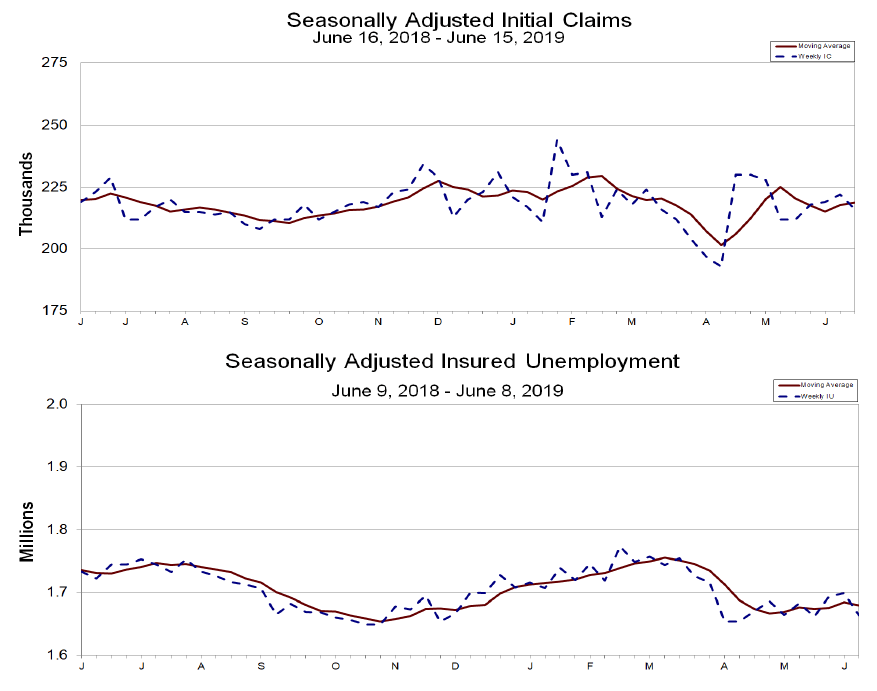
US initial jobless claims dropped -6k to 216k in the week ending June 15, below expectation of 220k. Four-week moving average of initial claims dropped -1k to 281.75k. Continuing claims dropped -37k to 1.662M in the week ending June 8. Four week moving average of continuing claims dropped -5.25k to 1.679M.
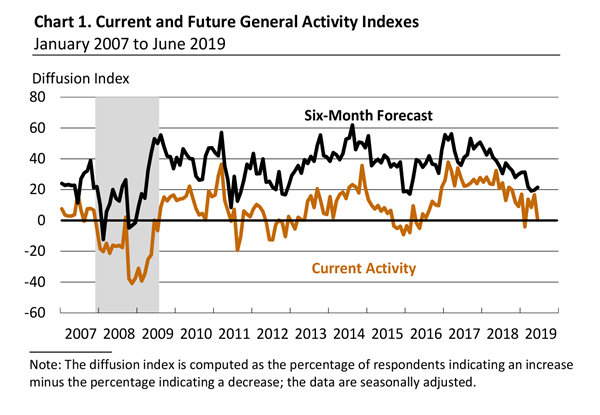
Philadelphia Fed Manufacturing Business Outlook diffusion index dropped sharply from 16.6 to 0.3 in June, missed expectation of 10.4. It's also the lowest level since February. The results suggest weaker regional manufacturing conditions compared with last month. The indexes for current activity, new orders, shipments, and employment remained positive but decreased from their May readings. The survey's price indexes suggest a notable moderation in price pressures. The survey's future indexes indicate that respondents continue to expect growth over the remainder of the year.
China insists core concerns must be resolved before trade agreement with US
China continues to talk down expectations of upcoming Xi-Trump summit at G20 in Osaka next week. Chinese commerce ministry spokesman Gao Feng said "the heads of the two trade teams will communicate, according to instructions passed down from the two presidents." And, "we hope (the United States) will create the necessary conditions and atmosphere for solving problems through dialogue as equals."
But most importantly, Gao insisted that "China's principles and basic stance on Sino-U.S. economic and trade consultations have always been clear and consistent, and China's core concerns must be properly resolved." He was clearly referring to disagreement on the three matters of principle that led to the collapse of trade negotiation earlier this year.
To recap, the three main differences include removal of all additional tariffs with the agreement. The among of additional Chinese purchases of US goods have to be realistic. And text of the agreement must be balanced without intrusion of sovereignty. It's believed that the third one, regarding removal of texts that force China to implement the agreement in domestic laws, is the most crucial red line.
BoE stands pat, warns of intensifying trade tensions and increased likelihood of no-deal Brexit
BoE left Bank Rate unchanged at 0.75% as widely expected. Asset purchase target was also held at GBP 435B. Both decisions were made by unanimous 9-0 vote.
BoE noted that near-term data have been "broadly in line" with projections in May Inflation report. However, "downside risks to growth have increased". Globally, "trade tensions have intensified" and "contributed to volatility in global equity prices and corporate bond spreads". Also forward interest rates in major economies "have fallen materially further. Additionally, "perceived likelihood of a no-deal Brexit has risen", putting downward pressure on UK forward interest rates and Sterling exchange rates.
On growth, BoE now expects Q2 GDP growth to be flat. H2 underlying growth appears to have "weakened slightly" to "a little" below potential. On Inflation, BoE said core inflation "has remained slightly below" target. But job market "remains tight" and wage growth has remained at "target-consistent levels".
BoE also reiterated that economic outlook depends significantly on Brexit, timing and nature, and new trading arrangement. Also, policy response to Brexit "will not be automatic and could be in either direction.
UK retail sales dropped -0.5% in May, ex-auto fuel dropped -0.3%
UK retail sales data for May came in mixed. No sector reported growth during the month. But the contraction was not as bad as expected. Retail sales including auto and fuel: -0.5% mom, 2.3% yoy versus expectation of -0.5% mom, 2.7% yoy. Retail sale excluding auto and fuel: -0.3% mom, 2.2% yoy versus expectation of -0.5% mom, 2.4% yoy.
BoJ warns of significant downside risks concerning overseas economies
BoJ left monetary policy unchanged today as widely expected. Under the yield curve control framework, short-term policy interest rate was kept at -0.1%. JGB purchase will continue continue to keep 10-year JGB yield at around zero percent, with some flexibility depending on developments. Monetary base is expected to increase at around JPY 80T per annum. Y. Harada and G. Kataoka dissented again in 7-2 vote.
In the accompanying statement, BoJ warned that "downside risks concerning overseas economies are likely to be significant". Risks include US macroeconomic policies, consequences of protectionist moves and their effects, emerging markets such as China, global adjustments in IT-related goods, Brexit and geopolitical risks.
Though, BoJ maintained that Japan's economy is "likely to continue on a moderate expanding trend". Domestic demand is expected to follow an uptrend. Exports are projected to show some weakness, but would stay on a "moderate increasing trend". CPI is likely to increase gradually toward 2 percent, mainly on the back of the output gap remaining positive and medium- to long-term inflation expectations rising.
Also from Japan, all industry activity index rose 0.9% mom in April, above expectation of 0.70% mom.
RBA Lowe: Not unrealistic to expect more rate cut
In a speech on "The Labour Market and Spare Capacity" delivered today, RBA Governor Philip Lowe reaffirmed that the central bank is on track for further rate cuts again. He said that would be "unrealistic to expect that lowering interest rates by ¼ of a percentage point will materially shift the path we look to be on." And, "the most recent data – including the GDP and labour market data – do not suggest we are making any inroads into the economy's spare capacity."
Therefore, "it is not unrealistic to expect a further reduction in the cash rate as the Board seeks to wind back spare capacity in the economy and deliver inflation outcomes in line with the medium-term target." Though, he also emphasized that Australia should also look into other options to get closer to full employment, including fiscal policy and structural policies.
New Zealand GDP grew 0.6% in Q1, weak details keeps RBNZ on dovish side
New Zealand GDP grew 0.6% qoq in Q1, unchanged from prior quarter, and matched expectations. Looking at the sectors, growth were driven by 2.0% expansion in goods producing industries. Services growth slowed to 0.2% while primary industries contracted -0.7%. On the components, household spending was up 0.5%, investment spending was up 2.4%, exports of goods and services was up 2.8%
While the headline number was a little stronger than expected, slowdown in services, which accounted for two thirds of GDP, remained a concern. Also, investment growth was mainly driven by residential and nonresidential buildings. Contractions were seen in all other components. RBNZ might be granted some more room to wait-and-see with today's data. But bias will remain towards easing beyond next week's meeting.
USD/CHF Mid-Day Outlook
Daily Pivots: (S1) 0.9899; (P) 0.9958; (R1) 0.9999; More...
USD/CHF drops to as low as 0.9830 so far today and break of 0.9854 support confirms resumption of fall from 1.0237. Rejection by 55 day was also a clear near term bearish signal. Intraday bias remains on the downside for 0.9716 support next. On the upside, break of 0.9897 minor resistance will turn intraday bias neutral and bring consolidations. But recovery should be limited well below 1.0014 resistance to bring fall resumption.
In the bigger picture, USD/CHF's break of long term trend line support is the first indication of medium term reversal. That is, rise from 0.9186 (2018 low) could have completed at 1.0237 already). Sustained break of 38.2% retracement of 0.9186 to 1.0237 at 0.9836 will confirm and target 61.8% retracement at 0.9587. However, strong rebound from 0.9836 will revive medium term bullishness for 1.0237 and above.
Economic Indicators Update
| GMT | Ccy | Events | Actual | Forecast | Previous | Revised |
|---|---|---|---|---|---|---|
| 22:45 | NZD | GDP Q/Q Q1 | 0.60% | 0.60% | 0.60% | |
| 01:30 | AUD | RBA Bulletin | ||||
| 02:45 | JPY | BOJ Rate Decision | -0.10% | -0.10% | -0.10% | |
| 05:30 | JPY | All Industry Activity Index M/M Apr | 0.90% | 0.70% | -0.40% | -0.30% |
| 06:00 | CHF | Trade Balance (CHF) May | 3.41B | 2.87B | 2.29B | |
| 08:00 | EUR | ECB Monthly Bulletin | ||||
| 08:30 | GBP | Retail Sales Ex Auto Fuel M/M May | -0.30% | -0.50% | -0.20% | -0.30% |
| 08:30 | GBP | Retail Sales Ex Auto Fuel Y/Y May | 2.20% | 2.40% | 4.90% | 4.70% |
| 08:30 | GBP | Retail Sales Inc Auto Fuel M/M May | -0.50% | -0.50% | 0.00% | -0.10% |
| 08:30 | GBP | Retail Sales Inc Auto Fuel Y/Y May | 2.30% | 2.70% | 5.20% | 5.10% |
| 11:00 | GBP | BoE Bank Rate | 0.75% | 0.75% | 0.75% | |
| 11:00 | GBP | BOE Asset Purchase Target Jun | 635B | 435B | 435B | |
| 11:00 | GBP | MPC Official Bank Rate Votes | 0--0--9 | 0--0--9 | 0--0--9 | |
| 11:00 | GBP | MPC Asset Purchase Facility Votes | 0--0--9 | 0--0--9 | 0--0--9 | |
| 12:30 | USD | Current Account (USD) Q1 | -130.4B | -125B | -134B | -143.9B |
| 12:30 | USD | Initial Jobless Claims (JUN 15) | 216K | 220K | 222K | |
| 12:30 | USD | Philadelphia Fed Business Outlook Jun | 0.3 | 10.4 | 16.6 | |
| 14:00 | USD | Leading Index May | 0.10% | 0.20% | ||
| 14:00 | EUR | Eurozone Consumer Confidence Jun A | -6.5 | -6.5 | ||
| 14:30 | USD | Natural Gas Storage | 102B |
US initial jobless claims dropped to 216k, Philly Fed outlook dropped to 0.3
US initial jobless claims dropped -6k to 216k in the week ending June 15, below expectation of 220k. Four-week moving average of initial claims dropped -1k to 281.75k. Continuing claims dropped -37k to 1.662M in the week ending June 8. Four week moving average of continuing claims dropped -5.25k to 1.679M.
Philadelphia Fed Manufacturing Business Outlook diffusion index dropped sharply from 16.6 to 0.3 in June, missed expectation of 10.4. It's also the lowest level since February. The results suggest weaker regional manufacturing conditions compared with last month. The indexes for current activity, new orders, shipments, and employment remained positive but decreased from their May readings. The survey's price indexes suggest a notable moderation in price pressures. The survey's future indexes indicate that respondents continue to expect growth over the remainder of the year.
WTI oil surges on concerns of US-Iran military conflicts
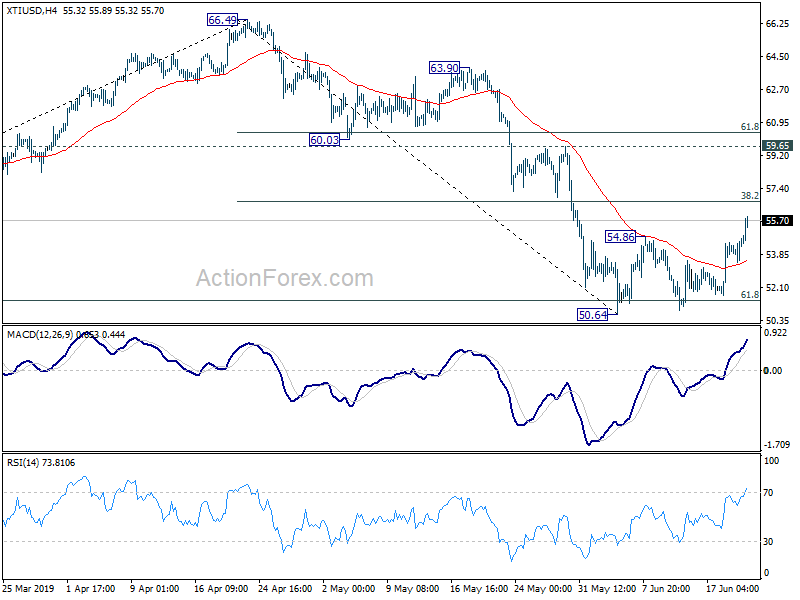
Oil prices surge sharply today on concerns over escalation in geopolitical tensions that could eventually lead to military confrontation between US and Iran. It's confirmed that a US drone was shot down by an Iranian surface-to-air missile. The US side claimed that the drone was shot in international airspace over the Strait of Hormuz. Iran's Revolutionary Guards said the drone was flying over southern Iran.
WTI crude oil extends recent rebound and hits at high as 55.89 so far. Break of 54.86 resistance confirms short term bottoming at 50.64, after hitting 61.8% retracement of 42.05 to 66.49 at 51.38 . Further rise should now be seen back to 55 day EMA (now at 57.54). For now, we'd expect upside to be limited comfortably below 60 to complete the rebound. This level is close to 60.03 support turned resistance, 59.65 resistance and 61.8% retracement of 66.49 to 50.64.
Fed Aftermath; Norway Hikes; BOE Keeps Rates Steady
The dollar got pummeled, Treasuries continued to surge higher, gold skyrocketed as the Fed aftermath was accompanied by an escalation in the Middle East. The biggest event of the month will likely be the Fed’s signal that most members are reading to begin an easing cycle. Powell’s press conference showed some reluctance, but it seems markets are certain the Fed will cut in July. If data deterioration is worst than expected, calls for a 50-basis cut at the July meeting will grow in the coming weeks.
BOE
The Bank of England kept rates steady in a unanimous vote, surprising some who expected Haldane and Saunders to follow through on their recent hawkish comments. The BOE mentioned that the market is not agreeing with their Brexit assumption view. No-deal risks are rising and since the BOE was expecting a smooth Brexit, we will likely see a long pause on a rate hike from the BOE. The bank cut their Q2 outlook from 0.2% to 0.0%.
Norges
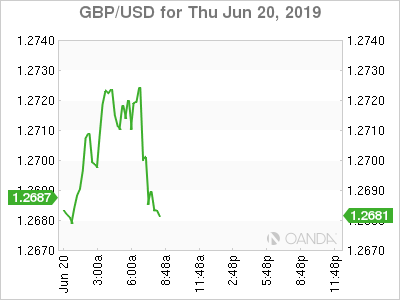
Norway’s central bank delivered a rate hike as the rest of the advanced economies are contemplating easing or unleashing fresh stimulus into their domestic markets. The Norwegian economy has performed well and with recent upgrades to their forecasts, more hikes could be coming this year. Markets were expecting this to be the last hike, so we could see the Norwegian krone deliver further gains.
China insists core concerns must be resolved before trade agreement with US
China continues to talk down expectations of upcoming Xi-Trump summit at G20 in Osaka next week. Chinese commerce ministry spokesman Gao Feng said "the heads of the two trade teams will communicate, according to instructions passed down from the two presidents." And, "we hope (the United States) will create the necessary conditions and atmosphere for solving problems through dialogue as equals."
But most importantly, Gao insisted that "China's principles and basic stance on Sino-U.S. economic and trade consultations have always been clear and consistent, and China's core concerns must be properly resolved." He was clearly referring to disagreement on the three matters of principle that led to the collapse of trade negotiation earlier this year.
To recap, the three main differences include removal of all additional tariffs with the agreement. The among of additional Chinese purchases of US goods have to be realistic. And text of the agreement must be balanced without intrusion of sovereignty. It's believed that the third one, regarding removal of texts that force China to implement the agreement in domestic laws, is the most crucial red line.
BoE stands pat, warns of intensifying trade tensions and increased likelihood of no-deal Brexit
BoE left Bank Rate unchanged at 0.75% as widely expected. Asset purchase target was also held at GBP 435B. Both decisions were made by unanimous 9-0 vote.
BoE noted that near-term data have been "broadly in line" with projections in May Inflation report. However, "downside risks to growth have increased". Globally, "trade tensions have intensified" and "contributed to volatility in global equity prices and corporate bond spreads". Also forward interest rates in major economies "have fallen materially further. Additionally, "perceived likelihood of a no-deal Brexit has risen", putting downward pressure on UK forward interest rates and Sterling exchange rates.
On growth, BoE now expects Q2 GDP growth to be flat. H2 underlying growth appears to have "weakened slightly" to "a little" below potential. On Inflation, BoE said core inflation "has remained slightly below" target. But job market "remains tight" and wage growth has remained at "target-consistent levels".
BoE also reiterated that economic outlook depends significantly on Brexit, timing and nature, and new trading arrangement. Also, policy response to Brexit "will not be automatic and could be in either direction.
Full statement below.
Bank Rate Maintained at 0.75%
Our Monetary Policy Committee has voted unanimously to maintain Bank Rate at 0.75%. The committee also voted unanimously to maintain the stock of corporate bond purchases and UK government bond purchases.
The Bank of England's Monetary Policy Committee (MPC) sets monetary policy to meet the 2% inflation target, and in a way that helps to sustain growth and employment. At its meeting ending on 19 June 2019, the MPC voted unanimously to maintain Bank Rate at 0.75%.
The Committee voted unanimously to maintain the stock of sterling non-financial investment-grade corporate bond purchases, financed by the issuance of central bank reserves, at £10 billion. The Committee also voted unanimously to maintain the stock of UK government bond purchases, financed by the issuance of central bank reserves, at £435 billion.
The MPC's most recent economic projections, set out in the May Inflation Report, assumed a smooth adjustment to the average of a range of possible outcomes for the United Kingdom's eventual trading relationship with the European Union and were conditioned on a path for Bank Rate that rose to around 1% by the end of the forecast period. In those projections, GDP growth was a little below potential during 2019 as a whole, reflecting subdued global growth and ongoing Brexit uncertainties. Growth then picked up above the subdued pace of potential supply growth, such that excess demand rose above 1% of potential output by the end of the forecast period. As excess demand emerged, domestic inflationary pressures firmed, such that CPI inflation picked up to above the 2% target in two years' time and was still rising at the end of the three-year forecast period.
Since the Committee's previous meeting, the near-term data have been broadly in line with the May Report, but downside risks to growth have increased. Globally, trade tensions have intensified. Domestically, the perceived likelihood of a no-deal Brexit has risen. Trade concerns have contributed to volatility in global equity prices and corporate bond spreads, as well as falls in industrial metals prices. Forward interest rates in major economies have fallen materially further. Increased Brexit uncertainties have put additional downward pressure on UK forward interest rates and led to a decline in the sterling exchange rate.
As expected, recent UK data have been volatile, in large part due to Brexit-related effects on financial markets and businesses. After growing by 0.5% in 2019 Q1, GDP is now expected to be flat in Q2. That in part reflects an unwind of the positive contribution to GDP in the first quarter from companies in the United Kingdom and the European Union building stocks significantly ahead of recent Brexit deadlines. Looking through recent volatility, underlying growth in the United Kingdom appears to have weakened slightly in the first half of the year relative to 2018 to a rate a little below its potential. The underlying pattern of relatively strong household consumption growth but weak business investment has persisted.
CPI inflation was 2.0% in May. It is likely to fall below the 2% target later this year, reflecting recent falls in energy prices. Core CPI inflation was 1.7% in May, and core services CPI inflation has remained slightly below levels consistent with meeting the inflation target in the medium term. The labour market remains tight, with recent data on employment, unemployment and regular pay in line with expectations at the time of the May Report. Growth in unit wage costs has remained at target-consistent levels.
The Committee continues to judge that, were the economy to develop broadly in line with its May Inflation Report projections that included an assumption of a smooth Brexit, an ongoing tightening of monetary policy over the forecast period, at a gradual pace and to a limited extent, would be appropriate to return inflation sustainably to the 2% target at a conventional horizon. The MPC judges at this meeting that the existing stance of monetary policy is appropriate.
The economic outlook will continue to depend significantly on the nature and timing of EU withdrawal, in particular: the new trading arrangements between the European Union and the United Kingdom; whether the transition to them is abrupt or smooth; and how households, businesses and financial markets respond. The appropriate path of monetary policy will depend on the balance of these effects on demand, supply and the exchange rate. The monetary policy response to Brexit, whatever form it takes, will not be automatic and could be in either direction. The Committee will always act to achieve the 2% inflation target.
GBP/USD – What BoE Decision?
Cable surges on dovish Fed
The dollar has been tearing lower again on Thursday, after the Fed delivered on expectations and indicated that rate cuts are coming as early as next month.
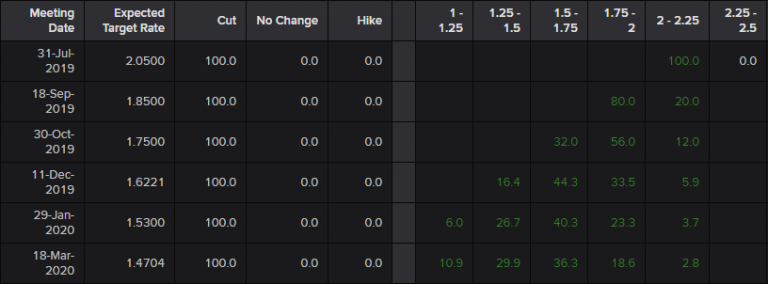
Traders have been craving some rate cut hints from the Fed, having decided a while back that they were going to be necessary to avoid a recession. The Fed may not have delivered one yet but traders are convinced – literally, 100% priced in – that it will come next month.
Fed Interest Rate Probabilities
BoE overshadowed by leadership race
It's not often that a central bank announcement is overshadowed by other domestic events but today is very much one of those occasions.
The Conservative leadership – and therefore Prime Minister – race has understandably stolen the spotlight in the UK this week, with the number of contenders now falling to four and that will halve again today following one final vote by MPs. The next PM will then be selected from the final two by the Tory membership over the next month, at which point attention will quickly shift back to Brexit meaning the BoE may have to get used to playing second fiddle.
The meeting today is likely to be a non-event, with the central bank currently not expected to move interest rates at all over the next year and no press conference to follow. A statement is expected to accompany the decision but we can't expect much from that. What will be of far more interest to traders today is who will join Johnson in the final two. With Raab gone, there's little difference between the other three remaining contenders but Hunt may be preferable being a reformed remainer that is strongly opposed to no deal. That said, Johnson will probably win the run-off anyway so it probably doesn't actually make much of a difference.
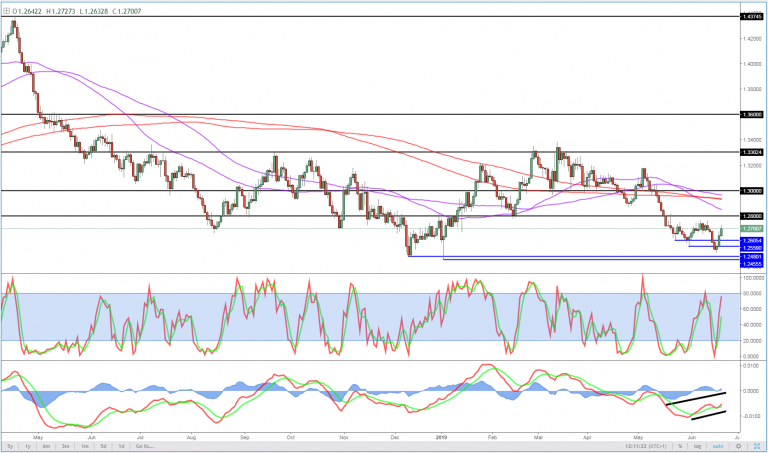
GBPUSD pushes higher with notable resistance in focus
The rally in cable, coming after we saw divergence form on the most recent low, has brought a potentially key resistance level into focus, with 1.2750 now looking very interesting. This level provided strong resistance for the pair repeatedly since late May so a break through here could be technically very significant.
GBPUSD Daily Chart
Norges Pulls The Trigger For Another Hike And Leaves Door Open For More
Notes/Observations
- Dovish Fed opens the door for a rate cut as soon as July
- USD halts a 4-month rally in aftermath of Fed decision as FED open to cutting borrowing costs for the first time since 2008.
- Norway Central Bank hikes its key rate (as expected) and left the door open for another one this year
- Philippines surprises market and keeps its policy steady (was expected to hike)
- Spain and France both issue bonds in session at record low yields
Asia:
- BOJ kept its policy steady (as expected) with vote being 7-2 (Harada and Kataoka dissented). BOJ reiterated forward guidance that policy rates would be kept at extremely low levels for an extended period of time, at least through around spring 2020. Reiterated overall assessment that domestic economy was expanding moderately. Saw downside risks on overseas economies as high
Europe:
- Italy coalition reportedly drafting a bill to reform central bank's management. Central banks board to be proposed by government and parliament instead of internally
- UK Conservative Party announced results of 3rd leadership ballots; Rory Stewart eliminated from contest. Boris Johnson 143 votes (prior 126 votes); Jeremy Hunt 54 votes (prior 46 votes); Michael Gove 51 votes (prior 41 votes); Sajid Javid 38 votes (prior 33 Votes)
Americas:
- FOMC left the Target Range unchanged between 2.25-2.50% (as expected) and dropped its ‘patient' language on future policy adjustments and now would act as appropriate to sustain expansion
- FOMC projections cut the medium term forecasts for rate outlook. Cut Median forecast for end-2020 rate from 2.625% to 2.125%; end-2021 rate from 2.625% to 2.375% and the Long Run rate from 2.75% to 2.500%. Did raise the mid-point on GDP for the forecast horizon
- Fed Chair Powell post rate decision press conference noted that many FOMC participants saw stronger case for rate cuts and noted that changes made to its statement were "significant". To closely monitor incoming data and take appropriate action as necessary. Mindful of undercurrents related to trade and growth and that in recent weeks crosscurrents had re-emerged. Drop in market-based inflation expectations were a major factor for many participants' forecast for more policy accommodation
- US President Trump said to have stated he would not remove Fed Chair Powell for now but did think he had authority to replace him
- Brazil Central Bank left its Selic Target Rate unchanged (as expected). Economic picture demanded stimulative monetary policy and structurally low interest rates. Recent data showed economic recovery had been interrupted (Note: removed wording regarding symmetry regarding risks)
- Trade Rep Lighthizer stated that was prepared to work with Democrats sooner rather than later to iron out differences on USMCA. Reiterated that China had backtracked on some digital issues in the trade talks
Energy:
- Iran Revolutionary Guard shot down US drone. US official later commented that the drone was downed in international airspace
SPEAKERS/FIXED INCOME/FX/COMMODITIES/ERRATUM
Equities
- Indices [Stoxx600 +0.7% at 387.4, FTSE +0.3% at 7425, DAX +1.0% at 12430, CAC-40 +0.7% at 5560, IBEX-35 +0.3% at 9260, FTSE MIB +1.1% at 21452, SMI +0.6% at 10038, S&P 500 Futures +0.8%]
- Market Focal Points/Key Themes: European Indices trade higher across the board tracking firmer Asian indices and higher US Equity futures following a dovish FOMC, adopting a more easing bias, which did lift global indices as well as weaken the Dollar across the board. On the corporate front shares of Rocket Internet gain sharply as reports suggest the CEO is considering delisting the company, Groupe Gorge also rises after selling a subsidiary to Spie. On the earnings front Dunelm rises sharply following raised guidance, while Dixons Carphone declines over 12% following a decline in profits, and Revenue which missed forecasts. In other news Evraz declines following a placing; Barry Calleaut gains on an analyst upgrade, while XXL ASA, McBride, Novo Nordisk and Yara International decline on analyst downgrades. Looking ahead notable earners include Kroger, Methode Electronics, Commercial Metals Co and Darden Restaurants.
Equities
- Consumer discretionary: Dixons Carphone [DC.UK] -13% (Earnings), Dunelm [DNLM.UK] +7.0% (Trading update), Delivery Hero [DHER.DE] +9% (Raised outlook), Barry Callebaut [BARN.CH] +2.2% (analyst upgrade)
- Healthcare: Novo Nordisk [NOVOB.DK] -1.4% (analyst downgrade)
- Industrials: Groupe Gorge [GOE.FR] +4.3% (Divestment)
- Technology: Rocket Internet [RKET.DE] +8% (Reportedly CEO mulls delisting)
Speakers
- ECB's Rehn (Finland) reiterated that ready to act if needed; had concerns on Euro Zone economy but not forecasting any recession
- ECB's Knot (Netherlands) stated that the central bank actively thinks about emergency plans in the event growth did not pick up
- ECB De Guindos (Spain): Inflation to deteriorate in coming months and reiterated that ECB was prepared to act if trend continued
- ECB Economic Bulletin reiterated its forward guidance that interest rates at their present levels at least through H1 of 2020
- Norway Central Bank (Norges) Policy Statement noted that decision was unanimous to raise rates as underlying inflation was little higher than target. Overall outlook and balance of risks suggested that policy rate would be increased somewhat further and likely to see another rate hike this year.
- Norway Central Bank (Norges) Gov Olsen post rate decision press conference noted that the domestic 2020 GDP growth was seen stronger than prior forecast. Drop in oil production to dampen growth over the longer term. Concerned over global developments. Did not want to be precise on timing of next rate hike (for 2019); could also see another towards summer of 2020
- Italy PM Conte response letter to possible EU deficit procedure said to contain €2.0B in spending cuts
- Italy PM Conte: Letter to EU was not seeking any special treatment on budget rules; wanted constructive dialogue. Italy was not looking to dodge budget rules but looked to discuss Euro Area and EU economic governance; EU threat to sanction the country was incomprehensible. Italy to improve the 2020 structural budget deficit by 0.2% and added that EU needed to manage the bank crisis more efficiently
- Italy Stats Agency (ISTAT) maintain its 2019 GDP growth at 0.3% but noted that Q2 could register a contraction
- EU Budget chief Ottinger: Germany pushing for the EU Commission position over ECB head. Focusing on securing EU Commission presidency for Manfred Weber rather than ECB chief's role for Jens Weidmann
- BOJ Gov Kuroda post rate decision press conference reiterated stance to continue with current powerful monetary easing patiently but would not hesitate more easing if price momentum was lost. Reiterates overall assessment that domestic economy is expanding moderately as a trend but risks associated with overseas economy are significant . Reiterated that expected inflation to gradually pick up towards target; no change to its stance on achieving the target. Conceded that it was possible for forward guidance to be pushed back beyond spring 2020. Reiterated that BOJ would consider the costs and benefits of any additional easing
- Indonesia Central Bank Policy Statement noted it would monitor global financial conditions in considering room for rate cut to support economic growth. Monetary policy strategy continued to be directed to maintain enough liquidity in financial system. Cutting interest rates was a matter of timing and magnitude
- Indonesia Central Bank Gov Warjiyo pre-rate decision commentary noted that the escalation in trade war was affecting global economy. Saw a widening of current account deficit and would take policy mix to spur momentum
- Philippines Central Bank (BSP) Policy Statement noted that CPI risks were broadly balanced for both 2019 and 2020 and saw room for rate cuts if inflation cooled
- Taiwan Central Bank (CBC) Policy Statement saw inflation being stable and that trade war to influence its Q2 GDP growth outlook
- China Commerce Ministry (MOFCOM) Spokesman Gao Feng: Negotiators to hold discussions under instructions of respective state leaders. Believes that both parties could 'certainly' find the solution of its differences. China's stance on trade talks have been consistent and insisted that its fundamental demands must be met. China- US economies were closely connected and reiterated view that US to hurt it's own economy if trade war continued
- Iran IRGC commander Salami: Downing of US drone sends a strong message
Currencies/Fixed Income
- USD saw a halt to its a 4-month rally in aftermath of Fed decision as Fed was now open to cutting borrowing costs for the first time since 2008. Dealers noted that the next level in the downside of the dollar index was in the region of the 96.00 area. The 10 year Note futures made a new 2 1/2 year high as bond yields continue their downward spiral. - EUR/USD retested the 1.13 resistance area but still could not muster any momentum for any sustained break of the level. Focus turnng to key European PMI manufacturing release in Friday's session. USD/JPY probe the mid-107.50 area
- GBP/USD higher by 0.6% to test above the 1,27 level. BOE rate decision later today but no changes seen as Brexit and Political uncertainty remains. The 4th round of the Tory leadership challenge later today. Dealers noted that the prospect of frontrunner Boris Johnson taking Britain out of the European Union on October 31st remained a risk
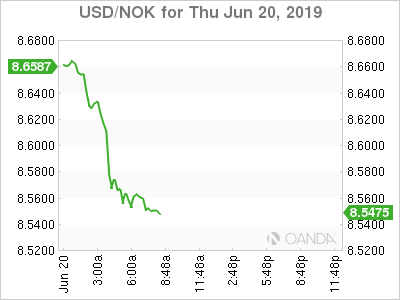
- EUR/NOK was lower by 1% in the session after Norges Bank raised its Deposit Rate by another 25bps and left the door open for further rate rises in 2019
Economic Data
- (NL) Netherlands Jun Consumer Confidence Index: 0 (flat) v -3 prior
- (NL) Netherlands Apr Consumer Spending Y/Y: 1.8% v 1.0% prior - (NL) Netherlands May Unemployment Rate: 3.3% v 3.3% prior
- (CH) Swiss May Trade Balance (CHF): 3.4B v 2.3B prior; Real Exports M/M: -1.2% v -0.3% prior; Real Imports M/M: 0.7 v 1.5% prior; Watch Exports Y/Y: +11.4 v -0.3% prior - (DK) Denmark Jun Consumer Confidence: 5.8 v 5.9 prior
- (ID) Indonesia Central Bank (BI) left the 7-Day Reverse Repo unchanged at 6.00% (as expected); cut the RRR by 50bps
- (TR) Turkey Jun Consumer Confidence: 57.6 v 55.3 prior
- (NO) Norway Central Bank (Norges) raised Deposit Rates by 25bps to 1.25% (as expected)
- (PH) Philippines Central Bank (BSP) left the Overnight Borrowing Rate unchanged at 4.50% (not expected
- (TW) Taiwan May Export Orders Y/Y: -5.8% v -3.7% prior
- (UK) May Retail Sales (Ex-auto/fuel) M/M: -0.3% v -0.4%e; Y/Y: 2.5%e
- (UK) May Retail Sales (includes auto/fuel) M/M: -0.5% v -0.5%e ; Y/Y: 2.3% v 2.7%e
- (TW) Taiwan Central Bank (CBC) left the Benchmark Interest Rate unchanged at 1.375% (as expected)
Fixed Income Issuance
- (ES) Spain Debt Agency (Tesoro) sold total €3.495B vs. €3.0-4.0B indicated range in 2021, 2024 and 2035 bonds
- Sold €1.18B in 0.05% Oct 2021 SPGB; Avg yield: -0.408% v -0.361% prior, Bid-to-cover: 1.88x v 2.60x prior
- Sold €825M in 0.25% July 2024 SPGB bond; Avg yield: -0.182% v -0.096% prior; Bid-to-cover: 2.11x v 2.55x prior
- Sold €1.49B in 1.85% July 2035 SPGB; Avg Yield: 0.883% v 1.466% prior, bid-to-cover: 1.42x v 1.26x prior
- (FR) France Debt Agency (AFT) sold total €8.992B vs. €7.5-9.0B indicated range in 2022, 2023 and 2025 bonds
- Sold €2.98B in 0.00% Feb 2022 Oat; Avg Yield: -0.65% (record low) v -0.52% prior; Bid-to-cover: 2.63x v 3.56x prior
- Sold €3.017B in 0.0% Mar 2023 Oat; Avg Yield: -0.60% (record low) v -0.13% prior; bid-to-cover: 3.24x v 2.06x prior
- Sold €2.995B in 0.0% Mar 2025 Oat; Avg Yield: -0.38% (record low) v -0.19% prior; Bid-to-cover: 2.54x v 2.10x prior
- (IE) Ireland Debt Agency (NTMA) sold €500MM vs. €500M indicated in 12-month Bills; Avg yield: -0.470% v -0.405% prior; Bid-to-cover: 3.67x v 3.46x prior
Looking Ahead
- (EU) EU Leader Summit in Brussels
- (IT) Italy Debt Agency (Tesoro) announcement for upcoming CTZ and BTPei auctions for Tuesday, Jun 25th
- 05:30 (SE) Sweden Central Bank (Riksbank) Dep Gov Floden
- 05:30 (HU) Hungary Debt Agency (AKK) to sell bonds (3 tranches)
- 05:50 (FR) France Debt Agency (AFT) to sell €0.75-1.0B in 2024, 2030 and 2047 Inflation-linked bonds (Oatei)
- 06:00 (EU) ECB SSM chief Enria in Dublin
- 06:45 (US) Daily Libor Fixing
- 07:00 (UK) Bank of England (BOE) Interest Rate Decision: Expected to leave Interest Rates unchanged 0.75%; Expected to maintain Asset Purchase Target at £435B
- 07:00 BOE Jun Minutes
- 08:00 (UK) Daily Baltic Dry Bulk Index
- 08:30 (US) Q1 Current Account Balance: -$124.3Be v -$134.4B prior
- 08:30 (US) Jun Philadelphia Fed Business Outlook: 10.4e v 16.6 prior
- 08:30 (US) Initial Jobless Claims: 220Ke v 222K prior; Continuing Claims: 1.68Me v 1.695M prior
- 08:30 (CA) Canada May ADP Payroll Estimates: No est v +61.7K prior
- 08:30 (US) Weekly USDA Net Export Sales
- 09:00 (RU) Russia May Unemployment Rate: 4.6%e v 4.7% prior; Real Wages Y/Y: No est v 1.6% prior
- 09:00 (RU) Russia May Real Retail Sales Y/Y: 1.3%e v 1.2% prior
- 09:00 (RU) Russia Gold and Forex Reserve w/e Jun 14th: No est v $502.7B prior
- 09:00 (BE) Belgium Jun Consumer Confidence Index: No est v -5 prior
- 10:00 (US) May Leading Index: 0.1%e v 0.2% prior
- 10:00 (EU) Euro Zone Jun Advance Consumer Confidence: -6.5e v -6.5 prior
- 10:30 (US) Weekly EIA Natural Gas Inventories
- 11:00 (CO) Colombia Apr Trade Balance: -$0.5Be v -$0.8B prior; Total Imports: $4.6Be v $4.3B prior
- 11:00 (US) Treasury announcement on upcoming issuance
- 11:30 (US) Treasury to sell 4-Week and 8-Week Bills
- 13:00 (US) Treasury to sell 5-year TIPS reopening
- 15:00 (MX) Citibanamex Survey of Economists
- 16:00 (UK) BOE Gov Carney mansion House speech
(BOE) Bank Rate Maintained at 0.75%
Our Monetary Policy Committee has voted unanimously to maintain Bank Rate at 0.75%. The committee also voted unanimously to maintain the stock of corporate bond purchases and UK government bond purchases.
The Bank of England's Monetary Policy Committee (MPC) sets monetary policy to meet the 2% inflation target, and in a way that helps to sustain growth and employment. At its meeting ending on 19 June 2019, the MPC voted unanimously to maintain Bank Rate at 0.75%.
The Committee voted unanimously to maintain the stock of sterling non-financial investment-grade corporate bond purchases, financed by the issuance of central bank reserves, at £10 billion. The Committee also voted unanimously to maintain the stock of UK government bond purchases, financed by the issuance of central bank reserves, at £435 billion.
The MPC's most recent economic projections, set out in the May Inflation Report, assumed a smooth adjustment to the average of a range of possible outcomes for the United Kingdom's eventual trading relationship with the European Union and were conditioned on a path for Bank Rate that rose to around 1% by the end of the forecast period. In those projections, GDP growth was a little below potential during 2019 as a whole, reflecting subdued global growth and ongoing Brexit uncertainties. Growth then picked up above the subdued pace of potential supply growth, such that excess demand rose above 1% of potential output by the end of the forecast period. As excess demand emerged, domestic inflationary pressures firmed, such that CPI inflation picked up to above the 2% target in two years' time and was still rising at the end of the three-year forecast period.
Since the Committee's previous meeting, the near-term data have been broadly in line with the May Report, but downside risks to growth have increased. Globally, trade tensions have intensified. Domestically, the perceived likelihood of a no-deal Brexit has risen. Trade concerns have contributed to volatility in global equity prices and corporate bond spreads, as well as falls in industrial metals prices. Forward interest rates in major economies have fallen materially further. Increased Brexit uncertainties have put additional downward pressure on UK forward interest rates and led to a decline in the sterling exchange rate.
As expected, recent UK data have been volatile, in large part due to Brexit-related effects on financial markets and businesses. After growing by 0.5% in 2019 Q1, GDP is now expected to be flat in Q2. That in part reflects an unwind of the positive contribution to GDP in the first quarter from companies in the United Kingdom and the European Union building stocks significantly ahead of recent Brexit deadlines. Looking through recent volatility, underlying growth in the United Kingdom appears to have weakened slightly in the first half of the year relative to 2018 to a rate a little below its potential. The underlying pattern of relatively strong household consumption growth but weak business investment has persisted.
CPI inflation was 2.0% in May. It is likely to fall below the 2% target later this year, reflecting recent falls in energy prices. Core CPI inflation was 1.7% in May, and core services CPI inflation has remained slightly below levels consistent with meeting the inflation target in the medium term. The labour market remains tight, with recent data on employment, unemployment and regular pay in line with expectations at the time of the May Report. Growth in unit wage costs has remained at target-consistent levels.
The Committee continues to judge that, were the economy to develop broadly in line with its May Inflation Report projections that included an assumption of a smooth Brexit, an ongoing tightening of monetary policy over the forecast period, at a gradual pace and to a limited extent, would be appropriate to return inflation sustainably to the 2% target at a conventional horizon. The MPC judges at this meeting that the existing stance of monetary policy is appropriate.
The economic outlook will continue to depend significantly on the nature and timing of EU withdrawal, in particular: the new trading arrangements between the European Union and the United Kingdom; whether the transition to them is abrupt or smooth; and how households, businesses and financial markets respond. The appropriate path of monetary policy will depend on the balance of these effects on demand, supply and the exchange rate. The monetary policy response to Brexit, whatever form it takes, will not be automatic and could be in either direction. The Committee will always act to achieve the 2% inflation target.