Sample Category Title
GBP/USD Outlook: Dovish Fed And Positive Expectations From BOE Keep Strong Bullish Tone
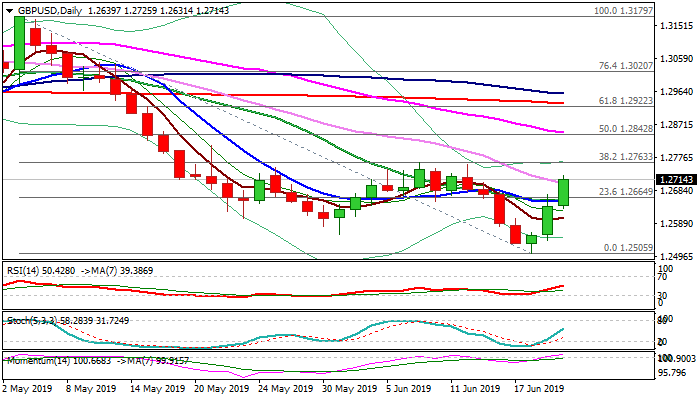
Cable is holding near one-week high at 1.2725, posted on strong post-Fed bullish acceleration, as weak UK retail sales data (May m/m -0.5% vs -0.1% prev/y/y 2.3% vs 5.1% prev) had mild impact on bulls.
Dovish Fed axed the greenback, while more positive tones which diminish fears of no-deal Brexit, further improved the outlook.
Bulls broke above falling 30SMA (1.2705), the last obstacle on the way to key barriers at 1.2763 (double-top/Fibo 38.2% of 1.3179/1.2505 fall), violation of which is expected to generate stronger bullish signal.
BOE MPC meeting is the key event for pound today, with traders expecting the central bank to reiterate its message of interest rate hike, despite Fed's strong dovish stance that further improves the sentiment.
Sterling advanced nearly 1.5% in three days on bounce from new low at 1.2505 (18 June), with sustained break of 1.2763 pivot to spark extension of recovery from 1.2505 and expose targets at 1.2842 (50% retracement of 1.3179/1.2505) and 1.2872 (weekly cloud base).
Converged 10/20SMA's offers solid support at 1.2658/54, which needs to hold and maintain bullish bias.
Res: 1.2725, 1.2763, 1.2810, 1.2842
Sup: 1.2654, 1.2631, 1.2606, 1.2559
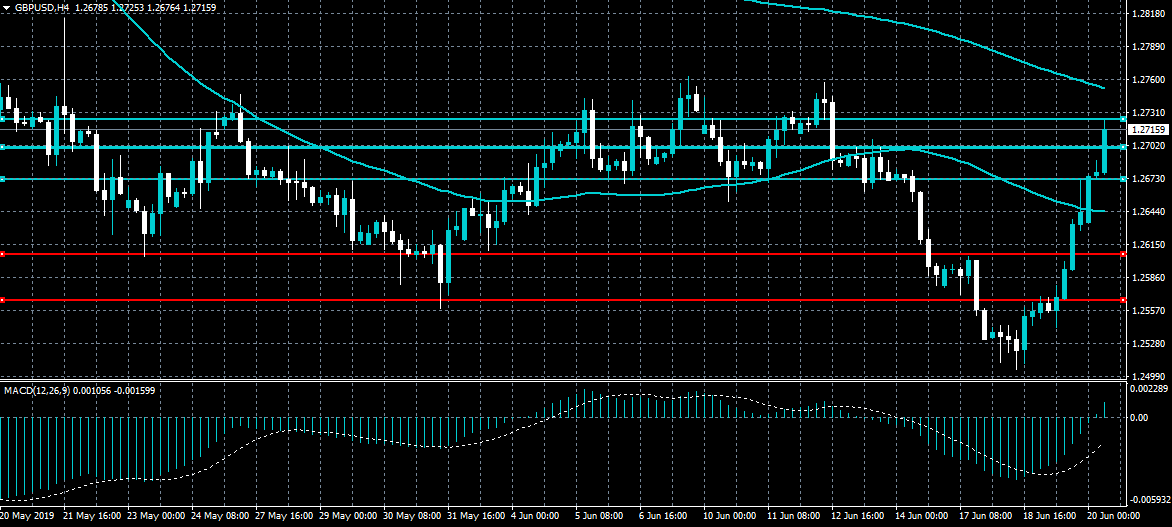
GBPUSD Awaiting BoE Decision
The British pound has so far found resistance from the 1.2730 level against the US dollar as traders turn bullish towards sterling ahead of the BOE rate decision. GBPUSD bulls need to break the 1.2745 resistance level in order to trigger the next upside rally towards the 1.2810 level. Downside risks will start to build towards the GBPUSD pair is sellers move price back under the 1.2645 support level.
If the GBPUSD pair trades above the 1.2645 level, key resistance is found at the 1.2745 and 1.2810 levels.
If the GBPUSD pair trades below the 1.2645 level, key support is found at the 1.2600 and 1.2560 levels.
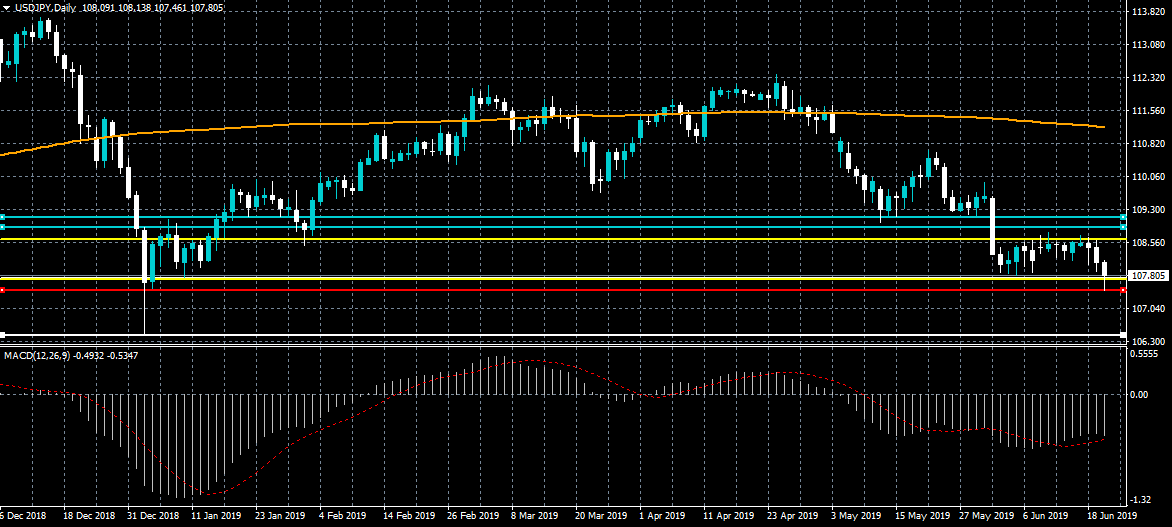
USDJPY BOJ Meeting In Focus
The US dollar has broken its established trading range against the Japanese yen currency, with the pair so far finding support from the 107.60 technical region. The key risk for traders is now the Bank of Japan policy meeting, with bullish spikes towards 109.00 level still possible. Overall, the heavy bearish bias towards the USDJPY pair is valid while price trades below the 108.00 support level.
The USDJPY pair is only bearish while trading below the 108.00 level, key support remains at the 107.60 and 106.80 levels.
If the USDJPY pair trades above the 108.00 level, key technical resistance remains at the 108.80 and 109.00 levels.
GBPJPY Could Recoup Some Losses In Short Term
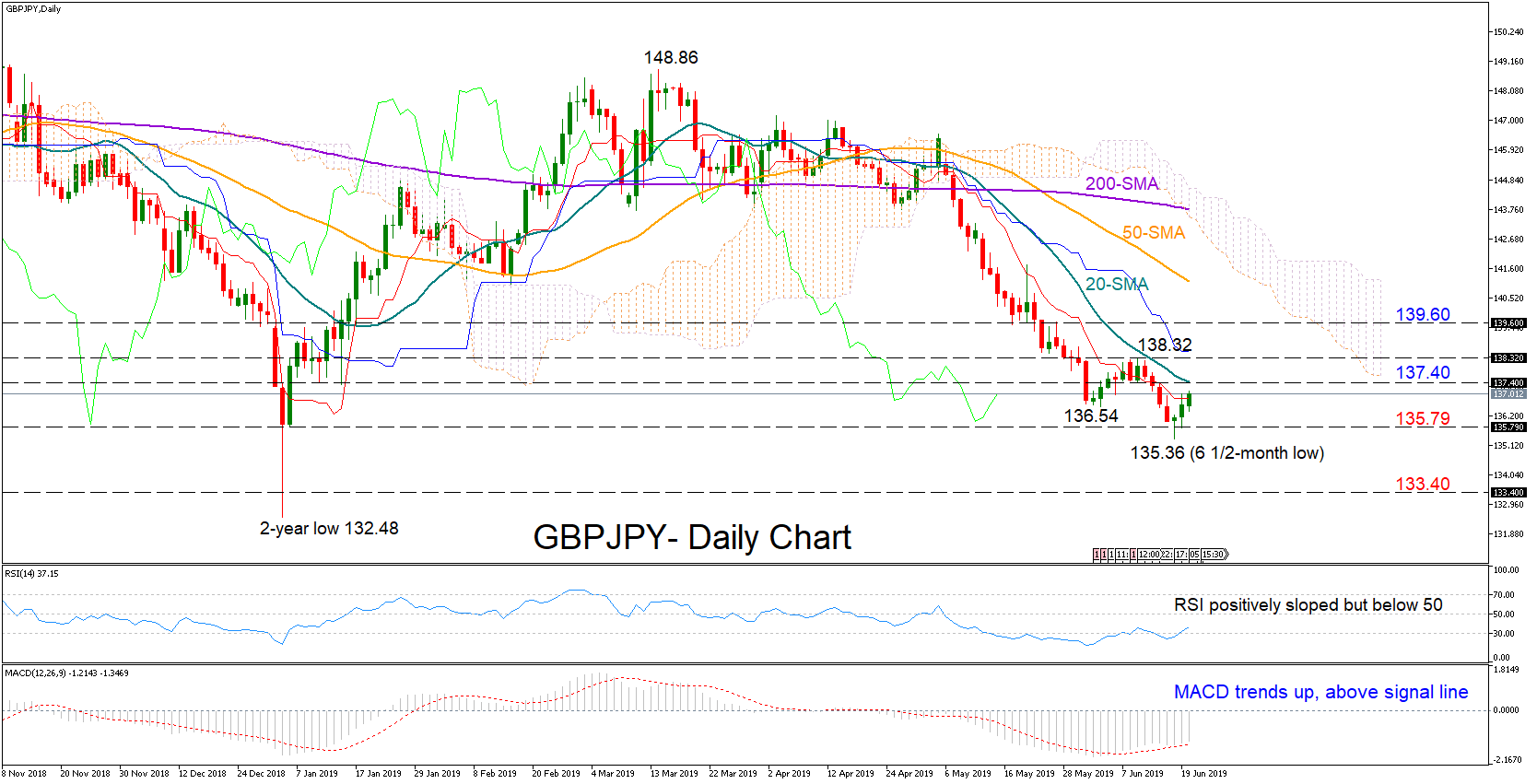
GBPJPY registered another lower low at its March downleg slightly below the key support level of 135.79, but it soon bounced up again as the RSI signaled oversold conditions. The latter is currently moving with a positive slope towards its 50 neutral mark, while the MACD continues to trend up above its red signal line, both suggesting some recovery in the short term.
The price, however, needs to overcome the 20-day simple moving average (SMA) and a former support region of 137.40 to somewhat boost confidence in the market. Buyers may find a rally above the previous high of 138.32 more convincing, consequently sending the price up to the 139.60 barrier.
In the negative scenario, the sell-off could sharpen if the bears clear the 135.79-135.36 zone, shifting the spotlight lower to 133.40, a congested area in 2016, and the 132.48 bottom.
Meanwhile in the medium-term, GBPJPY turned even more bearish after the extension of the March downtrend. With the 50-day SMA holding currently a steep negative slope under the 200-day SMA, hopes for a bull market are weakening.
In brief, the short-term bias is tilted to the upside, while the medium-term picture shows no sign of improvement yet.
Eurozone PMIs In Spotlight After Draghi’s ‘Additional Stimulus’ Comments
The flash release of the Eurozone PMIs for June will be on investors' radar on Friday at 0800 GMT. After the European Central Bank chief, Mario Draghi, gave his clearest indication yet on Tuesday that more stimulus could be on the way, the PMI data will be watched closely for possible signs that Eurozone growth is stagnating again. In the meantime, there is some relief for the euro as the Federal Reserve makes an even bigger dovish turn than the markets were anticipating, pushing the US dollar down.
Risks to Eurozone growth and inflation rising
The Eurozone's economy may have expanded by a solid 0.4% quarter-on-quarter in the first three months of the year, but the second quarter is already proving more challenging. Rising trade tensions and slowing growth in other parts of the world are weighing on the bloc's economy, particularly Germany's, which is heavily exposed to China. The Bundesbank (Germany's central bank) recently said it expects the German economy to contract slightly in the second quarter. The ECB is all too aware of the risks to growth and inflation and has been forced to backtrack on its normalization plans, and even contemplate loosening policy soon.
Steady PMIs predicted for June
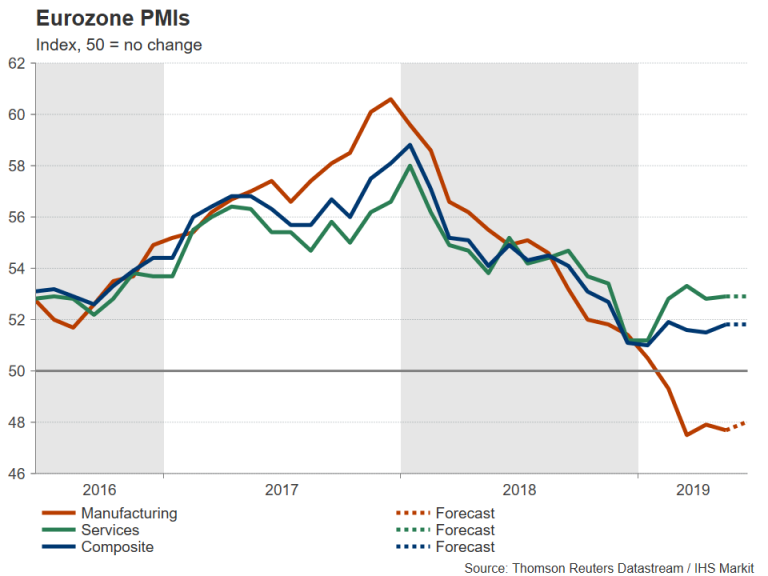
The flash PMIs for June should complete the data for the second quarter and give some idea how the euro area performed during the period. The manufacturing PMI is forecast to edge up slightly from 47.7 to 48.0, though being below 50, that would still represent a decline in activity in the sector. The services PMI is expected to stay unchanged at 52.9, while the composite PMI, which combines both the services and manufacturing sectors, is also forecast for no change at 51.8, suggesting no improvement in overall economic activity in June.
Although such PMI readings alone are unlikely to alarm ECB policymakers, when taken into consideration with falling inflation, the central bank risks a further delay in lifting inflation to its target of close to but below 2%. More worrying for the ECB is the sharp drop in inflation expectations since late last year, so without a significant acceleration in growth, neither market-based expectations nor actual measures of inflation are likely to rise.
Draghi does a U-turn
Mario Draghi may only have a few months left in his term as President but appears ready for a major policy U-turn. Speaking in Portugal at the ECB's annual Central Banking Forum earlier this week, Draghi told the audience “In the absence of improvement, such that the sustained return of inflation to our aim is threatened, additional stimulus will be required”.
The euro initially fell on Draghi's remarks but was able to rebound as the Fed later also signalled that it could ease policy soon. With the ECB having less bandwidth than the Fed to cut rates and purchase additional bonds, the single currency may not see the same degree of downside as with previous times the Bank eased policy if the Fed is cutting rates simultaneously.
Limited downside for euro
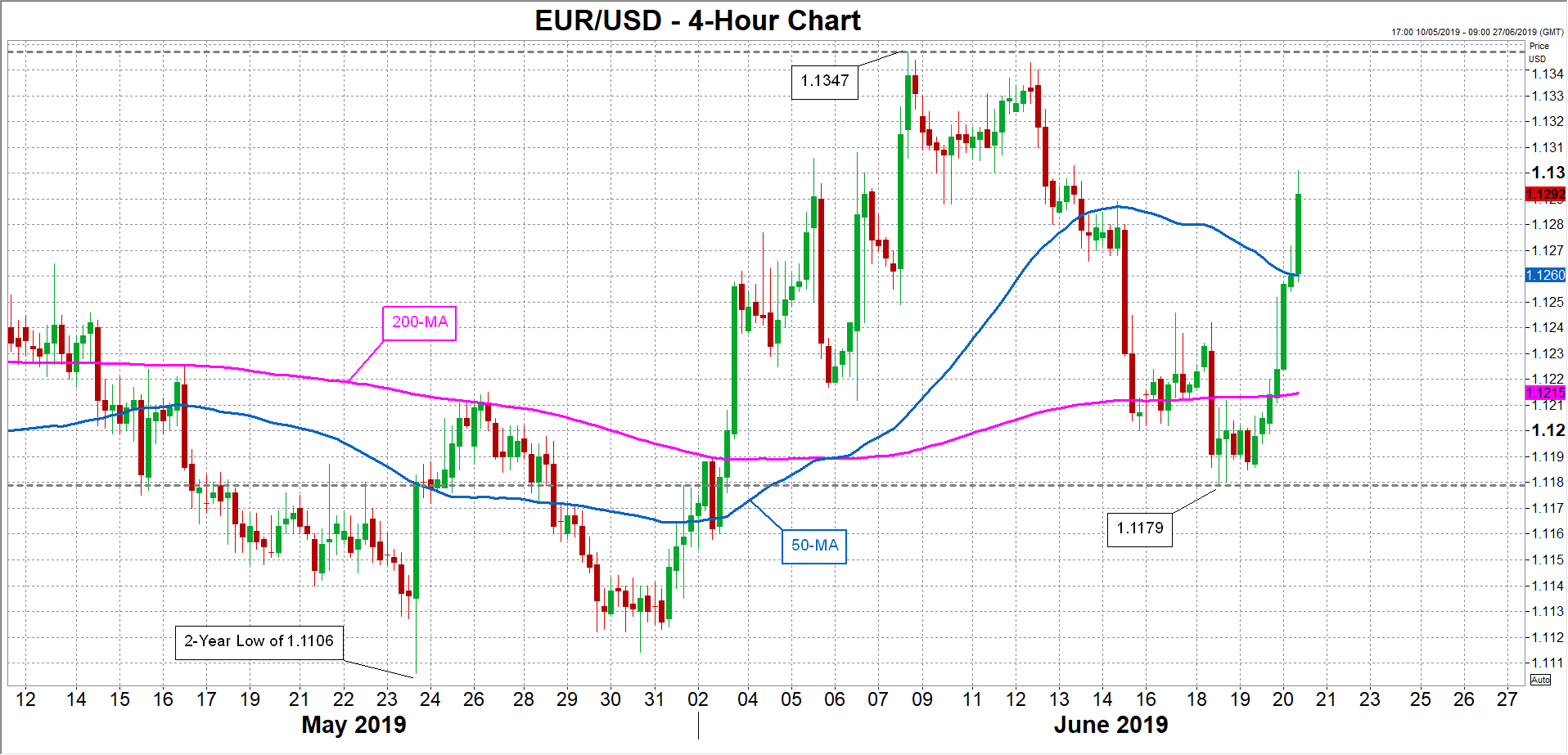
In the immediate term, the euro could come under some selling pressure if the PMIs miss expectations by a big margin. The June low of $1.1179 is the critical support to watch that could break the euro's current upswing. However, should the PMI numbers impress and point to a steady growth picture, the euro could extend its positive momentum to reclaim the $1.13 handle and challenge the recent top $1.1347.
The US Dollar Is In The Red After The Fed Meeting
The US dollar weakened against a basket of major currencies after the Fed meeting. The regulator left the interest rate in the range of 2.25-2.50% per annum but made it clear that it could cut the rate even by half a percentage point before the end of the current year due to the uncertainty in the economy and the weak rate of inflation. The US currency is under pressure as a result of the news that US President Donald Trump believes that he has the authority to appoint another head of the Fed instead of Jerome Powell. The US dollar index #DX closed yesterday in the negative zone (-0.59%).
The Bank of Japan, in turn, left the main parameters of monetary policy unchanged, as well as confirmed plans to keep the key rate at the "extremely low" level until spring 2020. Today, the Bank of England meeting is in the focus of attention. As analysts forecast, the regulator will keep the interest rate unchanged at 0.75%.
The "black gold" prices are rising due to the reduction of US oil inventories. At the moment, futures for the WTI crude oil are testing the mark of $55.45 per barrel.
Market Indicators
- Yesterday, the bullish sentiment was observed in the US stock market: #SPY (+0.23%), #DIA (+0.09%), #QQQ (+0.38%).
- The 10-year US government bonds yield dropped significantly. At the moment, the indicator is at the level of 2.00-2.01%.
The news feed on 2019.06.20:
- Report on retail sales in the UK at 11:30 (GMT+3:00);
- Bank of England interest rate decision at 14:00 (GMT+3:00);
- Philadelphia Fed manufacturing index at 15:30 (GMT+3:00).
EURUSD Remains Bullish With Eyes On 1.1347 Resistance
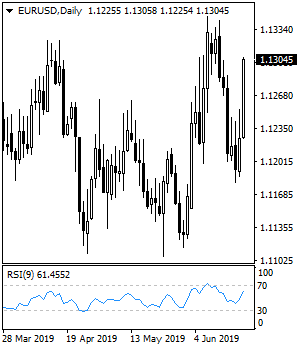
EURUSD remains bullish with eyes on 1.1347 resistance in the days ahead. Support comes in at the 1.1250 where a violation will turn risk to the 1.1200 level. A break below here will target the 1.1150 level. Further down, support sits at the 1.1100. Conversely, on the upside, resistance resides at 1.1347 level with a break through there opening the door for further upside towards the 1.1.1400 level. Further up, resistance comes in at the 1.1450 level where a violation will expose the 1.1500 level. Its daily RSI is bullish and pointing higher suggesting further strength. All in all, EURUSD expects more recovery to occur in the days ahead.
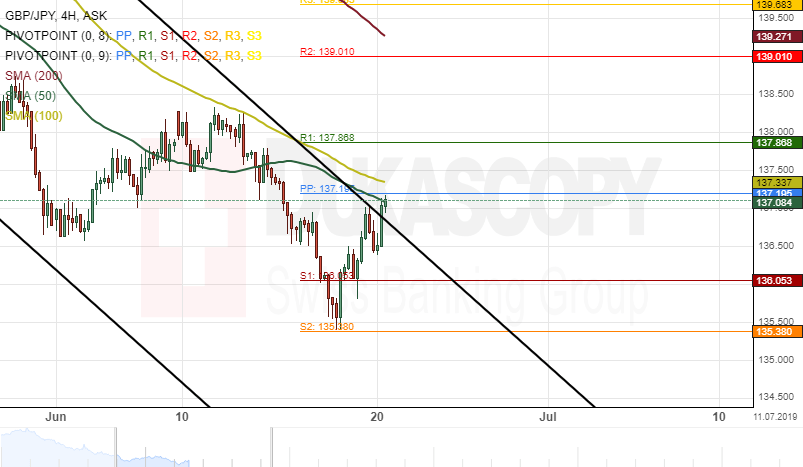
GBP/JPY 4H Chart: Set For Breakout
The Pound Sterling edged lower by 1.98% in value against the Japanese Yen during last week's trading sessions. The currency pair bounced off from a support level at 135.38 on June 18.
The exchange rate was trading near the upper boundary of a descending channel pattern at 136.55 and could be set for a breakout.
If this breakout occurs, a surge towards a resistance level formed by the 200-hour simple moving average could follow.
However, the combination of the 50– and 100-hour SMAs at 137.37 might hinder the currency exchange rate progress during next week's trading sessions.
AUD/JPY 4H Chart: Remains Near Support Cluster
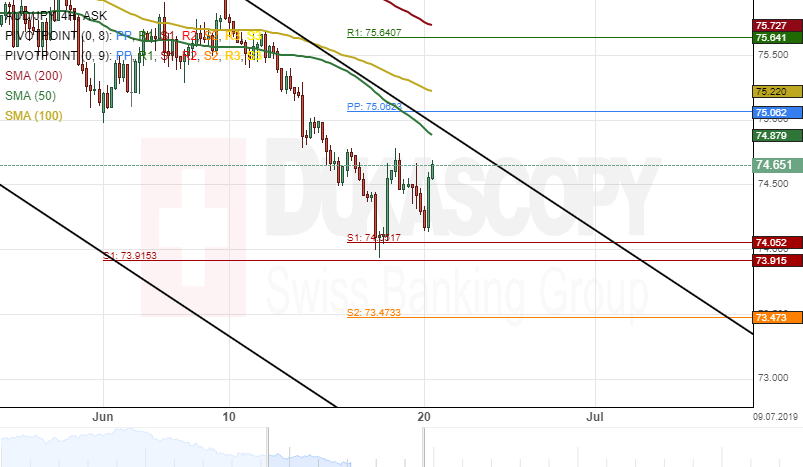
The Australian Dollar has continued to depreciate in a descending channel against the Japanese Yen. The currency pair decline by 1.31% in value during last week's trading sessions.
The exchange rate was trading near a support cluster formed by the combination of the weekly and the monthly pivot points at 73.91 during the morning hours of Thursday's trading session.
If this support cluster holds, a breakout through the upper boundary of the channel pattern could occur within the next 48 hours.
However, if the pair breaks the cluster as mentioned earlier, bears could drive the rate further south during next week's trading sessions.
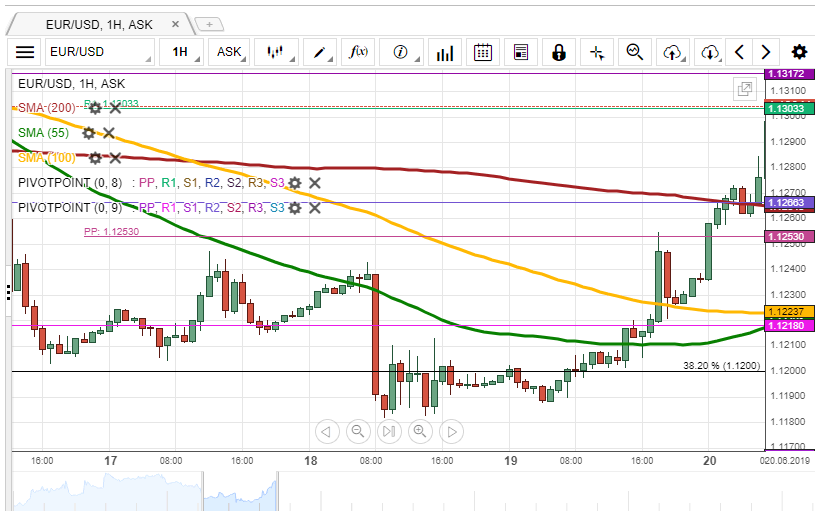
EUR/USD Tests Weekly R1
Yesterday, the EUR/USD currency pair surged to the 1.1260 level. During today's morning, the pair was testing the resistance level formed by the weekly R1 at 1.1303.
If the given resistance level holds, it is expected, that a reversal south could occur in the nearest future. Note, that in this case the exchange rate could be supported by the 200-hour SMA, the weekly PP and the monthly R1 in the 1.1254/1.1265 range.
If the given resistance does not hold, it is likely, that the rate could continue to go upwards. Note, that the nearest resistance level could be the monthly R2 at 1.1338.