

Sample Category Title
Fed Keeps Rates Steady, But Majority of Members See Cuts ahead
- As expected, the Federal Open Market Committee (FOMC) decided to maintain the target range for the federal funds rate at 2.25-2.50%. The decision was not unanimous however, with Bullard dissenting in favor of a 25 basis point rate cut.
- However, FOMC officials did downgrade their assessment of current economic conditions. The statement still characterized the labor market as strong, and growth of economic activity as "moderate", but noted that indicators of business fixed investment have been soft.
- The statement also acknowledged that uncertainties around the outlook have increased. Reference to remaining "patient" is gone. In its stead, the committee will now "closely monitor" the implications of incoming information and "act" as appropriate to sustain the expansion.
- Not surprisingly, the median FOMC members does not expect to raise rates any further over the forecast horizon, a notable decrease from March. The majority of FOMC members expect to keep rates steady in 2019, but it is a narrow majority, with 8 of 17 expecting to lower rates this year. The majority do expect to be lowering rates next year, before raising them back up to current level in 2021.
- The FOMC notably lowered its expectation of the "longer run" fed funds rate by 25 basis points to 2.5%, right where the upper limit is now.
- These lower rate expectations were consistent with a lower inflation forecast. Relative to the previous Summary of Economic Projections in March:
- The median projection for real GDP growth in 2019 was unchanged at 2.1%. However, 2020 was revised up (2.0% from 1.9%), likely reflecting the median expectation for a rate cut. The expectation for growth over the longer run was unchanged at 1.9%.
- The median unemployment rate forecast was lowered over the forecast horizon, including the longer run expectation, which now sits at 4.2% (versus 4.3% in March).
- Most importantly, the median estimate for core PCE inflation was revised down in 2019 (1.8% from 2.0%) and 2020 (1.9% from 2.0%). Although easier monetary policy is expected to lead inflation to rise back at the 2% target in 2020.
Key Implications
- Few expected the Fed to cut rates today, but there was a remarkable shift in the number of members who expect the next move in interest rates will be down. And the most dovish member, Bullard, dissented on the decision, believing the Fed should have cut rates at this meeting. The majority of members expect to cut rates 25 basis points next year, with the median dot for 2020 50 basis points lower than its March level.
- We have recently shifted our own forecast in favor of Fed rate cuts given increased uncertainty in the global economic outlook, thanks largely to tensions on the trade front. Today's projections make clear that the Fed is not too far away from our own view, and has committed to "act" if need be. We will listen to the press conference closely to see how the Chair is thinking about the uncertainty and risks stemming from the U.S.'s aggressive stance on tariffs, and whether a positive outcome at next week's G20 meeting might mean for the outlook.
Fed Policymakers Losing Patience
- As expected, the target range for the fed funds rate was held steady at 2.25-2.50% today
- The Fed’s median interest rate projections are now showing a rate cut by the end of this year – with 7 participants thinking two 25 basis point cuts will be appropriate
- The policy statement removed the reference to a “patient” approach to future rate adjustments, reinforcing expectations that a rate cut could be coming as soon as the next meeting in July
A policy statement that was slightly more dovish than already dovish expectations will only reinforce market expectations that a 25 basis point cut to the fed funds target range could be on its way – and as soon as the next policy decision in July. A total of 8 out of 17 meeting participants think it will be appropriate to cut rates by the end of this year. 7 of those think two 25 basis point cuts will be appropriate and one (James Bullard) voted for a rate cut immediately in June. That is a sharp shift from March when no members thought a rate cut would be appropriate this year – and a dramatic change from the end of last year when the median participant still saw 2 more hikes this year. The statement dropped the word “patient” in determining future adjustments to interest rates. That will only reinforce expectations that a potential cut in rates at the next meeting in July is firmly on the table.
Much of the shift in policymaker rate plans has come via an escalation in international trade concerns. The US industrial sector has already weakened following the implementation of new tariffs on imports from China late last year, and that was before a hike in the tariff rate on those imports from 10% to 25% in May. To be sure, as the Fed broadly reiterated, the other (non-industrial sector) 85% of the US economy has still looked relatively solid. The unemployment rate is at multi-decade lows and wage growth has been tracking 3% or higher. That admittedly is an odd backdrop to be talking about rate cuts from levels that are still historically quite low. But muted inflation trends are also leaving the Fed with plenty of flexibility to get ahead of any potential future economic shock, and escalating trade tensions certainly count as a legitimate risk at this point. We still think tensions could ease around next week’s G-20 meetings in Japan, but the Fed is also clearly aware of the damage that further escalation could have on the US economy and is ready, willing, and able to step in with rate cuts if needed.
Fed Powell press conference live stream
https://www.youtube.com/watch?v=vuVtXgnq21E
Dollar down but not out, Fed not patient but not impatient
Dollar drops broadly after Fed stands pat, removed "patience" with "will act as appropriate" (statement) . In the new economic projections, Fed forecasts no change in interest rate in 2019, but projects one rate cut in 2020. Selloff in the greenback is so far limited for the moment. Fed does deliver dovishness to the market. Yet, it's possible not dovish enough to those who're expecting two rate cuts this year, with one in July. Fed is no longer patient, but the overall announce argues that it's in no rush neither.
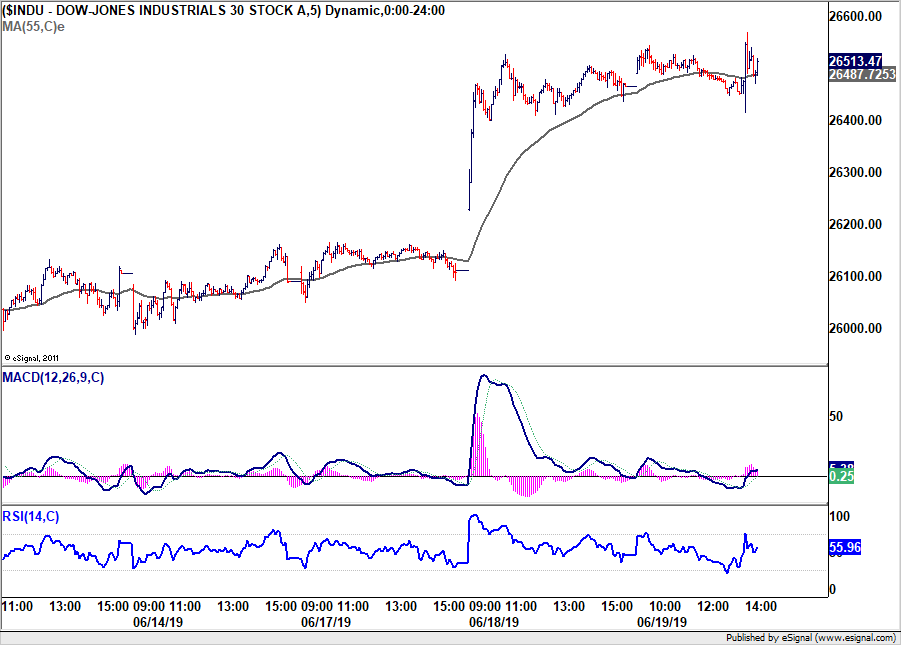
At this point, DOW is only up around 50 pts, or 0.20%.
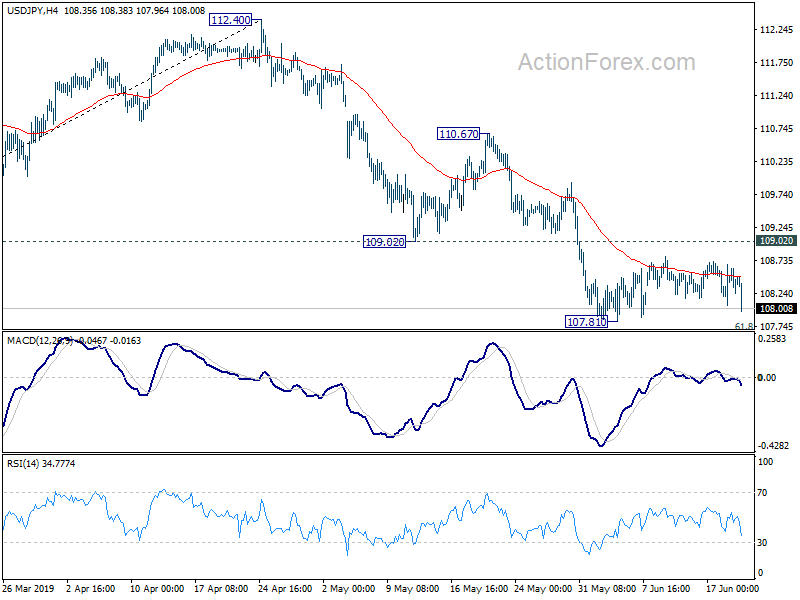
USD/JPY is still held above 107.81 low.
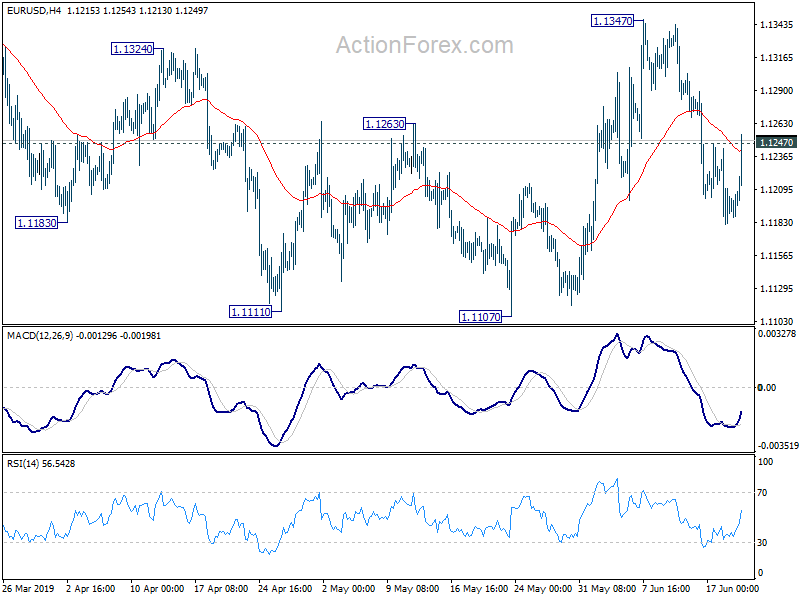
Though, EUR/USD's breach of 1.1247 suggests it's heading back to 1.1347 resistance.
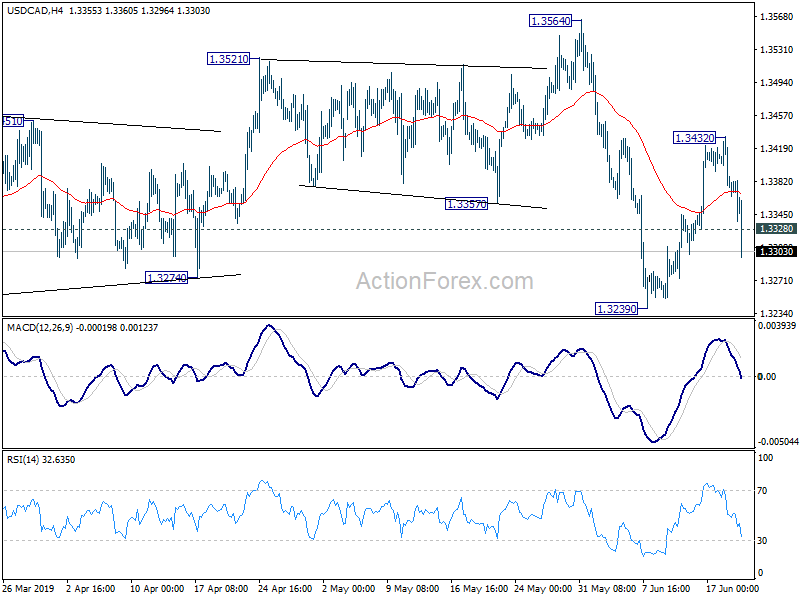
USD/CAD also finally makes up its mind and break through 1.3328 support, heading back to 1.3239. CAD is also rising on stronger than expected inflation data released earlier today.
Fed forecasts rate cut in 2020, revised down inflation projections
The most important part of Fed's new projection is that policymakers are expecting possibly one 25bps rate cut in 2020, instead of one 25bps rate hike. Median federal funds rates is at 2.1% by the end of 2020, revised down from 2.6%. Nevertheless, for this year, median federal funds rates forecast is unchanged at 2.4%. Fed indeed expect interest rate to go back to 2.4% in 2021.
Inflation appears to be main driver behind the forecasts. Core PCE inflation projections in 2019 and 2020 are both revised down. Though, it should b noted that GDP growth for 2020 was revised up, likely due to the rate cut. Unemployment rate forecasts are revised down for whole horizon.
Overall, the economic projections are in-line with Fed's statement that "will act as appropriate" to economic data. But the so called "insurance" rate cut may not come as early as some expected.
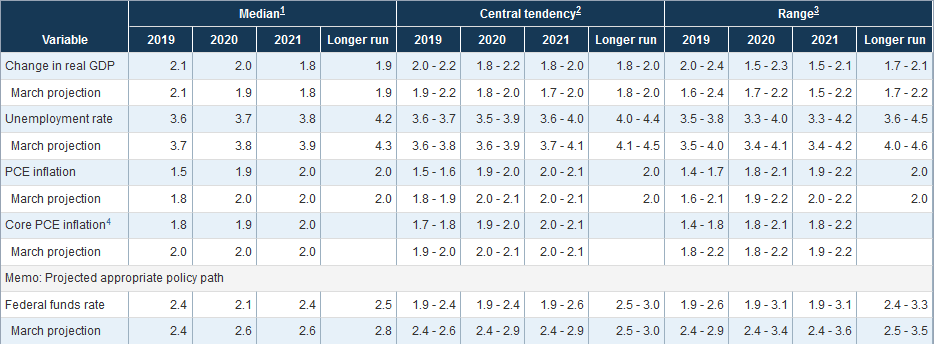 Here are some details.
GDP growth:
- 2019 at 2.1%, unchanged
- 2020 at 2.0%, revised up from 1.9%.
- 2021 at 1.7%, unchanged.
Unemployment rate:
- 2019 at 3.6%, revised down from 3.7%.
- 2020 at 3.7%, revised down from 3.8%.
- 2021 at 3.8%, revised down from 3.9%.
Core PCE inflation:
- 2019 at 1.8%, revised down from 2.0%.
- 2020 at 1.9%, revised down from 2.0%.
- 2021 at 2.0%, unchanged.
Federal funds rate:
- 2019 at 2.4%, unchanged.
- 2020 at 2.1%, revised down from 2.1%.
- 2021 at 2.4%, revised down from 2.6%.
- Longer range rate at 2.5%, revised down from 2.8%.
Fed keeps interest rate at 2.25-2.50%, no longer patient
Fed kept federal funds rate unchanged at 2.25-2.50% as widely expected. The most important change in the statement is dropping the language that "Committee will be patient as it determines what future adjustments". Instead, the committee "will act as appropriate to sustain the expansion, with a strong labor market and inflation near its symmetric 2 percent objective." Another important point to note is that Bullard dissented and wanted a cut.
On inflation, Fed acknowledged that "market-based measures of inflation compensation have declined". Though, it maintained that "survey-based measures of longer-term inflation expectations are little changed." On the positive side, Fed also said, "growth of household spending appears to have picked up".
Full statement below.
Federal Reserve Issues FOMC Statement
Information received since the Federal Open Market Committee met in May indicates that the labor market remains strong and that economic activity is rising at a moderate rate. Job gains have been solid, on average, in recent months, and the unemployment rate has remained low. Although growth of household spending appears to have picked up from earlier in the year, indicators of business fixed investment have been soft. On a 12-month basis, overall inflation and inflation for items other than food and energy are running below 2 percent. Market-based measures of inflation compensation have declined; survey-based measures of longer-term inflation expectations are little changed.
Consistent with its statutory mandate, the Committee seeks to foster maximum employment and price stability. In support of these goals, the Committee decided to maintain the target range for the federal funds rate at 2-1/4 to 2-1/2 percent. The Committee continues to view sustained expansion of economic activity, strong labor market conditions, and inflation near the Committee's symmetric 2 percent objective as the most likely outcomes, but uncertainties about this outlook have increased. In light of these uncertainties and muted inflation pressures, the Committee will closely monitor the implications of incoming information for the economic outlook and will act as appropriate to sustain the expansion, with a strong labor market and inflation near its symmetric 2 percent objective.
In determining the timing and size of future adjustments to the target range for the federal funds rate, the Committee will assess realized and expected economic conditions relative to its maximum employment objective and its symmetric 2 percent inflation objective. This assessment will take into account a wide range of information, including measures of labor market conditions, indicators of inflation pressures and inflation expectations, and readings on financial and international developments.
Voting for the monetary policy action were Jerome H. Powell, Chair; John C. Williams, Vice Chair; Michelle W. Bowman; Lael Brainard; Richard H. Clarida; Charles L. Evans; Esther L. George; Randal K. Quarles; and Eric S. Rosengren. Voting against the action was James Bullard, who preferred at this meeting to lower the target range for the federal funds rate by 25 basis points.
(FED) Federal Reserve Issues FOMC Statement
Information received since the Federal Open Market Committee met in May indicates that the labor market remains strong and that economic activity is rising at a moderate rate. Job gains have been solid, on average, in recent months, and the unemployment rate has remained low. Although growth of household spending appears to have picked up from earlier in the year, indicators of business fixed investment have been soft. On a 12-month basis, overall inflation and inflation for items other than food and energy are running below 2 percent. Market-based measures of inflation compensation have declined; survey-based measures of longer-term inflation expectations are little changed.
Consistent with its statutory mandate, the Committee seeks to foster maximum employment and price stability. In support of these goals, the Committee decided to maintain the target range for the federal funds rate at 2-1/4 to 2-1/2 percent. The Committee continues to view sustained expansion of economic activity, strong labor market conditions, and inflation near the Committee's symmetric 2 percent objective as the most likely outcomes, but uncertainties about this outlook have increased. In light of these uncertainties and muted inflation pressures, the Committee will closely monitor the implications of incoming information for the economic outlook and will act as appropriate to sustain the expansion, with a strong labor market and inflation near its symmetric 2 percent objective.
In determining the timing and size of future adjustments to the target range for the federal funds rate, the Committee will assess realized and expected economic conditions relative to its maximum employment objective and its symmetric 2 percent inflation objective. This assessment will take into account a wide range of information, including measures of labor market conditions, indicators of inflation pressures and inflation expectations, and readings on financial and international developments.
Voting for the monetary policy action were Jerome H. Powell, Chair; John C. Williams, Vice Chair; Michelle W. Bowman; Lael Brainard; Richard H. Clarida; Charles L. Evans; Esther L. George; Randal K. Quarles; and Eric S. Rosengren. Voting against the action was James Bullard, who preferred at this meeting to lower the target range for the federal funds rate by 25 basis points.
Leadership Race Overshadows BoE
Central bank to play second fiddle in coming months
It’s already been a quite a week for the UK, with leadership elections taking place as we continue to edge towards the final two that will face the Conservative membership to become the next Prime Minister.
It’s not often that the Bank of England is overshadowed but this week is certainly one of those and with Brexit on the horizon, they may have to get used to playing second fiddle. Given their experience of the last few years, I’m sure Governor Mark Carney and his colleagues will have no issue with not being in the spotlight for a while.
Still, while they may not have the leading role this week, they may still have a part to play. Granted, it’s not “Super Thursday” so there’s no press conference and no new economic projections but there is a statement released alongside the announcement which may contain some hints. That said, markets are currently pricing in nothing for the next 12 months at least.
- What to look out for in the leadership election
- Can we expect anything from the BoE?
- Will Sterling stay in freefall?
Where do we stand in the race to become PM?
The pound is going to continue to be volatile over the coming days, with at least one, probably two votes, still to go before we learn which candidates will make the final two. Boris Johnson looks all-but certain to make up half of the duo, leaving the remaining candidates to fight it out for the other spot.
The elimination of Dominic Raab on Tuesday will likely come as a relief. Raab had previously promised to leave on 31 October even if it meant doing so without the backing of Parliament. Johnson has also alluded to similar so a duo including the two would likely have been the worst-case scenario for the pound.
Others may not be so attached to 31 October but one thing they all have in common is they want to deliver on the referendum result, they just have their own ideas on how that will be achieved and where their own red lines are drawn, which is where sterling volatility comes back into it.
Will the pound continue to fall?
Ultimately, the pound has been on a slippery slope for the last month or so as it became perfectly clear that Boris isn’t only leading but he’s running away with it. From what we know about the Conservative membership – who will vote on the final two over the course of a month – he seems to fit the bill on what they want on Brexit more than anyone else.
Of course, there’s always room for a surprise, especially when it comes to a binary vote. It’s almost three years to the day that so many – including the markets – were convinced that the UK would in fact vote to remain in the European Union. If nothing else, it would have made the last few years more tolerable.
To bring this back to the BoE, with so much uncertainty in the UK right now and the global outlook cloudy at best, it’s no wonder expectations for rate hikes or cuts are so low. This may make the BoE announcement a little dull on this occasion but there’s no lack of other catalyst.
We’ll also get some retail sales data on Thursday, following the release of the inflation figures on Wednesday showing CPI is running around the BoE’s target. Again, this may be overshadowed but it may be a little more exciting than the BoE.
All considered, it’s been a torrid time for the pound but this begs the question, what is left to be priced in, barring no deal? If there’s not much left to be priced in, how much further will the pound fall? And is it primed for correction?
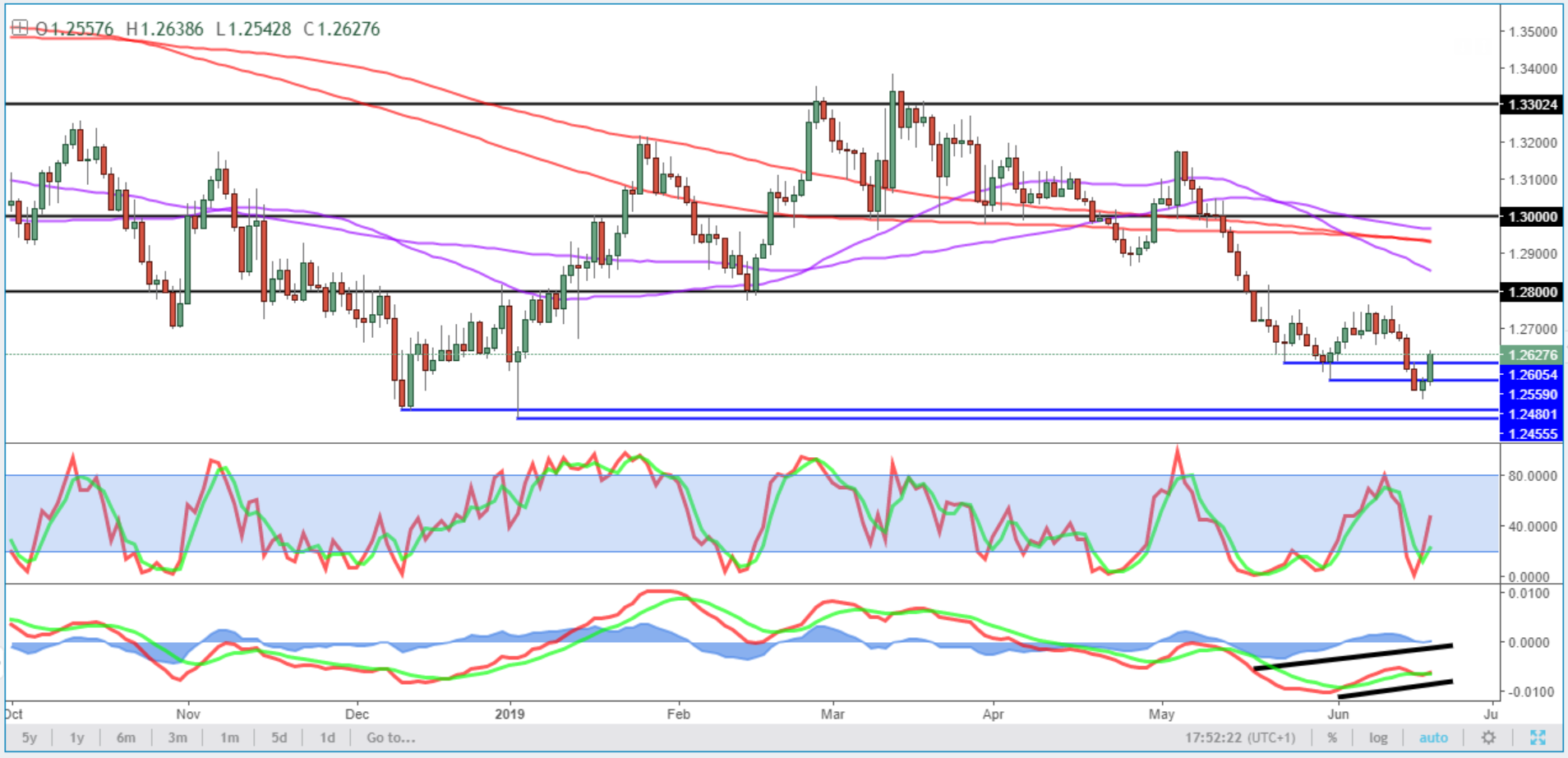
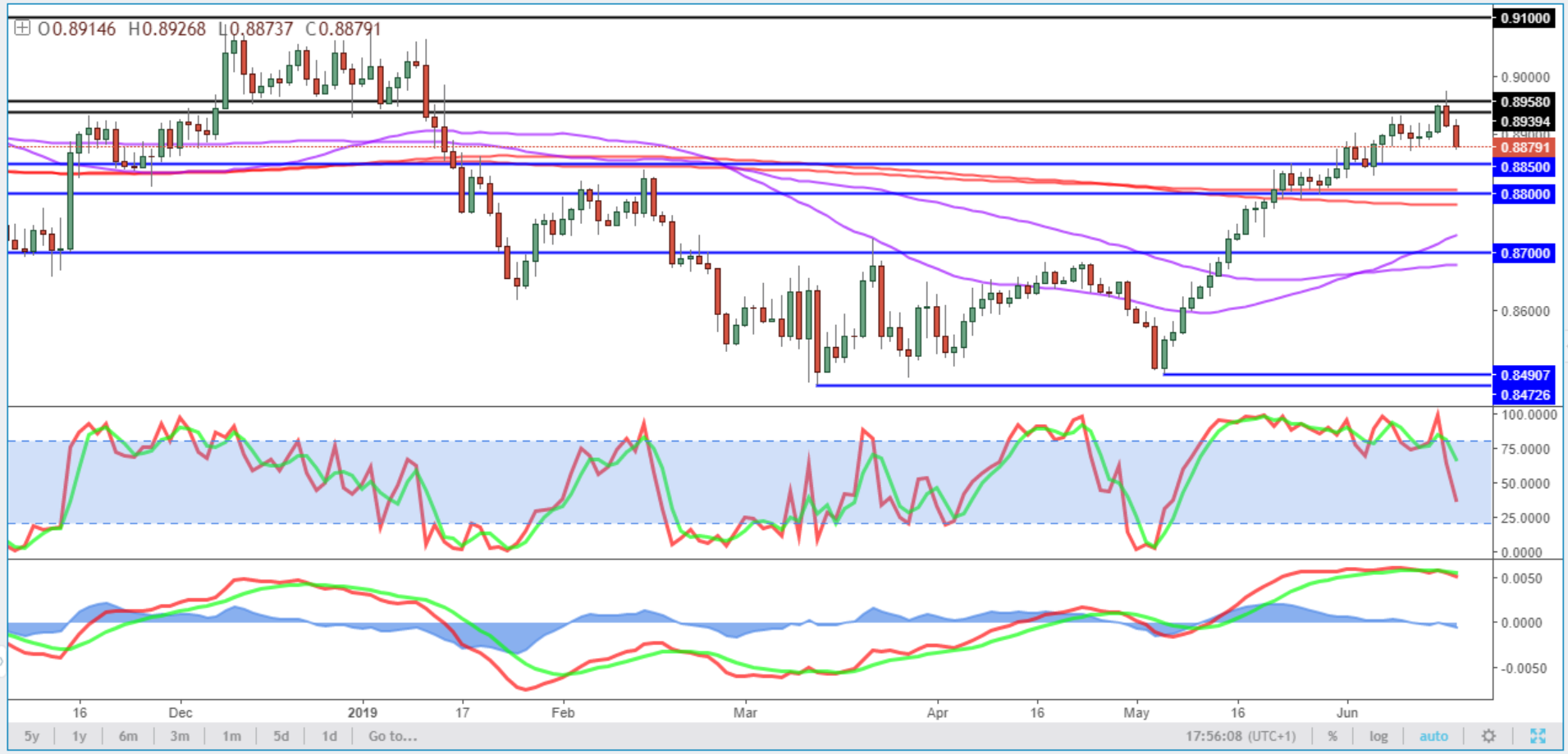
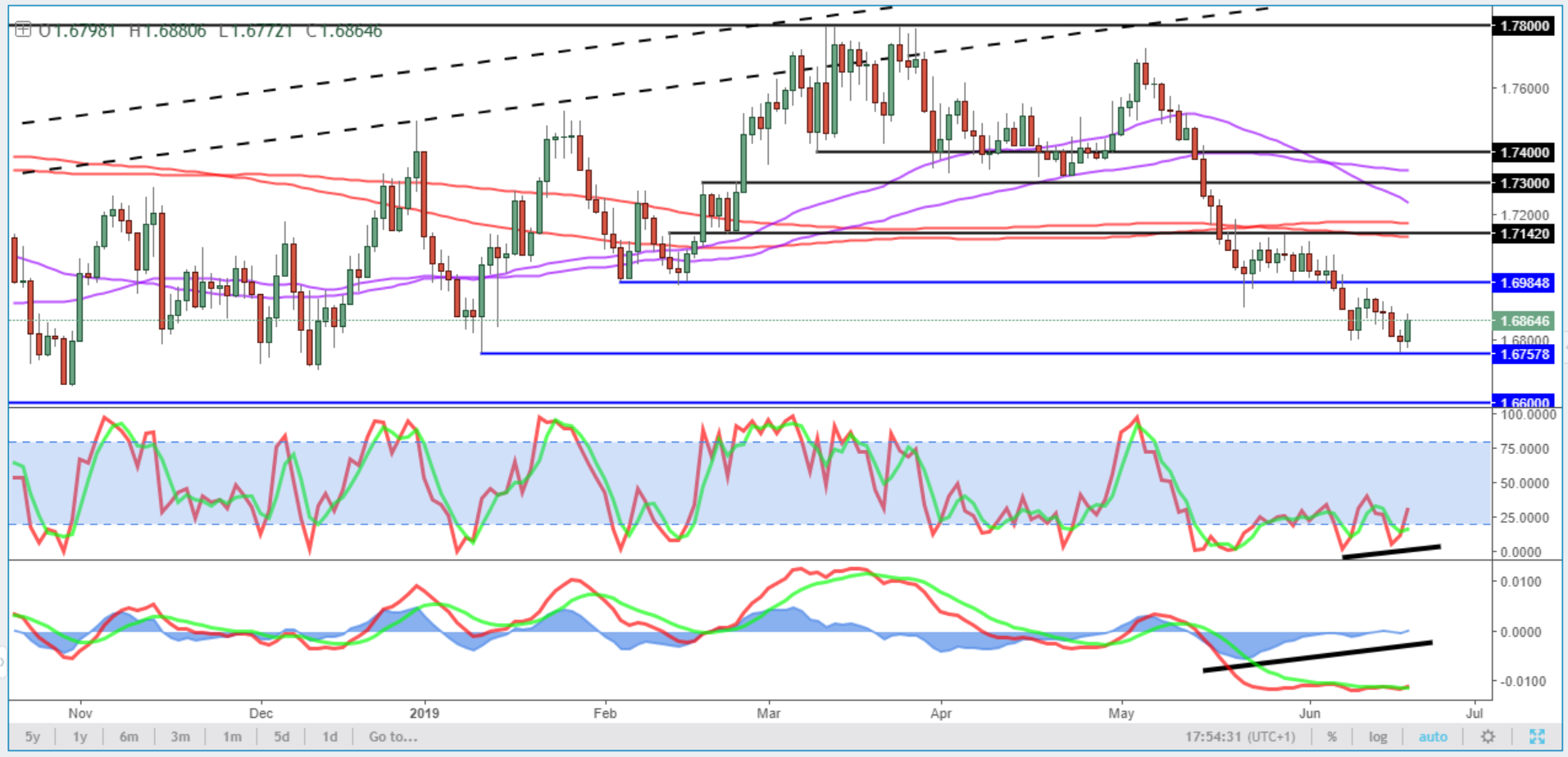
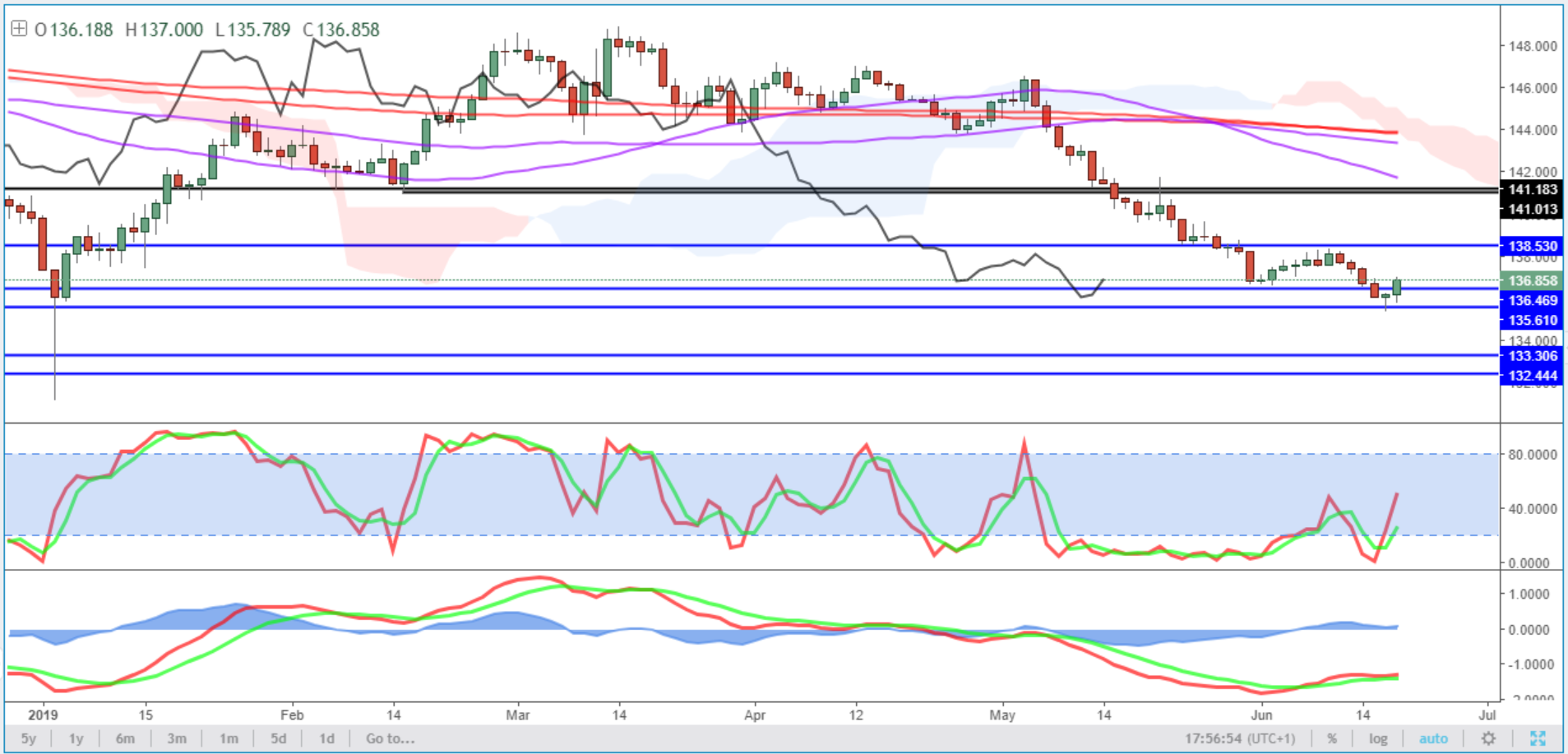
One thing all the charts below have in common is that we’re starting to see divergences, with the momentum indicators – particularly the MACD histogram – no longer making new lows alongside price. While this doesn’t indicate an immediate reversal, it does suggest the trend is running out of steam.
GBPUSD
EURGBP
GBPCAD
GBPJPY
Boris Johnson wins another round of Conservative leadership vote, Stewart eliminated
Boris Johnson wong another round of Conservative leadership ballot today, getting 143 votes. Main rival Jeremy Hunt followed as second and won 54 votes. Michael Gove got 51 while Sajid Javid got 38. Rory Stewart got only 27 and was eliminated.
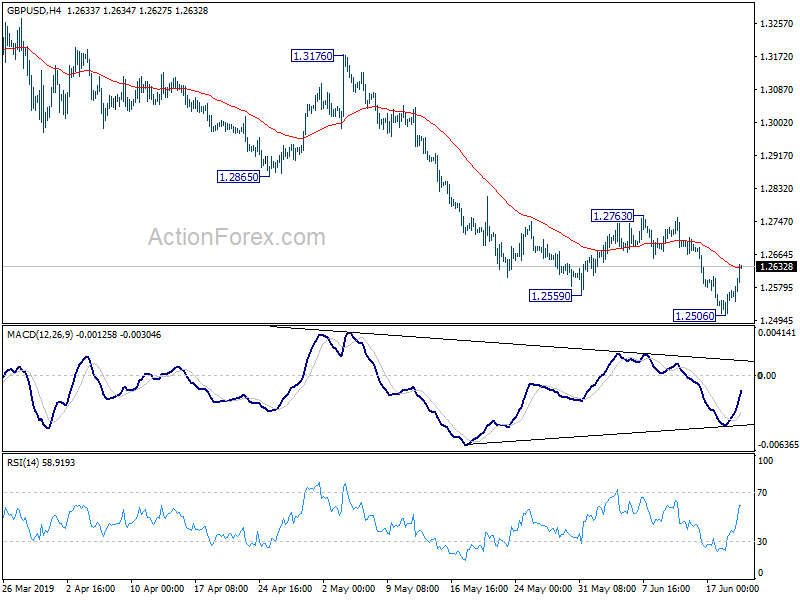
GBP/USD is in a strong recovery today but upside is held well below 1.2763 resistance. Thus, near term outlook remains bearish. Next move will depend on FOMC rate decision.
USTR Lighthizer: It’s in the interests of both China and US to have a deal
US Trade Representative Robert Lighthizer told the House Ways and Means Committee that he's going to have a phone call with Chinese Vice Premier Liu He "in the next day and a half", regarding restarting trade negotiation. And, he will meet Liu together with Treasury Secretary Steven Mnuchin in Osaka next week, ahead of the Trump-XI summit.
Lighthizer noted that "we have a very unbalanced relationship with China and we have one that risks literally the jobs of the future." But he also admitted that "it's in the interests of both China and the United States to have some kind of successful agreement."