Sample Category Title
Slow But Steady, NZ GDP, March Quarter 2019
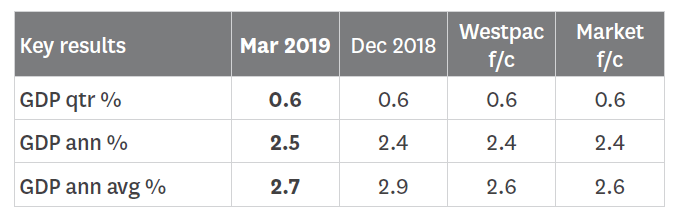
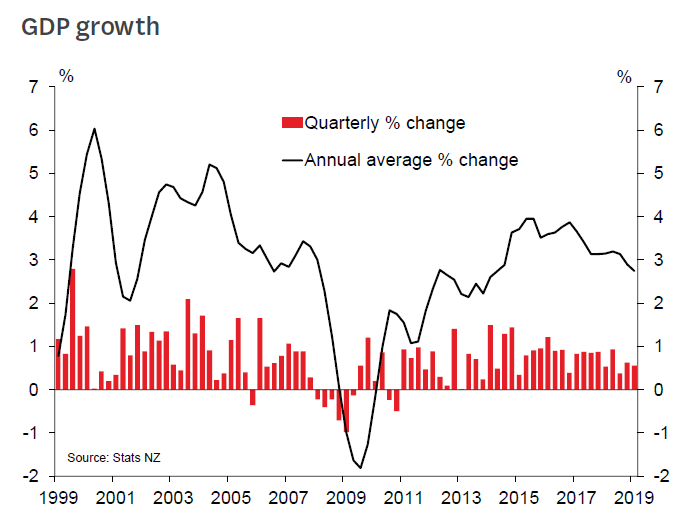
- GDP rose by 0.6% in the March quarter, in line with market forecasts.
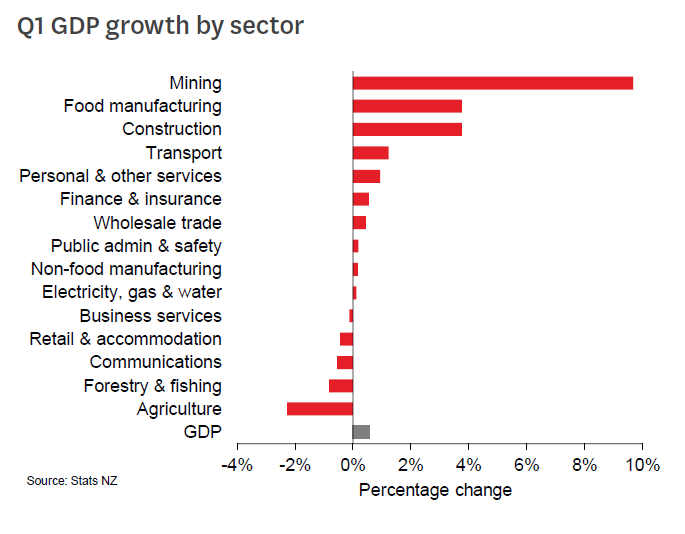
- There were strong gains in construction, mining and food manufacturing, though the risk is that some of these gains are reversed in the next quarter.
- Growth in the service sectors was subdued in most cases.
- Today's result was ahead of the Reserve Bank's already-low forecast, and should be enough to leave it in data watching mode for now.
The New Zealand economy expanded by 0.6% in the March quarter, which was in line with our view and with market forecasts. There were some small upward revisions to the previous two quarters, which lifted the annual growth rate to a slightly stronger than expected 2.5%.
The pace of growth has slowed from its peaks in the last couple of years. We put this down mostly to domestic factors: the unwinding of the Canterbury rebuild, the cooling in the housing market, and more recently, low confidence weighing on firms' hiring and investment plans. The latter in particular will not be alleviated quickly. However, we do expect growth to accelerate over the next year or so. Interest rates are low, government spending is ramping up, and there is a substantial amount of building work in the pipeline.
The Reserve Bank had already braced itself for some nearterm softness in GDP, forecasting a 0.4% quarterly increase in its May Monetary Policy Statement. Today's result should give the RBNZ some comfort about the state of the economy, though it will be tempered by the fact that June quarter indicators have so far been subdued. We'll discuss what to expect from next week's OCR review in our preview bulletin tomorrow.
Turning to the details of today's release, the breakdown by sector was broadly in line with our forecasts. Construction and food manufacturing made strong gains for the quarter, but growth elsewhere was patchy.
The result was slightly flattered by a 9.6% jump in the mining sector. While there was a lift in oil and gas extraction over the quarter, much of this gain likely reflects exploratory drilling at the Kohatukai field, which has since ended without success. Consequently, this will be a drag on growth in the next quarter.
Construction activity rose by 3.7%, with strong gains in both residential (+2.7%) and non-residential building (+9.9%). Building consents are clearly pointing to a strong pipeline of building work for the next year, though it was surprising to see how much of it came through in the March quarter. The result was tempered by another steep fall in civil construction (-6.4%), which in part reflects the wind-down of quake-related repairs.
Food manufacturing rose by 3.8% for the quarter. While dry conditions weighed on both agricultural output and dairy processing, this was more than offset by strong gains in areas such as fruit and beverages. The latter can be quite jumpy, and the risk is for an unwind in the next quarter.
The service sectors were subdued overall, with growth of just 0.2%. Retail rose by a modest 0.5%, accommodation was dragged down by a drop in tourist numbers, real estate services fell as house sales slowed, and telecommunications fell by 0.6%. Even government services were up just 0.2%, after strong growth in previous quarters. The exception to the services sector weakness was healthcare, with a 1.7% rise.
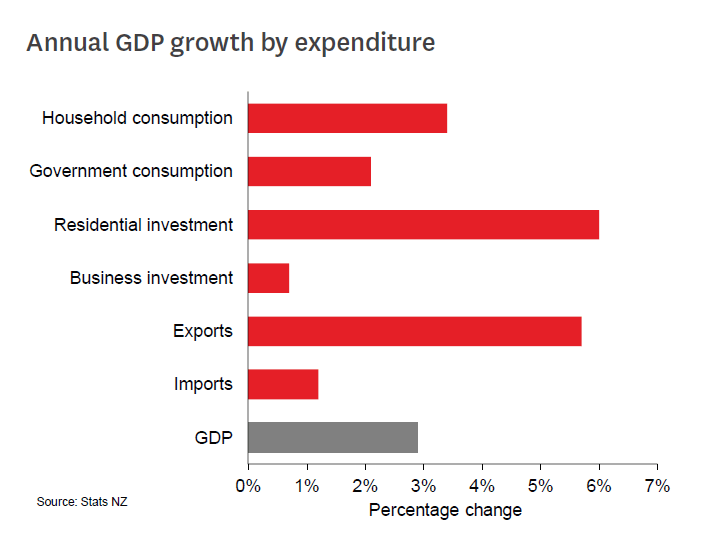
The expenditure measure of GDP was a little more positive, rising by 0.8% in the March quarter. While this measure is considered less reliable on a quarterly basis, its recent trends perhaps provide a clearer demonstration of what has driven the slowdown in growth.
On the plus side, household spending has continued to growth at a modest pace but is down from the peaks of a few years ago, matching the slowdown in house prices and the subsequent effect on housing wealth. Government spending has also been providing support, though it has tended to fall behind what was planned. Housing construction, while already operating at a high level, has found some fresh legs in the past year.
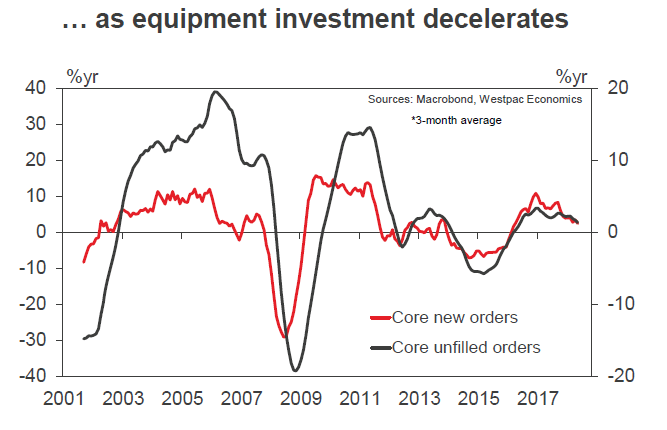
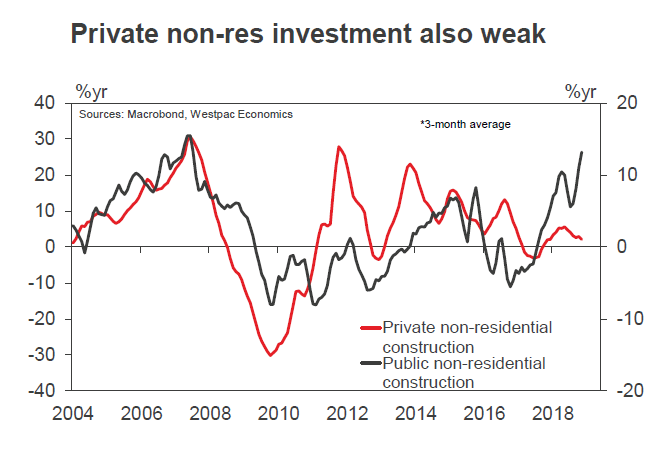
In contrast, business investment has been relatively subdued – even more so if we take out building work. Investment in plant and machinery has been flat to falling over the last year, after having been an important source of growth in previous years.
Northern Exposure: FOMC Perceive Clear And Present Risk
At the June meeting, the FOMC's stance on monetary policy shifted materially. While their core view of the economy remains constructive, 'uncertainties' now dominate.
'In light of these uncertainties and muted inflation pressures, [ahead] the Committee will closely monitor the implications of incoming information for the economic outlook and will act as appropriate to sustain the expansion.' Front of mind for the Committee in terms of these ‘uncertainties' is US trade policy and its impact on US business investment.
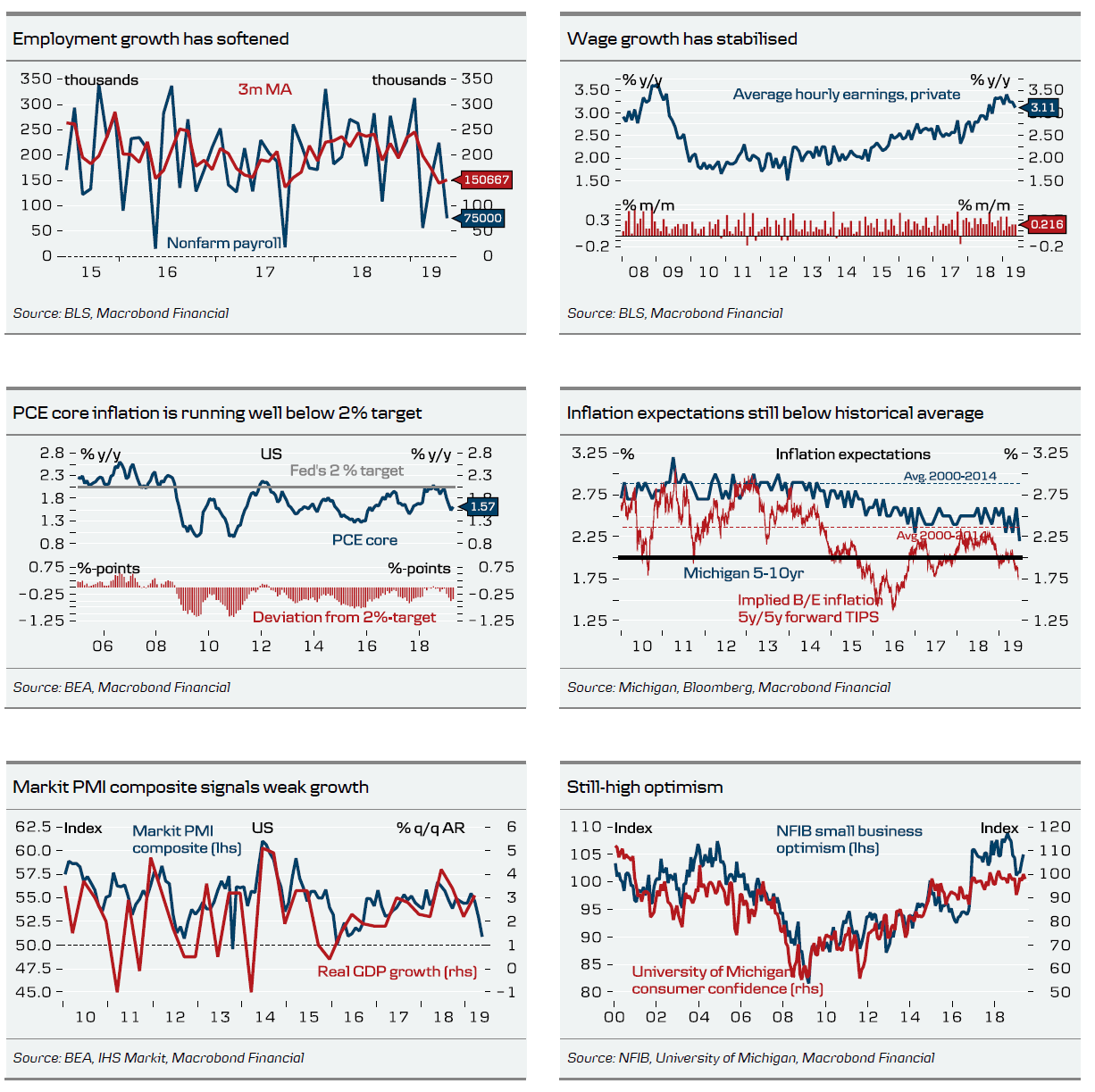
Beginning with the core view, it clearly remains constructive. The only real economy forecast to see material revision in June was the 2019 inflation view, which was revised down from 1.8% to 1.5%. Arguably this revision is a consequence of (purportedly transitory) weakness in PCE inflation since the March meeting rather than fears over the future path. Supporting this view, core inflation is seen at 1.8% in 2019 (previously 2.0%) then 1.9% and 2.0% in 2020 and 2021 respectively.
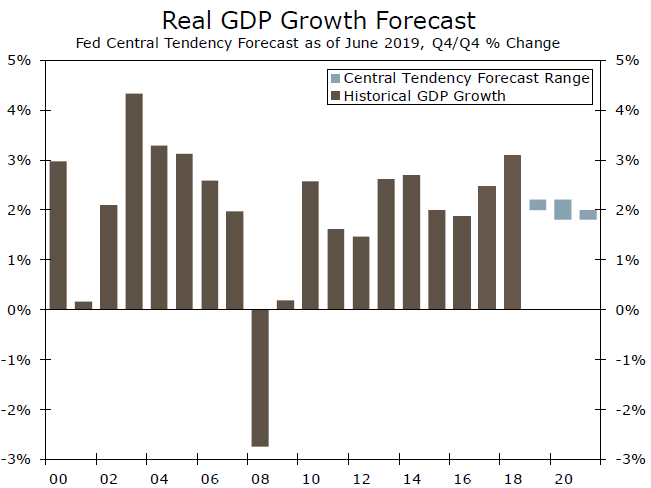
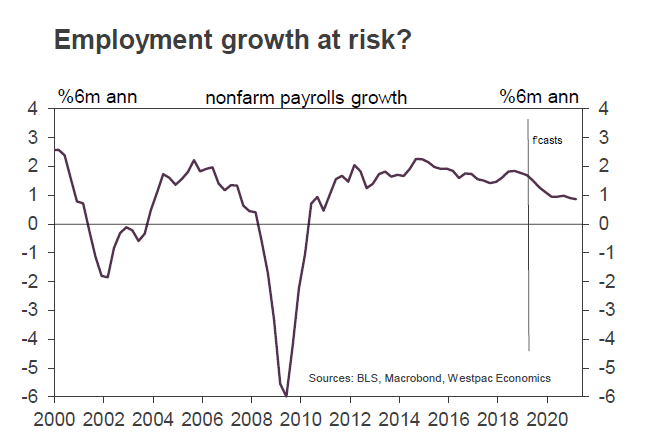
There was also essentially no change in the GDP forecasts, with above-trend growth still seen across the forecast horizon, while the unemployment rate forecasts were actually marked a touch lower – despite May's material disappointment for nonfarm payrolls.
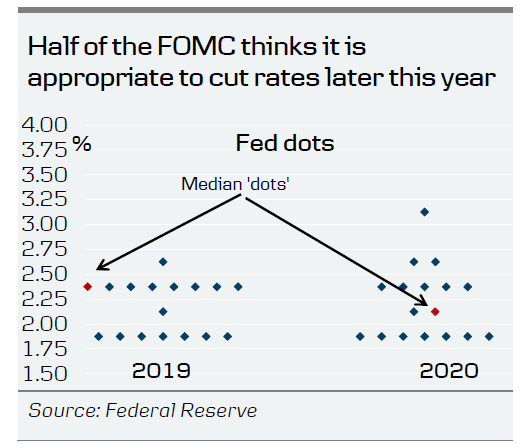
That seven participants now see two cuts in the federal funds rate by year end, and another member one cut, highlights the above core view has slipped into the background. Front of mind is instead the risks from US trade tensions with China and others and, more broadly, anxiety over global growth. The meeting between President Xi and President Trump at the Osaka G20 in a little over a week will be particularly key for US monetary policy.
If these risks are significant enough to detail at length, then why not cut now? As made clear in the Press conference, the reason is that the Committee want to respond to trends that are sustained, not temporary noise.
To the extent that trade tensions have really only escalated (again) in the past month, the FOMC clearly want to gain a greater understanding of their persistence and the consequences for the US economy.
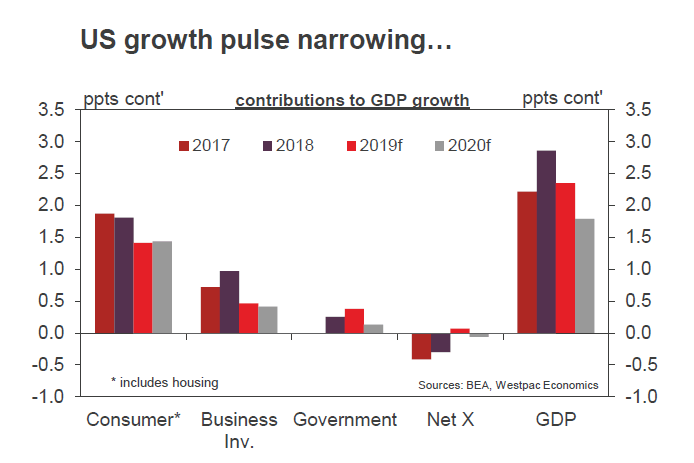
In our recent analysis of the US economy, we have highlighted that business investment was already soft and likely to slowly deteriorate hence. Further, we also cited the risk that employment could also be affected by current tensions. The baseline trade assumption that underpinned this view was that US trade hostilities would not escalate further with any nation in the months ahead but, that without a clear conclusion, another point of tension would be anticipated around the corner.
Under such a scenario, a pro-active but measured approach to policy is called for from the FOMC, cutting twice by year end, most likely in September and December. From today's communications, it seems as though the FOMC are broadly aligned to this view. Very clearly though, there are considerable risks to this call, most notably of quicker action from the FOMC.
To the downside, there is a material risk that, after the Osaka G20 meeting, President Trump extends the 25% tariff to the remaining $300bn of US imports from China. Given the soft state of US investment and fragile confidence amongst business, under such a scenario, the FOMC could easily justify bringing forward the first cut to July and showing stronger concern over the outlook. The risk of the imposition of this tariff soon after could also see the FOMC act in July. To see the FOMC deliver more than two cuts over the coming year however, consumption would have to weaken along with investment. While not our base view, given the surprisingly weak employment outcome of May and as wages growth looks to be turning down, it is a risk worth watching.
Upside risks are lower probability and also likely transitory. The one to call out is clear evidence of a resolution to US/ China tensions at the Osaka meeting. If this occurs, near-term rate cuts would be put off. That said, based on his actions of the past year, it seems highly unlikely that President Trump will abandon his trade agenda all together ahead of the 2020 Presidential election. Hence an easing bias would remain warranted ahead of a potential immanent re-escalation of tensions with China or another party.
FOMC Review: Fed As Dovish It Could Be Without Cutting Rates Already
Key takeaways
- As growth has moderated, inflation expectations have fallen and uncertainties have increased, the Fed now says it “will act as appropriate to sustain the expansion”.
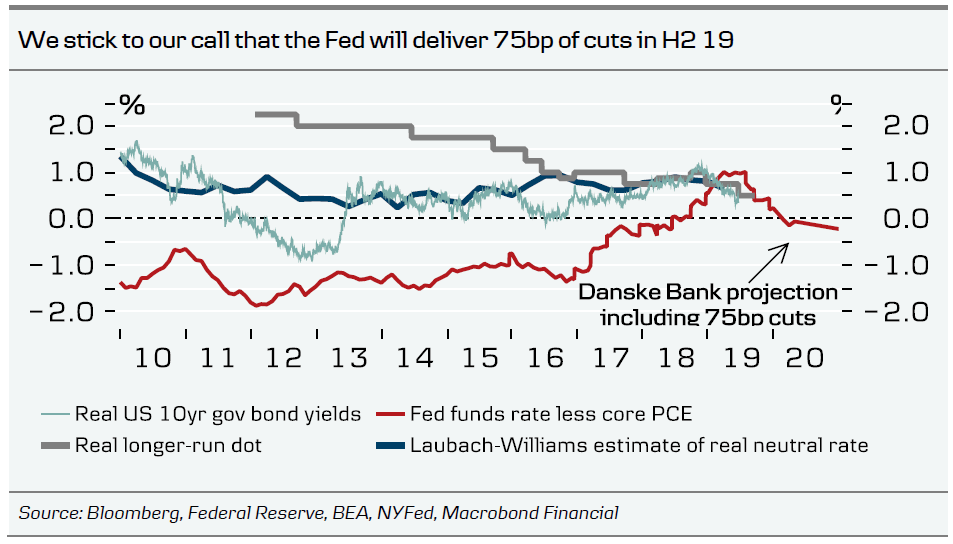
- We stick to our view that the Fed will cut rates in July by 25bp and deliver a total of 75bp of rate cuts in the second half of 2019 (July, September and December). The trade war is an important risk to our outlook in both directions.
- After two days of dovish central banks, we still see a strong case for a higher EUR/USD and lower USD/JPY as the Fed is set to ease more than other central banks (see overleaf).
Several important dovish changes to the FOMC statement
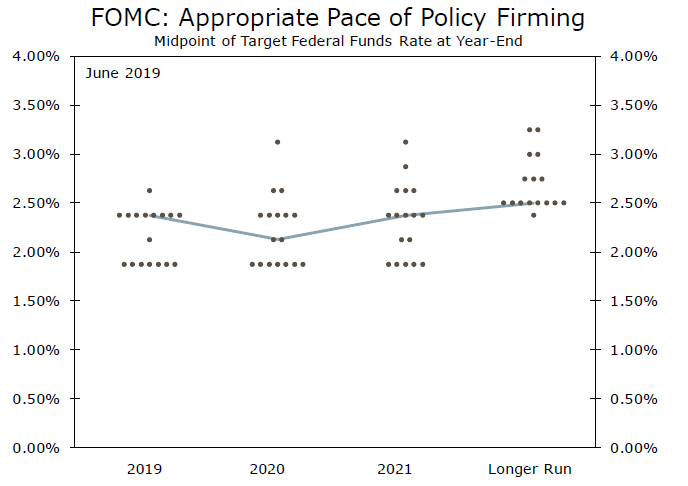
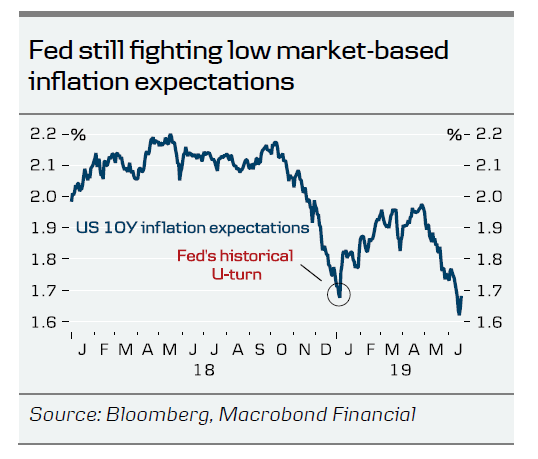
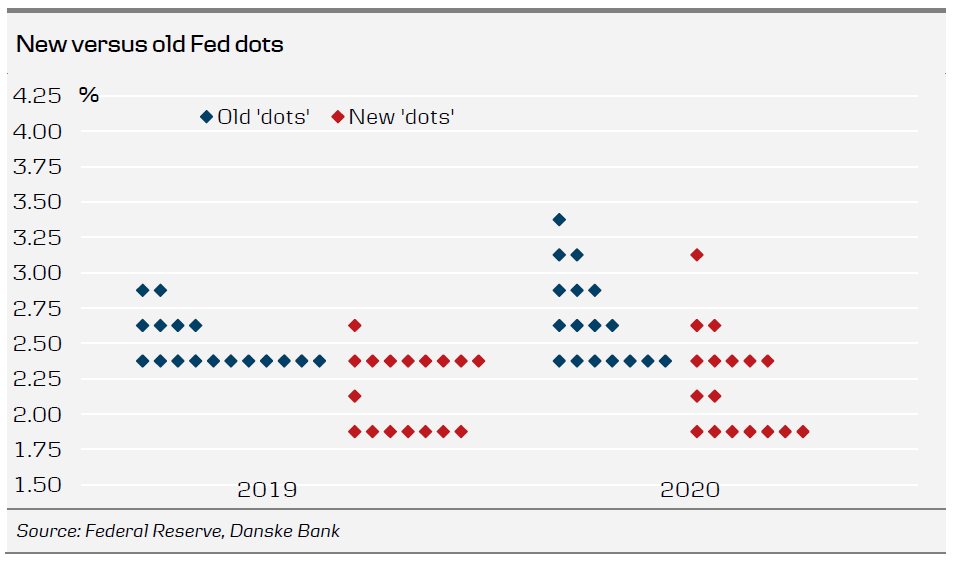
Overall, the Fed was as dovish as it could be without cutting rates at its meeting. In line with our view, there were several important dovish changes to the statement. Most importantly, the Fed removed the wording that it was “patient” and now said, “the Committee will closely monitor the implications of incoming information for the economic outlook and will act as appropriate to sustain the expansion”, which we believe, as outlined in our preview, is a strong easing signal. To the dovish side was also that the committee was divided on whether to signal cuts outright this year or not (see chart to the right). The Fed also lowered its longer-run dot (the Fed’s estimate of the neutral rate, where monetary policy is neither easy nor tight), which means the current monetary policy stance is tighter than it thought three months ago (see chart below).
In the statement, the Fed also recognised that economic growth is now “moderate” (versus “solid” in May), that market-based inflation expectations have “declined” and that “uncertainties” to the outlook “have increased” (which is a new element to the statement). The latter is mostly, but not only, a reference to the ongoing trade war with China.
Trade uncertainty the key risk to our Fed outlook
Listening to Fed Chair Powell during the press conference, we also think he was dovish. While he highlighted the Fed wants more information before delivering, he hinted that data needed to improve and (trade) uncertainty needed to fade to really change the rate path outlook. Another interesting thing was that he said the Fed has not yet discussed whether rate cuts should be 25bp or 50bp. That said, it also seems clear to us that the Fed is not in panic mode and any rate cuts should be seen as insurance cuts, not recession cuts. We stick to our view that the Fed will cut rates in July by 25bp and deliver a total of 75bp of rate cuts in the second half of 2019 (July, September and December). The trade war is an important risk to our outlook in both directions. Also, notice that Powell mentioned at the press conference that the Fed may change the balance sheet runoff plan if it ends up cutting rates.
FX: Fed paves the way for more USD weakness
EUR/USD tested 1.1250 and USD/JPY tested 108 levels on a dovish Fed, which justified the dovish pricing heading into the meeting. USD rates fell sharply, where the market is now about fully priced for a July rate cut. Fed Chair Powell stressed that the Fed is monitoring trade talks and needs to see more weak data to pull the trigger. It means that the upcoming G20 meeting, along with upcoming key data releases, i.e. PMIs, ISM, non-farm payrolls etc., will be particularly important for the pricing of upcoming Fed meetings and hence for the direction of the USD. We do not see data turning around for the better and see the risk of no breakthrough in the trade talks before the next Fed meeting, which should pave the way for a continued trend lower in the USD.
After two days of dovish central banks, we still see a strong case for a higher EUR/USD and lower USD/JPY as the Fed is set to ease more than other central banks. We continue to look for EUR/USD to rise to 1.15 in 3M, although we note that despite large movements in rate markets, EUR/USD has so far had a difficult time breaking out of its long-held range close to 1.12
Market Morning Briefing: Euro-Yen Has Crucial Support At 121 And Lower Near 120
STOCKS
Not much cheer in the Equity segment as the Fed just met the market expectation by keeping the rates unchanged and hinting rate cuts in the future which has been factored in the market already. However, the broader picture remains positive for the equities. Dow and DAX might see intermediate dips before resuming their uptrend. Nikkei is bullish for further rise. Shanghai retains its sideways range but may break the range on the upside if it sustains above 2900. Sensex and Nifty continue to remain weak and keeps the bearish view intact for further fall.
Dow (26504, +38.46, +0.15%) remains higher but the pace of rise seems to be slowing down. The broader picture is bullish to test 27200-27500 over the medium term. However, an intermediate dip to 26250 is possible from 26600 before we see a fresh rally to the above mentioned targets.
DAX (12308.53, -23.22, -0.19%) was stuck in a narrow range yesterday. The resistance at 12350 is holding well as of now. However, the support at 12200 can limit the downside and will keep the bullish view intact for a rise to 12430-12450.
Nikkei (21432.09, +98.22, +0.46%) has risen further higher. Out bullish view remains intact for a rise to 21750 while the index remains above its support level of 21250.
Shanghai (2929.18, +11.37, +0.39%) tested 2950 -the upper end of its 2835-2950 sideways range as expected and has come-off slightly from there. As mentioned yesterday, the bias is positive to see a break above 2950 and a rise to 3000 in the coming days.
The resistance at 39500 on the Sensex (39112.74, +66.40, +0.17) and 11800 on the Nifty (11691.45, -0.05, 0.00%) are holding well. The upside is likely to be capped at 39750 (Sensex) and 11850 (Nifty). The bias remains bearish for the Sensex to test 38500-38000 and Nifty to fall to 11600 in the coming days.
COMMODITIES
The US Federal Reserve left the rates unchanged and has hinted for rate cuts in the coming months as expected by the market. Gold and Silver have surged above their key resistances as against our expectation for a fall after the Fed meeting. They are now looking bullish for further rise. Copper has come-off slightly but has support which is likely to hold and push it higher again. Oil remains stable and can consolidate sideways for some time before resuming its downtrend.
Contrary to our expectation, Gold (1378) and Silver (15.22) have surged breaking above their key resistances at 1360 and 15.10 respectively thereby proving our bearish view wrong. The outlook has turned bullish. While above 1360 gold can test 1400. Silver can target 15.50 while it trades above 15.
Copper (2.67) has support at 2.66 (21-day moving average) which can limit the downside and trigger a bounce again to 2.70-2.71. As mentioned yesterday, a strong rise past 2.72 is needed to pave way for a fresh rally to 2.75-2.77.
Brent (62.54) remains stable within its broad 59.5-64 sideways range. As mentioned yesterday, a rise within this range to 64 is possible on a break above 62.8. However, our broader bearish view is intact and we expect Brent to eventually break below 59.5 and fall to 57-55.
WTI (54.69) has risen and is heading as expected towards 55 - the upper end of the 50.5-55 sideways range. We expect this sideways range to remain intact and a pull-back to 53-52 can be seen in the coming days.
FOREX
Dollar Index (96.90) is trading lower after the FED statement yesterday. While the FOMC is prepared for a rate cut and has dropped the word “patient” from the policy statement, at least one rate cut within this year is favoured. Note that the central bank predicts one or two rate cuts in its set of economic predictions, but not until 2020. But the markets still seem to be betting that the Fed rate cuts would be seen as soon as July. We would watch if immediate support at 96.75 holds and manages to push back the index towards 97.50 in the near term.
Euro (1.1265) is up on Dollar weakness but while below crucial resistances near 1.1350-1.1300, the currency still has room for bearishness in the medium term. If support at 96.75 holds on Dollar Index, Euro may start coming off after a short bounce for a couple of sessions.
Dollar-Yen (107.60) has fallen below our expected level of 108. Now near term important supports are visible at 107.50 and 107.00 which is likely to hold and produce a near term bounce towards 108.50-109.00.
Euro-Yen (121.22) has crucial support at 121 and lower near 120. These could hold on for the medium term eventually pushing back Euro-Yen towards 122.50 in the near term and higher towards 124 in the longer run.
Aussie (0.6892) has scope to rise towards immediate resistance at 0.695 from a where a fall back towards 0.685 is possible. Overall trade within 0.695 and 0.985 is possible in the near term.
Pound (1.2685) seems to be breaking above immediate resistance near 1.2665 and while it manages to move higher, we could see a rally towards 1.28 in the near term.
USDINR (69.69) could trade within broad 69.50-69.90 today. Break above 69.90 could take it higher towards 70.00-70.10.
INTEREST RATES
FED kept interest rates unchanged but expressed concerns over the slowing global growth. Although rate cut is on the cards, the FED would wait to see more economic developments in the near term. Some officials expect a rate cut by the end of the year.
The US yields have fallen sharply after the FED statement yesterday. the 2YR (1.72%), 5Yr (1.73%), 10Yr (1.98%) and the 30Yr (2.49%) are down from 1.89%, 1.85%, 2.08% and 2.56% seen a day before. The 5Yr may have support coming up in the 1.6-1.7% region while the 10Yr and 30YR could see some more fall towards 1.90% and 2.30% before bouncing back from there.
The US-Japan 10Yr (2.13%) is testing immediate channel support near current levels and could see a bounce in the near term indicating a possible bounce in dollar Yen too. We would keep a close watch on this in the next few sessions.
The 10Yr GOI (6.9745%) could pause near 6.95% just now and see a short corrective bounce towards 7% or higher in the near term. A break below 6.95% if seen would make it vulnerable for a fall towards support near 6.80%.
USD/CAD Tumbles Below 1.3300 Post Fed Policy
Key Highlights
- The US Dollar failed to surpass the 1.3430-1.3440 resistance zone against the Canadian Dollar.
- USD/CAD traded below a major bullish trend line with support at 1.3390 on the 4-hours chart.
- Canada's Consumer Price Index (CPI) increased 0.4% (MoM), more than the +0.2% forecast.
- The US Initial Jobless Claims for the week ending June 15, 2019 might decline from 222K to 220K.
USDCAD Technical Analysis
Earlier this month, the US Dollar formed a strong support near 1.3250 and later climbed higher against the Canadian Dollar. The USD/CAD pair traded above 1.3350, but it recently struggled to surpass the 1.3430-1.3440 resistance zone.
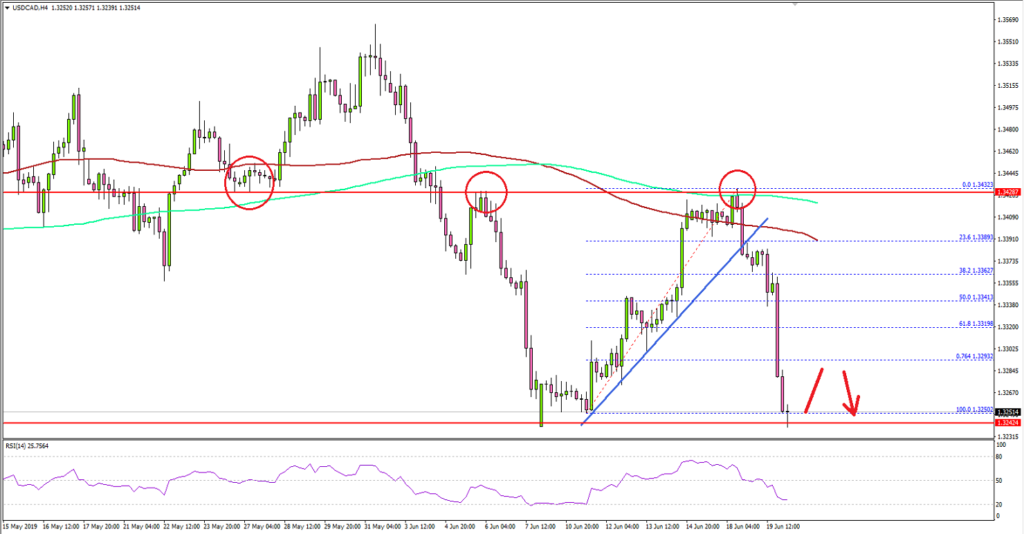
Looking at the 4-hours chart, the pair failed near 1.3432 level and the 200 simple moving average (green, 4-hours). As a result, the price dropped below the 1.3400 support and the 100 simple moving average (red, 4-hours).
Moreover, the pair traded below a major bullish trend line with support at 1.3390 on the same chart. It even cleared the 76.4% Fib retracement level of the upward move from the 1.3250 low to 1.3432 high.
The pair is currently trading near the last swing low at 1.3250, and if it continues to decline, there could be further losses below 1.3250.
The next major support is near the 1.3220 level, below which USD/CAD could retest 1.3200. An intermediate support is near 1.3210 or the 1.236 Fib extension level of the upward move from the 1.3250 low to 1.3432 high.
On the upside, an initial resistance is near the 1.3300 level. However, the main resistance is near the 1.3430 and 1.3440 levels. A successful close above 1.3440 plus the 200 simple moving average (green, 4-hours) is must to start an uptrend.
Fundamentally, the Canadian Consumer Price Index (CPI) for May 2019 was released by the Statistics Canada. The market was looking for a 0.2% rise in the CPI compared with the previous month.
The actual result was above the market forecast, as the CPI increased 0.4% in May 2019 (MoM). Looking at the yearly change, there was a 2.4% increase, more than the +2.1% forecast and well above the last +2.0%.
The report added:
Prices increased year over year in all eight major components in May, with six components growing at faster rates and two components growing at the same pace compared with April. Higher prices for food (+3.5%) and transportation (+3.1%) contributed to the increased growth in the all-items index.
Overall, the report helped the Canadian Dollar, but USD/CAD could still bounce back as long as it is above the 1.3250 support area.
Economic Releases to Watch Today
- UK Retail Sales for May 2019 (YoY) – Forecast +2.7%, versus +5.2% previous.
- UK Retail Sales for May 2019 (MoM) – Forecast -0.5%, versus 0% previous.
- BoE Interest Rate Decision – Forecast 0.75%, versus 0.75% previous.
- US Initial Jobless Claims – Forecast 220K, versus 222K previous.
Daily Markets Broadcast
Wall Street rises as the Fed prepares to cut
The Fed held rates at yesterday's meeting but hinted that future cuts could come. The FOMC dropped the word patient from its statement, adding they would “act as appropriate” to sustain the economy. Oil prices rose as inventories fell.
US30USD Daily Chart
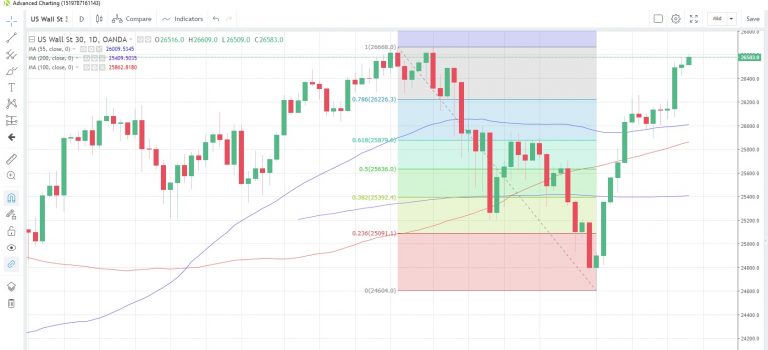
The US30 index rose yesterday and look set to extend gains into a fourth consecutive day today on the Fed outlook
The index is nearing the April high of 26,668 and touched the highest since May 1 in early trading this morning
The Philadelphia Fed manufacturing index is seen sliding to 11.0 in June from 16.6 last month. That would still be the fourth consecutive month it has stayed above zero.
DE30EUR Daily Chart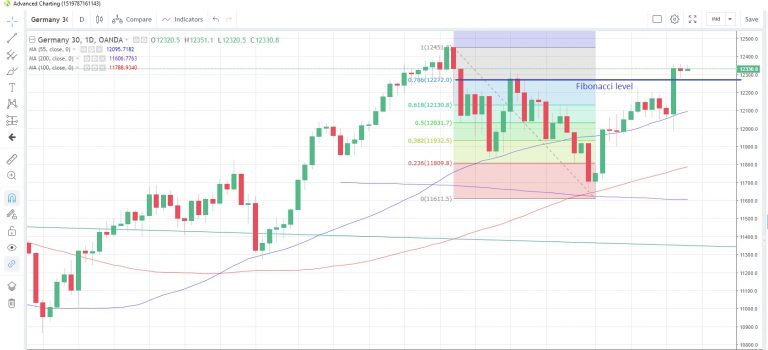
The Germany30 gave back some of Tuesday's gains yesterday as it consolidated the strong upmove. It's trading slightly higher in early trading today
The index is likely eyeing the May high of 12,452 after holding above 78.6% Fibonacci retracement of the May-June drop at 12,272
Reports suggest ECB policy makers are divided on the next policy step, with either a rate cut, guidance change or further quantitative easing all being considered.
WTICOUSD Daily Chart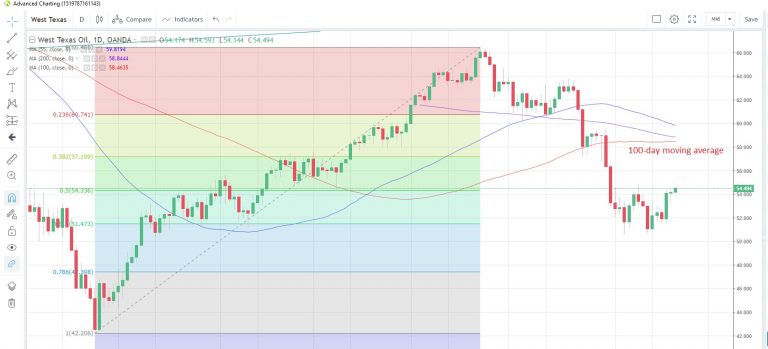
Crude oil prices rose after weekly inventory data revealed drawdowns across all three categories. The EIA crude oil data showed a drawdown of 3.1 million barrels in the week to June 14, the first reduction in stockpiles in three weeks
WTI is testing the June 10 high of 54.77 and a rise above it could bring the 100-day moving average at 58.46 into play
OPEC and its allies have confirmed a meeting on July 1-2 in Vienna to discuss oil output, a shift from the late-June time that had been suggested earlier.
USD/CAD Canadian Dollar Rises After Fed Signals Upcoming Rate Cut
The Canadian dollar rose 0.67 percent on Wednesday after the US central bank is ready to go back to monetary policy easing with an upcoming interest rate cut. Trade optimism after Trump tweeted about his phone call with Chinese president Xi and lower rates in the US that could come as early as the July FOMC meeting put the greenback on the back foot.
The loonie appreciated versus the US dollar in the morning after Canadian inflation rose to 2.4 percent in May. The Bank of Canada (BoC) is unlikely to follow the Fed down the easing path in the near term. The interest rate gap will be closer once the Fed decides the economy needs stimulus to avoid losing momentum.
The dollar is lower across the board against major pairs after the Fed delivered a dovish statement at the end of the June FOMC meeting. There was no interest rate cut, but the removal of the word patient from the language appears to be the first step towards a return to monetary policy easing.
OIL – Crude Rises on Inventory Drop and Dovish Fed
Crude prices rose on Wednesday after the Energy Information Administration (EIA) published the weekly US crude inventories report. Crude and gasoline inventories registered bigger drawdowns than expected and drove prices higher. US crude stocks fell by 3.1 million barrels and gasoline by 1.7 million barrels.
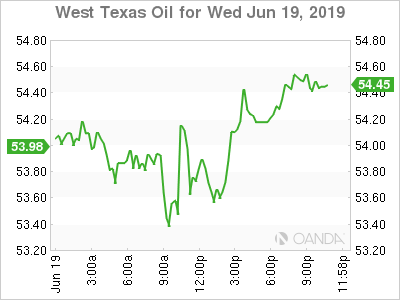
Oil prices had surged on Tuesday after US President Donald Trump tweeted encouraging developments with China. A sit down with Chinese President Xi as part of the G20 meeting in Japan at the end of the month appears to be in the works. The Chinese official media confirmed that the two leaders are talking with a possible talk during the G20. The trade war between the two largest economies has been a negative factor for energy prices.
The Fed meeting this week got an even bigger spotlight after European Central Bank (ECB) President Mario Draghi said he is ready to cut rates if necessary. The US central bank did not cut interest rates but it did signal it’s ready to stimulate the economy and avoid falling into a recession.
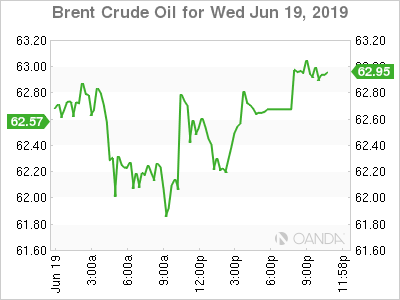
The anxiety around supply disruptions has died down as trade optimism is surging. Middle East conflict is sure to influence crude prices, with a frenetic end to the month of June as the G20 meeting and more details to emerge on the possibility of an extension to the OPEC+ supply cut agreement.
West Texas Intermediate rose 0.44 percent after the drop in inventories, with Brent rising 0.29 percent after the mixed signals sent by the Fed. The dollar could weaken further if economic indicators deteriorate in the short term building the case for a rate cut in July.
The OPEC+ has announced it will hold its ministerial meetings on July 1 and 2. The group’s production cut agreement has been he major stabilizing force for energy prices. The major factor to the downside has been the prolonged trade war between the US and China, but the G20 meeting at the end of June guarantees that crude traders will have lots of insights starting June 28.
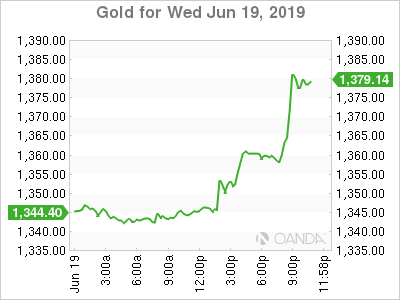
GOLD – Yellow Metal Rises as Dollar Weakens after Dovish Fed
Gold is higher on Wednesday after the Fed held rates, but did turn up the dovish rhetoric in their monetary policy statement and press conference by Fed Chair Jerome Powell. The US central bank led major central banks in a move towards normalizing rates in 2018, but a slowdown in the economy could warrant a 180 degree turn and a return to lower rates. Powell used the Ben Franklin quote:”an ounce of prevention is worth a pound of cure” when asked about rate cuts, so overall the market is rating the Fed as mostly dovish.
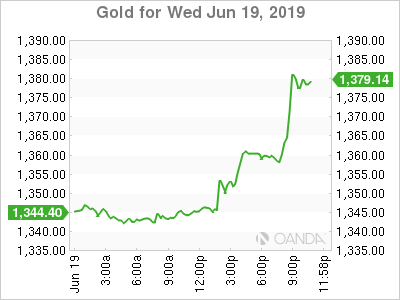
Lower rates are a positive for the yellow metal, but with a tweet Donald Trump infused optimism into the market saying that it’s posible for Chinese President Xi and himself to have a meeting while they are both in Japan for the G20 at the end of the month. Gold has been a favorite destination of investors seeking a safe haven from the US-China tariff uncertainty. Hope for an end to back and forth aggression could be near, and reduces the appetite for the metal.
Conflict in the Middle East and Brexit concerns will remain and will continue to push gold higher as investor appetite for risk wanes during high volatility periods.
STOCKS – Stocks Rise on Fed Dovish Rhetoric
Equities rose on Wednesday after the Fed delivered a more dovish statement as expected. The removal of the word patient from the language in exchange for “act as appropriate” is a signal of an upcoming interest rate cut, that could happen as soon as the July Federal Open Market Committee (FOMC) meeting.
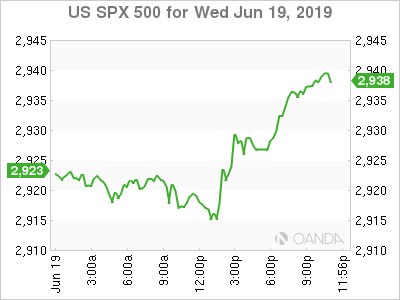
Fed members remains divided on the next step, while the rate cut contingent has growth, there remains a sizeable group that finds the current conditions acceptable. Economic indicators will validate the two sides in the near term. The market will now be more sensitive to upcoming releases. Trade headwinds have already started to impact the US economy, but some of that pressure could be short lived if Trump and Xi had a successful meeting in Japan at the end to the month.
US Crude Oil Inventory Fell For First Time in Three Weeks
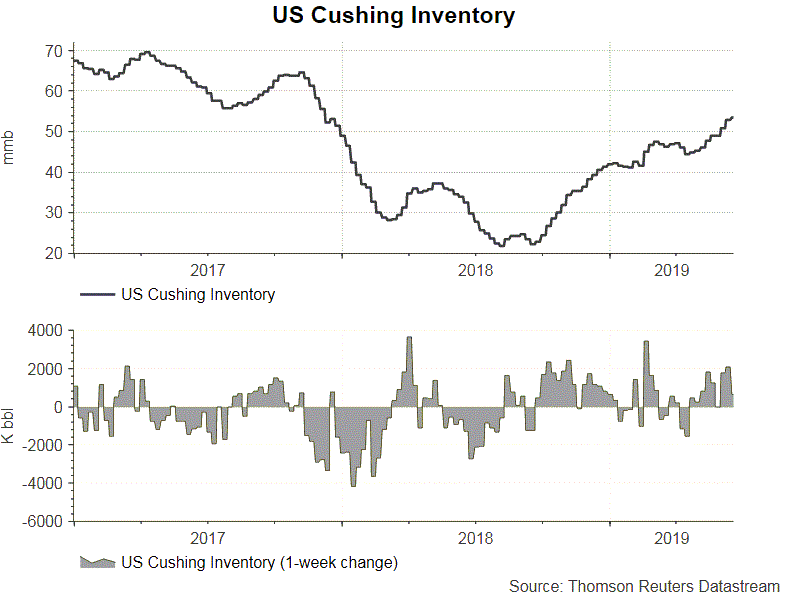
The report from the US Energy Information Administration (EIA) shows that total crude oil and petroleum products (ex. SPR) stocks decreased -0.41 mmb to 1316.77 mmb in the week ended June 14. Crude oil inventory fell -3.11 mmb to 482.36 mmb (consensus: -1.08 mmb). Inventories rose in 2 out of 5 PADDs. Stockpile in PADD3 (Gulf Coast) alone sank 5.83 mmb during the week. Cushing stock added +0.64 mmb to 53.58 mmb. Utilization rate climbed +0.7% to 93.9% while crude production slipped -0.1M bpd to 12.2M bpd for the week. Crude oil imports dropped -0.14M bpd to 7.47M bpd in the week.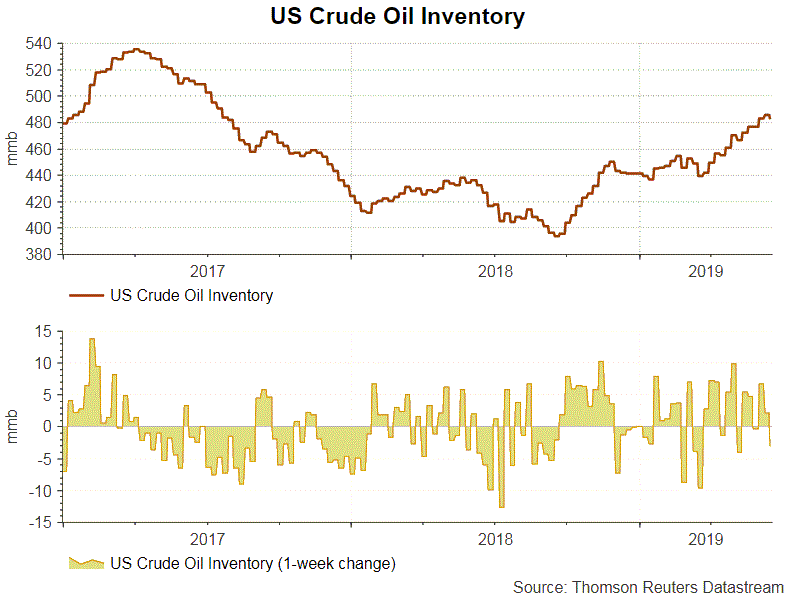
Concerning refined oil product inventories, gasoline inventory dropped -1.69 mmb to 233.21 mmb as demand added +0.52% to 9.83M bpd. The market had anticipated a +0.94 mmb increase in stockpile. Production rose +0.08% to 10.26 bpd while imports added +19.57% to 0.84M bpd during the week. Distillate inventory slipped -0.56 mmb, to 127.82 mmb. Demand rose +8.18% to 4.06M bpd. The market had anticipated a +0.71 mmb gain in inventory. Production gained +2.52% to 5.37M bpd while imports soared +34.15% to 0.17M bpd during the week.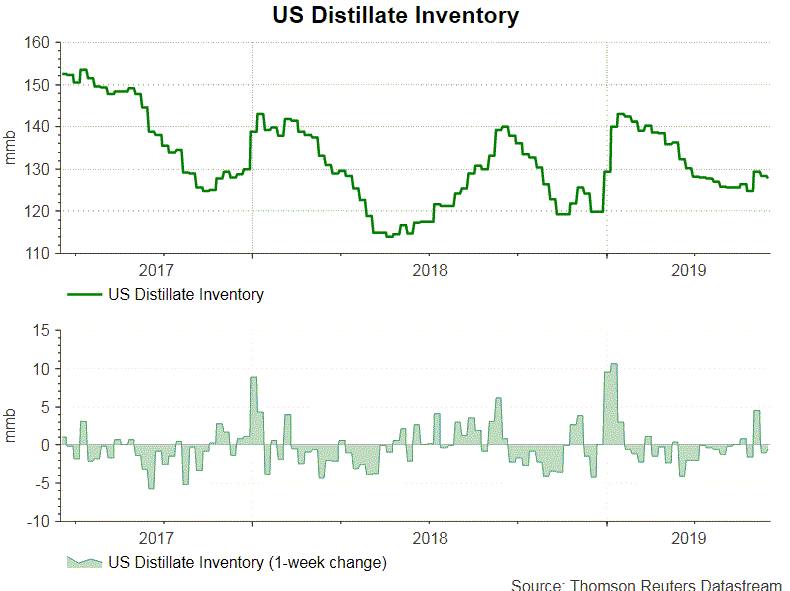
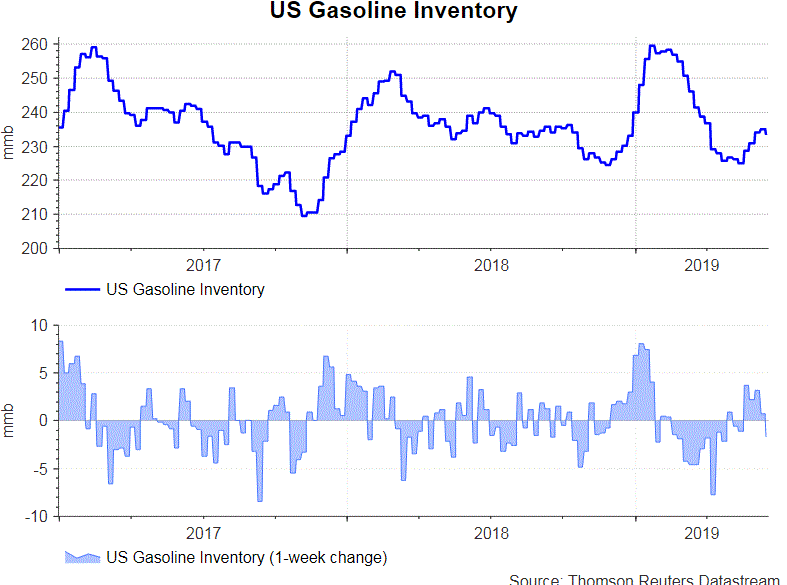
Released after market close on Thursday, the industry- sponsored API estimated that crude oil inventory dropped -0.81 mmb during the week. For refined oil products, gasoline stockpile added +1.46 mmb while distillate fell -0.05 mmb.
Eco Data 6/20/19
[php_everywhere instance="1"]
FOMC Signals Rate Cuts Ahead
The FOMC acknowledges that uncertainties about the outlook have increased. We concur with the seven committee members that think rates will be 50 bps lower at the end of the year.
FOMC Keeps Rates Unchanged But Sends a Dovish Message
As widely expected, the Federal Open Market Committee (FOMC) decided at its meeting today to leave its target range for the federal funds rate unchanged between 2.25% and 2.50%. That said, the committee indicated that it could be easing policy in the not-too-distant future. For starters, the FOMC downgraded its assessment of the economy. At the last FOMC meeting in early May, the committee stated that "economic activity rose at a solid rate." Now it says that "economic activity is rising at a moderate rate."
There were no major changes to the Fed's GDP growth projections for the next few years relative to the forecast that was released after the March FOMC meeting (top chart). However, the FOMC acknowledged in today's statement that "uncertainties to this outlook have increased." It also noted that inflationary pressures are "muted." Furthermore, the committee dropped the word "patient" from its statement. Many observers had surmised that "patient" meant that the FOMC would be on hold for some time as it analyzed incoming data. The committee now says that it "will closely monitor the implications of incoming information for the economic outlook and will act as appropriate to sustain the expansion." We interpret this sentence as signaling that the Fed will cut rates at the first sign of trouble.
There were also important changes to the so-called "dot plot." In March, none of the 17 FOMC members looked for rates to be lower at the end of 2019. The dot plot that was released today indicated that one committee member looks for rates to be 25 bps lower by the end of the year, and seven members expect that rates will be 50 bps lower at the end of 2019 (middle chart). The change in the dot plot reinforces our view that the Fed indeed will be cutting rates soon.
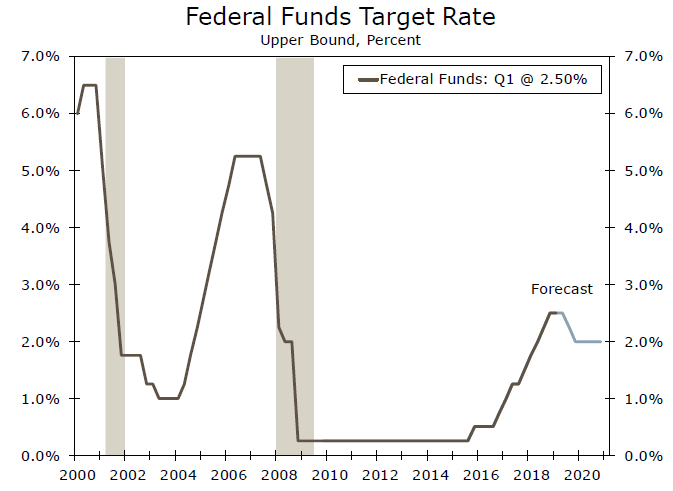
In that regard, we expect that the FOMC will cut its target range for the fed funds rate 25 bps at its next meeting on July 31 (bottom chart). We also look for another 25 bps rate cut in the fourth quarter, probably at the October 30 meeting. As we discussed in our most recent Monthly Economic Outlook, the continued undershoot of inflation below the Fed's target and the relative lack of conventional "ammunition" argue for more accommodative monetary policy in an environment of uncertainty. As we also noted, our overall macroeconomic forecast is predicated on the assumption that uncertainty related to trade policy continues to linger. If, however, President Trump and Chinese President Xi agree to a trade deal next week at the G-20 that eliminates the tariffs that both countries have levied on the other side, then the need to cut rates may dissipate. On the other hand, however, if negotiations completely break down and the United States levies tariffs on the remaining $300 billion worth of Chinese imports, then the FOMC may need to cut rates more than 50 bps. Stayed tuned.