Sample Category Title
Elliott Wave Analysis: AUDUSD Dropping Temporarily; 0.690 in View!
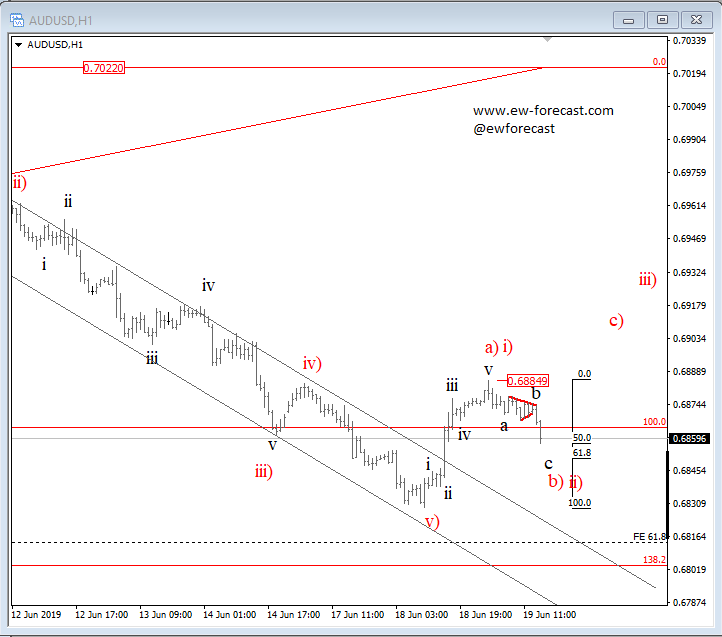
Aussie is dropping as expected from the 0.688 level where a temporary top for wave a)/i) of a three-wave move had been located. Current three-wave drop can now be labelled as wave b)/ii), with possible support, and turning point zone around the Fibonacci ratio of 50.0/61.8. A rally above the current high would suggest more upside into wave c)/iii).
AUDUSD, 1h
US oil inventory dropped -3.1M barrels, little reaction in WTI, stays bearish
US commercial crude oil inventories dropped -3.1M barrels in the week ending June 14, larger than expectation of -1.5M. At 482.4 million barrels, U.S. crude oil inventories are about 7% above the five year average for this time of year.
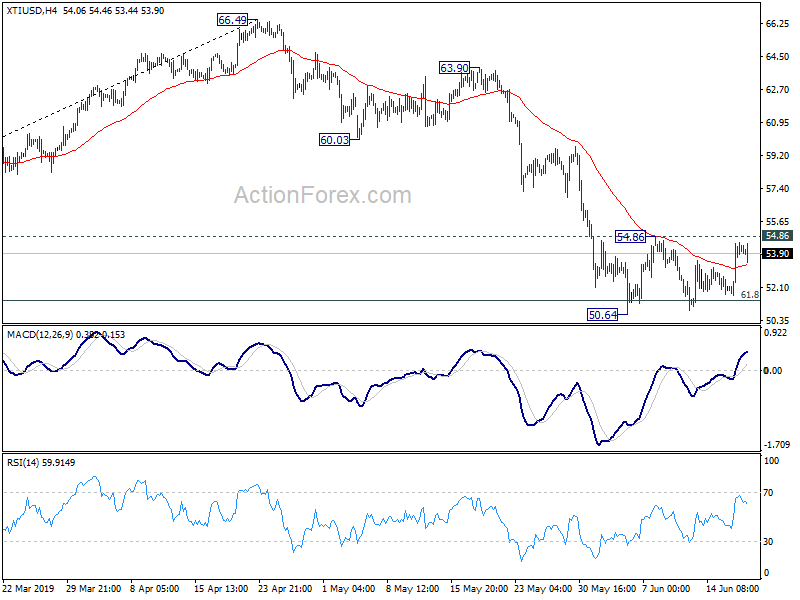
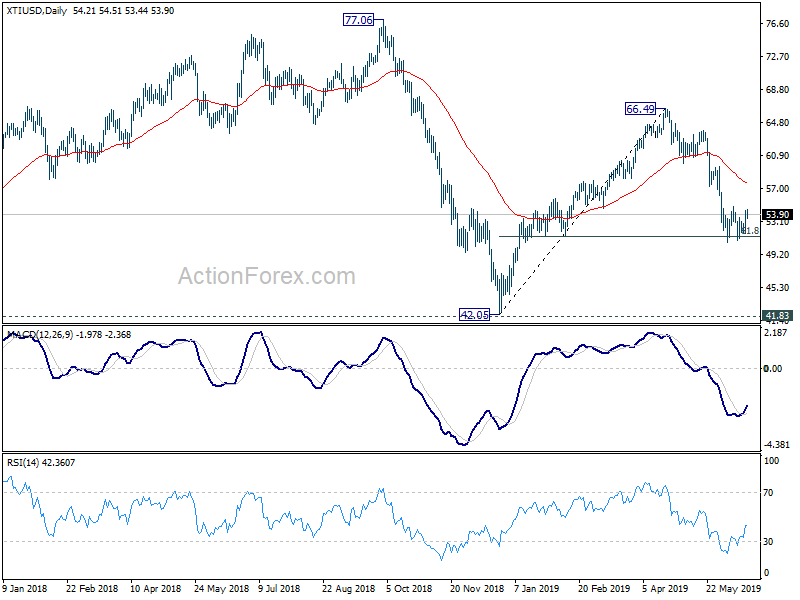
WTI crude oil has little reaction the data. The break of 4 hour 55 EMA is another sign of stabilization in oil price. Yet, WTI is held below 54.86 resistance so far. Thus, near term outlook remain bearish for another fall. Break of 50.64 and sustained trading below 61.8% retracement of 42.05 to 66.49 at 51.38 could pave the way to retest 42.05 low. However, sustained break of 54.86 will confirm short term bottoming. Stronger rebound would than be seen back to 55 day EMA (now at 57.59).
BoE Meets But Pound’s Focus on Next UK Prime Minister
The Bank of England will announce its latest policy decision on Thursday at 1100 GMT and is widely anticipated to hold rates at 0.75%. Ahead of the BoE’s announcement, retail sales numbers for May will be watched at 0830 GMT. But with recent remarks by BoE policymakers reaffirming the Bank’s tightening bias, the June meeting could well end up being a non-event as there will be no press conference for reporters to quiz Governor Mark Carney on the Bank’s stance. This could leave investors seeking direction from UK politics where the Conservative party is in the process of selecting Theresa May’s replacement as the next British prime minister.
BoE not backing down on rate hike guidance
The UK’s central bank has raised rates twice since the financial crisis – not as many as the US Federal Reserve and Bank of Canada have been able to deliver but it still gives the BoE more ammunition than the European Central Bank and Bank of Japan to respond to a downturn. The limited room for cuts may be one of the reasons why the Bank is keen to resume its rate hike cycle and is sticking to its tightening bias even as other major central banks around the world make a dramatic about-face on policy towards easing.
Several MPC members, including Carney, have indicated over the past couple of weeks that interest rates will need to rise if the UK economy performs as expected. The Bank will probably stick to the script on Thursday and reiterate that rates will need to be lifted “at a gradual pace and to a limited extent”. However, with growth appearing to stutter in the second quarter and overseas risks sharply increasing amid a worsening trade war and a possible conflict in the Middle East, investors are not convinced by the Bank’s forward guidance.
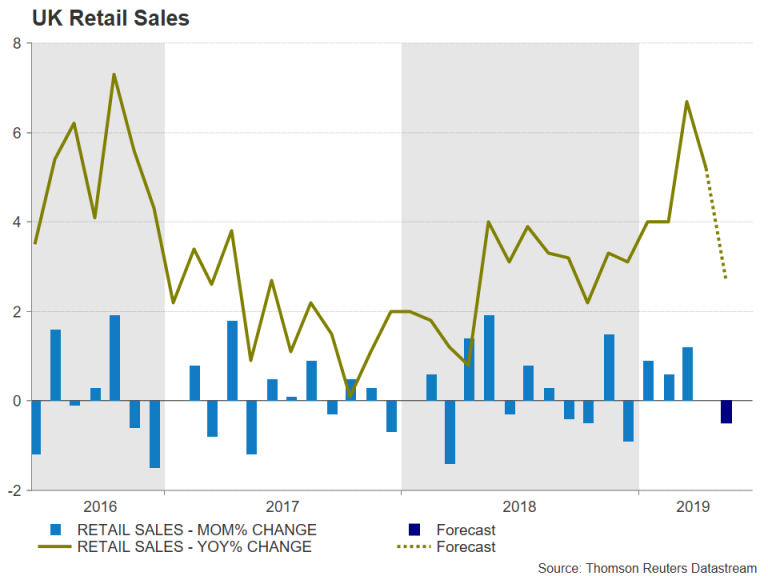
UK growth is slowing; retail sales to fall in May
UK economic data deteriorated at a frightening pace in April as manufacturing output was sharply scaled back following a boost from stockpiling in February and March in preparation of a possible disorderly Brexit on the original leave date of March 29. More significantly, the dominant services sector, which suffered in March from the Brexit turmoil, failed to bounce back in April and the May PMIs were also weak, suggesting the slowdown is spreading to all sectors of the economy. This puts the spotlight on Thursday’s retail sales readings as UK consumers have so far been resilient to the political chaos in Westminster.
Retail sales are forecast to have declined by 0.5% month-on-month in May after flat growth in April. The annual rate stood at a healthy 5.2% in April but could moderate to 2.7% in May if the monthly change comes in as expected.
Pound halts losses; Tory leadership contest eyed
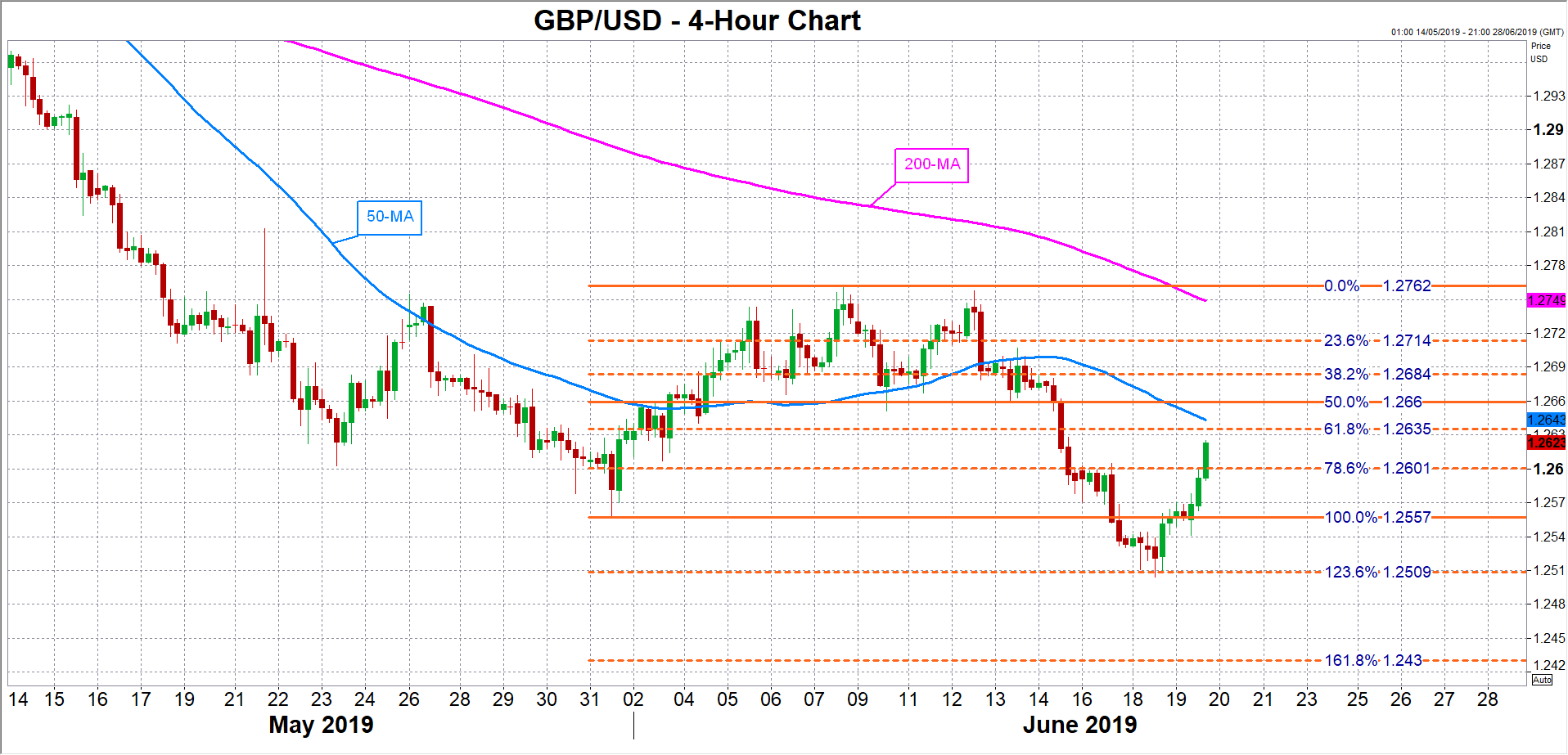
The pound, which yesterday halted a week-long decline, could slip back towards the May low of $1.2557 if the retail sales numbers disappoint, while a drop below this level would risk a breach of the 2019 trough of $1.2504 touched on Tuesday. However, a surprise rise in retail sales, combined with a hawkish-sounding BoE statement could see sterling challenging the 61.8% Fibonacci retracement of the May-June upleg at $1.2635.
But with Conservative MPs due to decide this week on who will be the remaining two candidates that will make it to the final ballot that will be voted on by party members, there’s a good chance traders will ignore the data and the BoE decision and instead focus on the outcome of these ballots.
Tuesday’s ballot saw current frontrunner Boris Johnson extend his lead and former Brexit Secretary Dominic Raab being eliminated from the race. There will be further ballots on Wednesday (1700 GMT) and Thursday (1200 GMT) and unless someone drops out of the race, a second ballot will be held on Thursday at 1700 GMT to decide who will join Johnson (as predicted) to the final vote on July 22.
Until then, the pound could extend its technical rebound on the back of Johnson’s slight softening of his no-deal Brexit threat, while a more dovish Fed could also lend support to cable.
BoJ Meeting: Opening the Door for More Stimulus?
The Bank of Japan (BoJ) will conclude its meeting early on Thursday, and while no action is expected, the yen may still tumble a little if the central bank hints it could add more stimulus going forward. In the bigger picture though, the outlook for the currency seems to be brightening as both the Fed and ECB have much more ‘ammunition’ to ease than the BoJ does, with trade tensions further enhancing the yen’s allure.
The BoJ finds itself in a tricky situation. While the economy is still in decent shape overall, with annualized GDP growth of 2.2% in Q1 and a very tight labor market, some cracks are starting to show. For instance, real wage growth has declined significantly, even as inflation remains lackluster. Meanwhile, the global outlook has deteriorated further, with boiling trade tensions diminishing demand for Japanese exports, which have been shrinking throughout 2019 so far.
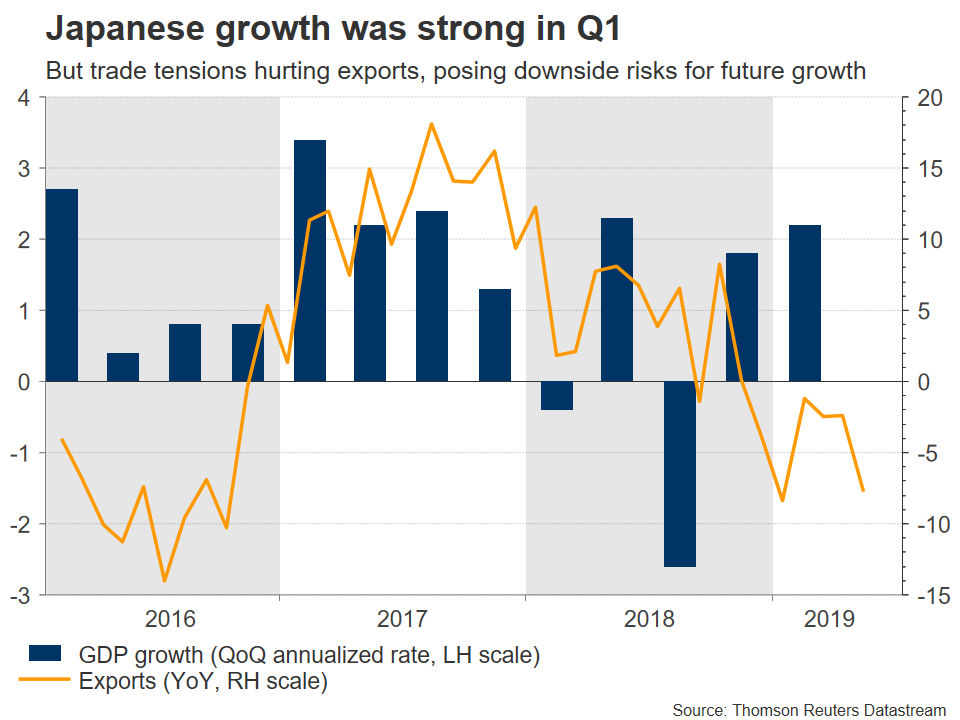
Separately, Shinzo Abe’s government plans to raise the nation’s consumption tax in October, something that triggered a recession the last time it was attempted back in 2014. The implication is that if this tax hike proceeds as planned, the pressure on the BoJ to support the economy by adding even more stimulus would grow exponentially.
Global easing
Beyond that, it’s also useful to consider what other major central banks are doing. Both the Fed and ECB have signaled they may loosen their policies soon. That could push the yen higher as it becomes more attractive relative to the dollar and euro, making it harder for Japan’s already-tepid inflation to rise, as a stronger currency pushes down on the price of imported products. In other words, unless the BoJ hints it could ease too, it may soon have another headache to deal with in the form of an appreciating yen.
The problem is that the BoJ doesn’t have nearly as much firepower as say the Fed does, even if it wanted to ease further. It already has in place the most aggressive easing program in the world and may therefore be wary of using its ‘final bullets’ without it being absolutely necessary.
Buying time
Blending everything together, the most appropriate route for the BoJ at this juncture may be to hint that more stimulus is possible soon, depending on how risks evolve. That would help alleviate some upward pressure on the yen, without actually requiring any action for now. If so, the Japanese currency may come under some selling pressure on the news, though any negative reaction is unlikely to be massive.
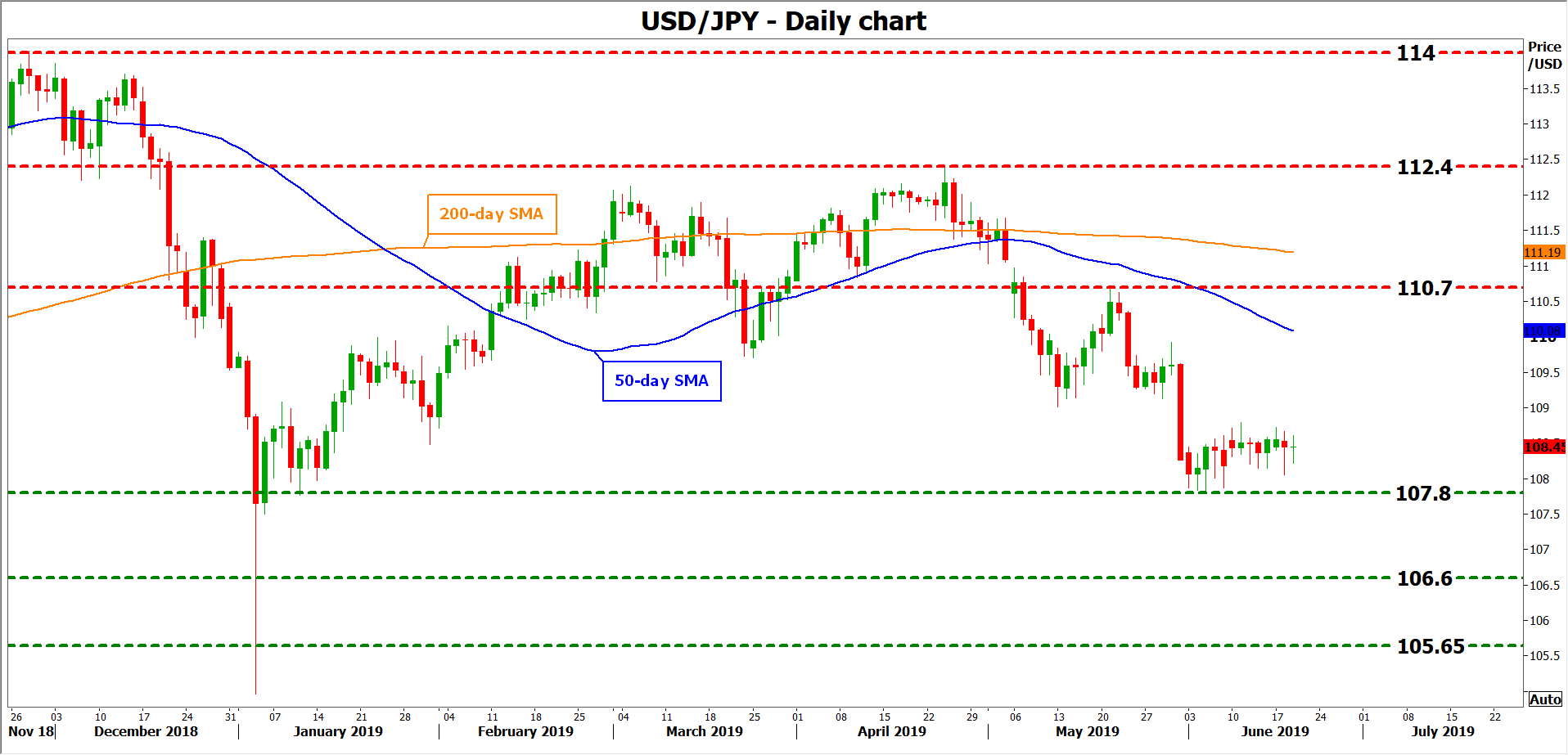
Taking a technical look at dollar/yen, resistance to advances may be found near the 50-day simple moving average (SMA) at 110.08. On the flipside, declines in the pair may stall initially at 107.80, the area that halted the drop in early June.
Brighter picture
In the big picture, the outlook for the yen seems to be brightening, as both the Fed and the ECB have more room to ease than the BoJ does if the global outlook darkens further. Not to mention that a worsening global picture would also divert safe haven flows into the yen. That said though, a lot will also depend on how the trade narrative plays out, with all eyes now on the meeting between Trump and Xi Jinping at the G20 summit next week.
Brent Crude – Steady as OPEC Confirms Meeting Fate
OPEC to meet after G20
OPEC’s website this morning confirmed that it’s meeting will take place a few days later than initially planned, with it now seemingly penned in for 1 and 2 July, the latter of which will include allies including Russia.
The decision to delay the meeting may well relate to the G20 and talks taking place between the US and China, with the trade war seen as the greatest threat to the global economy at the moment and one that has led to downward revisions to oil demand growth, weighing on prices.
With this in mind, the next couple of weeks could be very volatile for oil prices, with inventory data adding another cause for concern for producers, given the recent inventory numbers. API reported a slight reduction on Tuesday – EIA is expected to confirm this later on today – which may alleviate some of the downward pressure in the near-term.
Brent Daily Chart
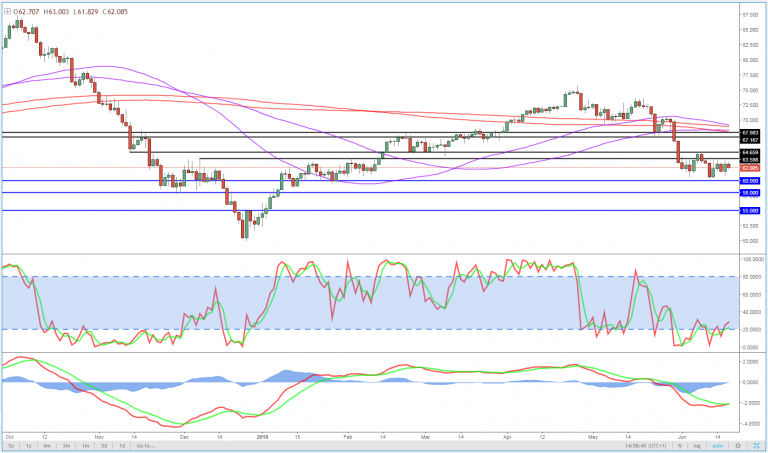
As far as price in concerned, it remains subdued, with $60 coming under repeated pressure this month. The inability to top previous highs on rallies won’t be comforting for bulls, although with so many different factors driving price right now, unpredictable events could change the look of the charts. Just look at the spike last week following the tankers attack in the Gulf of Oman.
Should $60 break, it could be a bearish signal in the near-term, with $58 being the next notable level below and $55 below that. A break back above $64.70 could mark a reversal in the trend, resulting in a double bottom and giving a possible price projection – based on its size – of around $69. Of course, there’s never a guarantee with these and they’re not meant to be precise.
Sunset Market Commentary
Markets
Attention obviously turns to the FOMC meeting tonight. Fed Chair Powell stated in March that sustaining the US economic expansion is the Fed’s overarching goal. We expect the new reaction function of the Fed to reflect that stance. Instead of saying that the next rate move could occur in either direction, Powell will probably show clear determination to cut policy rates if eco data deteriorate further. That scenario of “insurance cuts” is discounted in rate markets, with forward curves pricing up to 4 cuts by the end of next year. It was also quite striking that Fed governors didn’t really downplayed market moves in the run-up to the FOMC meeting. The new dot plot is a big question mark. How will governors reflect the binary risk of willing to cut rates? We expect dots to shift towards market pricing, but they’ll retain some distance. The market implied probability of a July cut stands at 84%. The probability of at least two 25 bps rate cuts by the end of the year exceeds 80%. We don’t expect the Fed meeting to be the start of a profit taking move on the core bond market and that it will prevent a sustained USD rebound. EUR/USD 1.11 remains the line in the sand.
Markets digested yesterday’s ECB policy easing comments during an extremely calm trading day ahead of thre Fed meeting. Global core bonds simply took a breather after yesterday’s surge, especially in the German bund. The US yield curve bear flattens with yields changing from +3bps (2y) to +2 bps (30y). German yield changes vary from +2 bps (2y) over +4 bps (5y) to +3 bps (10y, 30y). Peripheral spreads narrow further with Italy and Greece outperforming (both -7 bps). FX markets oscillated near opening levels. EUR/USD currently creeps higher in technical trade to levels close to 1.12. Market moves are very gradual and remain limited however. The important Fed meeting holds currency and bond markets in check. Investors first want more clues as to how far the Fed is willing to go in sustaining the current economic expansion (i.e. how many rate cuts will Powell hint at?).
After yesterday’s sharp and sudden ECB-driven decline, EUR/GBP kicked off European dealings in a shy recovery mode. The upward leg soon ran out of steam however. The couple returned to opening levels and posted additional, yet minor, losses after British CPI in May, if anything, marginally beat expectations. The EUR/GBP 0.89 is currently under test. Cable ekes out slight gains and is closing in on the 1.26 handle. A clear direction of the pound sterling is absent in the run up to this evening’s third Tory party voting round and especially to tomorrow’s Bank of England meeting. Markets are keen to see whether the BoE will cling on to it’s tightening bias amidst a global shift of central banks towards more monetary easing.
News Headlines
UK inflation in May decelerated slightly from 2.0% YoY to 1.9% on cheaper air travel and car prices. Core measures also declined a tad but a little less than expected (from 1.8% YoY to 1.7%, 1.6% expected). UK producer prices (May) and housing prices (April) were similarly lower compared to the previous month.
May inflation in Canada surprised on the upside with headline inflation accelerating from 2.0% YoY to 2.4% (0.4% MoM) with food, recreation and education offsetting a steep drop in energy and transportation prices. Gains for the loonie stayed limited though (USD/CAD near 1.336, -0.15%).
EUR/USD Mid-Day Outlook
Daily Pivots: (S1) 1.1169; (P) 1.1206; (R1) 1.1231; More......
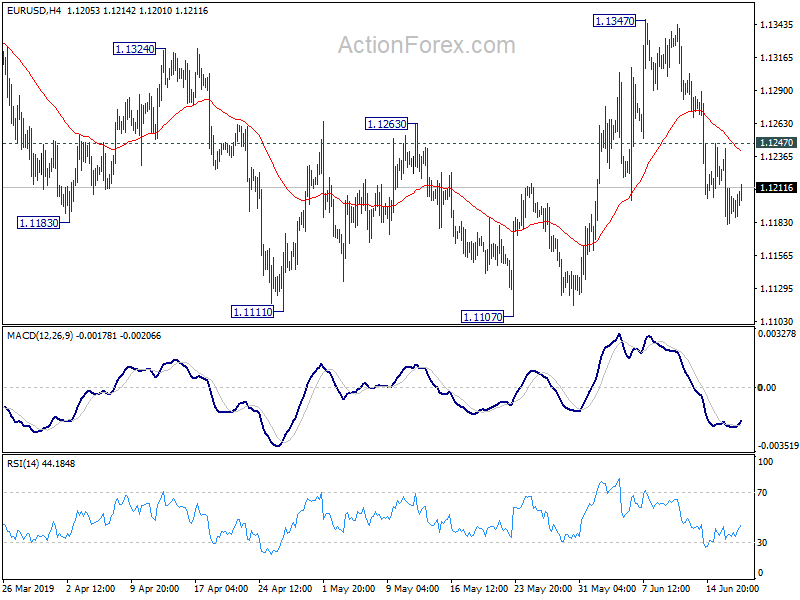
With 1.1247 minor resistance intact, further fall is still in favor in EUR/USD for 1.1107 low. We'd stay cautious on strong support from 1.1107 low to bring rebound. On the upside, above 1.1247 minor resistance will turn bias back to the upside for 1.1347 again.
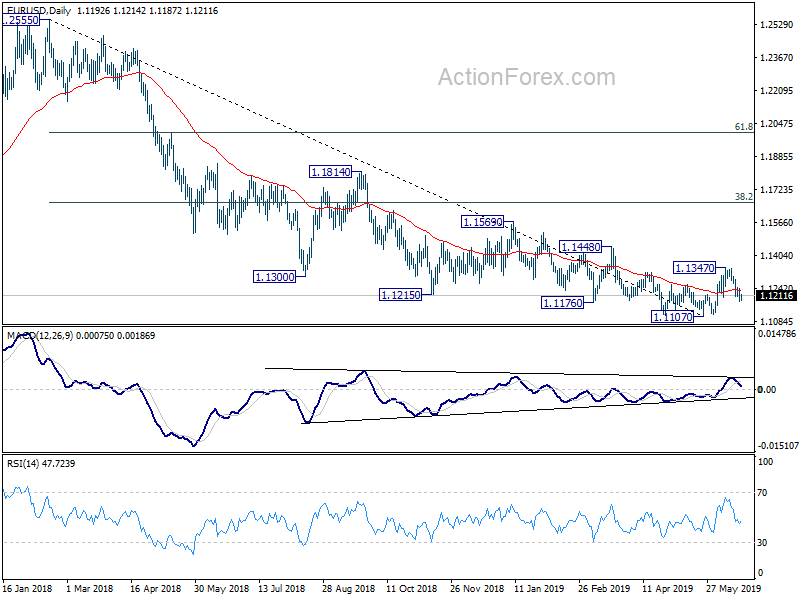
In the bigger picture, considering bullish convergence condition in daily and weekly MACD, a medium term bottom could be in place at 1.1107 after hitting 61.8% retracement of 1.0339 (2016 low) to 1.2555 (2018 high) at 1.1186. Hence, for now, risk will stay on the upside as long as 1.1107 low holds. Break of 1.12347 will extend the rebound towards 38.2% retracement of 1.2555 to 1.1107 at 1.1660. However, sustained break of 1.1107 will confirm resumption of down trend from 1.2555.
GBP/USD Mid-Day Outlook
Daily Pivots: (S1) 1.2520; (P) 1.2543; (R1) 1.2580; More....
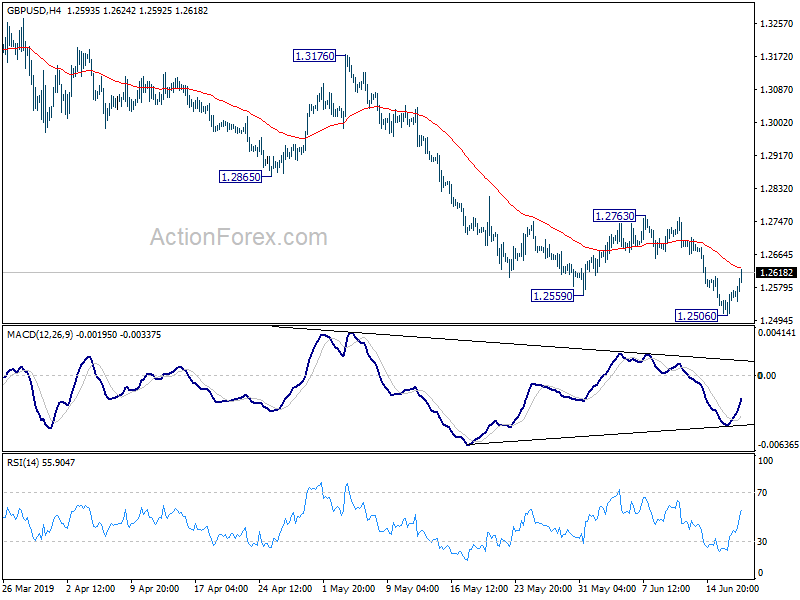
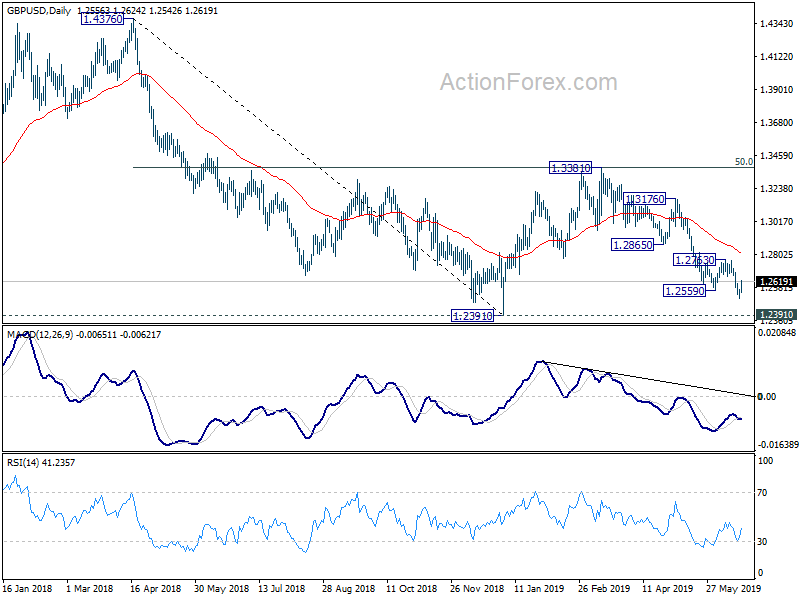
Intraday bias in GBP/USD remains neutral for consolidation above 1.2506 temporary low. Upside of recovery should be limited below 1.2763 resistance to bring fall resumption. On the downside, below 1.2506 will extend the fall from 1.3381 to 1.2391 low. Decisive break there will confirm resumption of larger down trend. Nevertheless, break of 1.2763 will indicate short term bottoming and bring stronger rebound.
In the bigger picture, medium term decline from 1.4376 (2018 high) is possibly ready to resume. Decisive break of 1.2391 would target a test on 1.1946 long term bottom (2016 low). For now, we don't expect a firm break there yet. Hence, focus will be on bottoming signal as it approaches 1.1946. In any case, medium term outlook will stay bearish as long as 1.3381 resistance holds, in case of strong rebound.
GBP/JPY Triggers Corrective Recovery Nearer Term
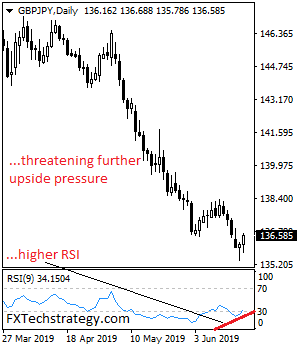
GBPJPY triggers corrective recovery nearer term as we expect more gain in the days ahead. On the downside, support comes in at the 136.00 level where a violation will aim at the 135.50 level. A break below here will target the 135.00 level followed by the 134.50 level. Conversely, resistance is seen at the 137.00 level followed by the 137.50 level. A cut through that level will set the stage for a move further higher towards the 138.00 level. Further out, resistance resides at the 138.50 level. All in all, GBPJPY remains biased to the upside nearer term.
USD/CAD Outlook: Loonie Rose on Upbeat Canada’s CPI Data
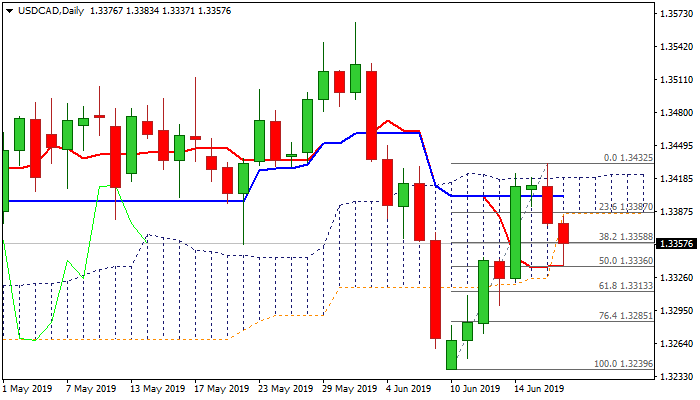
The pair dipped on Wednesday, extending bearish acceleration from the previous day, after bulls were trapped above daily cloud top.
Upbeat Canada's inflation data (May CPI y/y 2.4% vs 2.1% f/c; 2.0% prev) showed the highest levels in seven months that is signal for the central bank to hold off on cutting interest rates.
Fresh weakness emerged below daily cloud base and hit support at 1.3337 (daily Tenkan-sen/50% retracement of 1.3239/1.3432 upleg), where fresh bears faced headwinds. Strong bearish momentum on daily chart, with south-heading stochastic support bears for extension towards 1.3313 (Fibo 61.8%), possibly to key supports at 1.3288/75 (weekly cloud top/200SMA).
Formation of reversal pattern after triple failure to break above daily cloud and bull-trap, add to negative near-term outlook.
Broken daily cloud base marks solid resistance at 1.3385, which should ideally cap and maintain bearish bias.
Release of Fed policy decision is expected to provide fresh signals for the pair.
Res: 1.3385; 1.3401; 1.3419; 1.3432
Sup: 1.3337; 1.3313; 1.3300; 1.3275