

Sample Category Title
Gold: Yellow Metal Reverses Its Gains In The Asian Session
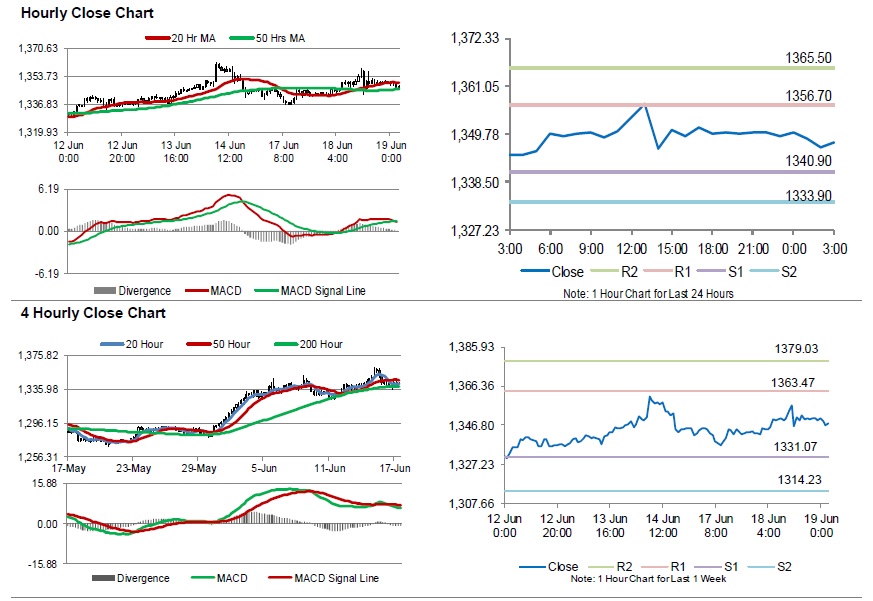
For the 24 hours to 23:00 GMT, Gold rose 0.56% against the USD and closed at USD1350.20 per ounce, amid cautious investor sentiment ahead of the Federal Reserve’s monetary policy outcome.
In the Asian session, at GMT0300, the pair is trading at 1347.90, with gold trading 0.17% lower against the USD from yesterday’s close.
The pair is expected to find support at 1340.90, and a fall through could take it to the next support level of 1333.90. The pair is expected to find its first resistance at 1356.70, and a rise through could take it to the next resistance level of 1365.50.
The yellow metal is trading below its 20 Hr moving average and showing convergence with its 50 Hr moving average.
Silver: White Metal Trading On A Weaker Footing This Morning
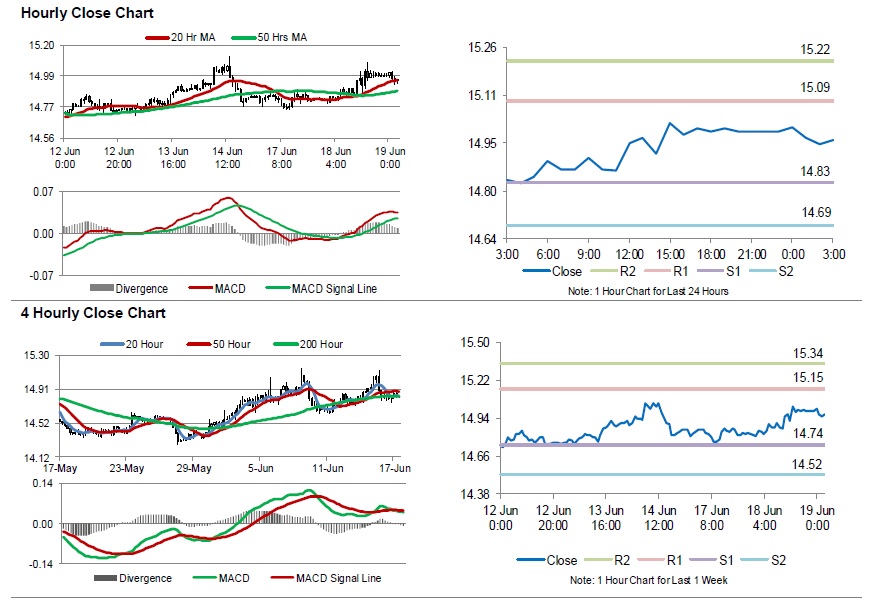
For the 24 hours to 23:00 GMT, Silver rose 1.15% against the USD and closed at USD14.99 per ounce, tracking gains in gold prices.
In the Asian session, at GMT0300, the pair is trading at 14.97, with silver trading 0.17% lower against the USD from yesterday’s close.
The pair is expected to find support at 14.83, and a fall through could take it to the next support level of 14.69. The pair is expected to find its first resistance at 15.09, and a rise through could take it to the next resistance level of 15.22.
The white metal is showing convergence with its 20 Hr moving average and trading above its 50 Hr moving average.
Crude Oil: Oil Trading Lower, Ahead Of EIA’s Weekly Crude Oil Stockpiles Data
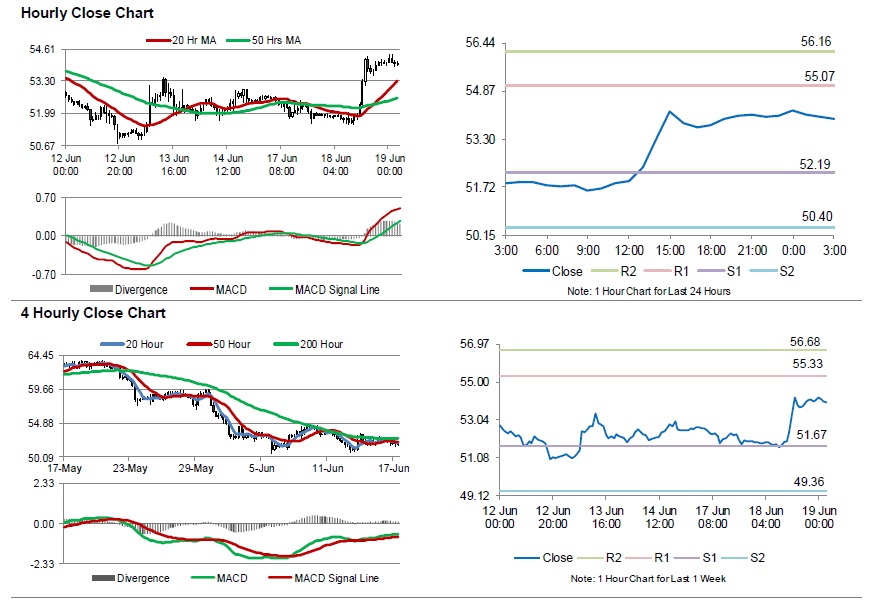
For the 24 hours to 23:00 GMT, Crude Oil rose 4.08% against the USD and closed at USD54.06 per barrel, after the American Petroleum Institute (API) reported that US crude oil inventories slid by 0.8 million barrels in the week ended 14 June 2019.
In the Asian session, at GMT0300, the pair is trading at 53.97, with oil trading 0.17% lower against the USD from yesterday's close.
The pair is expected to find support at 52.19, and a fall through could take it to the next support level of 50.40. The pair is expected to find its first resistance at 55.07, and a rise through could take it to the next resistance level of 56.16.
Crude oil is trading above its 20 Hr and 50 Hr moving averages.
UK Johnson stays as the far and away favorite after Tuesday votes
Former UK Foreign Minister Boris Johnson further solidified his place as far and away favorite to be the next Conservative Leader and Prime Minister. In the last round of leadership vote on Thursday, Johnson got 126 votes, nearly three times of runner-up, current Foreign Minister, Jeremy Hunt's 46. Environment Secretary Michael Gove was third with 41 votes, and International Development Secretary Rory Stewart was fourth with 37, Home Secretary Sajid Javid had 33. Dominic Raab, with 30 votes, was knocked out. More votes are scheduled for Wednesday and Thursday.
In a televised debate yesterday, Johnson pledged that "we must come out on the 31 Oct. because, otherwise I am afraid we face a catastrophic loss in politics". And, "unless we do it, unless we get out on Oct. 31 I think we will all start to pay a really serious price."
Trump: I think we have a chance for a trade deal with China
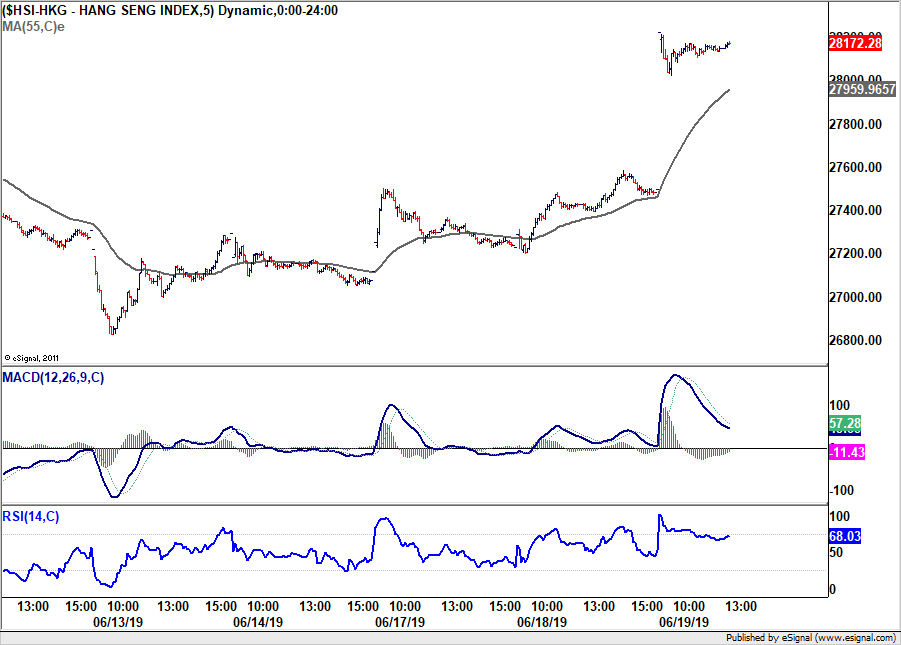
Risk appetite was given a strong boost as US and China are returning to the table for trade negotiations. At the time of writing, Nikkei is up 1.74%, Hong Kong HSI is up 2.37% and China Shanghai SSE is up 1.50%. Overnight, DOW rose 1.35%, S&P 500 rose 0.97% and NASDAQ rose 1.39%. Of course, in the background, ECB's hints on additional monetary stimulus ahead were confidence lifting too.
The news started with Trump tweeting yesterday that he had a "very good telephone conversation" with Chinese President Xi Jinping. And Trump said both will have an "extended meeting" next week at the G20 in Osaka, Japan. The phone call was also confirmed by China's state media.
Later at the White House, Trump told reporters, "I think we have a chance. I know that China wants to make a deal. They don't like the tariffs, and a lot of companies are leaving China in order to avoid the tariffs". He added "I think the meeting might very well go well, and frankly our people are starting to deal as of tomorrow. The teams are starting to deal. So we'll see. China would like to make a deal. We'd like to make a deal, but it has to be a good deal for everybody."
Chinese state media reported Xi saying "The key is to show consideration to each other's legitimate concerns. We also hope that the United States treats Chinese companies fairly. I agree that the economic and trade teams of the two countries will maintain communication on how to resolve differences."
HK HSI gaps higher at open and is currently up more than 2.3%.
Making Substantial Changes To Our ECB Views
Executive Summary
- ECB President Draghi made clear in comments today that the ECB is likely to ease policy relatively soon if the economic situation in the Eurozone does not improve.
- In light of these comments, and considering recent economic developments and past policy actions from the ECB, we now expect the ECB to cut its deposit rate and main refinancing rate 10 bps to -0.50% and -0.10%, respectively, in September. We also expect a change in forward guidance on interest rates.
- We do not expect the central bank to restart asset purchases at this time, although a further deterioration in growth and inflation outcomes could change that view.
Draghi Offers Freshly Minted Dovish Comments
The underwhelming performance of the Eurozone economy has been a source of concern for monetary policymakers at the European Central Bank (ECB) for some time. Economic growth has been sluggish, with GDP growth of just 1.2% year-over-year through Q1-2019. On the price front, CPI inflation has struggled to get anywhere close to the central bank’s inflation target of “close to, but below” 2%, and indeed the core CPI inflation rate has dipped below a 1% year-over-year pace on multiple occasions over the past several months. While we—and the ECB—expect economic growth to continue, we believe the downside risks for both growth and inflation have become more prominent. It is against this backdrop that ECB President Draghi delivered some critical comments in a seminal speech at the ECB’s Forum on Central Banking in Sintra, Portugal today, which we believe have significant implications for the path of ECB monetary policy moving forward.
In his recapping of the ECB monetary policy experience of the past twenty years, as well as the current situation, Draghi noted that while there has been a successful transmission of monetary policy to financing conditions and the GDP and employment, “the final legs of the transmission process to wages and inflation have been slower than we expected.” And while noting that wage growth is now strengthening as labor market slack lessens, Draghi also noted that “the pass-through from wages to prices remains weak.” In this context and referring to the economic outlook and economic trends, Draghi stated: “In the absence of improvement, such that the sustained return of inflation to our aim is threatened, additional stimulus will be required.”
Mr. Draghi’s comments are particularly important in that, in contrast to the most recent ECB commentary, it now puts the onus on the economic data to improve to avoid further monetary policy easing. What then could represent that type of improvement? Simply looking at the ECB’s growth and inflation forecasts, one measure of improvement might be whether there are upside GDP growth surprises (for reference, the ECB’s staff projections forecast quarterly growth of 0.2% in Q2, 0.3% in Q3 and 0.4% in Q4), along with a sustained firming in underlying inflation trends.
Another perspective, however, is to consider the ECB’s monetary policy easing reaction function over the past several years. Although the ECB has a sole inflation mandate, and thus price trends appear to be most influential in prompting monetary policy moves, Eurozone growth conditions are also relevant. To capture both, we examine trends in the Eurozone Composite PMI as well as the Eurozone core CPI through most of this decade (Figure 1).
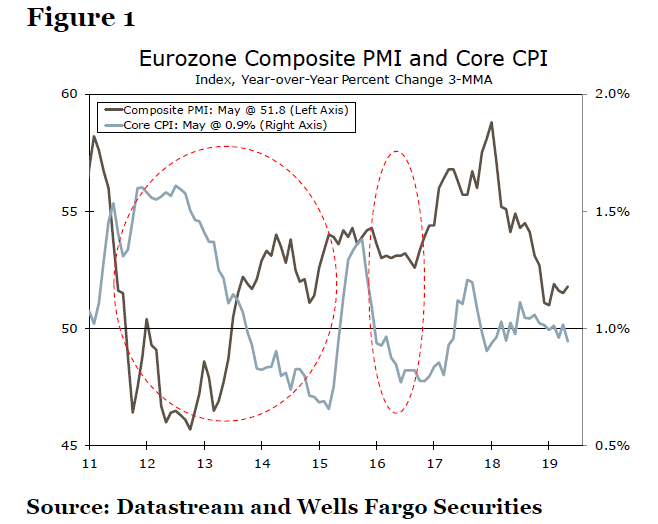
The ECB has in fact spent most of the current decade easing monetary policy through a variety of measures (policy interest rate cuts, negative policy interest rates, quantitative easing, an accelerated pace of quantitative easing and its targeted long-term lending programs), while the periods of monetary policy stability have been somewhat briefer. The key periods when the ECB was easing monetary policy in some form were:
- Mid-2011 to early 2015: The ECB implemented multiple rate cuts, eventually taking its deposit rate into negative territory, and initiated its quantitative easing program in early 2015.
- Early 2016 to Q1 2017. The ECB cut its deposit rate further, as well as accelerating the pace of its monthly asset purchases to €80 billion from €60 billion.
There have been no decisive easing actions from the ECB since Q2-2017, with the central bank initially trimming its asset purchases through the latter part of 2017, and subsequently tapering and eventually finishing its net asset purchases by the end of 2018.
Looking at the periods when the ECB was easing monetary policy (2011 to early 2015, and 2016), we note that one of two conditions typically prompted and contributed to those easing moves:
- The Eurozone economy was in recession or, alternatively, the composite PMI was substantially below the breakeven 50 level.
- The trend of core CPI inflation (three-month average of year-over-year inflation) was perceptibly below 1%.
Accordingly our rule of thumb for the ECB’s monetary policy easing reaction function over the past several years is:
ECB monetary policy easing typically occurs when the Eurozone composite PMI is substantially below 50, OR the trend of core CPI inflation is perceptibly below 1%.
In our view, for there to be “improvement” that would dissuade the ECB from easing further, both of the above conditions would need to be avoided. At the current juncture, we see little prospect of any significant firming in the composite PMI or core CPI by the time of the next ECB monetary policy meetings, in July and September. Although the composite PMI may still be in growth territory, the trend of core CPI inflation could still be below 1%, and indeed we think ECB policymakers perceive there to be a real risk of core CPI inflation slowing further from current levels. Accordingly, we now view additional ECB monetary policy easing as the most likely scenario, the timing and method of which we outline in greater detail below.
From the Bottom, Looking…Down?
The ECB has a few options in its policy toolkit, as highlighted by recent speeches from Draghi and other key policymakers, including rate cuts, changes to forward guidance and asset purchases (i.e., quantitative easing). As we will discuss over the course of this section, we think the most likely course of action for the ECB will be to cut interest rates and change forward guidance, but we do not currently expect renewed asset purchases.
Recent media reports have explicitly suggested that ECB officials anticipate using rate cuts as the first-order method of stimulus, but there are quite a few options in terms of the timing and nature of rate cuts. In terms of timing, we think September makes the most sense for a rate cut for a few reasons. First, it gives the central bank a few weeks to digest the market reaction to its recent communications, and also allows it to assess the outcome of potential U.S.-China trade talks at next week’s G20 summit. If the ECB still feels that action is warranted by the time its July meeting comes, it can then signal that a policy move will likely come at the September meeting, which notably features updated ECB economic projections. In recent history, the ECB has tended to make its most significant policy decisions in meetings accompanied by economic projections. As of now, we do not think the economic situation in the Eurozone is dire enough to warrant immediate policy action (i.e., in July), although this week’s Eurozone PMIs and next week’s CPI figures will be especially important to watch for further clues on the potential timing of any ECB policy action.
In terms of the nature of rate cuts, we think the ECB will cut its deposit rate and main refinancing rate (MRO rate) 10 bps to -0.50% and -0.10%, respectively, in September. The deposit rate has for the most part served as the most important ECB policy rate given the substantial amount of excess liquidity in the Eurozone financial system, and thus markets will probably be most focused on what changes, if any, the ECB makes to the deposit rate. However, the MRO rate is also important, particularly now that the new round of targeted longterm refinancing operations (TLTROs) will be offered at a floating rate indexed to the MRO rate over the life of those loans. Thus, any cuts to the MRO rate should reduce the rates offered on TLTROs, effectively making monetary policy more accommodative.
We do not expect the central bank to introduce a tiering system to mitigate the impact of negative interest rates on the commercial banking sector, but admit that it is a relatively close call and we will be closely monitoring any comments on the topic ahead of and during the July policy announcement. Finally, we would also expect the ECB to adjust its forward guidance, which currently states that rates will remain at present levels through H1-2020. In our view, this language could become less time-contingent (“at present levels for an extended period,” for example), and could also be modified to include the possibility of lower interest rates (“at present levels or lower”).
Asset purchases are another means through which the ECB could ease monetary policy. In recent commentary, ECB President Draghi stated that there was “considerable headroom” for renewed asset purchases. However, existing issuer limits prevent the ECB from purchasing more than 33% of any Eurozone sovereign’s total stock of government debt eligible for purchase under the public sector purchase program (PSPP). According to our calculations, the ECB already owns roughly 30% of the eligible stock of German government bonds, suggesting there is limited room to expand purchases with the current issuer limits in place. If the ECB seeks to restart asset purchases, it will likely need to raise this issuer limit—perhaps to 50%—which we suspect will be met with significant political resistance. In any case, we do not expect the ECB to restart its asset purchases at this time. That view could change if we start to see a more significant deterioration in actual core CPI inflation outcomes in the months ahead.
Markets In Limbo Ahead Of Fed Decision
Indices consolidate yesterday's surge
Asian markets were little changed in low-volume trading this morning, with most investors sitting on the sidelines while waiting for the decision at the end of the two-day Federal Reserve meeting. Expectations are relatively low for a move at this meeting, with market-based pricing suggesting only a less-than 20% chance of a 25bps cut, and it will be the forward guidance that will either confirm or reject market expectations of a cut at the July meeting. Those odds are currently as high as 82% for a 25bps cut.
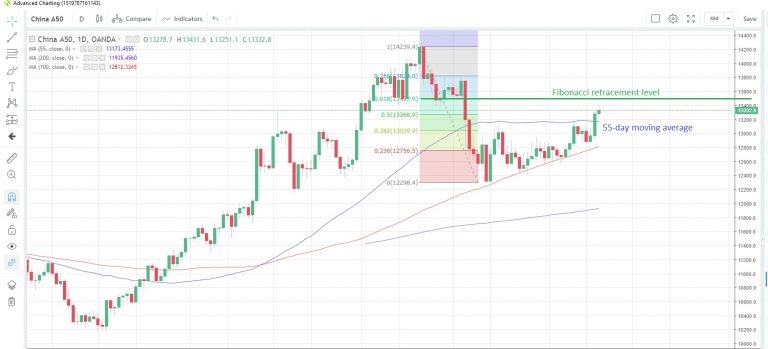
US indices consolidated yesterday's surge, barely changed for yesterday's close, while the China50 index rose 0.22% to touch the highest since May 6 while the Japan225 index climbed 0.31%. Currencies were little changed with AUD/USD holding on to yesterday's late gains at 0.6875 and USD/JPY flat at 108.43.
China50 Daily Chart
Commodities welcome Trump's tweet
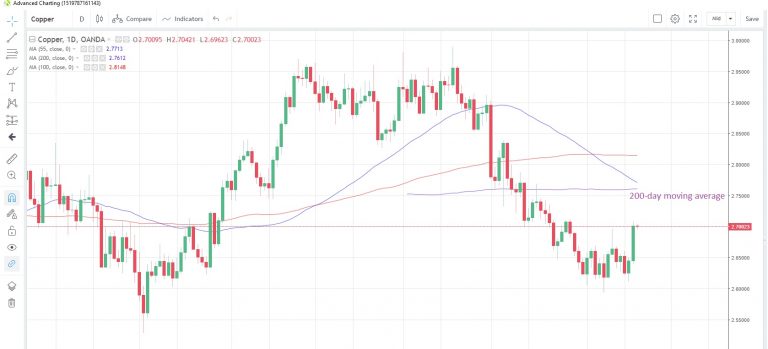
Trump's tweet last night that he had a “very good” phone conversation with China's Xi and they are due to have an extended meeting next week at the G-20 summit was welcome news to commodity markets. Copper prices rose by more than 2% to the highest in three weeks while soybeans advanced to the highest in nearly four months.
Copper Daily Chart
UK prices on tap
Today sees release of the UK's triple price indices, retail prices, producer prices and consumer prices for May. All three are expected to show a benign bias, with decelerating increases compared with April. Consumer prices increases are expected to slow to +2.0% y/y from 2.1% the previous month.
Aside from the FOMC decision, the North American session features Canada's CPI data for May, both the official data and the Bank of Canada's core indices. Early tomorrow morning, New Zealand publishes first quarter GDP numbers, with forecasts suggest a slight uptick on an annualized basis to 2.4% from 2.3% in Q4 and unchanged growth of +0.6% on a quarter-by-quarter basis.
Market Morning Briefing: Euro-Yen Has Support At 121
STOCKS
The news on the US and the Chinese Presidents meeting next week at the G-20 summit has renewed the optimism on the trade talk front and has boosted the equities. The broader bullish view on the equities remain intact. Will the Fed boost the momentum further in equities today with a rate cut? We will have wait and see. Dow, DAX, Nikkei have gained strength and remains bullish. Shanghai retains its sideways range, but gives bullish signals to break the range on the upside. Sensex and Nifty have key resistances ahead which may cap the upside in the near term and keep it pressured on the downside.
As expected, Dow (26465.54, +353.01, +1.35%) has surged breaking above 26250 and is heading towards 26500-26600. Though an intermediate pull-back to 26250 cannot be ruled out, Dow is likely to breach 26600 eventually and target 27200-27500 over the medium term.
DAX (12331.75, +245.93, +2.03%) dipped to test 12000 and has risen sharply from there in line with our expectation. Though there is resistance near current levels, the outlook remains bullish. DAX can extend its upmove to 12430-12450. Support is in the 12235-12200 region.
Nikkei (21311.89, +339.18, +1.62%) has risen past 21250 contrary to our expectation for a fall. While above 21250, the outlook is bullish to see a rise to 21750..
Shanghai (2928.64, +38.48, +1.33%) has bounced above 2900 and can now test 2935 and 2950 - the upper end of its 2835-2950 sideways range. The price action over the last one week leaves the bias positive to see a break above 2950 and a rise to 3000.
As expected, Sensex (39046.34, +85.55, +0.22%) and Nifty (11691.50, +19.35, +0.17%) have key resistances at 39500/39750 and 11800/11850 respectively. A test of resistances is possible in the near term, but a rise past them is less preferred. As such, while below these resistances, the outlook is likely to remain bearish to see a fall to 38500-38000 on the Sensex and 11600 on the Nifty
COMMODITIES
A rate cut either today itself from the Fed or in the coming months in line with market expectation can drag Gold and Silver lower on profit-booking as the market has already priced in the same. Copper has surged breaking on the upside of it sideways range as against our expectation. Oil retains is sideways range as expected and has risen within it. We expect the range to remain intact for some time before the overall downtrend resumes.
Gold (1343) is struggling to breach 1350 decisively indicating the inherent weakness in it and possible fall going forward. As such we expect the crucial resistance in the 1355-1360 region to hold and a fall to 1320-1310 looks likely. As mentioned yesterday, while below 1360 our bias is bearish to see a fall to 1300 and even lower levels - may be post fed meeting.
The upside in Silver (14.95) is likely to be capped at 15.10 which has been holding well over the last few days. We expect a fresh fall to 14.60-14.50 (initially) and then to 14.35-14.25 (eventually) in the coming days.
Contrary to our expectation, Copper (2.70) has surged above 2.68. A strong rise past 2.72 will pave way for 2.75-2.77 on the upside and prove our bearish view wrong.
Brent (62.24) has bounced from near 60. As we have been mentioning for some time, Brent can remain range-bound between 59.5 and 64 for some time. Within this range, a rise to 64 is possible on a break above 62.80.
WTI (54.08) has surged from a low of 51.50 and can test 55 - the upper end of the 50.5-55 sideways range. We expect the range to remain intact and a pull-back to 53-52 is possible from 55 in the coming sessions.
FOREX
Trump has agreed to have an extended meeting with Xi Jinping next week in the G20 summit reviving hopes of a positive outcome of the stalled trade-war concerns between the two countries. Chinese Yuan (6.9036) strengthened from 6.93 yesterday but could overall trade within 6.8960-6.9300 for the next few sessions. A fall below 6.8960 could take it lower to test support near 6.88/87 in the medium term. The sideways range could possibly extend for the week.
Draghi's comments on willingness to ease policy if inflation does not reach target saw sell off in the Euro (1.1191) yesterday as the currency was pushed down from levels of 1.1230 to 1.1193. Euro came off from 1.1250 itself contrary to our expectation of testing 1.1260/70 on the upside. While below 1.1250, the possibility of re-testing 1.1150/25 comes into the picture.
Dollar Index (97.63) held above 97.40 against our expectation of initial test of 97.20 on the downside while the overall medium term view remains bullish. 98 is immediate resistance on the upside which may be tested in the next few sessions followed by a fall towards 97.25 again.
Dollar-Yen (108.44) is stable just now, holding above 108.40.A break below 108.40, if seen could take it down to 108.
Near term is likely to turn bearish.
Euro-Yen (121.40) has support at 121 on the daily candles which if holds could produce an immediate bounce back towards 122. Only if 121 break, we will have to consider a fall towards 120.5-120.0 for the medium term. But we would give more possibility of a bounce from 121 itself in the near term.
Aussie (0.6877) rose back contrary to our bearish view mentioned in yesterday's edition. Support near 0.68 and 0.6850 is likely to hold in the near term producing a bounce towards 0.69 or higher.
Pound (1.2562) could rise towards 1.2600-1.2620 before resuming the overall medium term downtrend targeting 1.25.
USDINR (69.71) fell yesterday from levels near 69.90. We could see Rupee to strengthen in today's session targeting 69.40/30. Note immediate resistance is seen near 69.75 and then higher near 69.95/70.00.
INTEREST RATES
Bond market awaits FED meeting today but saw a sharp decline after Trump's tweet of meeting Xi Jinping next week recovering by the close of the session as comments from ECB stated its willingness to ease policy if inflation does not reach its target. However, this has pushed the European yields lower. Overall globally, yields are trading low today and could take few sessions to recover. As the market has already priced-in the rate cut from the Fed, it will be important now to see the number of rate cuts hinted/projected today by the Fed.
The US yields rose to close at higher levels after an initial dip. The 2YR (1.87%), 5Yr (1.84%), 10YR (2.07%) and 30YR (2.56%) are up from earlier levels of 1.83%, 1.81%, 2.05% and 2.54% respectively. The broader outlook is bearish and could be resumed after some corrective upmove is seen for a few sessions.
The German-US 2YR (-2.57%) is heading towards -2.75% and could be indicative of bearishness in Euro going forward.
European yields saw a sharp fall yesterday. Italy 10Yr (2.0930%) fell from 2.28% while Spain 10Yr (0.3940%) is down from 0.5280%. France and Germany 10 Yr yields are also sharply down from 0.107% and -0.2430% to 0.0090% and -0.3180% respectively. Near term looks bearish with a possible recovery likely after a couple of sessions.
The 10Yr GOI (6.9430%) has fallen below our mentioned level of 6.95%. The bearish view is intact, but the falling momentum seems to be much faster just now than expected. The 10Yr can test 6.75% on the downside indicating a fall in Dollar-Rupee.
Crude Oil Price Facing Key Resistance, Fed Next
Key Highlights
- Crude oil price formed a strong support above $51.00 against the US dollar.
- There was a break above a major bearish trend line at $52.20 on the 4-hours chart of XTI/USD.
- The US Housing Starts declined 0.9% in May 2019, more than the market expectation (-0.4%).
- The Fed interest rate decision is scheduled today and the central bank is likely to make no changes in rates.
Crude Oil Price Technical Analysis
After a significant decline, crude oil price found strong supports near $50.75 and $51.00 against the US Dollar. A base was formed near $51.00 and recently the price started a short term recovery above $52.00.
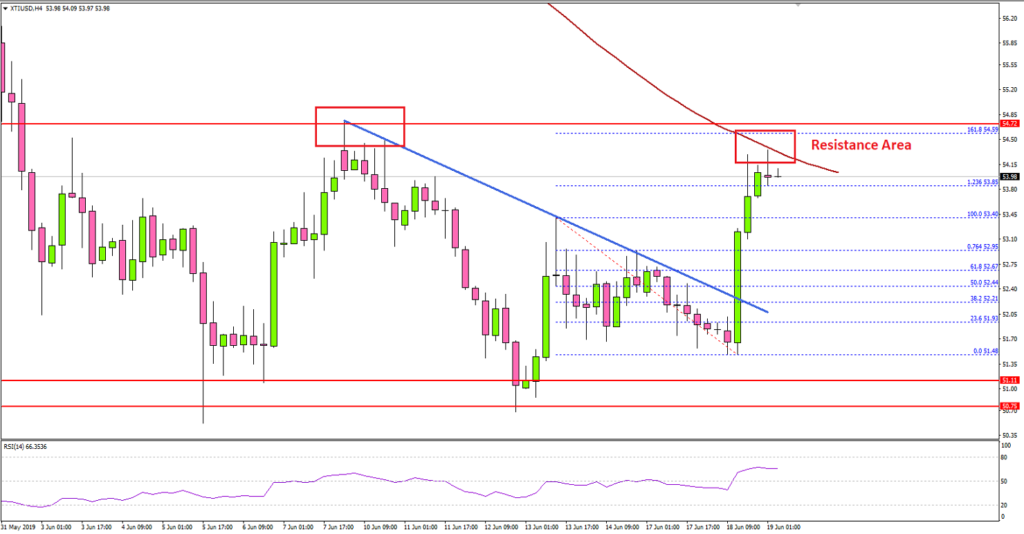
Looking at the 4-hours chart of XTI/USD, the price started a steady rise from the $51.48 swing low. It traded above the $52.00 and $52.50 resistance levels, but remained well below the 100 (red) simple moving average (4-hours), and the 200 (green) simple moving average (4-hours).
During the recent rise, there was a break above a major bearish trend line with resistance at $52.20. Moreover, the price surpassed the 76.4% Fib retracement level of the decline from the $53.40 high to $51.48 low.
It opened the doors for more gains above the $53.40 level. The bulls successfully cleared the $53.80 resistance level and the 1.236 Fib extension level of the decline from the $53.40 high to $51.48 low.
However, the main resistance is near the $54.20 level plus the 100 (red) simple moving average (4-hours), above which the price is likely to move into a bullish zone.
On the downside, an initial support is near the $53.20 level. If there is a downside extension, the price could retest the $52.50 support. The main support is near $51.00, below which there could be heavy losses.
Fundamentally, the US Housing Starts report for May 2019 was released by the US Census Bureau, at the Department of Commerce. The market was looking for a 0.4% decline in the Housing Starts, compared with the last 5.7% increase.
The actual result was lower than the forecast, as the US Housing Starts declined 0.9% in May 2019. On the other hand, the last reading was revised up from 5.7% to 6.8%. .
The report added:
Privately‐owned housing units authorized by building permits in May were at a seasonally adjusted annual rate of 1,294,000. This is 0.3 percent (±1.3 percent)* above the revised April rate of 1,290,000, but is 0.5 percent (±1.4 percent)* below the May 2018 rate of 1,301,000.
Looking at major pairs, EUR/USD and GBP/USD struggled to climb higher, whereas gold price settled above the $1,325 support level.
Economic Releases to Watch Today
- UK Consumer Price Index May 2019 (YoY) – Forecast +2.0%, versus +2.1% previous.
- UK Core Consumer Price Index May 2019 (YoY) – Forecast +1.7%, versus +1.8% previous.
- Canadian Consumer Price Index May 2019 (MoM) – Forecast +0.2%, versus +0.4% previous.
- Canadian Consumer Price Index May 2019 (YoY) – Forecast +2.2%, versus +2.0% previous.
- Fed Interest Rate Decision – Forecast 2.50%, versus 2.50% previous.
Daily Markets Broadcast
Wall Street surges on trade hopes
Hopes that a one-on-one Trump-Xi meeting at the G-20 summit could get trade negotiations back on track lifted US indices yesterday. We also await the result of the FOMC meeting later today, where talk of an easing bias is expected. Dovish comments from the ECB also lifted sentiment.
US30USD Daily Chart
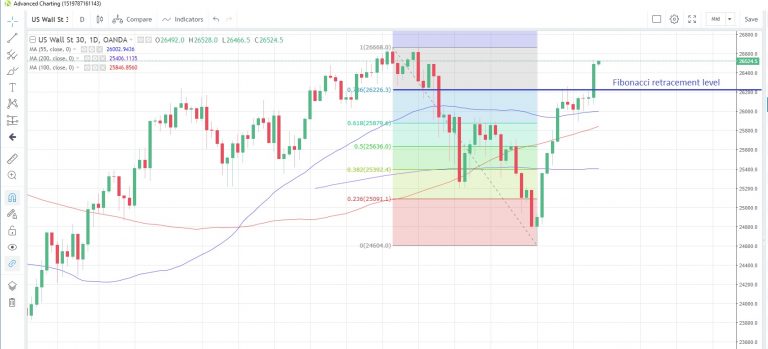
The US30 index jumped the most in two weeks yesterday following Trump’s tweet on a planned “extended meeting” at the G-20 summit
The index closed above the 78.6% Fibonacci retracement of the April-June drop at 26,226, and may be eyeing the April high of 26,668
The result of the two-day Fed meeting will be announced early Thursday (Singapore time) with market-based probabilities of a rate cut at 21% for this meeting and 83% for the July one. There are no other major data releases scheduled for today.
DE30EUR Daily Chart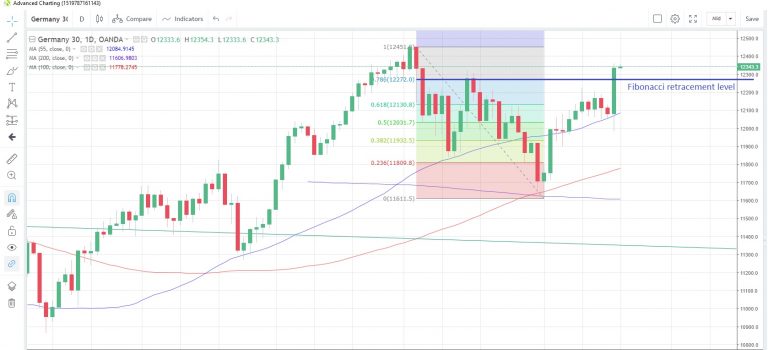
The Germany30 surged the most in five months yesterday after the ECB virtually promised that additional stimulus measures will be coming
The index is likely eyeing the May high of 12,452 as it rose through resistance at the 78.6% Fibonacci retracement of the May-June drop at 12,272
ECB Chief Draghi said that if the economic outlook didn’t improve, then additional stimulus was on the way. Financial press then reported that ECB members seemed to favour rate cuts as the primary tool.
CN50USD Daily Chart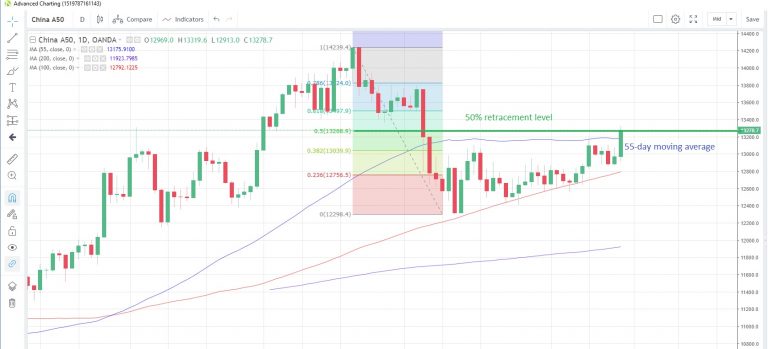
The China50 index jumped 2.4% yesterday on the Trump-Xi news, the biggest one-day gain in five weeks
The index closed above the 55-day moving average at 13,176 for the first time since May 6, and is testing the 50% retracement of the April-May drop at 13,269
US President Trump tweeted last night that he had a “very good” telephone conversation with President Xi of China, adding they will be having an extended meeting next week at the G-20 in Japan. He said “Our respective teams will begin talks prior to our meeting”. The phone call was confirmed by Chinese state media.