

Sample Category Title
USD/CHF Mid-Day Outlook
Daily Pivots: (S1) 0.9971; (P) 0.9985; (R1) 1.0004; More...
USD/CHF's rebound from 0.9854 extends higher today. Focus is now on 1.0008 support turned resistance. Decisive break will indicate completion of fall from 1.0237 and turn bias to the upside for 1.0098 resistance first. Rejection by 1.0008, followed by break of 0.9925 minor support will turn bias back to the downside for 0.9854 support.
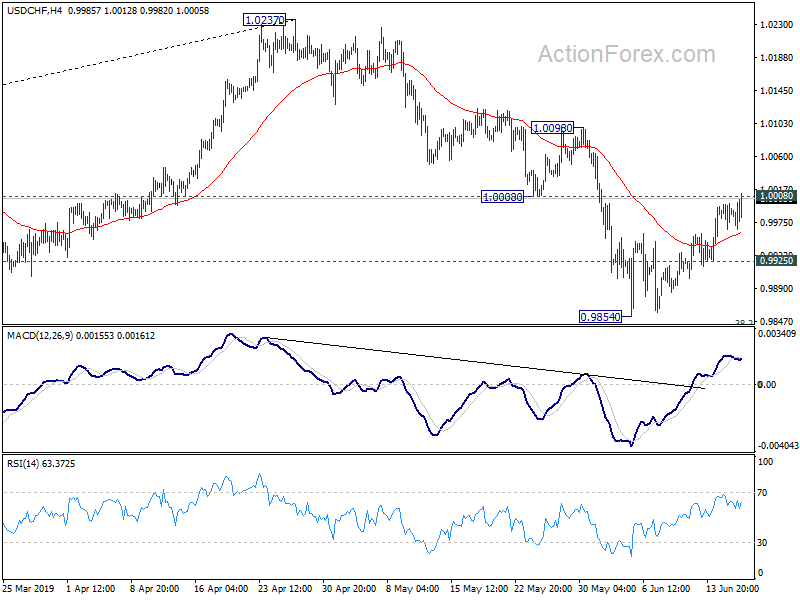
In the bigger picture, USD/CHF's break of long term trend line support is the first indication of medium term reversal. That is, rise from 0.9186 (2018 low) could have completed at 1.0237 already). Sustained break of 38.2% retracement of 0.9186 to 1.0237 at 0.9836 will confirm and target 61.8% retracement at 0.9587. However, strong rebound from 0.9836 will revive medium term bullishness for 1.0237 and above.
USD/JPY Mid-Day Outlook
Daily Pivots: (S1) 108.42; (P) 108.58; (R1) 108.68; More...
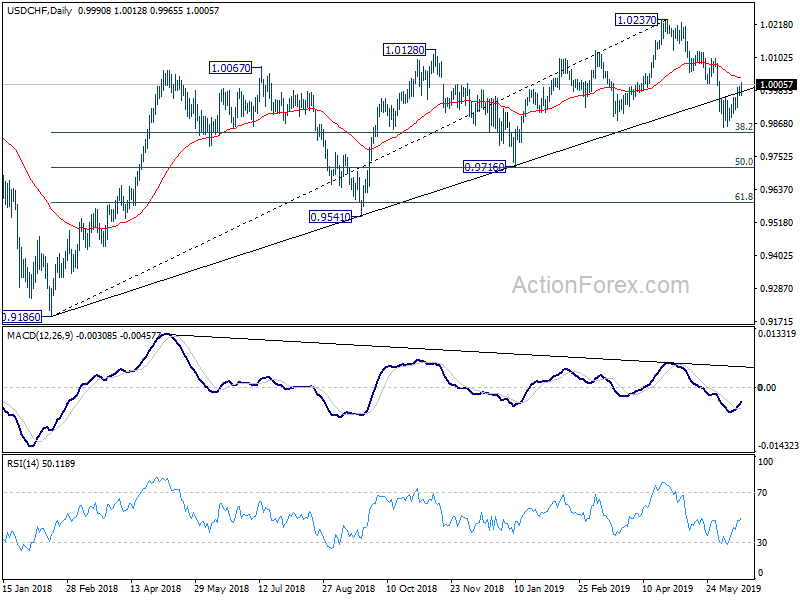
USD/JPY recovers strongly in early US session but intraday bias remains neutral first. Consolidation from 107.81 could extend but upside should be limited by 109.02 support turned resistance to bring fall resumption. On the downside, sustained break of 61.8% retracement of 104.69 to 112.40 at 107.63 will pave the way back to 104.62/9 key support. However, break of 109.02 support turned resistance will indicate short term bottoming and bring lengthier consolidations first.
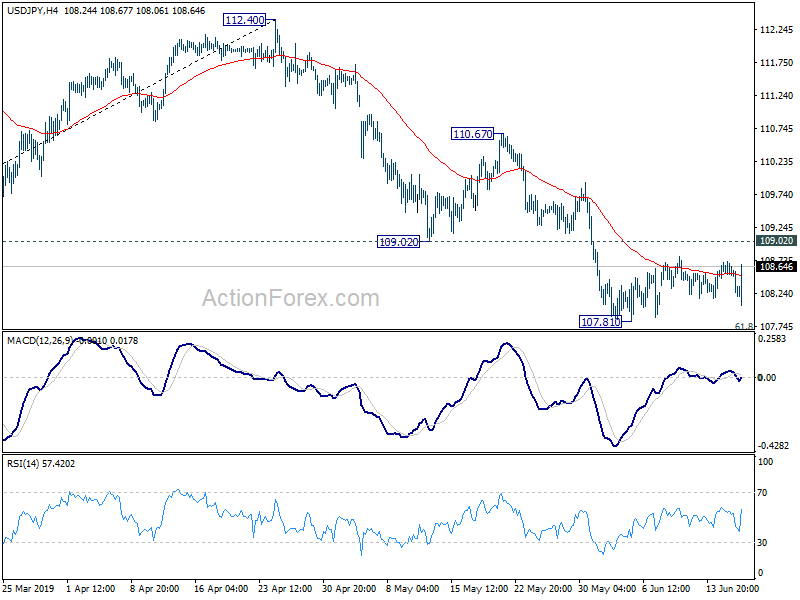
In the bigger picture, decline from 118.65 (Dec 2016) is still in progress, with the pair staying inside long term falling channel. Break of 104.62 will target 100% projection of 118.65 to 104.62 from 114.54 at 100.51. For now, we'd expect strong support above 98.97 (2016 low) to contain downside to bring rebound.
GBP/USD Mid-Day Outlook
Daily Pivots: (S1) 1.2508; (P) 1.2557; (R1) 1.2582; More....
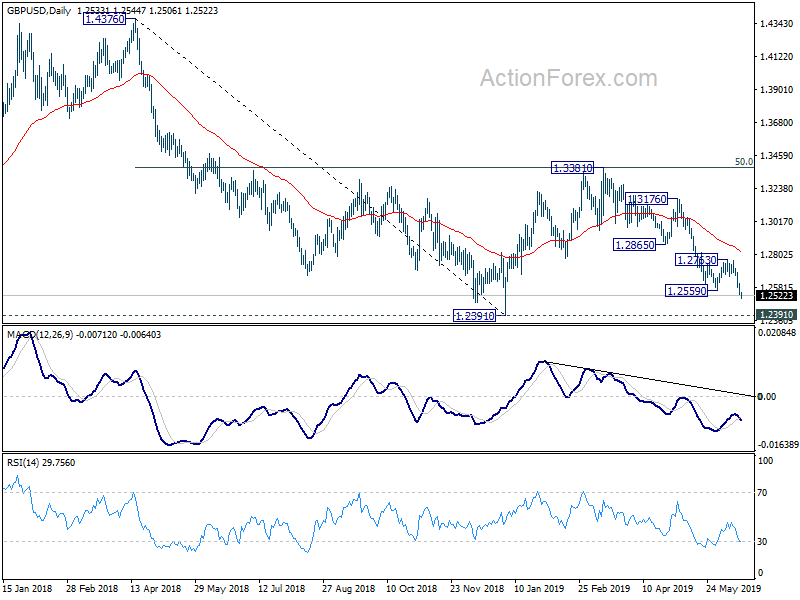
Intraday bias in GBP/USD remains neutral for the moment. Current fall from 1.3381 is in progress for 1.2391 low. Decisive break there will confirm resumption of larger down trend. On the upside, above 1.2605 minor resistance will turn intraday bias neutral first. But recovery should be limited below 1.2763 resistance to bring fall resumption.
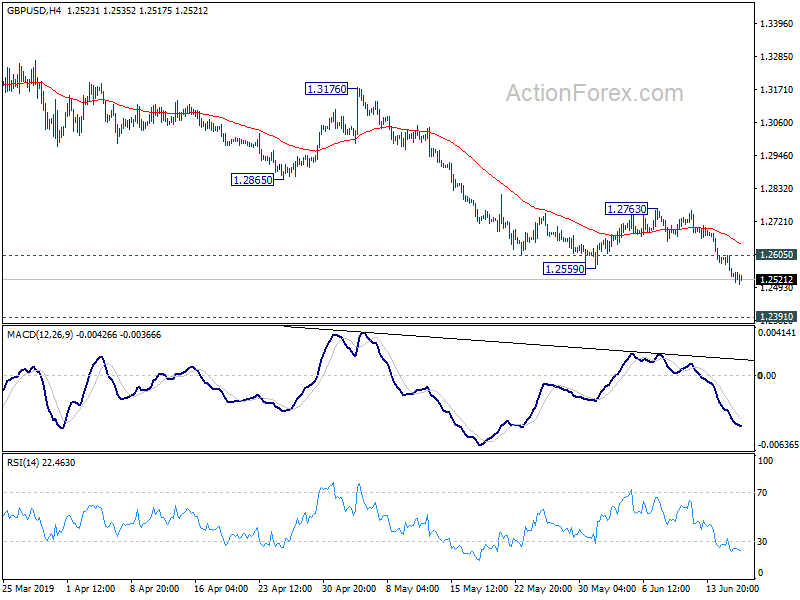
In the bigger picture, medium term decline from 1.4376 (2018 high) is possibly ready to resume. Decisive break of 1.2391 would target a test on 1.1946 long term bottom (2016 low). For now, we don't expect a firm break there yet. Hence, focus will be on bottoming signal as it approaches 1.1946. In any case, medium term outlook will stay bearish as long as 1.3381 resistance holds, in case of strong rebound.
WTI OIL Outlook: Bearish Bias Below 10SMA
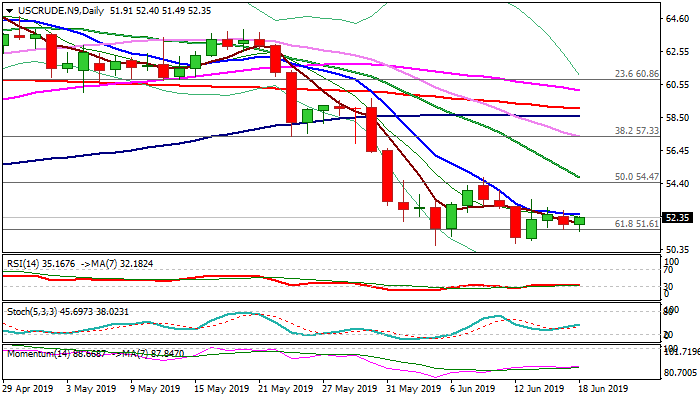
WTI oil price holds within narrow range on Tuesday and remains below 10SMA, which capped the action in past four days, maintaining bearish near-term bias.
Fundamentals remain unchanged, with rising concerns over global economy slowdown that would decrease demand, maintaining pressure on oil prices. On the other side, recent tensions between the US and Iran, partially offset negative impact and keep oil price afloat.
Technical studies remain bearish on daily chart and keep risk of retesting key supports at $50.59/71 (5/12 June lows) while 10SMA caps.
Only sustained break above 10SMA ($52.83) would ease pressure ad allow for stronger recovery.
OPEC+ meeting about extension of existing production cut deal has been delayed from original 26 June schedule, with members of cartel in talks about the new date (likely 10-12 July).
API crude stocks report is due later today and EIA report on Wednesday, with releases expected to give fresh signals.
Res: 52.53; 52.96; 53.43; 54.02
Sup: 51.49; 51.17; 50.71; 50.59
GBP Lower ahead of More Leadership Votes
The Conservative party leadership election has not been kind to sterling so far, with contenders being forced to paint themselves as the bigger Brexiteer and the more willing to leave without a deal.
The efforts are deemed necessary to compete with the front-runner Boris Johnson and stand a chance of winning over the Tory membership, who’s views on these issues are well known. Unfortunately, these views don’t sit well economically and therefore with the currency which is why the decline has been quite consistent.
Another casualty will fall following the race today and if that is a remain-voter and/or a proponent of delaying exit day rather than embracing no-deal, it’s unlikely to sit well with the currency. It will also make for an interesting debate this evening, when the remaining contenders will face off, this time in the company of Johnson who will have a chance to defend himself.
GBPUSD Daily Chart
Where does the pound head from here?
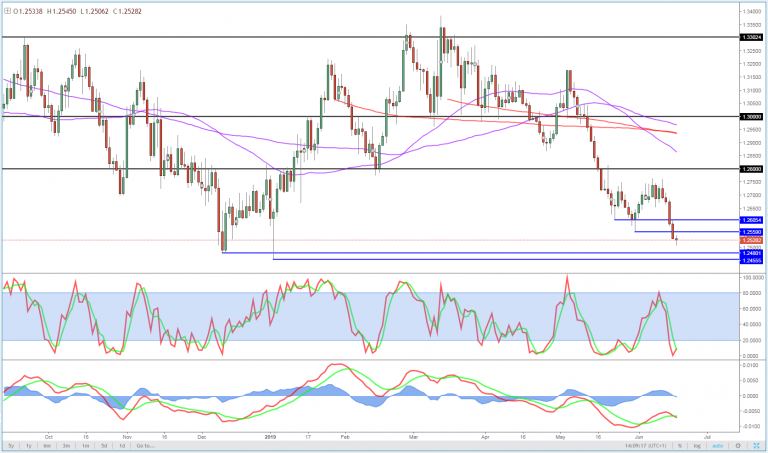
Sterling has been on a tear lower for over a month now and there’s so far few signs that it’s letting up. Having taken out recent support yesterday, the pair is now trading at its lowest levels since the start of the year, with further support potentially being found around 1.2450-1.25.
As we approach these levels though, momentum looks to be slipping. The MACD histogram and moving averages are both showing signs of divergence, having failed to match the new lows made in the price. The stochastic isn’t quite there yet but it’s not really making new lows either.
GBPUSD 4-Hour Chart
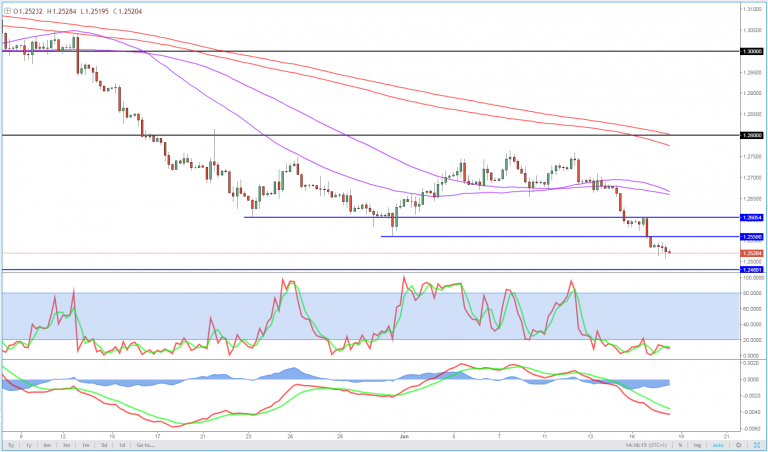
The 4-hour chart is displaying similar divergence and in this case, the stochastic is on the same page. That’s not to say we can break the 2019 lows but lagging momentum is not an encouraging sign. Perhaps after such a long period of downward pressure, a correction of some kind may be warranted.
US: Housing Starts Edge Lower in May
- U.S. housing starts declined in May by 0.9% to 1.27 million units (annualized) from an upwardly revised 1.28 million units in April.
- The decline was concentrated in the single-family segment, which fell by 6.4% to 820k. The more volatile multi-family segment posted a gain of 10.9% to 449k.
- Permits advanced by 0.3% in May to 1.3 million. Single-family permits were up 3.7%, breaking five consecutive months of declines, but multi-family permits fell by 5.0%, reversing much of the gain seen in the previous month.
- On a regional basis, starts was down across all regions but the South, which rose 11.2%. The Northeast was down by 45.5%, the Midwest by 8.0% and the West by 2.4%.
Key Implications
- After a good showing over the past two months (even better on revisions), starts turned down in May. Higher construction costs may be part of the story. The tight labor market has also driven up wages for construction workers, adding to margin pressures. Indeed, these concerns have shown up in recent homebuilder sentiment surveys, which fell in June for the first time this year.
- Declining mortgage rates and rising wages have supported housing affordability and there are nascent signs this is showing up in greater housing demand. With low vacancy rates, this should ultimately lead to increases in construction, though elevated uncertainty and rising costs may slow this process.
Autos Drive Canadian Manufacturing Sales Pullback in April
- Canadian manufacturing sales fell 0.6% (m/m) in April, following a 2.6% increase in March (previously reported as 2.1%). After accounting for price changes, the picture was still disappointing, with volumes down 0.8%.
- The decline was seen in 8 out of the 21 industries and was driven largely by durable goods industries, which fell 3.5%. Transportation equipment slumped 6.7%, with sales falling in all sub-categories. The largest contributor, however, was the drop in motor vehicle sales (-8.9%) due to temporary plant shutdowns. Primary metal shipments were also down 5.3% (after a strong 7% increase in March).
- Non-durable goods provided some offset, up 2.6% on the month. Food manufacturing shipments advanced an impressive 5.1%. Petroleum and coal product sales were also up 2.9%.
- Regionally, manufacturing sales were down in 5 of the 10 provinces. Ontario (-2.1%) and Quebec (-1.7%) drove the decline. Alberta and Saskatchewan had an impressive month, with sales up 4.6% and 6.5%, respectively.
- Inventories climbed for the fifth consecutive month (+1.3%). The combination of this and lower shipments pushed the inventory-to-sales ratio to 1.53 (up from 1.5 in March). Forward looking indicators were negative, with new orders down 1.4% and unfilled orders also down 0.3%.
Key Implications
- The disappointing release was largely pre-written given the well-telegraphed temporary plant shutdowns and April's drop in motor vehicle exports. Indeed, excluding the transportation equipment category, manufacturing sales were up 0.8%. Details of the release were mixed, with some decent increases in non-durable good categories, positive revisions to the prior month, and solid performances in the Western provinces countered by a disappointing rise in the inventory-to-sales ratio and weak forward-looking indicators.
- The outlook for manufacturing sales remains uncertain, namely due to ongoing trade uncertainty. As noted in our latest Quarterly Economic Forecast, generally supportive domestic sentiment and strengthening domestic demand stands in contrast with a more uncertain external backdrop that may act as a headwind to manufacturing shipments and exports.
Canada Manufacturing Sales Edged Lower in April
- Canada manufacturing sales dipped 0.6% lower in April
- Volume sales declined 0.8%
The pull-back in manufacturing sales in April was not entirely surprising given an earlier soft international trade report for the month, and details were less concerning than the headline. A 7% drop in motor vehicle and parts sales appears to have been due to temporary plant shutdowns that will be reversed. Excluding the transportation sector and a price-led increase in the petroleum & coal component, sales were up 0.5% from April and 3% from a year ago. And a very strong month of economic data for the prior month in March, including growth in the manufacturing sector, still leaves overall GDP growth tracking at a slightly above 2% rate for Q2. That doesn’t mean there is no reason for concern about the Canadian manufacturing sector. The removal of US steel & aluminum tariffs and Canadian retaliatory measures in May will help but rising US-China trade tensions appear to be weighing on the US industrial sector – and tight cross-border integration of production chains means some of that softness will spill over to Canada. That uncertainty, more than current economic data, is what we expect will keep the Bank of Canada firmly on hold in terms of interest rate policy for the foreseeable future.
EUR/USD Mid-Day Outlook
Daily Pivots: (S1) 1.1198; (P) 1.1222; (R1) 1.1242; More......
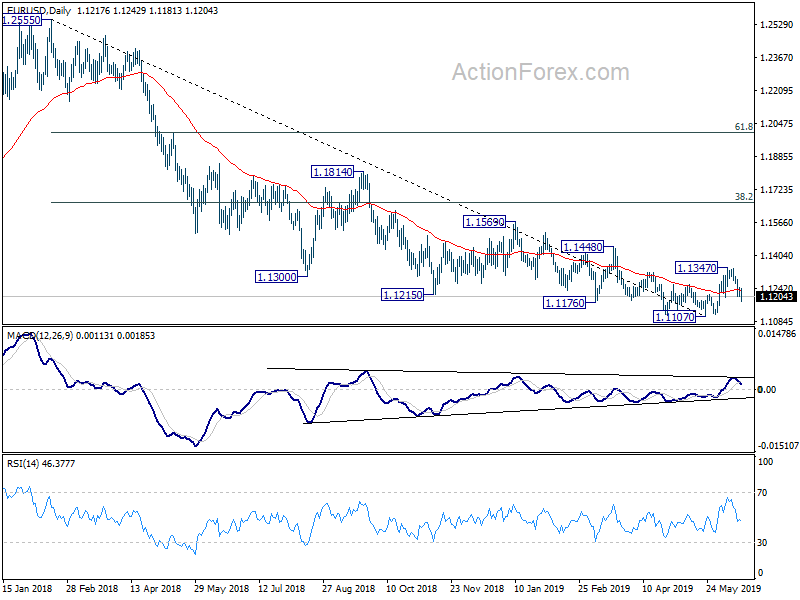
EUR/USD's fall from 1.1347 extends to as low as 1.1181 so far today. Intraday bias remains on the downside for 1.1107 low. Though, we'd stay cautious on strong support from 1.1107 low to bring rebound. On the upside, above 1.1247 minor resistance will turn bias back to the upside for 1.1347 again.
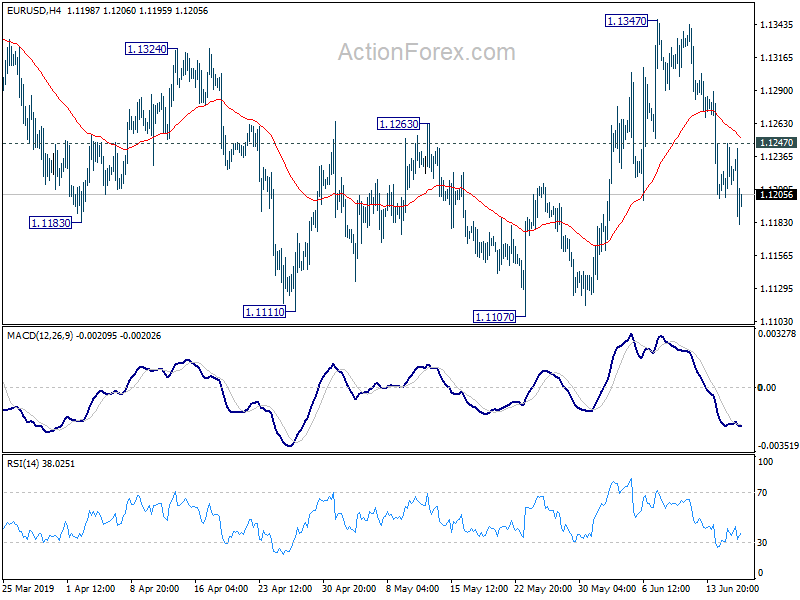
In the bigger picture, considering bullish convergence condition in daily and weekly MACD, a medium term bottom could be in place at 1.1107 after hitting 61.8% retracement of 1.0339 (2016 low) to 1.2555 (2018 high) at 1.1186. Hence, for now, risk will stay on the upside as long as 1.1107 low holds. Break of 1.12347 will extend the rebound towards 38.2% retracement of 1.2555 to 1.1107 at 1.1660. However, sustained break of 1.1107 will confirm resumption of down trend from 1.2555.
Euro Tumbles, German Yield Hits Record Low as ECB Prepares for More Easing
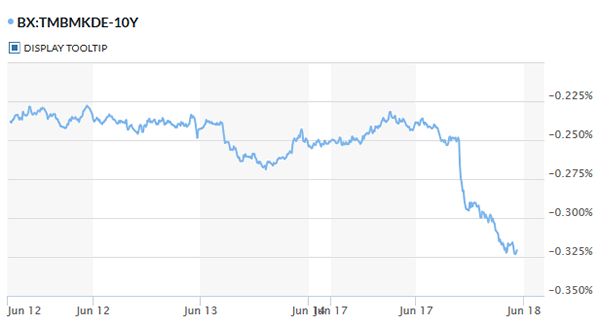
Surprisingly dovish comments from ECB President Mario Draghi sent Euro sharply lower, and German 10-year yield to new record low today. There are some speculations that ECB could eventually cut interest rates, with a tiered system", alongside released of new economic projections in July. The comments also send German and French stocks sharply higher. Trump blames in a tweet that Draghi makes it "unfairly easier for them to compete against the USA". But at the same time, Trump doesn't comment on positive lift to US stocks, with DOW futures up 150 pts at the time of writing.
Staying in the currency markets, Australian Dollar and Sterling ties for second weakest. Aussie is sold off after RBA minutes confirm that more rate cuts are underway. Sterling is pressured as markets raise their bets on no-deal Brexit on Boris Johnson's lead in Conservative leadership race. On the other hand, Yen is the strongest one following free fall in major treasury yields. Kiwi and Swiss Franc are the next strongest for now.
Technically, while EUR/USD extends the fall from 1.1347 today, it's kept well above 1.1107 low. There is no disaster in the pair yet as traders are probably holding their bets before tomorrow's FOMC rate decision. EUR/GBP is holding above 0.8871 minor support while EUR/AUD is kept above 1.6298 minor support. That is, both crosses remain near term bullish. EUR/JPY is more likely the focus for today and it's set to take on 120.78 support and break will confirm resumption of recent fall towards 118.62 low.
In Europe, currently, FTSE is up 1.17%. DAX is up 1.48%. CAC is up 1.75%. German 10-year yield is down -0.0796 at -0.322, close to record low at -0.323 (still making new ones). Earlier in Asia, Nikkei dropped -0.72%. Hong Kong HSI rose 1.00%. China Shanghai SSE rose 0.09%. Singapore Strait Times rose 0.96%. Japan 10-year yield dropped -0.0032 to -0.129.
ECB Draghi: Additional stimulus required in absence of improvement in downside risks
ECB President Mario Draghi emphasized in a speech that "monetary policy remains committed to its objective and does not resign itself to too-low inflation… forever or even for now." Also, he reiterated monetary policy is "patient, persistent and prudent".
He added: "Patient, because faced with repeated negative shocks we have had to extend the policy horizon. Persistent, because monetary policy will remain sufficiently accommodative to ensure the sustained convergence of inflation to our aim. And prudent, because we will pay close attention to underlying inflation dynamics and to risks and will adjust policy appropriately."
Draghi also reiterated risks remains "tilted to the downside" and indicators point to "lingering softness". And he warned, "in the absence of improvement, such that the sustained return of inflation to our aim is threatened, additional stimulus will be required." The options on further measures were "raised and discussed" at ECB's last meting.
The measures including enhancing the forward guidance on bias and conditionality. Also, "Further cuts in policy interest rates and mitigating measures to contain any side effects remain part of our tools". And, "the APP (asset purchase program) still has considerable headroom."
German ZEW dropped -21.1, substantially worsened German data and increased global uncertainty
German ZEW Economic Sentiment dropped sharply to -21.1 in June, down from -2.1 and missed expectation of -5.8. That's also the lowest reading since November. Current Situation gauge dropped to 7.8, down from 8.2, beat expectation of 6.1. Eurozone ZEW Economic Sentiment dropped to -20.2, down from -1.6 and missed expectation of -3.6. Eurozone Current Situation gauge rose 3.3 pts to -3.7.
ZEW President Professor Achim Wambach said: "The sharp drop in the ZEW Indicator of Economic Sentiment coincides with an increased uncertainty regarding the future development of the global economy and substantially worsened figures for the German economy at the beginning of the second quarter. The intensification of the conflict between the USA and China, the increased risk of a military conflict in the Middle East and the higher probability of a no-deal Brexit are all casting a shade on the global economic outlook. On top of this, German industry has been reporting worse than expected figures for production, exports and retail sales for April."
Ifo affirms 2019 Germany growth forecasts, downgrades 2020
Ifo institute maintains 2019 German growth forecast at 0.6%, but revised down 2020 growth forecasts by -0.1% to 1.7%. Private consumer pending is expected to drive the economy, rise 1.4% in 2019 and 1.3% in 2020. Investments are expected to growth 3.0% and 2.8% respectively,d riven by construction. Export is expected to grow just 1.3% in 2019 and normalizes to 3.8% in 2020.
Timo Wollmershaeuser, Head of ifo Economic Forecasts, said "there are increasing signs that industrial weakness is gradually spreading to the domestic economy via the labor market and deep value chains." And, "that means the German economy will enter the coming year without any momentum." Wollmershaeuser also warned, "economic policies that attempt to change the globalized economic order through isolation, sanctions, and threats have increased uncertainty worldwide, cooled industrial activity, and caused world trade to collapse."
Eurozone CPI finalized at 1.2%, core CPI at 0.8% in May
Eurozone CPI was finalized at 1.2% yoy in May, down from April's 1.7% yoy. CPI core was finalized at 0.8% yoy, unchanged from April's figure. EU28 CPI was finalized at 1.6% yoy in May, down from April's 1.9% yoy.
The lowest annual rates were registered in Cyprus (0.2%), Portugal (0.3%) and Greece (0.6%). The highest annual rates were recorded in Romania (4.4%), Hungary (4.0%) and Latvia (3.5%). Compared with April 2019, annual inflation fell in sixteen Member States, remained stable in five and rose in six. The highest contribution to the annual euro area inflation rate came from services (0.47%), followed by energy (0.38%), food, alcohol & tobacco (0.29%) and non-energy industrial goods (0.08%).
Also released, Eurozone trade surplus narrowed to EUR 15.3B in April, below expectation of EUR 16.4B.
RBA Minutes: Further rate cut is more likely than not
RBA cut cash rate by -25bps to 1.25% at the June 4 meeting. Minutes of the meeting noted "members agreed that it was more likely than not that a further easing in monetary policy would be appropriate in the period ahead."
Policymakers acknowledged that inflation has been below 2-3% target range for three years and even deteriorated to 1.5% in Q1. Unemployment rate had not declined any further in the last six months despite ongoing job growth. It has eve edged up in the most recent two months. Thus, "a lower level of interest rates would support growth in the economy, thereby reducing unemployment and contributing to inflation rising to a level consistent with the target."
Also, lower interests could support the economy through lower exchange rate, reduced borrowing rates for businesses, and lower interest payments for households. And give the extent of spare capacity in the economy and the subdued inflationary pressures, there was "a low likelihood of a decline in interest rates resulting in an unexpectedly strong pick-up in inflation."
Instead, lowest interest rates would " stimulate activity and thereby improve the resilience of the Australian economy to any future adverse shocks."
Australia house prices dropped -3% in Q1, decline in all capital cities
Australia house price index dropped -3.0% qoq in Q1, much worse than expectation of -2.6%. There's also deterioration from Q4's -2.4% qoq. House prices also declined in all capital cities: Sydney (-3.9%), Melbourne (-3.8%), Adelaide (-0.2%) and Hobart (-0.4%), Brisbane (-1.5%), Perth (-1.1%), Canberra (-0.9%) and Darwin (-1.8%).
ABS Chief Economist, Bruce Hockman said: "These results are in line with soft housing market indicators, with sales transactions and auction clearance rates lower than one year ago, and days on market trending higher. A continuation of tight credit supply and reduced demand from investors and owner occupiers has contributed to weakness in property prices in all capital cities this quarter."
From New Zealand, Westpac consumer confidence dropped -0.3 to 103.5 in Q2.
EUR/USD Mid-Day Outlook
Daily Pivots: (S1) 1.1198; (P) 1.1222; (R1) 1.1242; More......
EUR/USD's fall from 1.1347 extends to as low as 1.1181 so far today. Intraday bias remains on the downside for 1.1107 low. Though, we'd stay cautious on strong support from 1.1107 low to bring rebound. On the upside, above 1.1247 minor resistance will turn bias back to the upside for 1.1347 again.
In the bigger picture, considering bullish convergence condition in daily and weekly MACD, a medium term bottom could be in place at 1.1107 after hitting 61.8% retracement of 1.0339 (2016 low) to 1.2555 (2018 high) at 1.1186. Hence, for now, risk will stay on the upside as long as 1.1107 low holds. Break of 1.12347 will extend the rebound towards 38.2% retracement of 1.2555 to 1.1107 at 1.1660. However, sustained break of 1.1107 will confirm resumption of down trend from 1.2555.
Economic Indicators Update
| GMT | Ccy | Events | Actual | Forecast | Previous | Revised |
|---|---|---|---|---|---|---|
| 21:00 | NZD | Westpac Consumer Confidence Q2 | 103.5 | 103.8 | ||
| 01:30 | AUD | House Price Index Q/Q Q1 | -3.00% | -2.60% | -2.40% | |
| 01:30 | AUD | RBA Minutes Jun | ||||
| 09:00 | EUR | Eurozone Trade Balance (EUR) Apr | 15.3B | 16.4B | 17.9B | |
| 09:00 | EUR | Eurozone CPI M/M May F | 0.10% | 0.20% | 0.70% | |
| 09:00 | EUR | Eurozone CPI Y/Y May F | 1.20% | 1.20% | 1.70% | |
| 09:00 | EUR | Eurozone CPI Core Y/Y May F | 0.80% | 0.80% | 0.80% | |
| 09:00 | EUR | German ZEW Economic Sentimen Jun | -21.1 | -5.8 | -2.1 | |
| 09:00 | EUR | German ZEW Current Situation Jun | 7.8 | 6.1 | 8.2 | |
| 09:00 | EUR | Eurozone ZEW Economic Sentiment Jun | -20.2 | -3.6 | -1.6 | |
| 12:30 | CAD | Manufacturing Sales M/M Apr | -0.60% | 0.40% | 2.10% | 2.60% |
| 12:30 | USD | Housing Starts May | 1.27M | 1.24M | 1.24M | 1.28M |
| 12:30 | USD | Building Permits May | 1.29M | 1.30M | 1.29M | 1.29M |