

Sample Category Title
Eco Data 6/19/19
[php_everywhere instance="1"]
Kudlow: There’s a certain joy Trump and Xi are back to discussion
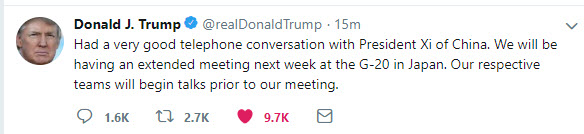
Trump tweeted earlier today that he had a phone call Chinese President Xi Jinping. And both agreed to have an "extended meeting" next week at G20 in Japan. This news is confirmed by Chinese State media. And XI said "the key is to show consideration to each other's legitimate concerns. We also hope that the United States treats Chinese companies fairly. I agree that the economic and trade teams of the two countries will maintain communication on how to resolve differences."
White House economic adviser Larry Kudlow welcomed the meeting and said "No results are guaranteed - I think people know that - but I think there's a certain joy that they are back to a discussion." Though, he also emphasized US "wants to continue the conversations about structural changes regarding intellectual property theft and forced technology transfers and market openings and tariffs... We're looking for an enforceable agreement as we always have - that's absolutely vital. So all of those general topics will be on the table."
Canadian Inflation & Retail Sales Figures May Lift the Loonie
After losing some ground last week in the face of a stronger US dollar and softer oil prices, the Canadian dollar will now turn its sights to the nation’s inflation and retail sales figures, due out on Wednesday and Friday respectively at 12:30 GMT. Forecasts point to a solid set of data overall, which could highlight what seems like a divergence between Fed and BoC policies, and thereby lift the loonie.
The loonie has been largely unable to gain traction recently, even despite US-Canada interest rate differentials narrowing in its favor amid mounting bets for Fed rate cuts, and market risk sentiment improving drastically. The fact that the US will not be levying tariffs on Mexico did not lead to sharp gains for the Canadian currency either. Granted, part of the underperformance is likely owed to the drop in oil prices, but even accounting for that, the currency still looks relatively soft considering that the Bank of Canada (BoC) is among the few central banks that the market doesn’t expect aggressive easing from in the near term.
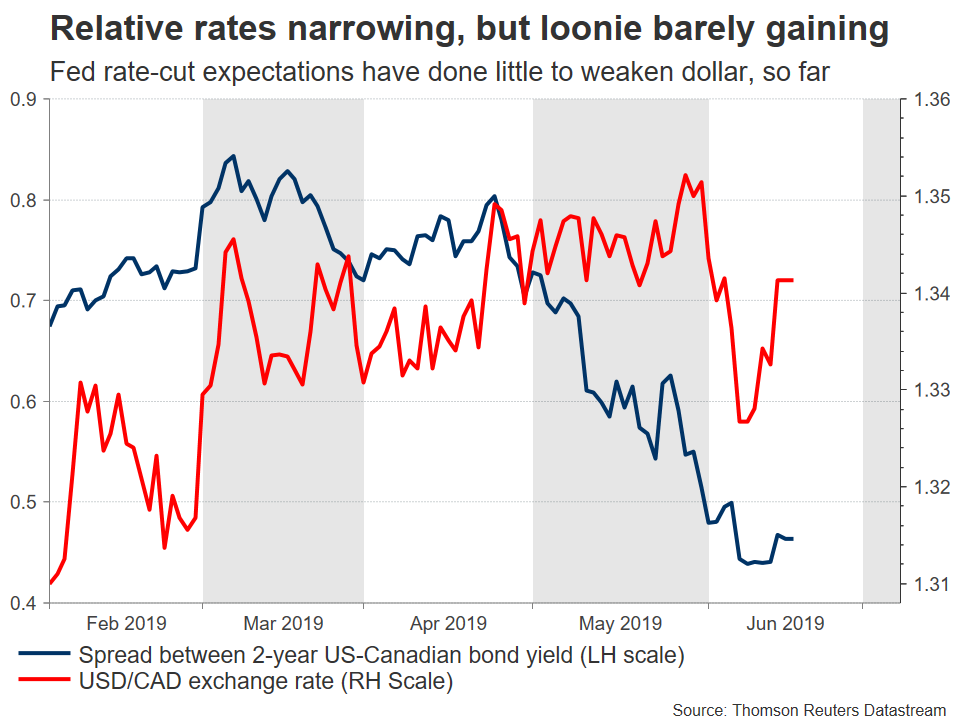
This could therefore be a decisive week for the loonie, as a potentially solid set of Canadian data coupled with a dovish Fed could underscore this divergence in monetary policies – and propel the loonie higher in the process.
On Wednesday, the nation’s CPI figures for May are expected to show that inflation picked up to 2.1% in yearly terms, from 2.0% earlier. Indeed, the forecast is supported by the Markit manufacturing PMI for the month, which noted a ‘solid uptick’ in prices charged by firms. Likewise, the retail sales for April that are due for release on Friday are anticipated to clock in at 0.2% on a monthly basis, much lower than the robust 1.1% previously, but still a positive print overall.
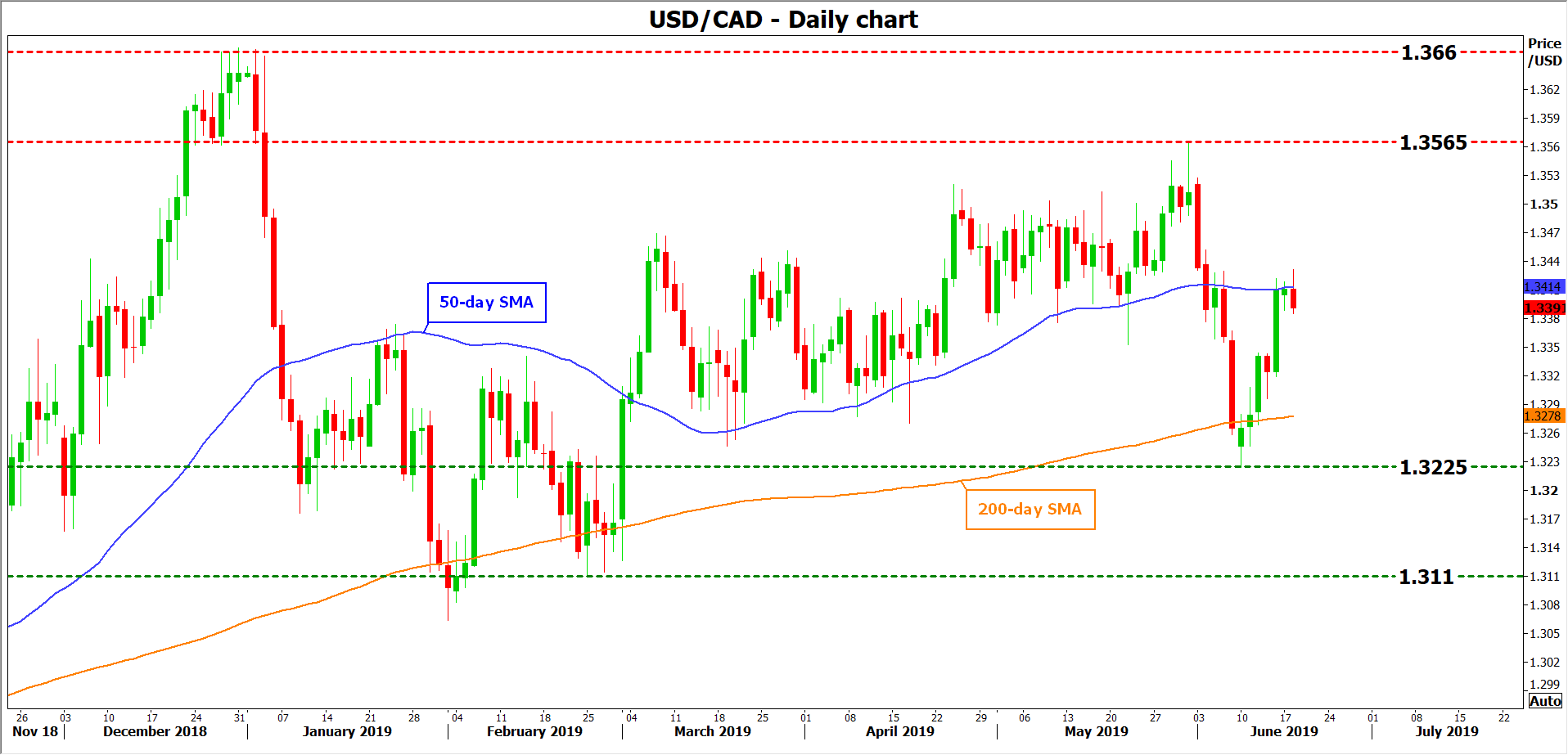
If the actual prints meet expectations, that could send dollar/loonie lower, with initial support to declines likely to come near the 200-day simple moving average (SMA), currently at 1.3278. A downside break could open the way for a test of the June 10 lows, near 1.3225.
On the other hand, a negative surprise in these data – or perhaps a less cautious tone than markets are expecting from the Fed – may send the pair higher, perhaps for another test of the 1.3565 area.
In the bigger picture, besides the quality of domestic Canadian data and how dovish the Fed is this week, the other key determinant for the loonie will be what trade signals come out from the G20 meeting next week. Namely, whether the US and China will resume negotiations soon, and by extent provide relief for commodity-linked currencies. Separately, what OPEC does at its own meeting, which is rumored to take place in the middle of July, could also prove crucial.
CRUDE OIL Recovers Further Higher On Correction
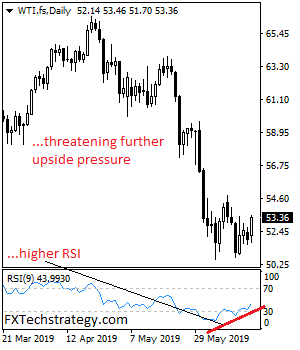
CRUDE OIL recovers further higher on correction. Support lies at the 53.00 level where a break will expose the 52.30 level. A cut through here will set the stage for a run at the 52.00 level. Further down, support comes in at the 51.50 level. On the upside, resistance resides at the 53.50 levels. Further out, resistance comes in at the 54.00 level. A break above here will aim at the 54.50 level and then the 55.00 level followed by the 55.50 level. Its daily RSI is bullish and pointing higher suggesting more strength. All in all, CRUDE OIL recovers further higher on correction.
MARKET WRAP: Facebook Comes Up With Its Crypcurrency
*LIBRA is here, a new crypcurrency by Facebook *ECB takes a dovish stance
Stocks
- The S&P 500 Index is back in the green, at least for now and rose 1.% as of 15:22 London time, while the Nasdaq Composite Index, the lagging index, jumped 1.78% and the Dow Jones Industrial Average soared 1.3%.
- The Stoxx Europe 600 jumped higher because of the dovish stance by the ECB’s president, Mario Draghi. It rose 1.64%.
- The MSCI Emerging Market Index followed global markets and jumped 0.7%.
Currencies
- The Bloomberg Dollar Spot Index looks strong as the Fed started their two day monetary policy decision and gained nearly 0.18%.
- The Euro took the nose dive today and lost nearly 0.37% to $1.1185,.
- The British pound is still holding the 1.25 mark but down by 0.28% to $1.2522.
Bonds
- The yield on 10-year Treasuries fell 3 basis points to 2.06%.
- Germany’s 10-year yield plunged 8 basis points to negative 0.32%.
Commodities
- West Texas Intermediate rose 0.9% to $53.57 a barrel.
- Gold held some minor gains and was up 0.23% to $1,345 an ounce
Fed’s Upcoming Rate Decision Could be “Trade-Biased”
Central banks cut interest rates when fears over an economic downturn are seriously mounting. This is the impression that markets are currently getting from the US as weakening economic data combined with heightening external risks dampen economic projections and hence raise the stakes for a rate reduction. The Federal Open Market Committee, however, announces its policy decision this Wednesday at a crucial time, a week before the G20 summit in Osaka, and policymakers may wisely judge that this is not the right moment to proceed, well not before Washington and Beijing clarify the situation on the trade front anyway.
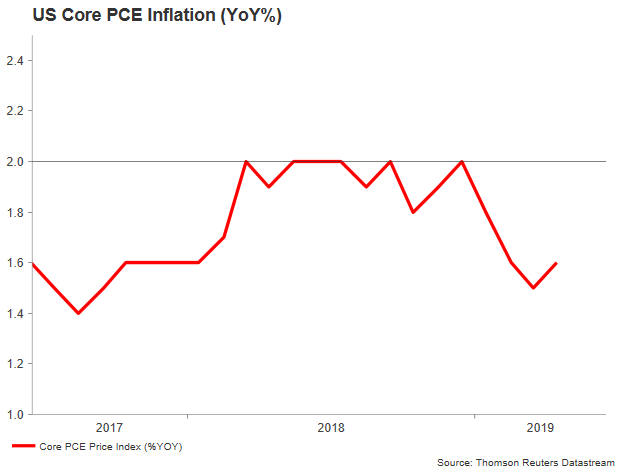
At the start of the current year, the Fed, which delivered four rate hikes in 2018, was confident that further tightening will follow soon, but rolling into the first quarter, economic numbers worsened along with trade tensions, making the Fed somewhat hesitant about future rate hikes. The core PCE index, the Fed’s favorite inflation measure, followed a downtrend after hitting the 2.0% target in March even with tariffs going into effect. The core CPI, another closely watched price indicator, also decelerated, making markets wonder whether the inflation weakness is indeed transitory as Fed chief Powell supports or something more temporary, such as a discouraged domestic demand.
Adding to the worrisome picture was May’s Nonfarm payrolls report. Although the unemployment rate steadied at a 50-year low, workers disappointingly did not see much of the benefit as average hourly earnings slowed for the second consecutive month. New job hiring was not great either but rather disappointing, with the economy creating less than 100k jobs for the second time in four months and previous readings seeing downside revisions.
And if the above are not enough to back a rate cut, the ISM manufacturing PMI slipped unexpectedly to the lowest point since Trump’s election in May, mirroring to an extent the problems caused by the heavy US import tariffs on industrial activities.
James Bullard, the St. Louis Fed president and an FOMC voter in 2019, was the first to call for a downward adjustment in policy since the Fed surprisingly adopted a more patient approach in January. He messaged that the direct effects of the trade war to the US economy are relatively small but the spillovers from the global financial markets could be larger and hence lower rates maybe needed to prevent inflation from falling and generally mitigate a larger-than-expected growth slowdown. While such an opinion is more or less awaited from a dovish policymaker, the Fed chief, Powell, a centrist, did not rule out the scenario when he spoke about monetary issues earlier this month. Instead he said that the Bank was “closely monitoring” the implications of trade developments and would act accordingly to sustain a healthy expansion. More importantly, he refrained from characterizing current interest rates as appropriate and avoided to signal a patient approach as in previous speeches, with markets translating his comments as a change of policy.
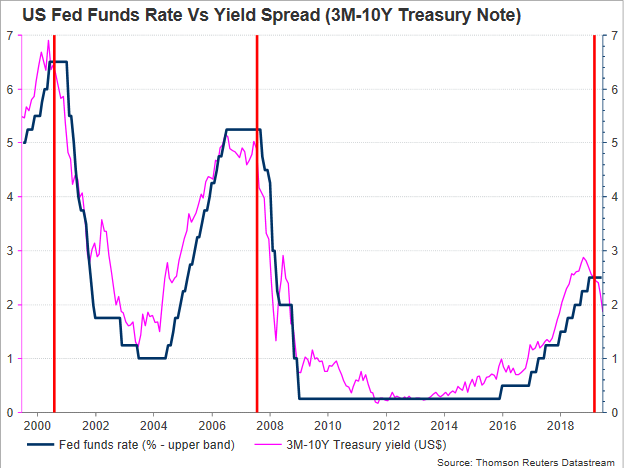
Consequently, treasury yields justifiably plunged and the bets for a rate cut soared, with Fed Funds futures heavily pricing two rate reductions by September. Nevertheless, with the G20 summit getting underway just a week after the FOMC gathering on June 28-29, we don’t expect any change in policy on Wednesday. The Bank will probably await a trade update from Trump and Xi Jinping before taking action. Should the leaders show willingness to move towards a deal, policymakers may delay easing in coming months until the two sides finally secure an agreement. On the other hand, if the summit proves fruitless, increasing doubts about whether and if a trade deal could be reached, a rate cut may come as soon as in July to save the economy from a sharper growth slowdown. It is also worth noting that the spread between the 10-year and 3-month Treasury yields is currently negatively sloped and below the Fed funds rate and such a negative spread was followed by a rate cut in previous years. Besides, with Trump starting his re-election campaign for the 2020 presidential elections later this month, the central bank may face stronger pressure to pull back interest rates in coming months.
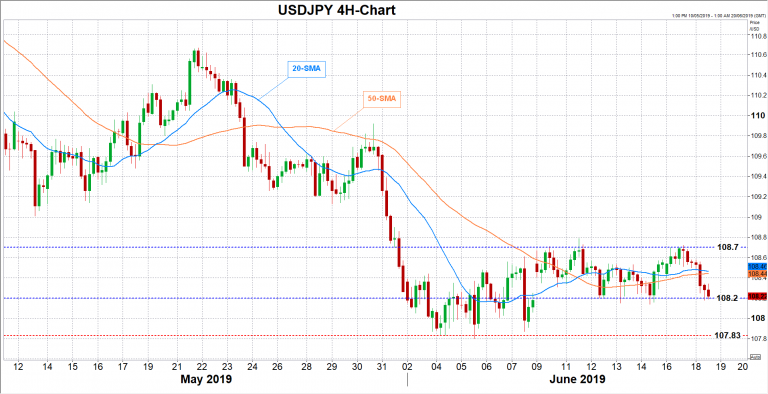
In terms of market reaction, investors and traders will pay special attention on the famous dot plot that displays policymakers’ forecasts for future rate movements, and new economic projections. Should the the Bank keep rates steady but more policymakers take the rate cut side, with the dot plot showing potentially at least two rate cuts this year, USDJPY could break support at 108.20 and retest the 108 round-level before heading to the 107.83 bottom. Losses could also emerge if the Bank delivers a surprising rate cut on Wednesday. Equities could surge in this case.
On the positive scenario, the greenback could rally above its 20- and 50-period simple moving averages (SMA) and up to the 108.70 resistance if the Fed leaves rates the same and repeats the need for patience, hinting that conditions are not as bad as markets believe.
Gold Spikes to 14-Month Highs; Could Gain More
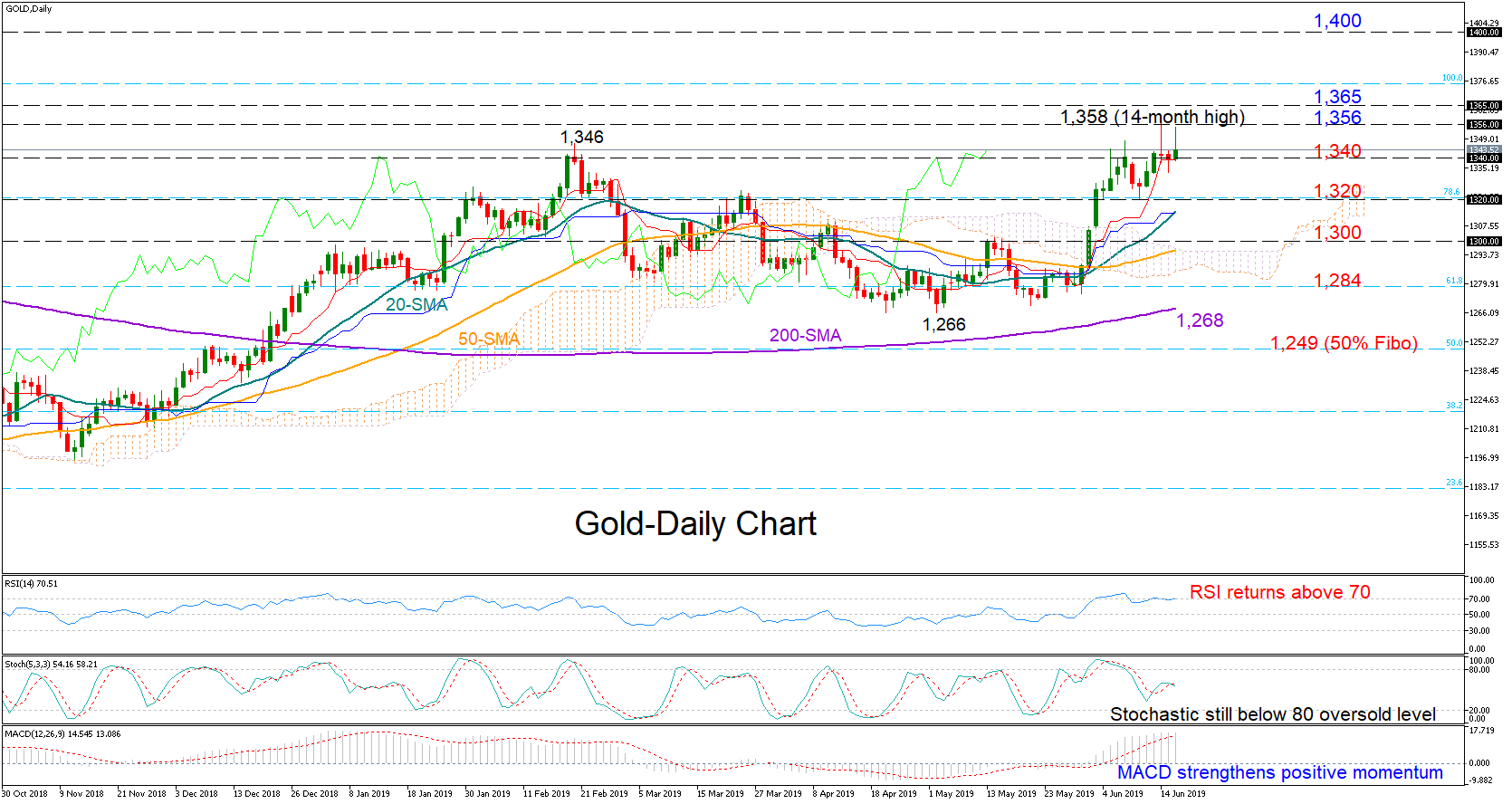
Gold bulls took over again on Tuesday, driving the price near Friday’s 14-month high of 1,358. The location of the RSI – above 70 – hints that the bullish action may be overdone, and therefore no space is left for additional upside. However, with the Stochastics trending under the 80 oversold level and the MACD strengthening momentum above its red signal line, the market may see further improvement before potentially reversing lower.
The 1,356-1,365 area is the next target, while slightly higher the 2016 peak of 1,375 could also play a key role for the rally to continue until the 1,400 psychological number.
In the negative scenario, the bears would try to clear the 1,340-1,320 zone to reach the 1,300 round level. A closing price below the 61.8% Fibonacci of 1,284 of the donwleg from 1,3750 to 1,122 would shift the spotlight towards the 200-day simple moving average (SMA) currently at 1,268.
Turning to the medium-term picture, gold could officially claim a bullish outlook if it manages to climb above the 1,356-1,365 region. The positive slope in the 50-day SMA, which deviates above the 200-day SMA, increases the likelihood of such a situation occurring.
In brief, the short-term risk is currently viewed cautiously positive. Gold is awaiting a bounce above 1,356-1,365 to resume bullish profile.
Stocks given further lift as Trump will meet Xi for an extended meeting at G20
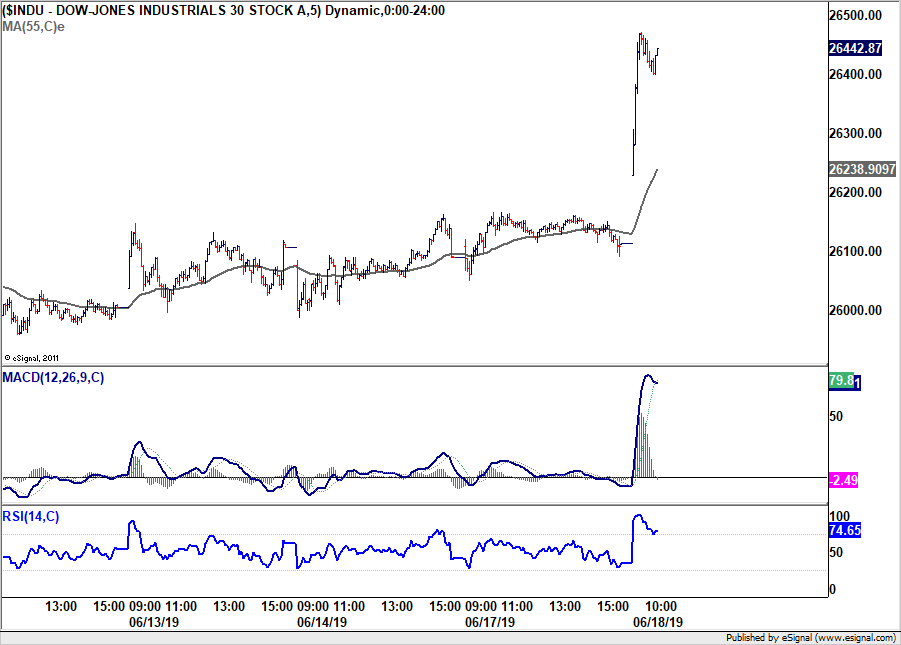
US stocks open higher, following German DAX, as lifted by ECB President Mario Draghi's hint on further stimulus. Stocks was then further lifted by Trump's tweet regarding phone conversation with Chinese President Xi Jinping. Trump said they're going to have an "extended meeting" at G20 in Osaka, Japan, next week. And the "respective teams will begin talks prior to our meeting". DOW is currently up more than 330 pts, or 1.3%. S&P 500 and NASDAQ are up 1.1% and 1.7% respectively. On the other hand, 10-year yield is down -0.0023 at 2.064, recovered notably from day low at 2.029.
https://twitter.com/realDonaldTrump/status/1140977371421564928
Meanwhile, one important thing to note is that Fed will have less pressing need to have "insurance" rate cut if US-China trade tensions ease. On the other hand, ECB is on track for more stimulus. Thus, we might actually see further decline in EUR/USD, thanks to both Draghi and Trump. Trump might have complained that Draghi made it "unfairly easier" for Eurozone to compete against the US. It's also that easy for him to give advantages to Eurozone too, and he did it.
https://twitter.com/realDonaldTrump/status/1140935620291964928
Sunset Market Commentary
Markets
No such thing as calm before the Fed-storm on bond markets today. An uneventful Asian trading session and a rather poor economic calendar suggested a dull/technical trading day in the run up to tomorrow’s Fed meeting. But Draghi decided otherwise. In his introductory speech in Sintra the ECB chair made clear that “in absence of any improvement” in the outlook for growth and inflation, additional stimulus will be needed. He referred to all possible tools but three euro-zone central bank officials said lowering the depo rate would be the most likely initial step. Euro bond rates tanked with the bond rally drawing additional support from weak ZEW investor confidence. The German yield curve bull shifts south with stunning yield changes, varying from -6bps (2y) to -7bps (5y, 10y, 30y), to new record lows. The Swedish and French 10y yield fell below/touched 0% for the first time ever. Peripheral spreads narrow 6bps (Spain, Portugal) up to 13bps (Greece, Italy). Today’s hunger for bonds also lead US yields to decline considerably before pairing some of the losses after Trump said he’ll meet China’s Xi Jinping during the G20 summit. The US yield curve bull flattens with yields -2bps (2y) to -3bps (10y) lower. The US10y yield is extensively testing the 2.06% support.
With markets awaiting tomorrow’s Fed policy decision, ECB president Draghi drove to price action on the (FX) markets today. The ECB president indicated that further stimulus will be needed if the economic outlook doesn’t improve. Both asset purchases and interest rate cuts are possible, but the latter apparently has the biggest chance to be implemented in the near future. EUR/USD tried a technical rebound early this morning, but the pair nosedived from the 1.1240 area to the 1.1185/80 area after the headlines of Draghi’s Sintra speech. The decline was substantial, but markets soon doubted whether/at what pace it should continue. US yields also declined substantially, limiting the relative interest rate advantage for the dollar. US president Donald Trump also reacted very soon as he labeled the (prospect of) more ECB stimulus and the subsequent decline of the euro as unfair. Next question of course remains how the Fed will react. Markets see a rising chance of the Fed taking bolder action than what was recently expected. US politicians, including president Trump, will probably also continue to raise the issue of a (too?) strong dollar in the run-up to next week’s G20 meeting. So, further substantial USD gains-EUR/USD downside isn’t guaranteed yet. EUR/USD is currently trading in the 1.1200 area. USD/JPY hovers in the 108.20 area.
Sterling trading was driven by UK political uncertainty over the previous days. The Conservative party is holding a second vote on a successor for Theresa May today. However, sterling trading was also captured by the overall market moves in the wake of ECB’s Draghi’s comments in Sintra. EUR/GBP dropped from the 0.8965 area tot the 0.8920/25 area on overall euro weakness. As was the case for EUR/USD, the decline halted rather soon. EUR/GBP is currently trading in the 0.8945 area. Spill-over selling from EUR/USD pushed cable to the low 1.25 area (currently 1.2625). Despite today’s ‘intermezzo’ UK politics and Brexit might soon return to the forefront for sterling trading. Markets will also look out whether the BoE will keep its ‘tightening bias’ at Thursday’s policy meeting.
News Headlines
President Trump denounced Draghi’s hint at more monetary stimulus during his Sintra speech this morning. Trump noticed the immediate euro drop vs. the dollar in the wake of Draghi’s comments and said that it makes it “unfairly easier for them [the EMU] to compete against the USA”.
German ZEW investor confidence disappointed in June. The current conditions component (7.8) declined less than markets expected (6.1) but prospects for the next six months fell to readings seen during end of 2018’s equity market rout (-21.1).
Trump’s Tweet Ignites Stock Bulls
President Trump’s tweet minutes after the open sent markets soaring. Leaders of the two largest economy spoke on the phone and expectations are for them to hold an extended meeting at the G-20. Markets previously were concerned if Xi was going to attend and if anything of substance would come out of the G20 summit. China’s state media confirmed the call between Trump and Xi.
Source: Twitter
Investors rushed to US stocks, with the S&P 500 index rising 1.1%, the Dow Jones Industrial higher by 1.3% and the tech heavy Nasdaq leading the rally with 1.8% gain. The dollar also remains near its high of the session.
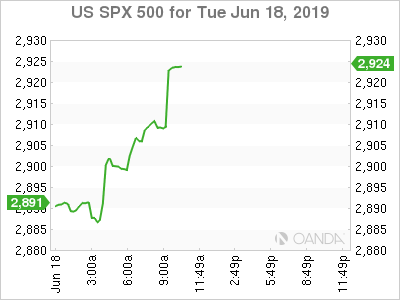
US equities may be poised to make a run at those record highs if we see continued trade optimism and a strong dovish signal from the Fed.