

Sample Category Title
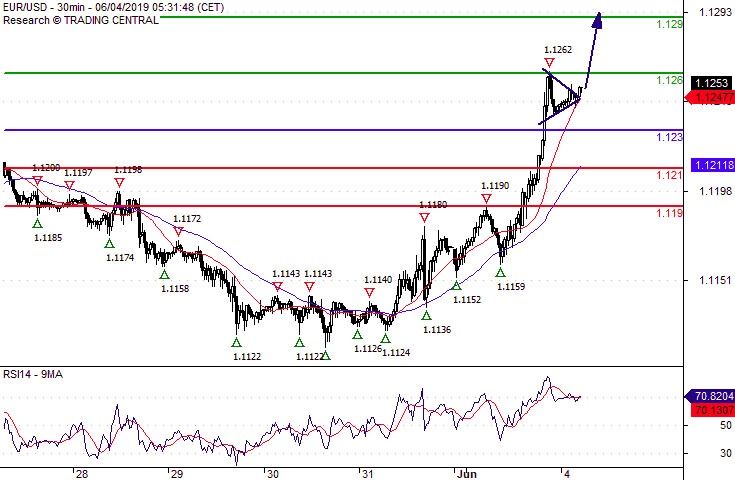
EUR/USD Towards 1.1290
Pivot (invalidation): 1.1230
Our preference Long positions above 1.1230 with targets at 1.1260 & 1.1290 in extension.
Alternative scenario Below 1.1230 look for further downside with 1.1210 & 1.1190 as targets.
Comment The RSI is bullish and calls for further advance.
EUR/USD Daily Outlook
Daily Pivots: (S1) 1.1136; (P) 1.1136; (R1) 1.1191; More.....
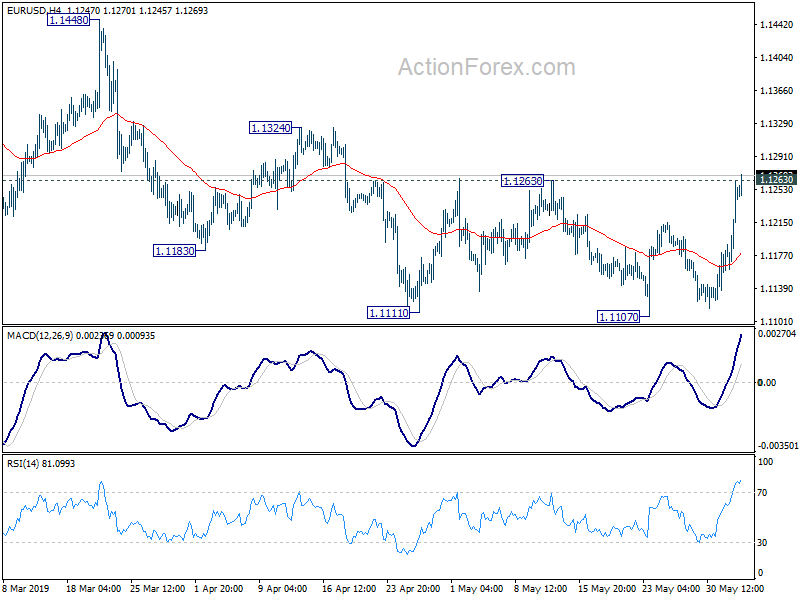
EUR/USD's rise extends further today and it's now pressing 1.1263 key near term resistance. At long as this resistance holds, outlook will stay bearish. That is, larger down trend from 1.2555 should resume sooner rather than later through 1.1107 low. However, considering bullish convergence condition in daily MACD, firm break of 1.1263 will be an early sign of medium term bottoming. Intraday bias will be turned back to the upside for 1.1448 resistance for confirmation.
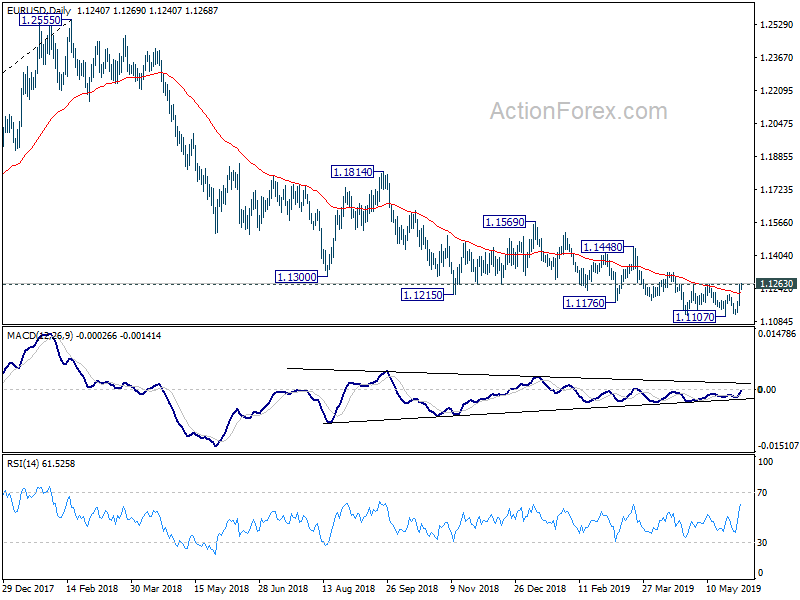
In the bigger picture, down trend from 1.2555 (2018 high) is still in progress. Such decline would target 78.6% retracement of 1.0339 (2016 low) to 1.2555 (2018 high) at 1.0813 next. Sustained break there will pave the way to retest 1.0339. On the upside, break of 1.1448 resistance is needed to confirm medium term bottoming. Otherwise, outlook will stay bearish in case of rebound.
RBA Cuts Rates As Expected, Markets Now Look Ahead To Comments From RBA Gov Lowe For Rate Outlook
General Trend:
- US and China continue to debate why trade talks broke down
- Possible antitrust probe into big US tech companies weighs on tech shares: Tencent -1.7%, Softbank -2.8%, Samsung Electronics -1%
- Australian markets outperform, utilities and REITs gain after rate cut
- Consumer Discretionary, Industrial, Materials and Health Care firms are among the decliners in Shanghai
- Fast Retailing is expected to report monthly sales after the Nikkei close
- New Zealand’s A2 Milk declines, China is seeking to increase domestic production of baby formula; NZD declines
- RBA Gov Lowe is expected to speak during the NY morning (5:30 AM est)
- Australia Q1 current account deficit was the smallest since 1996, iron ore exports rose
- Australian April retail sales unexpectedly decline, Q1 GDP data due on Wednesday
- Korean Won (KRW) weakens as Q1 GDP contraction and exports were worse than feared
- US T-note Futures decline in Asia after gains on Monday
- Various Canadian lumber companies announce production cuts, market conditions cited
Headlines/Economic Data
Australia/New Zealand
- ASX 200 opened +0.1%
- (AU) RESERVE BANK OF AUSTRALIA (RBA) CUTS CASH RATE TARGET BY 25BPS TO 1.25%; AS EXPECTED (1st rate move since Aug 2016, resuming the easing cycle)
- (AU) AUSTRALIA APR RETAIL SALES M/M: -0.1% V +0.2%E
- (AU) AUSTRALIA Q1 CURRENT ACCOUNT (A$): -2.9B V -2.9BE (smallest deficit since 1996)
- (NZ) NEW ZEALAND Q1 TERMS OF TRADE Q/Q: 1.0% V 0.5%E
- (AU) Australia Treasurer Frydenberg has told the big 4 banks to pass on in full any interest rate cut to stimulate the economy – AFR
- (AU) Australia government: Q1 gov't investment will not contribute to GDP, gov't consumption to add 0.2 pct point to GDP
- CLQ.AU Confirms that it has commenced a partnering process for its wholly-owned Sunrise nickel, cobalt and scandium project located in central New South Wales [+20%]
Japan
- Nikkei 225 opened +0.1%
- (JP) Japan Fin Min Aso: No change in stance on sales tax, economy is gradually recovering
- (JP) Japan Econ Min Motegi: Japan and US to hold working level trade talks in the US from June 10-11th
- (JP) Japan May Monetary Base ¥511.8T v ¥514.6T prior; Y/Y: 3.6% v 3.1% prior
- (JP) Japan MoF sells ¥2.1T v ¥2.1T indicated in 0.10% 10-year JGBs: avg yield: -0.1060% v -0.060% prior, bid to cover 3.99x v 4.44x prior
- 6501.JP Releases mid term plan: Planning growth investment of ¥2.0-2.5T; Capex ¥1.8T
Korea
- Kospi opened -0.1%
- (KR) SOUTH KOREA MAY CPI M/M: 0.2% V 0.4%E; Y/Y: 0.7% V 0.8%E; Core CPI y/y: 0.8% v 0.8%e (lowest rate since Dec 1999)
- (KR) SOUTH KOREA Q1 FINAL GDP Q/Q: -0.4% V -0.3%E; Y/Y: 1.7% V 1.8%E
- 207940.KR Prosecutors find evidence was destroyed on CEO's computer - Yonhap
- (KR) South Korea sells KRW1.85T v 1.85T indicated in 30-yr bonds; avg yield 1.725% v 1.90% prior
China/Hong Kong
- Hang Seng opened +0.4%; Shanghai Composite opened -0.1%
- (CN) CICC said to have downgraded various banks in China to hold on deleveraging concerns after gov't takeover of Baoshang Bank - US financial press
- (CN) China PBoC is more likely to use reverse repo and MLF to ease credit - China Securities Journal
- (CN) China NDRC issues notice on infant formula sector; to set higher standards for baby formula, targeting to boost domestic production beyond 60% and improve quality - Chinese press
- (CN) China firmly opposes US Sec of State Pompeo's statement on human rights in China, his statement interfered in its internal affairs
- (CN) China PBoC sets yuan reference rate: 6.8822 v 6.8896 prior
- (CN) China PBoC Open Market Operation (OMO): Injects CNY60B in 7-day reverse repos v CNY80B prior; Net: drain CNY90B v CNY0B prior
- HUAWEI.CN Chairman: We currently are not in communication with the US government; remains confident in business continuity management
North America
- (CN) USTR and US Treasury Dept. issue response to China 'White Paper' on trade: Disappointed China is 'misrepresenting' trade talks; China 'misrepresenting' why talks broke down
- (US) FED'S BULLARD (DOVE, VOTER): INTEREST RATE CUT MAY BE WARRANTED SOON ON TRADE AND INFLATION RISKS
- (MX) Mexico Agriculture Sec Villalobos: Tariffs announced by Trump would cause total economic damage in the US and Mexico of $117M/month
- (MX) Mexico Econ Min Márquez: Mexico could take several paths if the US goes ahead with the tariffs; could ask for help from WTO, but that is a slow route or implement its own tariffs on US goods - US financial press
- (US) SEMI: Q1 Worldwide Semiconductor Manufacturing Equipment Billings: $13.8B v $17.0B y/y; -8% y/y; -19% q/q
- Thirteen large global banks are preparing to launch digital versions of major global currencies in 2020 - Press
- (US) There is said to be some Republican opposition to the tariffs that Trump proposed for Mexico - US press
Europe
- (UK) May BRC Sales LFL y/y: -3.0% v 0.8%e
- (IE) Ireland May Manufacturing PMI: 50.4 v 52.5 prior (lowest level since July 2016)
- (UK) Pres Trump tweets: "Also, big Trade Deal is possible once U.K.gets rid of the shackles. Already starting to talk!"
- (UK) France Pres Macron: Oct 31 is now the final Brexit deadline
Levels as of 1:20 ET
- Nikkei 225, -0.1%, ASX 200 +0.3%, Hang Seng -0.5%; Shanghai Composite -0.8%; Kospi -0.1%
- Equity Futures: S&P500 +0.1%; Nasdaq100 +0.1%, Dax -0.3%; FTSE100 -0.3%
- EUR 1.1258-1.1240 ; JPY 108.09-107.85 ; AUD 0.6994-0.6959 ;NZD 0.6602-0.6580
- Gold flat at $1,327/oz; Crude Oil -0.2% at $53.14/brl; Copper -0.3% at $2.650 /lb
The Fed’s Bullard First To Open The Door For A Rate Cut
Market movers today
Focus continues to be on the US-China trade war, weakening macro data globally and the potential for central bank easing. US ISM manufacturing dropped further yesterday to 52.1, the lowest level in 2˝ years, adding to evidence that the US economy has joined the global slowdown with few engines left pulling.
Today's main event is the inflation print out of the euro area. In April, the 'Easter effect' pushed core inflation up by 0.5pp to 1.3% y/y but the May print will probably be a more reliable guide to the trend in actual underlying inflation pressures. As the Easter boost to travel-related service prices wanes, we expect both headline and core inflation to drop back in May, to 1.6% and 1.1%, respectively (see also Euro Area Research - Inflation under the microscope: simmering, not boiling ). It leaves the ECB with a rather bleak picture of still too low core inflation and the expected recovery being threatened by trade war escalation and weaker Chinese growth. Market inflation expectations also keep falling and are back at the lows seen in 2016.
US Fed Chair Powell will speak this afternoon as part of the 'Fed listens' event. The theme will be monetary policy strategy, tools and communication practices. Although the speech may not entail guidance for new policy signals near term yet, the speech is important as part of the revisit of the monetary policy framework/target discussion. Watch out for interviews on the sidelines of the conference. Note also our new Fed piece calling for a rate cut in Q3: FOMC Comment - Dovish policy signal to pave the way for an upcoming insurance cut , 31 May 2019.
In Scandi, we get Swedish industrial orders and production and we also get Danish FX reserves for May (see more on the next page).
Selected market news
Yesterday, the Fed's Bullard (dove, voter) became the first FOMC member to open the door for a rate cut . Bullard said a "downward policy rate adjustment may be warranted soon to help re-centre inflation and inflation expectations at target and also provide some insurance in case of a sharper-than-expected slowdown". Markets are now pricing in 50bp of rate cuts by the Fed in 2019 and a further 50bp easing in 2020.
Financial markets have been fairly calm overnight . Asian stocks are a bit lower while the S&P futures and bond yields are trading sideways. The trend is still lower, though, and US bond yields reached a new low last night before rebounding a bit again in Asia. Nasdaq took another beating yesterday as the US government is moving towards a major antitrust probe that could hit big tech companies such as Amazon, Facebook, Apple and Google.
The Reserve Bank of Australia this morning became the first major central bank to cut rates as the key rate was lowered to 1.25% from 1.5% in line with consensus expectations.
The US top trade negotiators yesterday shot back at China in a joined statement stating disappointment over China's blame game. It is a response to the Chinese White Paper released over the weekend that blamed the US for the trade war.
RBA Slashes Its Benchmark Interest Rates To 1.25% From 1.50%
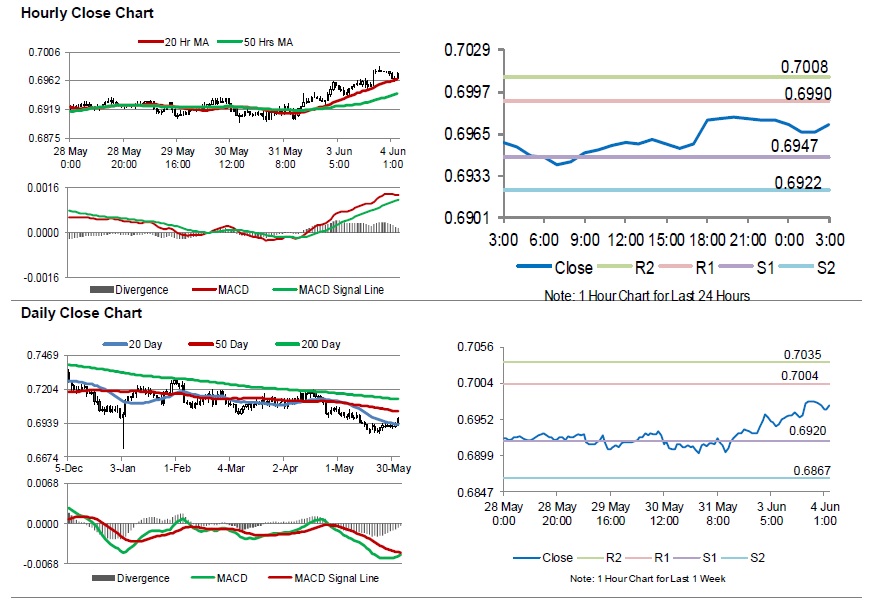
For the 24 hours to 23:00 GMT, the AUD rose 0.36% against the USD and closed at 0.6975.
LME Copper prices rose 0.3% or $15.5/MT to $5796.0/MT. Aluminium prices rose 0.1% or $2.5/MT to $1763.5/MT.
In the Asian session, at GMT0300, the pair is trading at 0.6972, with the AUD trading marginally lower against the USD from yesterday’s close.
Overnight data showed that Australia’s seasonally adjusted retail sales unexpectedly fell 0.1% on a monthly basis in April, compared to an advance of 0.3% in the previous month. Markets had expected retail sales to record a rise of 0.2%.
The Reserve Bank of Australia (RBA), in its June monetary policy meeting, trimmed its interest rate to 1.25% from 1.50%, for the first time since August 2016, in an effort to support employment growth. However, the central bank indicated that its economy would grow at a rate of 2.75% in 2019 and 2020 and expects inflation to be in the range of 1.75% in 2019 and 2.0% in 2020.
The pair is expected to find support at 0.6947, and a fall through could take it to the next support level of 0.6922. The pair is expected to find its first resistance at 0.6990, and a rise through could take it to the next resistance level of 0.7008.
Moving forward, traders would keep an eye on Australia’s AiG performance of service index and the CBA services PMI, both for May followed by gross domestic product for the first quarter.
The currency pair is showing convergence with its 20 Hr moving average and trading above its 50 Hr moving average.
Euro-Zone’s Manufacturing Sector Activity Fell For The Fourth Consecutive Month In May
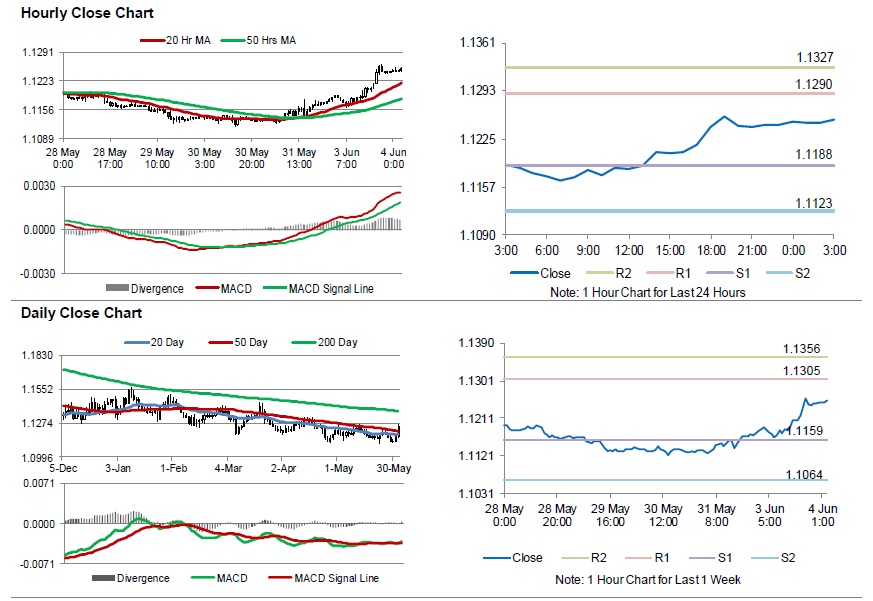
For the 24 hours to 23:00 GMT, the EUR rose 0.55% against the USD and closed at 1.1245.
On the macro front, the Euro-zone's final manufacturing PMI dropped to a level of 47.7 in May, contracting for the fourth consecutive month as well as meeting market expectations and confirming the preliminary print. In the preceding month, the PMI had recorded a reading of 47.9.
Separately, in Germany, the final Markit manufacturing PMI declined to a level of 44.3 in May, in line with market expectations and confirming the preliminary print. In the prior month, the PMI had recorded a reading of 44.4.
The US dollar declined against the euro, following weak ISM manufacturing data.
In the US, data showed that the ISM manufacturing activity index unexpectedly eased to a level of 52.1 in May, declining to its lowest level since October 2016 and defying market consensus for a gain to a level of 53.0. In the prior month, the index had recorded a level of 52.8. Additionally, the final Markit manufacturing PMI fell to a decade low level of 50.5 in May. In the previous month, the PMI had recorded a level of 52.6. The preliminary figures had indicated a fall to 50.60. Meanwhile, the nation's construction spending remained flat on a monthly basis in April, defying market anticipations for an advance of 0.4%. In the previous month, construction spending had recorded a revised rise of 0.1%.
In the Asian session, at GMT0300, the pair is trading at 1.1253, with the EUR trading 0.07% higher against the USD from yesterday's close.
The pair is expected to find support at 1.1188, and a fall through could take it to the next support level of 1.1123. The pair is expected to find its first resistance at 1.1290, and a rise through could take it to the next resistance level of 1.1327.
Going ahead, traders would keep an eye on Euro-zone's unemployment rate for April and the consumer price index for May, slated to release in a few hours, Later in the day, the US factory orders and durable goods orders, both for April, will keep traders on their toes.
The currency pair is trading above its 20 Hr and 50 Hr moving averages.
UK’s Manufacturing Sector Activity Contracted To Its Lowest Level Since July 2016 In May
For the 24 hours to 23:00 GMT, the GBP rose 0.13% against the USD and closed at 1.2666.
Data indicated that UK's manufacturing PMI contracted to a level of 49.4 in May, declining to its lowest level since July 2016 and more than market consensus for a fall to a level of 52.2. The PMI had registered a reading of 53.1 in the prior month.
In the Asian session, at GMT0300, the pair is trading at 1.2667, with the GBP trading a tad higher against the USD from yesterday's close.
Overnight data showed that Britain's BRC retail sales across all sectors surprisingly fell 3.0% on an annual basis in May, falling at its quickest pace in 24 years and defying market anticipations for a rise of 0.8%. In the previous month, retail sales across all sectors had registered a climb of 3.7%.
The pair is expected to find support at 1.2627, and a fall through could take it to the next support level of 1.2588. The pair is expected to find its first resistance at 1.2690, and a rise through could take it to the next resistance level of 1.2714.
Trading trend in the Sterling today, is expected to be determined by UK's Markit/CIPS construction PMI for May, slated to release in a few hours.
The currency pair is trading above its 20 Hr and 50 Hr moving averages.

Japanese Yen Trading A Tad Lower In The Asian Session
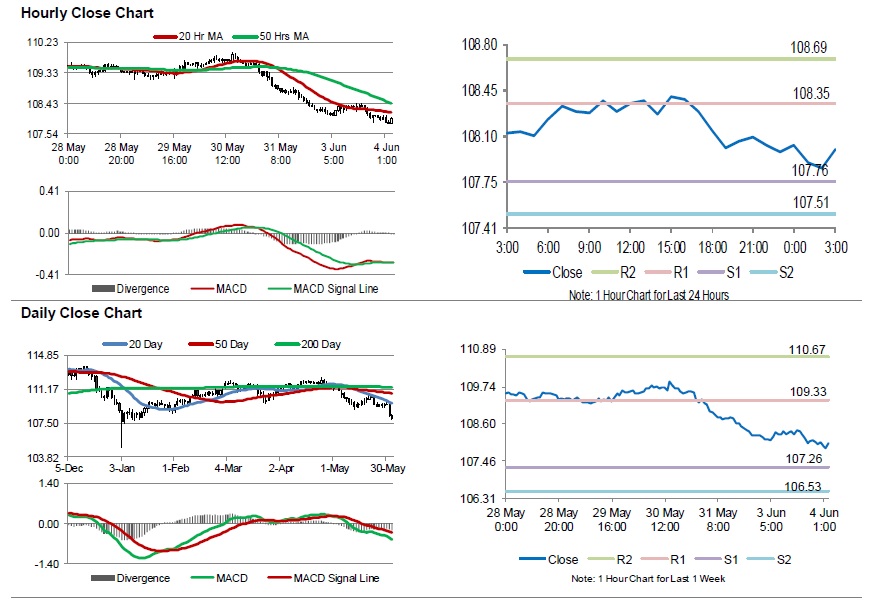
For the 24 hours to 23:00 GMT, the USD declined 0.20% against the JPY and closed at 107.98.
In the Asian session, at GMT0300, the pair is trading at 108.00, with the USD trading slightly higher against the JPY from yesterday’s close.
The pair is expected to find support at 107.76, and a fall through could take it to the next support level of 107.51. The pair is expected to find its first resistance at 108.35, and a rise through could take it to the next resistance level of 108.69.
Looking forward, investors would closely monitor Japan’s Nikkei services PMI for May, set to release overnight.
The currency pair is trading below its 20 Hr and 50 Hr moving averages.
Switzerland’s Consumer Price Inflation Slowed As Estimated In May
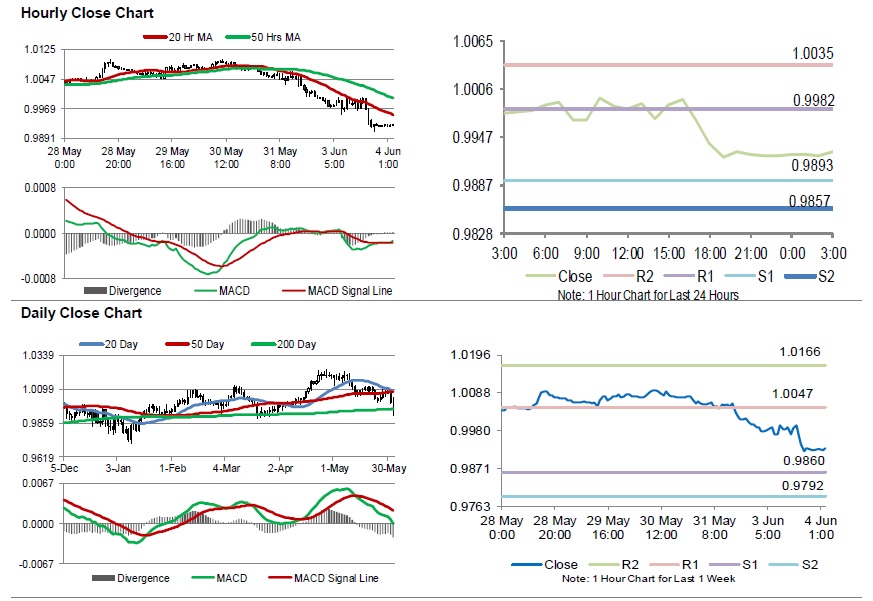
For the 24 hours to 23:00 GMT, the USD declined 0.66% against the CHF and closed at 0.9923.
In economic news, Switzerland's consumer price inflation (CPI) slowed to 0.3% on a monthly basis in May, at par with market expectations. The CPI had recorded a level of 0.2% in the previous month. Moreover, the SVME manufacturing PMI climbed to a level of 48.6 in May, compared to a reading of 48.5 in the prior month. Market participants had envisaged the PMI to record an increase to a level of 48.8.
In the Asian session, at GMT0300, the pair is trading at 0.9928, with the USD trading 0.05% higher against the CHF from yesterday's close.
The pair is expected to find support at 0.9893, and a fall through could take it to the next support level of 0.9857. The pair is expected to find its first resistance at 0.9982, and a rise through could take it to the next resistance level of 1.0035.
The currency pair is trading below its 20 Hr and 50 Hr moving averages.
RBA Cuts Cash Rate and Leaves Open Prospects for Further Moves
The labour market will remain the key focus for policy. The two additional cuts that we anticipate in August and November are consistent with our more downbeat view on the labour market.
As expected, the Reserve Bank Board decided to lower the cash rate by 25bps to 1.25%. This action is very much in line with Westpac’s forecast first set out on February 21, although comes two months earlier than our original timeline. The basis for the RBA decision was “to support employment growth and provide greater confidence that inflation will be consistent with the medium-term target”. The major dynamic in that regard is to push harder on the unemployment rate to try to reach that point where wages growth lifts markedly.
The Governor has left open the prospect of further action, noting that “the Board will continue to monitor developments in the labour market closely and adjust monetary policy to support sustainable growth in the economy and the achievement of the inflation target over time”.
Regular readers will be aware that Westpac expects that there will be further cuts in this cycle in August and November. It is possible that the Board might choose to bring forward the cut we expect in August to July in the event of a particularly disappointing employment report on June 13. However, we expect that given the limited policy flexibility available, the prudent approach will be to await more information and provide a full explanation of the next cut at the August meeting. A further benefit will be to provide updated forecasts for inflation and growth in the August Statement on Monetary Policy.
However, the key point from our perspective is the clear message that more work needs to be done and only one more cut will be seen as insufficient.
The description of the labour market still has vestiges of the consistent upbeat message that has been a key aspect of the Governor’s Statements in the last few years. However, he is clearly disappointed that recent progress on unemployment appears to have stalled at a level which is clearly not consistent with a healthy acceleration in wages growth. It is interesting that despite the tick-up in the unemployment rate in April to 5.2% being attributable to a record participation rate, he chooses not to qualify the rise in the unemployment rate in that manner.
The commentary on inflation seems largely unchanged with current pressures being described as subdued, although a pick-up is anticipated and the 1.75% forecast for underlying inflation in 2019 remains intact. We expect that the June and September quarter inflation reports will make it untenable to maintain that forecast as well as the associated lift in 2020 to 2%, indicating the clear need for further policy responses.
A key area of uncertainty is the outlook for the housing market given the recent surprising political developments and this rate cut. In that regard, the Governor provides no real guidance, pointing to “conditions remain soft”. He does recognise that price declines have slowed and growth in housing credit has stabilised recently.
Superimposed on this caution around the domestic economy is recognition of the damage that the trade disputes are having on the global economy. While the RBA’s outlook for global growth “remains reasonable”, quite rightly, he emphasises downside risks, including weak international trade and soft investment intentions.
Conclusion
In February, Westpac surprised markets by forecasting two rate cuts in 2019. Recently we revised that forecast to anticipate three cuts. Today’s decision confirms the validity of those forecasts and goes some way to justifying our decision to increase the number of forecast cuts from two to three.
The labour market will remain the key focus for the policy profile, and the two additional cuts that we anticipate in August and November are consistent with our more downbeat view on the labour market.