

Sample Category Title
Sunset Market Commentary
Markets
Core bonds managed to cling to Friday’s impressive gains. More hawkish trade rhetoric over the weekend caused a deep negative opening on European stock markets with core bonds, but mainly US Treasuries, profiting. The move didn’t last long though with equities rapidly finding a bottom and topping core bond gains. Several US Fed governors are still scheduled to speak, but tomorrow’s address by Fed Chair Powell probably overshadows them. The US yield curve continues to bull steepened with yields down 3 bps (2-yr) to 0.4 bps (30-yr). Changes on the German yield curve are limited between +0.6 bps (2-yr) and -1.6 bps (30-yr). 10-yr yield spreads vs Germany narrowed up to 3 bps with Italy (-7 bps) outperforming. Investors clearly don’t fear PM Conte’s press conference later tonight. Media suggest that he plans to issue an ultimatum to his quarreling deputy PM’s, 5SM’s Di Maio and Lega Salvini. Polls and European elections show that mainly Lega (34%) will profit from a new ballot.
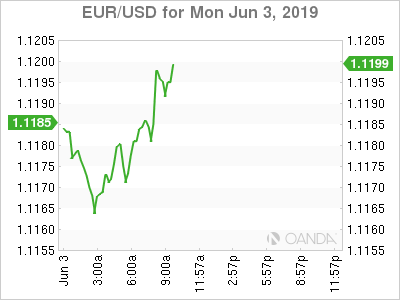
The sharp decline in US interest rates (and US-GE spreads) on Friday finally triggered an (albeit modest) decline of the dollar, pushing EUR/USD higher in the 1.11 big figure. Uncertainty on different aspects of the US trade war continued to haunt markets this morning, but the decline in core yields and in equities was modest and orderly. The dollar initially showed no clear trend. USD/JPY hovered in the lower part of the 108 big figure, holding within reach of recent lows. The euro even slightly outperformed in technical trade, with EUR/USD testing the 1.12 barrier. EUR/USD shorts are less at ease as Friday’s price action suggested that, at some point, the trade war could become a negative for the US economy and the USD, too. US data starting with the manufacturing ISM later this afternoon might become a good pointer of further potential negative fallout.
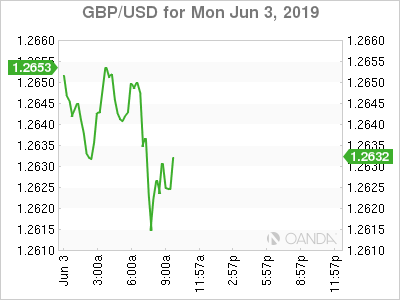
Sterling continued fighting an uphill battle today. Both economic and political events weighted on the UK currency. Sterling tried a cautious rebound early in the session, but the upside was blocked soon. The UK May manufacturing PMI unexpectedly dropped from 53.1 to 49.4, indicating a contraction in the sector. The consensus only expected a more modest decline to 49.4. Sterling gradually came under pressure after the publication of the PMI. Headlines of Boris Johnson advocating that the UK should leave the EU on October 31, with or without an exit deal, brought the political event risk of a potential disorderly Brexit back in the spotlights. EUR/GBP came again close to last week’s top in the 0.8870/75 area. The overall rebound of EUR/USD also supported the EUR/GBP cross rate. The performance of sterling against the dollar was more balanced as the US currency was also under modest pressure. Cable is changing hands in the 1.2630 area.
News Headlines
Mexico sent a senior delegation to Washington on Monday after US president Trump unexpectedly announced a 5% tariff on all Mexican imports end of last week. Mexico’s ministers of Foreign Affairs, Agriculture and Economy are scheduled to meet their US counterparts this week.
The Belgian central bank said it “stands ready” to activate the countercyclical buffer for credit risks after an important credit cycle indicator surpassed key thresholds. Germany’s financial stability board suggested the introduction of a similar buffer last week to ensure lending in case of an economic downturn.
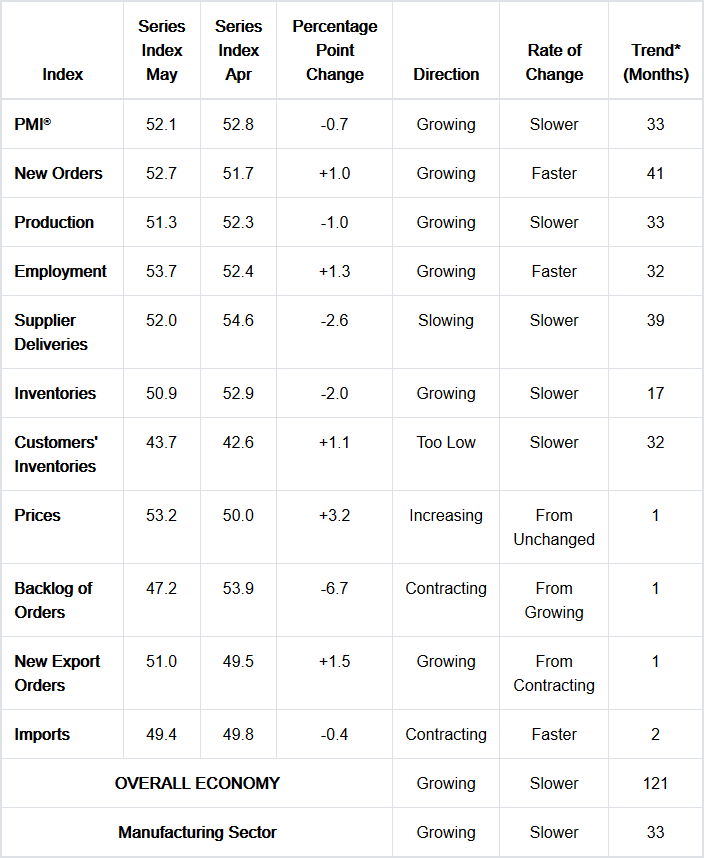
US ISM manufacturing business confidence unexpectedly slipped from 52.8 to 52.1 in May (53.0 expected). Details however were not too bad. Production edged lower but new orders and employment slightly rose compared to April. New export orders left contraction territory.
EUR/USD Mid-Day Outlook
Daily Pivots: (S1) 1.1136; (P) 1.1136; (R1) 1.1191; More.....
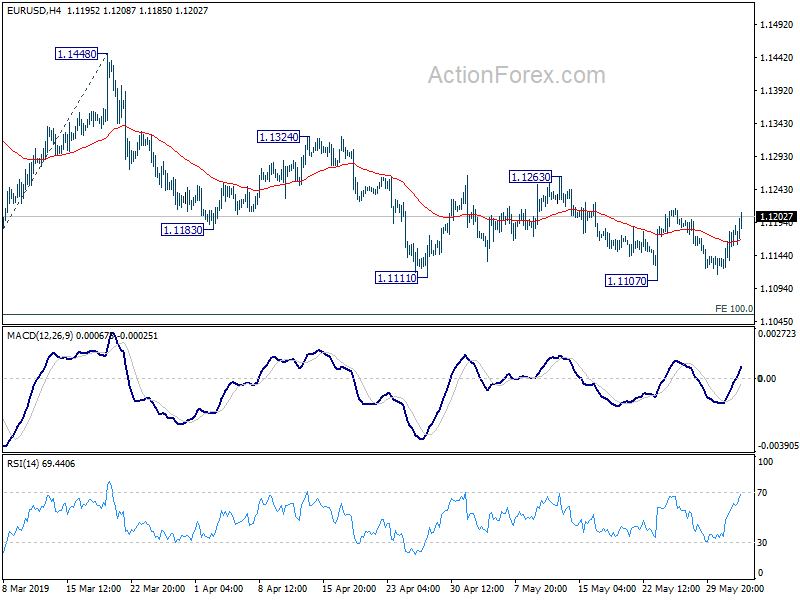
EUR/USD rebounds further today but after all, it's staying in consolidation from 1.1111. Intraday bias remains neutral first. In case of stronger rise, upside should be should be limited by 1.1263 resistance to bring down trend resumption. On the downside, firm break of 1.1107 will target 100% projection of 1.1448 to 1.1183 from 1.1324 at 1.1059. However, sustained break of 1.1263 resistance will now be an early sign of trend reversal and turn bias to the upside for 1.1448 key resistance.
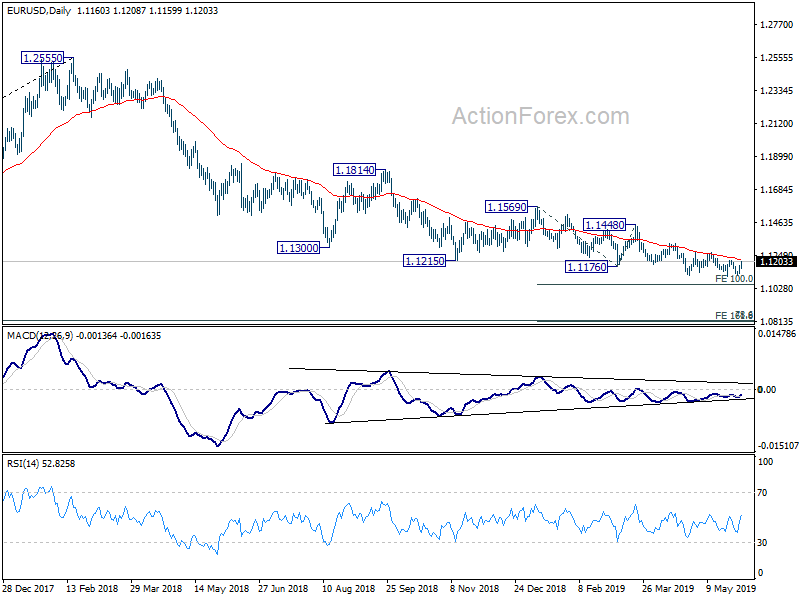
In the bigger picture, down trend from 1.2555 (2018 high) is still in progress. Such decline would target 78.6% retracement of 1.0339 (2016 low) to 1.2555 (2018 high) at 1.0813 next. Sustained break there will pave the way to retest 1.0339. On the upside, break of 1.1448 resistance is needed to be the first sign of medium term bottoming. Otherwise, outlook will stay bearish in case of rebound.
GBP/USD Mid-Day Outlook
Daily Pivots: (S1) 1.2580; (P) 1.2612; (R1) 1.2666; More....
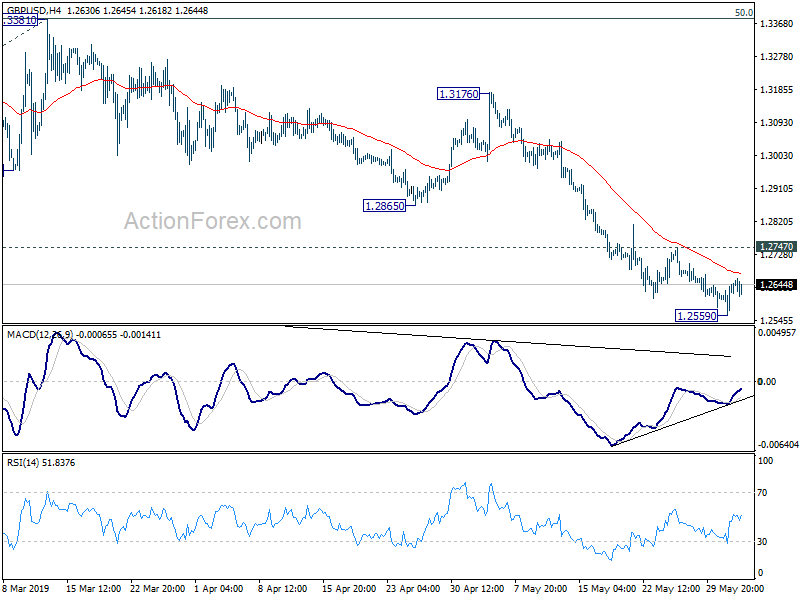
Intraday bias in GBP/USD is neutral for consolidation above 1.2559 temporary low. But outlook stays bearish with 1.2747 resistance intact. Current fall from 1.3381 is still in progress. Break of 1.2559 will target 1.2391 low first. Firm break there will resume larger down trend to 61.8% projection of 1.4376 to 1.2391 from 1.3381 at 1.2154 next. Though, break of 1.2747 resistance will confirm short term bottoming and bring stronger rebound.
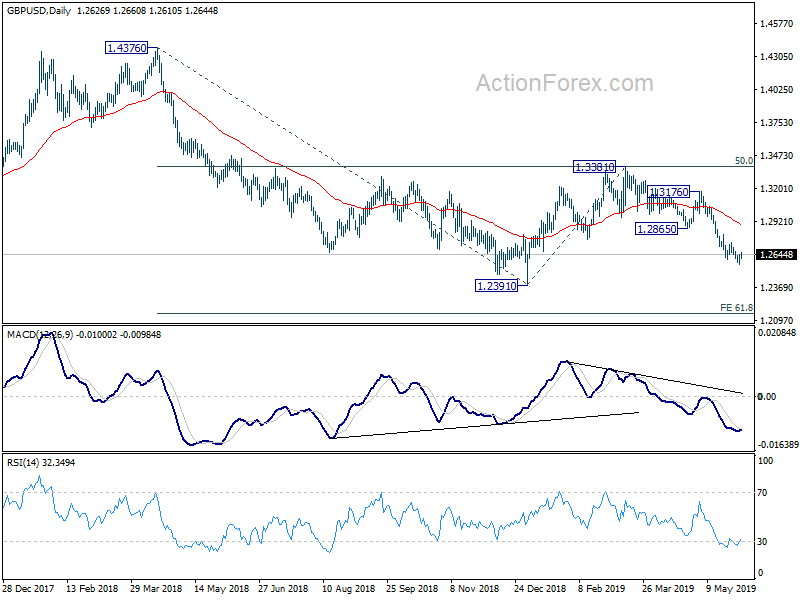
In the bigger picture, medium term decline from 1.4376 (2018 high) is possibly ready to resume. Decisive break of 1.2391 would target a test on 1.1946 long term bottom (2016 low). For now, we don't expect a firm break there yet. Hence focus will be on bottoming signal as it approaches 1.1946. In any case, medium term outlook will stay bearish as long as 1.3381 resistance holds, in case of strong rebound.
USD/CHF Mid-Day Outlook
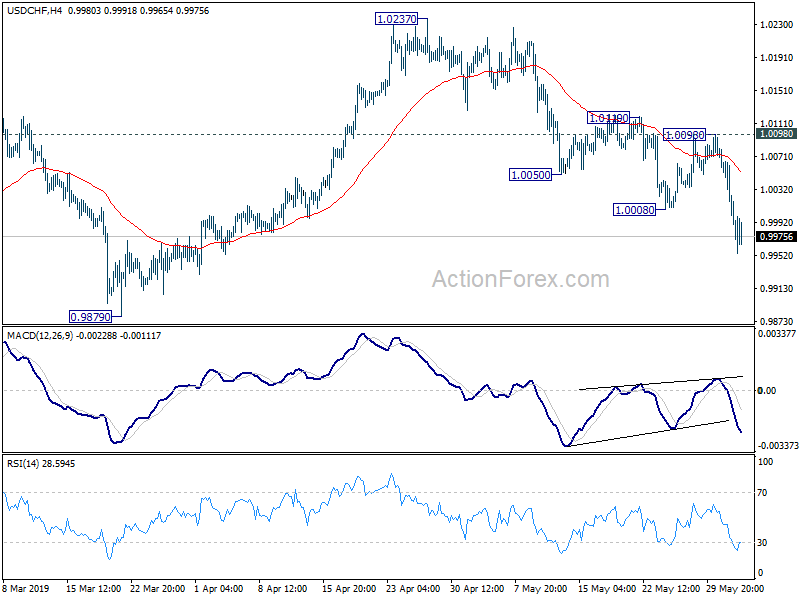
Daily Pivots: (S1) 0.9978; (P) 1.0031; (R1) 1.0061; More...
USD/CHF's fall from 1.0237 is still in progress and intraday bias stays on the downside. Next target is 0.9879 key support. Decisive break there will carry larger bearish implications. On the upside, break of 1.0098 is needed to indicate completion of such decline. Otherwise, outlook will stay mildly bearish in case of recovery.
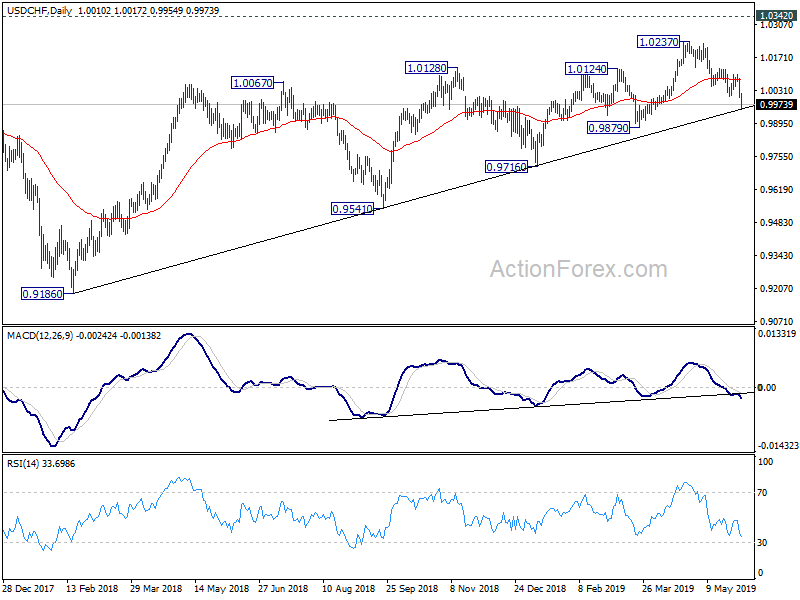
In the bigger picture, USD/CHF is losing upside momentum ahead of 1.0342 key resistance (2016 high). There is no clear sign of reversal yet. But even in case of another rise, we'd be cautious on strong resistance from 1.0342 to limit upside. On the downside, break of 0.9879 support will suggest that larger rise from 0.9186 (2018 low) has completed. Deeper fall will be seen to 0.9716 support for confirmation.
USD/JPY Mid-Day Outlook
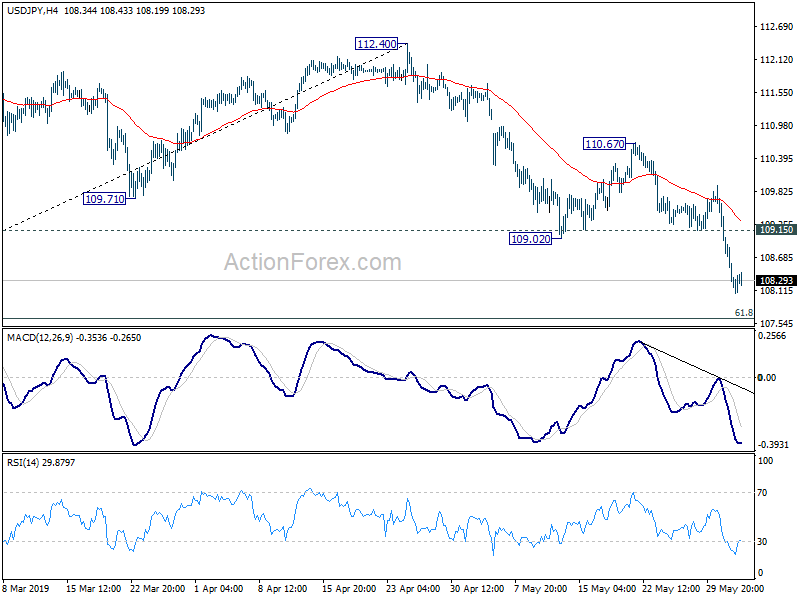
Daily Pivots: (S1) 107.82; (P) 108.73; (R1) 109.20; More...
USD/JPY's decline is still in progress and intraday bias remains on the downside. Current fall from 112.40 should target 61.8% retracement of 104.69 to 112.40 at 107.63. Sustained break there will pave the way back to 104.62/9 key support zone. On the upside, break of 109.15 support turned resistance is needed to be the first sign of short term bottoming. Otherwise, outlook will remain bearish in case of recovery.
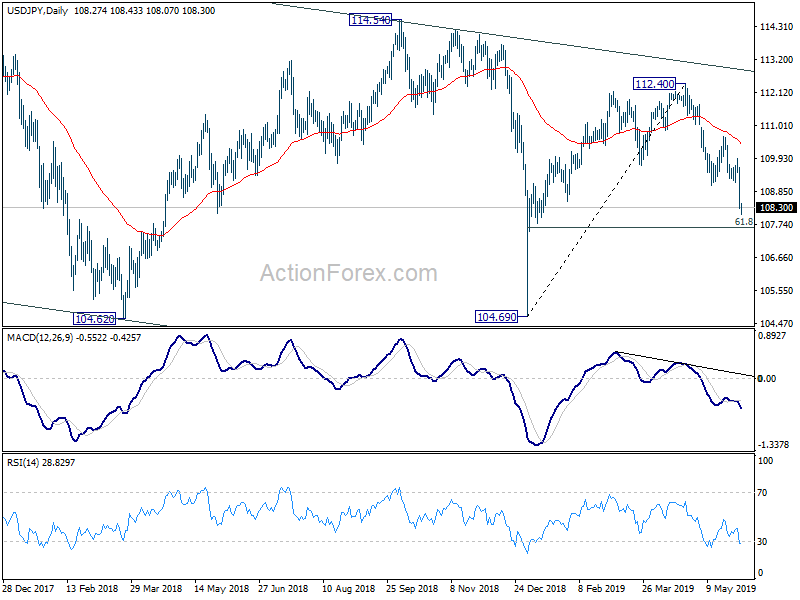
In the bigger picture, decline from 118.65 (Dec 2016) is still in progress, with the pair staying indicate long term falling channel. Break of 104.62 will target 100% projection of 118.65 to 104.62 from 114.54 at 100.51. For now, we'd expect strong support above 98.97 (2016 low) to contain downside to bring rebound.
ISM manufacturing dropped to 52.1, price paid jumped, manufacturers concerned with trade war escalation
ISM Manufacturing Index dropped to 52.1 in May, down from 52.8 and missed expectation of 53.0. Looking at some details, new orders rose from 51.7 to 52.7, productions dropped from 52.3 to 51.3. Employment rose from 52.4 to 53.7. Prices rose 3.2 to 53.2.
"Respondents expressed concern with the escalation in the U.S.-China trade standoff, but overall sentiment remained predominantly positive. The PMI® continues to reflect slowing expansion," says Timothy Fiore, Chair of the Institute for Supply Management® (ISM®) Manufacturing Business Survey Committee..
Here are some comments from respondents:
- "Ongoing tariffs [issue is] impacting costs and influencing supplier realignment on country of origin. Border issue is causing delays in imports from Mexico." (Computer & Electronic Products)
- "The threat of additional tariffs has forced a change in our supply chain strategy; we are shifting business from China to Mexico, which will not increase the number of U.S. jobs." (Chemical Products)
- "Sales remain strong. Labor remains tight. Tariffs are having a significant impact on cost of goods. No impact on where we buy our goods." (Food, Beverage & Tobacco Products)
- "The threat of a 15-percent increase on Section 301 tariffs is a concern. Although the potential has been around for months, the recent deadline was not expected. We had calculated and communicated the potential cost impact to our leadership." (Petroleum & Coal Products)
- "Newly increased tariffs on Chinese imports pose an issue on a number of chemicals and materials that are solely produced in China. We are expecting increases in raw materials starting June 1." (Plastics & Rubber Products)
Bond Rally Resumes Trade Talks Remain in Gridlock
US stocks are poised to open lower after China methodically announces fresh retaliatory tariff threats. Over the weekend, China released a government policy paper that suggested a willingness to return to negotiations, while be highly critical of the Trump administration’s tactics with tariffs and blaming them for talks falling apart. China also issued a warning to students of the risks of receiving US education. China plays a prominent role with education in sheer numbers and top talent. China also opened a probe against FedEx for wrongful deliveries of items, possibly targeting packages that were supposed to arrive at Huawei. It seems China is tightening the screws on their retaliatory measures, expecting the US will cave in offering concessions and removal of additional tariffs if we see further damage to the US economy and stock market.
Last week, markets were surprised by President Trump’s surprise announcement that US will unleash tariffs on their southern neighbor. Mexico sent a delegation to the US to review immigration issues, this followed their immediate retaliatory tariff threat. Mexico Foreign Minister noted the Mexican government is following its laws on immigration, while their ambassador to the US added because of Mexico 250,000 migrants did not arrive to the US. Mexico remains committed to working with the US but are threatening the migrant situation would be much worse without their help. The US should be able to resolve the spat with Mexico, but that will likely not provide much relief to markets, since China remains the key roadblock for global growth.
USD
American growth is not invulnerable to this trade war and we are starting to see dollar weakness here. The Federal Reserve is also highly expected to deliver rate cuts as Treasury yields continue to slide. The dollar is lower across its all of its major trading partners except for the British pound. The dollar index reached a fresh 2019 at the end of last week, but it seems we are in the midst of a pullback. All eyes will be on the US Manufacturing data this morning.
GBP
The British pound was softer after the May manufacturing reading delivered its first contraction in 34 months. New orders also dropped sharply, but this followed heavy stockpiling ahead of the March 29th date that Britain was initially expected to leave the EU.
President Trump is in London for a three-day visit, and while nothing of substance is expected out of his visit, it will make for entertaining optics if he meets with Boris Johnson or Nigel Farage.
Oil
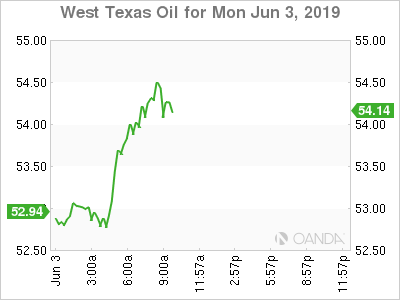
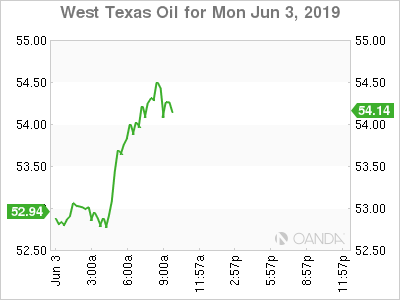
Crude prices got pummeled last month, the worst May performance in seven years, as trade war escalation dealt a strong blow to global growth and safe-haven demand saw Treasuries soar, driving the dollar higher. Oil prices are rallying today on mainly a slightly softer dollar and on Saudi energy minister Al-Falih assured markets that OPEC + will continue to stabilize the market beyond June and that the recent selloff was unwarranted. West Texas Intermediate crude is higher by 2% and Brent crude is 1.3% higher in early trade.
Gold
Gold is breaking out higher as downbeat expectations for global growth have investors searching for safe-havens. The yellow metal underperformed last month against other safe-haven trades and the climb above $1,3000 an ounce is attracting many technical traders. If trade tensions continue to heighten globally and we do not see an immediate reason suddenly be optimistic on the trade front, bullion could look to attempt to reach the 2019 high of $1,349.80 an ounce.
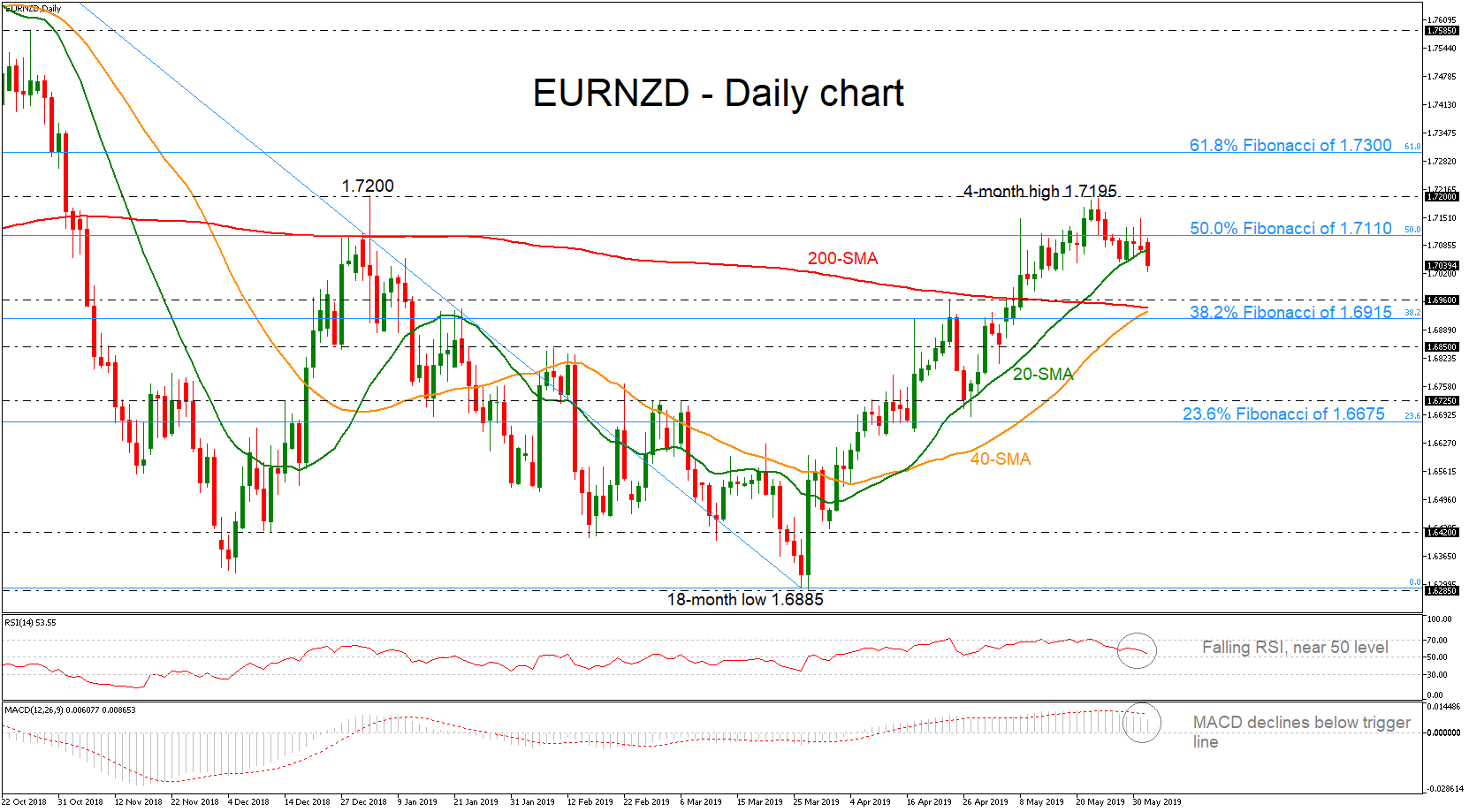
EURNZD Remains Under Pressure Celow 20-day SMA
EURNZD is declining below the 20-day simple moving average (SMA) today, confirming the recent bearish structure in the near term. The RSI is moving towards the 50 level, while the MACD is holding below the trigger line but is still hovering above the zero line, increasing speculation for more downside pressure.
In case the pair maintains its short-term direction to the downside after the bounce off the four-month high of 1.7195, the bears will probably challenge the 1.6960 support, which stands near the 200-day SMA and the 40-day SMA. A break lower could find immediate support at the 38.2% Fibonacci of 1.6915.
On the flipside, an advance above the 50.0% Fibonacci retracement level of the downfall from 1.7585 to 1.6885, near 1.7110 could send the market towards the 1.7200 handle. A penetration of this key zone may drive the price towards the 61.8% Fibonacci of 1.7300.
Summarizing, if the price surpasses the four-month high it could turn the focus for more bullish orders until the next resistance, however, it is currently in a negative correction mode.
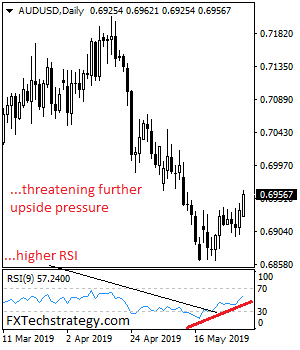
AUDUSD Risk Continues To Point Higher On Recovery
AUDUSD risk continues to point higher on price recovery in the new week. On the upside, resistance lies at the 1.7000 level. A cut through here will turn attention to the 0.7050 level and then the 0.7100 level where a violation will set the stage for a retarget of the 0.7150 level. Its daily RSI is bullish and pointing higher suggesting more upside pressure. Support resides at the 0.6900 level where a breach will aim at the 0.6850 level. Below here will set the stage for a run at the 0.6800 level with a cut through here targeting further downside pressure towards the 0.6750 level. On the whole, AUDUSD faces further upside threats.
Dollar Softens ahead of Important Economic Data, EUR/CHF Hits 2-Yr Low
Dollar weakens broadly today as markets are turning their focuses to manufacturing from the US. Final reading of Markit PMI shouldn't deviate much from the first print 50.6. Meanwhile, ISM manufacturing could probably how confidence turned after last round of trade war escalation with China. Even if the greenback might survive ISM manufacturing, more challenges lie ahead with ISM services and non-farm payrolls.
Trump sounded calm and affirmative with is morning tweet today. He noted "no visible increase in costs or inflation" from the tariffs as "China is subsidizing its product". Meanwhile, "US is taking Billions!" It's doesn't really matter much how true Trump's claims are, much like China's denial of its own faults. The point is, Trump also preparing his base for a prolonged trade war with China.
In the currency markets, New Zealand and Australian Dollars are currently the strongest ones for today. After initial selloff, major European stock indices quickly reversed and are all trading mildly up currently. Though German 10-year yield remains weak after hitting new record low at -0.217 earlier today. And that keeps Swiss Franc as third strongest, after EUR/CHF dives to new 2-year low. Meanwhile, Yen is the weakest one so far, mainly because it turned into consolidations on overbought conditions. Sterling is second weakest after manufacturing data showed reversal of pre-Brexit stockpiling effects.
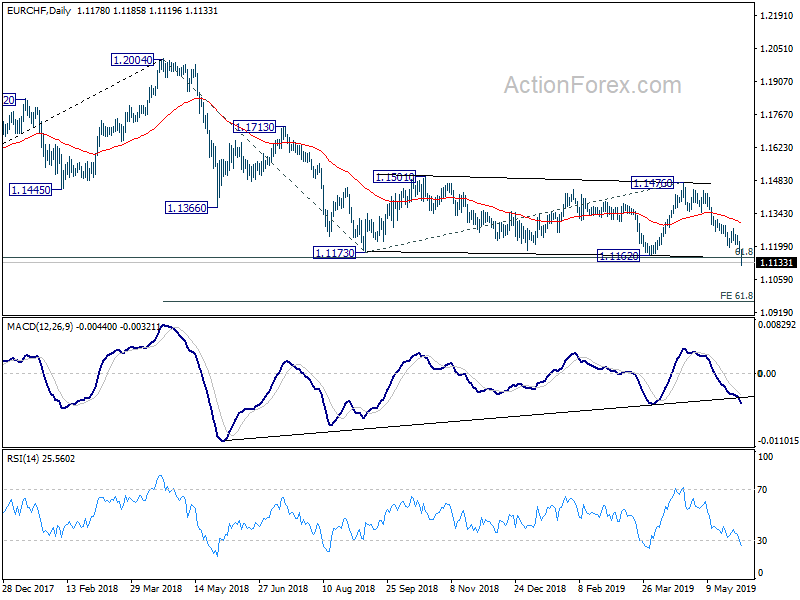
Technically, EUR/CHF's strong break of 1.1162 key support carries some long term bearish implications. And it's probably setting up for an extended down trend. While Dollar is weak, it should be noted that EUR/USD and AUD/USD are seen as staying in near term consolidations only. There is no bearish reversal in the greenback yet.
In Europe, currently, FTSE is up 0.11%. DAX is up 0.01%. CAC is up 0.12%. German 10-year yield is down -0.007 at -0.207. Earlier in Asia, Nikkei dropped -0.92%. Hong Kong HSI dropped -0.03%. China Shanghai SSE dropped -0.30%. Singapore Strait Times rose 0.18%. Japan 10-year JGB yield rose 0.0053 to -0.091.
UK PMI manufacturing dropped to 49.4, first contraction July 2016
UK PMI manufacturing dropped to 49.4 in May, down from 53.1 and missed expectation of 52.2. That's also the lowest level in 34 months. Markit noted that manufacturers reported increased difficulties in convincing clients to commit to new contracts during May, due to high level of inventories from pre-Brexit stockpiling. New order inflows also deteriorated from both domestic and overseas sources.
Rob Dobson, Director at IHS Markit, said: "The trend in output weakened and, based on its relationship with official ONS data, is pointing to a renewed downturn of production... New order inflows declined from both domestic and overseas markets, as already high stock levels at manufacturers and their clients led to difficulties in sustaining output levels and getting agreement on new contracts. Demand was also impacted by ongoing global trade tensions, as well as by companies starting to unwind inventories built up in advance of the original Brexit date. Some EU-based clients were also reported to have shifted supply chains away from the UK."
Both Johnson and Hunt prepared for no-deal Brexit
As the race for UK Prime Minister position continues, former Foreign Minister Boris Johnson pledged to leave EU on time on October 31, with or without a deal. He said "If I get in we'll come out, deal or no deal, on October the 31st." On other policies he said "Now is the time to unite our society, and unite our country. To build the infrastructure, to invest in education, to improve our environment, and to support our fantastic NHS (National Health Service) … To lift everyone in our country, and of course, also to make sure that we support our wealth creators and the businesses that make that investment possible."
Current Foreign Minister Jeremy Hunt also said he's prepared for no-deal Brexit in there was no alternative. He told BBC Radio "In the end, if the only way to leave the European Union, to deliver on the result of the referendum, was to leave without a deal, then I would do that… But I would do so very much as a last resort, with a heavy heart because of the risks to businesses and the risks to the union."
Eurozone PMI manufacturing finalized at 47.7, toughest spell since 2013 continued
Eurozone PMI Manufacturing was finalized at 47.7 in May, unrevised, down from April's 47.9. That's also very close to six year low at 47.5 made in March. Looking at the member states, German PMI manufacturing was worst at 44.3. Austria reading dropped to 50-month low at 49.5. Italy reading improved to 8-month high at 49.5 but stayed below 50. Spain reading dropped to 3-month low at 50.2. France reading improved to 3-month high at 50.6, barely expanding.
Chris Williamson, Chief Business Economist at IHS Markit said: "A fourth successive monthly drop in output and further steep decline in new orders underscored how the sector remains in its toughest spell since 2013... trade wars, slumping demand in the auto sector, Brexit and wider geopolitical uncertainty all remained commonly cited risks to the outlook, and all have the potential to derail any stabilisation of the manufacturing sector."
Also released, Swiss CPI slowed to 0.6% yoy in May, down from 0.7% yoy and matched expectation. Swiss PMI manufacturing rose 0.2 to 48.6 in May, below expectation of 48.8.
China Caixin PMI manufacturing unchanged at 50.2, some resilience with weakened confidence
China Caixin manufacturing PMI was unchanged at 50.2 in May, above expectation of 50.0. Production was broadly stable in May. Total new work and export sales both increase slightly. And, there was renewed rise in purchasing activity.
Zhengsheng Zhong, Director of Macroeconomic Analysis at CEBM Group said:"Overall, China's economy showed steady growth and resilience in May. The manufacturing sector saw demand rise from both overseas and domestic markets, and prices were stable. However, business confidence weakened, and manufacturers' inventory levels remained low. The trade tensions between the U.S. and China are having an impact on confidence and the best way to respond to this is to boost the confidence of enterprises, residents and capital markets by carrying out favorable reforms and to undertake timely adjustments to regulations and controls."
Japan PMI manufacturing finalized at 49.8, potential banana skins lie ahead
Japan PMI manufacturing was finalized at 49.8 in May, revised up from 49.6, down from 50.2 in April. Markit noted that domestic and external demand conditions deteriorate. Firms slow the rate of hiring amid production cutbacks. And, output expectations turn negative for first time since November 2012.
Joe Hayes, Economist at IHS Markit: "There were no signs a let-up in the recent manufacturing downturn during May, as output and new orders both slipped for fifth successive months. Weak demand from Japan's key trade partner, China, as well as signs of an increasingly sluggish domestic economy, have impacted sales volumes.... Given the importance of capital goods to Japan's foreign trade, it would suggest further difficulties lie ahead for Japanese exporters.
"With the upcoming sales tax hike and upper house elections in July, there lies ahead potential banana skins for Japanese firms to avoid. Re-escalated trade tensions between China and the US merely add to existing concerns for manufacturers. Subsequently, businesses cast a downbeat assessment for the year ahead for the first time in six-and-a-half years."
Also from Japan, capital spending rose 6.1% in Q1, beat expectation of 2.6%.
Australia AiG PMI dropped to -2.1, wage index at lowest since Mar 2017
Australia AiG Performance of Manufacturing Index dropped -2.1 pts to 52.7 in May, suggesting a slower rate of growth. Looking at the details, production dropped sharply by -6.9 to 51.2. New orders dropped -3.3 to 52.3. exports dropped -3.6 to just 40.3. Employment index staged a strong rebound and rose 4.1 to 55.6. But average wages dropped -2.2 to 55.5. Input prices rose 3.6 to 68.3 but selling prices dropped -2.8 to 52.1.
In particular, on wages, 55.5 is the lowest monthly results since March 2017 and is well below historical average of 59.2. This index has been trending lower since its recent peak in September 2018. It indicates that fewer manufacturing businesses are now implementing wage rises, compared to the recent peak in Q3 of 2018.
Also from Australia, TD Securities inflation rose 0.0% mom in May. Company operating profit rose 1.7% qoq in Q1.
EUR/CHF Daily Outlook
Daily Pivots: (S1) 1.1159; (P) 1.1192; (R1) 1.1242; More....
EUR/CHF drops sharply to as low as 1.1119 so far today after breaking 1.1162 support firmly. Current development confirms resumption of whole decline from 1.2004. Intraday bias is now on the downside for 61.8% projection of 1.2004 to 1.1173 from 1.1476 at 1.0962 next. On the upside, break of 1.1278 resistance is needed to confirm short term bottoming. Otherwise, outlook will stays bearish in case of recovery.
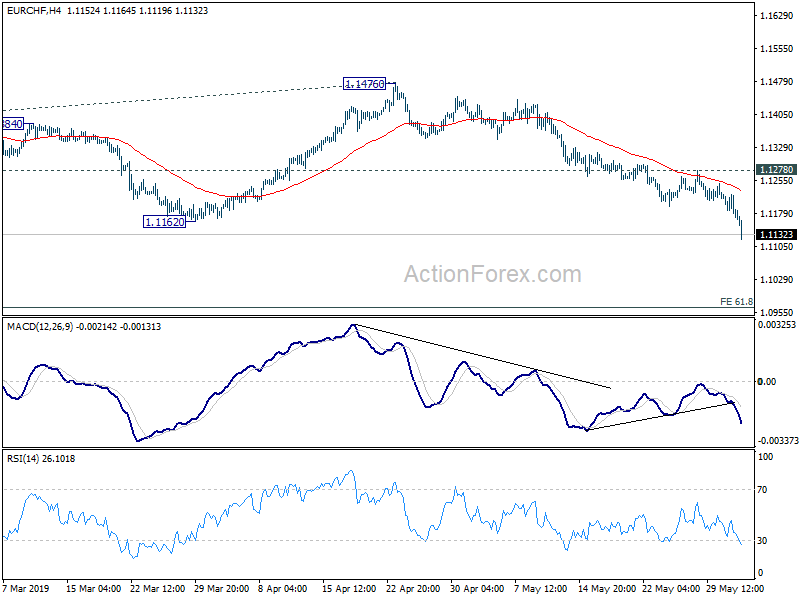
In the bigger picture, focus will stay on 61.8% retracement of 1.0629 to 1.2004 at 1.1154. Sustained break of 1.1154 will argue that fall from 1.2004 is itself a long term down trend. Next target will be 1.0629 support next. This will now remain the favored case as long as 1.1476 resistance holds even in case of rebound.
Economic Indicators Update
| GMT | Ccy | Events | Actual | Forecast | Previous | Revised |
|---|---|---|---|---|---|---|
| 22:30 | AUD | AiG Performance of Manufacturing Index May | 52.7 | 54.8 | ||
| 23:50 | JPY | Capital Spending Q1 | 6.10% | 2.60% | 5.70% | |
| 0:30 | JPY | PMI Manufacturing May F | 49.8 | 49.7 | 49.6 | |
| 1:00 | AUD | TD Securities Inflation M/M May | 0.00% | 0.20% | ||
| 1:30 | AUD | Company Operating Profit Q/Q Q1 | 1.70% | 2.80% | 0.80% | 2.80% |
| 1:45 | CNY | Caixin PMI Manufacturing May | 50.2 | 50 | 50.2 | |
| 6:30 | CHF | CPI M/M May | 0.30% | 0.30% | 0.20% | |
| 6:30 | CHF | CPI Y/Y May | 0.60% | 0.60% | 0.70% | |
| 7:30 | CHF | PMI Manufacturing May | 48.6 | 48.8 | 48.5 | |
| 7:45 | EUR | Italy Manufacturing PMI May | 49.7 | 48.5 | 49.1 | |
| 7:50 | EUR | France Manufacturing PMI May F | 50.6 | 50.6 | 50.6 | |
| 7:55 | EUR | Germany Manufacturing PMI May F | 44.3 | 44.3 | 44.3 | |
| 8:00 | EUR | Eurozone Manufacturing PMI May F | 47.7 | 47.7 | 47.7 | |
| 8:30 | GBP | PMI Manufacturing May | 49.4 | 52.2 | 53.1 | |
| 13:30 | CAD | Manufacturing PMI May | 49.7 | |||
| 13:45 | USD | Manufacturing PMI May F | 50.6 | 50.6 | ||
| 14:00 | USD | ISM Manufacturing May | 53 | 52.8 | ||
| 14:00 | USD | ISM Prices Paid May | 51 | 50 | ||
| 14:00 | USD | ISM Employment May | 52.4 | |||
| 14:00 | USD | Construction Spending M/M Apr | 0.40% | -0.90% |