

Sample Category Title
Canadian Dollar Gains Ground, Manufacturing PMIs Next
USD/CAD has posted slight losses in the Monday session. Currently, the pair is trading at 1.3496, down 0.15% on the day. On the release front, the focus is on manufacturing data. Canada releases manufacturing PMI. In April, the indicator dropped to 49.7, which shows contraction. The U.S. releases ISM manufacturing PMI, which has pointed to expansion in recent months. The April estimate stands at 53.0.
Canada’s economy grew by 0.5% in March, above the estimate of 0.4%. This was an impressive rebound from February, when GDP declined by 0.1%. Despite the positive news, the Canadian dollar was unable to gain ground on Friday, as trade tensions continue to weigh on minor currencies like the Canadian dollar.
The Canadian dollar is sensitive to trade risks, and lost ground on Friday after President Trump threatened to slap tariffs on all Mexican products, due to the illegal immigration crisis. Although Trump said that tariffs would be set at just 5%, risk appetite has fallen, sending the Canadian dollar lower. There was more negative news out of China, as manufacturing PMI dipped into contraction territory, with a reading of 49.4, shy of the estimate of 49.9 points. The Chinese economy has been hit hard by the trade war with the U.S., which has weakened global demand. This, in turn, has hurt export-reliant economies such as Canada, which has weighed on the Canadian dollar.
US 30 Index Opens with Gap Down; Flirts with 4-Month Low
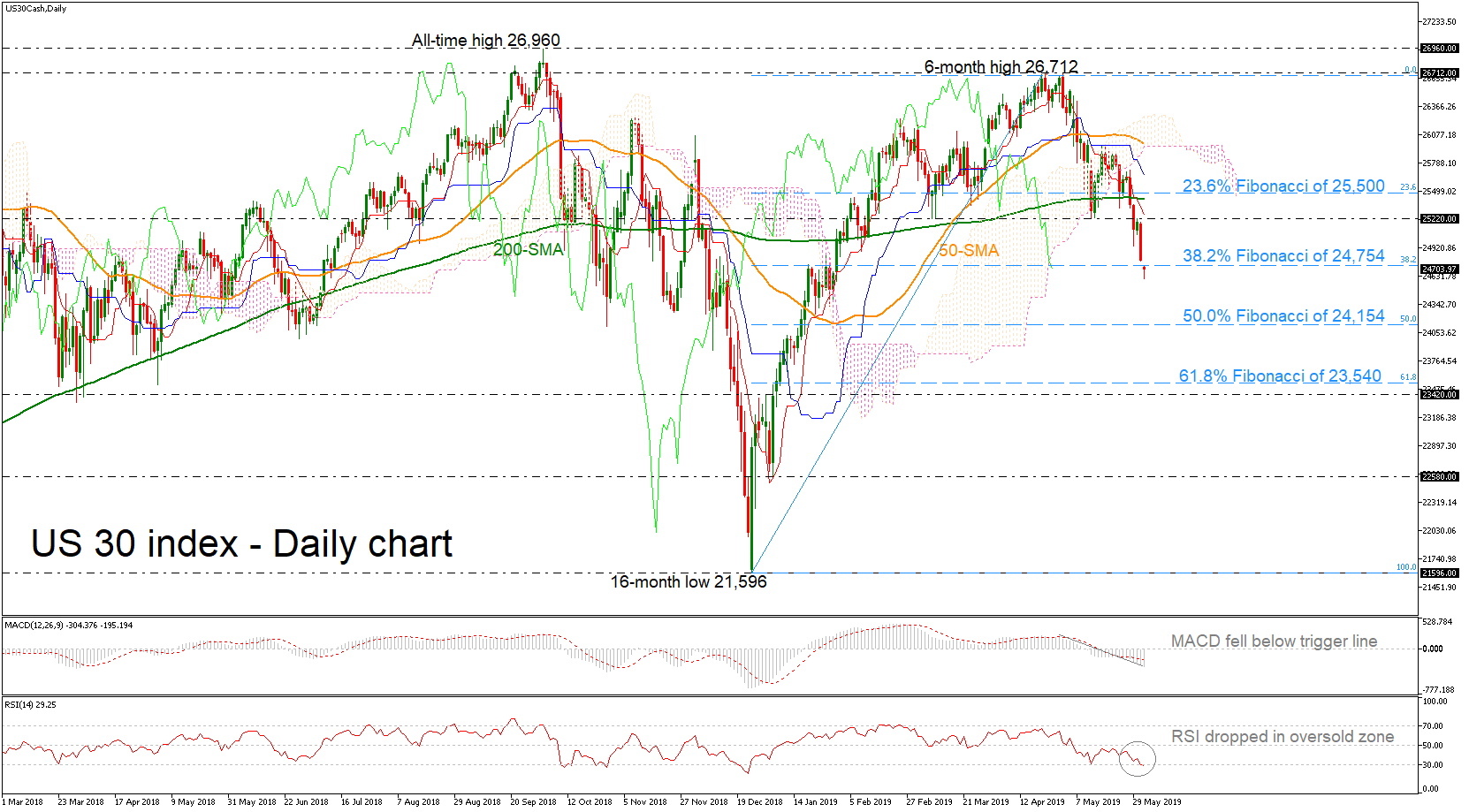
The US 30 index futures opened with negative gap today below the 38.2% Fibonacci retracement level of the upward movement from the 16-month low of 21,596 to the 6-month high of 26,712 near 24,754. The index is on the back foot, recording more than four-month low (24,606), and the technical indicators suggest that the market could ease a little bit more in the short-term; the MACD is falling in the negative zone, while the RSI looks to be losing momentum near oversold area.
In case of a correction lower, major support may be initially found near 24,154 which is where the 50.0% Fibonacci is currently located. Falling lower towards the 61.8% Fibonacci of 23,540, the medium-term picture would shift from bullish to neutral, while a drop under this significant region could endorse a bearish structure.
On the other hand, if the bulls take control and surpass 38.2% Fibonacci mark, resistance could come around 25,220 and the 200-simple moving average (SMA) near the 23.6% Fibonacci of 25,500.
Summarizing, in the near-term, the momentum indicators point to a possible bearish movement if the price fails to pare today’s gap.
Into US session: EUR/CHF breaks key support, but overbought Yen consolidates
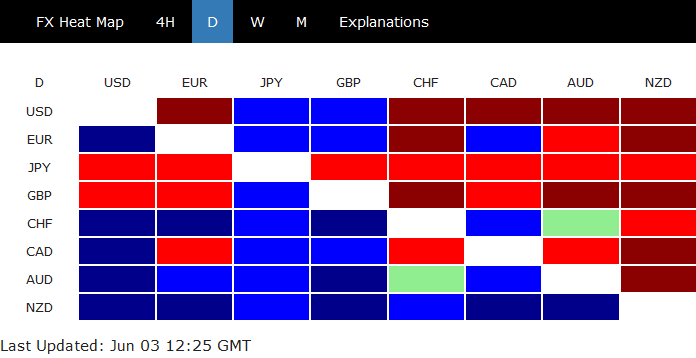
Sentiments hit their bottom during early European session but improved as the session goes. Most notably, German 10-year bund yield dropped to new record low of -0.217 but recovered much ground since then. That was enough to push EUR/CHF through key support at around 1.1150/60 to new two year low. But other than that, the forex markets are running its own course. The overbought Yen is not joining Franc's run as it's turning into consolidations. The Pound is weighed down by poor PMI manufacturing which dropped into contraction as impact of pre-Brexit stockpiling reversed. Meanwhile, New Zealand and Australian Dollar decouple from risk aversion. Both are having noticeable recovery, ahead of tomorrow's RBA rate cut.
After China's hard-line white paper on trade relationship with US, it's confirmed that there is little chance of any progress in trade negotiations for the near term. Not to mention, there is practically no chance for a deal between Trump and Xi at the G20 summit in Japan later this month. Trump's tweet on the topic is also calm. He noted that "China is subsidizing its product in order that it can continue to be sold in the USA. Many firms are leaving China for other countries, including the United States, in order to avoid paying the Tariffs. No visible increase in costs or inflation, but U.S. is taking Billions!" There's no point to debate how true Trump's claims are, much like China's denial of its own faults. The point is, Trump is also preparing his supports to stand by his trade war with China.
The bigger issue for the near term will be tariffs on Mexico. Mexico's Foreign Minister Marcelo Ebrard expressed his confidence to reach an agreement with US to resolve the migration flow dispute. He said today that if Washington imposed tariffs on Mexican imports it could be counterproductive to stopping immigration flows across the southern U.S. border. Meetings will be carried out on the issue this week, starting today. And Mexico looks very willing to do something. However, Mick Mulvaney, the acting White House chief of staff, indicated that there is no concrete criteria to judge whether Mexico has done enough to avert tariffs. And Mulvaney further said "We intentionally left the declaration sort of ad hoc... So, there's no specific target, there's no specific percentage, but things have to get better... They have to get dramatically better and they have to get better quickly." That is, Trump can move the goalpost for Mexico in anyway he wants. Such uncertainty will keep markets pressured.
In Europe, currently:
- FTSE is down -0.13%.
- DAX is down -0.09%.
- CAC is down -0.02%.
- German 10-year yield is down -0.0052 at -0.205.
Earlier in Asia:
- Nikkei dropped -0.92%.
- Hong Kong HSI dropped -0.03%.
- China Shanghai SSE dropped -0.30%.
- Singapore Strait Times rose 0.18%.
- Japan 10-year JGB yield rose 0.0053 to -0.091.
DAX Has Dismal Week As U.S. Threatens Tariffs Against Mexico
The DAX has started the week with slight losses. Currently, the index is at 11,707, down 0.17% on the day. In economic news, German manufacturing PMI ticked lower to 44.3, down from 44.4. The eurozone indicator dropped from 47.9 to 47.7. Both scores matched the estimates. On Tuesday, the eurozone releases CPI Flash Estimate.
It was a rough week for equity markets, and the DAX plunged 2.37%, its worst week since mid-March. The month of May was absolutely dismal, with whopping losses of 5.0%. On Friday, President Trump shook up the markets with a threat to slap tariffs on all Mexican products, due to the illegal immigration crisis. Although Trump said that tariffs would be set at just 5%, investors were jarred by the news. The DAX, which is especially vulnerable to trade risks, fell by 1.47% on Friday, as German automakers posted sharp losses.
Weak global demand has taken a toll on German and eurozone manufacturing. In Germany, manufacturing PMIs have hovered below the 50-level for five months, while the eurozone indicator has been below 50 for four months. This points to persistent contraction in the manufacturing sector. The trade war between the U.S. and China has dampened demand for German cars, which has hurt the massive German car industry. Unless the U.S.-China trade war shows signs of being resolved, the weak manufacturing numbers are likely to continue.
Dollar Direction To Be Dictated By Week’s Events
Monday June 3: Five things the markets are talking about
Global stocks are under pressure along with bond yields in the first session of a new month, as investors continue to digest the impact of President Trump's threat to introduce fresh tariffs on imports from Mexico. The market has grown nervous about the prospects for global growth in recent sessions as concerns about trade tensions returned to the fore.
U.S Ten-year Treasury yields (+2.08%) have fallen to the lowest in almost two-years with more downside expected to come, while crude oil has extended its rout from May, a month in which saw West Texas Intermediate (WTI) tumbled -16% amid concern over global demand. In FX, the yen (¥108.26) has managed to hold onto most of its late gains from last week.
President Trump's tariff moves against Mexico late Thursday has produced a wave of forecast revisions by the street. Fixed income dealers are now pricing in a -50 to- 75 bps cut in rates by the U.S Fed in H2, as rising trade tensions drag on global growth.
Expect investors to look to today's data on U.S manufacturing and this week's non-farm payroll (NFP) report on Friday for clues on how trade concerns are affecting the domestic economy. On Tuesday, Europe's statistics agency will provide fresh estimates on employment and inflation in the region.
On the central bank front, the Reserve Bank of Australia's (RBA) call on Tuesday (12:30 am ET) is too close to call with a rate cut a possibility. On Thursday the Reserve Bank of India (RBI) may well cut rates, while the European Central Bank (ECB), no action is expected (07:45 am ET). Yet the ECB's reaction to Brexit risk and the Sino-U.S trade war may yet put a greater “dovish” tilt to their statement.
In Germany, markets have drifted lower after the chairwoman of Chancellor Angela Merkel's junior coalition partner stepped down, adding to uncertainty over the government in Berlin.
On tap: USD ISM Manufacturing PMI & AUD retail sales (Jun 3), RBA monetary policy statement & AUD GDP (Jun 4), ECB monetary policy statement & press conference, CAD trade balance & CNY Bank Holiday (Jun 6), CAD & U.S employment data (Jun 7).
1. Stocks suffer due to tariff fears
In Japan, stocks plummeted overnight as investors worried about the rising risks to global and domestic growth from a widening tariff war between the U.S and its major trading partners. The Nikkei share average ended -0.9% lower, the weakest closing level since early February. The broader Topix also dropped -0.9%.
Note: The index-heavy SoftBank Group Corp tumbled -6.2% after the Wall Street reported that the company's bid to raise a second mega fund has met with “cool reception from some of the world's biggest money managers.”
Down-under, Aussie stocks slump on U.S trade tensions with China and Mexico. The S&P/ASX 200 index closed -1.2% lower overnight, reflecting the markets worries that Trump's aggressive trade diplomacy towards China and Mexico could tip the U.S and other major economies into recession. In S. Korea, the Kospi index rallied +1.4% as the KRW's bounce-back eased concerns about possible capital flight, and as investors hunted for bargains on perception that blue chips have been oversold.
In China and Hong Kong, stocks have started a new month on a ‘bearish' note on concerns that escalating trade tensions could increase risks of a global slowdown. The CSI300 index dipped -0.2%, while the Shanghai Composite Index lost -0.3%. In Hong Kong, the Hang Seng index dropped -0.1%, while the Hong Kong China Enterprises Index gained +0.1%.
In Europe, regional bourses trade lower amid trade tensions again weighing after various weekend comments from both China and U.S. In the U.K, the FTSE is underperforming following a weaker than expected PMI release (see below).
U.S stocks are set to open in the ‘red' (-0.53%).
Indices: Stoxx600 -0.59% at 366.90, FTSE -0.76% at 7,107.04, DAX -0.51% at 11,666.80, CAC-40 -0.64% at 5,174.51, IBEX-35 -0.62% at 8,948.00, FTSE MIB -0.55% at 19,692.50, SMI -0.44% at 9,481.80, S&P 500 Futures -0.53%
2. Oil prices plunge further on trade war fears
Oil prices plunged again, extending last week's heavy losses as deepening U.S trade wars fanned fears of a global economic slowdown.
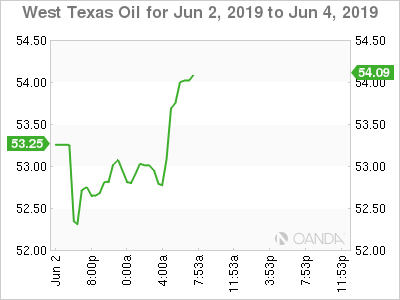
Front-month Brent crude futures are at +$60.96, down -$1.03 or -1.7% below Friday's close. U.S West Texas Intermediate (WTI) crude futures are at +$52.98 per barrel, down -52c, or -1%.
Note: Prices had dropped by more than -3% on Friday, with May recording the biggest monthly loss in six-months.
OPEC+ continues to give assurances that they would continue to manage global crude supplies to avoid a surplus.
Global markets have reeled in recent weeks over concerns that the global economy could stall amid rising trade tensions between the U.S and China. Fears over trade have been further stoked now that President Trump has announced punitive tariffs against Mexico – a key oil supplier to the U.S.
Note: Brent crude oil prices have dropped almost -20% from their 2018 peak as global supplies tightened due to output curbs by OPEC+, as well as a drop in Iranian exports due to U.S sanctions and Venezuelan production.
Data overnight showed that Saudi Arabia pumped +9.65M bpd, cutting deeper than its production target under a global pact to reduce oil supply – the Saudi's output target under the OPEC+ led pact is +10.3M bpd.
Ahead of the U.S market, gold prices trade atop of their six-month high print as fears of a global economic slowdown support the safe-haven demand for bullion, with a weaker dollar adding further support. Spot gold is up +0.3% at +$1,288.49 an ounce, having touched its highest since June 15 at +$1,292.32 late last week. U.S gold futures are up +0.5% at+$1,290.40.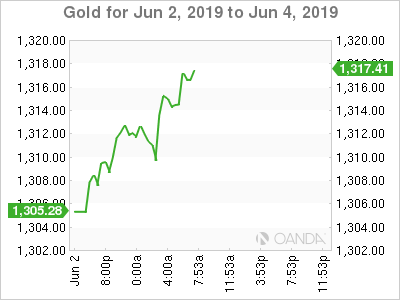
3. Reserve Bank of Australia (RBA) is set for its first cut since 2016
Down-under, in the last month, Australia has witnessed a surprise federal election result, a further uptick in the unemployment rate (along with an uptick in participation and under-employment) and a speech from Governor Lowe, which has many pricing in the first rate cut since August 2016. However, with a slam-dunk rate cut priced in, expect investor focus to fixate on the banks forward guidance.
Potential outcomes:
Base case: A -25 bps cut with a nod to at least one further cut (possibly in Lowe's evening speech).
Dovish case: Any suggestions that easing above and beyond the previous assumed -50 bps of cuts needs to be implemented to support the labour market and/or GDP growth.
Hawkish Case: A “wait and see” approach on the back of the assumed cut to see how the outlined macro measures feed through into housing and consumer spending.
Elsewhere, the yield on 10-year Treasuries has eased -4 bps to +2.086%, hitting the lowest in about two-years, while the yield on two-year Treasuries has dipped -6 bps to +1.86%. In Germany, the 10-year Bund yield has fallen -1 bps to -0.21%, the lowest on record, while in Japan, the 10-year JGB yield has gained less than +1 bps to -0.093%.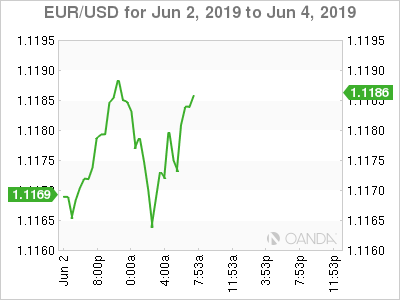 4. Dollar direction to be dictated by week events
Last week saw the USD index come under pressure as the Trade war remained the focal point. This week's events do not change anything – President Trump is visiting the U.K and other events ranging from non-farm payroll (NFP), ISM releases and Fed Chair Powell speaking Tuesday are expected to influence direction. Also making it a tad more difficult for FX traders is the yield in the U.S 10 years reaching two-year lows and encroaching on the +2.05% handle.
EUR/USD (€1.1176) trades within striking distance of the psychological €1.12 now that €1.11 handle held twice in the past fortnight. With BTP's and Bund futures trade higher today as the markets continue their “risk-off” theme started a few weeks back. The ‘single' unit is expected to remain quiet this week, at least until we will see the ECB rate decision on Thursday (07:45 am ET) with focus on the staff projections and any details on TLTRO-3.
GBP/USD (£1.2640) trades above the £1.26 handle after briefly trading below last week. The U.K is hosting Trump for a three-day state visit and he is expected to meet with Boris Johnson, a favorite for the PM position. The pound was unmoved from this morning's disappointing U.K PMI manufacturing data, which went into contraction for the first-time since the Jun 2016 Brexit Referendum. The Bank of England's (BoE) Governor Carney is scheduled to speak Thursday, which could see some market moving comments.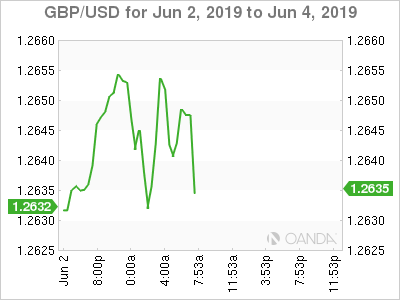
5. UK Manufacturing PMI signals contraction
Data this morning showed that the U.K manufacturing sector showed increased signs of renewed contraction last month.
At 49.4, down sharply from 53.1 in April, the headline seasonally adjusted IHS Markit PMI fell below the neutral 50.0 benchmark for the first time in three-years.
Digging deeper, manufacturers reported increased difficulties in convincing clients to commit to new contracts which mainly reflected the already high level of inventories following recent stockpiling activity in advance of the original Brexit date.
The total volume of new business placed fell for the first time in seven-months, while the rate of contraction was the greatest and fastest in a number of years. New order inflows deteriorated from both domestic and overseas sources, while new export business fell for the second month running and at the quickest pace in nearly five years – manufacturers reported a lower demand from Asia and Europe.
There was also mention of Brexit uncertainty, including clients diverting supply chains away from the U.K, leading to lower demand from within the E.U.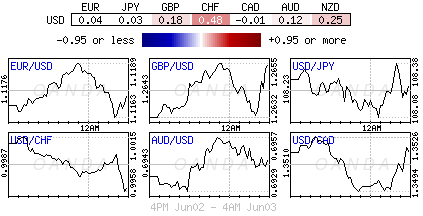
EUR/USD – Euro Steady As German, Eurozone Manufacturing PMIs Match Forecasts
EUR/USD has started the week with slight gains. Currently, the pair is trading at 1.1185, up 0.15% on the day. On the release front, German manufacturing PMI ticked lower to 44.3, down from 44.4. The Eurozone indicator dropped from 47.9 to 47.7. Both scores matched the estimates. In the U.S., ISM Manufacturing PMI is expected to rise to 53.0, up from 52.8 in the previous release. On Tuesday, the eurozone releases CPI Flash Estimate.
Weak global demand has taken a toll on German and eurozone manufacturing. In Germany, manufacturing PMIs have hovered below the 50-level for five months, while the eurozone indicator has been below 50 for four months. This points to persistent contraction in the manufacturing sector. The trade war between the U.S. and China has dampened demand for German cars, which has hurt the massive German car industry. Unless the U.S.-China trade war shows signs of being resolved, the weak manufacturing sectors is likely to continue.
The U.S. economy continues to perform well, with first-quarter growth above the 3% level. Second estimate GDP posted a gain of 3.1%, matching the estimate. This was just shy of the initial estimate in April, which came in at 3.1%. The U.S. economy is firing on all cylinders, despite the nasty trade war with China, which has escalated in recent weeks. U.S. officials, including President Trump, had announced that substantial progress had been made, and it seemed that a trade deal was just around the corner. However, Trump shocked the markets by slapping further tariffs on China, which led to counter-tariffs against U.S. products. China has reacted angrily to U.S. trade sanctions on Huawei, a giant Chinese telecom company. The euro has managed to weather the latest crisis in the U.S.-China trade war, but if there is no improvement, investors could opt for the safety of the greenback, at the expense of the euro.
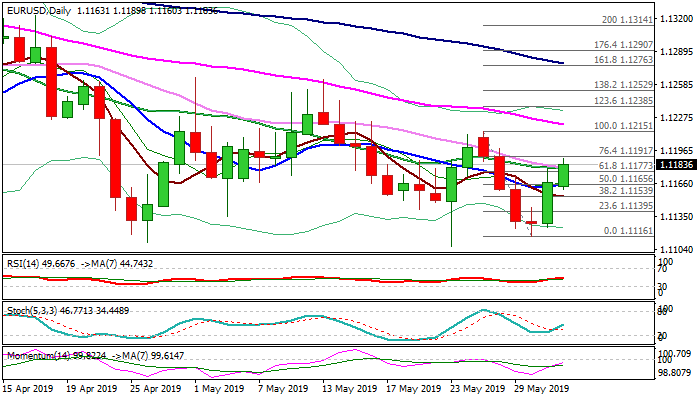
EUR/USD Outlook: Completion Of Reversal Pattern Opens Way For Test Of Key Barriers At 1.1215/20
The Euro extends recovery on Monday, as strong Friday's rebound (which resulted in close above 10SMA) completed Doji reversal pattern on daily chart. Fresh extension higher broke above significant barriers at 1.1177 (Fibo 61.8% of 1.1215/1.1116 bear-leg) and 1.1180 (converged 20/30SMA's) but requires daily close above to confirm signal and open way for test of key barriers at 1.1215/19/21 (27 May high/daily cloud base/falling 55SMA). Weaker dollar supports recovery, along with rising momentum, however fresh near-term bulls are expected to face very strong headwinds from 1.1220 resistance zone and only break here would sideline broader bears and allow for stronger recovery.
Res: 1.1189, 1.1215, 1.1121, 1.1252
Sup: 1.1177, 1.1160, 1.1153, 1.1125
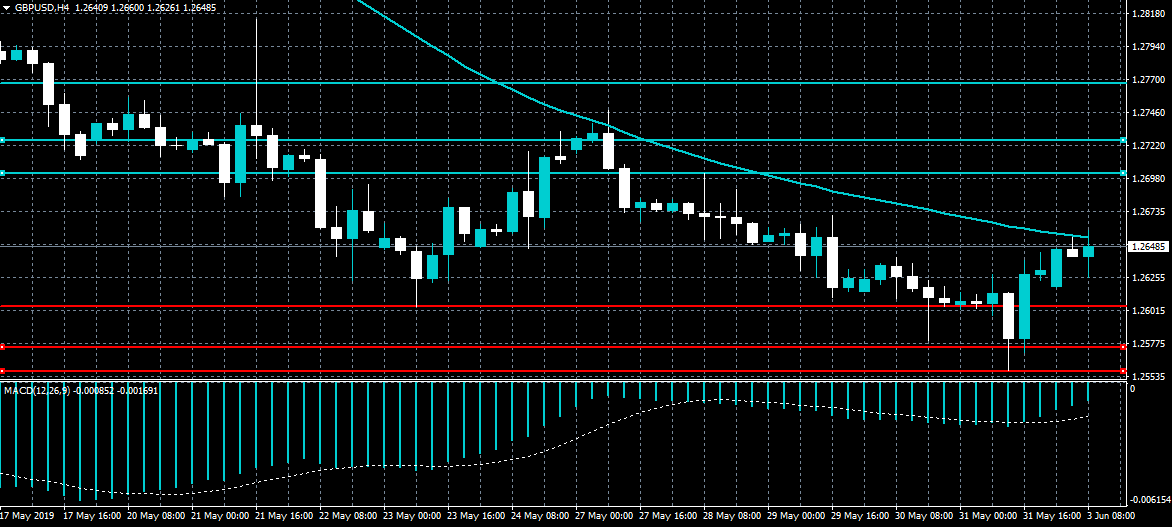
GBPUSD 1.2747 Key Weekly Resistance
The British pound has started to recover higher against the US dollar, despite much weaker than expected PMI Manufacturing data from the United Kingdom economy earlier today. Buyers will need to rally the GBPUSD pair above the 1.2747 level this week to negate the heavy bearish sentiment. The bearish head and shoulders pattern on the four-hour time frame has yet to reach its full downside projection.
The GBPUSD pair is bearish while trading below the 1.2655 level, key support is located at the 1.2550 and 1.2500 levels.
If the GBPUSD pair holds above the 1.2655 level, key intraday resistance is found at the 1.2700 and 1.2747 levels.
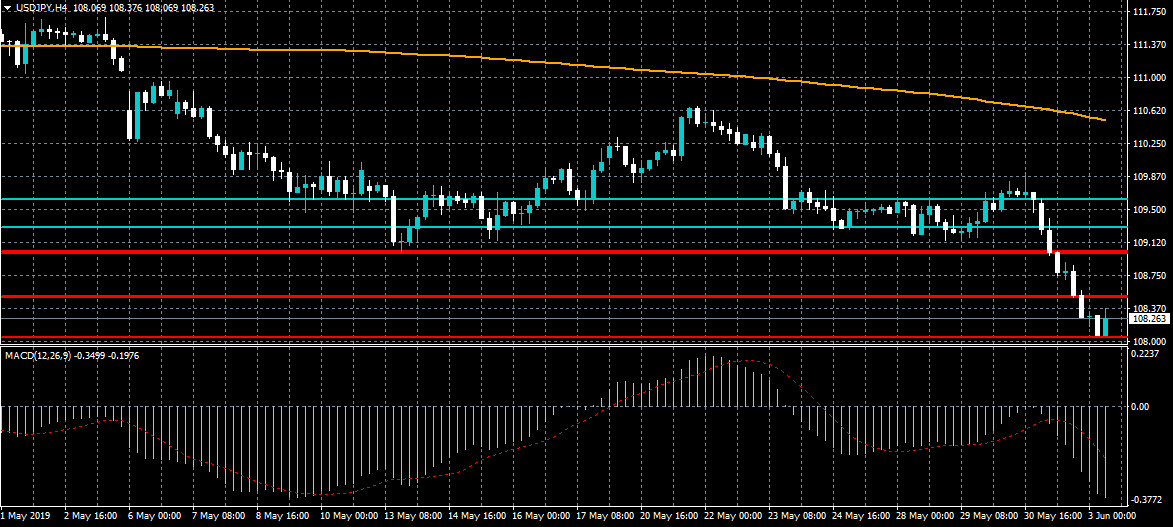
USDJPY Risks Still To The Downside
The US dollar has staged a minor technical recovery against the Japanese yen during the European session as traders book profits ahead of the release of high-impacting US data. The balance of risks are still firming tilted to the downside while price trades below the 109.00 level. Overall, the USDJPY pair is increasingly likely to target towards the 107.40 support level this week.
The USDJPY pair is heavily bearish while trading below the 109.00 level, key support is found at the 108.00 and 107.70 levels.
If the USDJPY pair trades above the 108.70 level, key technical resistance is found at the 109.00 and 109.30 levels.
Safe-Haven Flows Continue To Dominate On Trade Concerns, UK PMI Manufacturing Falls Back Into Contraction For 1st Since Brexit...
Notes/Observations
- Trade concerns continue to reverberate; safe haven flows dominate
- European Manufacturing PMI data mixed (Beats: Italy; Misses: Spain; Unrevised: France, Germany, Euro Zone )
- Italy PM Conte said to have issued ultimatum to ruling coalition to speed up govt action of face his resignation
Asia:
- Previously announced tariffs by the US and China took effect on June 1st (as expected). China raised tariffs 5-25% on $60B of US goods Saturday, preparing a blacklist of "unreliable" foreign companies. Conversely, US customs agents formally began collecting the higher 25% tariffs on $200B list of Chinese goods arriving at US seaports
- China Trade War White Paper issed which reiterated it stance that China would not concede on issues of principle and that the govt had enough fiscal and monetary policy tools: China's economic prospects were extremely optimistic and could ensure good momentum for a sustained economic development
- China Vice Commerce Minister stated that the purpose of the trade war White Paper was to lay out the backtracking by the US and make clear China's position. He did not have info to hand on whether Pres Xi/Trump will meet at G20
- China May Caixin PMI Mamufacturing: 50.2 v 50.0e
- Japan May Final PMI Manufacturing: 49.8 v 49.6 prelim (confirm move back into contraction territory)
Europe/Mideast:
- German SPD leader Nahles resigns - Greece provisional local election results show conservative opposition New Democracy party swept 12 of 13 regions ahead of snap election on July 7
- Italy Fin Min Tria confirmed formal reply letter had been sent to EU about debt. Reiterated stance that budget tightening would be counterproductive now. Reiterated 2019 budget deficit/GDP ratio would be below the govt's 2.4% forecast. Also reiterated that Italy was not seeking a clash with the EU over budget rules and confident it could avert disciplinary steps
Americas:
- President Trump: Mexico is sending a big delegation to talk about the Border. Problem is, they've been "talking" for 25 years. We want action, not talk. Mexico delegation to visit White House Wednesday, June 5th
- Mexico President Lopez Obrador (AMLO): encouraged by US willingness to have dialogue over trade issues; expect good results from meeting on Wed (June 5)
SPEAKERS/FIXED INCOME/FX/COMMODITIES/ERRATUM
Equities
- Indices [Stoxx600 -0.59% at 366.90, FTSE -0.76% at 7,107.04, DAX -0.51% at 11,666.80, CAC-40 -0.64% at 5,174.51, IBEX-35 -0.62% at 8,948.00, FTSE MIB -0.55% at 19,692.50, SMI -0.44% at 9,481.80, S&P 500 Futures -0.53%]
- Market Focal Points/Key Themes: Equities European Indices trade down across the board amid trade tensions again weigh after weekend comments of various officials in both China and U.S. U.K. FTSE underperforms other indices following weaker than expected PMI release and first contraction in almost 3 years. U.S. futures trade also trade in negative territory with Nasdaq futures declining 0.7%. On the corporate front, tech giant Infineon trades 6% lower after confirming acquistion of U.S.-traded Cypress Semiconductor. Novartis and Roche Holding both trading little lower after presenting study data. Wirecard in Germany trades 1% lower amid CEO tweet that company expects 'outstanding' H1 2019. On the earnings front, shares of Kier in London trade 42% lower after issuing profit warning as well as trading update. In other news, shares of Deutsche Bank again renew all-time lows following press story on merger talks with Swiss bank UBS. Scapa Group stock fell almost 50% following material contract termination. Looking ahead, no notable earners expected during U.S. morning session.
- Consumer discretionary: William Hill [WMH.UK] -2% (reports it was in merger talks)
- Materials: Lonza Group [LONN.CH] +0.5% (unit job cuts)
- Financials: Deutsche Bank [DBK.DE] -3% (reports on merger talks)
- Healthcare: Novartis [NOVN.CH] -0.5% (data), Roche Holding [ROG.CH] -1% (data), Targovax [TRVX.NO] +12% (study update)
- Industrials: Kier [KIE.UK] -42% (trading update; profit warning), Deutz [DEZ.DE] -1.5% (JV), Scapa Group [SCPA.UK] -47% (contract termination)
- Technology: Infineon [IFX.DE] -6% (acquisition), Wirecard [WDI.DE] -1% (CEO tweet)
- Telecom: Kcom Group [KCOM.UK] +12.5% (recommends offer)
Speakers
- Finland incoming PM Rinne: Govt planning over €4.0B in new spending. Targets balanced public finances by 2023
- China Global Times Editor-in-chief Hu Xijin tweeted that China to issue a warning on the risk of studying in the US due to recent series of discriminatory measures the US took against Chinese students. Could also be seen as a response to the US-initiated trade war.
- Saudi Energy Min Al-Falih: Effectiveness of OPEC efforts had been well proven over the course of 30 months; looked to continue towards market stability in H2
- Saudi Arabia May oil production said to be at 9.65M bpd v 9.74M bpd prior
Currencies/Fixed Income
- Last week saw the USD index futures sell off as the Trade war remained the focal point. We continue the week with Trump visiting the UK and quite a few market moving events ranging from Non-Farm Payrolls and ISM figures to Powell speaking Tuesday just after the US open. Also on the fixed income front we see yields in the US 10 year reaching 2 year lows as futures trade above the 1.27 handle.
- EUR/USD The Euro trades around the 1.12 handle as the 1.11 handle held twice in the past few weeks. We also saw both the BTP and Bund futures trade higher today as the markets continue their risk of theme started a few weeks back. The Euro should be fairly quiet as this week we will see the ECB rate decision on Thursday with focus on the staff projections and any details on TLTRO-3.
- GBP/USD The Cable trades above the 1.26 handle after briefly trading below last week.
- The UK are hosting Trump during the D-Day 75th memorial and he is expected to meet with Boris Johnson a favorite for the PM position to be voted on sometime this month. We also saw UK PMI manufacturing go into contraction for the 1st time since the Jun 2016 Brexit Referendum with a very muted move. We also see BOE Gov Carney to speak Thursday, which could see some market moving comments.
Economic Data
- (IN) India May PMI Manufacturing: 52.7 v 51.8 prior
- (RU) Russia May PMI Manufacturing: 49.8 v 51.5e
- (SE) Sweden May PMI Manufacturing: 53.1 v 50.4e
- (CH) Switzerland May CPI M/M: 0.3% v 0.3%e; Y/Y: 0.6% v 0.6%e; CPI Core Y/Y: 0.6% v 0.5% prior
- (CH) Switzerland May CPI EU Harmonized M/M: -0.2% v +0.6% prior; Y/Y: 0.5% v 1.1% prior
- (AU) Australia May Commodity Index: 125.9 v 122.8 prior
- (NL) Netherlands May Manufacturing PMI: 52.2 v 52.0 prior (69th month of expansion)
- (NO) Norway May PMI Manufacturing: 54.4 v 54.0e (11th month of expansion)
- (HU) Hungary May Manufacturing PMI: 57.9 v 54.0e (42nd month of expansion)
- (PL) Poland May Manufacturing PMI: 48.8 v 49.0e (7th straight contraction)
- (TR) Turkey May Manufacturing PMI: 45.3 v 46.8 prior (14th straight contraction and lowest since Dec)
- (TR) Turkey May CPI M/M: 1.0% v 1.3%e; Y/Y: 18.7% v 19.3%e; Core Index Y/Y: 15.9% v 16.4%e
- (TR) Turkey Apr M/M: 2.7% v 3.0% prior; Y/Y: 28.7% v 30.1% prior
- (HU) Hungary Apr PPI M/M: 1.0% v 0.0% prior; Y/Y: 4.1% v 2.7% prior
- (ES) Spain May Manufacturing PMI: 50.1 v 51.3e (3rd straight expansion)
- (CH) Swiss May PMI Manufacturing: 48.6 v 48.8e (2nd straight contraction)
- (CZ) Czech Republic May Manufacturing PMI: 46.6 v 46.5e (6th straight contraction)
- (SE) Sweden Apr Retail Sales M/M: 1.9% v 0.6%e; Y/Y: 3.9% v 1.5%e
- (IT) Italy May Manufacturing PMI: 49.7 v 48.5e (8th straight contraction)
- (FR) France May Final Manufacturing PMI: 50.6 v 50.6e (confirms 2nd month of expansion)
- (DE) Germany May Final Manufacturing PMI: 44.3 v 44.3 e (confirms 5th straight contraction)
- (EU) Euro Zone May final Manufacturing PMI: 47.7 v 47.7e (confirms 4th straight contraction)
- (GR) Greece May Manufacturing PMI: 54.2 v 56.6 prior
- (CH) Swiss Weekly Total Sight Deposits (CHF): 578.2B v 578.6B prior; Domestic Sight Deposits: 474.3B v 485.0B prior
- (UK) UK May PMI Manufacturing: 49.4 v 52.2e (1st contraction in 34 months)
- (DK) Denmark May PMI Survey: 47.6 v 58.8 prior
- (ZA) South Africa May Manufacturing PMI: 45.4 v 47.2 prior (5th straight contraction)
- (IS) Iceland Q1 Current Account Balance (ISK): 35B v 0.1B prior
Fixed Income Issuance
- None seen
Looking Ahead
- (NG) Nigeria May Manufacturing PMI
- (RU) Russia May Sovereign Wealth Funds: Wellbeing Fund: No est v $59.0B prior
- (ZA) South Africa May Naamsa Vehicle Sales Y/Y: 1.2% (revised from 0.7%)
- (IT) Italy May Budget Balance: No est v -€2.9B prior
- (RO) Romania May International Reserves: No est v $37.5B prior
- (IL) Israel Central bank May Meeting
- (AR) Argentina May Government Tax Revenue (ARS): No est v 357.4B prior
- (BR) Brazil AprCNI Capacity Utilization: No est v 76.5% prior
- (US) Monthly US auto sales data
- 05:30 (NL) Netherlands Debt Agency (DSTA) to sell €1.0-2.0B in 6-month bills
- 05:30 (ZA) South Africa announces details of upcoming I/L bond sale (held on Fridays)
- 06:45 (US) Daily Libor Fixing
- 07:00 (IN) India announces details of upcoming bond sale (held on Fridays)
- 07:25 (BR) Brazil Central Bank Weekly Economists Survey
- 08:00 (CZ) Czech May Budget Balance (CZK): No est v -29.7B prior
- 08:00 (UK) Daily Baltic Dry Bulk Index
- 08:00 (ES) Spain Debt Agengy (Tesoro) size announcement for Thursday's bond issuance
- 08:30 (CA) Canada Apr MLI Leading Indicator M/M: No est v 0.2% prior
- 09:00 (FR) France Debt Agency (AFT) to sell combined €3.7-4.9B in 3-month, 6-month and 12-month Bills
- 09:00 (BR) Brazil May PMI Manufacturing: No est v 51.5 prior
- 09:00 (SG) Singapore May Purchasing Managers Index (PMI): 50.1e v 50.3 prior; Electronics Sector Index: No est v 49.5 prior
- 09:00 (CL) Chile Apr Retail Sales Y/Y: -0.6%e v +0.7% prior; Commercial Activity Y/Y: No est v 2.6% prior
- 09:10 (US) Fed's Quarles (hawk, voter)
- 09:30 (CA) Canada May Manufacturing PMI: No est v 49.7 prior
- 09:45 (US) May Final Markit Manufacturing PMI: 50.6e v 50.6 prelim
- 10:00 (US) May ISM Manufacturing: 53.0e v 52.8 prior; Prices Paid: 51.0e v 50.0 prior
- 10:00 (US) Apr Construction Spending M/M: +0.4%e v -0.9% prior
- 10:00 (MX) Mexico Apr Total Remittances: $2.8Be v $2.9B prior
- 10:00 (MX) Mexico Central Bank Economist Survey
- 10:30 (MX) Mexico May PMI Manufacturing: No est v 50.1 prior
- 11:30 (US) Treasury to sell 3-Month and 6-Month Bills
- 12:00 (IT) Italy May New Car Registrations Y/Y: No est v 1.5% prior
- 12:15 (IT) Italy PM Conte to hold press conference
- 12:40 (US) Fed's Barkin (hawk, non-voter) at Charlotte Economics Club
- 13:00 (MX) Mexico May IMEF Manufacturing Index: 51.5e v 52.0 prior; Non-Manufacturing Index: 51.5e v 52.4 prior
- 13:25 (US) Fed's Bullard (dove, voter) in Chicago
- 14:00 (BR) Brazil May Trade Balance: $6.5Be v $6.1B prior