

Sample Category Title
Market Morning Briefing: Aussie Is Rising Towards 0.70
STOCKS
Major equities like the Dow, Dax and Nikkei remain weak.Shanghai continues to consolidate sideways. Sensex and Nifty can continue to outperfrome as they have gained momentum and remains bullish.
Dow (24819.78, +4.74, +0.02%) remains bearish to test 24500 and 24000. Strong resistance between 25100 and 25250 which can cap the upside of any intermediate bounce.
The support at 11620 (200-day moving average) has held well and DAX (11792.81, +65.97, +0.56%) has bounced as expected. Resistance at 11850 can be tested and is likely to cap the upside. A sideways consolidation between 11600 and 11850 can be seen for sometime before the overall downtrend resumes.
Nikkei (20296.35, -114.53, -0.56%) has dipped further and keeps our bearish view intact for a test of 20000 and 19500.
Shanghai (2868.04, -22.04, -0.76%) has dipped and is heading towards the lower end of its 2835-2950 sideways range as expected. A breakout on either side of 2835-2950 is needed to get a clear picture on the next trend.
Sensex (40267.62, +553.42, +1.39%) is bullish to test 40700. A break above the immediate resistance at 40400 can accelerate the rally to 40700.
Nifty (12088.55, +165.75, +1.39%) can test 12150-12200.
COMMODITIES
Gold has surged on increasing prospects of a rate cut from the Fed coupled with the high risk aversion in the market on the back of global slow-down fears. Copper remains bearish. The fall in oil may pay pause in the near-term and a consolidation/corrective rally looks likely before a fresh leg of downmove begins.
As expected, Gold (1325) has risen towards 1325 and remains positive to test 1345-1350 in the near term. The level of 1360 is a crucial resistance to watch.
Silver (14.76) is heading towards the key resistance level of 14.80 as expected. A break above 14.8 will see the corrective rally extending to 15 after which the downtrend can resume.
Copper (2.64) fell to 2.61 and has bounced from there. The outlook remains to test 2.60. Resistance is in the 2.66-2.67 region.
Brent (61.34) remains bearish to test 55. But an intermediate corrective rally/consolidation is possible after testing 59.74 (the 61.8% Fibonacci retracement support) before targeting 55.
WTI (53.25) has support at 51.72 (61.8% Fibonacci retracement support) which may pause the fall. A corrective rally to 54-55 is possible from there before WTI heads towards our preferred target level of 45.
FOREX
Probability that the FED would cut rate in July rose to 70% from earlier 47% on Friday. Dollar Index (97.18) has been falling sharply over the last 2-sessions and could fall to 96.75 in the near term. Failure to test 98.50 or higher increases chances of falling towards 96.50 in the medium term now. Overall trend is bearish for the week.
Euro (1.1249) shot up beyond our mentioned resistance near 1.1220. While the rising momentum remains strong, we could see a rise towards 1.1290 or even 1.1325 on the upside. Near term looks bullish ahead of the ECB meeting on 6th June where it is expected to keep the current policy unchanged. Markets expect a “wait-and-see” approach from Draghi as they prepare to launch another round of Targeted Long-Term Refinance Operations (TLTRO). The Governing Council also may take its own time to alter the forward-guidance for the monetary policy. While the medium term outlook for Euro remains bearish, we may allow for a rise towards 1.1290-1.1325 on the upside just now.
Euro-Yen (121.51) has risen from levels above 120.50 and while the bounce sustains, we could see a rise towards 122 in the near term.
Dollar-Yen (107.98) could get some support near 107.50-107.00 region in the near term from where a bounce back could be expected. View is bearish for the near term while below 109.
Aussie (0.6972) is rising towards 0.70, which is an interim resistance. If 0.70 holds, Aussie could fall from there back towards 0.69. Else, a rise past 0.70 would take it to the upper resistance near 0.71. Overall near to medium term trend look sideways to bullish.
Pound (1.2667) could be expected to rise towards 1.2700-1.2750 while it trades above 1.2650 in the near term. A corrective bounce could be in place just now within an overall downtrend.
USDCNY (6.9049) is almost stable. It could possibly remain sideways within 6.92-6.88 region for a few sessions.
USDINR (69.2650) is likely to see a gap down opening today also testing support at 69 on sharp rise in Euro. While Euro continues to rise towards our expected 1.1290, Rupee could see strength. Also rising Nifty (refer equities section above) and lower Crude prices are in favor of Rupee strength for the remaining sessions of the week. A fall below 69, if seen could accelerate the fall in the near term turning bearish for the next 1-2 weeks.
INTEREST RATES
The US ISM manufacturing index fell to 52.1 for May’19, lower than the market expectation of 53. Slight upmove seen in the yields. The 2YR (1.87%) is up 1bps while the 5Yr (1.87%) and 10YR (2.10%) are up by 2bops. According to the CME Group data, the markets now see 80% chances of two rate cuts in 2019 and 96% chances of seeing one rate cut in the year. There is room on the downside for the US yields to fall in the medium term.
The US-Japan 10YR (2.20%) has fallen by 2bps and could pause above 2.1% from where a bounce is expected.
The sharp rise in the German-US 10Yr (-2.30%) and in the German-US 2Yr (-2.52%) has been indicating a rise in Euro but the broad negative correlation has turned positive now that the Euro has been pulled up sharply from levels above 1.11 in the last few sessions. The spreads look bullish in the near term.
The German yields are almost stable. Could see a bounce in the near term. The 10YR (-0.199%) could rise towards -0.15% in the near term.
Daily Markets Broadcast
Wall Street mixed on tech sector worries
Most US indices closed flat to higher yesterday, though the NAS100 index slumped on news of antitrust probes on the FAANG stocks. Fed’s Bullard said a rate cut may be warranted “soon” on inflation, trade war concerns. RBA is expected to cut its benchmark rate today.
NAS100USD Daily Chart
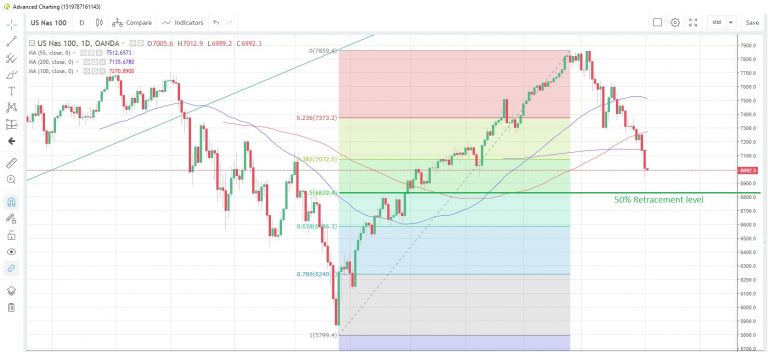
The NAS100 index fell the most in three weeks yesterday on news of an antitrust probe against the tech sector, including Facebook and Amazon, would be launched. The index touched a three-month low
The index is down 11.7% from the April peak and is heading toward the 50% retracement level of the December to April rally at 6,829
US factory orders are expected to fall 0.9% m/m in April, according to the latest survey of economists. That comes after a 1.9% gain in March.
DE30EUR Daily Chart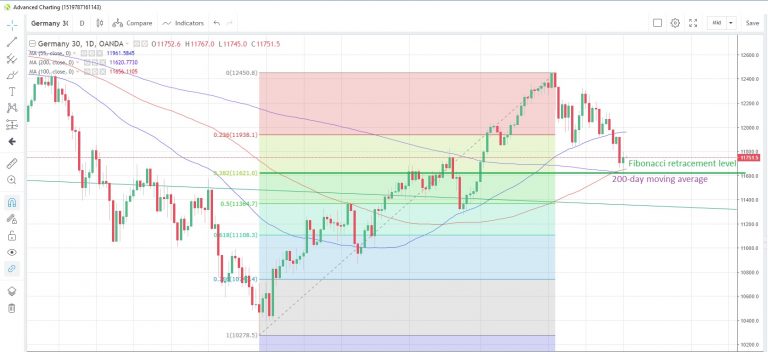
The Germany30 recouped early losses to finish in the black yesterday
The index rebounded off the 200-day moving average at 11,620, which has supported prices on a closing basis since April 1. The 38.2% Fibonacci retracement of the 2019 rally is at 11,621
Consumer prices in the Euro-zone are seen rising 1.3% y/y in May, a slower pace than the +1.7% recorded in April. The unemployment rate is seen steady at 7.7% in April.
AU200AUD Daily Chart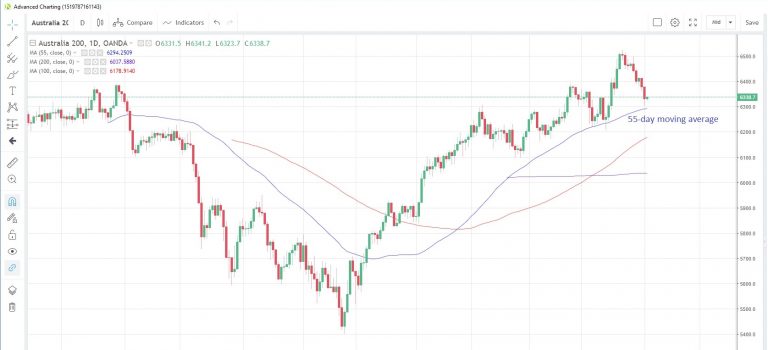
The AU200 index fell for a second straight day yesterday and is trading unchanged this morning ahead of the RBA rate meeting
The index is holding above the 55-day moving average at 6,294, as it has done on a closing basis since January 7
A 25 bps cut from the RBA is fully priced in to markets already. It will be more a question of forward guidance on the next move. Markets are currently pricing in almost two cuts by September while Westpac expects three, possibly four, by year-end.
GBP/USD In Major Downtrend Below 1.2750
Key Highlights
- The British Pound extended its decline below the 1.2600 support area against the US Dollar.
- GBP/USD remains in a strong downtrend unless it recovers above 1.2750.
- The UK Manufacturing PMI declined sharply from 53.1 to 49.4 in May 2019.
- The UK Construction PMI might remain stable at 50.5 in May 2019.
GBPUSD Technical Analysis
In the past few weeks, there was a steady decline in GBP/USD below 1.2800 and 1.2700. The British Pound even settled below 1.2700 to move into a major downtrend against the US Dollar.
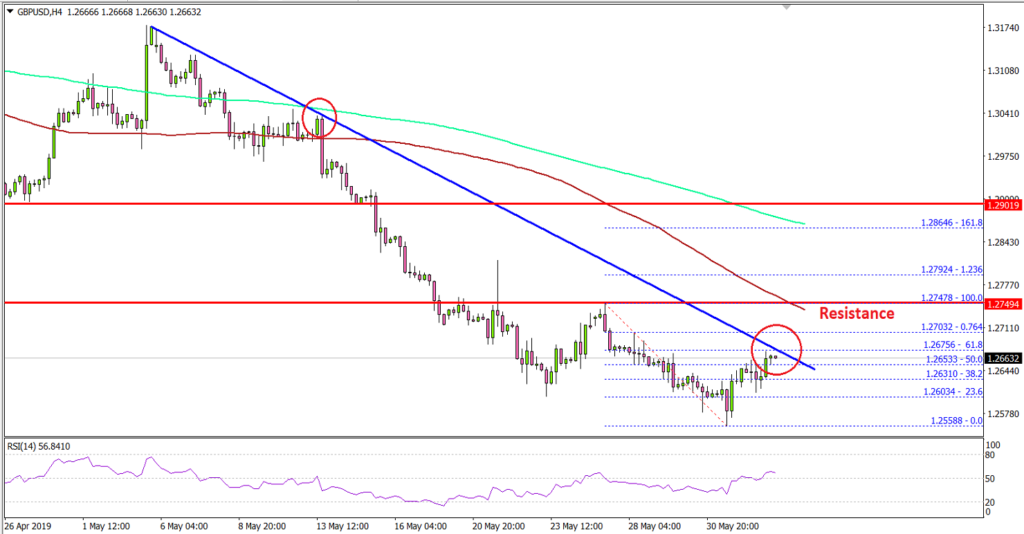
Looking at the 4-hours chart, the pair failed to stay above 1.3000 and started a significant decline below 1.2900, 1.2800 and even 1.2700. Finally, the pair broke the 1.2600 support and settled below the 100 simple moving average (red, 4-hours).
A new monthly low was formed at 1.2558 before the pair started a short term upside correction. It recovered above the 1.2620 level and tested the 50% Fib retracement level of the downward move from the 1.2747 high to 1.2558 swing low.
However, there are many hurdles for the bulls waiting near the 1.2675 and 1.2700 levels. There is also a bearish trend line formed on the same chart with current resistance near 1.2780.
The main resistance is near the 1.2750 level and the 100 simple moving average (red, 4-hours). A successful close above the 1.2750 resistance could start a decent recovery in the near term.
Conversely, if the pair fails to move above 1.2700 or 1.2750, it might continue to move down towards 1.2500 in the coming days.
Fundamentally, the UK Manufacturing Purchasing Managers Index (PMI) for May 2019 was released by both the Chartered Institute of Purchasing & Supply and the Markit Economics. The market was looking for a minor decline from 53.1 to 52.0.
However, the actual result was disappointing since there was a sharp decline to 49.4 (fell below the neutral 50.0 benchmark for the first time since July 2016).
The report stated that:
Manufacturers reported increased difficulties in convincing clients to commit to new contracts during May. This mainly reflected the already high level of inventories following recent stockpiling activity in advance of the original Brexit date.
Overall, GBP/USD remains in a strong downtrend and there is a risk of more losses below the 1.2550 and 1.2500 levels in the near term.
Economic Releases to Watch Today
- UK's Construction PMI for May 2019 – Forecast 50.5, versus 50.5 previous.
- Euro Zone CPI for May 2019 (YoY) (Prelim) – Forecast +1.3%, versus +1.7% previous.
- Euro Zone Core CPI for May 2019 (YoY) (Prelim) – Forecast +0.9%, versus +1.3% previous.
Eco Data 6/4/19
[php_everywhere instance="1"]
Aussie Improves to 3-Week High, Retail Sales Next
AUD/USD has moved higher in the Monday session. In North American trade, AUD/USD is trading at 0.6957, up 0.30% on the day. Earlier in the day, the pair touched 0.6966, its highest level since mid-May. On the release front, Australian Company Operating Profits climbed 1.7% in the first quarter, but fell short of the estimate of 2.9%. The MI inflation gauge slowed to 0.0%, down from 0.2% in the previous release. In the U.S., ISM Manufacturing PMI dropped to 52.1, short of the estimate of 53.0. On Tuesday, Australia releases GDP and the RBA is expected to cut rates to 1.25%. Traders should be prepared for some movement from AUD/USD on Tuesday.
The RBA has maintained rates at 1.50%, despite the weaker Australian economy, which has been hurt by the slowdown gripping the Chinese economy. Critics would argue that the bank has been in denial, as bank members have sounded dovish about the economy but haven’t lowered rates in order to stimulate growth. However, the RBA is expected to cut rates to 1.25% at the upcoming meeting. If the rate statement or comments from RBA Governor Lowe are dovish, the Aussie could lose ground.
The U.S. economy continues to perform well, with first-quarter growth above the 3% level. Second estimate GDP posted a gain of 3.1%, matching the estimate. This was just shy of the initial estimate in April, which came in at 3.1%. The U.S. economy is firing on all cylinders, despite the nasty trade war with China, which has escalated in recent weeks. U.S. officials, including President Trump, had announced that substantial progress had been made, and it seemed that a trade deal was just around the corner. However, Trump shocked the markets by slapping further tariffs on China, which led to counter-tariffs against U.S. products. China has reacted angrily to U.S. trade sanctions on Huawei, a giant Chinese telecom company. The euro has managed to weather the latest crisis in the U.S.-China trade war, but if there is no improvement, higher risk apprehension could make the Aussie less attractive to investors.
FTSE Bids Adieu to Miserable Month of May
The FTSE has posted gains on Monday. Currently, the FTSE index is trading at 7,187, up 0.35% on the day. In economic news, the focus is on manufacturing releases. British Manufacturing PMI slowed to 49.4, missing expectations. Later on, the U.K. releases BRC Retail Sales Monitor, with an estimate of 0.9%. In the U.S., ISM Manufacturing PMI dropped to 52.1, short of the estimate of 53.0. On Tuesday, the U.K. releases Construction PMI.
May was a turbulent month for equity markets, as trade tensions soared between the U.S. and China, dashing hopes that a trade agreement was imminent. The blue-chip FTSE had a dismal May, falling 3.79%, its worst monthly performance in 2019. Aside from the U.S.-China spat, there could be more headwinds on the trade front. On Friday, U.S. President Trump shook up the markets with a threat to slap tariffs on all Mexican products, due to the illegal immigration crisis. Although Trump said that tariffs would be set at just 5%, investors were jarred by the news. The FTSE declined over 1.0%, a reminder that risk apprehension remains high, and the possibility of further U.S. tariffs could cause further volatility in the equity markets.
The focus was on manufacturing data on Monday, and the results were disappointing on both sides of the pond. In the U.K., manufacturing PMI dipped below the 50-level, which separates expansion from contraction. The PMI dropped to 49.4, marking the first contraction since July 2016. Manufacturing news in the U.S. also disappointed, as ISM Manufacturing PMI slowed to 52.1, down from 53.0 a month earlier. Global demand has fallen off trade tensions, and unless this situation improves, manufacturing sectors across the globe will remain under strong pressure.
RBA to cut interest rates, a look at AUDJPY and AUDCAD
RBA rate decision will be the major focus in upcoming Asian session. Expectations of rate cut intensified after Governor Philip Lowe said on May 21, "at our meeting in two weeks' time, we will consider the case for lower interest rates." The core reason behind RBA's change in stance is that it now sees that unemployment rate could sustain below 5% without raising inflation concerns. Additionally, after April's rise from 5.0% to 5.2% in unemployment rate, it's "less likely" that "current policy settings are sufficient to deliver lower unemployment." Thus, RBA would likely opt for loosening monetary policy to restart the downtrend in unemployment rate for lifting inflation.
Hence, it's generally expected that RBA will lower cash rate from 1.50% to 1.25% tomorrow. The question is whether that's enough to achieve RBA's purpose. And, would RBA signal more rates cuts are coming. Markets are generally expecting one to two more rate cuts this years. They'd certainly like to have such expectations affirmed.
Here are some readings on RBA:
- Lowe's full speech The Economic Outlook and Monetary Policy.
- AUD/USD Hits A 3-Week High Ahead Of Key RBA Meeting
- RBA to Cut Rates, But Will It Signal Aggressive Easing?
- RBA to Cut the Cash Rate to 0.75% by November; AUD to USD0.66 by End 2019
As for Australia Dollar, it's actually stabilized a lot and even tried to stay rebounds in the past two weeks. Election results was a supportive factor. Also strong Iron ore price and exports also kept the Aussie buoyed. Additionally, expectations of a Fed cut also intensified.
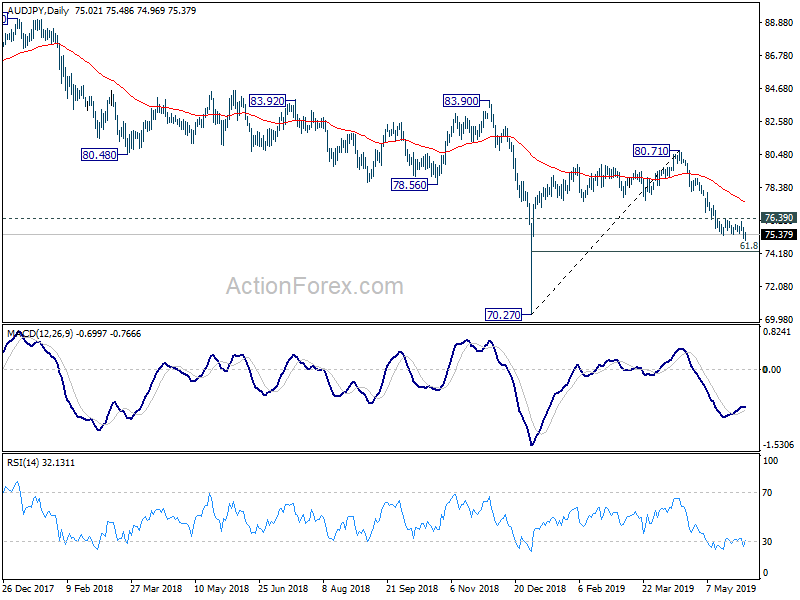
Still, there is no sign in general bullish reversal in Aussie yet. For example, AUD/JPY's decline in 80.71 is still in progress for 61.8% retracement of 70.27 to 80.71 at 74.25. Sustained break will pave the way to retest 70.27 low. Break of 76.39 resistance might bring stronger rebound and lengthier consolidation. But outlook won't turn bullish before sustained trading above 55 day EMA.
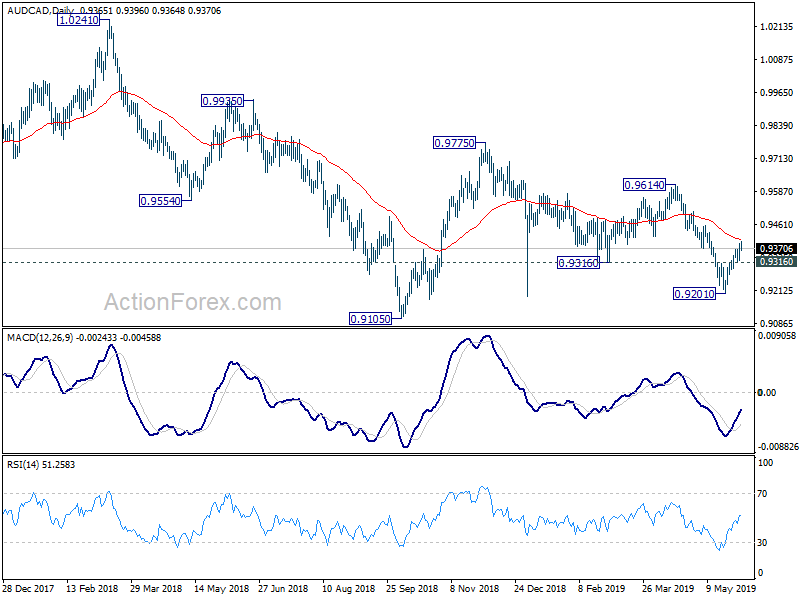
AUD/CAD's strength is also not totally convincing yet despite the rebound from 0.9201. Before sustained trading above 55 day EMA, outlook will stays bearish. Break of 0.9316 minor support will suggest that the rebound form 0.9201 has completed. Deeper fall should then be seen back to 0.9201 and possibly further to 0.9105 low.
British Pound Yawns as U.K. Manufacturing PMI Contracts
GBP/USD has posted is unchanged in the Monday session. Currently, GBP/USD is trading at 1.2645, up 0.11% on the day. On the fundamentals front, the focus is on manufacturing releases. British Manufacturing PMI slowed to 49.4, missing expectations. Later on, the U.K. releases BRC Retail Sales Monitor, with an estimate of 0.9%. In the U.S., ISM Manufacturing PMI dropped to 52.1, short of the estimate of 53.0. On Tuesday, the U.K. releases Construction PMI.
It was a sour start to the week for British fundamentals, as manufacturing PMI dipped below the 50-level, which separates expansion from contraction. The PMI dropped to 49.4, marking the first contraction since July 2016. Although the pound has held its own on Monday, the unexpected contraction could unnerve investors and weigh on the pound. Manufacturing news from the U.S. also disappointed, as ISM Manufacturing PMI slowed to 52.1, down from 53.0 a month earlier. Global demand has fallen off trade tensions, and unless this situation improves, manufacturing sectors across the globe will remain under strong pressure.
The U.S. economy continues to perform well, with first-quarter growth above the 3% level. Second estimate GDP posted a gain of 3.1%, matching the estimate. This was just shy of the initial estimate in April, which came in at 3.1%. The U.S. economy is firing on all cylinders, despite the nasty trade war with China, which has escalated in recent weeks. U.S. officials, including President Trump, had announced that substantial progress had been made, and it seemed that a trade deal was just around the corner. However, Trump shocked the markets by slapping further tariffs on China, which led to counter-tariffs against U.S. products. China has reacted angrily to U.S. trade sanctions on Huawei, a giant Chinese telecom company. The euro has managed to weather the latest crisis in the U.S.-China trade war, but if there is no improvement, investors could opt for the safety of the greenback, which could hurt the British pound.
US: Manufacturing Activity in May Slows, but Buoyed by Uptick in New Orders and Employment
- The ISM manufacturing index fell to 52.1 in May from 52.8 in April, below market expectations for a slight increase to 53.
- The underlying details of the report were mixed. The production sub-index fell to 51.3 (from 52.3), backlog of orders fell to 47.2 (from 53.9), supplier deliveries fell to 52.0 (from 54.6), and inventories fell to 50.9 (from 52.9). On the other hand, the new orders index rose to 52.7 (from 51.7), and employment rose to 53.7 (from 52.4).
- On the trade front, new export orders moved back to expansionary territory (51.0 from 49.5), while imports slid further to 49.4 (from 49.8).
- The prices paid index rose 3.2 percentage points to 53.2 in May.
Key Implications
- Manufacturing activity has slowed considerably over the past several months as the U.S. "catches down" to its global peers. On the bright side, it remains in expansionary territory, which is more than can be said for manufacturing activity in America's major trading partners. Europe (including Germany), Canada, Japan all have manufacturing PMI's in contractionary territory. China, meanwhile, is barely growing with a PMI of 50.2.
- Even before the administration's recent threat to impose tariffs on all Mexican imports, businesses had been complaining about delays at the southern border as weighing on activity. The threat of escalating tariffs on Mexico is a big deal, and, if followed through will impose significant costs on consumers and businesses and likely lead to further disruptions in American manufacturing activity.
MARKET WRAP: Stocks Fall To A New Low
Trump's trade war has pushed investors back in the safe haven trade. *Dollar drops while gold makes a new high for this month
Stocks
- The S&P 500 Index dropped 0.59 percent as of 15:30 in London. This is despite the fact that the US consumer confidence data came in much stronger
- The Stoxx Europe 600 Index fell 0.53 percent while the FTSE declined 0.57 percent.
- The MSCI EM Index fell 0.22 percent.
Currencies
- The Dollar Spot Index dropped 0.16 percent after some soft ISM manufacturing data, it came in at 52.6 vs Est 53.
- The Euro recovered some of its losses today and moved higher by 0.34 percent to $1.199. The move supported by the improvement in the italain manufacturing PMI.
- The Japanese yen gained 0.40 percent to 111.34 per dollar.
- The British pound has moved back above the 1.30 and gained 0.78 percent to $1.3034.
Bonds
- The yield on 10-year Treasuries moved lower by one basis points to 2.51 percent.
- Germany’s 10-year yield was unchanged at -0.01 percent.
- Britain’s 10-year yield gained three basis point to 1.19 percent.
Commodities
- Crude oil gained 0.12 percent to $65.91 a barrel.
- Gold moved higher by 0.24 percent to $1,282 an ounce.