Sample Category Title
USD/JPY Daily Outlook
Daily Pivots: (S1) 107.82; (P) 108.14; (R1) 108.38; More...
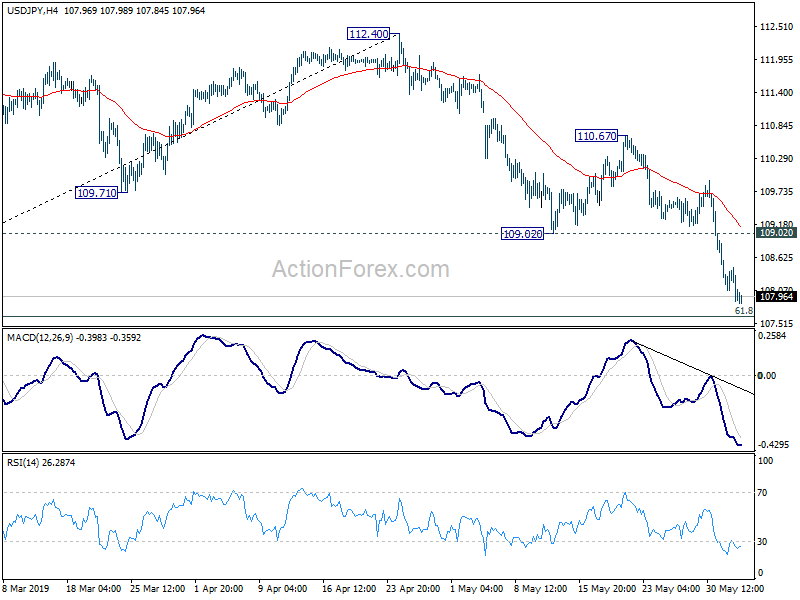
Intraday bias in USD/JPY remains on the downside as fall from 112.40 is still in progress for 61.8% retracement of 104.69 to 112.40 at 107.63. Sustained break there will pave the way back to 104.62/9 key support zone. On the upside, break of 109.02 support turned resistance is needed to be the first sign of short term bottoming. Otherwise, outlook will remain bearish in case of recovery.
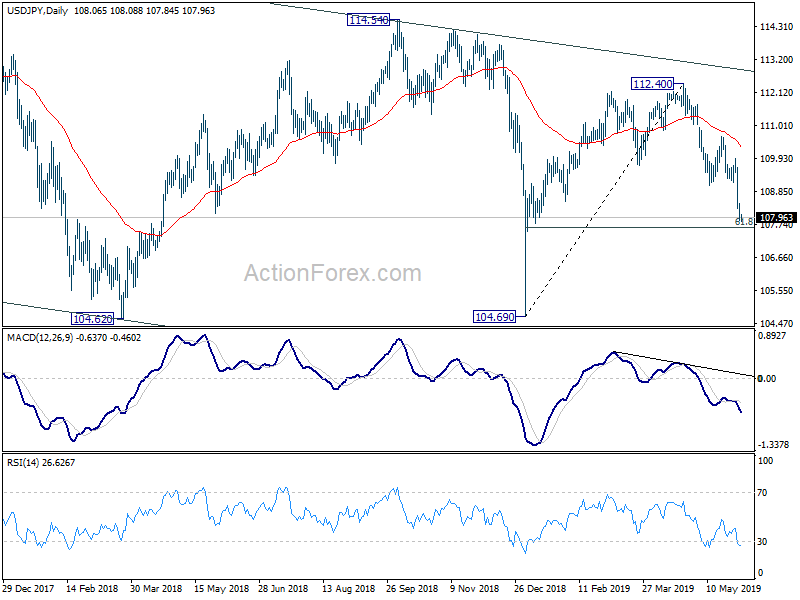
In the bigger picture, decline from 118.65 (Dec 2016) is still in progress, with the pair staying indicate long term falling channel. Break of 104.62 will target 100% projection of 118.65 to 104.62 from 114.54 at 100.51. For now, we'd expect strong support above 98.97 (2016 low) to contain downside to bring rebound.
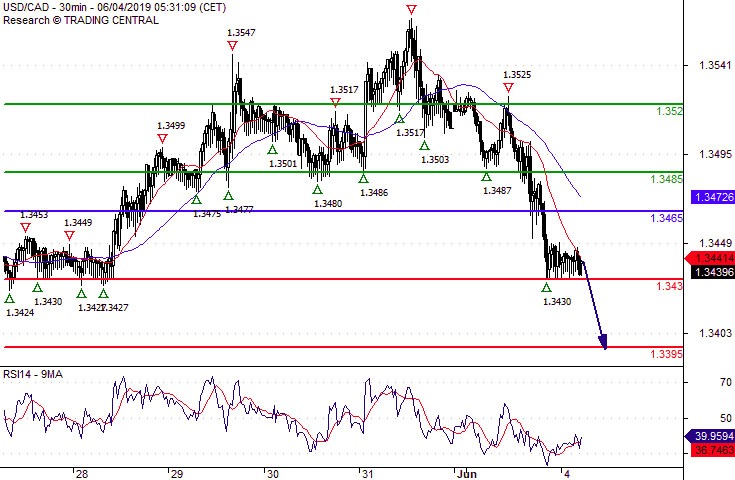
USD/CAD 1.3395 Expected
Pivot (invalidation): 1.3465
Our preference Short positions below 1.3465 with targets at 1.3430 & 1.3395 in extension.
Alternative scenario Above 1.3465 look for further upside with 1.3485 & 1.3520 as targets.
Comment A break below 1.3430 would trigger a drop towards 1.3395.
USD/CHF The Downside Prevails
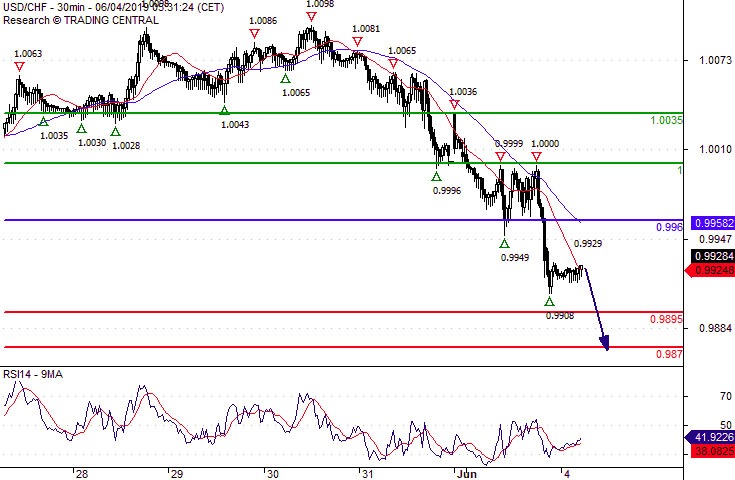
Pivot (invalidation): 0.9960
Our preference Short positions below 0.9960 with targets at 0.9895 & 0.9870 in extension.
Alternative scenario Above 0.9960 look for further upside with 1.0000 & 1.0035 as targets.
Comment The break below 0.9960 is a negative signal that has opened a path to 0.9895.
USD/CHF Daily Outlook
Daily Pivots: (S1) 0.9881; (P) 0.9953; (R1) 0.9996; More...
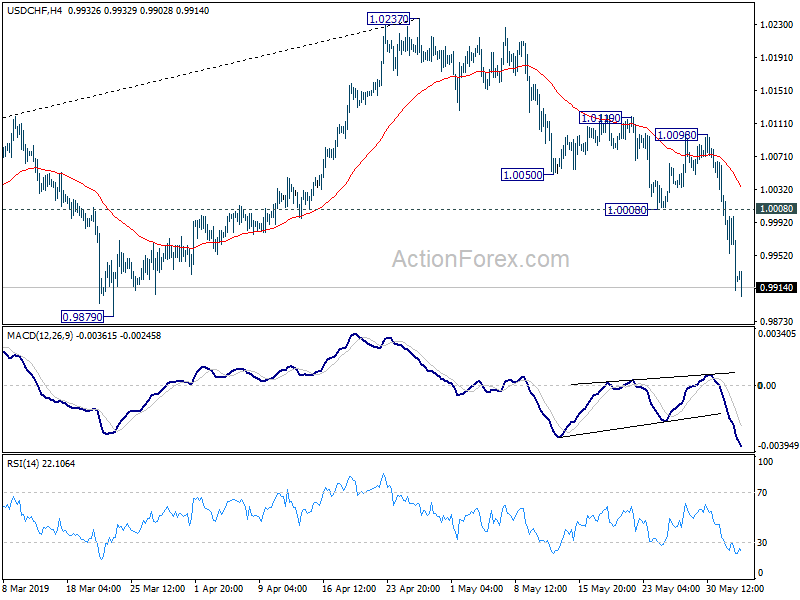
USD/CHF drops to as low as 0.9902 so far today and intraday bias stays on the downside for 0.9879 key support. Decisive break there will carry larger bearish implications and target 0.9716 support next. On the upside, break of 1.0008 support turned resistance is needed to indicate short term bottoming. Otherwise, outlook will remain mildly bearish in case of recovery.
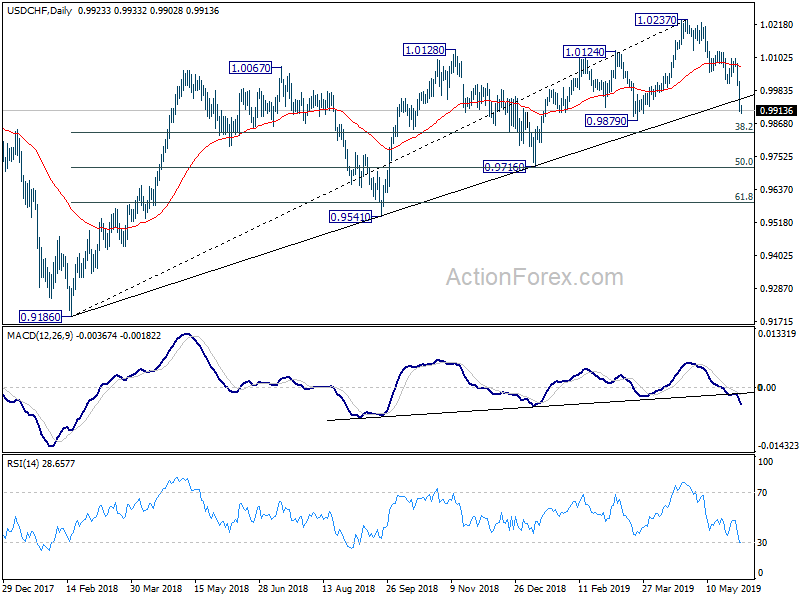
In the bigger picture, USD/CHF's break of long term trend line support is the first indication of medium term reversal. Focus is now back on 0.9879 support. Decisive break should add to the case that rise from 0.9186 has completed at 1.0237 already. Further fall should be seen to 0.9716 cluster support (50% retracement of 0.9186 to 1.0237 at 0.9712) next.
Dollar Decline Accelerates on Falling Yield and Stocks, Trade Wars and Fed Cut Talks
Dollar suffered another round of selloff this week and remains broadly weak today. Free fall in treasury yields continued overnight with 10-year yield closing at 2.081, down -0.061. 2% handle is now looking vulnerable with current downside acceleration. Tech stocks were hit hard with NASDAQ lost -1.61%, on news that US Justice Department was planning to begin an antitrust investigation into Google. Meanwhile, US formally blamed China for "blame game" in its white paper on trade. Mexico drew a clear red line in rejection so called "safe third country" options in tariff-migration negotiations with US. St. Louis Fed President James Bullard now openly called for a rate cut as insurance to sharp slowdown. These are all Dollar negative factors.
Staying in the currency markets, Dollar stays weak together with New Zealand and Australian Dollar. RBA delivered the highly anticipated rate cut and hinted that more could be coming. Yen is currently the strongest one for today, but it's generally staying in consolidation except versus Dollar. It may still take some more time before Yen is in full gear again. Euro is currently the second strongest, very much helped by rally in EUR/USD.
Technically, 1.1263 resistance in EUR/USD, 0.6988 resistance in AUD/USD and 1.3429 support in USD/CAD are the levels to watch today. Decisive break of these levels will be strong signal of near term bearish reversal in Dollar. That will align with bearish outlook in USD/CHF and USD/JPY too and indicates more downside for the greenback ahead. At the same time, with such development, gold could head further for a test on 1346.71 near term resistance.
In Asia, Nikkei dropped -0.1%. Hong Kong HSI is down -0.68%. China Shanghai SSE is down -0.98%. Singapore Strait Times is up 0.38%. Japan 10-year JGB yield is down-0.009 at -0.101. Overnight, DOW rose 0.02%. S&P 500 dropped -0.28%. NASDAQ dropped -1.61%. 10-year yield dropped -0.061 to 2.081.
US accused China for blame game and misrepresentation of history on trade war
On Monday, US Trade Representative and Treasury Department issued a joint statement in response to China's "White Paper" on trade negotiations. The statement criticized China for pursuing a "blame game misrepresenting the nature and history of trade negotiations between the two countries." And, all started with "unfair trade practices that China has engaged in for decades, which have contributed to persistent and unsustainable trade deficits"
They also hit back on China's claims and noted "our insistence on detailed and enforceable commitments from the Chinese in no way constitutes a threat to Chinese sovereignty." They emphasized that "the issues discussed are common to trade agreements and are necessary to address the systemic issues that have contributed to persistent and unsustainable trade deficits."
Mexico rejects safe third country proposal, pledges retaliation to US tariffs
As Mexican officials are meeting US counterparts this week to avert sudden increase in tariffs, Foreign Minister Marcelo Ebrard rejected that the so called "safe third country" proposal. Under this option favored by some US officials, Mexico will be forced to handle Central Americans seeking asylum in the US. Ebrard said "an agreement about a safe third country would not be acceptable for Mexico... They have not yet proposed it to me. But it would not be acceptable and they know it."
Ebrard also hit back at Trump's claims that Mexico was doing "nothing" to help the US. And he said 250k more immigrants would reach the United States in 2019 without its efforts. He reiterated the country's commitment to continue to work on curbing migration flows from Central America to US.
Separately, Mexican Economy Minister Graciela Marquez warned in a statement that Trump's tariffs on Mexican imports would affect all 50 US states, harm value chains, consumers and trade-related jobs in both countries. The proposed tariffs would cause total economic damage to the agriculture sector of $117 million per month in both countries. Marquez also pledged to retaliate if the proposed tariffs were imposed.
Mexico's ambassador to the United States, Martha Barcena, also warned "Tariffs, along with the decision to cancel aid programs to the northern Central American countries, could have a counterproductive effect and would not reduce migration flows."
Fed Bullard: Rate cut could be coming as severe trade uncertainties may bring sharper than expected slowdown
St. Louis Fed President James Bullard warned the current policy rate setting is "inappropriately high" in the remarks presented to the Union League Club of Chicago on Monday. And, a rate cut could be coming soon to help "re-center inflation and inflation expectations" and provided "insurance" in case of "sharper-than-expected slowdown."
He noted that US GDP growth in 2019 is expected to be a a lot slower than 3.2% over the last year. And more importantly "to the extent global trade uncertainties have become more severe, this slowing may be sharper than previously anticipated".
Additionally, he noted that yield curve inversion has become more pronounced recently, with 10-year yield below federal funds rate. And, "Financial markets appear to expect less growth and less inflation going forward than the FOMC does, a signal that the policy rate setting may be too restrictive for the current environment."
So, "a downward adjustment of the policy rate may help re-center inflation and inflation expectations at the 2% target, and simultaneously provide some insurance in case the slowdown is sharper than expected," Bullard said, adding, "Even if the sharper-than-expected slowdown does not materialize, a rate cut would only mean that inflation and inflation expectations return to target more rapidly."
RBA cuts cash rate to assist faster progress in employment and inflation
RBA cut cash rate by 25bps to 1.25% as widely expected. The objective of the cut is to "assist with faster progress in reducing unemployment" and thus, "achieve more assured progress towards the inflation target". More importantly, RBA leaves the option open for more rate cut. It will "continue to monitor developments in the labour market closely and adjust monetary policy" for the objectives.
On the economy, RBA expects growth to be around 2.75% in 2019 and 2020. Outlook for household consumption is the "main domestic uncertainty, which is "affected by a protracted period of low income growth and declining housing prices". The central bank noted the tick up in unemployment to 5.2% in April. But the data suggests that "Australian economy can sustain a lower rate of unemployment." RBA also noted "lower than expected" inflation outcomes which "suggest subdued inflationary pressures across much of the economy". But inflation is still expected be at 1.75% in 2019 and 2.00% in 2020.
Separately, the Australian Financial Review reported that Treasurer Josh Frydenberg met executives of the big four banks of f Commonwealth Bank of Australia, Westpac Banking Corp, Australia and New Zealand Banking Group and National Australia Bank. Issues on interest rates, housing slump, regulatory supervision and a securitization fund, were discussed. More improtantly, Frydenberg urged the banks to pass in any rate cus to the public to weather the signficant economic headwinds.
On the data front
Australia retail sales dropped -0.1% mom in April, below expectation of 0.2% mom. Current account deficit narrowed to AUD -2.9B in Q1. New Zealand terms of trade index rose more than expected by 1.0% qoq in Q1. Japan monetary base rose 3.6% yoy in May. UK BRC retail sales monitor dropped -3.0% yoy in May.
Looking ahead, UK will rlease construction PMI in European session. Eurozone will rlease CPI flast and unemployment rate. US will release factory orders.
EUR/USD Daily Outlook
Daily Pivots: (S1) 1.1136; (P) 1.1136; (R1) 1.1191; More.....
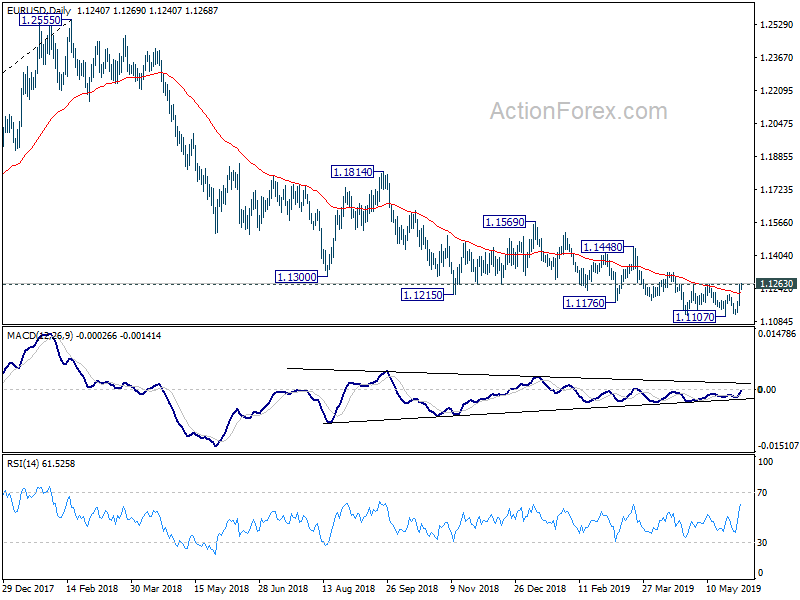
EUR/USD's rise extends further today and it's now pressing 1.1263 key near term resistance. At long as this resistance holds, outlook will stay bearish. That is, larger down trend from 1.2555 should resume sooner rather than later through 1.1107 low. However, considering bullish convergence condition in daily MACD, firm break of 1.1263 will be an early sign of medium term bottoming. Intraday bias will be turned back to the upside for 1.1448 resistance for confirmation.
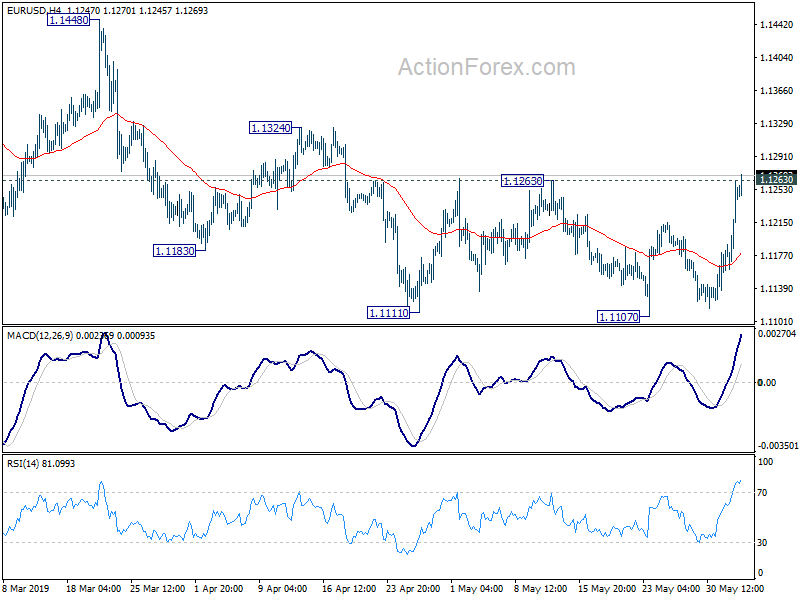
In the bigger picture, down trend from 1.2555 (2018 high) is still in progress. Such decline would target 78.6% retracement of 1.0339 (2016 low) to 1.2555 (2018 high) at 1.0813 next. Sustained break there will pave the way to retest 1.0339. On the upside, break of 1.1448 resistance is needed to confirm medium term bottoming. Otherwise, outlook will stay bearish in case of rebound.
Economic Indicators Update
| GMT | Ccy | Events | Actual | Forecast | Previous | Revised |
|---|---|---|---|---|---|---|
| 22:45 | NZD | Terms of Trade Index Q/Q Q1 | 1.00% | 0.50% | -3.00% | -3.20% |
| 23:01 | GBP | BRC Retail Sales Monitor Y/Y May | -3.00% | 0.80% | 3.70% | |
| 23:50 | JPY | Monetary Base Y/Y May | 3.60% | 3.20% | 3.10% | |
| 1:30 | AUD | Current Account Balance (AUD) Q1 | -2.9B | -2.9B | -7.2B | -6.3B |
| 1:30 | AUD | Retail Sales M/M Apr | -0.10% | 0.20% | 0.30% | |
| 4:30 | AUD | RBA Rate Decision | 1.25% | 1.25% | 1.50% | |
| 8:30 | GBP | Construction PMI May | 50.6 | 50.5 | ||
| 9:00 | EUR | Eurozone Unemployment Rate Apr | 7.70% | 7.70% | ||
| 9:00 | EUR | Eurozone CPI Core Y/Y May A | 0.90% | 1.30% | ||
| 9:00 | EUR | Eurozone CPI Estimate Y/Y May | 1.30% | 1.70% | ||
| 14:00 | USD | Factory Orders Apr | -0.90% | 1.90% |
Dollar Weakens Amid Rising Bets Of A Fed Rate Cut
The US Dollar Index (DXY) has weakened by about 0.6 percent to trade around the 97.2 mark at the time of writing, after St. Louis Fed President James Bullard suggested that an “insurance” Fed rate cut may be“warranted soon”. This is in contrast to the Fed's “patient” stance at the onset of May indicating no bias for moving US interest rates either way, which Fed Chair Jerome Powell conveyed prior to President Trump ramping up trade tensions with China, Mexico and India.
With markets now pricing in more than a 90 percent chance of a rate cut at the September FOMC meeting, Bullard's comment appears to have cracked open the door for a Fed rate cut in 2019while also framing the FOMC meeting later this month. A more overt shift towards an easing stance by Fed officials may clear the path for one, or more, US rate cuts this year, which could also prompt more downside for the Dollar.
Trump's tariff net could hasten Fed rate cut and spur more gains in safe havens
Rising global trade tensions are featuring more prominently on the Fed's policy radar, with the central bank also keeping an eye on the potential fallout in financial markets worldwide in the event of a full-blown trade war. Should President Trump cast his tariff net wider and further escalate global trade tensions, this could also hasten a Fed rate cut while fuelling risk aversion across markets, prompting further gains in safe haven assets, such as Gold, Yen, and US Treasuries.
US non-farm payrolls could offset Dollar's recent declines
Still, this doesn't mean the Dollar's decline will be unabated. Should this Friday's US non-farm payrolls once again paint a robust domestic jobs market, it could test the Fed's data-dependent stance while allowing Dollar bulls to push back.
Fund flows into US Treasuries during these times of heightened uncertainty should also provide support for the Greenback. With Europe and the UK battling their respective economic and political woes, that's expected to limit gains for the Euro and the Pound, which in turn should help mitigate the downside for the DXY.
Oil traders ignoring Saudi Arabia's commitment to keep markets stable
Brent futures' year-to-date gains have been slashed with Oil now trading around the $62/bbl handle at the time of writing. The intensification ofUS-led trade tensions in recent weeks have weighed negatively on the global growth outlook, adding to the downward pressure for Oil prices.
Market fears over the resilience of global demand for Oil have overshadowed the commitment by Saudi Energy Minister to “do what is needed” to rebalance the markets. Even if OPEC+ producers decide later this month to extend its supply cuts programme through the second half of 2019, that may not be enough to significantly offset the downward momentum for Oil, as long as heightened trade tensions persist and continue snuffing out any exuberance over the global economic expansion.
RBA Lowers Policy Rate to 1.25%. Two of Big Four Pledge to Pass the Cut to Market in Full
For the first time in 3 years, RBA lowered the cash rate by -25 bps to 1.25%, a fresh record low, in June. The rate cut had been well anticipated as the members sought to support the labor market and boost inflation. Further reduction is possible later this year. Whether monetary easing could stimulate the economy depends on a successful transmission mechanism. At the of writing this report, ANZ, first of the big four banks responding to RBA’s action, cut its mortgage rate by -18 bps. On the other hand, NAB and CBA would pass the cut in full to the market. Westpac has not yet revealed changes.
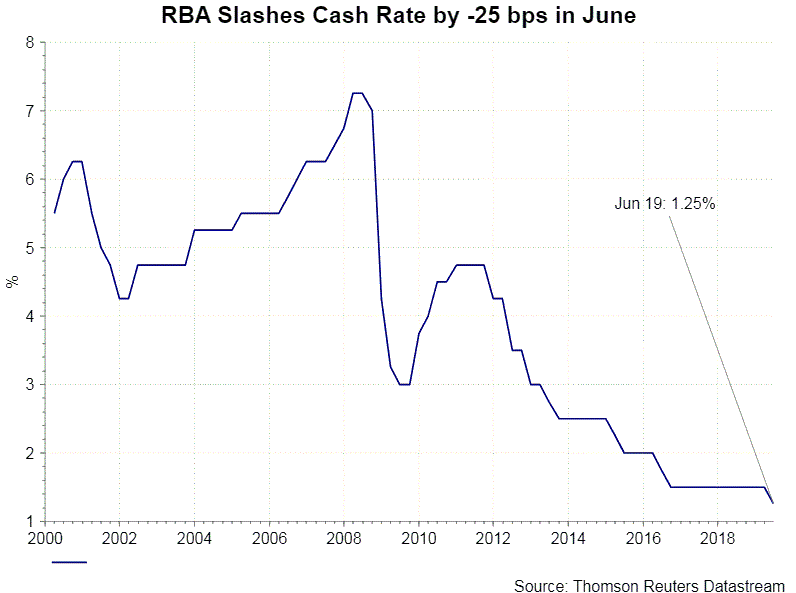
Globally, the members noted that “the downside risks stemming from the trade disputes have increased”. They also indicated that “growth in international trade remains weak and the increased uncertainty is affecting investment intentions in a number of countries”. In May, the member described growth in international trade as “declined” and investment intentions “softened” in a number of countries.
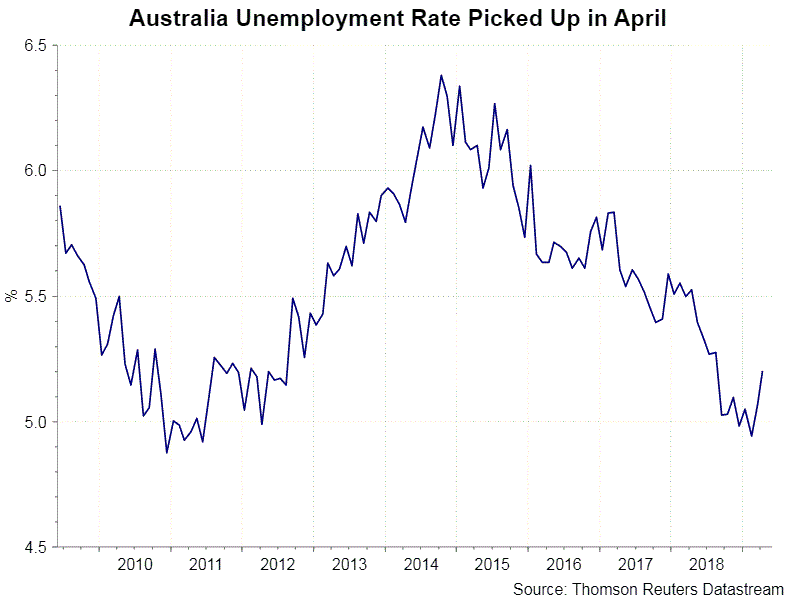
Concerning domestic developments, RBA remained concerned about the slow wage growth. It acknowledged the ongoing positive developments in the job market: increasing labour force participation, high vacancy rate skills shortages in some areas. Yet, steadiness of the unemployment rate (at around 5%) evidenced “little further inroads into the spare capacity in the labour market”. This would make it difficult for the unemployment rate to drop further This could be worrisome for the RBA as it believes the unemployment rate has yet to reach a point where wage growth would improve significantly. In April, the country’s unemployment ticked up +0.1 percentage point from a month ago to 5.2%. The wage price index steadied at +0.5% q/q qnd +2.3% y/y during the period.
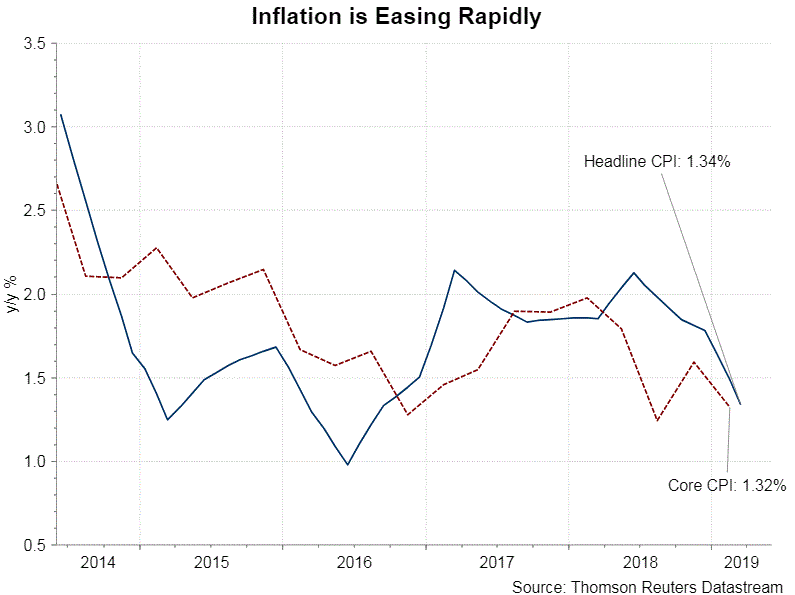
 Undoubtedly, policymakers are dissatisfied with inflation, acknowledging “lower- than- expected” inflation and “subdued inflationary pressures across much of the economy. Yet, they retained the view that inflation would “pick up”. With the near-term boost as higher petrol price. For the medium- to long- term, RBA maintained the forecasts that underlying inflation would reach “1.75% this year, 2% in 2020 and a little higher after that”.
The rate cut aims to “support employment growth and provide greater confidence that inflation will be consistent with the medium-term target”. Again, future action would be data-dependent. As suggested in the statement, the central bank would “continue to monitor developments in the labour market closely and adjust monetary policy to support sustainable growth in the economy and the achievement of the inflation target over time”.
GBP/USD Daily Outlook
Daily Pivots: (S1) 1.2625; (P) 1.2650; (R1) 1.2690; More....
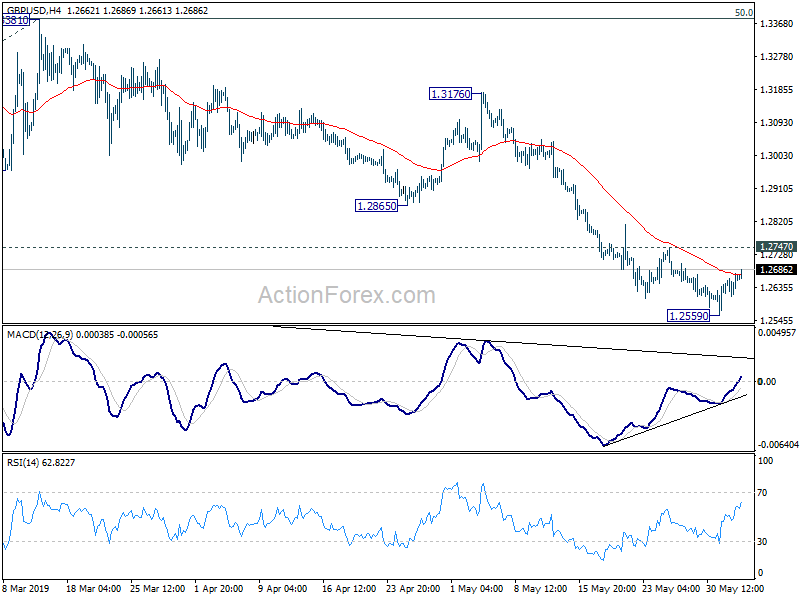
GBP/USD's recovery from 1.2559 extends higher today but stays below 1.2747 resistance. Intraday bias remains neutral for the moment. Outlook stays bearish with 1.2747 intact and fall from 1.3381 would still extend lower. On the downside, break of 1.2559 will target 1.2391 low first. Firm break there will resume larger down trend to 61.8% projection of 1.4376 to 1.2391 from 1.3381 at 1.2154 next. Though, break of 1.2747 resistance will confirm short term bottoming and bring stronger rebound.
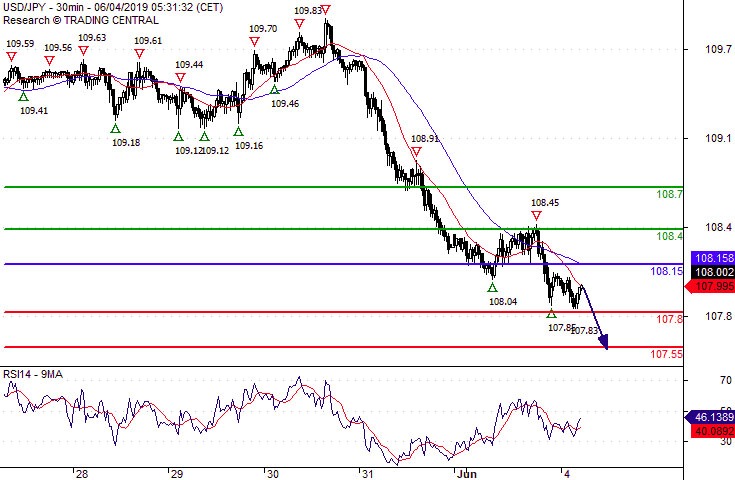
In the bigger picture, medium term decline from 1.4376 (2018 high) is possibly ready to resume. Decisive break of 1.2391 would target a test on 1.1946 long term bottom (2016 low). For now, we don't expect a firm break there yet. Hence focus will be on bottoming signal as it approaches 1.1946. In any case, medium term outlook will stay bearish as long as 1.3381 resistance holds, in case of strong rebound.
USD/JPY Key Resistance At 108.15
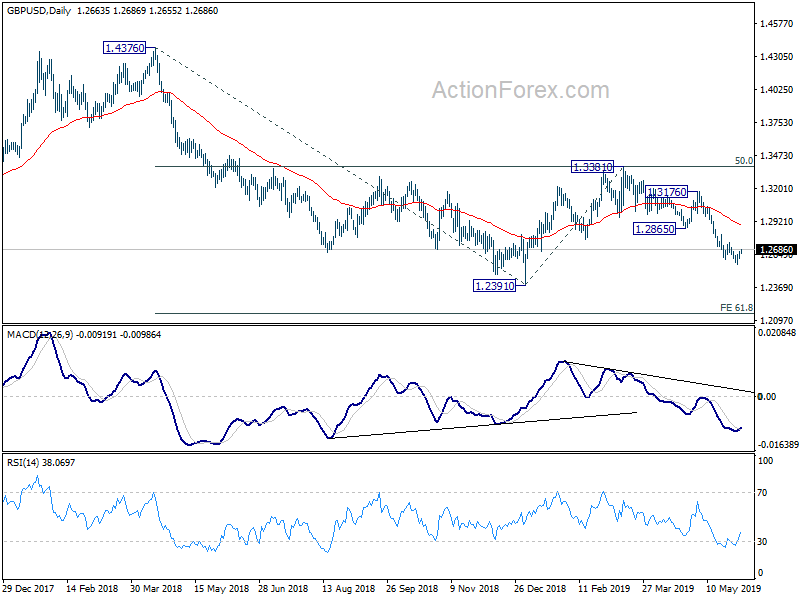
Pivot (invalidation): 108.15
Our preference Short positions below 108.15 with targets at 107.80 & 107.55 in extension.
Alternative scenario Above 108.15 look for further upside with 108.40 & 108.70 as targets.
Comment A break below 107.80 would trigger a drop towards 107.55.
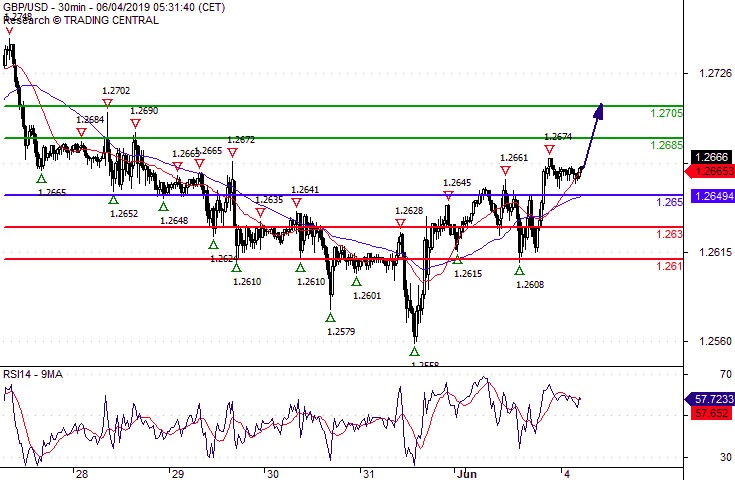
GBP/USD The Bias Remains Bullish
Pivot (invalidation): 1.2650
Our preference Long positions above 1.2650 with targets at 1.2685 & 1.2705 in extension.
Alternative scenario Below 1.2650 look for further downside with 1.2630 & 1.2610 as targets.
Comment The RSI lacks downward momentum.