Sample Category Title
USD Weakens On Soft Fianancials And Prospects Of A Rate Cut
Market expectations for a possible rate cut by the FED, until October 2019 increased, weakening the greenback yesterday. The USD retreated after hitting its highest level for two years in the USD Index, signaling its weakness. There was also a loss of momentum for the USD, as second tier US financial indicators missed their target yesterday. Analysts once again stressed the possibility of a detrimental effect of a prolonged US-Sino trade war on the US economy enhancing the bearish sentiment for the USD even further. The USD seems to be stabilising during today’s Asian session, yet should worries persist we could see the USD weakening further, especially given the financial releases today. USD/JPY dropped yesterday breaking the 109.75 (R1) support line (now turned to resistance) and has currently stabilised below it during the Asian session. We could see the pair maintaining a sideways movement, yet today’s financial releases could weaken the USD, causing the pair to drop further. Should the pair come under renewed selling interest, we could see it breaking the 109.15 (S1) support line and aim for lower grounds. Should the pair’s long positions be favoured by the markets, we could see its price action breaking the 109.75 (R1) resistance level and aim for the 110.30 (R2) resistance hurdle.
Oil prices stabilize after worst daily drop in 5 months
Oil prices continued to weaken yesterday, as analysed yesterday due to the slack of the US oil market indicated by the EIA crude oil inventories. The drop in oil prices was the steepest for the year and prices retreated to early March levels, surrendering any gains made in that period. The IMF commented on Thursday that the latest escalation of the US-Sino trade war could significantly dent business and financial market sentiment, disrupt global supply chains, and jeopardize the projected recovery in global growth in 2019. The comments were perceived as weighing heavily on the demand side of oil, especially China’s. Prices seem to have stabilized currently, yet we would not be surprised if OPEC took action to rebalance the oil market at higher prices. WTI prices continued to drop yesterday as it was expected, breaking consecutively the 60.50 (R2) support level and the 59.10 (R1) support line, before bouncing on the 57.75 (S1) support barrier and currently stabilising above it. We could see WTI prices maintaining a sideways motion today, yet we could see the commodity prices correcting higher. We could also see WTI prices being somewhat sensitive to today’s Baker Hughes oil rig count figure. Should the bulls take control of WTI’s prices, we could see it breaking the 59.10 (R1) and aim for the 60.50 (R2) resistance line. Should the bears have the upper hand once again, we could see WTI prices dropping and breaking the 57.75 (S1) support line, aiming for the 56.00 (S2) support level.
Other economic highlights, today and early tomorrow
In the European session, we get from the UK the retail sales growth rates for April and in the American session from the US, we get the durable goods orders growth rates for April and the Baler Hughes oil rig count. During Monday’s Asian session, BoJ’s governor Kuroda is scheduled to speak. Please note that on Monday the US and the UK are to have a bank holiday, while the EU Parliament election results are to be announced on Sunday at midnight and could create volatility for EUR pairs.
WTI H4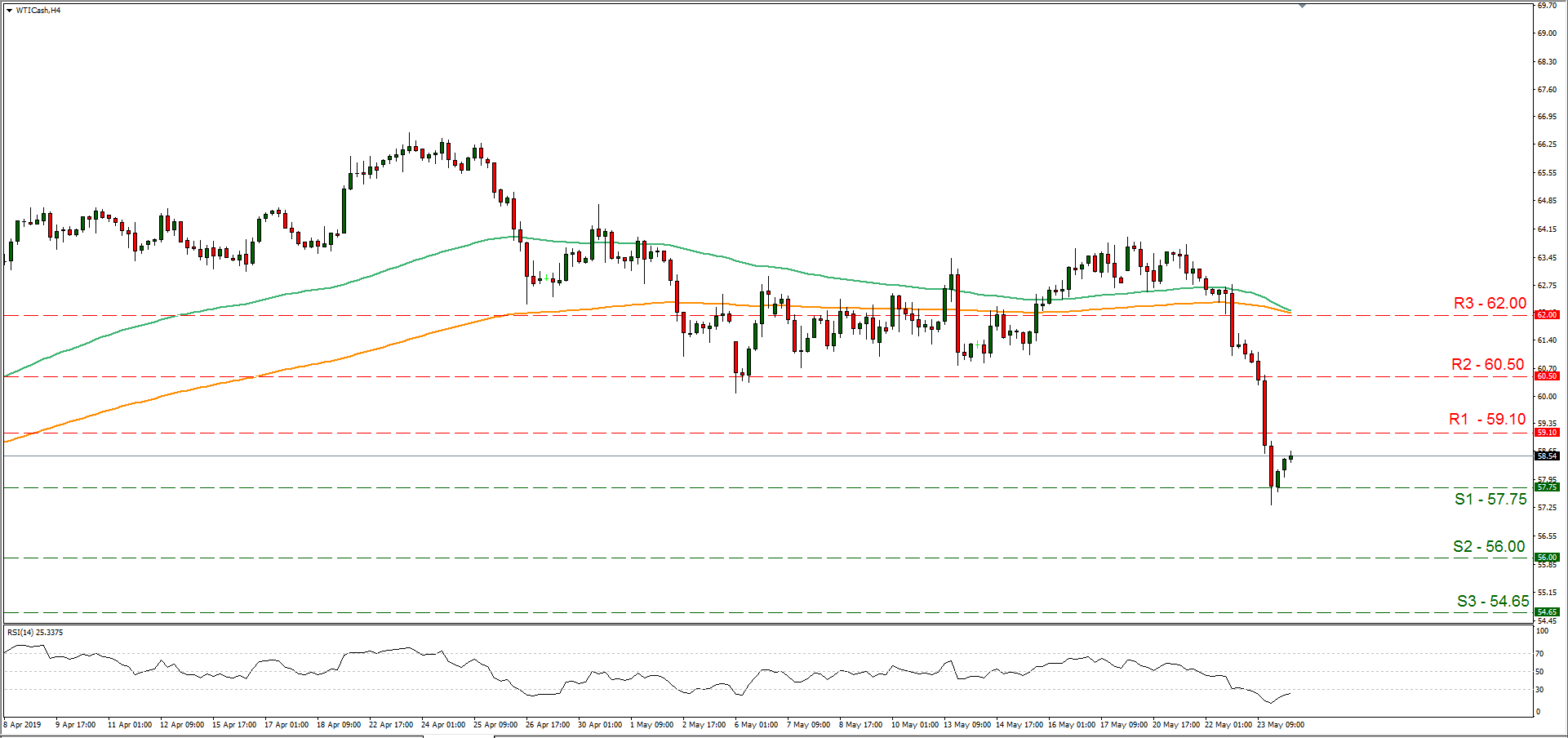
Support: 57.75 (S1), 56.00 (S2), 54.65 (S3)
Resistance: 59.10 (R1), 60.50 (R2), 62.00 (R3)
USD/JPY H4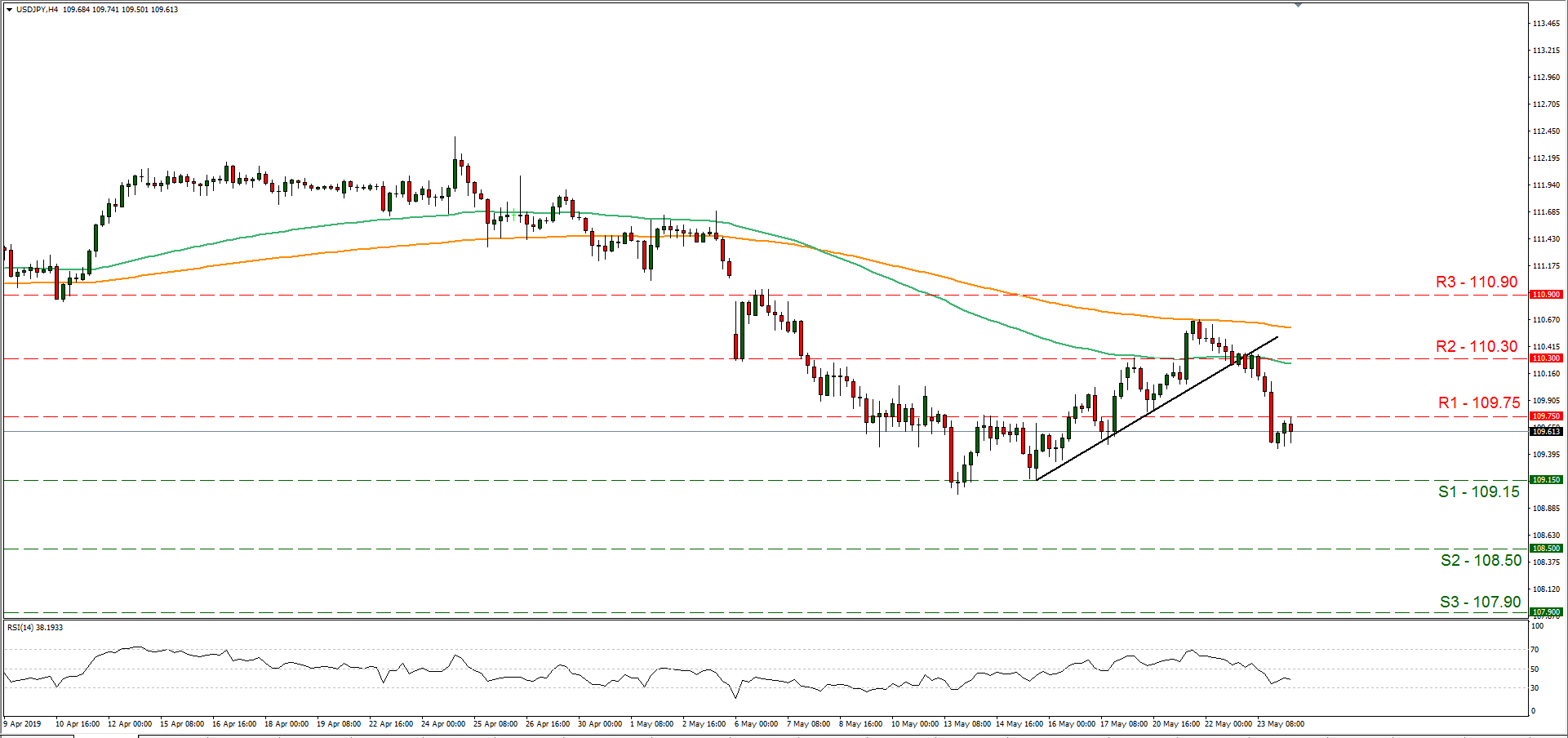
Support: 109.75 (S1), 110.30 (S2), 110.90 (S3)
Resistance: 109.15 (R1), 108.50 (R2), 107.90 (R3)
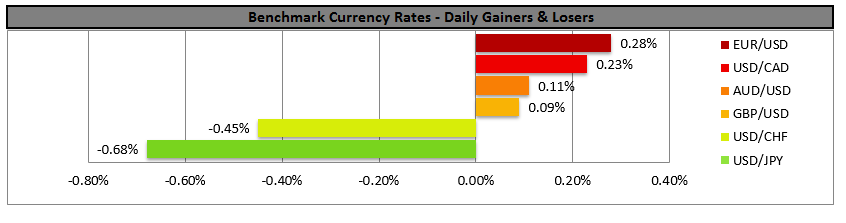
Dollar Retreats As Rate-Cut Bets Grow, Yen Soars
- Wall Street tumbles, yen soars on growth and trade concerns
- Dollar pulls back on mounting expectations for Fed easing
- Sterling catches its breath as May prepares to set departure date
Risk sentiment takes a hit as soft PMIs revive growth worries
Risk aversion dominated markets on Thursday, as alarming PMI data from major economies coupled with deepening US-China trade tensions amplified concerns around the global growth outlook. Preliminary Markit PMIs from both the US and Europe disappointed, highlighting that trade worries are starting to impact business confidence and new orders.
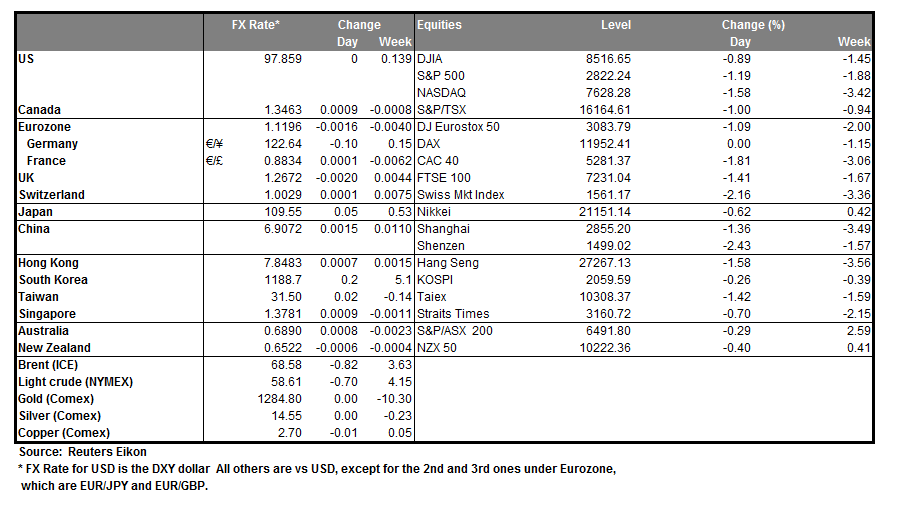
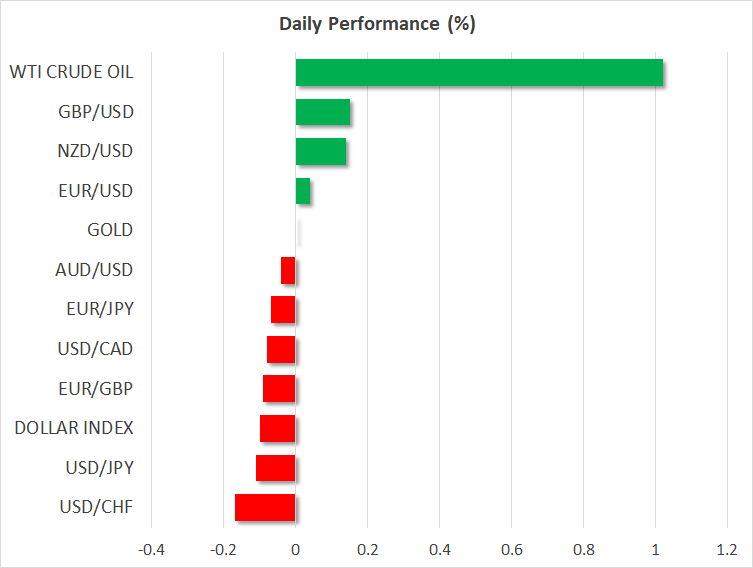
The result was a classic risk-off reaction, with stock markets both in Europe and the US suffering losses of 1-2 percent as investors rotated out of riskier assets, while haven currencies such as the yen and Swiss franc outperformed in the FX universe. The dimmer outlook for global demand also weighed on oil, with WTI falling by more than 5%, dragging the Canadian dollar down alongside it.
Most of these sharp moves have retraced a little on Friday, with futures pointing to a modestly higher open on Wall Street for instance, after some soothing remarks by Trump that there’s still a ‘good possibility’ for a trade deal and that Huawei may be part of it. Alas, this looks more like a temporary reprieve before the next ‘storm’, not the beginning of a stable recovery in sentiment, as there are currently no signs to suggest that tensions will subside anytime soon.
Dollar retreats as Fed rate cut bets grow
The most striking move though, was the retreat in the dollar, which pulled back as worries that US growth may be faltering led investors to reassess the outlook for monetary policy. Specifically, markets priced in more Fed easing, with one quarter-point rate cut now being fully priced in by December and traders also assigning a ~25% probability for a second one. That sent long-term US rates lower, diminishing some of the greenback’s carry appeal as interest rate differentials narrowed.
Overall, while it does seem likely that Fed officials will soon adopt a more cautious tone, perhaps as early as at their June meeting, this may not be a game-changer for the dollar’s fortunes overall. A lot of easing is already priced in, implying that for the greenback to materially weaken, it may require either a prolonged string of discouraging US news or positive developments abroad that drive funds out of America – neither of which is there yet.
US durable goods orders are on tap today.
Pound catches its breath after sell-off
The British pound has stabilized somewhat on Friday, following more than two weeks of continued losses, as the political situation calmed down a little – and perhaps as some traders locked in profits on their prior short positions. The latest headlines suggest Theresa May could announce her resignation as early as today, providing a timetable for her departure so that a new Tory leader can be chosen in the summer.
Her most likely replacement is Boris Johnson, who effectively spearheaded the Leave campaign and has since advocated for less close relations with Europe than what May has been pursuing, for example. This implies a greater risk for a no-deal Brexit, and while some of that gloom has probably been priced into the battered sterling by now, the overall picture still looks negative.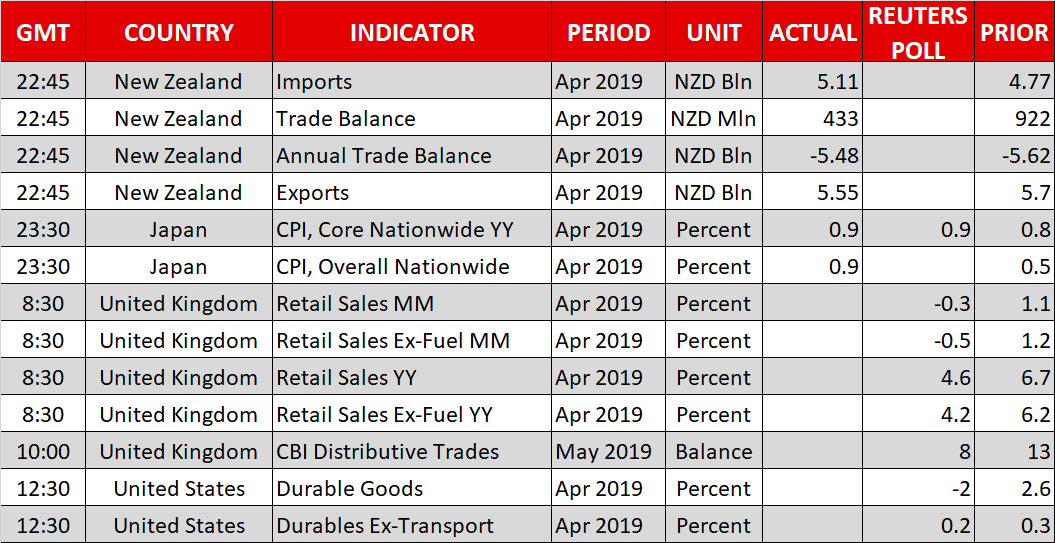
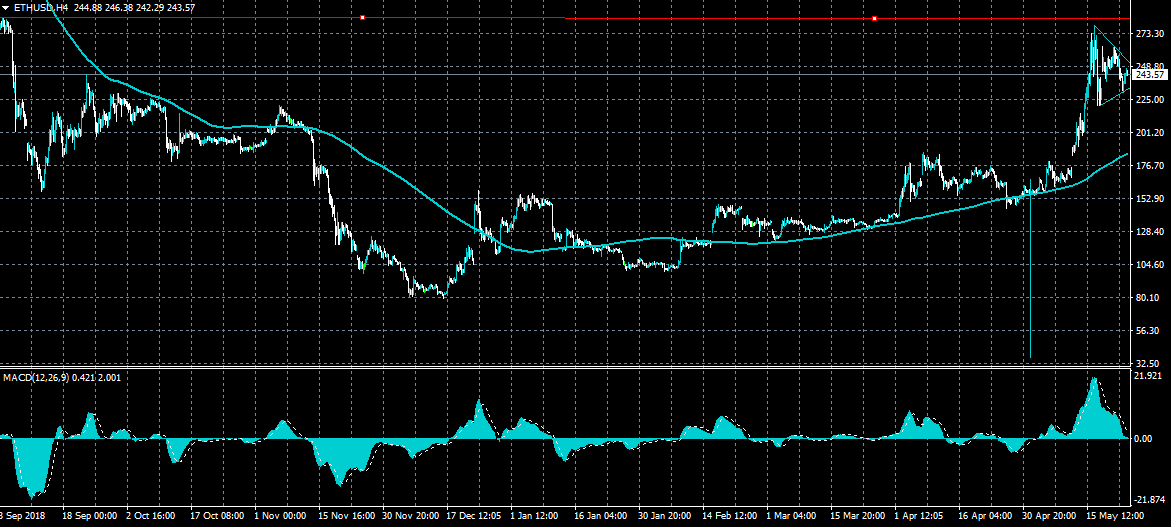
ETHUSD Inside Neutral Triangle
Ethereum has recovered higher in early Friday trade after finding strong technical support from the $220.00 level. The ETHUSD pair is currently trapped within a neutral triangle pattern on the four-hour time frame. A bullish breakout from the triangle pattern would take the ETHUSD towards the $330.00 level, while a bearish breakout may see a move towards the $180.00 support level.
The ETHUSD pair is intraday bullish while trading above the $245.00 level, key resistance is found at the $275.00 and $330.00 levels.
If the ETHUSD pair trades below the $245.00 level, key support is found at the $220.00 and $180.00 levels.
EURUSD Bullish Above 1.1190
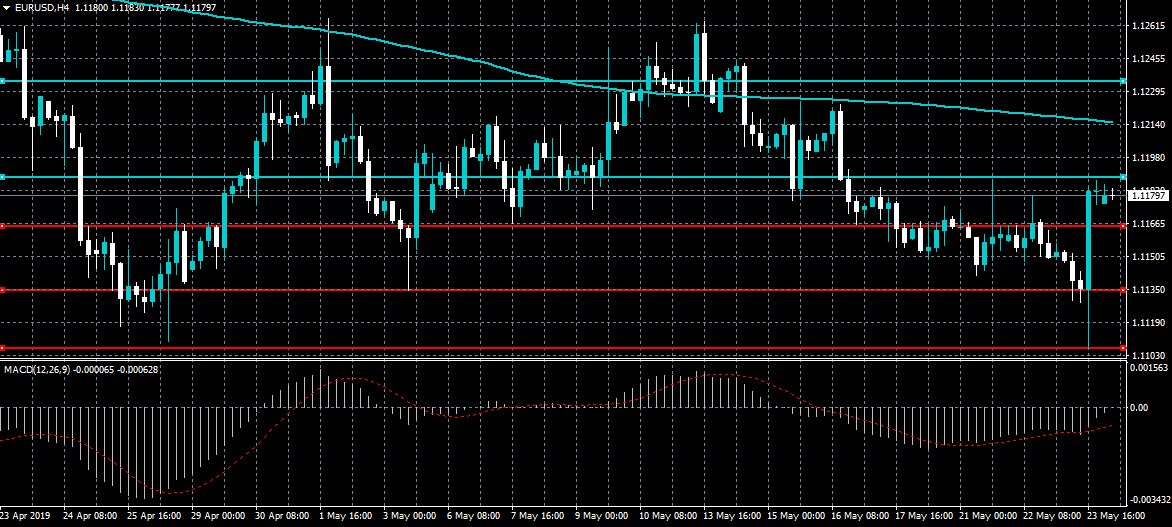
The euro currency has reversed direction against the US dollar, following much weaker than expected economic data from the United States economy on Thursday. The EURUSD pair has an intraday bullish bias while trading above the 1.1190 level and would only perform a key technical breakout above the 1.1265 level. Sentiment remains mixed ahead of the EU election result, while a weekly price close below the 1.1130 level will be taken as a bearish sign for the EURUSD pair.
The EURUSD pair is bullish while trading above the 1.1190 level, key technical resistance is found at the 1.1230 and 1.1265 levels.
If the EURUSD pair moves under the 1.1165 level, key technical support is found at the 1.1130 and 1.1100 levels.
USDJPY Bearish Below 110.00
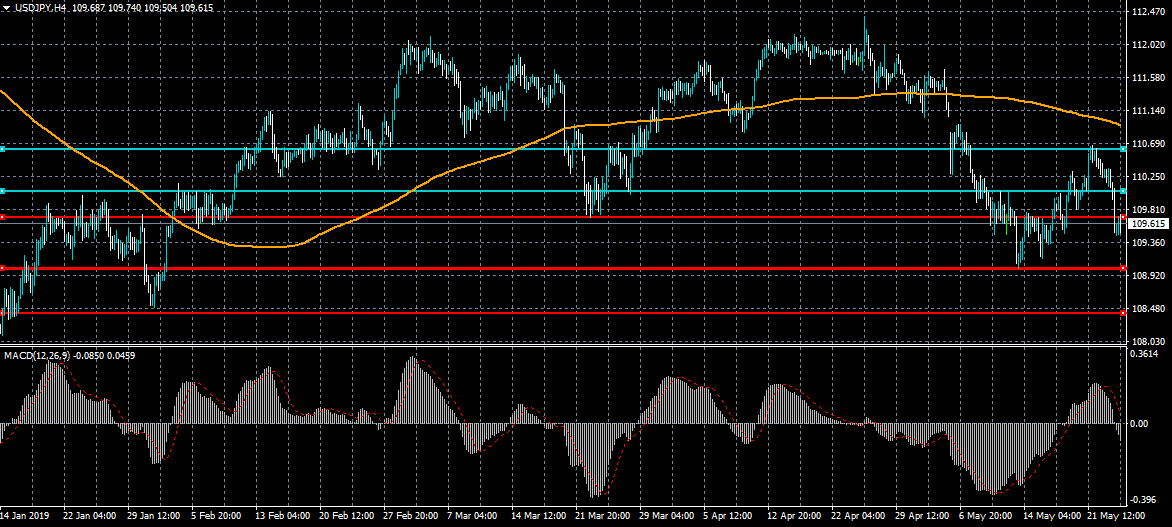
The US dollar is now under heavy selling pressure against the Japanese yen, following much weaker than expected PMI manufacturing data from the United States economy. The USDJPY pair has a bearish intraday bias while trading below the 110.00 level and could soon target the 109.00 level. If the 109.00 level is broken the 108.40 level then offers the strongest form of weekly support.
The USDJPY pair is intraday bearish while trading below the 110.00 level, key support is found at the 109.00 and 108.40 levels.
If the USDJPY pair trades above the 110.00 level, key intraday resistance is found at the 110.30 and 110.60 levels.
US Stocks And Treasuries Tank As Trade War Fears Escalate
The price of crude oil experienced its biggest decline of the year in yesterday's American session only to par some of the losses in the Asian session. There are two key reasons for the decline. Firstly, investors are concerned about the trade war, which they believe will affect demand. Secondly, they are worried about the rising US inventories. On Wednesday, data from EIA showed that the inventories rose by more than 4 million barrels, which was higher than the expected drawdown of slightly under 500K barrels.
Yesterday, US stocks declined sharply as investors continued to worry about trade. The Dow ended the day down by almost 300 points while the S&P declined by 1.2%. 80% of the stocks in the S&P 500 declined. US treasuries too declined sharply. This week, global stocks in Asia, North America, and Europe have all declined sharply as traders worry about the implications of the trade war.
Today, New Zealand released its trade data. In April, exports increased to $5.55 billion while imports increased to $5.11 billion. The trade deficit increased to $5.48 billion, which was worse than the expected $5.465 billion. In Japan, the national CPI and core CPI rose slightly to 0.1% and 0.9% respectively. Later today, the UK will release its retail sales data while US will release the durable goods data.
XBR/USD
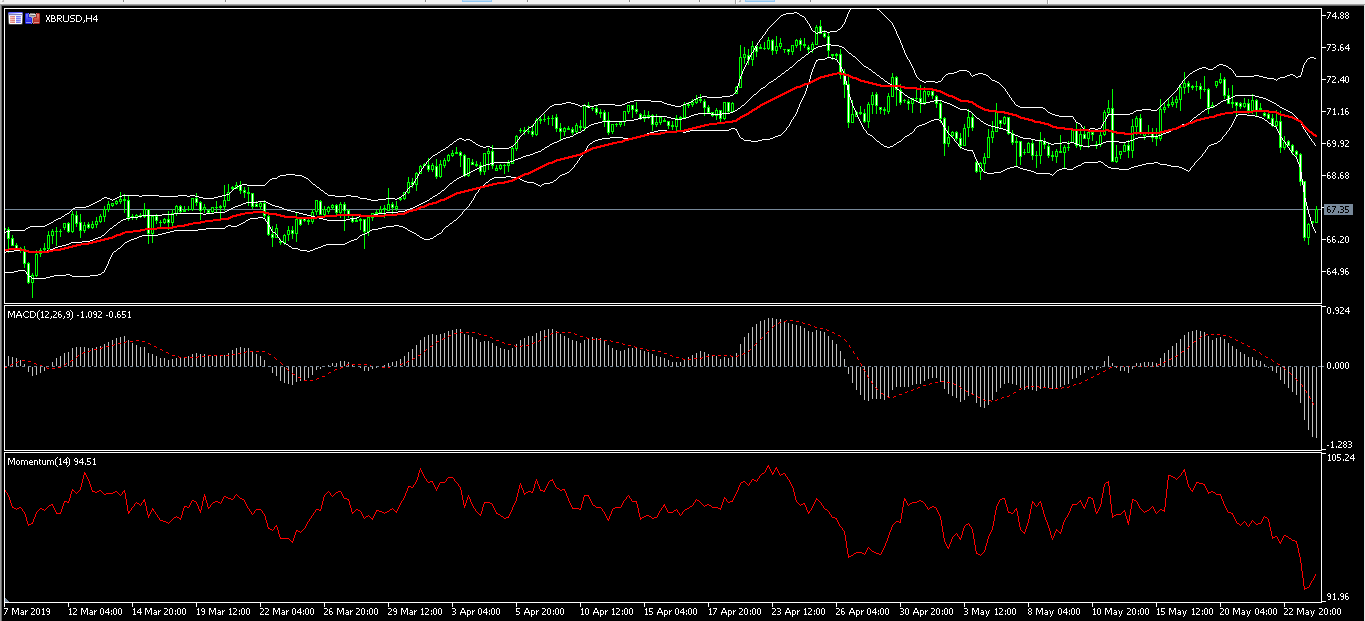
Yesterday, the XBR/USD pair declined to a low of 65.98, which was the lowest level since March 29. On the four-hour chart, this price is along the lower line of the Bollinger Bands and lower than the 50-day and 25-day moving averages. The signal line of the MACD has declined to the lowest level since December. The same is true with the momentum indicator. While the pair will likely continue moving lower, there is the chance of a recovery in June as OPEC leaders meet.
EUR/USD
The EUR/USD pair rose sharply in the American session. The pair rose from a low of 1.1106 and reached a high of 1.1187. In the Asian session, it was relatively unchanged. On the chart below, the price is above the 50-day and 25-day moving averages. The price is also above the important downward trend line shown below. The 14-day RSI has remained slightly below the overbought level. Looking ahead, with no major data expected from Europe, the pair will likely react to the durable goods data from the US.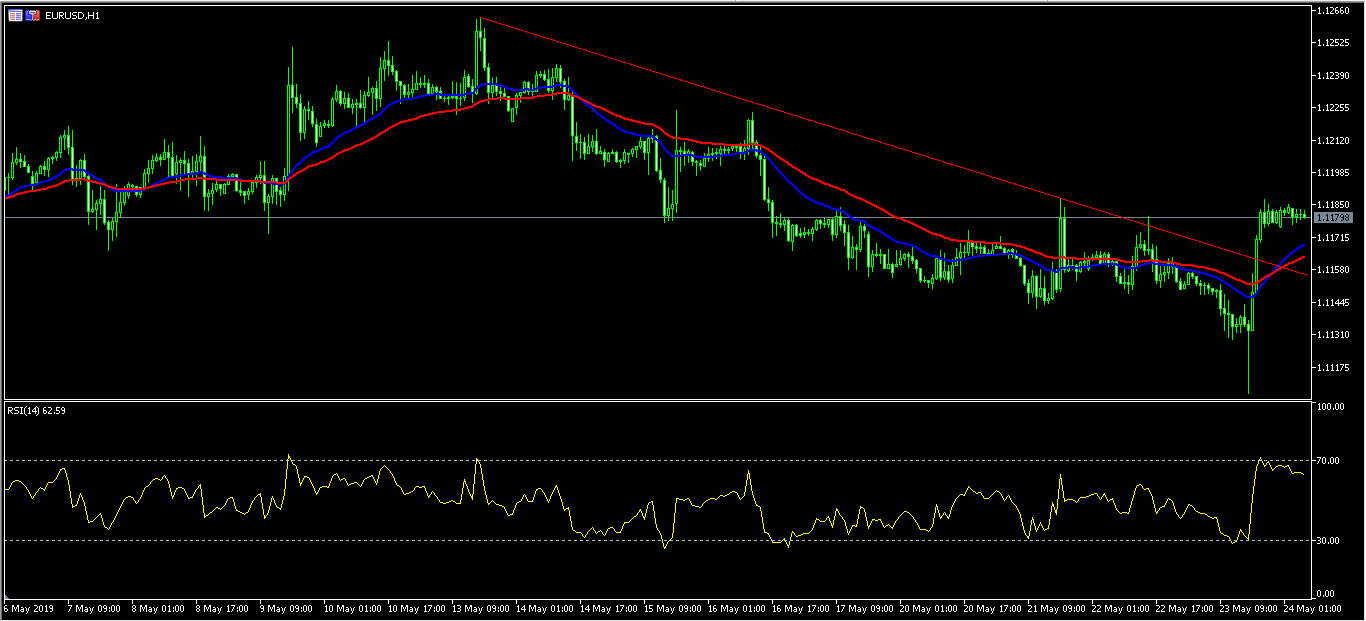
USD/JPY
After almost two weeks of gains, the USD/JPY pair started declining on Tuesday this week. The pair dropped from a high of 110.63 and reached a low of 109.45. On the hourly chart, the price is slightly below the 25-day moving averages and along the middle line of the Bollinger Bands. The triple exponential moving average has continued to decline. While the pair will likely continue to decline, there is a chanceof a recovery in the next few days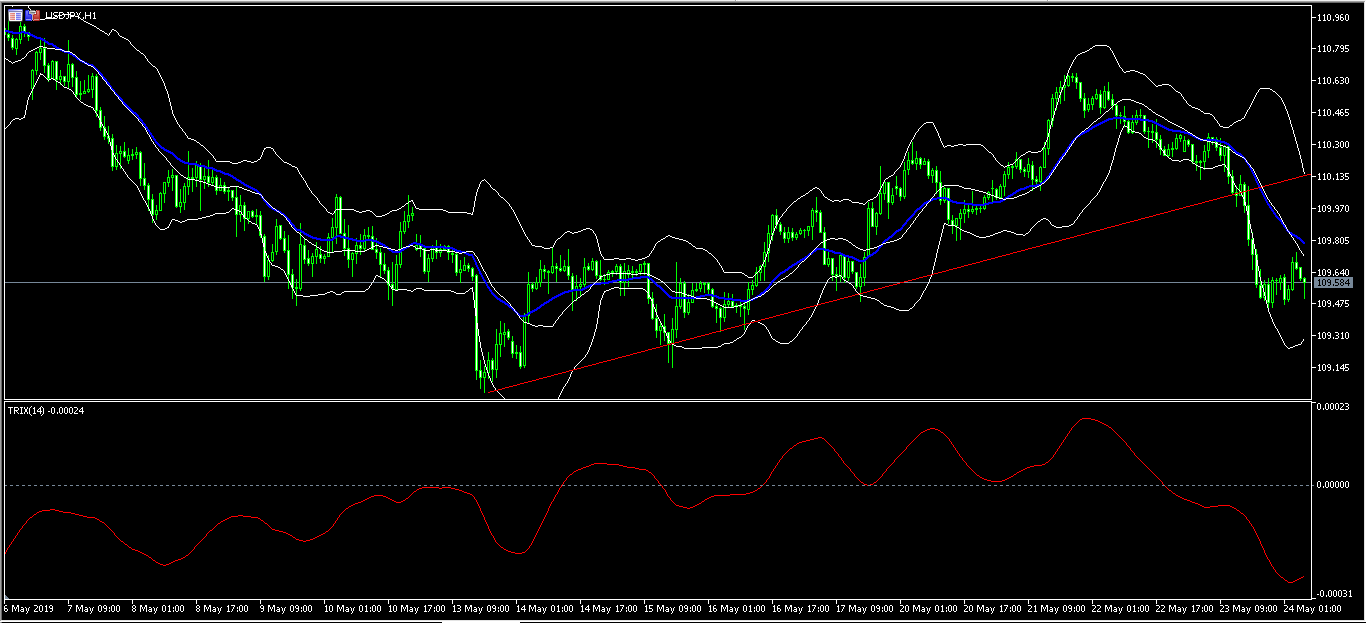
Escalating Trade Tensions Weigh On Investors
Global markets continue to weather some erratic turbulence now that the U.S and China have hit each other with increased tariffs and ended their latest round of trade negotiations without a resolution. But the prices of relatively risky assets have mostly stabilized, and stocks are still within touching distance of their all-time highs.
Measures of confidence have also held up, suggesting worries about the Sino-U.S trade fight have yet to really dent investors’ outlook. Even gold prices have barely budged for the month. Nevertheless, there are a number of signs of fear in the bond market. The U.S yield curve has inverted a couple of times this year, including today as yields fall. But the spread between three-month and 10-year Treasury yields has failed to hold below zero for more than a few sessions, which suggests that dealers are not fully convinced that the U.S economy is heading towards a contraction just yet. And despite lower yields, the US dollar remains the currency of choice.
PM May’s short lifeline
Sterling’s record losing streak combined with the growing risks that Brexit will see a hard exit, is making fund managers abandon long-term ‘bullish’ bets. Just a few months ago, the base case was that Brexit would be delivered by PM May and that it would be a soft exit. Now expectations are running high that PM Theresa May will give up pushing her Brexit deal and possibly quit on Friday (May 24) or in early June.
However, if we do see Boris Johnson, the current oddsmaker favorite, become Theresa May’s successor, we could see the ‘hardest’ Brexit occur. The pound (£1.2645), which is currently atop of its four-month lows, could see further pressure to target the psychological £1.2000 level and eventually the 2016 lows. A no-deal Brexit and a general election risks are likely to keep the pound under pressure.
But a weaker than expected showing for the Brexit party in the EU elections could potentially provide some relief for sterling, particularly if the Liberal Democrats perform strongly. A new Tory leader that is less of a Brexiteer than the likes of Boris Johnson could also see a modest bounce in the pair.
Support for Nigel Farage’s “no-deal” supporting party is at +37%, according to a recent survey, compared to +19% for the pro-remain Liberal Democrats and just +7% for PM May’s Conservatives.
Central Banks
According to the published minutes of the April 30 – May 1 meeting, the Federal Open Market Committee (FOMC) has signalled that it is in no rush to change policy rates even if there is an improvement in global economic conditions. The combination of Fed patience, lingering concerns about relatively sluggish inflation and persistent global economic uncertainty, continues to support both investors and dealers’ “dovish” assessment of the Fed rate path.
Meanwhile, a plethora of strong Canadian data lately has many revising their rate expectations for the Bank of Canada (BoC). Data for April showed headline inflation was “in line” with target, retail sales for March surprised higher, while manufacturing sales for March and existing home sales for April also surprised. Thrown into the mix Canada’s April record month for job gains has fixed income pricing out a rate cut over the next 12-months.
Down -under, there has been a sharp “dovish” shift in market-implied policy rate probabilities after RBA Governor Philip Lowe stated “…at our meeting in two weeks’ time, we will consider the case for lower interest rates”. A June cut is now fully priced in, with a second cut pencilled in for September.
On Thursday, South Africa Reserve Bank (SARB) left interest rates unchanged at +6.75% as expected. The vote was 3-2 to keep rate on hold, two members voted for a -25 bps cut. “Based on recent short-term indicators and negative growth in mining and manufacturing, GDP is expected to contract in Q1 of 2019. Policy makers also see the Rand as slightly undervalued.
Economic events
On the Economic Calendar, results for the European Parliamentary elections will be announced this Sunday evening (May 26).
European parliamentary elections exit polls on Sunday begin around 12:00 EST (6PM Germany time) with results for all EU nations expected at 5pm EST (11pm Brussels time).
Market concerns
- EU parliament election – rise of Eurosceptics
- UK leadership scramble & Brexit fallout
- US-Sino – China standing firm against US
- Trans-Atlantic trade tensions to intensify
- OPEC, Saudis, Venezuela, Libya & Trump
- Iran is threatening to close the Strait of Hormuz
- Venezuela/Russia/U.S tension
- Geo-political concerns in Iran, Russia, Ukraine & France
- U.S ramps up trade talks with India and Turkey
Next week: GBP retail sales & US durable goods (May 24), European Parliamentary Elections Day 4 (May 26), UK & US Bank holiday (May 27), UK inflation hearings, NZD financial stability report, ANZ Business confidence, RBNZ Gov. Orr speaks (May 28), BoC monetary policy announcement, AUD private capital expenditure & NZD annual budget release (May 29), CH, Fr. & DE bank holiday, US preliminary GDP & CNY manufacturing PMI (May 30), CAD GDP (May 31).
Oil Price Immune To Trade War? What About Gold?
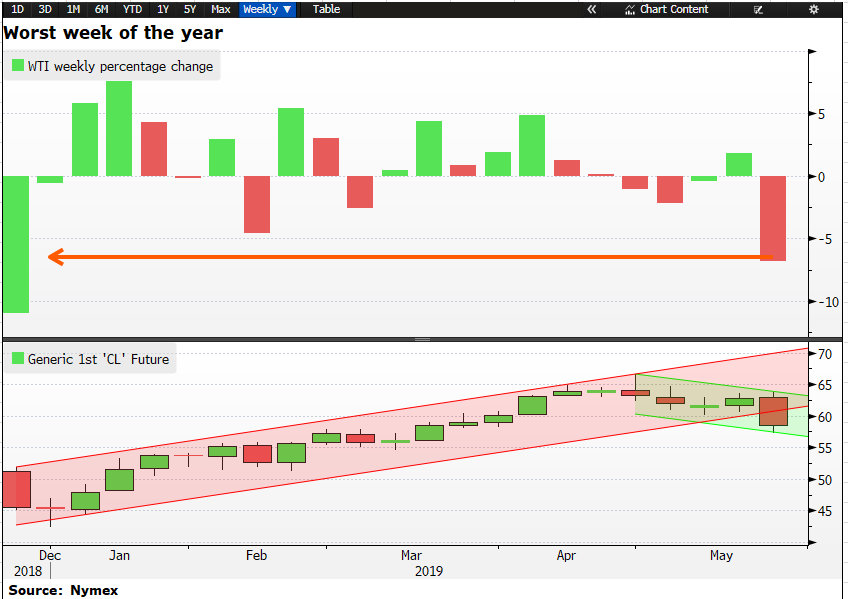
Crude oil is back in green, it is trading higher by 1.19 percent after the price plunged nearly 5.7 yesterday. Clearly, bargain hunters are back in town. However, it is still set to record the worst week of the year (as shown in the chart below) and this is due to the increase in trade war tensions between the US and China. Investors aren’t concerned that the trade war is going to leave a major dent on the oil demand, after all we are talking about the two biggest economies of the world. If the business cycle starts to slowdown here, it is going to have huge impact on oil demand and the fact is that the spill over effects of the business cycle in these countries also has an impact around the world.
The recent strength in the oil price was mainly due to the concerns over the supply because Donald Trump decided to pick a figtht with the Republic of Iran. As and if the Middle East isn’t already sensitive enough. Sanctions on Iran trigged the huge surge in the oil price. There is no doubt in saying that investors have become more sensitive to Donald Trump’ tweets. They have large implications across different asserts. The oil price also got the tail wind because of the sanctions on Venezuela and the disruption in oil production from Russia to Nigeria. For now, these disrutpions in oil supply have failed to triumph pesimission in the market.
So, the surge in the oil price which we are experiencing tody may not be able to last longer if the trade issues continue to escalate. Yes, there is no harm in saying that the oil industry have been resilient to the trade war issues for long time because it is not that the trade war started only this week but the reason that investors didn’t pay too much attention to this was mainly due to the concerns over the supply diruptions and they really thought this trade war will not last that long. Donald Trump has softened some of his stance today towards China but we are no where close to where we need to be.
In terms of technical analysis, during the past 2 days, the price has fallen more than 8%. This sell off made the price to break out of its upward channel towards the downside. The WTI price has been trading in this upward channel for most of the year. The downward channel’s strength is in focus for now and it is likely that the price may continue to trade within this channel unless the momentum really picks up and pushs the price out of this downward channel. The support is near 55.80 and a break of this would open the door towards the next level of 53.20. The resistance stands at 63.96.
GOLD
The shinning metal has continued its move to the downside after a brief rally yesterday which triggered due to the soft economic numbers out of the US. The US initial jobs data fell short of expectations, the actual number was 211K agains the forecast of 215K. The bad news didn’t stop there, the Manufacturing PMI and new homes Sales number were soft as well. This all helped the gold price to move higher but the momentum wasn’t strong enough to push the price above the critical level of 1300. One important factor to note
is that the Exchange-traded funds have added 7,759 troy ounces of gold during the last trading session. SPDR Gold Shares, the biggest gold ETF by State Street also confirmed that the institutions are still maintaining their holdings and we have not seen any change durint the last session.
The safe haven, gold has reacted to trade war development but it has not shown any extreme reactions, meaning we have not seen any explicit moves to the upside in the gold price on the back of the trade war between the US and China. It looks like gold traders do not see that as a major threat at all, which could be a very expensive mistake.
GBP/USD Outlook: Bears Take A Breather Ahead Of May’s Announcement
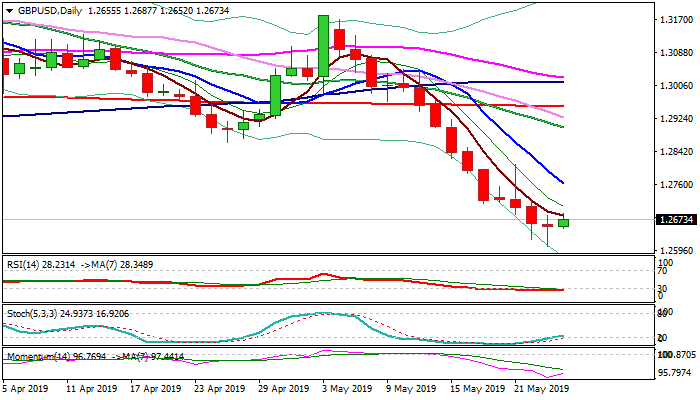
Cable ticks higher in early Friday's trading after bears faced headwinds at 1.2600 zone (Thu low at 1.2605) awaiting an announcement of PM May about the date of her departure. Thursday's action ended in long-tailed Doji, signaling that bears might be losing traction, as daily stochastic emerges from oversold territory and end of week profit-taking supports scenario. Strong bearish sentiment on rising Brexit uncertainty leaves little space for recovery and suggests mild adjustment before bears resume. PM May is expected to make her announcement in the mid-morning, but will remain in her position until her successor will be elected. Collapse of her Brexit deal leaves all problems (no deal, new deal, no Brexit) on the table and new leader is expected to push for a more decisive Brexit deal that would likely spark fresh tensions with the EU as the bloc said they are not willing to make changes to the agreement they sealed in November. Upticks were so far capped by initial resistance at 1.2687 (falling 5SMA) ahead of more significant 1.2763 barrier (falling 10SMA) which should ideally cap and guard pivot at 1.2824 (Fibo 38.2% of 1.3179/1.2605 descend). However, strong bullish close today would signal formation of Doji reversal pattern on daily chart that would leave the door open for stronger recovery, with close above 1.2824 needed to confirm scenario. Release of UK retail sales today would further sour the sentiment if data come along with expectations (Apr m/m -0.3% f/c vs 1.1% prev / y/y 4.6% f/c vs 6.7% prev).
Res: 1.2687, 1.2740, 1.2763, 1.2824
Sup: 1.2652, 1.2605, 1.2580, 1.2528
Investors ‘Sell In May And Go Away’ As Risk Aversion Intensifies, Oil Collapses
Stock markets across the globe have been treated without mercy this week as fears over prolonged US-China trade tensions weighed on market sentiment over global economic growth and stability.
The gut-wrenching selloff witnessed this month suggests that markets are adapting to the reality that US-China trade tensions are here to stay, especially following both sides ramping up their rhetoric on trade tensions throughout. It is becoming evident that global equity markets are facing the perfect storm of headwinds in the form of persistent US-China trade drama, concerns over plateauing global growth and tumbling commodity prices. For as long as these themes remain in play, investor appetite for stocks is poised to evaporate – ultimately bringing equity bears back into the game.
Asian stocks flashed red on Friday morning. This followed a painful session on Wall Street overnight. European shares are at threat of trading lower this morning and will likely be further at risk to volatility depending on the newsflow coming outof the European elections.
Dollar not so mighty after US data disappoints
Investors who were looking for an appropriate opportunity to attack the Dollar were given the thumbs up yesterday after official reports showed that the IHS Markit US manufacturing PMI hit a 9-year low this month.
Rising concerns over the prolonged US-China trade disputes negatively impacting the US economy are at threat of playing a leading role in the sudden USD selloff. Markets still expecting the Federal Reserve to cut US interest rates later this year, highlighting that the unexpected Dollar upside in 2019 risks running on borrowed time.
While the perception that the US remains in a far better condition than everyone else could continue supporting the Greenback, and a sudden spell of bad data would threaten this sentiment falling over like a house of cards.
Oil crumbles on surging US stockpiles; trade tensions weigh
There are few doubts that yesterday should unofficially be declared as the seller’s market for Oil prices after the commodity tumbled more than 5%, the steepest drop for Oil in 2019.
The dangerous combination of surging US crude inventories, weak demand from refineries and rising concerns over US-China trade tensions impacting economic health is creating a recipe for disaster in Oil markets.
It must be kept in mind that concerns over supply shocks following the resumption of economic sanctions on Iran could only push Oil prices to a certain level and this has been baked into the market months ago.
Commodity spotlight – Gold
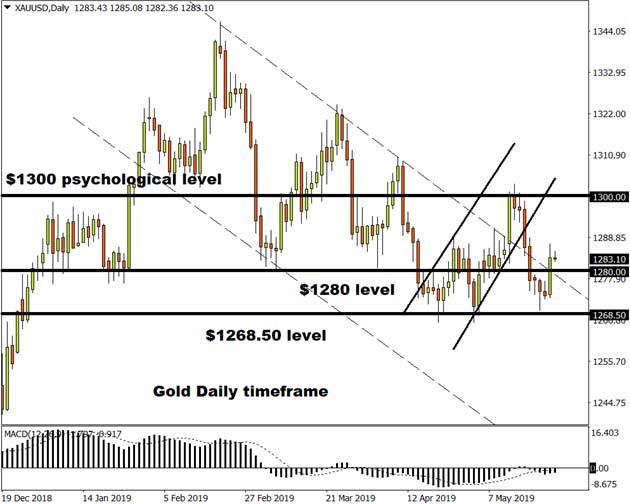
Gold flickered back to life yesterday as ongoing US-China trade tensions and Brexit drama accelerated the flight to safety. A depreciating Dollar supported upside gains with prices punching back above the stubborn $1280 resistance level. With speculation in the air of the Fed cutting interest rates this year and persistent concerns over slowing global growth weighing on risk sentiment, Gold’s medium to longer-term outlook remains tilted to the upside.
Taking a look at the technical picture, bulls seem to be back in the driving seat after prices pushed back above $1280. The daily close above this point is likely to signal a move higher towards $1300.