Sample Category Title
UK Hammond: Real risk of new PM seeking damaging no-deal brexit
According to pre-released extract of a speech on Tuesday, UK Chancellor of Exchequer Philip Hammond is set to criticize that advocating for "no deal" Brexit is to "hijack" the result of the Brexit referendum held nearly three years ago.
Hammond will said there are some "on the populist right" who claim that only leaving without a deal is a "truly legitimate Brexit". However, "the 2016 Leave campaign was clear that we would leave with a deal". Thus, "to advocate for 'no deal' is to hijack the result of the referendum, and in doing so, knowingly to inflict damage on our economy and our living standards. Because all the preparation in the world will not avoid the consequences of no deal."
Hammond will also warned that "there is a real risk of a new Prime Minister abandoning the search for a deal, and shifting towards seeking a damaging no-deal exit as a matter of policy ... in order to protect an ideological position which ignores the reality of Britain's economic interests and the value of our Union."
RBA Minutes Signal Easing Bias
RBA emphasises easing bias and highlights focus on the labour market in the period ahead.
The minutes of the May RBA Board meeting confirm that the Board holds a clear easing bias.
This is spelt out when the technical assumption that the cash rate followed the path implied by market pricing is used in the forecast.
As the minutes note “financial market pricing implied that the cash rate was expected to be lowered by 25bps within the next three months and again by the end of 2019”.
The Board notes that “without an easing in monetary policy over the next six months, growth and inflation outcomes would be expected to be less favourable than the central scenario”.
Recall that, the detailed forecasts which were printed in the Statement on Monetary Policy on May 10 highlighted GDP forecast growth at 2.6% and underlying inflation growth at 1.75% in 2019, lifting to growth of 2.75% and underlying inflation of 2% in 2020. These are barely acceptable forecasts with the 2019 forecasts being below trend for growth and below the bottom of the 2-3% target band for underlying inflation.
So the issue really becomes one of the profile for lower rates. Here, the minutes give considerable emphasis to the labour market. The Board points out that international experience suggests that inflation had remained low despite historically low rates of unemployment. It also notes that there is spare capacity in the Australian labour market which would remain for some time. Consequently, there is ample scope for policy to drive down the unemployment rate without overshooting the RBA’s inflation target. As such, the Board concluded that it was important to continue to pay close attention to developments in the labour market.
In the concluding paragraph of the Statement on Monetary Policy, the RBA noted that “a lower rate of unemployment is achievable while also having inflation consistent with the target”. The minutes also refer to the unemployment rate as the key indicator of labour market conditions.
Central banks always give a weighting to conditions in the global economy. Due to the continued disruption to international trade, the Board has noted downside risks to the global economy. We also note that the RBA significantly lowered its forecast for household consumption growth in the SMP from 2.5% in February to 2.0% in May and signalled downside risks.
Conclusion
On February 21, Westpac forecast that the RBA would cut the cash rate in two 25bps tranches in August and November. These forecasts have not changed since then. Subsequently, markets and most forecasters have moved largely towards the Westpac view of two cuts. Indeed, we are pleased that markets now fully pricing in 50bps of cuts by November.
Westpac will continue to monitor its forecasts in light of these minutes and further developments.
GBP/USD In Significant Downtrend, Could Test 1.2650
Key Highlights
- The British Pound declined heavily and broke the key 1.2870 support against the US Dollar.
- GBP/USD traded below a crucial triangle support at 1.2995 to start a sharp decline.
- The Chicago Fed National Activity Index in April 2019 declined from 0.05 to -0.45.
- The US Existing Home Sales might increase 2.6% in April 2019 (MoM).
GBPUSD Technical Analysis
This past week, the British Pound struggled to stay above the key 1.3000 support area against the US Dollar. As a result, the GBP/USD pair declined heavily below the 1.2920, 1.2870 and 1.2800 support levels.
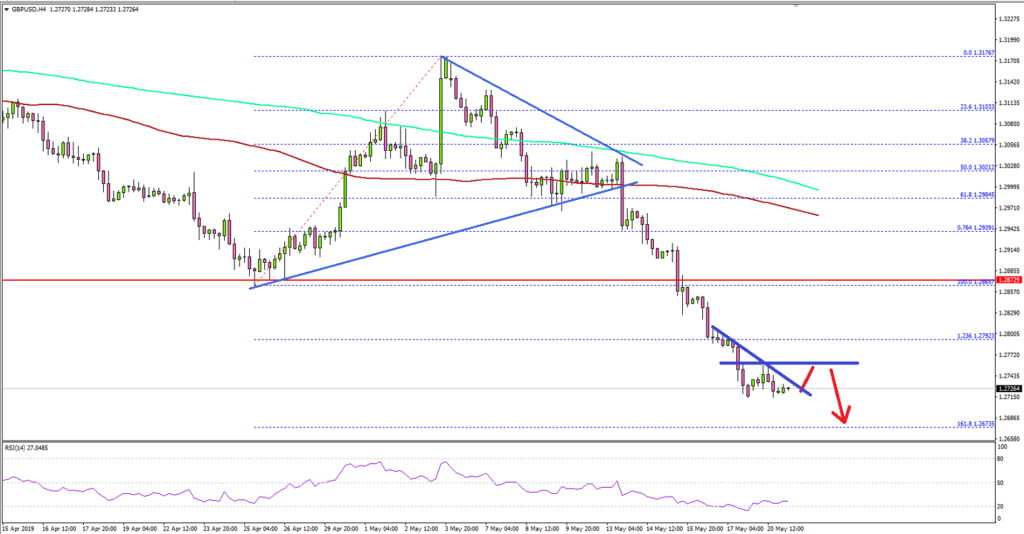
Looking at the 4-hours chart, the pair topped near the 1.3055 level and started a strong decline below the 100 simple moving average (4-hours, red). The decline was initiated after the pair traded below a crucial triangle support at 1.2995.
It opened the doors for a sharp decline below the key 1.2870 support level. The pair even settled below 1.2800 and the 1.236 Fib extension level of the upward move from the 1.2865 low to 1.3176 high.
The next stop for GBP/USD could be the 1.2650 support or the 1.618 Fib extension level of the upward move from the 1.2865 low to 1.3176 high at 1.2673. If there are more downsides, the pair could test the 1.2600 level.
On the upside, an initial resistance is near the 1.2775 and 1.2800 level. However, the main resistance is near 1.2870 (the previous support area). As long as the pair is below 1.2800 and 1.2870, GBP/USD remains in a downtrend and it could continue to decline in the near term.
Fundamentally, the Chicago Fed National Activity Index for April 2019 was released by Federal Reserve Bank of Chicago. The market was looking for a decline in the index from -0.15 to -0.33.
The actual result was disappointing, as there was a sharp decline in the Chicago Fed National Activity Index to -0.45. On the positive side, the past reading was revised up from -0.15 to 0.05.
The report added:
Three of the four broad categories of indicators that make up the index decreased from March, and two of the four categories made negative contributions to the index in April.
Overall, GBP/USD is clearly in a strong downtrend and the current technical indicators suggest more downside towards 1.2650 in the coming sessions. Similarly, there could be more downsides in EUR/USD towards 1.1100.
Economic Releases to Watch Today
- UK's Inflation Report Hearings.
- US Existing Home Sales Change April 2019 (MoM) – Forecast +2.6%, versus -4.9% previous.
RBA Removes Rhetoric of “No Strong Case” for Near-Term Rate Cut
RBA turned more dovish, than what was suggested in the meeting statement, in May. As the minutes revealed, policymakers expected to cut the policy rate if inflation remains weak while the unemployment rate climb higher. The latest economic forecasts, published two weeks ago, were based on the assumptions that interest rates would be lower in six months’ period, suggesting that the economic performance would falter if no monetary easing added. Moreover, the minutes dropped the reference that there’s no strong case for a near-term move in the monetary policy, giving more hints that policymakers are getting to act.
At suggested in the minutes, members judged that “a decrease in the cash rate would likely be appropriate” if “inflation did not move any higher and unemployment trended up”. While the members had noted in the accompanying statement that they would closely monitor the job market, and believed that improvement of which would help lift inflation, they did not suggest a rate cut would come. RBA’s forward guidance also retained that it is “appropriate” to stand on the sideline.
As revealed earlier this month, RBA revised lower its GDP growth forecast to 2.3% y/y for last year, compared with February’s projection of +2.75%. It, however, maintained the forecasts for 2019 and 2020 unchanged at 2.75%. The central bank expects the unemployment rate to remain around 5% over 2019 and 2020 before declining a little to 4.75% in 2021. Meanwhile, underlying inflation was expected to be 1.75% over 2019, 2% over 2020 and “a little higher after that”. Note, however, that the above forecasts were made based on market pricing of future policy rate, which suggested that interest rates would drop “over the next 6 months”. As indicated clearly in the minutes, “without an easing in monetary policy over the next six months, growth and inflation outcomes would be expected to be less favourable than the central scenario”.
In April’s minutes, RBA affirmed that “there was not a strong case for a near-term adjustment in monetary policy”. Removal of this reference in the May minutes reinstate that the possibility of a rate cut has increased in coming months.
GOLD Looks To Decline Further On Medium Term Bear Pressure
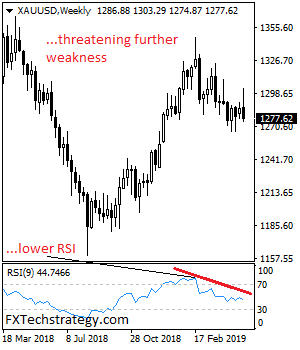
GOLD looks to decline further on medium term bear pressure following its lower close the past week. On the downside, support comes in at the 1,270.00 level where a break will turn attention to the 1,260.00 level. Further down, a cut through here will open the door for a move lower towards the 1,250.00 level. Below here if seen could trigger further downside pressure targeting the 1,240.00 level. Conversely, resistance resides at the 1,290.00 level. Further out, resistance resides at the 1,300.00 level where a break will aim at the 1,310.00 level. A turn above there will expose the 1,320.00 level. Further out, resistance stands at the 1,330.00 level. All in all, GOLD looks to decline further on medium term bear pressure.
Daily Markets Broadcast
Wall Street shudders as it digests Huawei developments
US indices fell yesterday, with the tech-heavy NAS100 index under-performing on the back of Huawei’s blacklisting by the US as chip suppliers were impacted. Australian shares rallied after the Conservative coalition won the election.
US30USD Daily Chart
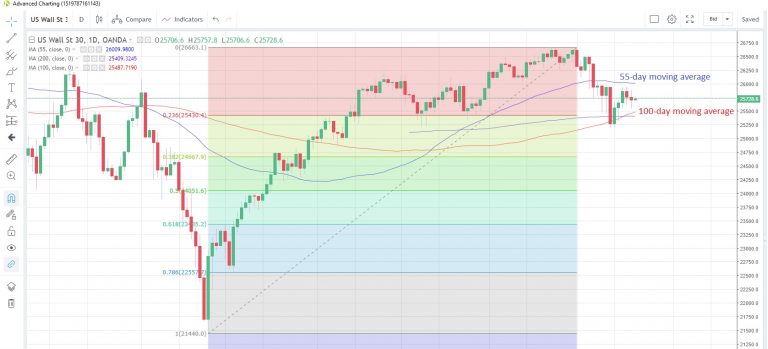
The US30 index fell for a second consecutive day yesterday on Huawei developments. China stated it would respond accordingly
The index is holding above the 100-day moving average at 25,487 wile the 55-day moving average caps for now at 26,009
US existing home sales probably rose 2.6% m/m in April, according to the latest poll of economists, rebounding from March’s 4.9% decline.
DE30EUR Daily Chart
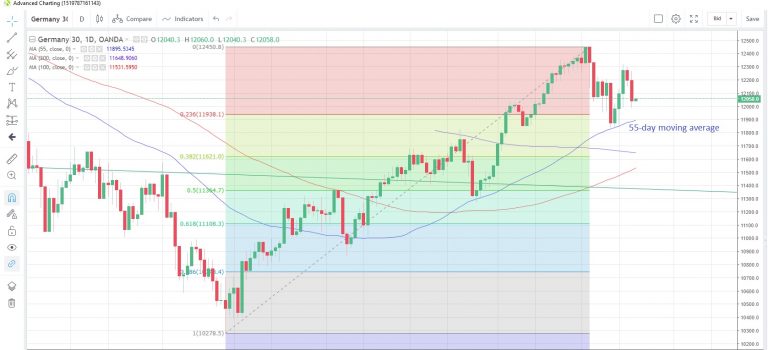
The Germany30 index fell the most in a week yesterday as European chip makers came under pressure following the Huawei developments
The 55-day moving average at 11,895 continues to support prices, as it has done on a closing basis since February 8
There are no major data releases from either the Euro-zone or Germany scheduled for today. German factory gate prices rose 0.5% m/m in April, faster than expected, data released yesterday showed.
AU200AUD Monthly Chart
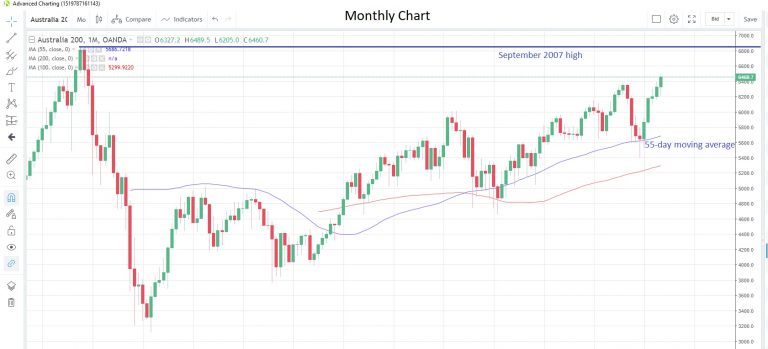
Australian shares rose 1.22% yesterday in response to the Conservative coalition winning the weekend election. The coalition’s election manifesto included tax cut promises
The index hit the highest level since December 2007 with the September 2007 high of 6.596 the next possible resistance point
RBA Governor Lowe is scheduled to speak at 0310mGMT today and his comments will be scrutinised for dovish leanings, or not, given the prospect of tax cuts boosting the economy. A more hawkish bias could stem the AU200 index’s current rally.
The Empire Strikes Back?
The empire strikes back?
Trade tensions reasserted their dark cloud over markets last night with the effect of the US Government Huawei ban rippling through technology stocks in particular. Investors marked down technology and semiconductor stocks not only on the prospect of lost sales to the Chinese telecom giant but also because these sectors may be the first in the firing line for any Chinese retaliatory measures. The spillover was also felt in the energy markets where concerns over global growth overwhelmed the initial rally sparked by OPEC+’s intentions to keep production tight.
The US-China trade war is in danger of assuming Brexit-like characteristics – long and drawn out with a series of false dawns, but with no discernible progress made after a lot of emotional noise. China has been remarkably quiet on the retaliation front, but I suspect that won’t last for long now. When it does come, its effect on markets could be more powerful initially than recent US measures as the world’s attention has been on America’s punch combinations and not its opponents.
US treasuries, Japanese JGBs and German bunds may remain the favoured safe harbours for investors, with flows continuing into US dollars, Japanese yen (JPY) and Swiss francs (CHF). Some things never go out of fashion and in times of trouble, you can always rely on the classics.
The performance of European and North American stock markets overnight will most likely snuff out the feel-good election rallies we saw in India and Australia yesterday, also weighing on regional markets. A very quiet day data-wise means the street will have plenty of time to ponder trade-war scenarios and their implications for the global economy. The answers won’t be good.
FX
The US dollar was mostly unchanged against the major currencies overnight with the action contained to equity markets. As the US ratchets up the pressure yet again on China, regional currencies may feel the heat today in the absence of any heavyweight Asian data releases. With its high correlation to China, the Australian dollar (AUD) may struggle to hold onto its post-election gains above 0.6900.
Equities
The S&P fell 0.70%, the Dow Jones dropped 0.30% and the tech-heavy Nasdaq plummeted 1.50% as the ramifications of the Huawei ban surged through the markets. The price action in the technology and semiconductor sub-indices was even uglier, the feeling being that US technology companies will be on the front line of any retaliatory measures by China.
The results should be predictable for Asian stock markets today. The Australian ASX and Japan Nikkei are already trading slightly in the red and Asia will probably be a sea of red this morning as regional markets open. Any salvos from China on the trade war front could deepen the malaise.
Oil
It was a game of two halves for energy markets overnight. Both Brent Crude and WTI rose strongly post the OPEC+ weekend meeting that reaffirmed production cuts. The rally soon spluttered though as a dig into the Saudi Oil Ministers comments, which highlight the fragile nature of the global economy, saw sentiment swing.
Global growth concerns saw Brent Crude turn and fall 0.20% to USD72.00 a barrel while WTI maintained some gains, rising 0.60% to USD63.10 a barrel. The divergence is likely a function of the outperformance of the US economy vis-a-vis the rest of the world.
Unless we see a surprise headline or two from the Middle East, Asia will likely continue on a similar theme and be inclined to sell rallies. That could accelerate on any retaliatory announcements from China.
Gold
Gold continues to doggy paddle furiously and is clearly not going to sink without a fight, fighting off an initial sell-down and swimming its way back to the surface, finishing unchanged at USD1,278.00 an ounce. The price action remains unimpressive with the yellow metal struggling to find any safe-haven benefit from the global economic tensions of recent times. The rise in cryptocurrencies over the same period may give some insight into where those flows are now going.
Asia is likely to be happy to sell rallies above USD1,280.00 today in keeping with that theme. The USD1,265.00 region remains critical longer-term technical support.
Aussie Rebounds After Surprise Election Win For PM Morrison
AUD/USD continues to lose ground this week. Currently, the pair is trading at 0.6911, up 0.62% on the day. On the release front, there are no data releases out of the U.S. or Australia. Later on Monday, the RBA releases the minutes of the policy meeting earlier this month. On Tuesday, the U.S. posts existing home sales.
Australian employment numbers were mixed last week. The economy created 28.4 thousand jobs in April, marking a 3-month high and crushing the estimate of 15.2 thousand. However, the unemployment rate climbed to 5.2%, higher than the estimate of 5.0%. This is the highest level since August. Meanwhile, wage growth has remained fairly steady. Wage price index remained pegged at 0.5% for a second straight quarter. The key indicator has posted gains of 0.5% or 0.6% since the last quarter of 2016.
The Australian general election was a shocker, as Prime Minister Scott Morrison’s conservatives had been widely expected to lose to the center-left Liberals. Morrison had trailed badly in the polls throughout the campaign, but came from behind in stunning fashion to pull off the victory. The markets reacted favorably to the election results, and AUD/USD climbed as high as 1.0% on Monday. The pair is coming off a dismal week, falling 1.9%. This marked its sharpest decline since early February.
Federal Reserve Chair Jerome Powell will speak at an event on Monday, and there are a dozen Fed speakers at various venues during the week. Still, investors don’t expect to hear anything new from the Fed, which has said that the next rate move could be in either direction. The markets have priced in a rate cut later this year, and some analysts are predicting a second rate cut before 2020. This could take dampen enthusiasm for the strong U.S. dollar, as rate cuts would make the greenback less appealing to investors.
Eco Data 5/21/19
[php_everywhere instance="1"]
World Trade Outlook Indicator stays at nine-year low, significant risks on the downside
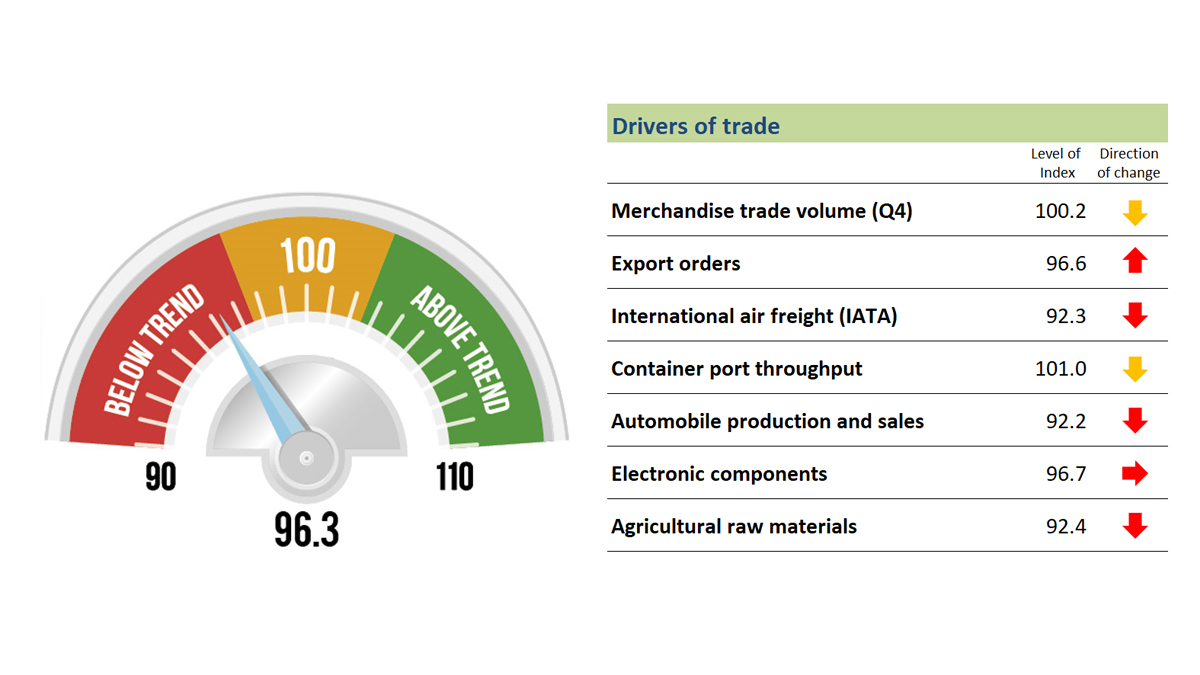
World Trade Outlook Indicator (WTOI) is unchanged at 96.3 in May, same as February's reading, which was the lowest level since 2010. The indicator suggests that world trade growth is likely to remain weak into Q2. Also, recent major trade measures announced were not included in the the calculations yet. Thus, outlook would worsen further ahead if heightened trade tensions are not resolved or if macroeconomic policy fails to adjust to changing circumstances.
WTO also recapped that in the April forecasts, global merchandise trade growth would slowed to 2.6% in 2019, down from 3.0% in 2018. Though, rebound is expected to 3.0% in 2020. However, "there are significant downside risks to the 2019 forecast. Any rebound in 2020 would depend on reduced trade tensions and/or improved macroeconomic performance. "