Sample Category Title
Risk Aversion Dominates as Huawei Situation Intensifies
The Chinese-US trade war intensified on Monday as Huawei’s suppliers stopped doing business with the telco giant. The fallout could really accelerate risk off flows as China’s response is expected to be to suspend business with all suppliers who agreed to halt supplying Huawei.
European indexes are all selling off on the trade war angst and the US markets are all expected poised to open down, with the Nasdaq being hit the hardest. Safe-haven flows are driving the Japanese yen and Swiss franc higher, while gold prices struggle to breakout higher. Oil prices were supported by this weekend’s comments from Jeddah.
Five Key Stories for Monday:
- Huawei/Iran – Tech stock blood bath
- Oil – OPEC hints at keeping cuts
- Fed Speak – Powell, Clarida and Broadbent may hint at dovish tilt
- Aussie and Indian elections – Markets like election outcomes
- Gold and Bitcoin – Cryptos behaving more like a safe-haven
Huawei/Iran
Risk aversion flows were the dominant theme to start the trading week as the trade war between the two largest economies saw the ripple effect on the US restrictions that were put on Huawei. The White House decision on Huawei is expected to see a Chinese response and this could drive US stocks below last week’s low. According to Bloomberg, Google, Intel, Qualcomm, Xilinx, Broadcom, and Infineon all froze supplies of critical software and components to the giant Chinese telco.
The trade war is getting uglier and even if we do see some framework agreement reached by the middle of summer, the damage will be done to global growth figures for the second quarter. All current trade talks appear to be halted and we could see continued selling until we a de-escalation with this protectionist showdown.
The other wildcard for risk aversion is the growing tensions between Iran and the US. Over the weekend, Iran fired a rocked into the heavily fortified Green Zone in Baghdad, just 0.3 miles away from the US embassy. President Trump tweeted, “If Iran wants to fight, that will be the official end of Iran. Never threaten the United States again!” Iran’s foreign minister Zarif dismissed Trump’s taunts and we should not be surprised to see Iran step down from its recent behavior. If we see continued military threats by Iran, we could see this escalate into war, something markets have not really considered to price in.
Oil
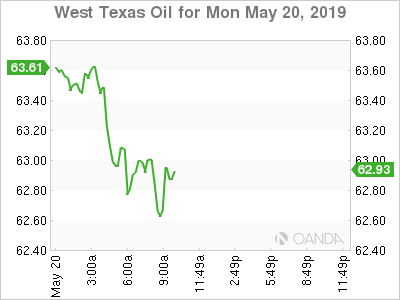
Crude prices initially rose sharply after both OPEC + indicated they want to stick to the current plan of production cuts for the rest of the year and tensions remained elevated between the US and Iran. The Saudi-led coalition discussed production levels, the Iran situation, and how much further they could drive down inventory levels. Saudi’s Al-Falih stated that Saudi Arabia will take an additional month of observing production cuts in July to observe the situation, hoping their colleagues will do the same.
The physical market remains tight, OPEC + compliance was last at 168%, but global growth demand is being dealt a blow by global trade wars and it will be hard to imagine other countries will be content with Saudi Arabia taking up all the loss oil from Iran. The path for oil is still likely higher due to supply risks from Iran, Venezuela and Libya, but we will likely see volatile moves until both the trade war is resolved and oil markets price in the risk that the OPEC + could fall apart if Russia decides to ease production cuts.
Fed Speak
Most analysts expect Fed speakers this week to stay consistent and maintain the stance that interest rates remain on hold. Recent developments however, with the trade war and global weakness, could allow the Fed to deliver a fresh dovish tilt that could allow them to catch up to the market. Fed Fund futures are currently only showing a 9.5% chance of a rate cut at the June 19th meeting and a coin flip at the September 18th meeting.
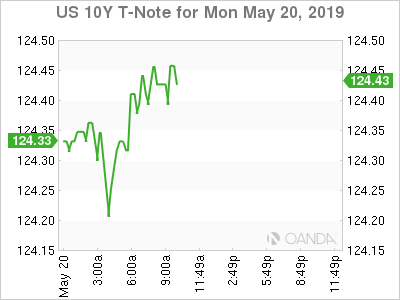
Markets will closely listen to Vice Chair Clarida’s (1:05pm ET) and Fed Chair Powell’s (7:00pm) comments today. The data dependent Fed may need to see trade talks collapse, before cutting but with the recent actions taking place with the Huawei situation, growth will be weaker globally, and the data will be much weaker in the second quarter thus warranting a cut at the end of summer.
Elections AU/IN
Morrison and Modi victories are delivering a nice boost to Australian and Indian stock markets.
The bigger surprise was from Australia. Election analysts got another election wrong, mirroring the surprise we saw with Brexit and Trump, as pollsters were calling for Morrison’s right-leaning coalition to lose for months. Australian’s chose to ignore turmoil that saw Morrison’s coalition go through three prime ministers in six years. His promise for lower energy costs, help for first-time homeowners and criticism of Labor’s initiatives and the effects on the budget appeared enough to win over voters. Tax relief is expected to be implemented early as next month. Markets are loving Australian assets today, and the A$ could have a key bottom in place if we do not see a complete catastrophic outcome from the US/China trade war.
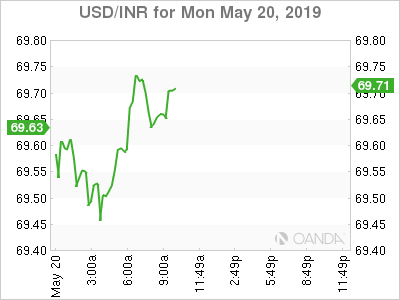
India’s exit polls saw Prime Minister Narendra Modi’s set for a decisive victory in India’s general election. An impressive victory during a time when unemployment is off the charts and the rural sector continues to struggle. It appears, Modi will now be able to move forward on infrastructure investments, assistance for farmers and policies that appeal to Hindu nationalists. The rupee is 0.7% firmer against the dollar, but off its session highs.
Gold/Bitcoin
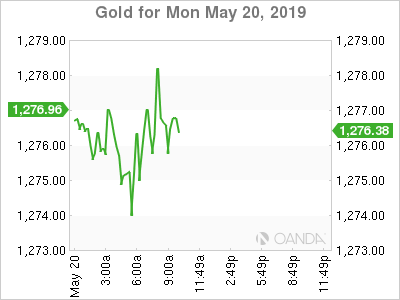
Gold prices are slightly firmer despite an overall risk off start to the trading week. Disinflationary conditions persist and until the Fed confirms what the markets are heavily pricing in, we could see the yellow metal struggle.
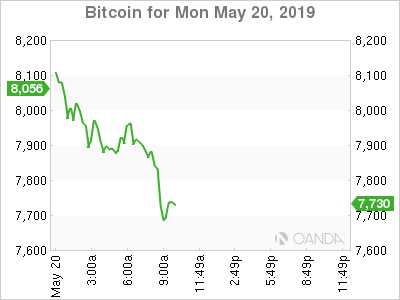
Bitcoin is up 8.5%, in early volatile trade displaying better safe-haven appeal than gold prices. The bubbly asset has had an amazing rally in recent weeks, but many are calling the recent moves similar to what we saw in 2017, before things collapsed. Momentum could see Bitcoin hit $10,000 before collapsing.
US 30 Index Eases Inside Ichimoku Cloud; Fails to Improve
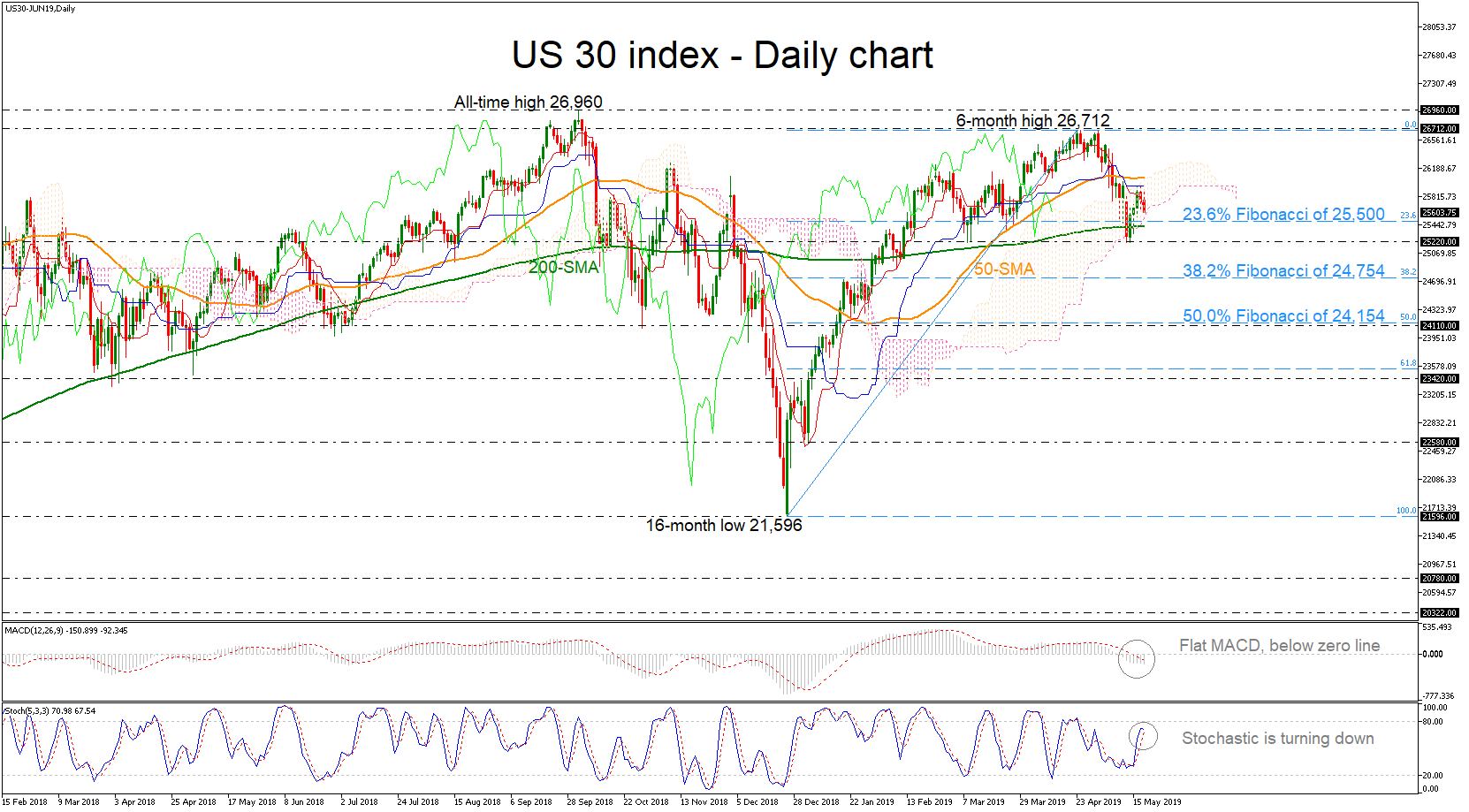
The US 30 index is trading below the six-month high of 26,712, struggling within the Ichimoku cloud and the between the 50- and 200-simple moving averages (SMAs). The index is on the back foot and the technical indicators suggest that the market could ease a little bit in the short-term; the MACD is flattening in the negative zone, while the stochastic looks be losing momentum.
In case of a correction lower, preliminary support may be initially found near 25,500 which is where the 23.6% Fibonacci retracement level of the upleg from 21,596 to 26,712 and the 200-day SMA are currently located. Falling towards 25,220, the medium-term picture would shift from bullish to neutral as well as touch the 38.2% Fibonacci of 24,754.
On the other hand, if the bulls take control, immediate resistance could come around the 50-day SMA currently at 26,072. If buyers pierce above that, the next obstacle may be the six-month high of 26,712, where the rally topped on April 24.
Summarizing, in the near-term, the momentum indicators point to a possible bearish retracement and if there is a drop below 25,220, this could open the door for further losses.
USD/CHF Mid-Day Outlook
Daily Pivots: (S1) 1.0089; (P) 1.0106; (R1) 1.0126; More...
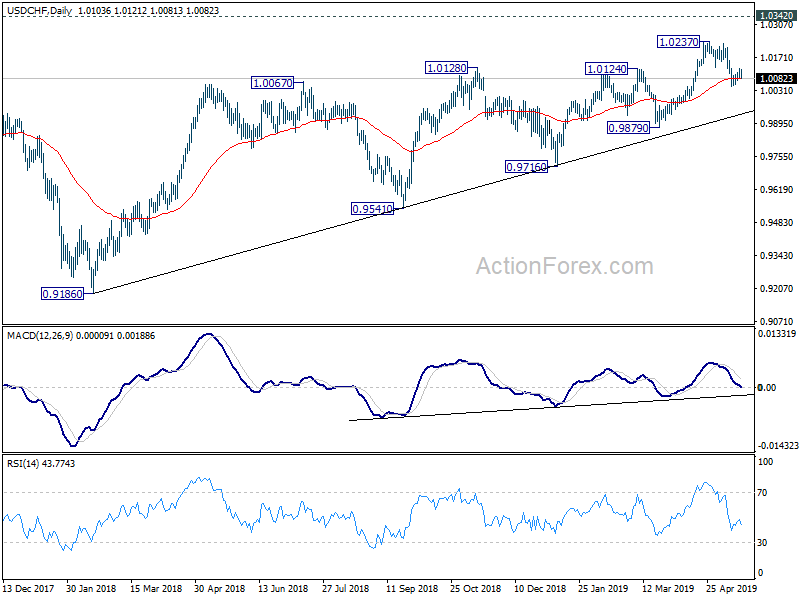
USD/CHF weakens mildly after failing to break 4 hour 55 EMA. But it's staying above 1.0050 temporary low and intraday bias remains neutral. Further decline remains mildly in favor as long as 1.0126 support turned resistance holds. On the downside, break of 1.0050 will resume the fall from 1.0237 to retest 0.9879 key support. However, firm break of 1.0126 will turn bias back to the upside for 1.0237 resistance.
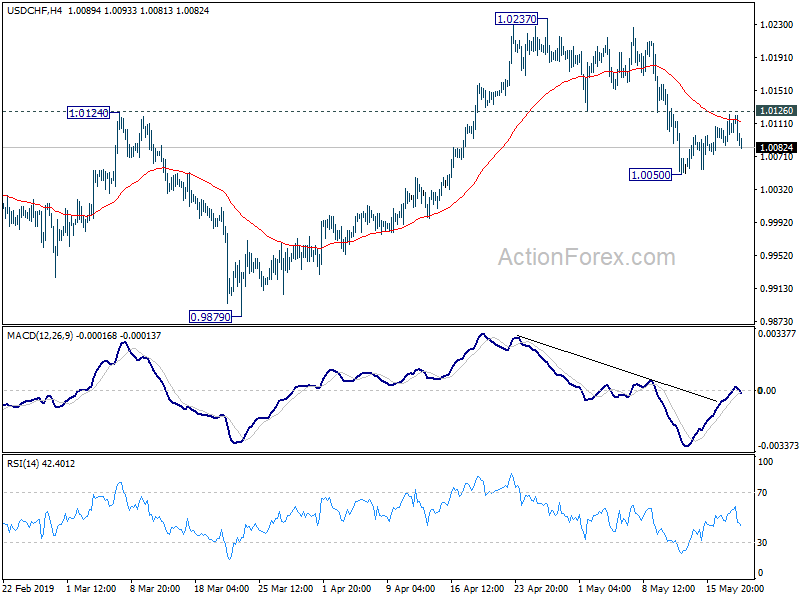
In the bigger picture, as long as 0.9879 support holds, medium term up trend form 0.9186 is still in progress. Break of 1.0237 will target 1.0342 resistance next. For now, we'd be cautious on strong resistance from there to limit upside, until we see medium term upside acceleration. However, decisive break of 0.9879 will be a strong sign of medium term reversal. Focus will be turned back to 0.9716 support for confirmation.
US-China Trade War Intensifies with Huawei Isolation, Currency Markets Shrug Risk Aversion
US-China trade war remains a dominant theme in the global financial markets today. Words from both sides continued to indicate hard line stances. It doesn't quite matter how much close to facts are their rhetorics. What matters most is that neither the US or China is going to back down for now. More importantly, after Trump's double efforts to isolate Huawei, global tech companies are starting to halt supplies to the Chinese telecom giant. Those companies include Intel, Qualcomm, Broadcom, Germany's Infineon. And, even Google is said to halt support on its Android platform. US-China tension will only get worse.
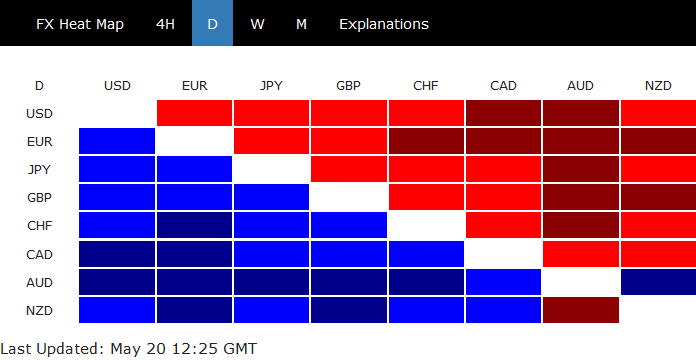
Nevertheless, while risk aversion is seen in Europeans stocks while US futures point to lower open, the currency markets shrug it off. Australian Dollar remains the strongest one for now, as lifted by election results over the weekend. New Zealand and Canadian Dollars follow as next strongest. There is no apparent strength in Yen for today. Instead, Dollar, Euro and Yen are so far the weakest.
Technically, while Yen is mildly lower today, there is now sign of bottoming in Yen crosses yet. We'd still expect more decline in USD/JPY, EUR/JPY and GBP/JPY ahead. 109.02 in USD/JPY, 122.08 in EUR/JPY and 139.54 in GBP/JPY will be watched for declines resumption. Sterling also looks generally weak too on revival of no-deal Brexit. GBP/USD is staying in near term decline, and EUR/GBP is staying in near term rally.
In Europe, currently, FTSE is down -0.84%. DAX is down -1.77%. CAC is down -1.74%. German 10-year yield is up 0.013 at -0.088. Earlier in Asia, Nikkei rose 0.24%. Hong Kong HSI dropped -0.57%. China Shanghai SSE dropped -0.41%. Singapore Strait Times dropped -0.77%. Japan 10-year JGB yield rose 0.008 to -0.047.
China: Trump had extravagant expectations for achieving unreasonable interests through extreme pressure
China hit back on Trump's claim that there was "very strong deal", a "good deal" that the formed changed, leading to higher tariffs on Chinese imports. Foreign Ministry spokesman Lu Kang said: "We don't know what this agreement is the United States is talking about. Perhaps the United States has an agreement they all along had extravagant expectations for, but it's certainly not a so-called agreement that China agreed to."
Lu also criticized that the US tried to "achieve unreasonable interests through extreme pressure". And, "from the start this wouldn't work."He also reiterated "China-U.S. economic and trade consultation can only follow the correct track of mutual respect, equality and mutual benefit for there to be hope of success."
EU businesses saw forced technology transfer in China persisted, at double rate
In a survey the European Union Chamber of Commerce in China, EU companies are generally sceptical on whether China will release open up market assess. European businesses continued to witness "sustained support for state-owned enterprises, higher incidences of unfair technology transfers and the strengthening of the Communist Party's role in business." It's also noted that "one of the more significant shortcomings of China's reform agenda is that certain high-level promises to improve its business environment for international companies have failed to translate into concrete action."
More importantly, European Chamber Vice President Charlotte Roule complained that "our members have reported that compelled technology transfers not only persist, but that they happen at double the rate of two years ago." And, "it is unacceptable that this practice continues in a market as mature and innovative as China,"
Here are some highlights of the survey results:
- Optimism on growth over the next two years dropped from 62% in 2018 to 45% in 2019.
- 47% of respondents expect the number of regulatory obstacles to increase in the next five years, and 25% expect the number will stay the same.
- About half of respondents expect it will take five years to see competitive neutrality realized, while a third never expect it to be realized.
- 20% of respondents felt compelled to transfer technology as a condition for market access, nearly two thirds of which occurred over the last two years, and a quarter of which were taking place at the time the survey was being conducted.
Bundesbank: Downturn forces prevalent in Germany industry, may intensify somewhat
Germany's Bundesbank said in the monthly report that the rebound in Q1 was largely due to one-off factors. Underlying momentum in the economy remained weak and growth might not sustain.
It noted that "these effects, which had largely driven growth after the turn of the year, are expected to lapse or even reverse... Moreover, downturn forces continue to be prevalent in industry, and they may even intensify somewhat."
In addition, automakers were facing weaker external demand. Global car sales were expected to contract further in 2019, extending the drop in 2018.
USTR Lighthizer said to meet Japan Motegi on May 24, dashing to close trade deal
It's reported, without confirmation yet, US Trade Representative Robert Lighthizer will travel to Japan on May 24. He will meet Japanese Economy Minister Toshimitsu Motegi to resume trade negotiations. Trump declared auto-imports as threat to national security last week. And Lighthizer will have 180 days to complete the trade agreement. Otherwise, Trump might start imposing tariffs on autos and parts from Japan.
Kenji Wakamiya, chairman of the lower house of parliament's foreign affairs committee, said he expected Trump would not be as tough on Japan as it had been on China. He added US could demand Japan set targets on US productions by their automakers. However, he warned that "it would be difficult for the Japanese government to tell carmakers what they should do. They have their ideas and shareholders ... So it won't be easy.
Separately, the claim of auto imports as national security threat to US infuriated Japanese maker Toyota Motor. Toyota said in a statement last Friday that Trump's proclamation "sends a message to Toyota that our investments are not welcomed, and the contributions from each of our employees across America are not valued."
Japan reported strong 0.5% headline GDP growth, but consumer and business spendings contracted
Japan's economy showed surprising resilience even though there were speculations of contractions. Q1 GDP grew 0.5% qoq versus expectations -0.1% qoq. Annualized, GDP grew 2.1%. However, the details are rather weak indeed. Consumer spending dropped -0.1% qoq. Business spending also dropped -0.3% qoq. Exports also had the biggest contraction since 2015. The figures argue that Japan might be entering into a mild recession
Economy Minister Toshimitsu Motegi, nevertheless, hailed that Japan's economic fundamentals remain sound, supported by strong domestic demand, which is continuing up trend. Also, employment and income environments have improved while corporate profits are high.
Though, the government will watch the impact of trade tensions carefully. Exports are already slowing, and output remains weak due to China's economic slowdown. Some manufacturers are also delaying capital spending, leading to decline in capital expenditure.
Australian Dollar rebounds on election results, upside capped by RBA and trade
Australian Dollar spikes higher today after the central-right coalition's surprising victory in the elections over the weekend, securing an outright majority too. The Liberal-Party led coalition is seen by some economists as better manager of the economy. Also, returning to power, the coalition will continue with their promised tax cuts on July 1. That's seen by some as stimulus equivalent to a 25bps rate cut, without the cut of course.
Nevertheless, upside in Aussie is so far limited. There are two major factors that's clouding the outlook. Firstly, RBA Governor Philip Lowe Philip Lowe will deliver a speech on Tuesday. After surprised jump in unemployment rate in April, there are speculations that Lowe could make use of the occasion to chart out the course for rate cuts in the second half of the year. Secondly, after recent escalations in US-China trade war, there is only one way to go in tensions between the two countries. Relationships will only worsen.
USD/CHF Mid-Day Outlook
Daily Pivots: (S1) 1.0089; (P) 1.0106; (R1) 1.0126; More...
USD/CHF weakens mildly after failing to break 4 hour 55 EMA. But it's staying above 1.0050 temporary low and intraday bias remains neutral. Further decline remains mildly in favor as long as 1.0126 support turned resistance holds. On the downside, break of 1.0050 will resume the fall from 1.0237 to retest 0.9879 key support. However, firm break of 1.0126 will turn bias back to the upside for 1.0237 resistance.
In the bigger picture, as long as 0.9879 support holds, medium term up trend form 0.9186 is still in progress. Break of 1.0237 will target 1.0342 resistance next. For now, we'd be cautious on strong resistance from there to limit upside, until we see medium term upside acceleration. However, decisive break of 0.9879 will be a strong sign of medium term reversal. Focus will be turned back to 0.9716 support for confirmation.
Economic Indicators Update
| GMT | Ccy | Events | Actual | Forecast | Previous | Revised |
|---|---|---|---|---|---|---|
| 23:01 | GBP | Rightmove House Prices M/M May | 0.90% | 1.10% | ||
| 23:01 | GBP | Rightmove House Prices Y/Y May | 0.10% | -0.10% | ||
| 23:50 | JPY | GDP Q/Q Q1 P | 0.50% | -0.10% | 0.50% | |
| 23:50 | JPY | GDP Deflator Y/Y Q1 P | 0.20% | 0.20% | -0.30% | |
| 4:30 | JPY | Industrial Production M/M Mar F | -0.60% | -0.90% | ||
| 6:00 | EUR | German PPI M/M Apr | 0.50% | 0.30% | -0.10% | |
| 6:00 | EUR | German PPI Y/Y Apr | 2.50% | 2.40% | 2.40% | |
| 8:00 | EUR | Eurozone Current Account (EUR) Mar | 24.7B | 24.2B | 26.8B | 27.9B |
GBPCAD Hovers Near 3-Month Low
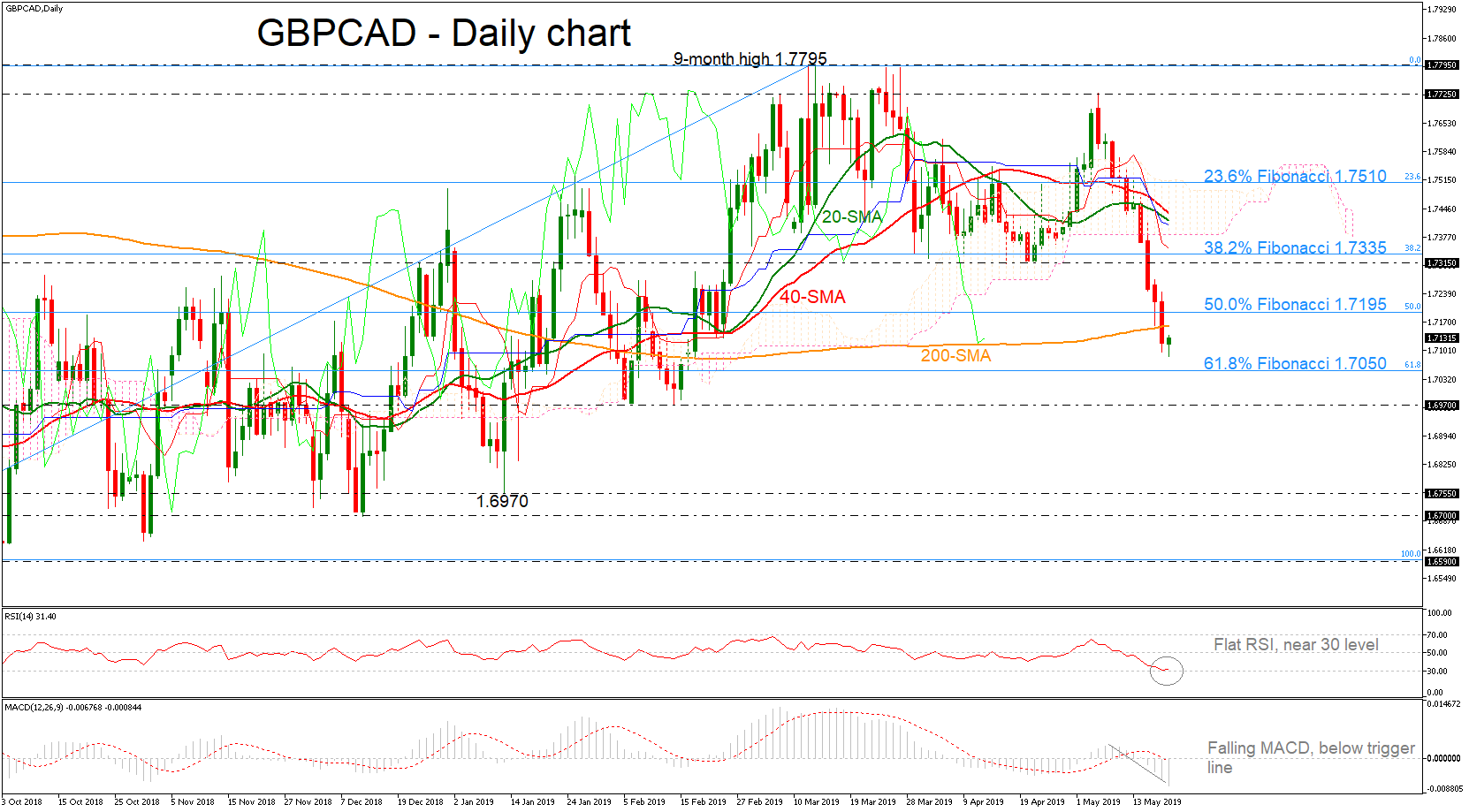
GBPCAD plunged below the 50.0% Fibonacci retracement level of the upleg from 1.6590 to 1.7795 and the 200-day moving average. Currently, the price is developing beneath the Ichimoku cloud, while the 20- and 40-simple moving averages (SMAs) are turning lower. The RSI indicator is flattening just above 30 oversold level while the MACD is strengthening its negative momentum.
In case of more decreases, the price could meet the 61.8% Fibonacci of 1.7050, posting a new three-month low. A break lower, could last until the 1.6970 support, identified by the lows on February 14.
Alternatively, if the pair changes its short-term direction to the upside, the bulls would probably challenge the 200-day SMA, currently at 1.7160, before touching the 50.0% Fibonacci of 1.7195. More bullish actions could push the market until the 1.7315 resistance.
In brief, in the short-term picture, the negative tendency is still in play following the pullback on 1.7725, while in the medium-term timeframe the market holds neutral unless the price drops below 61.8% Fibonacci, in which case the outlook would turn bearish.
Into US session: Aussie stays firm despite risk aversion, stocks weighed down by Huawei isolation
Entering into US session, European stocks are trading broadly lower while US futures also point to lower open. Sentiments are hurt as US is stepping up measures to isolate China's telecom giant Huawei as trade war intensifies. Chipmakers including Intel, Qualcomm, Broadcom indicated that they will stop supply to Huawei. Germany's Infineon Technologies is also reported to have halted shipments to the Chinese company. But most importantly, Google will also cut up supply of hardware and some software services.
However, the reactions in currency markets are relatively muted. Australian Dollar remains the strongest one, as boosted by election results over the weekend. New Zealand and Canadian Dollars follow. There is no apparent lift on Yen and Swiss Franc despite risk aversion. On the other hand, Dollar, Euro and Yen are the weakest ones for now.
In Europe, currently:
- FTSE is down -0.96%.
- DAX is down -1.50%.
- CAC is down -1.61%.
- German 10-year yield is up 0.0105 at -0.091.
Earlier in Asia:
- Nikkei rose 0.24%.
- Hong Kong HSI dropped -0.57%.
- China Shanghai SSE dropped -0.41%.
- Singapore Strait Times dropped -0.77%.
- Japan 10-year JGB yield rose 0.008 to -0.047.
Bundesbank: Downturn forces prevalent in Germany industry, may intensify somewhat
Germany's Bundesbank said in the monthly report that the rebound in Q1 was largely due to one-off factors. Underlying momentum in the economy remained weak and growth might not sustain.
It noted that "these effects, which had largely driven growth after the turn of the year, are expected to lapse or even reverse... Moreover, downturn forces continue to be prevalent in industry, and they may even intensify somewhat."
In addition, automakers were facing weaker external demand. Global car sales were expected to contract further in 2019, extending the drop in 2018.
ECB de Cos: European financial system remains fragile and fragmented
ECB Governing Council member Pablo Hernandez de Cos warned that the European financial system remains fragile and fragmented because of "the doom-loop between sovereigns and banks."
He added, "investment portfolios are not well diversified and investment opportunities are lost as these may not always be matched with savers' funds.
He also emphasized the need to strengthen European regulations. "As European markets become more integrated and technologically complex, this is becoming a more essential element that policy-makers need to address," he said.
Japanese GDP Figures Surprise, Yet A Sluggish Outlook Remains
A lull on the front of negative trade war headlines are giving markets a little pause. JPY extends decline for a third session, pushing USD/JPY back above the 110 level (USD/JPY: +0.37% year-to-date). The recent release of 1Q GDP growth data also had a muted impact on financial markets, as Japanese Nikkei 225 index closed +0.24% while European equities opened flat ahead of EU elections kicking off on Thursday.
Japan’s economy unexpectedly grew in 1Q 2019 at an annualized rate of 2.10% (prior: 1.90%), largely above forecasts of a contraction of -0.20%, providing PM Shinzo Abe with solid arguments to ramp up the hike in consumption tax to 10% from actual 8% in October of this year. Yet when looking closer at the underlying components of the metric, there are good reasons to question the trend of a potential economic recovery. Major contributors of the result are the net export balance, although both exports and imports quarterly figures dropped by -2.40% and -4.60% respectively while the latter suggests a major drop in domestic demand. Indeed, private consumption dropped by as much as -0.10% (prior: 0.20%), private non-residential investment decreased by -0.30% (prior: 2.50%) while an unusual contribution of public investment of 1.50% (prior: -1.40%) due to last year natural disasters came supporting the data. There is therefore much signs of growth uncertainty when it comes to the outlook in 2Q 2019. Despite improving corporate sentiment, risks over US - China trade frictions could accelerate the drawdown in external trade. Trump – Shinzo Abe meeting in Tokyo scheduled for 27 May 2019 is not expected to deliver a joint statement with regard to US trade deficit, as divergences, including the file on North Korean missile launch remain. Risks on JPY should thus not be ruled looking forward.
Currently trading at 110.06, USD/JPY is expected to trade sideways short-term.
EURUSD 1.1110 Bearish Target
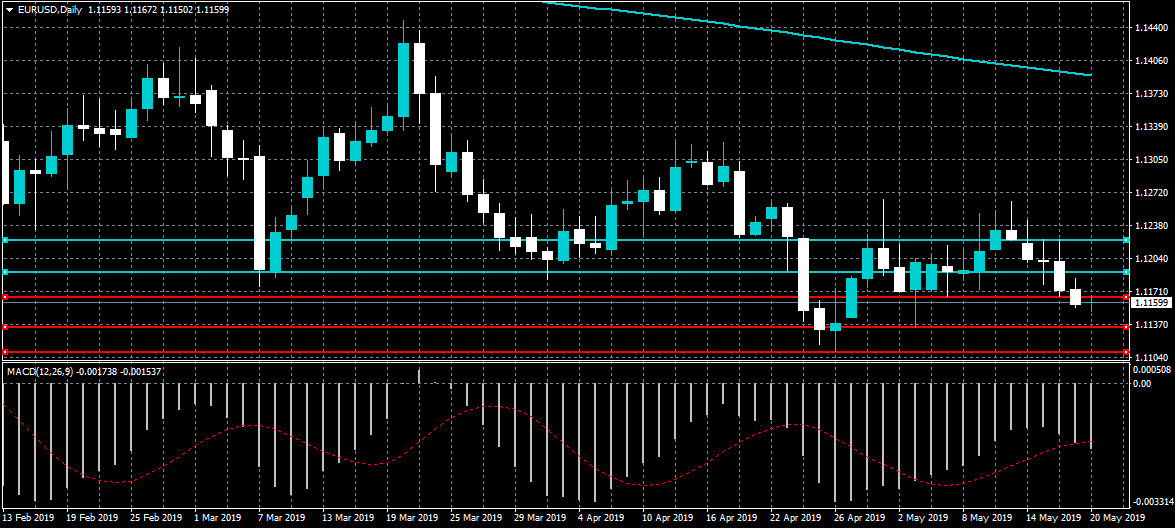
The euro currency has remained under pressure against the greenback during the European trading session, following the recent bearish range break below the 1.1165 level. Continued weakness below the 1.1165 level will likely prompt a technical test of the 1.1110 support level. The bearish pattern on the daily time frame is highlighting the 1.1060 level as a potential weekly downside target.
The EURUSD pair is heavily bearish while below the 1.1165 level, key technical support is found at the 1.1110 and 1.1060 levels.
If the EURUSD pair moves above the 1.1165 level, key technical resistance is found at the 1.1190 and 1.1234 levels.