

Sample Category Title
Crude Oil: Oil Trading Marginally Lower, Ahead Of API’s Weekly Inventories Data
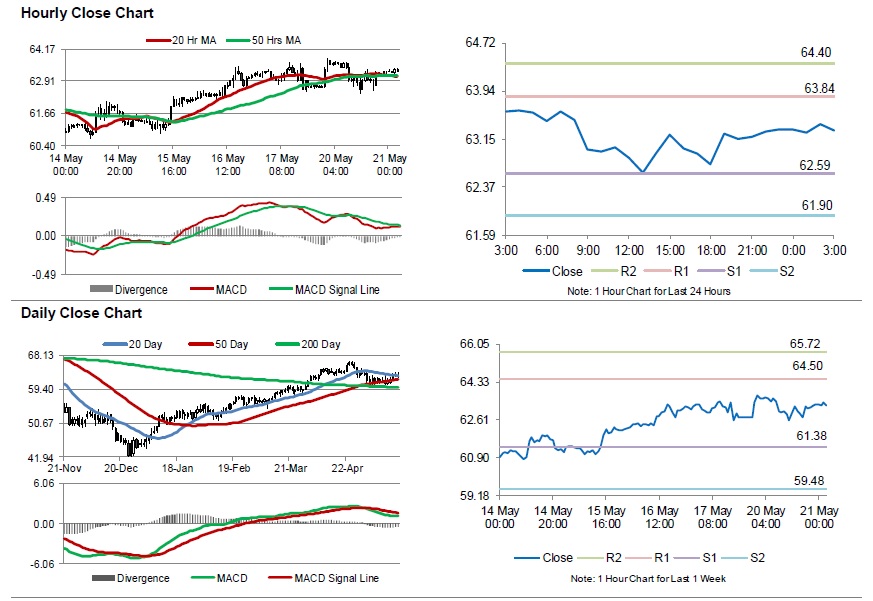
For the 24 hours to 23:00 GMT, Crude Oil declined 0.42% against the USD and closed at USD63.30 per barrel, amid worries about a slowdown in energy demand.
In the Asian session, at GMT0300, the pair is trading at 63.29, with oil trading slightly lower against the USD from yesterday's close.
The pair is expected to find support at 62.59, and a fall through could take it to the next support level of 61.90. The pair is expected to find its first resistance at 63.84, and a rise through could take it to the next resistance level of 64.40.
Crude oil is trading above its 20 Hr and 50 Hr moving averages.
USD/CAD Daily Outlook
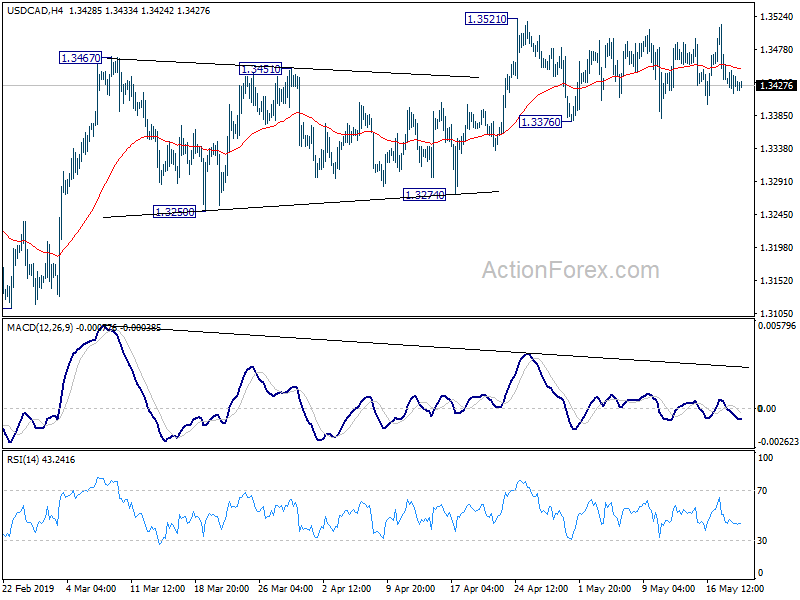
Daily Pivots: (S1) 1.3412; (P) 1.3435; (R1) 1.3453; More...
Consolidation from 1.3521 is still in progress and intraday bias in USD/CAD remains neutral first. Deeper retreat through 1.3376 cannot be ruled out. But in that case, downside should be contained above 1.3274 support to bring rally resumption. On the upside, firm break of 1.3521 will resume the whole rise from 1.3068 to retest 1.3664 high. However, decisive break of 1.3274 support will indicate completion of rise from 1.3068 and turn outlook bearish.
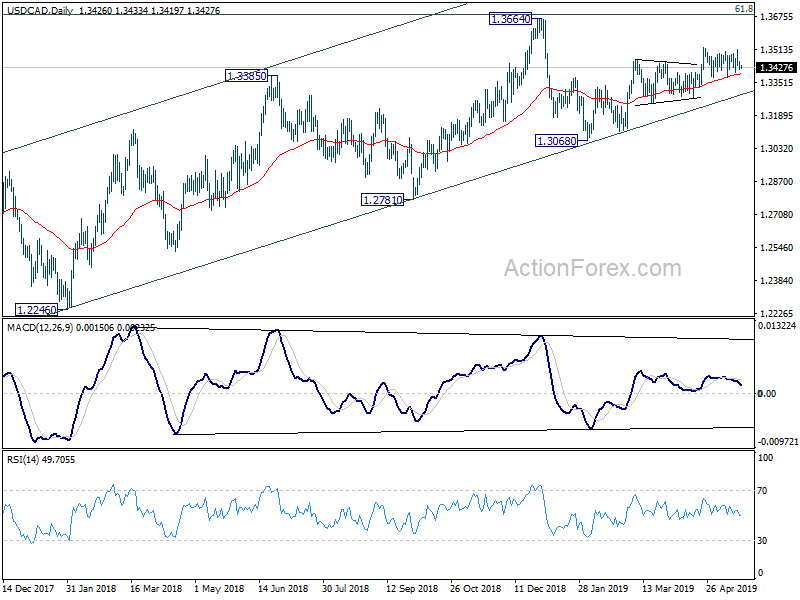
In the bigger picture, USD/CAD is staying well inside medium term rising channel (support at 1.3296). Thus, the up trend from 1.2061 (2017 low) should be in progress. On the upside, decisive break of 61.8% retracement of 1.4689 (2016 high) to 1.2061 at 1.3685 will pave the way to 78.6% retracement at 1.4127 next. This will remain the favored case as long as 1.3068 support holds. However, sustained break the channel support will be the first sign of medium term reversal. Firm break of 1.3068 would confirm.
AUD/USD Daily Outlook
Daily Pivots: (S1) 0.6886; (P) 0.6911; (R1) 0.6931; More...
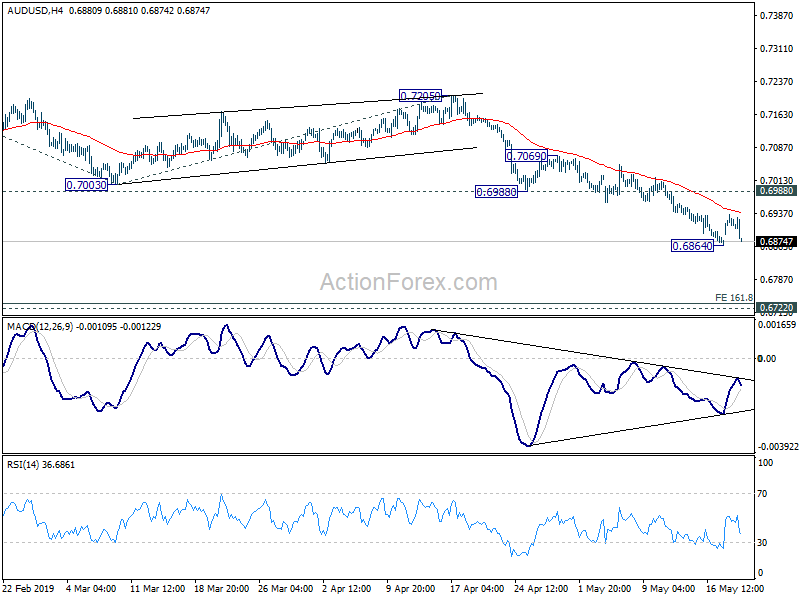
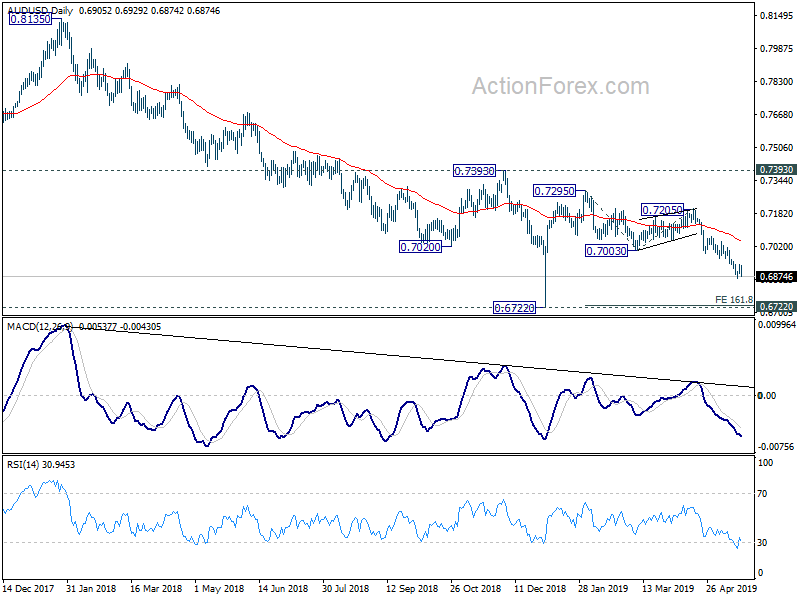
AUD/USD's recovery was limited below 4 hour 55 EMA and drops notably today. But it's staying above 0.6864 temporary low and intraday bias remains neutral first. In case of another recovery, upside should be limited by 0.6988/7069 resistance zone to bring fall resumption. On the downside, break of 0.6864 will turn bias to the downside and extend the fall from 0.7295 to 161.8% projection of 0.7295 to 0.7003 from 0.7205 at 0.6733, which is close to 0.6722 low.
In the bigger picture, with 0.7393 key resistance intact, medium term outlook remains bearish. The decline from 0.8135 (2018 high) is seen as resuming long term down trend from 1.1079 (2011 high). Decisive break of 0.6826 (2016 low) will confirm this bearish view and resume the down trend to 0.6008 (2008 low). However, firm break of 0.7393 will argue that fall from 0.8135 has completed. And corrective pattern from 0.6826 has started the third leg, targeting 0.8135 again.
Australian Dollar Tumbles as RBA Hints on Rate Cut; Huawei Sanctions Temporarily Eased
Australian Dollar continues to be the spotlight of the week. It's knocked down by RBA Governor's comment that they's going to consider cutting interest rates in June meeting. It's actually slightly earlier than market expectations of an August cut. The selloff is more than enough to reverse post election gains Aussie. New Zealand Dollar is following as the second weakest for today.
Risk markets are steady today despite weakness in US stocks overnight, in particular NASDAQ. US announced temporary measures to ease sanctions on China's Huawei. But there was little optimism among Asian investors. Though, risk aversion is not apparent with Yen and Swiss Franc mixed. For now, Canadian Dollar and US Dollar are the strongest ones for today so far.
Technically, 0.6864 temporary low in AUD/USD is back in focus immediately. Break will resume recent fall from 0.7295 towards 0.6722 low. Similarly, EUR/AUD is looking at 1.6262 temporary top for resuming recent rally. Yen crosses are still staying in consolidation. For now, recoveries in EUR/JPY and GBP/JPY are notably weaker than USD/JPY's. Sterling is losing some downside momentum against Dollar and Euro. But there is no sign of bottoming in the Pound yet.
In Asia, currently, Nikkei is down -0.17%. Hong Kong HSI is up 0.15%. China Shanghai SSE is up 1.48%, back above 2900 handle. Singapore Strait Times is down -0.41%. Japan 10-year JGB yield is down -0.0013 at -0.049. Overnight, DOW dropped -0.33%. S&P 500 dropped -0.67%. NASDAQ dropped -1.46%. 10-year yield rose 0.023 to 2.416, closed above 2.4 handle but remains vulnerable.
RBA to consider cutting interest rate at June meeting
In a speech delivered today, RBA Governor Philip Lowe said the central bank will consider the case for cutting interests in the upcoming meeting in two weeks' time n June. After weak inflation reading and surge in unemployment rate in Q1, RBA might pull ahead the anticipated rate cut(s) for the second half.
Lowe said "accumulating evidence is that the Australian economy can support an unemployment rate of below 5 per cent without raising inflation concerns". Such judgement is also "consistent with the experience overseas". Meanwhile, recent flow of data suggests it's "less likely" that "current policy settings are sufficient to deliver lower unemployment."
There are few options ahead to lower unemployment rate. These include further monetary easing, additional fiscal support and structure policy changes. But he emphasized "relying on just one type of policy has limitations, so each of these is worth thinking about."
Lowe concluded the speech noting: "A lower cash rate would support employment growth and bring forward the time when inflation is consistent with the target. Given this assessment, at our meeting in two weeks' time, we will consider the case for lower interest rates."
Some readings on RBA minutes released today too:
US grants housekeeping temporary exemptions on restrictions on Huawei
The US Commerce Department announced limited exemptions on products of Chinese telecom giant Huawei. The move is seen as for keeping the house in order, so as to prevent internet, computer and cell phone systems from crashing
Under the move, Huawei and its 68 non-US affiliates will be granted 90 days temporary general license to have limited engagement in transactions involving the export, reexport, and transfer of items.
With the arrangement, "this license will allow operations to continue for existing Huawei mobile phone users and rural broadband networks". The Commerce Department said it will evaluate whether to extend the exemptions beyond 90 days.
Fed Powell: Another sharp increase in business debt could increase vulnerabilities appreciably
In a speech delivered yesterday, Fed Chair Jerome Powell said that "business debt has clearly reached a level that should give businesses and investors reason to pause and reflect." He pointed to corporate borrowing which hit record level of 35% of assets. And, he warned "another sharp increase...could increase vulnerabilities appreciably".
Though, Powell also emphasized the debt problem is not at the level of systemic threat as the sub-prime mortgage markets. "As of now business debt does not present the kind of elevated risks to the stability of the financial system that would lead to broad harm," he said.
Responding to some questions, Powell said "today's inflation dynamics are very different from even 25 years ago. Globalization and technology may be playing a role". Also, it was premature to make a judgement about the impact trade and tariff issues could have on monetary policy.
Fed Bullard: If low inflation persists, will push FOMC more to cut interest rates
In an interview with Handelsblatt published yesterday, St. Louis Fed President James Bullard said t"he wind has completely turned" in Fed's monetary policy since January. FOMC has approached his view that there should be no more rate hikes for 2019.
Bullard said at this stage of the business cycle, he'd normally expect at least 2% inflation. But core CPI is only 1.6% and "that worries me". He also noted that "If that persists, I will push the FOMC more to lower interest rates and try to bring inflation expectations down to two percent."
Regarding the impact of trade war with China on the economy, Bullard said "that depends on how long they last". "To really hurt the US, the dispute would have to continue for some time," he added. He also noted the worry is "even bigger" in Asia or Europe. US has "such a large and diversified economy" and hence, the impact as a whole is "relatively small".
Fed Bostic: Lack of hitting inflation target not a material failure
Regarding market pricing of Fed's rate cut, Atlanta Fed President Raphael Bostic told CNBC that "the market is ahead of where I am". And, "I would say I'm not expecting a rate cut to be imminent, certainly not by September. Things would need to happen in order for that to play out."
On inflation, Bostic noted "in general, my view is as long as we don't see inflation running away, that would the sign that our policy is basically at a neutral level"., And, "we could sustain that for a long time and we don't have to move."
On the other hand, Bostic was also unconcerned with downward inflation pressure. He said "I'm not super-concerned about that today, and mainly it's because when you look at inflation expectations, they haven't started to trail away in a significant way away from our target".
Nevertheless, he added, "if I started to see a trend moving away to one and a half or one and a quarter [percent] for inflation expectations, then I'd be concerned. But right now, I don't see our lack of hitting that target … as being a material failure."
UK Hammond: Real risk of new PM seeking damaging no-deal Brexit
According to pre-released extract of a speech on Tuesday, UK Chancellor of Exchequer Philip Hammond is set to criticize that advocating for "no deal" Brexit is to "hijack" the result of the Brexit referendum held nearly three years ago.
Hammond will said there are some "on the populist right" who claim that only leaving without a deal is a "truly legitimate Brexit". However, "the 2016 Leave campaign was clear that we would leave with a deal". Thus, "to advocate for 'no deal' is to hijack the result of the referendum, and in doing so, knowingly to inflict damage on our economy and our living standards. Because all the preparation in the world will not avoid the consequences of no deal."
Hammond will also warned that "there is a real risk of a new Prime Minister abandoning the search for a deal, and shifting towards seeking a damaging no-deal exit as a matter of policy ... in order to protect an ideological position which ignores the reality of Britain's economic interests and the value of our Union."
World Trade Outlook Indicator stays at nine-year low, significant risks on the downside
World Trade Outlook Indicator (WTOI) is unchanged at 96.3 in May, same as February's reading, which was the lowest level since 2010. The indicator suggests that world trade growth is likely to remain weak into Q2. Also, recent major trade measures announced were not included in the the calculations yet. Thus, outlook would worsen further ahead if heightened trade tensions are not resolved or if macroeconomic policy fails to adjust to changing circumstances.
WTO also recapped that in the April forecasts, global merchandise trade growth would slowed to 2.6% in 2019, down from 3.0% in 2018. Though, rebound is expected to 3.0% in 2020. However, "there are significant downside risks to the 2019 forecast. Any rebound in 2020 would depend on reduced trade tensions and/or improved macroeconomic performance. "
Looking ahead
BoE's inflation report hearing will be a focus in European session today. Eurozone will release consumer confidence. US will release existing home sales.
AUD/USD Daily Outlook
Daily Pivots: (S1) 0.6886; (P) 0.6911; (R1) 0.6931; More...
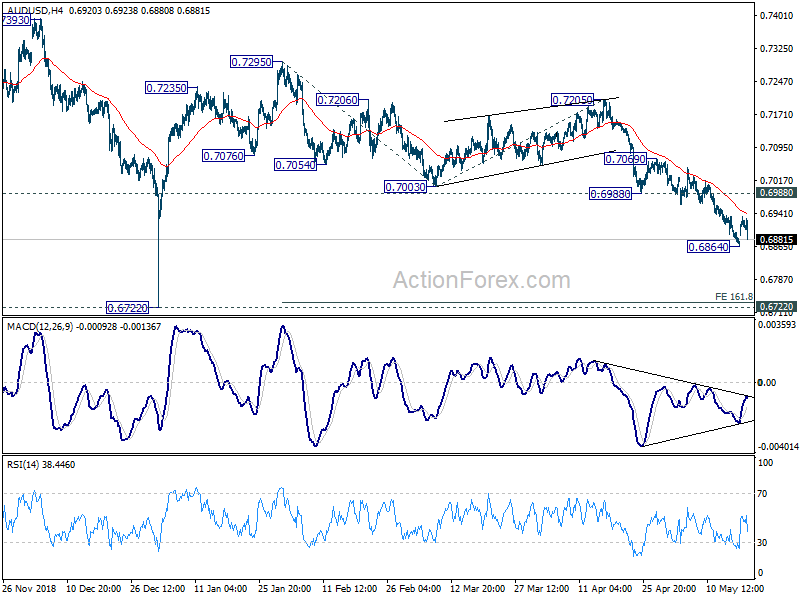
AUD/USD's recovery was limited below 4 hour 55 EMA and drops notably today. But it's staying above 0.6864 temporary low and intraday bias remains neutral first. In case of another recovery, upside should be limited by 0.6988/7069 resistance zone to bring fall resumption. On the downside, break of 0.6864 will turn bias to the downside and extend the fall from 0.7295 to 161.8% projection of 0.7295 to 0.7003 from 0.7205 at 0.6733, which is close to 0.6722 low.
In the bigger picture, with 0.7393 key resistance intact, medium term outlook remains bearish. The decline from 0.8135 (2018 high) is seen as resuming long term down trend from 1.1079 (2011 high). Decisive break of 0.6826 (2016 low) will confirm this bearish view and resume the down trend to 0.6008 (2008 low). However, firm break of 0.7393 will argue that fall from 0.8135 has completed. And corrective pattern from 0.6826 has started the third leg, targeting 0.8135 again.
Economic Indicators Update
| GMT | Ccy | Events | Actual | Forecast | Previous | Revised |
|---|---|---|---|---|---|---|
| 01:30 | AUD | RBA Minutes May | ||||
| 08:30 | GBP | BoE Inflation Report Hearings | ||||
| 10:00 | GBP | CBI Trends Total Orders May | -5 | -5 | ||
| 14:00 | EUR | Eurozone Consumer Confidence May A | -7.7 | -7.9 | ||
| 14:00 | USD | Existing Home Sales Apr | 5.35M | 5.21M |
US grants housekeeping temporary exemptions on restrictions on Huawei
The US Commerce Department announced limited exemptions on products of Chinese telecom giant Huawei. The move is seen as for keeping the house in order, so as to prevent internet, computer and cell phone systems from crashing
Under the move, Huawei and its 68 non-US affiliates will be granted 90 days temporary general license to have limited engagement in transactions involving the export, reexport, and transfer of items.
With the arrangement, "this license will allow operations to continue for existing Huawei mobile phone users and rural broadband networks". The Commerce Department said it will evaluate whether to extend the exemptions beyond 90 days.
RBA’s Lowe Caps Aussie’s Election Rally
RBA's Lowe says June rate cut under consideration
Coming on the back of the election victory by the Conservative coalition which promised tax cuts which could eventually flow through to the local economy, some were expecting RBA's Lowe to tone down the need for further rate cuts in his speech in Brisbane today. That wasn't the case, as he commented that the recent data makes it less likely that the labour market would surprise to the upside. While the global situation looks brighter, and he expects growth to strengthen later in the year, the board will consider the case for a rate cut at the June meeting, as slow wages growth and an unemployment above 5% limit inflation pressures.
AUD/USD slipped into the red for the day after his speech, falling to an intraday low of 0.6888 after hitting 0.6929 earlier while AUD/JPY fell from 76.28 to 75.96.
AUD/USD Daily Chart
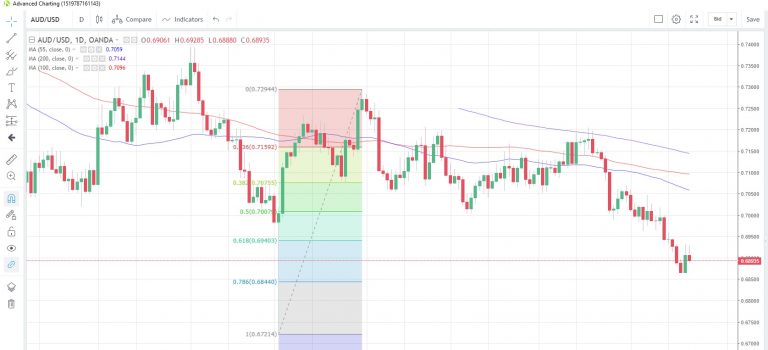
Election gains proved to be temporary
AUD/USD rallied 1.0% yesterday after it emerged that the Conservative coalition was victorious in the weekend election. That was the biggest one-day gain in 5-1/2 weeks and snapped a three-day losing streak. The Aussie had been under pressure from a shift in the perceived interest rate outlook at the RBA and the escalating tariff spat between the US and China.
The Aussie was looking to extend those gains today until both the minutes of the RBA meeting on May 7 were released and the RBA Governor spoke. The minutes highlighted discussions about the labour market and how a rate cut might be appropriate IF there was no further improvement in the labour market, given the recent weak Australian inflation data. These themes were continued in Lowe's speech and the June meeting now becomes a “live” meeting, with rates markets now pricing in a near 70% chance of a 25bps rate cut compared with 57% yesterday.
Waiting for China's response
The only reaction from China to the US move to blacklist China's Huawei has so far only been verbal in nature. China's envoy to the EU labeled the actions as “wrong behavior” which will produce a “necessary response” on Monday while at a regular news briefing in Beijing yesterday, China's Foreign Ministry spokesman Lu Kang said to “wait and see” for what countermeasures China would adopt.
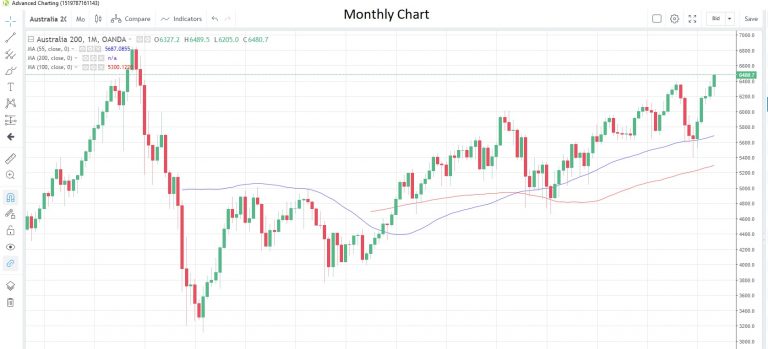
Equity markets appeared to take a breather from the two-day sell-off and posted moderate gains in Asia this morning. The US indices were up between 0.32% and 0.51%, the Japan225 index gained 0.71% while the Australia200 index rose 0.53% to be within yesterday's highs, which were the highest since December 2007.
Australia200 Monthly Chart
All quiet on the European front
The European data calendar is almost bare, with only the UK's CBI industrial trends survey on tap. The US session features existing home sales for April, which are seen rebounding to +2.6% m/m from March's disappointing 4.9% decline. Speeches from Fed's Evans and Rosengren complete the day.
RBA to consider cutting interest rate at June meeting
In a speech delivered today, RBA Governor Philip Lowe said the central bank will consider the case for cutting interests in the upcoming meeting in two weeks' time n June. After weak inflation reading and surge in unemployment rate in Q1, RBA might pull ahead the anticipated rate cut(s) for the second half.
Lowe said "accumulating evidence is that the Australian economy can support an unemployment rate of below 5 per cent without raising inflation concerns". Such judgement is also "consistent with the experience overseas". Meanwhile, recent flow of data suggests it's "less likely" that "current policy settings are sufficient to deliver lower unemployment."
There are few options ahead to lower unemployment rate. These include further monetary easing, additional fiscal support and structure policy changes. But he emphasized "relying on just one type of policy has limitations, so each of these is worth thinking about."
Lowe concluded the speech noting: "A lower cash rate would support employment growth and bring forward the time when inflation is consistent with the target. Given this assessment, at our meeting in two weeks' time, we will consider the case for lower interest rates."
Lowe's full speech The Economic Outlook and Monetary Policy.
Some readings on RBA minutes released today too:
AUD/USD dips notably today but stays above 0.6864 temporary low so far. Nevertheless, with 0.6988 resistance intact, near term outlook remains bearish. Further decline should be seen ahead to 161.8% projection of 0.7295 to 0.7003 from 0.7205 at 0.6733, which is close to 0.6722 low.
Fed Bullard: If low inflation persists, will push FOMC more to cut interest rates
In an interview with Handelsblatt published yesterday, St. Louis Fed President James Bullard said t"he wind has completely turned" in Fed's monetary policy since January. FOMC has approached his view that there should be no more rate hikes for 2019.
Bullard said at this stage of the business cycle, he'd normally expect at least 2% inflation. But core CPI is only 1.6% and "that worries me". He also noted that "If that persists, I will push the FOMC more to lower interest rates and try to bring inflation expectations down to two percent."
Regarding the impact of trade war with China on the economy, Bullard said "that depends on how long they last". "To really hurt the US, the dispute would have to continue for some time," he added. He also noted the worry is "even bigger" in Asia or Europe. US has "such a large and diversified economy" and hence, the impact as a whole is "relatively small".
Market Morning Briefing: Pound Has Bounced Back Slightly And While Above 1.27
STOCKS
Trump's move to add the Chinese firm Huawei to the list which requires the US companies to get licence to do business with it is weighing on the global equities. Dow and DAX have fallen and has room to further fall. Asians are trading mixed. On the domestic front, it needs to be seen if the impact of the exit polls will continue or not as the Sensex and Nifty have a crucial resistance ahead. SGX Nifty (11872.75, +1.30, +0.01%) is trading stable indicating a flat opening.
Dow (25679.90, -84.1, -0.33%) is turning down after testing the resistance at 26000 which keeps the overall bearish view intact. A dip to 25500-25450 is possible in the near term.
DAX (12041.29, -197.65, -1.61%) has come-off sharply and can revisit 11900 levels again. A strong close below 11900 will be bearish for a fall to 11600 and 11500 on the back of profit booking.
Nikkei (21218.54, -83.19, -0.40%) has declined below its support at 21250 thereby negating the chances of a rise to 21500-21750 mentioned yesterday. Now, while below 21250, a fall to 21000-20900 is possible.
Contrary to our expectation to break 2850 and fall to 2800, Shanghai (2885.60,+15, +0.52%) has bounced from a low of 2838. The sideways move is still intact. While above 2850, a rise to 2950 is possible in the coming sessions.
Nifty (11828.25, 421.10, 3.69%) has resistance at 11860 which needs to be broken to see further rise too 11900 and 12000 levels. While below 11860, a pull-back to 11700 cannot be ruled out.
Similarly, Sensex (39352.67, +1421.90, +3.75%) has resistance at 39600 which if holds can trigger a pull-back move to 39000 and 38500
COMMODITIES
Gold remains subdued but stable. Silver can see a correcitve bounce before further fall. Copper is consolidating within its overall downtrend. Oil remains higher but is not gaining momentum for further rise.
Gold (1276.1) trades stable below 1280. While below the immediate resistance at 1280, a fall to 1270-1265 can be seen in the near term.
Silver (14.42) is getting support near 14.35. While it sustains above this support, a corrective bounce to 14.60 is possible before we see a fresh fall.
Copper (2.74) is consolidating between 2.71 and 2.78 within its overall downtrend. The bias is bearish for it to break below 2.71 and fall to 2.68 in the coming days.
WTI (63.58) is struggling to breach 64. It might consolidate between 62 and 64 for some time. But while it remains above 62, the bias is bullish for it to break 64 and rise to 65 in the near term.
Similarly, Brent (72.34) lacks strong follow through buyers above 73. It has support at 71 and while it holds, a rise to 74 can be seen in the near term.
FOREX
Overall the currency pairs are almost stable near levels seen yesterday. Some sideways ranged movement is possible just now before the currencies pick up near term trend. US dollar could see some more strength in the near term.
Dollar Index (97.97) has paused near 98 and could see some sideways movement within 98.0-97.70 region before attempting a rise towards daily resistance near 98.50.
Euro (1.1164) has also paused and is trading above 1.1150. We could see some ranged movements before the currency attempts a test of 1.1100 or a further fall on the downside.
Euro-Yen (122.99) could face immediate rejection from very near term resistance at 123.20 which if holds could push Euro-Yen back to 122. A few sessions of sideways trade between 122-123.20 is possible before the pair moves up sharply beyond 123.20 in the medium term.
Dollar Yen (110.19) is likely to move up slowly towards 111 in the near term. View is bullish for the next few sessions.
Aussie (0.6911) is almost stable near levels seen yesterday. The bounce from 0.6865 is holding well for now and could take Aussie slowly towards 0.6960-0.7000 in the medium term.
Pound (1.2728) has bounced back slightly and while above 1.27, the currency could slowly pick up upward momentum and attempt to rise towards 1.28 or higher in the longer run. The EU Parliamentary elections on Thursday would be important to watch. We do not prefer a fall below 1.27 in the near term.
USDCNY (6.9012) is coming off just now from the high of 6.9186 seen yesterday and while that holds, we could see the corrective dip to extend towards 6.86/85 levels.
USDINR (69.7350) opened with a sharp gap-down yesterday contrary to our expectation to test 69.75 on the downside as exit polls were in favor of the current ruling party bringing in more hope. The pair rose back to close at 69.7350 yesterday. Immediate resistance is seen near 69.75/80 and while that holds, USDINR could come off towards 69.50/40 again today. A break of 69.75 could be seen later during the day or tomorrow taking the pair to higher levels of 70.00-70.10. We warn to remain cautious for the next 2-3 sessions before the actual election results are out on 23rd May, Thursday.
INTEREST RATES
The US yields have risen contrary to our expectation of a further fall. The 30Yr (2.84%), 10Yr (2.43%) and 5Yr (2.21%) are up slightly. While the overall trend is downward, we could see some upmove in the very near term. The 30Yr could rise towards 2.87% while the 10Yr and 5Yr could rise towards 2.47% and 2.27% respectively before again falling from there.
The Indian 10Yr GOI (7.4099%) closed lower yesterday and could probably test 7.35% on the downside before bouncing back towards 7.40/45% in the medium term.
The UK yields have bounced slightly contrary to our expectation of a fall as Pound recovers a bit from 1.27. The 5Yr (0.78%), 10Yr (1.06%) and 20Yr (1.52%) are up about 2bps and could see some more upmove over today and tomorrow before the EU Parliamentary elections on Thursday.
The German 10Yr (-0.084%) could move up towards 0% before again coming off from there. Medium term looks bearish.
Fed Powell: Another sharp increase in business debt could increase vulnerabilities appreciably
In a speech delivered yesterday, Fed Chair Jerome Powell said that "business debt has clearly reached a level that should give businesses and investors reason to pause and reflect." He pointed to corporate borrowing which hit record level of 35% of assets. And, he warned "another sharp increase...could increase vulnerabilities appreciably".
Though, Powell also emphasized the debt problem is not at the level of systemic threat as the sub-prime mortgage markets. "As of now business debt does not present the kind of elevated risks to the stability of the financial system that would lead to broad harm," he said.
Responding to some questions, Powell said "today's inflation dynamics are very different from even 25 years ago. Globalization and technology may be playing a role". Also, it was premature to make a judgement about the impact trade and tariff issues could have on monetary policy.
Powell's speech on Business Debt and Our Dynamic Financial System.