Sample Category Title
Gold failed 1300, to extend corrective fall through 1266 low
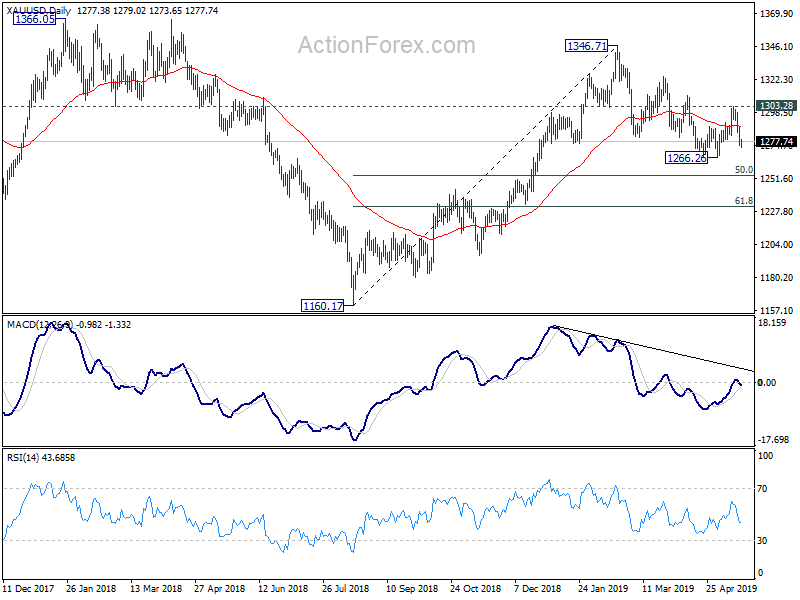
Gold's sharp fall and break of 1281.97 minor support suggests that rebound from 1266.26 has completed at 1303.28, failing to sustain above 1300 handle. More importantly, the development indicates that corrective decline from 1346.71 is not completed yet. Bias is now turned back to the downside for 1266.26 low.
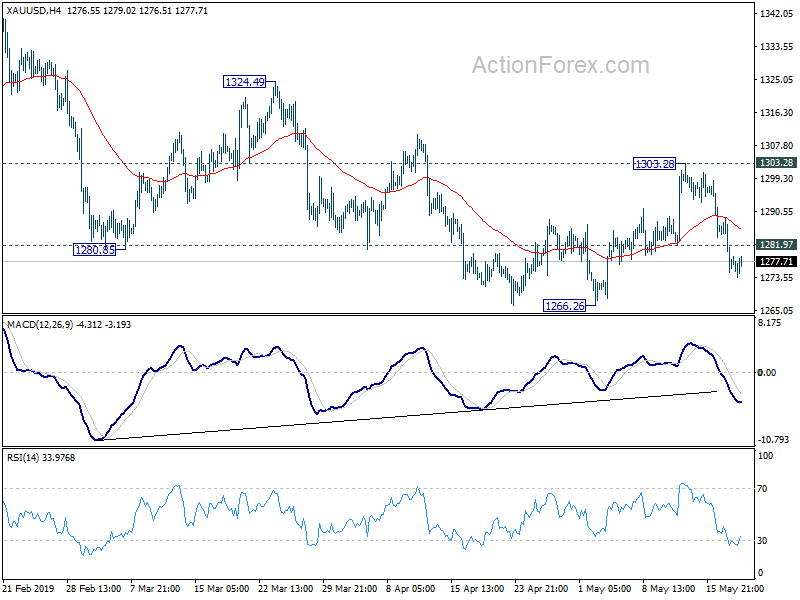
Firm break of 1266.26 will extend the correction from 1346.71 to 50% retracement of 1160.17 to 1346.71 at 1253.44 and possibly below. For now, we'd expect strong support from 61.8% retracement at 1231.42 to contain downside to complete the correction.
Oil Higher as Supply Risks Outweigh Growth Concerns for Now
Constructive banter from OPEC nations are to be expected leading up to the next key meeting in June. The outcome of the Jeddah talks shows that OPEC + members are on board to continuing production cuts throughout the rest of year, albeit if conditions warrant it. Uncertainty on both the global demand front and stockpiles from Iran Venezuela and Libya will likely keep things volatile and possibly see oil-producing nations punt the 176th extraordinary meeting again, from June to July. Saudi Arabia does not want a repeat from last year, when too many barrels came back to the market.
Geopolitics will remain key for oil and while the focus early this week lies with global growth concerns from an escalating trading war between China and the US, short-term differentials between spare capacity and output at risk should keep prices somewhat supported.
The OPEC + meeting over the weekend did not yield any surprises, with the most important comments coming from Russia, the most important non-OPEC partner in the coalition, hinting they could reduce production cuts if the market needs more crude.
The base case is slowly becoming OPEC and its partners will announce an extension of production cuts, especially if global growth concerns grow. Russian could decide to argue they do not want to take part with further cuts, or they could just not comply.
Choppy conditions remain in place for crude traders, with upside relying on geopolitical events driving shocks to supplies.
West Texas Intermediate crude could be vulnerable to a move towards $60 a barrel, but if the bullish move continues, $69.50 could be major resistance. The Canadian dollar is slightly firmer on the day against both the euro and US dollar.
Fed Bostic: Lack of hitting inflation target not a material failure
Regarding market pricing of Fed's rate cut, Atlanta Fed President Raphael Bostic told CNBC that "the market is ahead of where I am". And, "I would say I'm not expecting a rate cut to be imminent, certainly not by September. Things would need to happen in order for that to play out."
On inflation, Bostic noted "in general, my view is as long as we don't see inflation running away, that would the sign that our policy is basically at a neutral level"., And, "we could sustain that for a long time and we don't have to move."
On the other hand, Bostic was also unconcerned with downward inflation pressure. He said "I'm not super-concerned about that today, and mainly it's because when you look at inflation expectations, they haven't started to trail away in a significant way away from our target".
Nevertheless, he added, "if I started to see a trend moving away to one and a half or one and a quarter [percent] for inflation expectations, then I'd be concerned. But right now, I don't see our lack of hitting that target ... as being a material failure."
British Pound Steadies after Dismal Week
GBP/USD is showing little movement on Monday. In the North American session, the pair is trading at 1.2740, up 0.20% on the day. The pair dropped 2.2% last week, its sharpest weekly loss since October 2017. On the release front, British CB Leading Index posted a gain of 0.5%, after a decline of 0.4% in the previous release. There are no U.S. data events on the schedule. On Tuesday, BoE Governor Mark Carney testifies about inflation and the economic outlook before the Treasury Committee. The U.K. will release CBI Industrial Order Expectations and the U.S. posts existing home sales.
U.S. numbers impressed late in the week, and the positive news was spread across the economy. The Philly Fed Manufacturing Index jumped to 16.6, up from 8.5 a month earlier. Unemployment claims dropped to 212 thousand, marking a 4-week high. The week ended with a sizzling release from UoM Consumer Sentiment, which climbed to 102.4, its highest level in 15 years.
Brexit has been on the backburner for several weeks, but will be back on center stage in early June. Parliament is expected to vote yet again on a Brexit withdrawal agreement, after three previous attempts by the May government ended in failure. It’s difficult to see why the result will be any different this time around, as Conservative lawmakers remain deeply divided on Brexit. May tried to enlist the help of Labor leader Jeremy Corbyn, but these talks have been unproductive. The next Brexit vote in parliament will be May’s last chance before the summer recess, and her days as prime minister may be numbered.
MARKET WRAP: Stocks Moved Lowe, Euro & Sterling Recovered Losses
The global stock market remained sensitive due to the trade issues and Trump administration is no mood to de-escalate these tensions.
Stocks
- The S&P 500 Index dropped on the back of trade war fear by 0.82% as of 15:32 London time; the Nasdaq 100 extended its losses by 1.62%.
- The Stoxx Europe 600 Index declined by 1.40%.
- The U.K.’s FTSE 100 Index suffered heavy losses and lost nearly 1.2% of its value
- The MSCI Emerging Market Index followed the global equity market trend and sunk by 0.3%.
Currencies
- The Dollar Spot Index traded mostly in the red territory and dropped 0.07%.
- The Euro remained volatile ahead of the European election and increased by 0.06% to $1.1165.
- The British pound is still under punishment while Theresa May tries her deal for the fourth time. The pair gained 0.05% to $1.2730.
- The Japanese yen, the safe haven stayed green and gained 0.13% to 109.94 per dollar.
Bonds
- The yield on 10-year Treasuries sank by one basis point to 2.38%.
- Germany’s 10-year yield jumped by one basis point to -0.09%.
- Britain’s 10-year yield moved higher by two basis points 1.051%.
Commodities
- Gold declined again by 0.09% to $1,276 an ounce.
- West Texas Intermediate crude recovered its ground and moved higher by 0.33% to $62.95 a barrel.
Sunset Market Commentary
Markets
Global core bonds are treading water today as the sluggish US-Sino trade negotiations put investors in wait-and-see modus. Global core bonds started the week with a cautious downward trend, unable to profit from a lower equity opening in across Europe. As equity markets continued to slide, core bonds regained some ground. The Bundesbank said that Germany’s rebound at the start of the year was largely due to one-off factors and added that the underlying trend remains weak. German Bunds jumped higher and undid part of its intraday losses. The German yield curve is steepening with yield changes vary between -0.2 bps (2-yr) and +0.7 bps (30-yr). US Treasuries behaved similarly and erased early losses throughout the day. The US April Chicago National Activity printed below expectations but had little impact, as was the case for comments by Atlanta Fed chief Bostic. The rather dovish policy maker doesn’t foresee a Fed rate cut this year. The US yield curve is mixed with modest changes in the range of -1.5 bps(30-yr) to +0.1 bp (2-yr). Italian Deputy PM Salvini repeated that tax cuts should be initially financed with higher deficits and vowed to change EU Tax rules to push through his promise of a 15% flat tax for everyone. The Italian spread over the German 10-year yield widened (+ 3 bps). Other peripheral spreads remain stable.
The escalation in the US China trade war is causing substantial losses on most equity markets. Investors fear more retaliation after US companies suspended (some of) their supply to Chinese tech giant Huawei. However, for now, the risk-off repositioning mainly concerns equites. Moves in core bonds and in the major FX cross rates are modest. The yen outperforms, but its gain is modest and orderly. USD/JPY returned below the 110 handle and trades currently in the 109.80 area. Last week’s USD rebound against the euro also halted. US/German interest rate differentials are showing no clear directional trend. EUR/USD is regaining a few ticks and trades in the 1.1165 area. The relative calm on the FX markets is at least a bit remarkable. Markets apparently are pondering where the damage of a further escalation in the trade war might be the worst. The Swiss franc is gaining a few ticks (EUR/CHF dropped again below 1.13). The Norwegian and Swedish krona are again in the defensive. Central European currencies (CZK, Forint and zloty) for now are little affected.
Recent Brexit-driven decline of sterling slowed, at least temporary. Political uncertainty on the fate of the Brexit deal and on the replacement of Theresa May remains as high as it has ever been. Still, sterling investors are awaiting next steps in the process. Sterling is holding near recent lows against the euro and the dollar; EUR/GBP is trading in the 0.8760 area. Cable rebounded temporary on USD weakens intraday, but is again trading in the 1.2730 area.
News Headlines
Belgian consumer confidence rose from -7 to -5 in May, the strongest outcome since December 2018. Details are showing an increase in the outlook for the Belgian economy (-9 from -13), a decline in concerns about unemployment (7 from 12), expectations of personal financial situation (-2 from -1) and expectations of saving capacity (-4 from -1).
The German Bundesbank fears that events supporting growth after the turn of the year will lapse or even reverse. Those factors include fiscal measures that boosted private consumption, a revival in car sales and mild winter weather. Downturn forces continue to be prevalent in industry and may even intensify somewhat. A gradual rebound in activity is only expected in H2 2019 alongside a global recovery.
EUR/USD Outlook: Bears on Hold and Looking for Fresh Signals
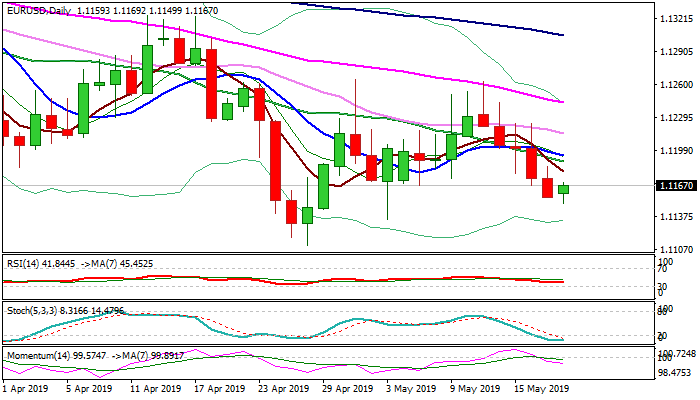
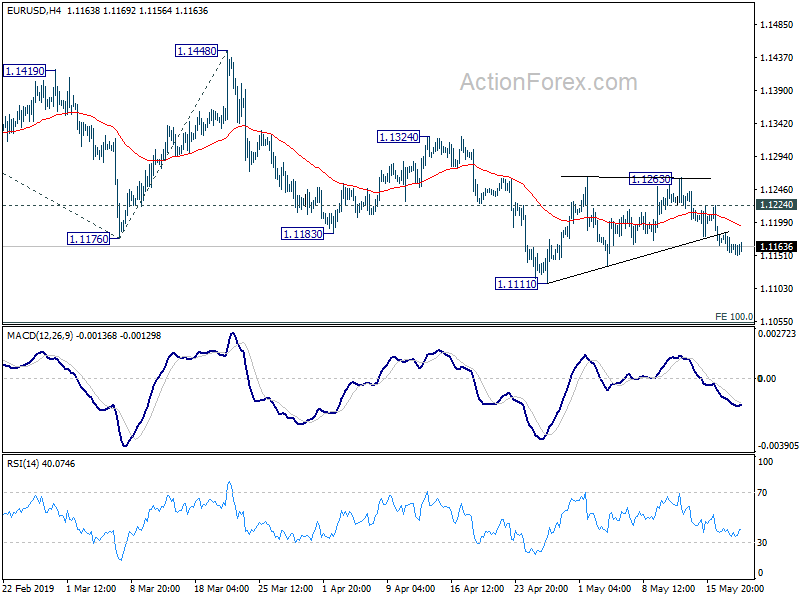
The pair holds in narrow consolidation above new two-week low as bears take a breather after 07% fall last week. Slight positive tone was boosted by weaker than expected US data on Monday, along with oversold daily stochastic and profit-taking. Technical studies remain negative and maintain strong bearish momentum on daily chart, with weekly bearish engulfing pattern adding to negative signals. Bears are looking for positioning ahead of fresh weakness as overall picture is bearish, but the pair looks for stronger signal that could be expected from EU elections that start on Thursday. Solid barriers at 1.1180/1.1200 zone should cap upticks and keep bears intact.
Res: 1.1180; 1.1200; 1.1215; 1.1226
Sup: 1.1150; 1.1134; 1.1111; 1.1075
EUR/USD Mid-Day Outlook
Daily Pivots: (S1) 1.1147; (P) 1.1165; (R1) 1.1176; More.....
No change in EUR/USD's outlook and intraday bias remains mildly on the downside. Consolidation pattern from 1.1111 has completed at 1.1263, after hitting 55 day EMA. Deeper fall should be seen to retest 1.1111 first. Break will resume larger down trend for 100% projection of 1.1448 to 1.1183 from 1.1324 at 1.1059. Though, on the upside, above 1.1224 minor resistance will turn bias back to the upside to extend the consolidation from 1.1111 first.
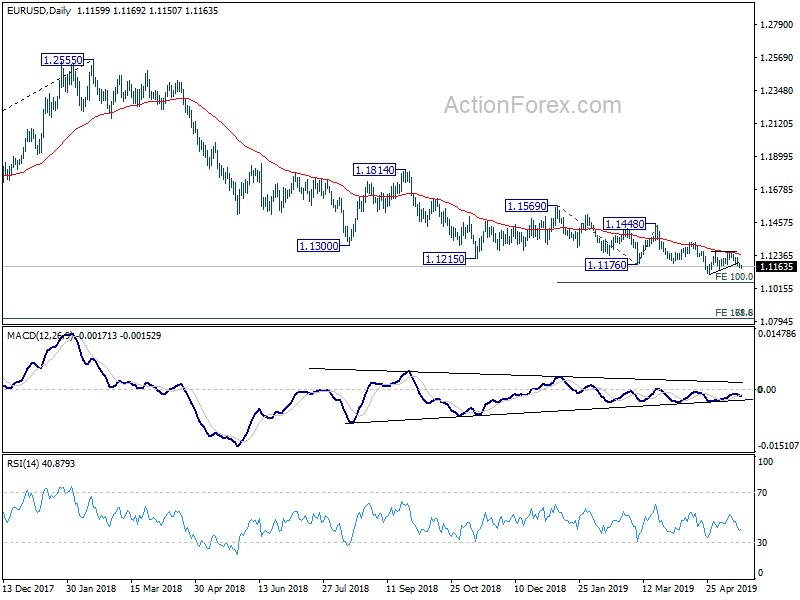
In the bigger picture, down trend from 1.2555 (2018 high) is still in progress. Such decline would target 78.6% retracement of 1.0339 (2016 low) to 1.2555 (2018 high) at 1.0813 next. Sustained break there will pave the way to retest 1.0339. On the upside, break of 1.1448 resistance is needed to be the first sign of medium term bottoming. Otherwise, outlook will stay bearish in case of rebound.
GBP/USD Mid-Day Outlook
Daily Pivots: (S1) 1.2685; (P) 1.2744; (R1) 1.2776; More....
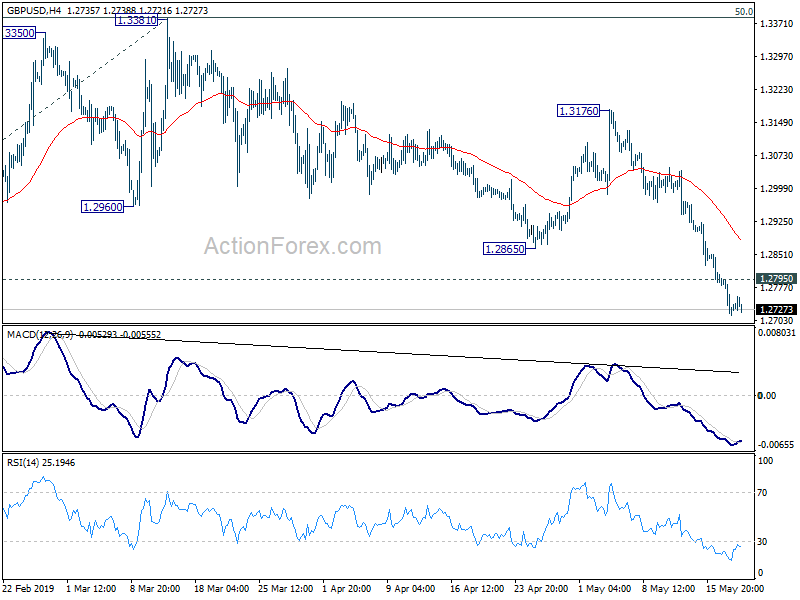
With 1.2795 minor resistance intact, intraday bias in GBP/USD remains on the downside. Current fall from 1.3381 is in progress for retesting 1.2391 low. Larger decline from 1.4376 might be resuming. Break of 1.2391 will target 61.8% projection of 1.4376 to 1.2391 from 1.3381 at 1.2154 next. On the upside, above 1.2795 minor resistance will turn intraday bias neutral for consolidation first before staging another decline.
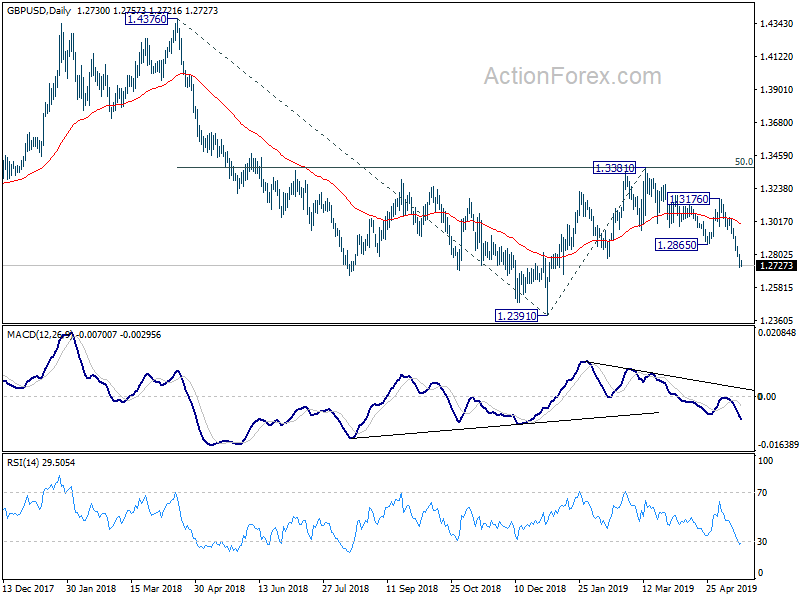
In the bigger picture, current development suggests that medium term decline from 1.4376 (2018 high) is not completed, and is possibly ready to resume. Decisive break of 1.2391 would target a test on 1.1946 long term bottom (2016 low). For now, we don't expect a firm break there yet. Hence focus will be on bottoming signal as it approaches 1.1946. In any case, medium term outlook will stay bearish as long as 1.3381 resistance holds, in case of rebound.
USD/JPY Mid-Day Outlook
Daily Pivots: (S1) 109.65; (P) 109.92; (R1) 110.34; More...
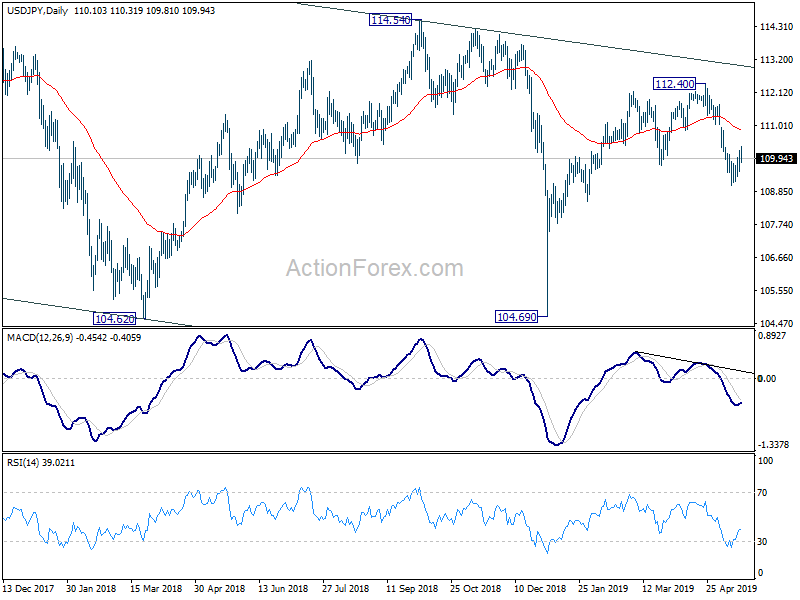
USD/JPY is staying in consolidation from 109.02 temporary low and intraday bias remains neutral. Stronger recovery cannot ruled out. But upside should be limited by 55 day EMA (now at 110.85) to bring another fall. On the downside, break of 109.02 will extend the decline from 112.40 to retest 104.69 low.
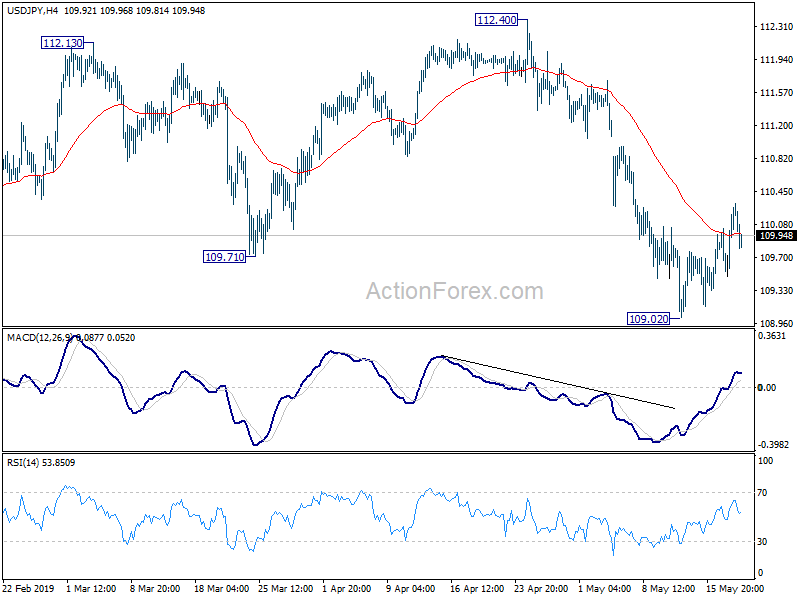
In the bigger picture, USD/JPY is staying inside falling channel from 118.65. Currently development suggests that rebound from 104.69 is only a corrective move. And fall from 118.65 is not completed yet. Decisive break of 104.69 will extend the down trend towards 98.97 support (2016 low). For now, we'd expect strong support above there to bring rebound.