Sample Category Title
Daily Markets Broadcast
Wall Street extends gains
US indices advanced for a third day yesterday, helped by better-than-expected data and some strong earnings reports from Wallmart and CISCO, while ignoring the tensions in the US-China trade talks. Australia heads to the polls this weekend.
US30USD Daily Chart
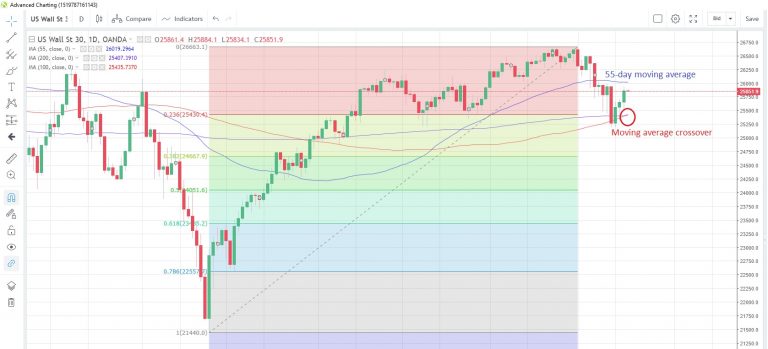
The US30 index rose for a third day yesterday but has shown a mild retracement since trading opened in Asia this morning
The 100-day moving average at 25,436 is above the 200-day moving average at 25,407 for the first time since January 28. The 55-day moving average is at 26,019
US housing starts rose 5.7% in April while building permits rose 0.6%. The only major release today is the Michigan consumer sentiment index for May, which is seen climbing to 97.5 from 97.2.
DE30EUR Daily Chart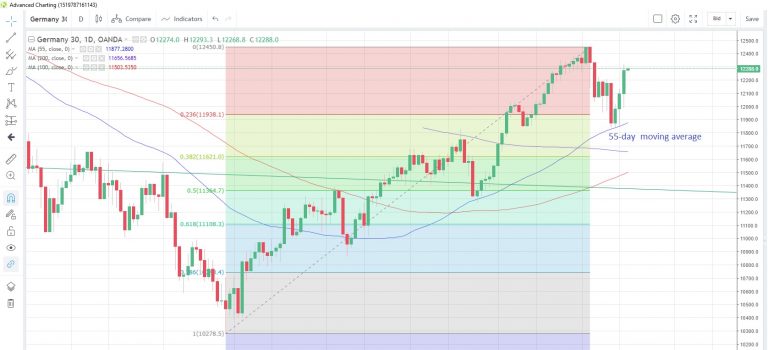
The Germany30 index looks poised to advance for a third straight day today after touching a nine-day high yesterday
The 55-day moving average at 11,877 continues to support prices, as it has done on a closing basis since February 8
The pace of increase in consumer prices in the Euro-zone is expected to slow to +0.7% m/m in April, latest surveys show. The growth in construction output is seen contracting 0.8% m/m in March.
CN50USD Daily Chart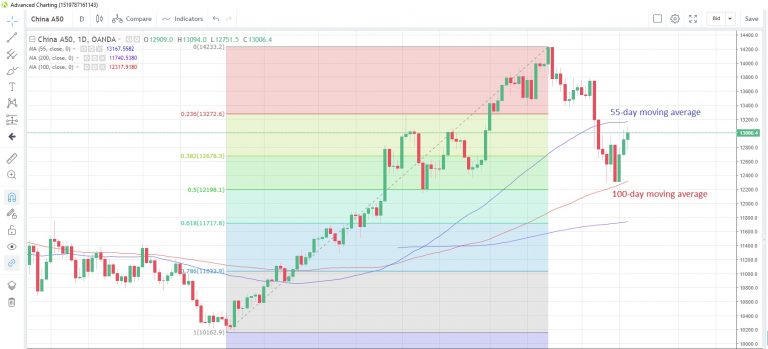
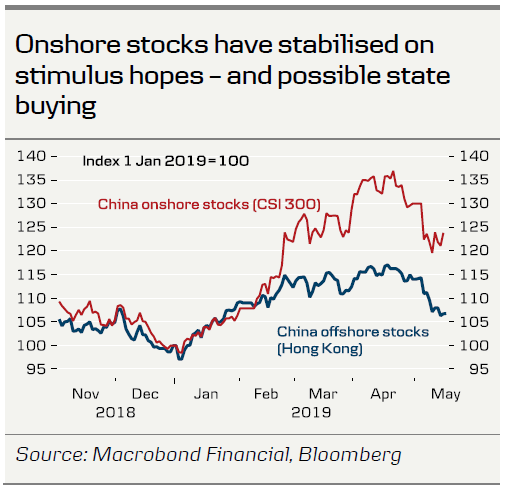
China shares were boosted to nine-day highs yesterday despite the uncertainty surrounding trade talks and the US move to blacklist Huawei
The China50 index is rising toward the 55-day moving average at 13,167
Hong Kong releases Q1 GDP growth numbers today. The last quarter of 2018 saw growth contracting 0.3% q/q, only the second negative growth quarter in the last ten.
Fluid Situations
Fluid situations
Global markets took an upbeat tone overnight, preferring to concentrate on known knowns rather than known unknowns or unknown unknowns. Following Washington’s decision to place Huawei on a blacklist that could ban them from sourcing vital US technology if enacted, the street appears to have temporarily given up trying to predict the fluid situation that is US-China trade relations and concentrate on the here and now.
The here and now on Wall Street was strong US housing starts and sparkling results from heavyweights Walmart, Nvidia and Cisco Systems, suggesting yet again that despite the international noise, the US economy is still moving full steam ahead. Following rises yesterday in Europe and China, the S&P finished 0.90% higher, the Nasdaq climbed 1%, and the Dow Jones rose 0.80%.
European Union inflation and the US Michigan Consumer Sentiment are the heavyweight data points due this evening to finish the week. They could tell a tale of two halves, with the US consumer alive and well while EU inflation continues bumping along the floor. Here in Asia, the New Zealand dollar (NZD) continued its weekly fall following uninspiring PPI data this morning.
We have important data from two trading bellwethers in Asia today. Singapore released its Balance of Trade at 0830 Singapore time (SGT), while Hong Kong releases its quarterly GDP Growth Rate at 1630 SGT. The street will be looking for a continued recovery in Singapore’s non-oil exports and a bounce back in Hong Kong’s quarterly GDP growth following a slump of 0.50% previously. Like Australia and New Zealand, Singapore and Hong Kong have a massive correlation to China growth and the data will be closely watched to gauge the state of play in Asian trade. Poor prints could see a negative overflow to regional markets.
Currencies
The US dollar maintained its tight grip on markets overnight following a strong performance by Wall Street with the dollar index rising 0.27%. The Australian (AUD) and New Zealand dollars (NZD) continued their slump with tomorrow’s Aussie elections weighing heavily on the former. The AUD fell 0.50% to 0.6890 with the 2016 lows around 0.6830 now in plain sight.
The euro fell ahead of upcoming European elections to 1.1175 while the British pound (GBP) continued its terrible run, falling below 1.2795 on Brexit uncertainty. The chances of a feasible Brexit solution being achieved seem to be falling by the day, much like the governments chance of re-election – any light at the end of the tunnel being a train coming the other way.
Equities
Assuming no surprises from Singapore data or President Trump’s Twitter account, regional markets should follow Wall Street’s lead and begin the day on a positive note. The march higher will be tentative at best though with sentiment both incredibly cautious and fragile. With the weekend upon us and plenty of unknown unknowns that could occur over the weekend, volumes will likely remain light in Asia today.
Oil
Middle East tensions were front and centre overnight as Saudi Arabia unsurprisingly blamed Iran for the recent sabotage on its tankers and oil platforms. Brent Crude rose 1.15% to USD72.70 a barrel and WTI climbed 1.65% to USD63.05 a barrel. The repricing of geopolitical threats has merit, although the likelihood of open hostilities from or against Iran remains low in my opinion.
Brent Crude has technical resistance in the USD75.00 a barrel area and WTI nearby at USD63.50. With quite a lot of politics and supply crunches already built into prices and the spectre of trade wars looming large, the geopolitical temperature will probably have to ratchet much higher to maintain a sustained rally through the resistance levels.
Gold
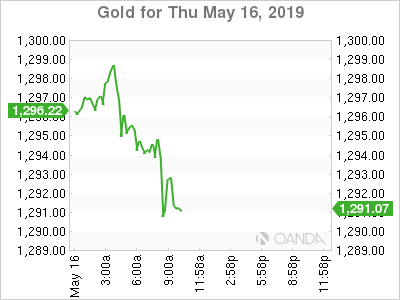
Gold collapsed by USD10 to USD1,285.00 an ounce overnight erasing its entire week’s gains in one fell swoop. A strong dollar and bond yields creeping higher took their toll. However, a global sense of disbelief that the trade wars will be taken to the wire drained the safe-haven harbour, flushing gold out with it.
The fall overnight will be tremendously disappointing to gold bulls, as the yellow metal exhibited a rise up the stairs, down via the 10th-floor window price action. Gold remains in a broader USD1,280.00-1,300.00 consolidation phase. What was emphasised by the overnight price action was that gold’s fate is not its own, and unless there is some news today, Asian trading will likely be tepid at best.
EURUSD Outlook Remains Lower In The Short Term
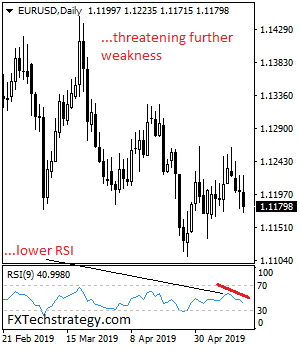
EURUSD outlook remains lower in the short term as we look for more decline to occur. Support comes in at the 1.1150 where a violation will turn risk to the 1.1100 level. A break below here will target the 1.1050 level. Further down, support sits at the 1.1000 level. Its daily RSI9 is bearish and pointing lower suggesting further weakness. Conversely, on the upside, resistance resides at 1.1200 level with a break through there opening the door for further upside towards the 1.1.1250 level. Further up, resistance comes in at the 1.1300 level where a violation will expose the 1.1350 level. All in all, EURUSD outlook remains lower in the short term.
Eco Data 5/17/19
[php_everywhere instance="1"]
EURUSD Outlook Remains Lower In The Short Term
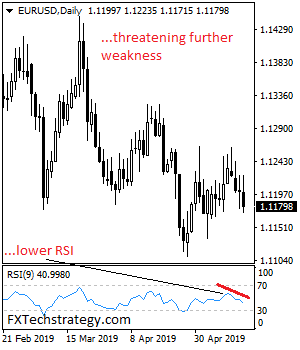
EURUSD outlook remains lower in the short term as we look for more decline to occur. Support comes in at the 1.1150 where a violation will turn risk to the 1.1100 level. A break below here will target the 1.1050 level. Further down, support sits at the 1.1000 level. Its daily RSI9 is bearish and pointing lower suggesting further weakness. Conversely, on the upside, resistance resides at 1.1200 level with a break through there opening the door for further upside towards the 1.1.1250 level. Further up, resistance comes in at the 1.1300 level where a violation will expose the 1.1350 level. All in all, EURUSD outlook remains lower in the short term.
US update: Stocks cheer Walmart, Dollar & yields follow, EURUSD heavy
US stocks and treasury yields stage a strong rebound today, thanks to earnings surprises and solid economic data. In particular, investors cheered Walmart, which reported best Q1 same-store sales growth in nine-years. At the time of writing, DOW, S&P 500 and NASDAQ are all trading up more than 1%. 10-year yield is also back above 2.4 handle at 2.402.
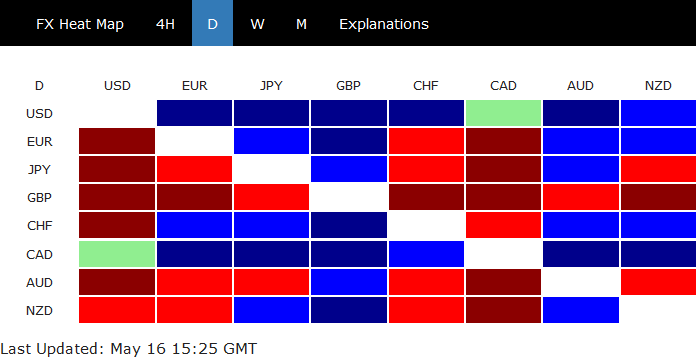
The positive developments in the US pull Dollar broadly higher.
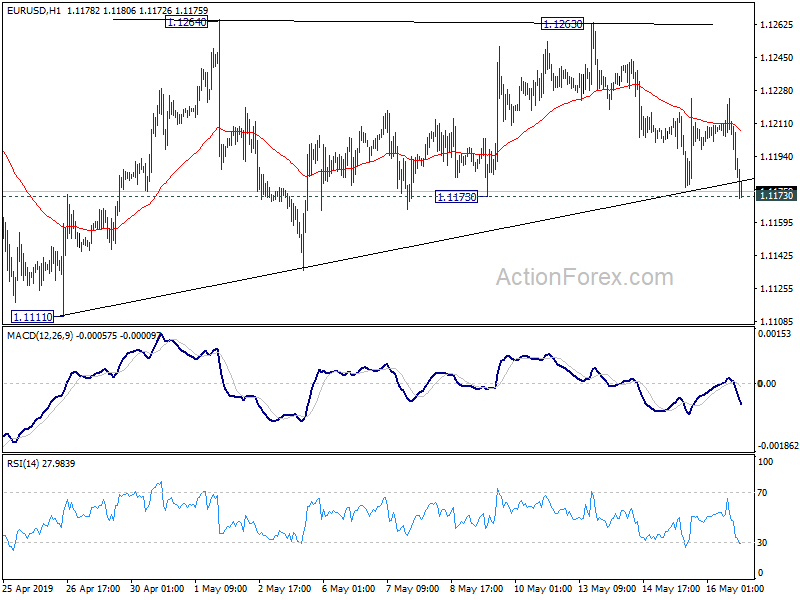
Technically, EUR/USD is set to take on 1.1173 minor support. Break will suggests that consolidation from 1.1111 has completed at 1.1263. retest of 1.1111 should be seen next.
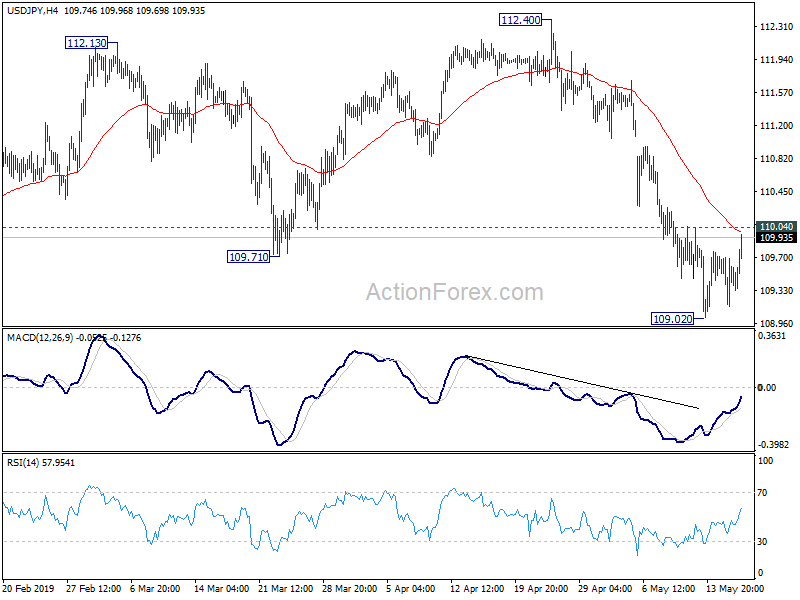
USD/JPY is eyeing 110.04 minor resistance. Break will indicate short term bottoming at 109.02 and bring stronger rebound back to 55 day EMA at 110.95.
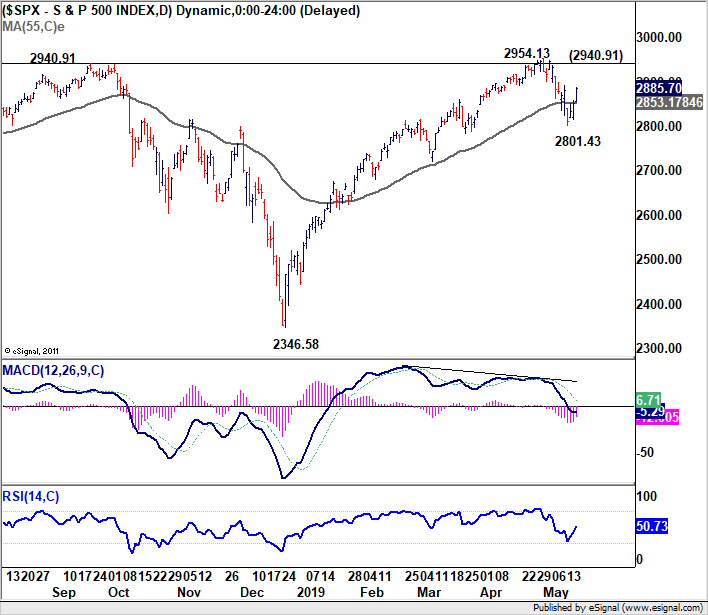
The strong rebound in S&P 500 puts it firmly back above 55 day EMA. That dampens our bearish view that rise fro 2346.58 has completed at 2954.13. We'll see from if SPX could extend the rebound to retest 2954.13 high next. Even though we don't expect a break there. Confidence is just average.
China Weekly Letter – China Strikes Defiant Tone, Recovery Postponed
- China has started to beat the nationalist drum and shows no signs of giving in to US demands of changing its laws as part of a trade deal.
- Trump has issued an executive order, banning Huawei and ZTE in the US.
- Xi warns that aim to remould other civilisations would be 'a stupid idea and a disastrous act'.
- More bad data in April. Recovery is postponed and more stimulus is on the way.
- CNY keeps weakening, more to come.
We publish our China Weekly Letter on Thursday this week as tomorrow is a national holiday in Denmark.
Both sides defiant in what now looks like a war of attrition
It was another busy week with lots of news on China and the trade war. One big change has been the much more defiant tone from China and authorities beating the nationalist drum for the first time during the trade war. A TV clip from China's state television CCTV went viral on social media with close to 3bn hits, see SupChina , 15 May. 'China has already given its answer: talk and the door is open, fight and we'll fight you to the end,' the news anchor read with a firm look. Even for a country with 1.4bn people, close to 3bn hits is substantial. Today China Daily wrote that 'China will never do anything that will leave it humiliated again. No one should expect China to swallow the bitter fruit of damaging its core interests'.
China retaliated the US additional tariffs this week by increasing tariffs on US goods worth USD60bn. It will most likely also halt purchases of US agricultural goods and take other measures but a formal announcement will probably not be made on this. China hit back at US allegations of backtracking and instead accused the US negotiators of themselves reneging on trade talks on the matter of the amount of Chinese purchases of US goods, see FT , 14 May. China believes the US has raised the amount above what was agreed between Trump and Xi in December.
On the other side of the table, Robert Delaney from SCMP writes about an 'anti-Chinese blaze' taking place in the US. He believes that 'the fire that Trump started has grown over the past three years into a blaze that he can't contain, pushing some US lawmakers and pundits to rhetorical extremes'. While Trump has bi-partisan support for his strong stance towards China, not everyone agrees on the tools. Some Republican politicians in farm states in the Midwest are starting to complain, see FT , 14 May. Farmers themselves are also unhappy with the situation asking for a trade deal soon.
Trump added some fuel to the fire on Wednesday by signing an executive order that effectively bans Huawei and ZTE from selling equipment to US companies and consumers due to national security. China immediately expressed strong opposition to the move, see Reuters , 16 May. After a string of confrontational tweets towards China over the weekend, Trump softened his tone on Tuesday stating he was sure it would all end successfully. It was probably not a coincidence that it happened after US stock markets had taken a beating on Monday.
Finally, in a week of more US-China confrontation Xi Jinping delivered a speech at the Conference on Dialogue of Asian Civilisations, where he warned that 'if someone thinks their own race and civilisation is superior and insists on remoulding or replacing other civilisations, it would be a stupid idea and a disastrous act', see SCMP, 15 May. Xi does not name the US but the statement comes after US State Department director Kiron Skinner stirred controversy two weeks ago by describing the competition with China as 'a fight with a really different civilisation and a different ideology', adding that it was the first time the US had faced a 'great power competitor that is not Caucasian'.
Comment. The sentiment between the US and China is the worst in decades, which makes it hard to see a resolve of the trade war soon. While US Treasury Secretary Stephen Mnuchin repeated that the two sides agreed to continue talks in Beijing, there is no plan on the timing. We worry that the two sides are 'digging in' and that Trump believes he can push China into more concession with his 'maximum pressure' tactic. We struggle to see a trade deal coming until there has been another round of escalation and sell-off in the markets that creates the needed pressure for both sides to meet each other halfway. We do not expect a trade deal until H2 with the highest probability mass in late Q3.
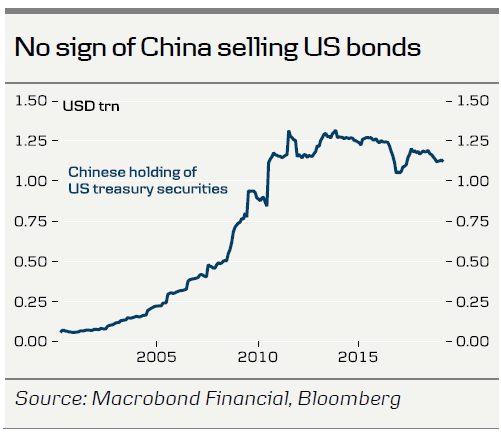
There was again speculation this week that China could use the selling of US Treasuries as a weapon in the trade war. We continue to see treasury selling as very unlikely as it could backfire and cause financial instability. We have seen a decline in treasury holdings but it is very small and fluctuations are quite normal: bonds mature and interventions in the FX market in favour of the CNY sometimes require liquidating USD-assets to buy CNY.
It is increasingly likely that we enter a phase where Chinese consumers will 'defend their country' by shying away from buying US goods and support Chinese goods instead. This would take the damage for US businesses and the stock market to another level.
More bad data and trade war paves way for more stimulus
Retail sales and industrial production also disappointed in April. Industrial production dropped back to 5.4% y/y following the spike to 8.5% y/y in March. Retail sales sank further to 7.2% y/y, another cycle low.
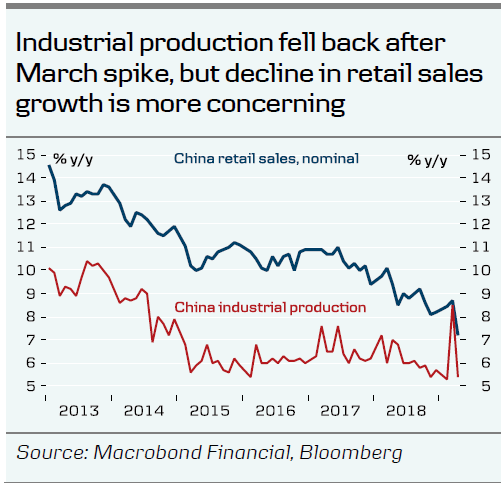
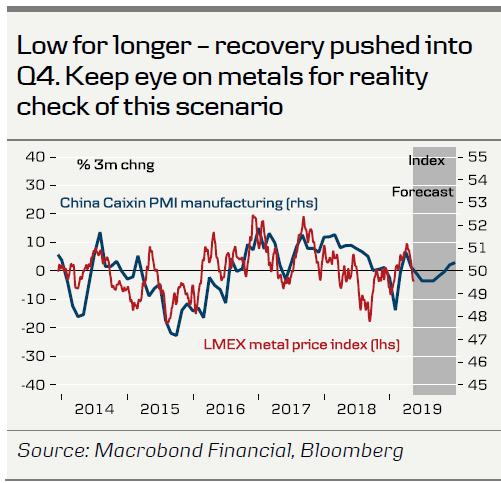
Comment. We believe that part of the April weakness is payback from a March that was too good to be true. The weak retail sales is a concern, though. The main worry now is the renewed uncertainty from the trade war. We expect China to announce new easing measures soon with the weight skewed to fiscal policy over monetary policy. We look for a cut in the Reserve Requirement Ratio and more subsidies for consumer goods like cars, home appliances etc. Infrastructure spending may be lifted as well, depending on how much the economy slows. We believe China has adequate tools to keep growth within the goal of 6-6.5% in 2019. We have revised our profile for PMI and expect more downside in coming months as well as the recovery being pushed into Q4.
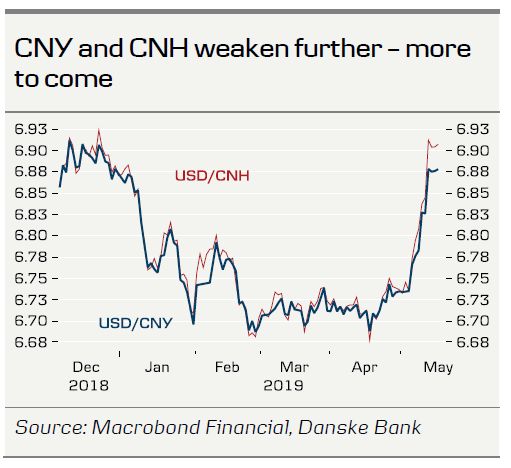
USD/CNY weakens, more to come
USD/CNY weakened further this week. Continued trade war fears and expectations of further easing of monetary policy put pressure on the renminbi.
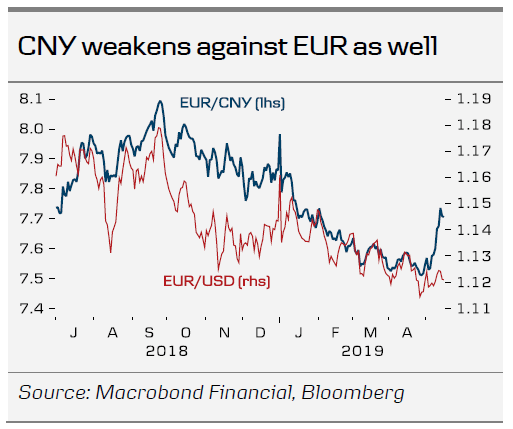
Comment. As we expect things need to get worse in order to get better, we expect the downward pressure on the CNY to continue. This week we revised our USD/CNY forecast to 7.1 in 3M. However, on the other side of a trade deal we expect it to decline again and revert to 6.8 in 12M, see also FX Forecast Update, 16 May (page 12).
Weekly Focus – After the New Trade Spat, What’s Next for Global Economy?
Market movers ahead
- In the trade dispute between China and US, we expect markets to look for signs of negotiations restarting.
- In the US, the preliminary PMI for May is likely to be affected by the weak global backdrop.
- In the euro area, the PMI is likely to show a small uptick from the current low level, while the German ifo number may already reflect the trade uncertainty.
- In the UK, the EU elections could inflict a heavy defeat on the conservative party and increase pressure on Prime Minister Theresa May to resign.
- In Japan, we estimate Japanese GDP fell 0.4% q/q in Q1.
Weekly wrap-up
- The trade spat between the US and China has calmed down a bit and markets are looking for a potential new meeting to be set up.
- Prime Minister Theresa May plans to attempt to get her Brexit deal through in the week beginning Monday 3 June.
- In Germany, Q1 GDP growth rebounded to 0.4% q/q, after narrowly avoiding a recession in H2 18.
- Risk sentiment has been fragile this week following the escalation of the trade war.
Japan’s Economy Likely Contracted Again in Q1; What Next for the BoJ?
Japan will be post GDP growth figures for the first quarter on Monday (Sunday, 23:50 GMT). But with trade uncertainty still weighing heavily on export-dependent Japanese businesses, the data is unlikely to bring music to policymakers’ ears as the world’s third largest economy is expected to have contracted during the period.
After achieving non-interrupted growth for eight consecutive quarters in 2016-2017 – the longest stretch in nearly three decades, Japan’s economy hit a stumbling block in 2018 as trade tensions began to brew. The United States has yet to formally take its trade fight to Japan, having only held preliminary talks so far. But the slowdown in China (Japan’s biggest export market) and the uncertainty generated by the trade frictions have hurt demand and cast a shadow over firms’ outlook.
Growth weighed by weak external and domestic demand
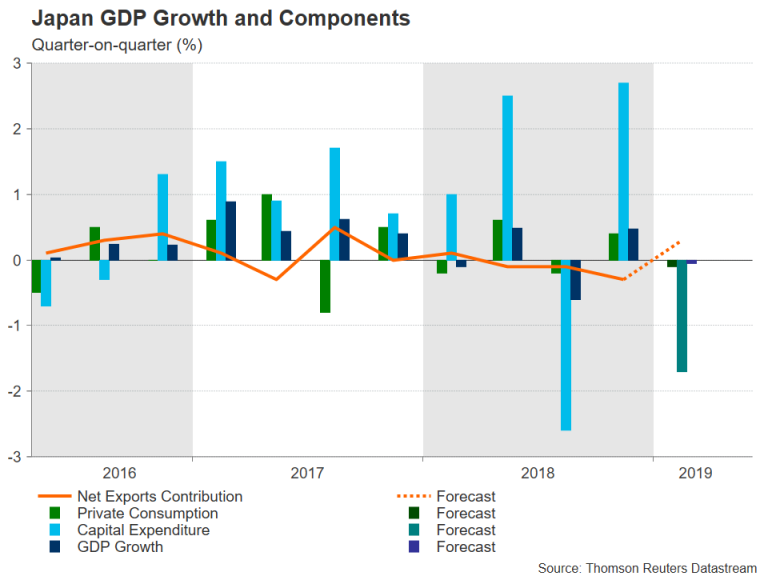
Economic growth in the first quarter is not expected to have benefited much from the easing of the trade tensions and the shift to a more accommodative policy stance by central banks around the world. In fact, the poor performance of exports probably acted as a drag, with any modest pickup unlikely to have been enough to offset anticipated drops in domestic consumption and business expenditure. GDP is forecast to have declined by 0.1% quarter-on-quarter and by 0.2% on an annualized basis. If confirmed, it would make it the third quarterly contraction in 15 months.
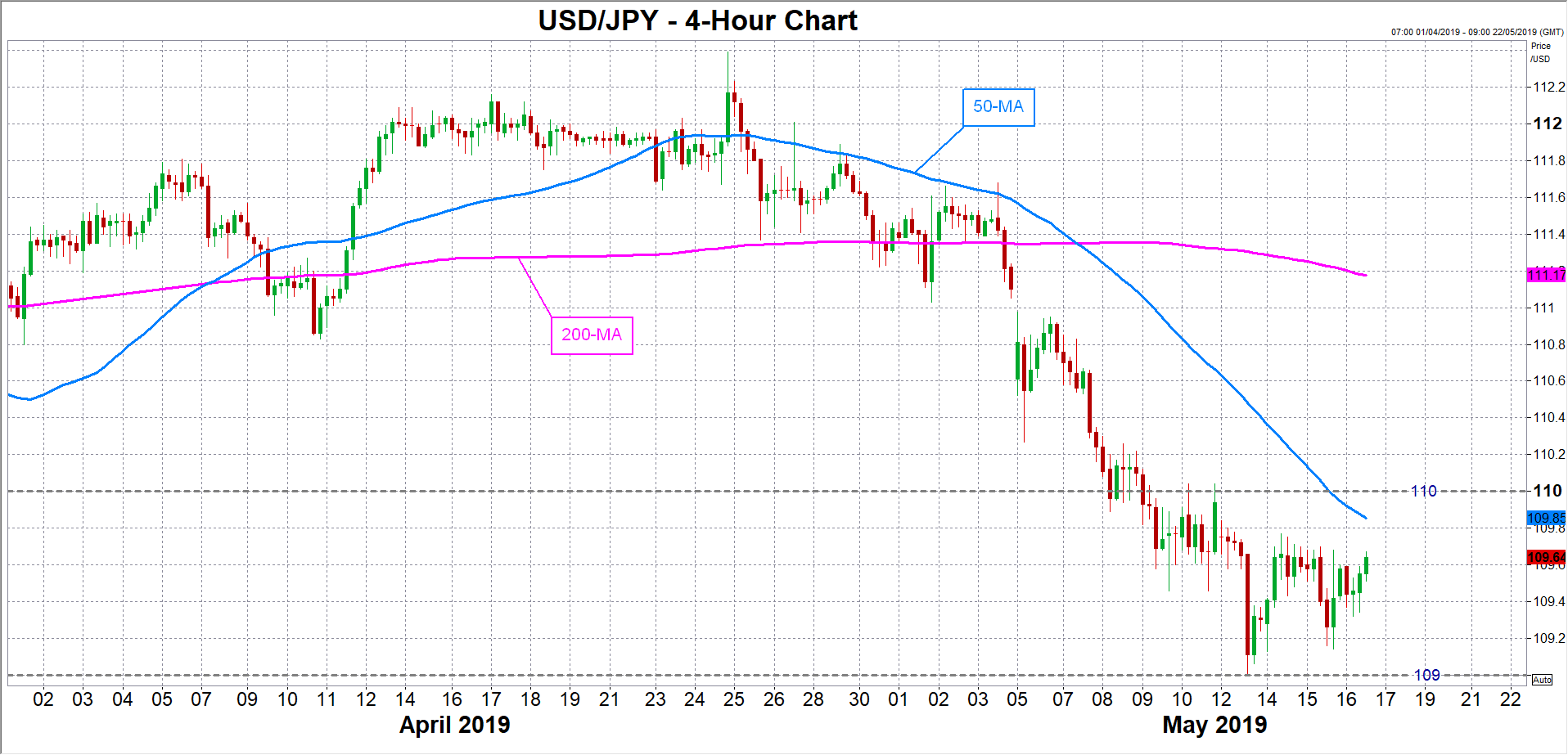
Should the GDP numbers reveal that the Japanese economy is in worse condition than is currently being projected, dollar/yen could get a lift to around the 110 handle, assuming safe-haven flows for the yen remain in check. But should Japan join the US, the Eurozone and China in reporting stronger-than-expected growth for Q1, dollar/yen could challenge key support at the 109 mark.
Bank of Japan not in a hurry to ease further
If growth during the first quarter isn’t as bad as feared, it would temporarily take the pressure off the Bank of Japan to take additional stimulus measures. However, even if the economy performed better than thought in Q1, the risks are clearly tilted to the downside as the chances of a quick resolution to the US-China trade dispute are looking increasingly remote. Hence, the Bank of Japan is unlikely to be let off the hook anytime soon as policymakers fret about stubbornly low inflation.
BoJ Governor Haruhiko Kuroda has repeatedly stressed the Bank would not hesitate to ease monetary policy further should the momentum in price increases be lost. However, at the same time, Kuroda has said the BoJ is not considering additional stimulus just now, meaning, there would have to be a significant deterioration in the growth picture before more easing is put back on the table.
Sales tax delay?
The Bank of Japan is not the only one that would need to rethink policy if the economy was to falter again. There is growing speculation the government might have to delay its planned rate hike for October 2019 from 8% to 10% if growth appears to be weakening substantially. The government is due to publish its monthly assessment on the economy next week. Back in March, the government had cut its assessment for the first time in three years. Another downgrade in May would only fuel speculation of a third delay to the sales tax increase.
Risk Appetite Improves Awaiting Further Trade Clarity
A fresh round of economic data for the US showed a rebound in Housing, continued strength in the labor market and a regional survey showed mostly improvements in the manufacturing sector. Stocks are poised to open near the overnight highs as investors await the next concrete steps in trade talks. The Cboe Volatility Indicator, VIX is down 2% at 16.10 as trade war watchers take the recent retaliatory rhetoric from China as nothing to fret about. The Dow is poised to open over 90 points higher while both the Nasdaq and S&P 500 are looking at gains slightly over 10 points. The British pound is the worst performing currency as no-deal risks grow and the end appears near for PM May
- Huawei – Restrictions to US markets ramp up trade war
- Brexit – Times running out for PM May
- Treasuries – China’s holdings fall for a ninth straight month
- Oil – Rises on Gas Inventory draw and Geopolitics
- Gold – Back below 1,300 as safe-havens give back gains
Huawei
Yesterday, President Trump kept the fight going on with China, after signing an executive order that targeted Huawei from potentially preventing it from buying American parts for their 5G networks. After Trump’s order, the Department of Commerce claimed to have put Huawei on a blacklist that will prevent it from working with American businesses.
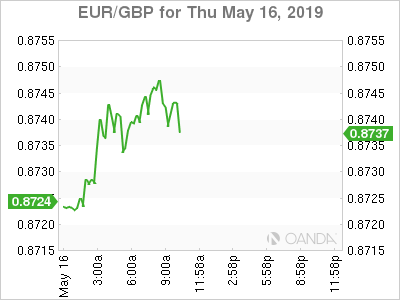
We saw a similar tactic to ZTE last year and that almost destroyed the company. This action however will also harm US suppliers Qualcomm, Micron, and Marvell. Approximately 20% of Huawei’s spend goes to American companies. Technology shares are down sharply in Asia. The Nasdaq’s gains are being weighed down on the Huawei news.
Brexit
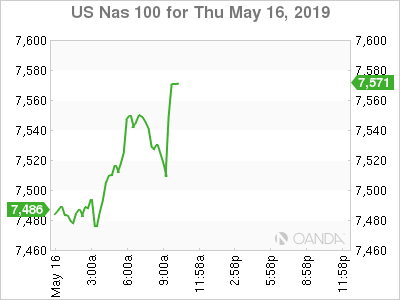
The British pound continues to weaken against the euro, poised for the longest slide since 2000 as no-deal Brexit risks grow. PM May seems to be not making any material progress in securing any progressive steps towards a deal and it appears the writing is on the wall for her. Continued calls for her resignation are growing and after this next failure in not securing a deal by the European Parliamentary elections, it only sees inevitable Brexit will need to be delivered by someone else.
Labour remains opposed to voting against that PM May’s name on it, as she will not concede on Labour’s central demand for a permanent customs union in cross-party talks on Brexit. Her latest legislation appears to be dead on arrival and if that does not pass, it will be hard to see a reason to give her deal a fourth attempt at passing.
Treasuries
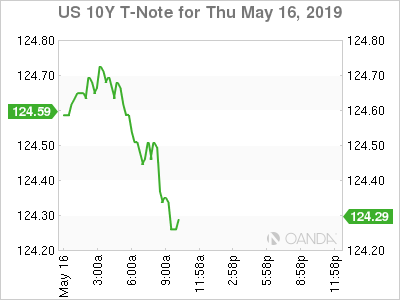
In what is being consider a response to trade tensions with the US, China’s reduced their US Treasuries holdings, now at a 2-year low and appears poised to test the levels seen at the financial crisis. The reduction of $10.4 billion in Treasuries brought down their portfolio to $1.12 trillion, the first decline since November.
Back in January of 2018, China shook the bond market when they announced they were favoring a slowing or halting of purchases of US Treasuries. Bond markets have prospered with a three-decade bull market and that could coming to an end if we see the Chinese avoid buying US debt during a time when central banks are considering upping their bond-buying stimulus.
Oil
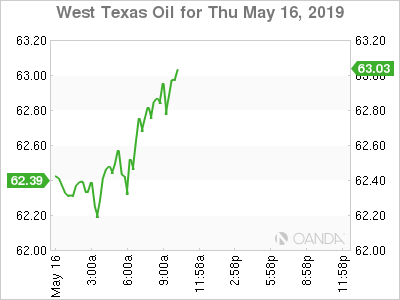
Crude prices are rising for a third consecutive day after the EIA report was bullish for gasoline inventories and geopolitics risk remain on high alert in the Middle East. The key driver for oil is coming out of the Persian Gulf. Saudi Arabia’s Vice Minister of Defense noted Tehran was behind the Sunday Houthi terrorist attacks. Other drivers for crude is the news that Iraq could be selling more oil to Turkey, filling the void left from Iran.
Gold
Some are saying gold is lower on technical selling, others profit taking, and trade optimism roughly rounds out the rest. The yellow metal remains beleaguered on global deflationary conditions and optimism that both the Americans and Chinese cannot afford lose any political capital domestically with a complete collapse in trade talks.