Sample Category Title
EURUSD Bullish Bias
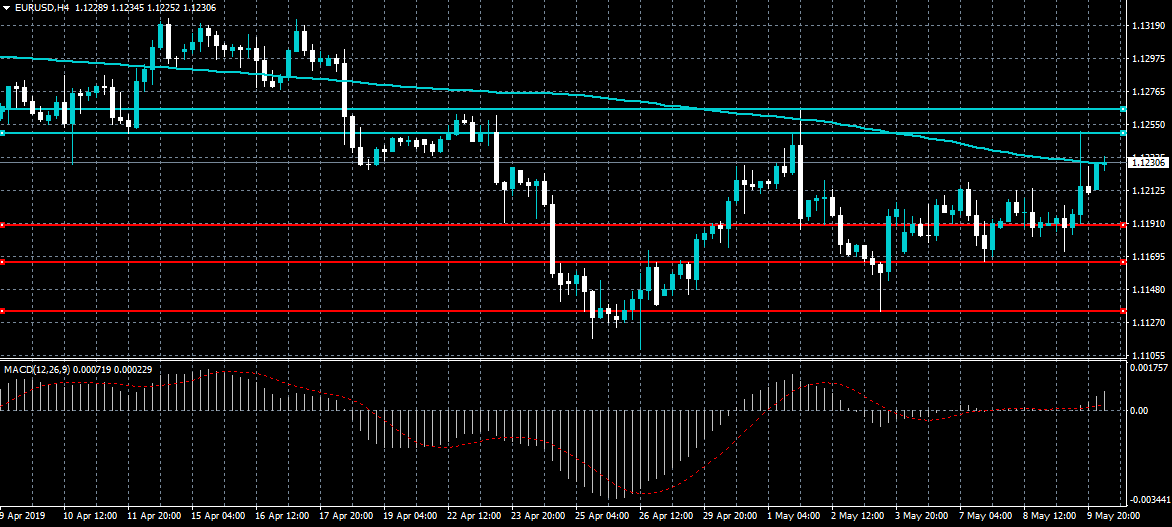
The euro is trading well above the 1.1200 support level against the US dollar after briefly spiking towards the 1.1250 level during Thursday’s US trading session. EURUSD buyers need to move price back above the 1.1250 level or they risk losing bullish trading momentum. Sellers will take back short-term control of the EURUSD pair if price starts to once again trade under the 1.1190 level.
The EURUSD pair is only bullish while trading above the 1.1190 level, key technical resistance is found at the 1.1250 and 1.1264 levels.
If the EURUSD pair moves below the 1.1216 level, key technical support remains at the 1.1190 and 1.1164 levels.
GBPUSD Awaiting GDP Data
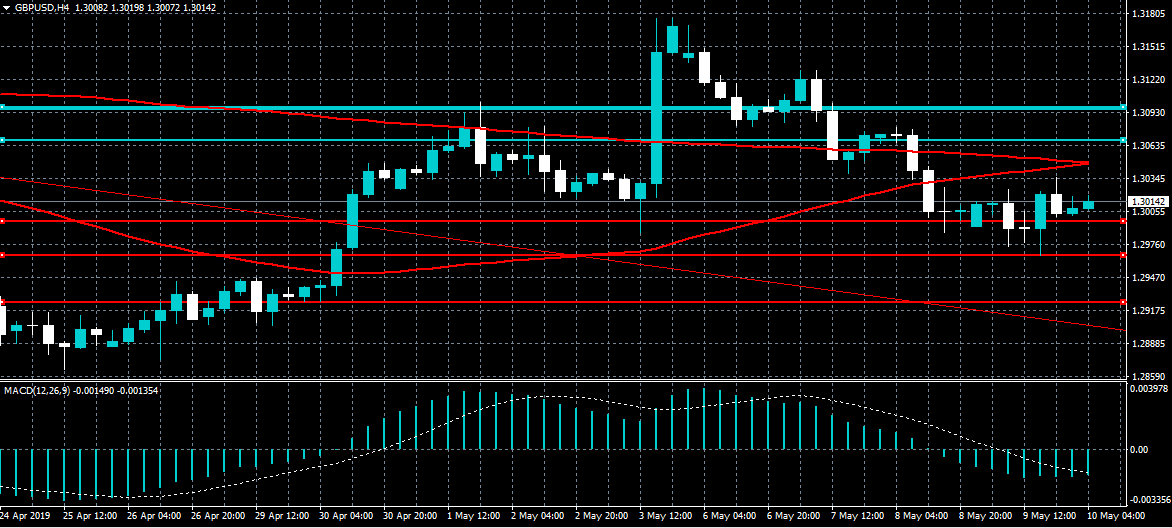
The British pound has recovered above the 1.3000 level against the US dollar as traders await the release of GDP data from the United Kingdom economy later this morning. The GBPUSD pair has so far found weekly support from the 1.2966 level and only has an intraday bullish bias while trading above the 1.3064 level. If sellers move the GBPUSD pair back under the 1.2990 level the GBPUSD is likely to test back towards the current monthly low.
The GBPUSD pair is bullish while trading above the 1.3064 level, key resistance is found at the 1.3100 and 1.3130 levels.
If the GBPUSD pair trades below the 1.2990 level, key intraday support is found at the 1.2966 and 1.2910 levels.
GBPAUD Slips, Could Struggle Until Bullish Cross Confirmed
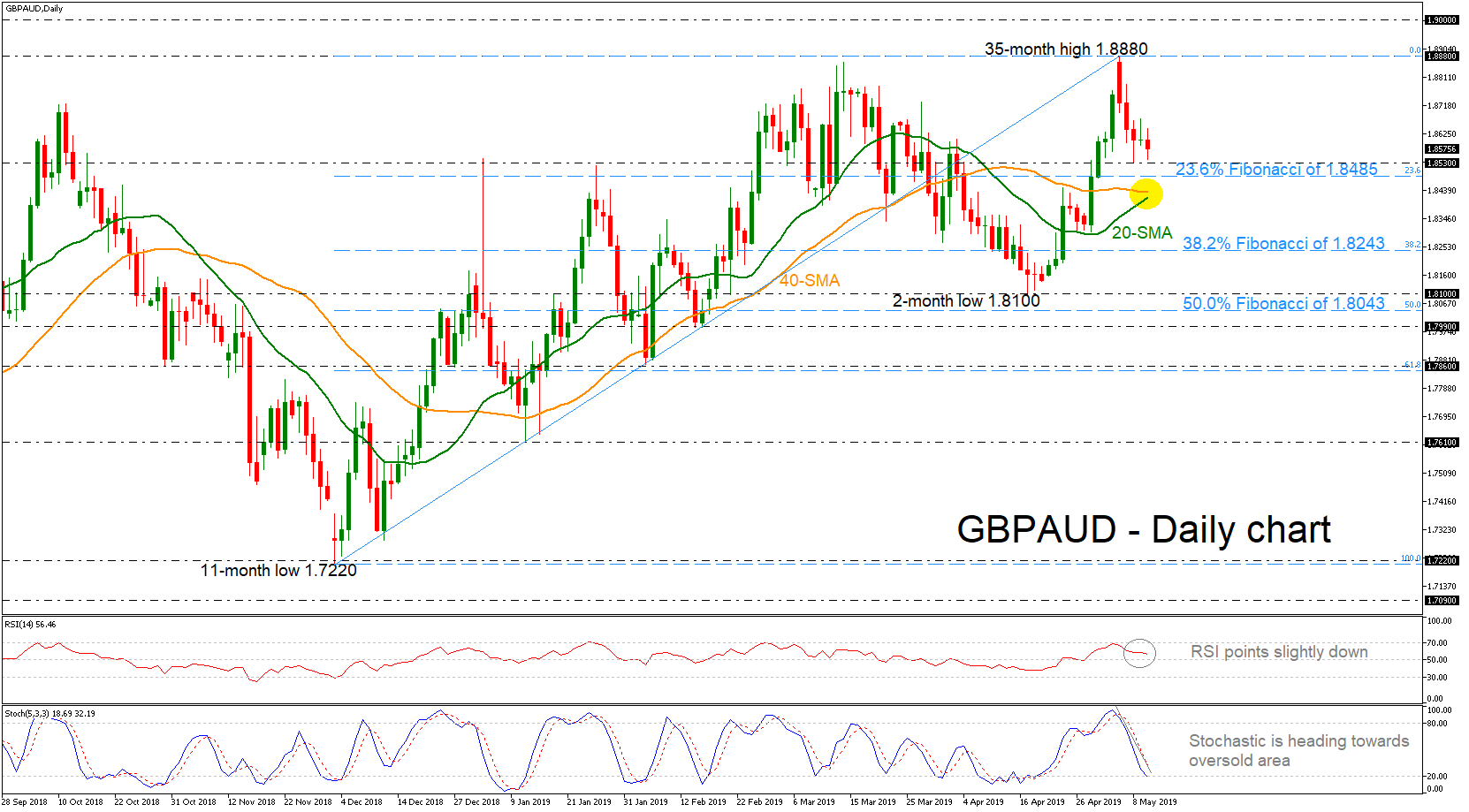
GBPAUD has declined considerably since it reached an almost three-year high of 1.8880 on Monday, sending the price until the 1.8530 support. The RSI is turning slightly lower approaching the 50 level, while the stochastic oscillator seems to be strongly bearish, as it is heading towards the oversold territory. However, the 20- and 40-simple moving averages (SMAs) in the daily chart are ready to post a bullish cross despite the latest bearish movement.
If the price continues to slip further, a rebound could come around the crossover within the SMAs currently at 1.8440, but first needs to challenge the 23.6% Fibonacci retracement level of the upleg from 1.7220 to 1.8880 near 1.8485.
On the upside, the price could touch once again the 35-month high of 1.8880, while a successful climb above this barrier could increase bullish sentiment until the significant psychological barrier of 1.9000.
Overall, GBPAUD seems to be in negative correction following the pullback on the 1.8880. However, if the price remains above the short-term SMAs, investors could turn their interest to the upside again.
Markets Offer Uncharacteristic Response To Higher US Tariffs On $200b Worth Of Chinese Goods
It's official – President Donald Trump has raised the existing 10 percent tariff to 25 percent on $200 billion worth of Chinese goods shipped to the United States, the net result being that there is now a 25 percent tariff imposed on a total of $250 billion worth of Chinese products. After a week-long sell-off in anticipation of new tariffs, there was an uncharacteristic reaction from Asian stock markets to the confirmation.
The Shanghai Composite Index initially pared gains but rebounded to a new intraday high. The Nikkei 225 reversed losses after its lunch break, while many other Asian stocks remain in positive territory. The unexpected price action in Asian equities could be due to optimism that the United States and China can still find a resolution to this long-standing issue with trade talks set to continue on Friday in Washington.
Safe haven assets such as Gold and the Japanese Yen are little changed at the time of writing, instead of surging as one may come to expect following an escalation in trade relations between the two largest economies in the world.
Meanwhile, Brent futures are refusing to take things lying down, and look set to continue testing the $71/bbl level. However, beyond the initial price movements, the escalation of trade tensions between the United States and China could be negative for global GDP momentum, and it would be expected that Oil markets would find themselves under negative pressure from concerns over the global economy in the long run.
More trade drama ahead?
Investors will try to ascertain next what China's "necessary countermeasures" will entail exactly, and whether this path will eventually lead to Trump pressing ahead with the 25 percent tariff on a separate $325 billion worth of Chinese goods. Noting that subsequent moves are only expected to ramp up tensions between the US and China, such posturing on both sides begs the question – how much further does this tit-for-tat tariff track go on for?
Judging by 2018 trade figures from the US Census Bureau, about 47% of Chinese imports into the United States currently have tariffs levied on them, while 91% of US goods sent to China are subjected to tariffs. This indicates that the United States has more mileage to implement tariffs than the other way around.
Should tariffs be imposed on all US-China trade, this will very likely raise the prospect of a global economic downturn and severely dent the year-to-date gains for riskier assets. Keep in mind that, according to calculations by Bloomberg Economics, using OECD data, some one percent of global GDP is exposed to risks stemming from US-China trade risks. Ramped up trade tensions could have broader ramifications beyond the exchange of goods and services between the world's two largest economies, potentially feeding fears in the global financial markets and impact consumer spending as well, while affecting other countries that are intertwined in the global supply chain.
Can investors still hope for a positive resolution?
The saving grace amid all these trade tensions is that trade talks in Washington are set to continue on Friday, offering markets a silver line of hope that a positive breakthrough may still be on the cards. Until then markets will remain on the edge of their seats, amid scant signs of a much-needed positive headline from these persistent negotiations.
UK GDP grew 0.5% qoq in Q1, but March contracted -0.1% mom
UK GDP grew 0.5% qoq in Q1, up from Q4's 0.2% qoq and matched expectations. Annually, GDP grew 1.8% yoy, up from Q4's 1.4%.
Looking at the details, production had a noticeable pickup by 1.4. But services growth slowed to just 0.3%. Construction growth increased to 1.0%. Output of agriculture, forestry and fishing sector fell by 1.8%.
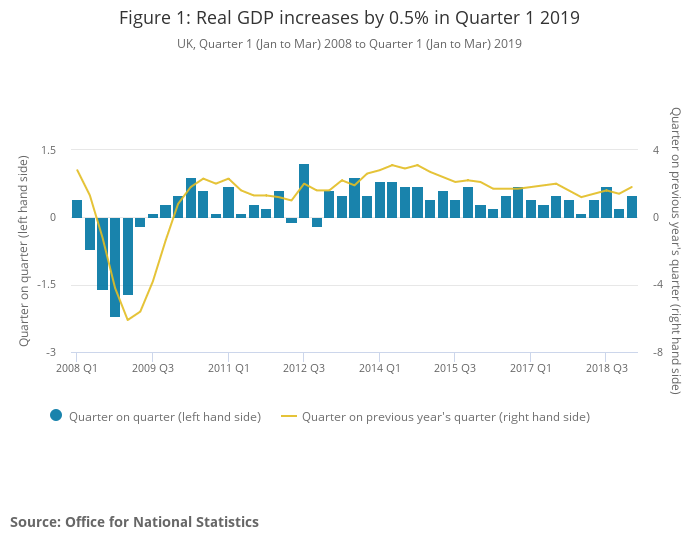
In March GDP contracted -0.1% mom, below expectation of 0.0% mom. Index of services dropped -0.1% mom. Index of production rose 0.7% mom. Manufacturing rose 0.9% mom. Construction dropped -1.9% mom. Agriculture dropped -0.1% mom.
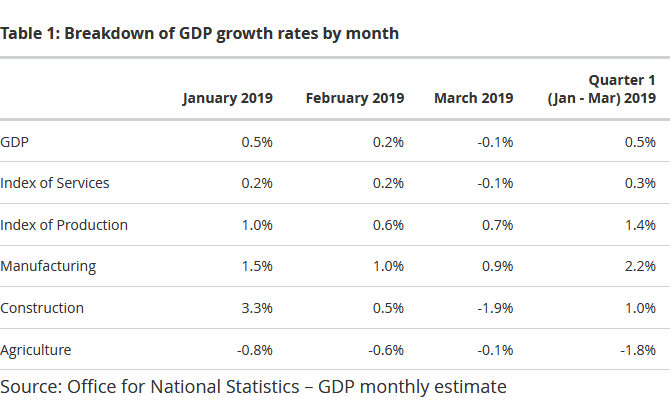 In March, UK industrial production rose 0.7% mom, 1.3% yoy, versus expectation of 0.1% mom, 0.4% yoy. Manufacturing production rose 0.9% mom, 2.6% yoy, versus expectation of 0.0% mom, 1.1% yoy. Visible trade deficit narrowed to GBP -13.65B, slightly smaller than expectation of -13.7B. Construction output dropped -1.9% mom, versus expectation of -0.9% mom.
US Impose Additional Tariffs As US-SINO Negotiations Continue
JPY stabilized against the USD yesterday, as some hopes surfaced about the US-Sino negotiations in Washington. US and Chinese officials began two-day talks on Thursday in an effort to prevent any further escalation but the US has imposed additional tariffs on Chinese imports, which came into effect at the US midnight today. The additional US tariffs imposed could be followed by threats on more tariffs on a wider spectrum of Chinese products imported in the US. Also, the newly imposed US tariff hike could be part of wider negotiating tactic of the US, especially as the Chinese side during the negotiations had persisted on the US tariffs being removed, while the US side was quite hesitant. We expect the next episode of the tariff saga, to be the Chinese response, however their options may be getting narrower. We expect that in the long run the two sides will probably be able to reach a deal as both have enough incentives to do that, however we also expect a bumpy rise until then. The uncertainty in the markets is expected to increase and that could lead to some strengthening of the JPY, especially if the Chinese response escalates the situation substantially. USD/JPY rose yesterday, bouncing on the 109.75 (S1) support line, however corrected somewhat lower later on. As the down ward trendline incepted since the 3rd of May was broken, we switch our bearish outlook in favor of a sideways movement. Should the pair’s long positions be favored by the market, we could see it aiming if not breaking the 110.30 (R1) resistance line. Should the pair come under the selling interest of the market, we could see it breaking the 109.75 (S1) support line and aim for the 109.15 (S2) support level.
Oil prices break higher on US-Sino hopes.
Oil prices rose during the Asian session today as hopes for progress in the US-Sino negotiations rose. Analysts point out that the market is rather headline driven and financial releases could be taking a backseat. Especially the statements made by president Trump as well as his tweets remain in the main focus of the markets, however also. Caution is expected to return to the markets as the additional US tariffs have been enacted and we expect argumentation for a possible Chinese slowdown to strengthen, undermining oil prices. Should the US-Sino negotiations break down or should the situation escalate further, we expect oil prices to weaken. WTI prices rose during today’s Asian session, breaking the 62.00 (S1) resistance line (now turned to support). As the downward trendline incepted since the 25th of April was broken, we switch our bearish outlook for the commodity in favor of a sideways movement. Should the bulls take control of WTI’s direction, we could see it breaking the 63.25 (R1) resistance line and aim for the higher grounds. Should the bears take over, we could see WTI prices breaking the 62.00 (S1) support line and aim if not break the 60.50 (S2) support hurdle.
Other economic highlights, today and early tomorrow
In the European session we get the trading data for March from Germany, the UK GDP growth rate for Q1 along with UK’s trade balance and manufacturing output growth rate, both for March. In the American session, we get the US inflation rates, for April and the US Baker Hughes oil rig count. From Canada we get the employment data for April and the building permits growth rate for March. In Monday’s Asian session we get from Australia the housing finance growth rate for March. As for speakers ECB’s Lautenshlager and Coeure, along with Fed’s Brainard, Bostic and Williams speak.
WTI H4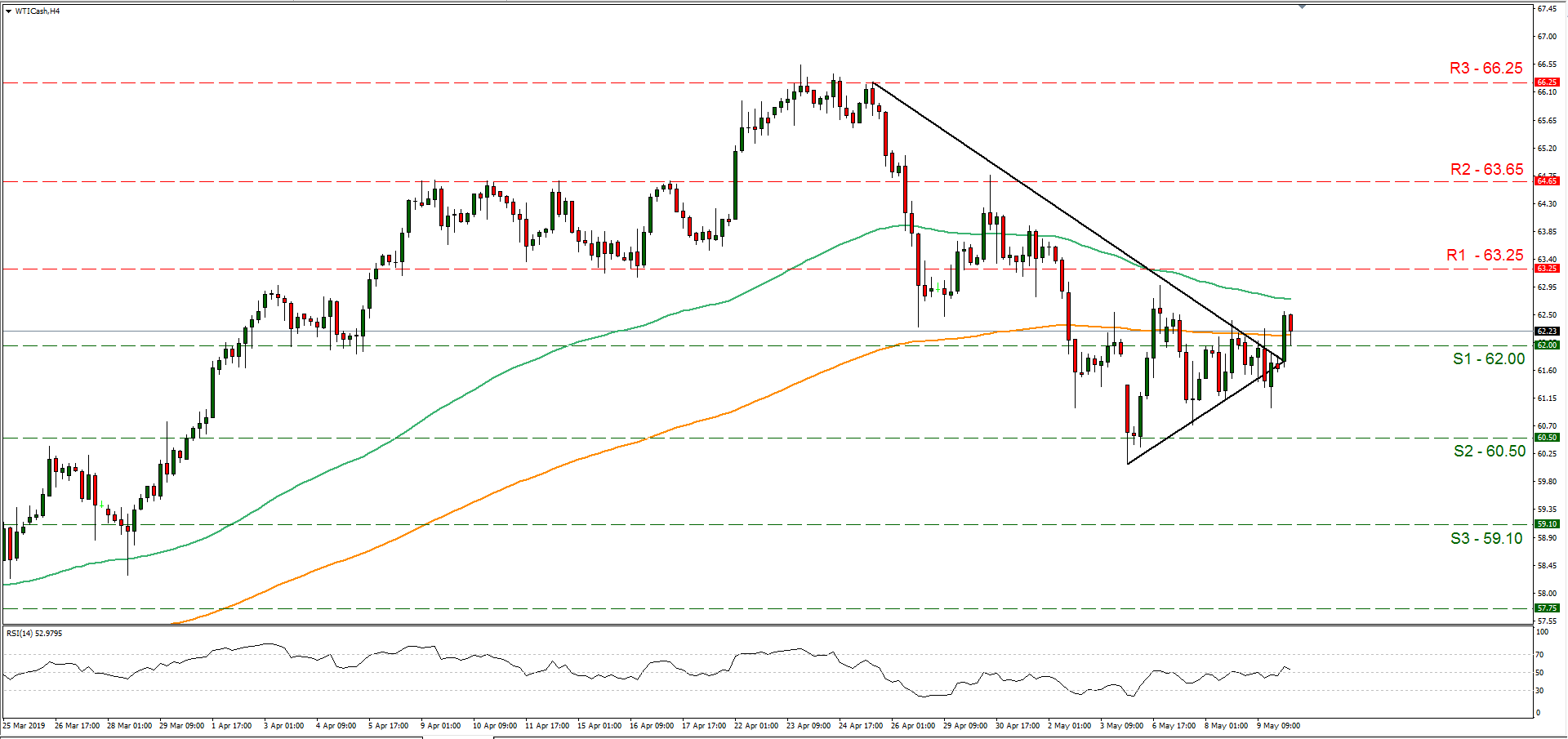
Support: 62.00 (S1), 60.50 (S2), 59.10 (S3)
Resistance: 63.25 (R1), 63.65 (R2), 66.25 (R3)
USD/JPY H4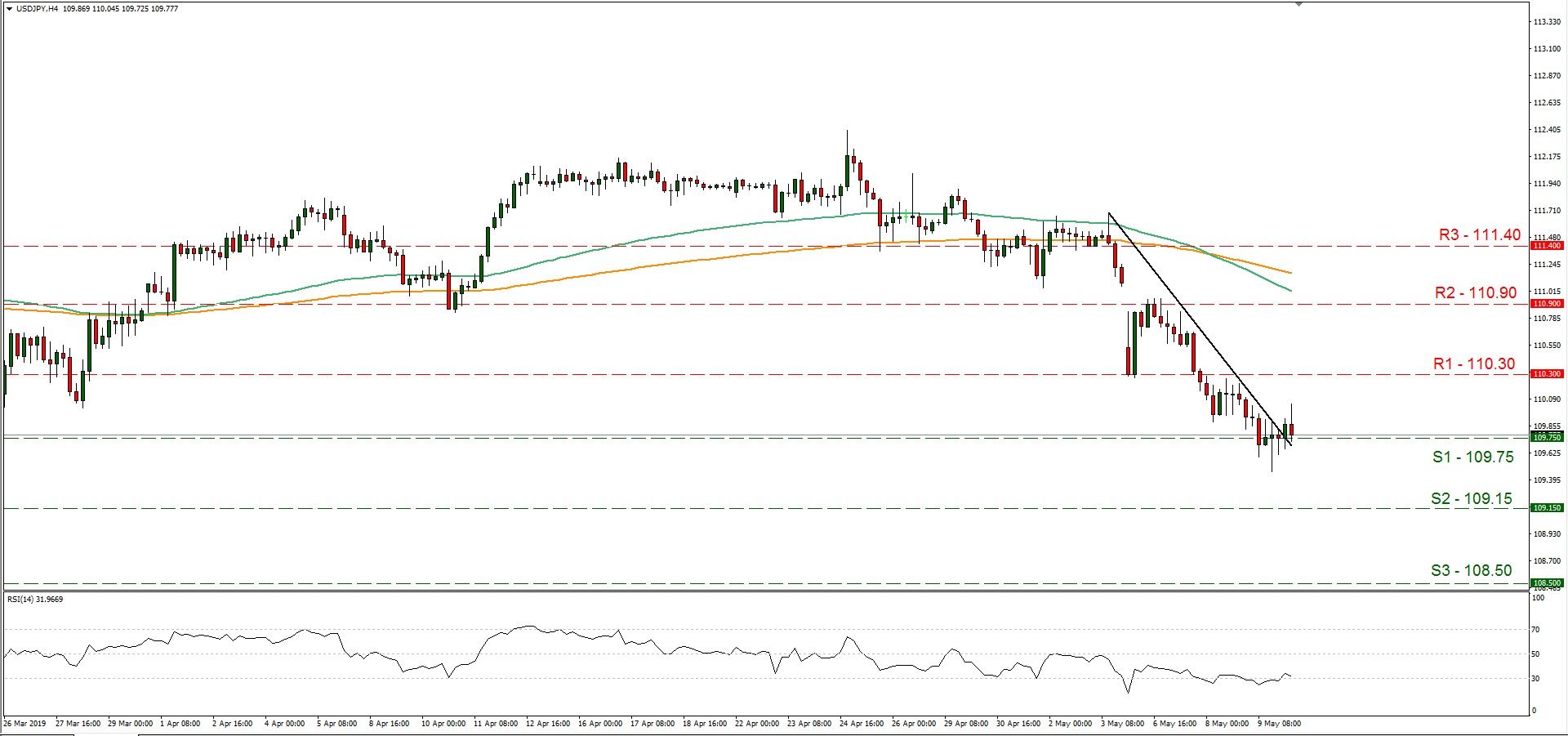
Support: 109.75 (S1), 109.15 (S2), 108.50 (S3)
Resistance: 110.30 (R1), 110.90 (R2), 111.40 (R3)
Forex Technical Analysis: EUR/USD, USD/JPY, GBP/USD
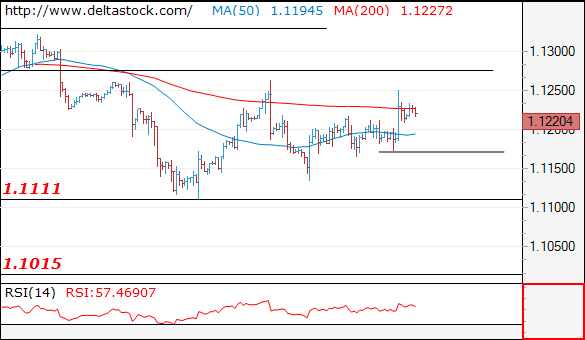
EUR/USD
Current level - 1.1220
The current rise should be the final leg of the consolidation pattern above 1.1110, preceding a slide towards 1.1015 area. Trigger on the downside is 1.1175 low. Intraday allow a test of 1.1275 hurdle.
| Resistance | Support | ||
| intraday | intraweek | intraday | intraweek |
| 1.1275 | 1.1330 | 1.1170 | 1.1010 |
| 1.1275 | 1.1450 | 1.1110 | 1.0860 |
 USD/JPY
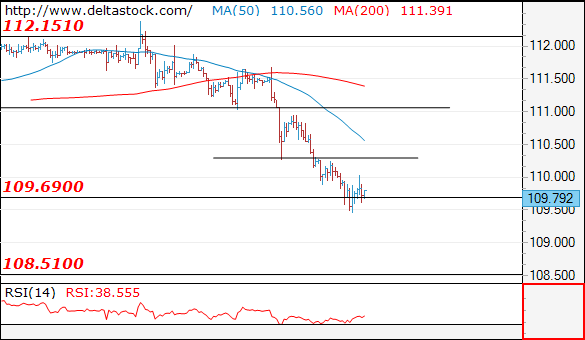
Current level - 109.79
The downtrend is intact, heading towards 108.50 area. Key resistance is projected at 110.30.
| Resistance | Support | ||
| intraday | intraweek | intraday | intraweek |
| 110.30 | 113.20 | 108.50 | 108.50 |
| 111.65 | 114.50 | 108.50 | 107.40 |
GBP/USD
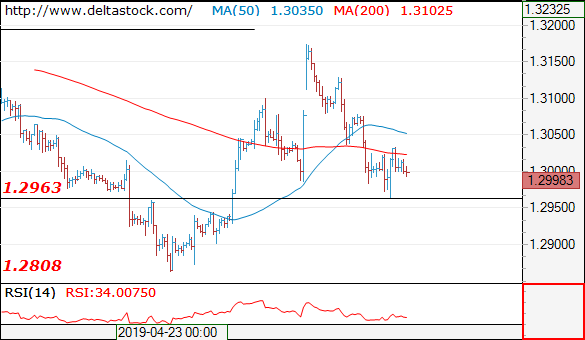
Current level - 1.2998
The test of 1.2960 failed and the bias is already positive, for a rise towards 1.3080.
| Resistance | Support | ||
| intraday | intraweek | intraday | intraweek |
| 1.3030 | 1.3340 | 1.2960 | 1.2810 |
| 1.3080 | 1.3450 | 1.2960 | 1.2610 |
ECB Praet: World norm challenged by power politics
ECB chief economist Peter Praet said a prepared speech that "the notion that the euro provides stability and security has been weakened by the gaps in our governance framework". Thus, "it is not surprising that claims that countries would be better off outside the euro find a sympathetic audience."
To him, the long run solution most likely involves "deeper fiscal integration". In the short run, Praet urged to "complete banking union". While the SSM has moved Eurozone towards the goal, "for deep cross-border integration to develop, effective institutions for public risk-sharing need also to be in place."
Praet also pointed out that "rules and norms" of international relations government since WWII are being challenged and replaced by "new power politics where large economies try to impose their will on smaller ones". And in such a world " it is undeniable that the EU amplifies the sovereignty of its members.:.
Also, Brexit also underling the pros and cons of EU membership. And, "it is now established that leaving the EU presents a trade-off: countries either have to follow the rules they could once set; or they have accept a diminished level of market access, and ultimately lower welfare for their people."
US Raises Tariffs, But Traders Still Think It’s Posturing
- Markets barely react after US raises tariffs, may be too complacent
- US inflation data coming up, may weigh on the dollar a little
- UK GDP and Canadian jobs figures also due for release today
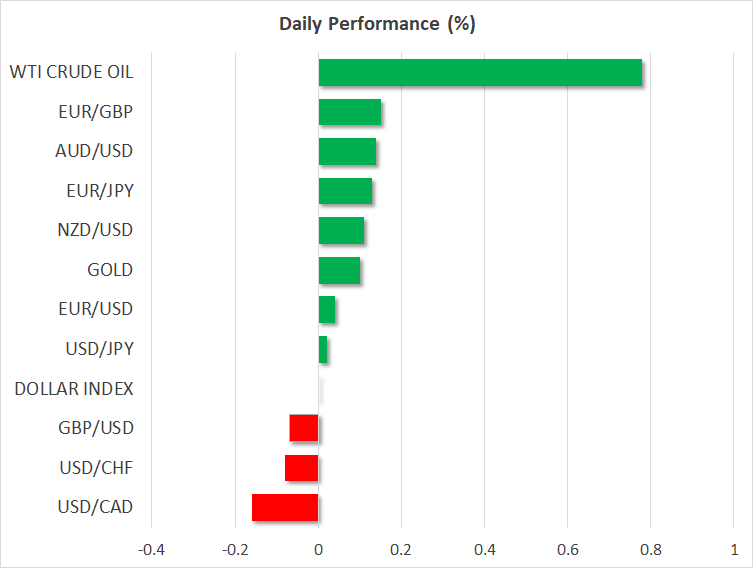
Trump hikes tariffs, but complacent markets still see it as posturing
As threatened, the US raised its tariffs on $200bn of Chinese goods to 25% overnight, from 10% previously. Beijing immediately responded it will be forced to retaliate, though did not provide any specifics. Yet, markets took the news in the stride, with Chinese stock markets actually recording substantial gains today and safe havens like the Japanese yen trading a touch lower. What gives?
Investors seem to have concluded this is indeed only a negotiating ploy by Trump and remain hopeful that the situation won't escalate further. Behind this optimism lies the fact that talks will continue in Washington today, as well as some soothing remarks by Trump, who said earlier that a deal is still possible this week, adding he may hold a phone call with the Chinese President soon. Separately, the increased tariffs will only apply to goods shipped from China as of today, meaning that there's still a small time window to reach a deal and avert them before they truly come into effect.
Markets are right in the big picture: a deal is still the most likely endgame, despite this escalation. Both sides have too much to lose by not reaching an eventual compromise. However, to believe that a deal can be sealed in a couple of weeks and that matters won't escalate any further before we get there seems like wishful thinking. To be clear, investors seem too complacent, and it wouldn't be surprising to see risk aversion return soon, depending of course on the scale of China's retaliation and how today's talks conclude.
US inflation data could hurt the dollar
On a more familiar note, the US will release its CPI inflation data for April today. A softening inflation outlook is among the primary reasons that market pricing currently points to a ~75% probability for a Fed rate cut by December, so these figures will be closely watched.
Both the headline and the core CPI rates are expected to have ticked up, though the risks surrounding those forecasts may be tilted to the downside, judging by what the nation's Markit PMIs for the month signaled. Both the manufacturing and service-sector surveys noted that inflationary pressures softened to multi-month lows in April, which in isolation implies that a downside surprise may be more likely than an upside one in today's CPI prints. A disappointment could amplify expectations for Fed rate cuts, and consequently weigh on the dollar.
There's also a slew of Fed speakers on the agenda, including Board Governor Brainard (12:30 GMT) and New York President Williams (14:00 GMT), both of which are permanent votes and highly influential.
UK GDP and Canadian jobs figures on tap too
It's a relatively busy data on the data front, as besides the US inflation data, we will also get preliminary GDP estimates for Q1 from the UK and Canada's employment figures for April.
In the UK, growth is expected to have accelerated, but the pound is unlikely to move much on the data. Economics barely impact sterling nowadays, which instead takes its cue entirely from political headlines. On that front, cross-party talks between Conservatives and Labour seem to be going nowhere, which implies that there's still no clear way to break the Brexit deadlock.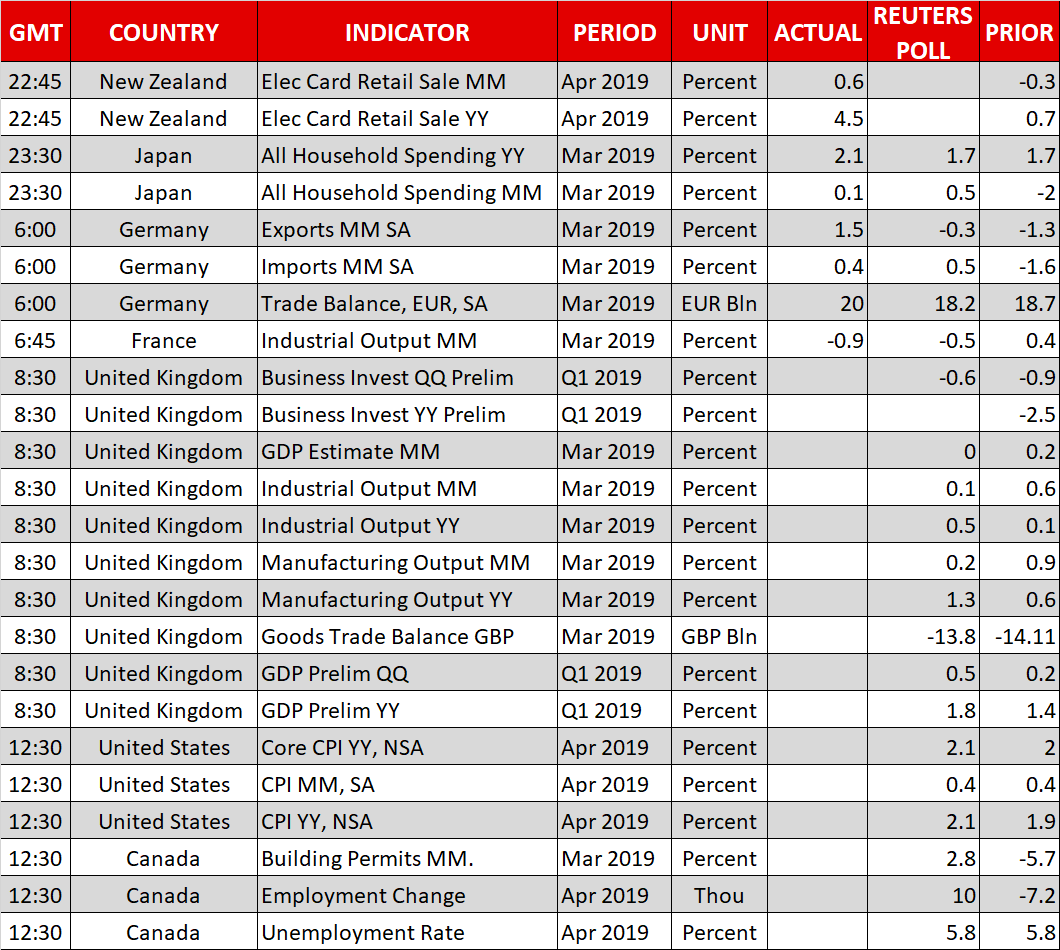
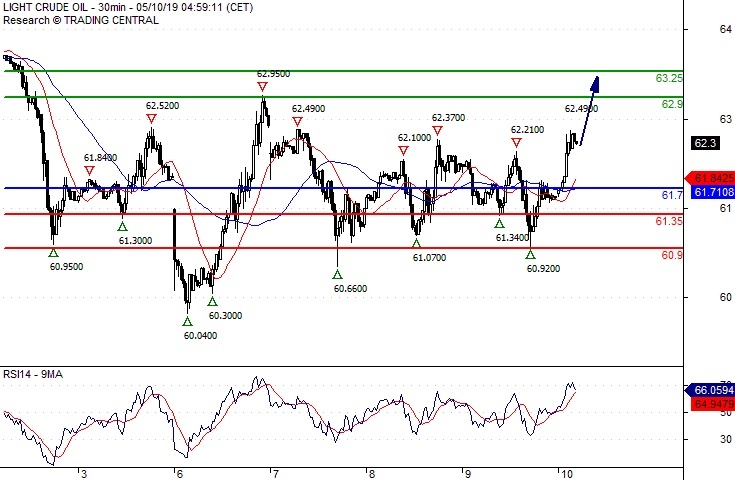
Crude Oil Look For 63.25
Pivot (invalidation): 61.70
Our preference Long positions above 61.70 with targets at 62.90 & 63.25 in extension.
Alternative scenario Below 61.70 look for further downside with 61.35 & 60.90 as targets.
Comment The RSI is bullish and calls for further advance.