Sample Category Title
Canadian Dollar Surges on Strong Job Data, Markets Shrug New Tariffs
A new round of US tariffs on Chinese imports took effect today and market reactions are rather muted. Trump stepped up his hard-line rhetorics and tweeted he's in no rush to make a trade deal. Yet investors shrug off such comments. Sterling also paid little attention to UK GDP and production data. Instead, Canadian Dollar steals the show with strong April job data.
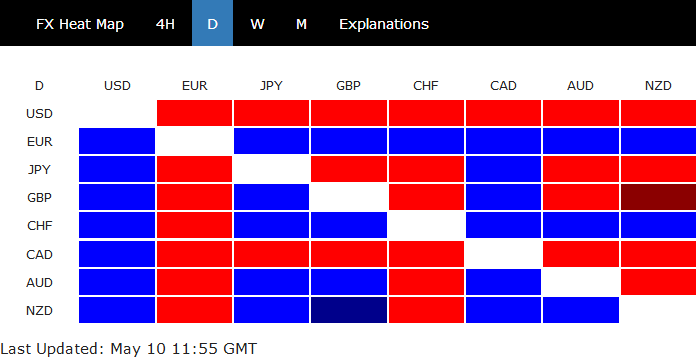
For now, Canadian Dollar is the strongest one for today, followed by Swiss Franc and then Kiwi. Dollar is the worst performing one followed by Yen. However, for the week, Yen remains the strongest one, followed by Swiss Franc on risk aversion. Sterling is the weakest on Brexit impasse, followed by Kiwi and then Aussie.
In Europe, currently, FTSE is up 0.26%. DAX is up 0.71%. CAC is up 0.39%. German 10-year yield is up 0.008 at -0.039, staying negative. Earlier in Asia, Nikkei dropped -0.27%. Hong Kong HSI rose 0.84%. China Shanghai SSE rose 0.31%. Singapore Strait Times rose 0.12%. Japan 10-year JGB yield rose 0.0019 to -0.044.
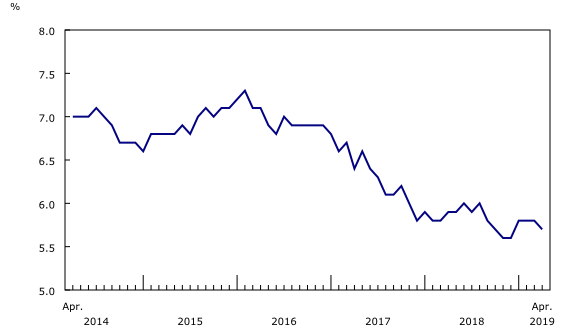
Canada added 106.5k jobs, unemployment rate dropped to 5.7%
Canadian Dollar jumps sharply after stellar job data. The employment market grew 106.5k in April, well above expectation of 15.0k. Unemployment rate dropped to 5.7%, down from 5.8% and beat expectation of 5.8%. On year-over-year basis, employment grew 2.3% or 426k, with 248k in full-time and 170k in part-time jobs. Employment grew in four provinces of Ontario, Quebec, Alberta and Price Edward Island.
US CPI rose to 2.0%, core CPU rose to 2.1% in April
US headline CPI rose to 2.0% yoy in April, up from 1.9% yoy but missed expectation of 2.1% yoy. Core CPI rose to 2.1% yoy, up from 2.0% yoy and matched expectations.
Trump will use China tariffs to buy US farm products, building new infrastructure, on healthcare...
In a series of tweets today, Trump indicates he's now in no rush to seal the trade deal with China, given that new tariffs are already in plan. Trump said "Talks with China continue in a very congenial manner - there is absolutely no need to rush - as Tariffs are NOW being paid" going "directly to the Treasury".
And, additionally Trump said with over USD 100B in tariffs, "we will buy agricultural products from our Great Farmers, in larger amounts than China ever did, and ship it to poor & starving countries in the form of humanitarian assistance."
Also, "If we bought 15 Billion Dollars of Agriculture from our Farmers, far more than China buys now, we would have more than 85 Billion Dollars left over for new Infrastructure, Healthcare, or anything else. China would greatly slow down, and we would automatically speed up!"
UK GDP grew 0.5% qoq in Q1, but March contracted -0.1% mom
UK GDP grew 0.5% qoq in Q1, up from Q4’s 0.2% qoq and matched expectations. Annually, GDP grew 1.8% yoy, up from Q4’s 1.4%. Looking at the details, production had a noticeable pickup by 1.4. But services growth slowed to just 0.3%. Construction growth increased to 1.0%. Output of agriculture, forestry and fishing sector fell by 1.8%.
However, in March GDP contracted -0.1% mom, below expectation of 0.0% mom. Index of services dropped -0.1% mom. Index of production rose 0.7% mom. Manufacturing rose 0.9% mom. Construction dropped -1.9% mom. Agriculture dropped -0.1% mom.
UK Chancellor of Exchequer Philip Hammond hailed that 0.5% growth in Q1 GDO was good news, with growth in all major sectors. He added, "we’re investing billions in our infrastructure and skills to boost jobs & wages".
Also from UK, industrial production rose 0.7% mom, 1.3% yoy, versus expectation of 0.1% mom, 0.4% yoy. Manufacturing production rose 0.9% mom, 2.6% yoy, versus expectation of 0.0% mom, 1.1% yoy. Visible trade deficit narrowed to GBP -13.65B, slightly smaller than expectation of -13.7B. Construction output dropped -1.9% mom, versus expectation of -0.9% mom.
ECB Praet: World norm challenged by power politics
ECB chief economist Peter Praet said a prepared speech that “the notion that the euro provides stability and security has been weakened by the gaps in our governance framework”. Thus, “it is not surprising that claims that countries would be better off outside the euro find a sympathetic audience.”
To him, the long run solution most likely involves “deeper fiscal integration”. In the short run, Praet urged to “complete banking union”. While the SSM has moved Eurozone towards the goal, “for deep cross-border integration to develop, effective institutions for public risk-sharing need also to be in place.”
Praet also pointed out that “rules and norms” of international relations government since WWII are being challenged and replaced by “new power politics where large economies try to impose their will on smaller ones”. And in such a world ” it is undeniable that the EU amplifies the sovereignty of its members.:.
Also, Brexit also underling the pros and cons of EU membership. And, “it is now established that leaving the EU presents a trade-off: countries either have to follow the rules they could once set; or they have accept a diminished level of market access, and ultimately lower welfare for their people.”
Released from Germany, trade surplus widened to EUR 20.0B in March versus expectation of EUR 19.4B.
BoJ opinions: Clarification on forward guidance strengthens confidence in powerful easing
Summary of opinions at the April 24-25 BoJ Monetary Policy Meeting is released today. At the statement of that meeting, BoJ added clarification of forward guidance for policy rates. It noted that BoJ intended to keet current levels of interest rates at least through around spring 2020.
The summary of opinions noted that "in order to strengthen public confidence in continuing with powerful monetary easing, it is appropriate to clarify forward guidance for policy rates, such as through making clear the specific period for which extremely low levels of interest rates will be maintained." Also, it is appropriate to consider revising forward guidance for policy rates, given, for example, that uncertainties regarding overseas economies have heightened compared to the time of its introduction.
Meanwhile BoJ also noted "there is a possibility that a further decline in interest rates will result in a greater risk of inducing side effects on the real economy, rather than positive effects". But BoJ dismissed the argument that QQE led to deterioration in banks' profitability. It's noted monetary easing has "brought about economic improvement, an increase in lending, a decline in credit costs, and an increase in profits stemming from stocks and bonds".
Release from Japan, household spending rose 2.1% yoy in March, above expectation of 1.6% yoy. But labor cash earnings dropped sharply by -1.9% yoy, well below expectation of -0.50%.
RBA SoMP: Slight downgrade of inflation, no imminent need to cut rates
In the Statement of Monetary Policy, RBA noted that the economy has "slowed" and inflation "remains "low". Also, "subdued" growth in household income and "adjustment" in housing markets affected consumer spending and residential construction. Still, labor market is "performing reasonably well". Underlying inflation came in lower than expected in Q1 and "with pricing pressures subdued across much of the economy".
Looking at the new economic projections, 2019 growth forecasts was revised down notably from 2.75% to 2.00%. But 2020 growth expectation was unchanged. Unemployment rate will stay longer at 5.00% through Dec 2020. Headline CPI was expected hit 2.00% in Dec 2019 and stay there throughout. Core CPI is revised slightly to 1.75% in Dec 2019 and 2.00% in Dec 2020.
All in all, while 2019 growth is expected to undershoot, it's expected to pick up quickly. The downward revision in core CPI was just showed a slower pickup back to target, not anything disastrous. Based on this outlook, RBA still has a lot of room to wait and see the developments, before cutting interest rates.
- GDP growth year average: 2019 at 2.00%, revised down from 2.75%; 2020 at 2.75%, unchanged.
- Unemployment rate: Dec 2019 at 5%, unchanged; Dec 2020 at 5%, revised up from 4.75%.
- CPI: Dec 2019 at 2.00%, revised up from 1.75%; Dec 2020 at 2.00%, down from 2.25%.
- Trimmed mean inflation:Dec 2019 at 1.75%, revised down from 2.00%; Dec 2020 at 2.00%, revised down from 2.25%.
RBNZ Bascand: Economy growing below potential, needs to be pumped up
RBNZ Deputy Governor Geoff Bascand said the economy is growing less than potential of 2.8%. And, there's just not enough pressure to get inflation up. “We think capacity pressures will just become a little less,” he said. “There is pressure there, there’s just not enough pressure to get inflation up. We need growth to be around 3% or more to keep being at or approaching our targets.”
Nevertheless, he added "nobody's talking gloom here" even though it was "getting a bit harder" to meet the inflation target. He said “the headwinds have become a bit stronger, the global economy has become a bit weaker, the domestic economy seems to have softened." Hence, "we’re going to be drifting away a little bit, not staying as close, there’s more chance of inflation ebbing than rising".
And, "because of that, we ended up coming to a view that we needed to help pump it up a bit more."
USD/CAD Mid-Day Outlook
Daily Pivots: (S1) 1.3456; (P) 1.3480; (R1) 1.3502; More...
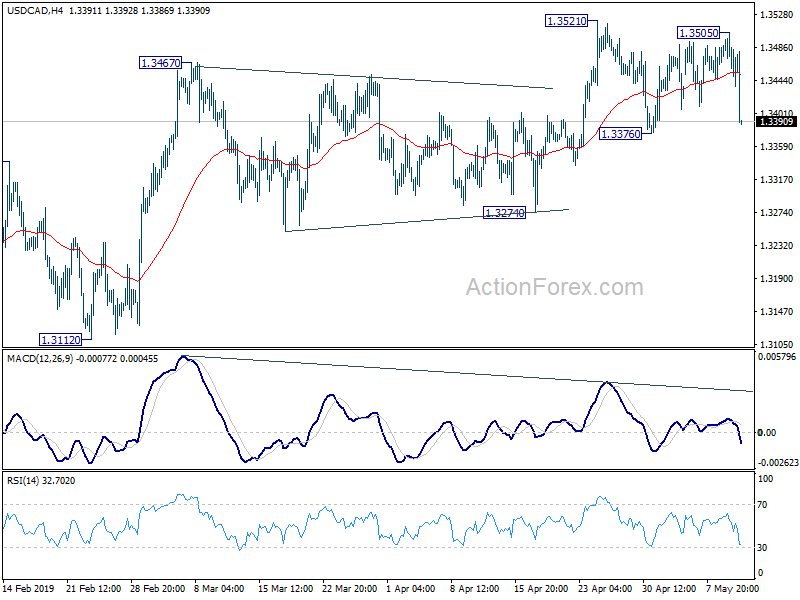
USD/CAD dives sharply as fall from 1.3505 accelerates. Still, outlook is unchanged that price actions from 1.3521 are seen as a corrective pattern. While break of 1.3376 minor support cannot be ruled out, downside should be contained above 1.3274 support to bring rise resumption. On the upside, firm break of 1.3521 will resume the whole rise from 1.3068 to retest 1.3664 high. However, decisive break of 1.3274 support will indicate completion of 1.3068 and turn outlook bearish.
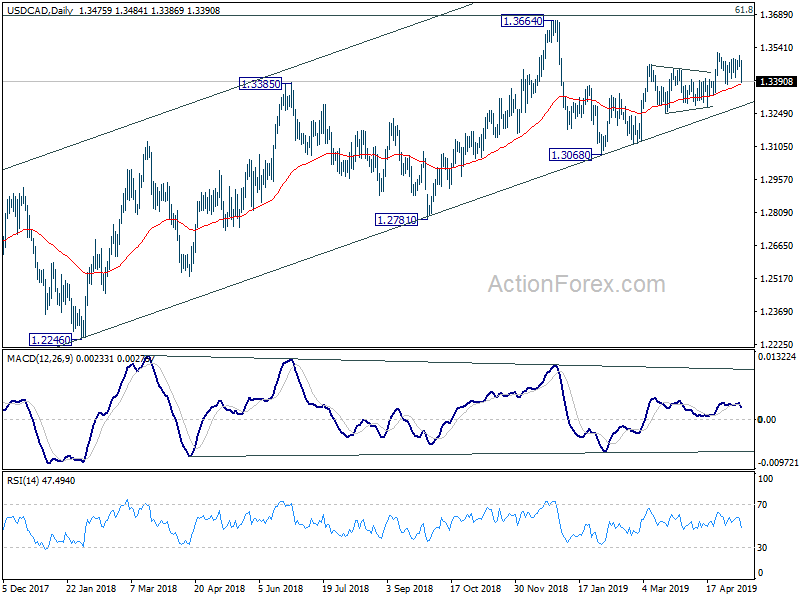
In the bigger picture, USD/CAD is staying well inside medium term rising channel (support at 1.3278). Thus, the up trend from 1.2061 (2017 low) should be in progress. On the upside, decisive break of 61.8% retracement of 1.4689 (2016 high) to 1.2061 at 1.3685 will pave the way to 78.6% retracement at 1.4127 next. This will remain the favored case as long as 1.3068 support holds. However, sustained break the channel support will be the first sign of medium term reversal. Firm break of 1.3068 would confirm.
Economic Indicators Update
| GMT | Ccy | Events | Actual | Consensus | Previous | Revised |
|---|---|---|---|---|---|---|
| 23:30 | JPY | Overall Household Spending Y/Y Mar | 2.10% | 1.60% | 1.70% | |
| 23:30 | JPY | Labor Cash Earnings Y/Y Mar | -1.90% | -0.50% | -0.80% | -0.70% |
| 23:50 | JPY | BOJ Summary of Opinions | ||||
| 01:30 | AUD | RBA Statement on Monetary Policy May | ||||
| 06:00 | EUR | German Trade Balance (EUR) Mar | 20.0B | 19.4B | 18.7B | |
| 08:30 | GBP | GDP M/M Mar | -0.10% | 0.00% | 0.20% | |
| 08:30 | GBP | GDP Q/Q Q1 P | 0.50% | 0.50% | 0.20% | |
| 08:30 | GBP | Total Business Investment Q/Q Q1 P | 0.50% | -0.70% | -0.90% | |
| 08:30 | GBP | Industrial Production M/M Mar | 0.70% | 0.10% | 0.60% | |
| 08:30 | GBP | Industrial Production Y/Y Mar | 1.30% | 0.40% | 0.10% | 0.40% |
| 08:30 | GBP | Manufacturing Production M/M Mar | 0.90% | 0.00% | 0.90% | 1.00% |
| 08:30 | GBP | Manufacturing Production Y/Y Mar | 2.60% | 1.10% | 0.60% | 1.20% |
| 08:30 | GBP | Construction Output M/M Mar | -1.90% | -0.90% | 0.40% | |
| 08:30 | GBP | Visible Trade Balance (GBP) Mar | -13.65B | -13.7B | -14.1B | |
| 08:30 | GBP | Index of Services 3M/3M Mar | 0.30% | 0.40% | 0.40% | |
| 12:30 | CAD | Building Permits M/M Mar | 2.10% | 2.30% | -5.70% | -5.10% |
| 12:30 | CAD | Net Change in Employment Apr | 106.5K | 15.0K | -7.2K | |
| 12:30 | CAD | Unemployment Rate Apr | 5.70% | 5.80% | 5.80% | |
| 12:30 | USD | CPI M/M Apr | 0.30% | 0.40% | 0.40% | |
| 12:30 | USD | CPI Y/Y Apr | 2.00% | 2.10% | 1.90% | |
| 12:30 | USD | CPI Core M/M Apr | 0.10% | 0.20% | 0.10% | |
| 12:30 | USD | CPI Core Y/Y Apr | 2.10% | 2.10% | 2.00% |
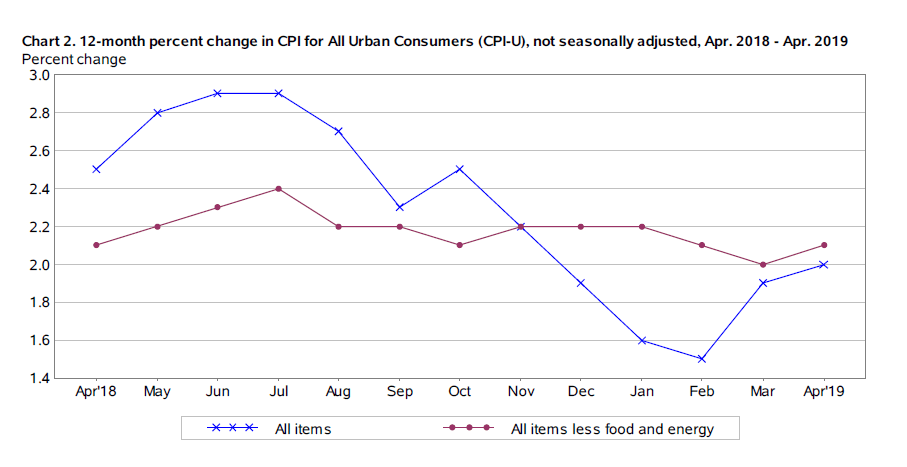
US CPI rose to 2.0%, core CPU rose to 2.1% in April
US headline CPI rose to 2.0% yoy in April, up from 1.9% yoy but missed expectation of 2.1% yoy. Core CPI rose to 2.1% yoy, up from 2.0% yoy and matched expectations.
Canada added 106.5k jobs, unemployment rate dropped to 5.7%
Canadian Dollar jumps sharply after stellar job data. The employment market grew 106.5k in April, well above expectation of 15.0k. Unemployment rate dropped to 5.7%, down from 5.8% and beat expectation of 5.8%. On year-over-year basis, employment grew 2.3% or 426k, with 248k in full-time and 170k in part-time jobs. Employment grew in four provinces of Ontario, Quebec, Alberta and Price Edward Island.
RBA Downgrades Growth, but Aussie Yawns
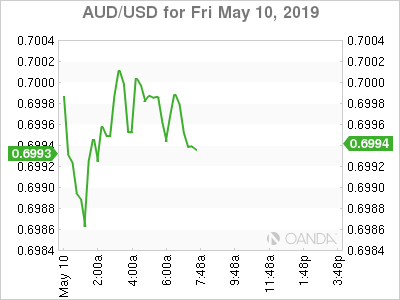
AUD/USD has ticked higher in the Friday session. Currently, the pair is trading at 0.6994, up 0.08% on the day. On the fundamentals front, the RBA released its quarterly monetary policy statement. In the U.S., the focus remains on inflation indicators, with the release of consumer inflation reports. CPI is expected to remain steady at 0.4%, while the core reading is projected to rise from 0.1% to 0.2%.
The RBA released its quarterly policy statement on Thursday, sending a pessimistic message to the markets. The bank downgraded its GDP forecast to 2.75%, down from 3.0% in February. Inflation remains low, and the RBA rate statement, released on Tuesday, said that the labor market would have to improve before inflation could reach the bank’s target of 2.0%. The RBA has been dovish about the economic outlook, and thus surprised the markets when it did not lower the key interest rate earlier this week. Despite the cloudy economic outlook, rate-setters are hopeful that the limping economy can rebound without the help of a rate cut.
The trade war between the U.S. and China has taken a heavy toll on the Chinese economy. China’s trade surplus fell sharply in April, dropping from 221 billion yuan to 94 billion ($32.6 billion to $13.8 billion). As well, Chinese exports declined 2.7% in April, on a year-to year basis. This was a sharper drop than the estimate of a 2.3% decline. A slowdown in China has damaged the Australian economy, as China is Australia’s number one trading partner.
Into US session: Markets shrug new tariffs, await US CPI and Canada jobs
Entering into US session, the forex markets are generally staying in very tight range. Risk aversion somewhat receded today even though Trump maintained his hard line on trade negotiations with China. He indicated there is no rush for a deal now that the new rounds of tariffs took effect today. And the US an even use newly collected tariffs to buy their own agricultural products to send to poor countries for humanitarian aids. Let's see if he will deliver what he claims.
For now, Dollar is the weakest one for today, followed by Yen and then Canadian. Euro is the strongest one, followed by Swiss franc and then Kiwi. The Pound gets no support from solid 0.5% Q1 GDP growth in UK. Dollar and Loonie will look into US CPI and Canadian job data for the next move.
In Europe, currently:
- FTSE is up 0.39%.
- DAX is up 0.80%.
- CAC is up 0.50%.
- German 10-year yield s up 0.008 at -0.039, staying negative.
Earlier in Asia:
- Nikkei dropped -0.27%.
- Hong Kong HSI rose 0.84%.
- China Shanghai SSE rose 0.31%.
- Singapore Strait Times rose 0.12%.
- Japan 10-year JGB yield rose 0.0019 to -0.044.
Talks Continue as Tariff Increase Sets Soft Deadline
President Trump’s tariff increase went into effect as expected at 12:01 AM ET. Chinese goods that left ports before May 10th are not subject to the increase, thus providing a roughly small two-week window that could provide added incentive for a deal to be finalized. Chinese have yet to announce retaliatory measures, but that is expected anytime now.
The ending of the trade truce will likely continue to weigh on global growth concerns. The longer it takes for a deal the worse off the two world’s largest economies will be. The chances of a deal being reached are still more likely than not.
- Global Stocks – Asian shares rally on Chinese state fund purchases
- RBA – Cut growth outlook
- Oil – Geopolitical risks provide safety net on trade worries
- Gold- Poised for a weekly gain on tariff bump
- Rand – Ramaphosa’s victory sets up reform push
- Lira – Turkish Bank’s sell dollars overnight
Global stocks
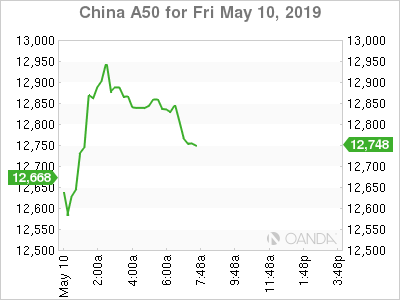
Immediately following the tariff increase, Chinese backed funds were active purchasing Chinese equities. This would be the second time this week state funds have come into try to stabilize the Shanghai’s biggest fall in three years. Expectations are also growing that China will ease monetary and fiscal policies along with credit as markets price in the effect of higher tariffs. European boarses all rose on optimism a deal will get done. US stocks are poised to open lower, coming off from a higher base and still repricing the risks to confidence.
RBA
The Statement of Monetary Policy (SOMP) showed the RBA could cut rates if we do not see the unemployment rate fall. The RBA downgraded growth forecasts and is pricing in 50 basis points of cuts, one for this year and next. The outlook for China remains a big uncertainty and the bank will likely adopt an easing bias quickly if their biggest trading partner sees the downside risks grow.
Oil
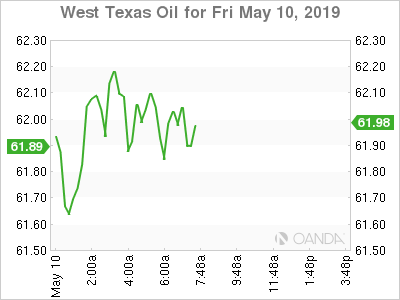
Crude prices appear to supported on both tighter supply and geopolitical risks. The escalation in the trade war has put a return in global growth worries, which would translate to softer crude demand. Optimism is still greater for a deal to get done soon, than for talks to fall apart, so the trade story could shortly become a tailwind for crude.
Crude prices should see some support from Iranian tensions and supply risks from Libya and Venezuela.
Gold
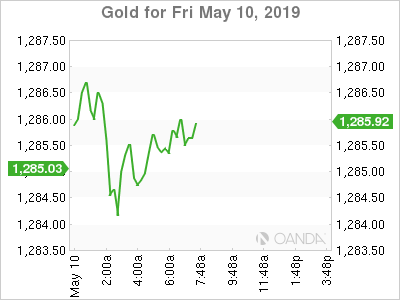
The yellow metal appears poised for a weekly gain as US tariffs on Chinese goods were raise shortly after the stroke of midnight. The yellow metal’s loss of safe-haven appeal should return if talks see a complete collapse, but that remains the lease likely scenario.
Rand
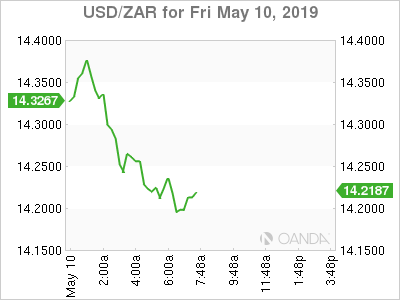
With 80% of the vote in, the ANC appears poised to win a diminished majority with 57% of the vote, down from 62% in the vote in 2014. Led by President Cyril Ramaphosa appears set to continue to try to clean up corruption and push forward with major reforms. The final tally is not expected until the weekend when more remote areas take time to come in. The rand is firmer for a fourth consecutive day as an ANC victory, albeit a small one was the most market friendly outcome.
Lira
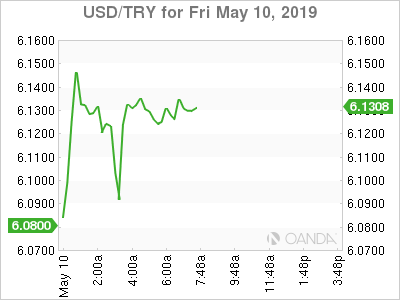
One of the best trades of the year has been shorting the lira. The political situation in Turkey is messy at the very least and the threat to democracy is a real risk. The last leg of lira weakness stemmed from President Erdogan’s decision to have a rerun of municipal vote in Instanbul. Overnight, Turkish banks sold dollars during illiquid times to maximize the effect to try to put a dent into some of this year’s losses.
Awaiting Details Of China’s Response To US Trade Tariffs
Notes/Observations
- US pulls the trigger and implements additional tariffs on $200B of China goods; trade talks continue in Washington
- UK Q1 GDP data in-line with expectations and improves quarterly largely attributed to stockpiling ahead of Brexit
Asia:
- US implemented that increase of tariffs on $200B of China goods from 10% to 25% and would apply to products exported from Friday, May 10th (not goods that are already in transit)
- China announced that it would retaliate (no specific details provided) and added that it deeply regretted the US move on tariffs hike. China reiterated its stance that was to solve trade issues via dialogue
- RBA Statement on Monetary Policy (SOMP) reiterated the recent rate decision. Board judged lower unemployment rate achievable given subdued inflation and would be paying close attention to the labor market at upcoming meetings. Staff Forecasts cut June 2019 GDP growth forecast from 2.5% to 1.75% and cut Dec 2019 GDP growth forecast from 3.0% to 2.75%. Raised June 2019 Headline CPI forecast from 1.25% to 1.75%, maintained June 2020 Core inflation forecast at 2.0% and cut June 2021 Core inflation from 2.25% to 2.0%
Europe/Mideast:
- Italy Fin Min Tria: EU's fiscal compact should be scrapped because it has negative effect on economy
- EU officials said to be worried about new Greece tax and spending proposals
Americas:
- President Trump stated that had received a letter from China President Xi and planned to speak with the Chinese leader by phone as trade talks continued
SPEAKERS/FIXED INCOME/FX/COMMODITIES/ERRATUM
Equities
- Indices [Stoxx600 +1.05% at 379.52, FTSE +0.84% at 7,268.00, DAX +1.11% at 12,106.97, CAC-40 +0.84% at 7,267.75, IBEX-35 +0.67% at 9,156.13, FTSE MIB +0.99% at 21,022.50, SMI +1.21% at 9,544.50, S&P 500 Futures -0.16%]
- Market Focal Points/Key Themes: European Indices trade higher this morning, tracking the pullback seen in Wallstreet overnight, and a mixed session in Asia. Indices have steadily drifted higher despite ongoing trade tensions. On the corporate front GEA Group trades sharply higher after a strong rise in profits; Altice Europe also gains sharply after earnings and affirmed outlook; British Airways parent IAG rises over 4% on confirmed outlook while Bechtle, Hochtief, UnipolSali and Unipol Gruppo, and Sweco are among other names rising on earnings. Meanwhile Awilco declines on earnings with Lonmin also declining on earnings. In other news ThyssenKrupp gains almost 10% after reports its to abandon planned separation of Industrials, Materials units; Lafarge Holcim gains on the divestment of its Phillipines unit, while Ambu declines sharply after the stepping down of its CEO. Looking ahead notable earners include JD.com, Marriott International and Cars.com among others.
Equities
- Consumer discretionary: Deutsche Post DHL [DPW.DE] -1% (earnings), IAG [IAG.UK] +3% (earnings; load factor), Thomas Cook [TCG.UK] +5.5% (bids speculation), Ambu [AMBUB.DK] -12% (new CEO), Bechtle [BC8.DE] +6% (earnings), GEA Group [G1A.DE] +8.5% (earnings; job cuts), Air France-KLM [AF.FR] +1% (load factor), Moncler [MONC.IT] +3% (Sales)
- Financials: Danske Bank [DANSKE.DK] -3% (new CEO), Natixis [KN.FR] +2.5% (earnings)
- Industrials: ThyssenKrupp [TKA.DE] +7% (to abandon planned units separation; to consider another unit IPO)
- Telecom: Iliad [ILD.FR] +4% (analyst action)
Speakers
- ECB's Hansson (Estonia) saw green shoots in recent regional data and would wait and see how economy develops in coming months. Saw no urgency to have discussion on ECB policy and that TLTRO terms should keep door open on normalization. He cautioned that negative rate tiering could lead to over engineering
- Czech Central Bank May Minutes: Large majority assessed that risks were broadly balanced; next rate movement could be in either direction
- China Foreign Ministry spokesperson Geng Shuang stated that was not aware of any planned phone call between Xi-Trump
Currencies/Fixed Income
- The implementation of US tariffs saw risk aversion sentiment abate a bit for the time being. Dealers noted that some time remained for negotiations as the higher tariffs on $200B of China goods would apply to products exported from Friday, May 10th (not goods that are already in transit) and would give negotiators a window of 2-4 weeks to reach a deal before the bulk of the pain commences. China did announce that it would retaliate but no specific measures were presented yet.
- EUR/USD remained above the 1.12 level in subdued trading and poised for its 2nd week of gains.
- GBP has been softer throughout the trading week as expectations of a Brexit compromise evaporated. UK Q1 GDP data was in-line with expectations and did show an improvement on a quarterly basis but was largely attributed to stockpiling ahead of Brexit
- USD/JPY steady but holding below the 110 level
Economic Data
- (NL) Netherlands Mar Manufacturing Production M/M: -0.5% v -0.4% prior; Y/Y: -1.0% v +0.1% prior; Industrial Sales Y/Y: -3.8 v -3.4% prior - (FI) Finland Mar Industrial Production M/M: -0.1 v -0.7% prior; Y/Y: -1.3% v +0.8% prior
- (DE) Germany Mar Current Account Balance: €30.2B v €26.0Be; Trade Balance: €22.7B v €20.0Be; Exports M/M: +1.5% v -0.4%e; Imports M/M: 0.4% v 0.5%e
- (NO) Norway Apr CPI M/M: 0.4% v 0.4%e; Y.Y: 2.9% v 2.9%e
- (NO) Norway Apr CPI Underlying M/M: 0.4% v 0.3%e; Y/Y: 2.6% v 2.5%e
- (NO) Norway Apr PPI (including Oil) M/M: +0.7% v -2.1% prior; Y/Y: 2.6% v 5.2% prior
- (DK) Denmark Apr CPI M/M: 0.3% v 0.4%e; Y/Y: 1.0% v 1.1%e
- (DK) Denmark Apr CPI EU Harmonized M/M: 0.3% v 0.1% prior; Y/Y: 0.9% v 1.2% prior
- (FR) France Mar Industrial Production M/M: -0.9% v -0.5%e; Y/Y: -0.9% v -0.1%e
- (FR) France Mar Manufacturing Production M/M: -1.0% v 1.1% prior; Y/Y: 0.5% v 2.8% prior
- (FR) France Q1 Preliminary Wages Q/Q: 0.7% v 0.3%e; Private Sector Payrolls Q/Q: 0.2% v 0.2%e
- (CN) Weekly Shanghai copper inventories (SHFE): 194.2K v 211.6K tons prior
- (CZ) Czech Apr Unemployment Rate: 2.7% v 2.8%e
- (SE) Sweden Mar Household Consumption M/M: -0.2% v -0.1% prior; Y/Y: 0.4% v 1.6% prior
- (IT) Italy Mar Industrial Production M/M: -0.9% v -0.8%e; Y/Y: -1.4% v -0.8%e; Industrial Production NSA Y/Y: -3.1% v +0.9% prior
- (UK) Q1 Preliminary GDP Q/Q: 0.5% v 0.5%e; Y/Y: 1.8% v 1.8%e
- (UK) Mar GDP M/M: -0.1% v 0.0%e
- (UK) Q1 Preliminary Private Consumption Q/Q: 0.7% v 0.5%e; Government Spending Q/Q: 1.4% v 0.4%e; Gross Fixed Capital Formation Q/Q: +2.1% v -0.3%e; Exports Q/Q: 0.0% v 1.7%e; Imports Q/Q: 6.8% v 4.5%e
- (UK) Mar Visible Trade Balance: -£13.7B v -£13.7Be; Overall Trade Balance: -£5.4B v -£4.6Be; Trade Balance Non EU: -£4.4B v -£5.4Be
- (UK) Mar Industrial Production M/M: 0.7% v 0.1%e; Y/Y: 1.3% v 0.5%e
- (UK) Mar Manufacturing Production M/M: 0.9% v 0.0%e; Y/Y: 2.6% v 1.1%e
- (UK) Mar Construction Output M/M: -1.9% v -0.9%e; Y/Y: 3.2% v 4.5%e
- (UK) Q1 Preliminary Total Business Investment Q/Q: +0.5% v -0.7%e; Y/Y: -1.4% v -2.7%e
- (UK) Mar Index of Services M/M: -0.1% v +0.1%e; 3M/3M: 0.3% v 0.4%e
- (IS) Iceland Apr International Reserves (ISK): 756B v 765B prior
- (GR) Greece Apr CPI Y/Y: 1.0% v 0.9% prior; CPI EU Harmonized Y/Y: 1.1% v 1.0% prior
- (GR) Greece Mar Industrial Production Y/Y: -2.7% v +3.0% prior
- (IT) Italy Mar Retail Sales M/M: -0.3% v +0.1%e; Y/Y: -3.3% v +1.0%e
Fixed Income Issuance
- (IT) Italy Debt Agency (Tesoro) sold €6.5B vs. €6.5B indicated in 12-month bills; Avg Yield: 0.122% v 0.070% prior; Bid-to-cover: 1.60x v 1.59x prior
- (IN) India sold total INR170B vs. INR170B indicated in 2024, 2029, 2043 and 2049 bonds
Looking Ahead
- 05:30 (IT) ECB's Visco (Italy) in Paris
- 06:00 (PT) Portugal Mar Trade Balance: No est v -£1.5B prior
- 06:00 (UK) DMO to sell €4.0B in 1-month, 3-month and 6-month bills £0.5B, £1.0B and £2.5B respectively)
- 06:30 (IS) Iceland to sell Bonds - 06:45 (US) Daily Libor Fixing
- 07:00 (BR) Brazil May IGP-M Inflation (1st Preview): 0.5%e v 0.6% prior
- 07:30 (IN) India Weekly Forex Reserves w/e May 3rd
- 08:00 (IN) India Mar Industrial Production Y/Y: No est v 0.1% prior
- 08:00 (BR) Brazil Apr IBGE Inflation IPCA M/M: 0.6%e v 0.8% prior; Y/Y: 5.0%e v 4.6% prior
- 08:00 (UK) Baltic Bulk Index
- 08:00 (IN) India announces upcoming bill issuance (held on Wed)
- 08:30 (US) Apr CPI M/M: 0.4%e v 0.4% prior; Y/Y: 2.1%e v 1.9% prior
- 08:30 (US) Apr CPI Ex-Food/Energy M/M: 0.2%e v 0.1% prior; Y/Y: 2.1%e v 2.0% prior
- 08:30 (US) Apr CPI Index NSA: 255.809e v 254.202 prior; CPI Core: 261.884e v 261.374 prior
- 08:30 (US) Apr Real Avg Hourly Earning Y/Y: No est v 1.3% prior; Real Avg Weekly Earnings Y/Y: No est v 1.3% prior
- 08:30 (CA) Canada Apr Net Change in Employment: +11.6Ke v -7.2K prior; Unemployment Rate: 5.8%e v 5.8% prior; Full Time Employment Change: No est v -6.4K prior; Part Time Employment Change: No est v -0.9K prior; Participation Rate: 65.7%e v 65.7 prior; Hourly Wage Y/Y: 2.3%e v 2.3% prior
- 08:30 (CA) Canada Mar Building Permits M/M: +2.4%e v -5.7% prior
- 08:30 (CL) Chile Central Bank Economists Survey
- 08:30 (US) Fed's Brainard (voter, dove) at conference
- 09:00 (MX) Mexico Mar Industrial Production M/M: No est v 0.3% prior; Y/Y: No est v -0.8% prior; Manufacturing Production Y/Y: No est v 1.1% prior
- 09:00 (US) Fed's Bostic (dove, non-voter) on Economic Outlook
- 10:00 (US) Fed's Williams (moderate, voter) at Bronx breakfast meeting
- 10:30 (FR) ECB's Coeure (France)
- 12:00 (US) World Agricultural Supply and Demand Estimates (WASDE)
- 13:00 (US) Weekly Baker Hughes Rig Count data
- 14:00 (US) Apr Monthly Budget Statement: $160.5B v -$146.9B prior
- (MX) Mexico Apr Nominal Wages: No est v 6.5% prior
EUR/USD – Euro Edges Higher, U.S Consumer Inflation Looms
EUR/USD is slightly higher in Friday trade. Currently, the pair is trading at 1.1212, up 0.12% on the day. On the release front, Germany’s trade surplus widened to EUR 20.0 billion in March up from EUR 18.7 billion a month earlier. This is the first time that the trade surplus has exceeded the EUR 20-billion level since May. In the U.S., the focus remains on inflation indicators, with the release of consumer inflation reports. CPI is expected to remain steady at 0.4%, while the core reading is projected to rise from 0.1% to 0.2%.
The trade war saga continues, with an ominous development on Friday. U.S. President Donald Trump made good on his threat to raise tariffs on some $200 billion worth of Chinese goods, from 10% to 25%. Trump had announced the measure on Friday, and global equity markets have been in flux the entire week, as risk appetite has waned. There had been hopes that the unpredictable U.S. president would change his mind ahead of the midnight Thursday deadline, but those hopes were dashed. China has promised retaliatory measures against the U.S. move. Despite these tensions, a high-level Chinese delegation is in Washington to continue the trade talks, and it is certainly in the interest of both sides to try and reach an agreement.
What can we expect from the Federal Reserve, which has kept a low profile? At last week’s policy meeting, the Fed maintained its key interest rate and indicated that it was comfortable with current monetary policy and had no plans to raise or lower rates in the coming months. However, the U.S. economy has exceeded expectations, with a sparkling GDP of 3.2% in Q1, and a sharp nonfarm payrolls of 263 thousand. Will these sharp numbers make a rate hike more likely? The markets don’t think so. According to the CME Group, there is zero probability that the Fed will raise rates before 2020. Moreover there is a 60% likelihood that the Fed will cut rates before the end of 2019. This sentiment could weigh on the greenback, as rate hikes make the currency more attractive to investors.
Trump will use China tariffs to buy US farm products, building new infrastructure, on healthcare…
In a series of tweets today, Trump indicates he's now in no rush to seal the trade deal with China, given that new tariffs are already in plan. Trump said "Talks with China continue in a very congenial manner - there is absolutely no need to rush - as Tariffs are NOW being paid" going "directly to the Treasury".
And, additionally Trump said with over USD 100B in tariffs, "we will buy agricultural products from our Great Farmers, in larger amounts than China ever did, and ship it to poor & starving countries in the form of humanitarian assistance."
Also, "If we bought 15 Billion Dollars of Agriculture from our Farmers, far more than China buys now, we would have more than 85 Billion Dollars left over for new Infrastructure, Healthcare, or anything else. China would greatly slow down, and we would automatically speed up!"
It actually sounds a bit like a mix of state capitalism and socialism.
https://twitter.com/realDonaldTrump/status/1126809699268141057
https://twitter.com/realDonaldTrump/status/1126809702535503872
USD/JPY Outlook: Bears Are Taking A Breather As Markets Await Results From Trade Talks
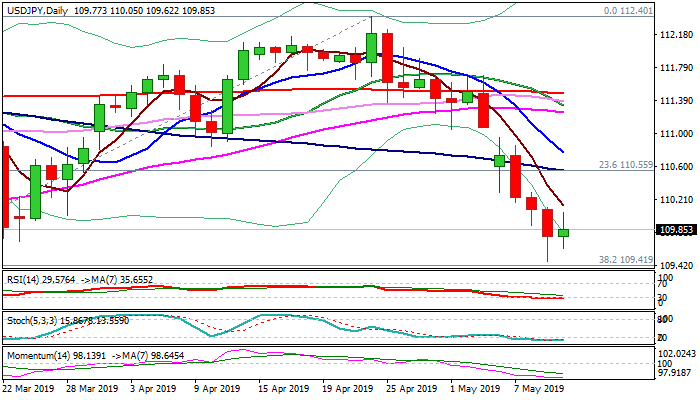
Bears are taking a breather on Friday following steep fall in past three days that cracked key support at 109.71 (25 Mar low) but s far failing to register close below.
Overextended daily techs and markets awaiting news from US/China trade talks, keep bears temporarily on hold, but fears that talks would end without deal, with potential escalation of trade conflict, keep risk-off mode in play and support safe-haven yen.
End-of-week profit-taking may push the price higher, with upticks to be capped by thick daily cloud base (110.31) to keep larger bears intact.
The pair is on track for the fourth bearish weekly close that reinforces bearish bias, but sustained break below key supports at 109.71 (25 Mar low) and 109.58 (weekly cloud base) and 109.41 (Fibo 38.2% of 104.57/112.40) is needed to confirm scenario and spark fresh bearish acceleration.
Conversely, penetration and close within daily cloud would sideline immediate bears, but only extension above cloud top (110.81) would neutralize and signal reversal.
Res: 110.00, 110.14, 110.31, 110.55
Sup: 109.71, 109.58, 109.41, 109.00