Sample Category Title
EUR/GBP Weekly Outlook
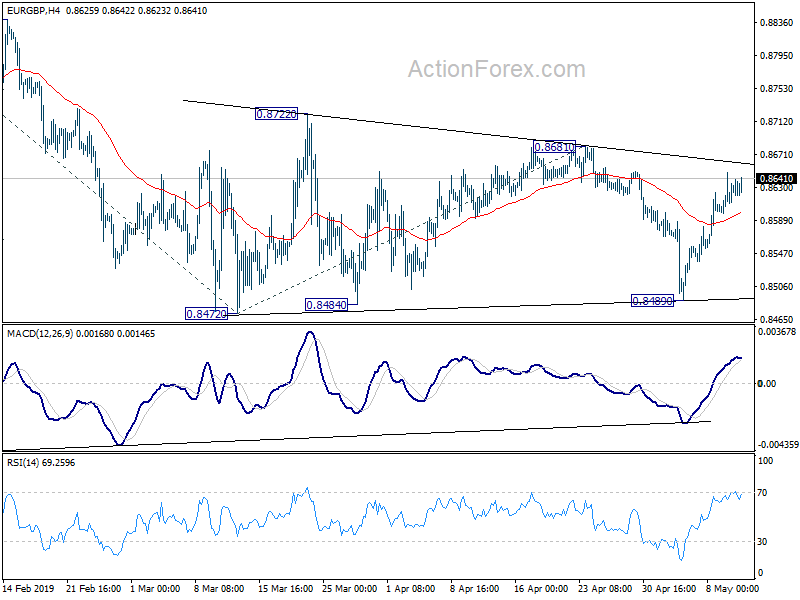
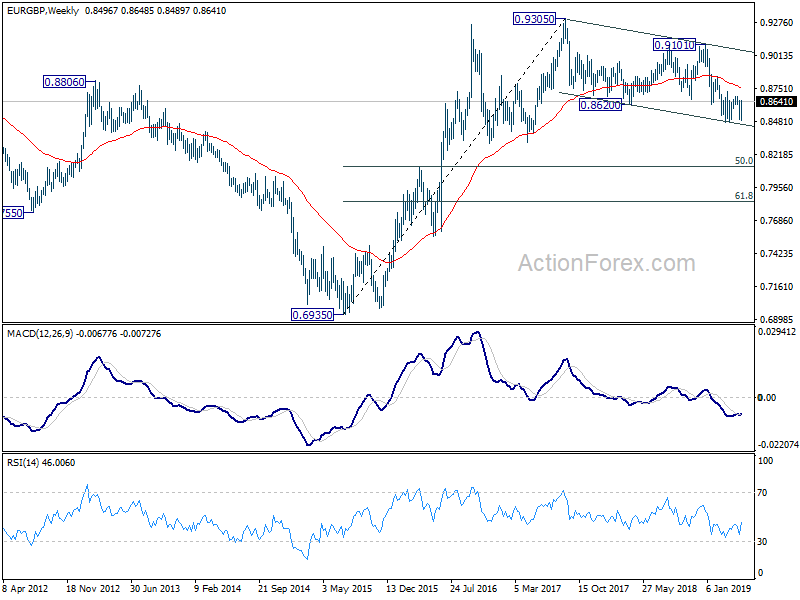
EUR/GBP rebounded strongly ahead of 0.8472 low last week. But still outlook is unchanged that price action form 0.8472 is seen as a consolidation pattern. In case of further rise, upside should be limited below 0.8681 resistance. On the downside, decisive break of 0.8472 will confirm resumption of down trend from 0.9101 and target 61.8% projection of 0.9101 to 0.8472 from 0.8681 at 0.8292 next.
In the bigger picture, medium term decline from 0.9306 (2017 high) is seen as a corrective move. Current development suggests that it's extending through 0.8312 support towards 50% retracement of 0.6935 (2015 low) to 0.9306 at 0.8121. We'll look for strong support around there to contain downside to complete the correction. But for now, break of 0.8681 resistance is needed to be the first sign of medium term bottoming. Otherwise, outlook will stay bearish in case of recovery.
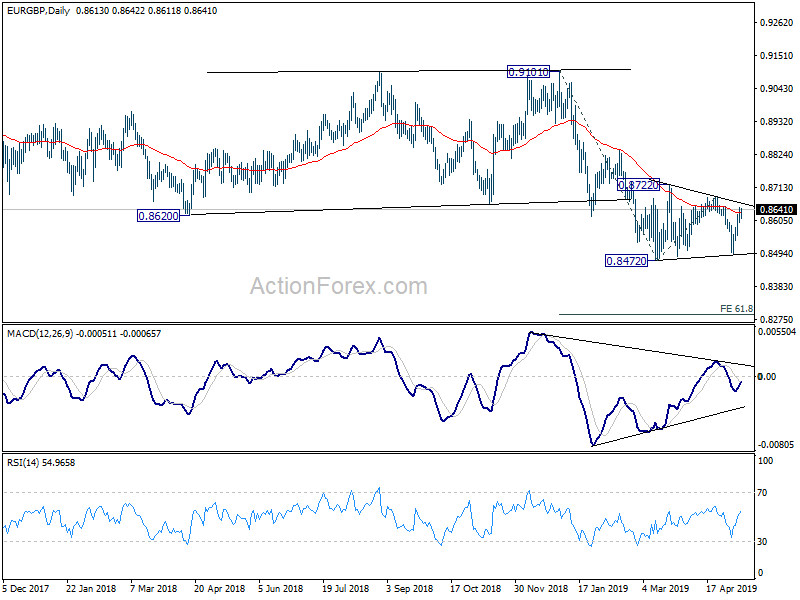
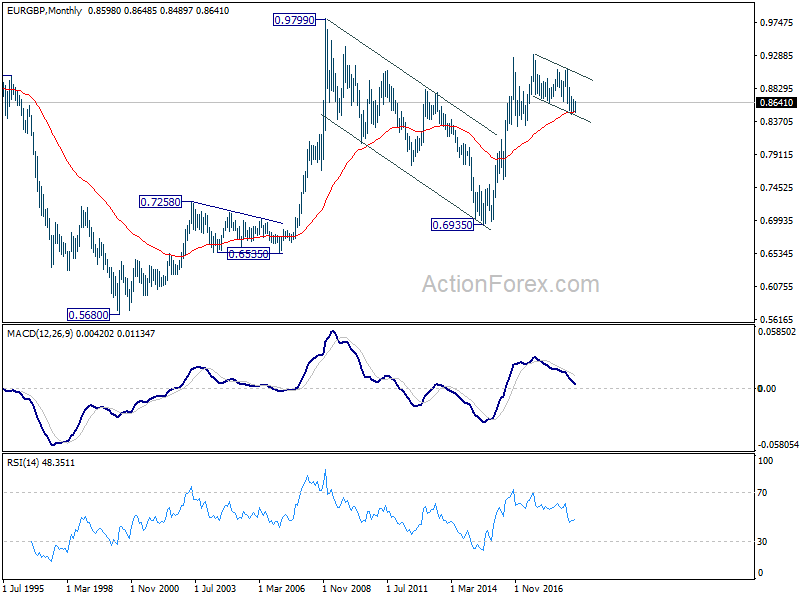
In the long term picture, we're holding on to the view that rise from 0.6935 (2015 low) is resuming the up trend from 0.5680 (2000 low). As long as 50% retracement of 0.6935 to 0.9304 at 0.8120 holds, further rise should be seen through 0.9305 to 0.9799 and above down the road.
EUR/AUD Weekly Outlook
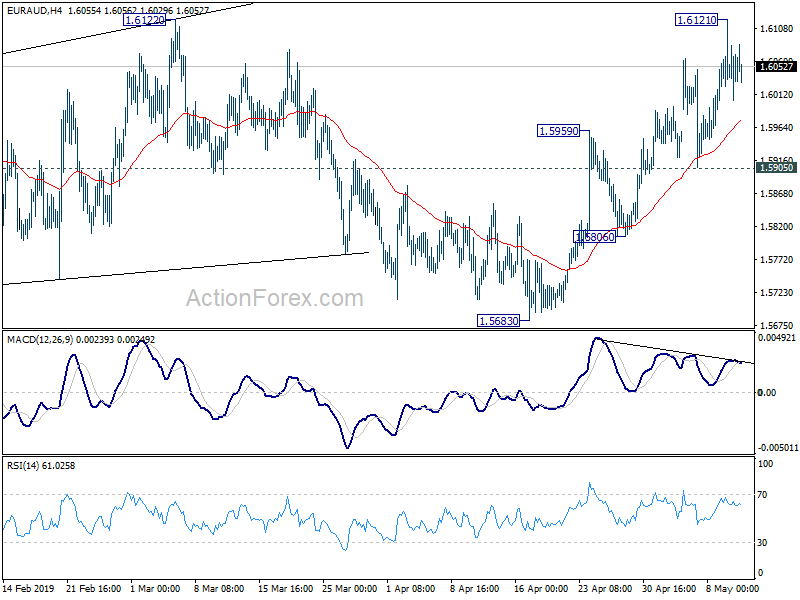
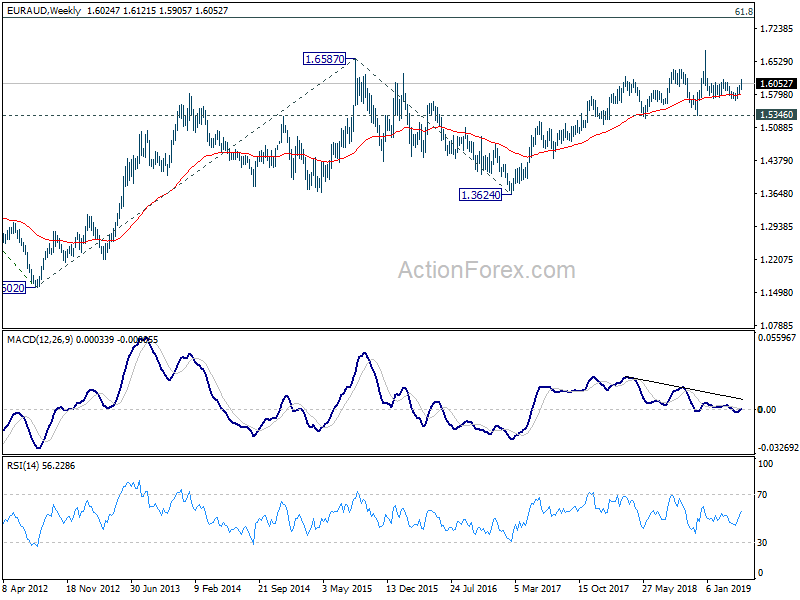
EUR/AUD rose to as high as 1.6121 last week but failed to take out 1.6122 key resistance yet. With a temporary top in place, initial bias is turned neutral this week first. On the upside, decisive break of 1.6122 will confirm the bullish view that correction from 1.6765 has completed with three waves down to 1.5683. In this case, further rise should be seen back to retest 1.6765 high. On the downside, break of 1.5905 support will indicate rejection by 1.6122 and turn bias to the downside for 1.5806 support and below.
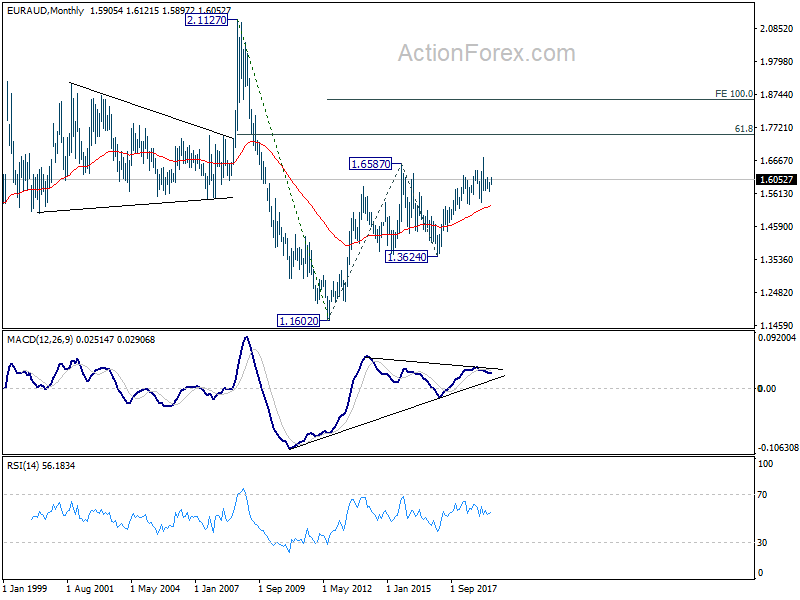
In the bigger picture, as long as 1.5346 support holds, outlook will still remain bullish. Up trend from 1.1602 (2012 low) is expected to resume sooner or later. Break of 1.6765 will target 61.8% retracement of 2.1127 (2008 high) to 1.1602 at 1.7488 next. However, firm break of 1.5346 key support will indicate trend reversal, with bearish divergence condition in weekly MACD, and turn outlook bearish.
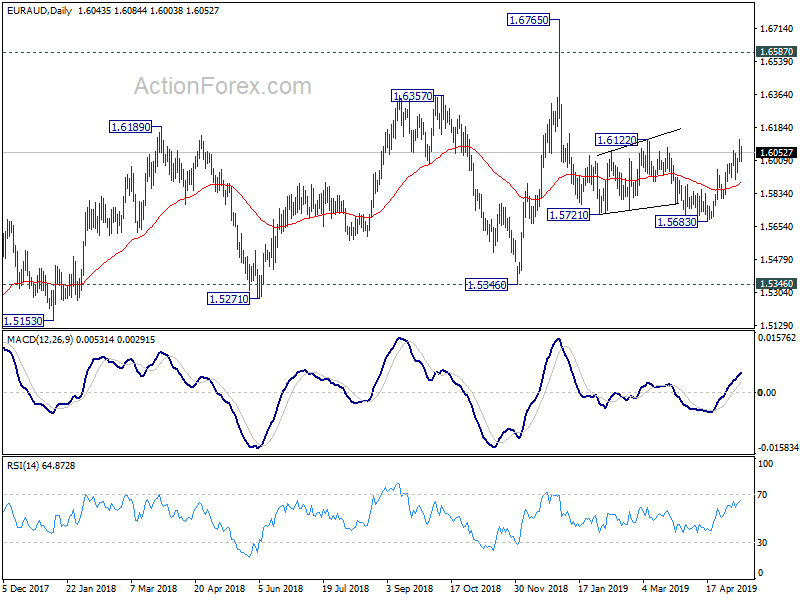
In the longer term picture, the rise from 1.1602 long term bottom (2012 low) is still in progress for 61.8% retracement of 2.1127 to 1.1602 at 1.7488. Firm break there will pave the way to 100% projection of 1.1602 to 1.6587 from 1.3624 at 1.8069. This will remain the favored case as long as 1.5346 remains intact.
EUR/CHF Weekly Outlook
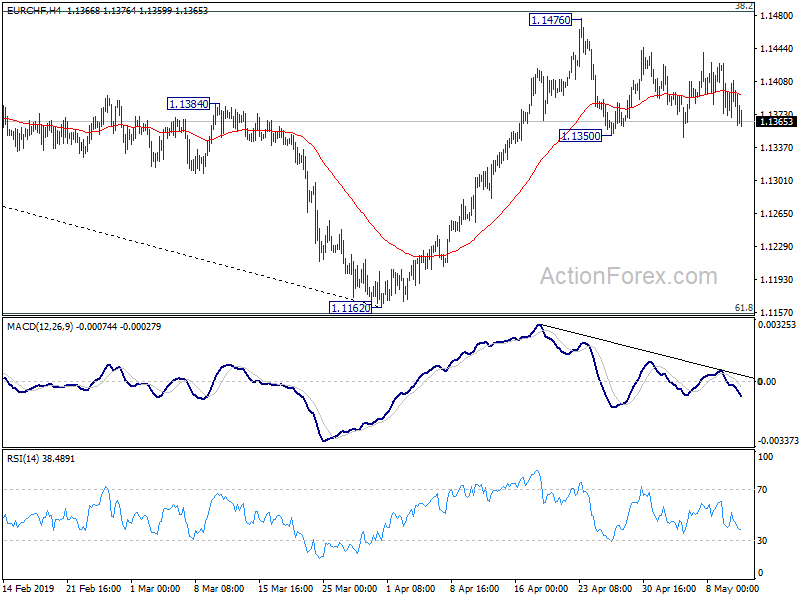
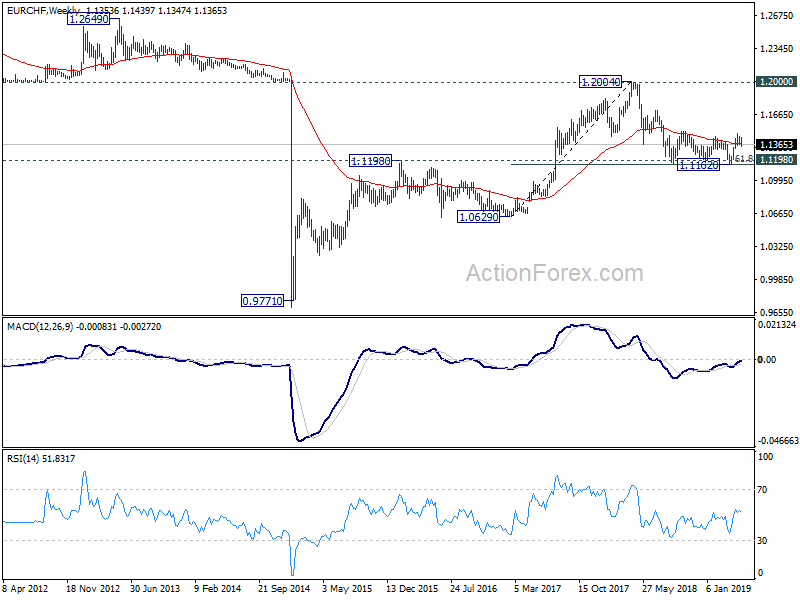
EUR/CHF stayed in consolidation below 1.1476 and outlook is unchanged. Initial bias remains neutral this week first. On the upside, sustained break of 38.2% retracement of 1.2004 to 1.1162 at 1.1484 will confirm completion of corrective fall from 1.2004. Further rally should then be seen to 61.8% retracement at 1.1682 and above. On the downside, sustained break of 55 day EMA (now at 1.1347) will pave the way back to retest 1.1162 low.
In the bigger picture, at this point, we're slightly favoring the case that corrective fall from 1.2004 has completed after being supported by 61.8% retracement of 1.0629 to 1.2004 at 1.1154. Decisive break of 1.1501 resistance should confirm and target 1.1713 resistance next. On the downside, firm break of 1.1154 is needed to confirm down trend resumption. Otherwise, medium term outlook will be neutral at worst.
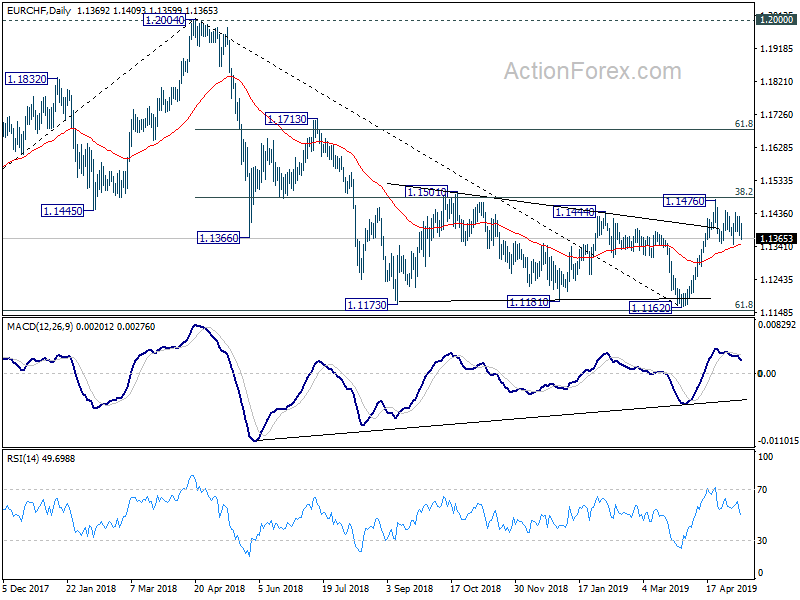
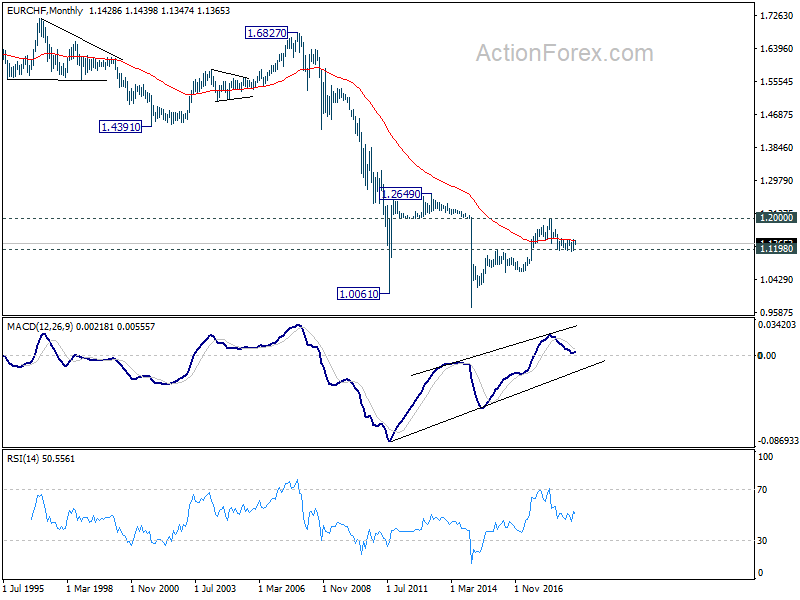
In the long term picture, current development suggests that medium term fall from 1.2004 is merely a corrective move. That is, up trend from 0.9771 is not completed yet. Nevertheless, there is little prospect of up trend resumption yet. More range trading should be seen in medium term.
GBP/JPY Weekly Outlook
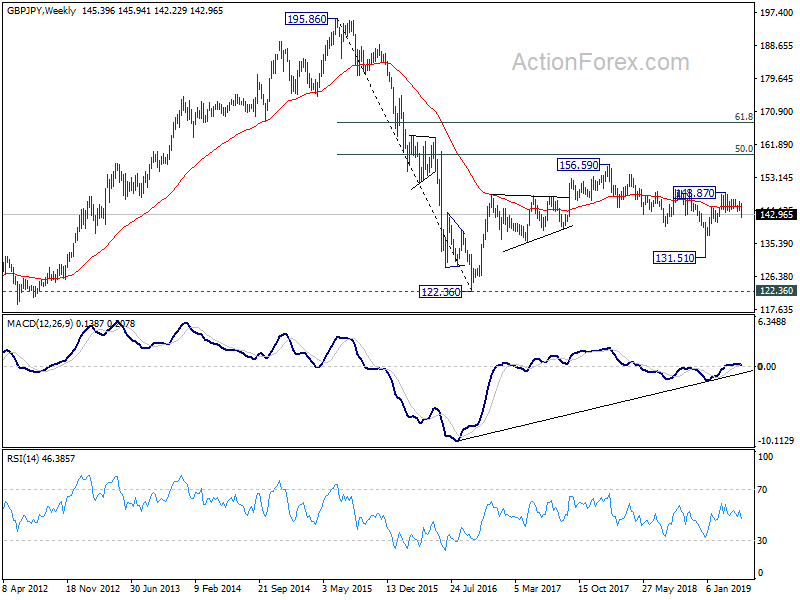
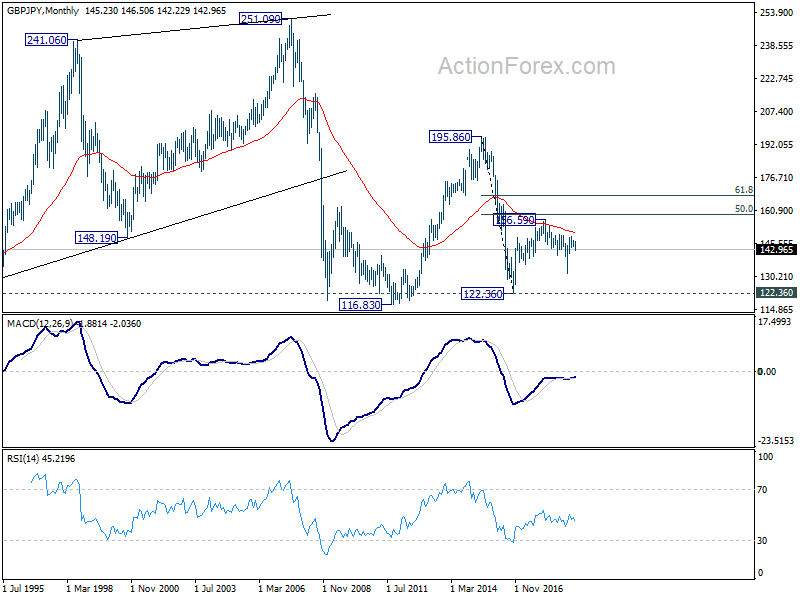
GBP/JPY dropped sharply to as low as 142.22 last week and broke 143.72 key support decisively. The development argues that whole rebound from 131.51 has completed at 148.87 already, ahead of 149.48 key resistance. Though, as a temporary low was formed just ahead of 38.2% retracement of 131.51 to 148.87 at 142.23, initial bias will be neutral this week for some consolidations first. Upside of recovery should be limited below 146.50 resistance to bring another decline. On the downside, break of 142.22 will resume the decline from 148.87 to 61.8% retracement at 138.14 next.
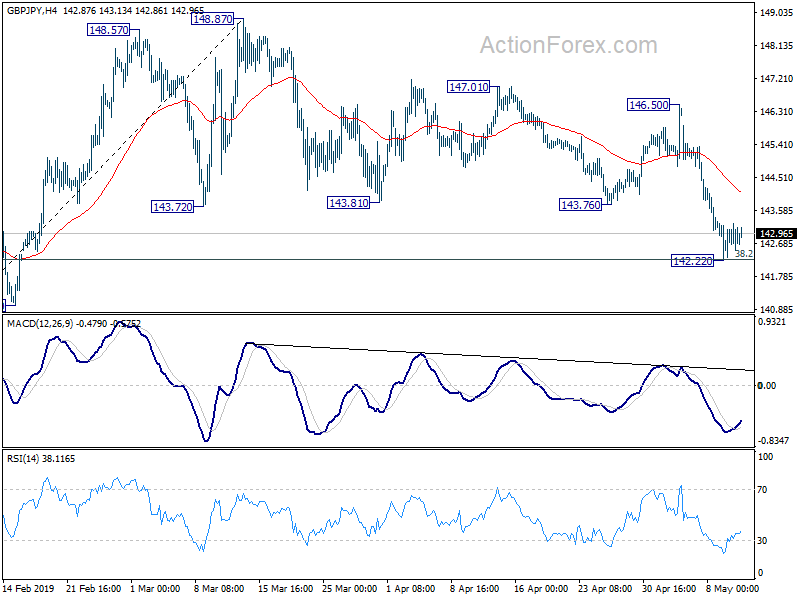
In the bigger picture, current development suggests that GBP/JPY was rejected by 149.98 key resistance. And medium term fall from 156.59 is still in progress. Break of 131.51 will target 122.36 (2016 low). On the other hand, decisive break of 149.98 should confirm that medium term fall from 156.59 (2018 high) has completed at 131.51 already. Further rally would be seen back to 156.59 resistance and above.
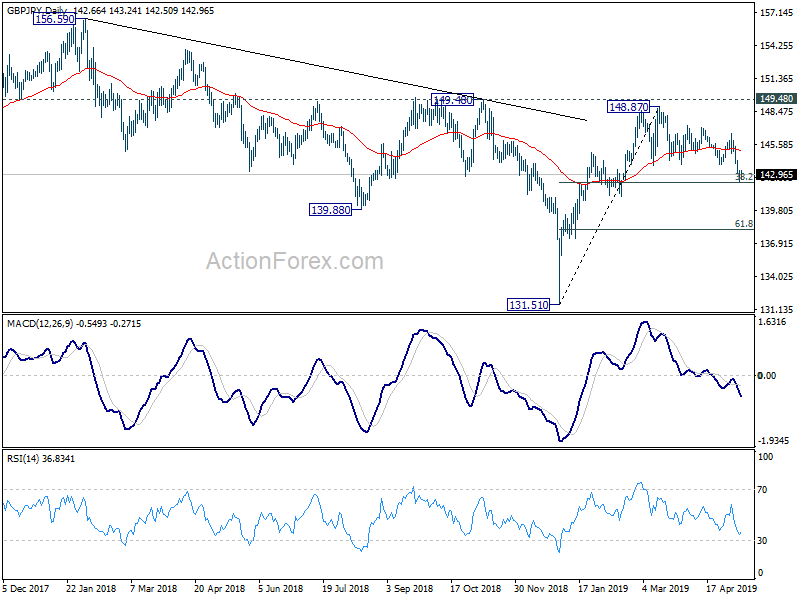
In the longer term picture, the rise from 122.36 (2016 low) to 156.59 (2018 high) doesn't display a clear impulsive structure. Thus, we're treating price actions from 122.36 as a corrective pattern. In case of an extension, strong resistance is likely to be seen at 50% retracement of 195.86 (2015 high) to 122.36 at 159.11 to limit upside. On the downside, break of 131.51 support will bring 122.26 low back into focus.
US-China Trade War Escalated, No End in Sight as Principle Differences Remain
US-China trade war was the center of global focus last week. Markets were expecting a deal with Chinese Vice Premier Liu He visited Washington Instead Trump announced to escalate to full-blown level after China reneged on its commitments during the negotiations. Trump's decision was understandable even though it may not be agreed by most investors, businesses and common people domestically and globally. Situation became worse as Liu's visit ended with nothing but declaration that there were still substantial differences between the two sides. Trade war will likely drag on which should weigh on global market sentiments.
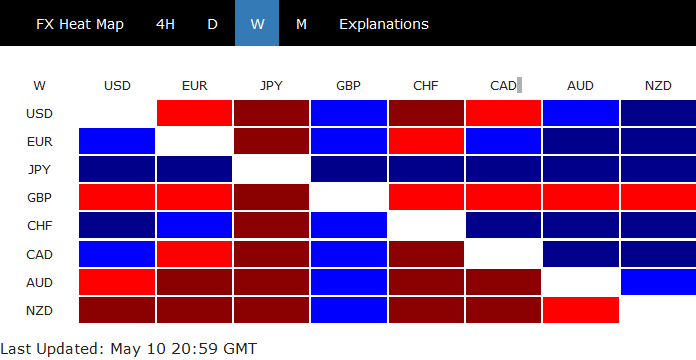
Over the week, Yen ended as the strongest one on risk aversion, naturally, followed by Swiss Franc. Euro displayed a lot of resiliences and ended as the third strongest. But it's strength might not sustain since it's know that Eurozone economy, in particular Germany, has been affected much by global trade tensions. Sterling ended as the weakest one on Brexit impasse as politicians looked staying unwilling to find a compromise between themselves. New Zealand Dollar was second worst performing after RBNZ rate cut. Australian Dollar was third even though RBA refrained from lowering interest rates.
US-China trade talks "have not broken down" but significant differences on issues of principle remain
Last week's US-China negotiations ended with practically no progress, but just confirmation that the tariff war will drag on. New round of tariffs already took effect on Friday and paperwork for tariffs on USD 325B in Chinese goods has started. For now, no new round of talks is scheduled. China's retaliations are awaited and could be announced any time soon.
Chines Vice Premier Liu He told reporters on Friday that the "negotiations have not broken down". He also tried to talked down the situation and said mall setbacks are normal and inevitable during the negotiations of both countries. Looking forward, we are still cautiously optimistic" . Yet, he added that "right now, both sides have reached mutual understanding in many things, but frankly speaking, there are also differences."
Liu emphasized "differences are significant issues of principle," and "we absolutely cannot make concessions on such issues of principle." One of the issues is over the current tariffs. Liu told Phoenix television in Hong Kong that if both sides wanted to reach an agreement, then all tariffs must be eliminated. Also, both sides have different opinions on the volume of additional purchase of US goods from China. As noted by a commentary by state news agency Xinhua, any purchases should be "in line with reality". The biggest issue, though, is likely on the text regarding law changes regarding core issues like IP theft, which China sees as intrusion of sovereignty. Liu said that "every nation has its dignity, so the text ought to be balanced,"
Trump continued to sound hard line on China with his tweets and said China was "beaten so badly" in recent negotiations and they may as well "wait around for next election" to see if they can "get lucky and have a Democratic win". But Trump also said "the only problem is that they know I am going to win... and the deal will become far worse for them if it has to be negotiated in my second term. Would be wise for them to act now, but love collecting BIG TARIFFS!". Trump typically didn't elaborate the logic link between China knowing he will win the second term yet, they're waiting for next election. That's no point in dragging on if a Trump win is certain.
China stocks and Yuan in free fall as trade tension heightened
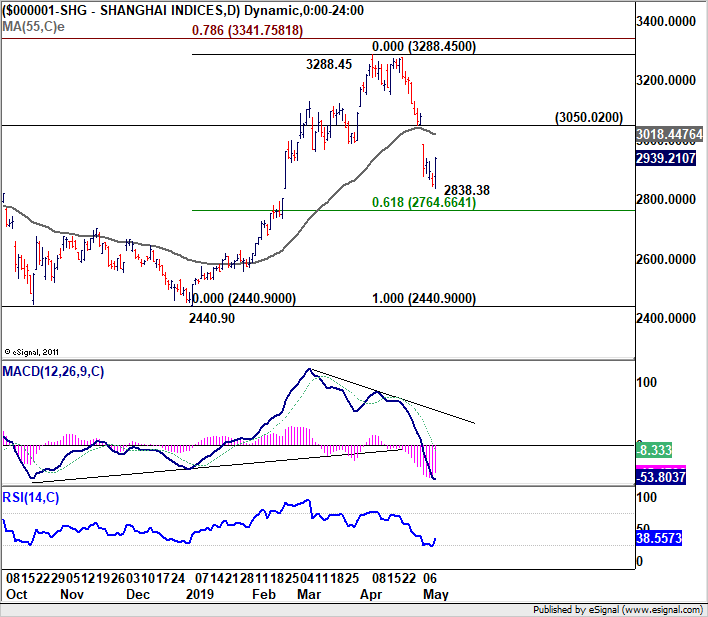
Chinese markets clearly suffered most on trade war escalation. Shanghai SSE composite gapped down and dived to as low as 2838.38 last week before paring some losses to close at 2939.21. While some sideway trading could be seen initially this week, we'd expect upside attempts to be limited by 3050.02 gap resistance to bring another decline. Break of 2838.38 should resume the fall from 3288.45 through 61.8% retracement of 2440.90 to 3288.45 at 2764.66. At this point, we're seeing such fall as a corrective move. Thus, selloff should finally slow down below 2764.66 fibonacci level.
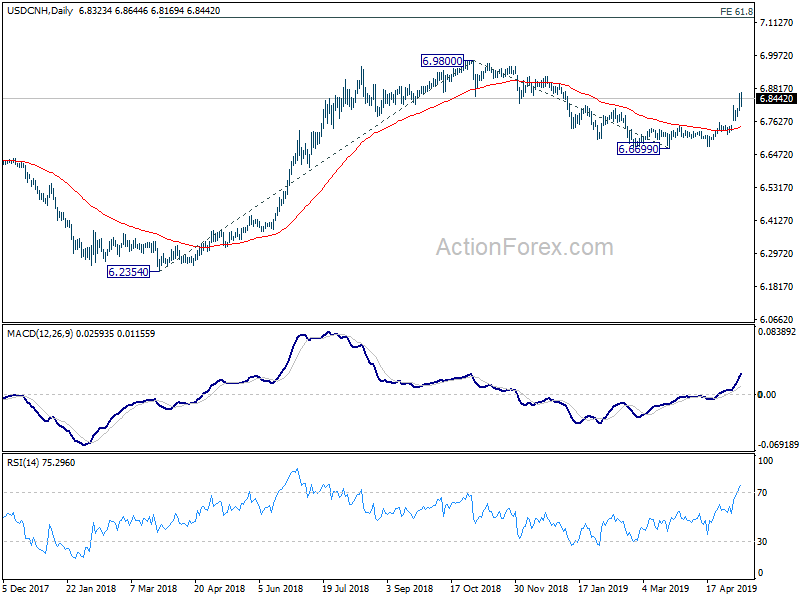
Yuan was so sold off sharply last week, with USD/CNH (offshore Yuan) hitting as high as 6.8644. The development indicates that corrective pull back from 6.9800 has completed at 6.6699 already. Further rise is now expected through 6.9800 to resume whole rally from 6.2354. Barring any government intervention, USD/CNH's next target is 61.8% projection of 6.2354 to 6.9800 from 6.6699 at 7.1301.
Nikkei was also dragged down heavily, risking reversal
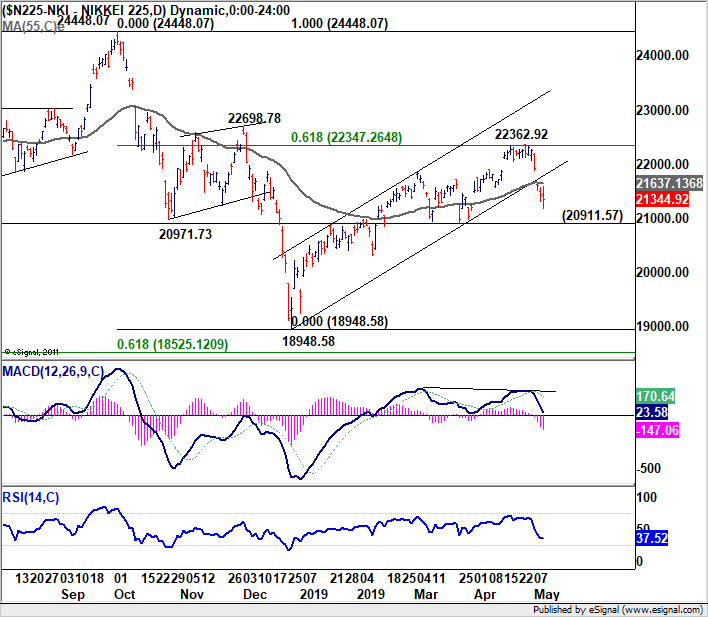
Staying in Asia, Japanese Nikkei also suffered steep selloff coming back from holidays. A short term top should at least be formed at 22363.92, on bearish divergence condition in daily MACD, after hitting 61.8% retracement of 24448.07 to 18948.58 at 22347.26. While the rebound from 18948.58 was stronger than originally expected, the structure still suggests that it's merely a correction. Immediate focus will be back on 20911.57 support this week. Firm break there will confirm completion of the corrective rebound and bring retest of 18948.58 low.
DAX performed less badly, but downside risk is high
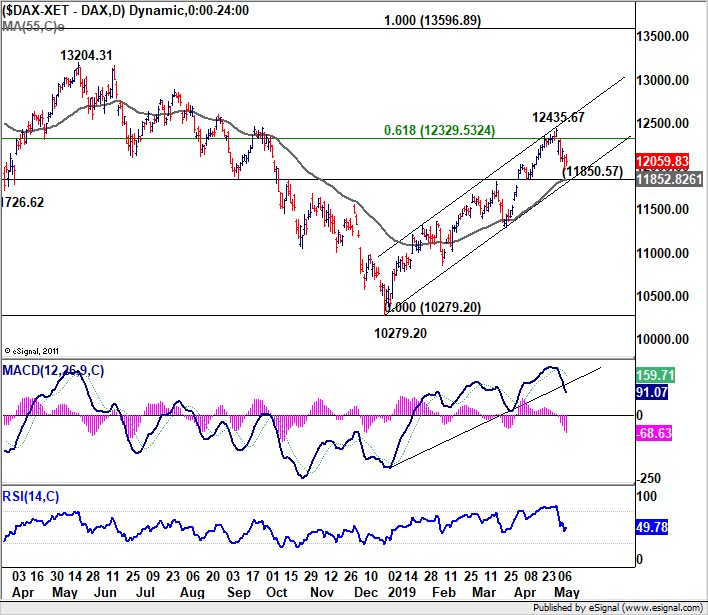
Over the Europe, while Euro was resilient, German stocks and yield suffered. 10-year bund yield dived to as low as -0.066 before closing at -0.041. Development in DAX was slightly better than Nikkei's but the index looks vulnerable. Corrective rise could have completed 12435.67 after hitting 61.8% retracement of 13596.86 to 10279.20 at 12329.53. Firm break of 11850.75 support will have 55 day EMA and channel support taken out. That should pave the way to retest 10279.20 low ahead.
DOW should have reversed, but needs confirmation from S&P 500 and NASDAQ
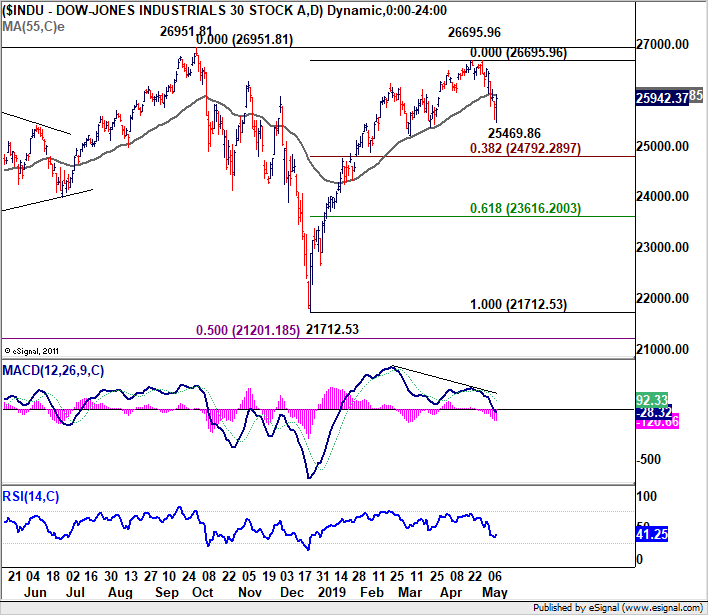
Back to the US, DOW dropped through 55 day decisively to as low as 25469.86 to close at 25942.37. The development suggests that rebound from 21712.53 has completed at 26696.96 already, on bearish divergence condition in daily MACD, just head of 26951.81. Such rise is seen as the second leg of consolidation from 26951.81. Thus, the third leg should have started. Next downside target is 38.2% retracement of 21712.53 to 26695.96 at 24792.28). Break will target 23616.20 and below. The biggest risk to this view is that, S&P 500 and NASDAQ just breached 55 day EMAs briefly and rebounded to close the week above. Further strength in these two indices might help push DOW back above 55 day EMA and invalidate our bearish view.
3-month and 10-year yield curve inversion coming back
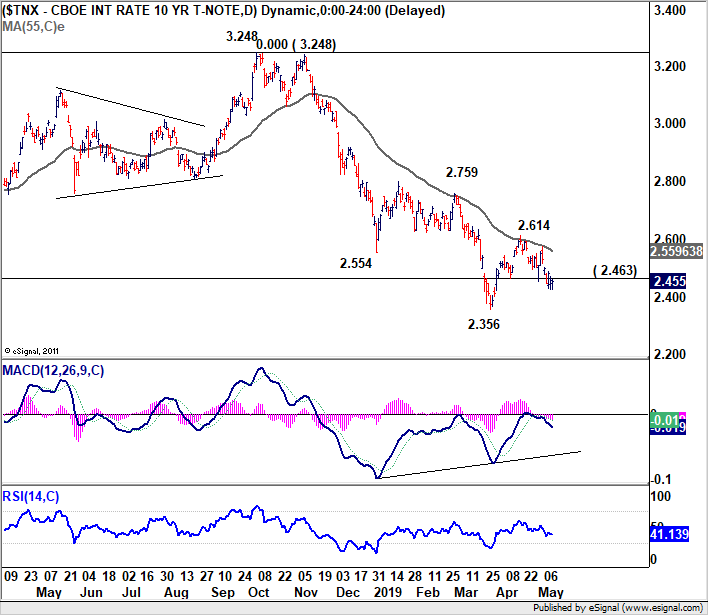
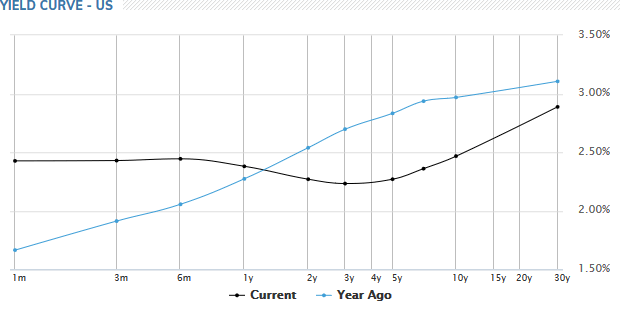
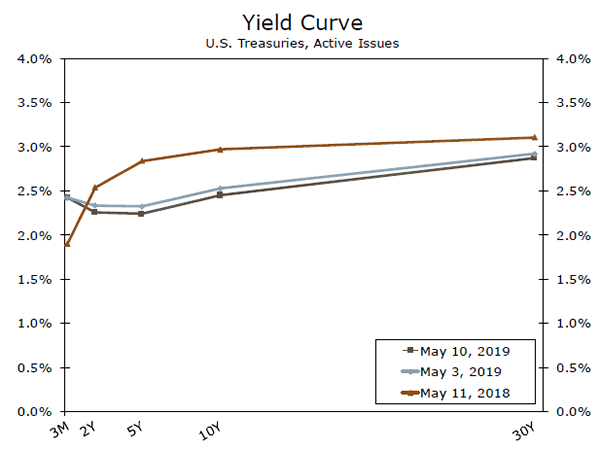
10-year yield was rejected by falling 55 day EMA and weakened against last week. The break of 2.463 support should confirm completion of corrective recovery from 2.356 at 2.614 after hitting 55 day EMA. Further decline should be seen back to retest 2.356 low and break will resume the fall from 3.248. Note that 3-month as 6-month-year yields are currently at 2.430, 2.444 respectively. Further decline in 10-year yield will invert this part of the yield curve too, which could be rather bearish for stocks and risk sentiments.
GBP/JPY Weekly Outlook
GBP/JPY dropped sharply to as low as 142.22 last week and broke 143.72 key support decisively. The development argues that whole rebound from 131.51 has completed at 148.87 already, ahead of 149.48 key resistance. Though, as a temporary low was formed just ahead of 38.2% retracement of 131.51 to 148.87 at 142.23, initial bias will be neutral this week for some consolidations first. Upside of recovery should be limited below 146.50 resistance to bring another decline. On the downside, break of 142.22 will resume the decline from 148.87 to 61.8% retracement at 138.14 next.
In the bigger picture, current development suggests that GBP/JPY was rejected by 149.98 key resistance. And medium term fall from 156.59 is still in progress. Break of 131.51 will target 122.36 (2016 low). On the other hand, decisive break of 149.98 should confirm that medium term fall from 156.59 (2018 high) has completed at 131.51 already. Further rally would be seen back to 156.59 resistance and above.
In the longer term picture, the rise from 122.36 (2016 low) to 156.59 (2018 high) doesn't display a clear impulsive structure. Thus, we're treating price actions from 122.36 as a corrective pattern. In case of an extension, strong resistance is likely to be seen at 50% retracement of 195.86 (2015 high) to 122.36 at 159.11 to limit upside. On the downside, break of 131.51 support will bring 122.26 low back into focus.
US-China trade talks “have not broken down” but significant differences on issues of principle remain
Last week's US-China negotiations ended with practically no progress, but just confirmation that the tariff war will drag on. New round of tariffs already took effect on Friday and paperwork for tariffs on USD 325B in Chinese goods has started. For now, no new round of talks is scheduled. China's retaliations are awaited and could be announced any time soon.
Chines Vice Premier Liu He told reporters on Friday that the "negotiations have not broken down". He also tried to talked down the situation and said mall setbacks are normal and inevitable during the negotiations of both countries. Looking forward, we are still cautiously optimistic" . Yet, he added that "right now, both sides have reached mutual understanding in many things, but frankly speaking, there are also differences."
Liu emphasized "differences are significant issues of principle," and "we absolutely cannot make concessions on such issues of principle." One of the issues is over the current tariffs. Liu told Phoenix television in Hong Kong that if both sides wanted to reach an agreement, then all tariffs must be eliminated. Also, both sides have different opinions on the volume of additional purchase of US goods from China. As noted by a commentary by state news agency Xinhua, any purchases should be "in line with reality". The biggest issue, though, is likely on the text regarding law changes regarding core issues like IP theft, which China sees as intrusion of sovereignty. Liu said that "every nation has its dignity, so the text ought to be balanced,"
Trump continued to sound hard line on China with his tweets and said China was "beaten so badly" in recent negotiations and they may as well "wait around for next election" to see if they can "get lucky and have a Democratic win". But Trump also said "the only problem is that they know I am going to win... and the deal will become far worse for them if it has to be negotiated in my second term. Would be wise for them to act now, but love collecting BIG TARIFFS!". Trump typically didn't elaborate the logic link between China knowing he will win the second term yet, they're waiting for next election. That's no point in dragging on if a Trump win is certain.
https://twitter.com/realDonaldTrump/status/1127337212813742082
Summary 5/13 – 5/17
Monday, May 13, 2019
[php_everywhere instance="1"]
Tuesday, May 14, 2019
[php_everywhere instance="2"]
Wednesday, May 15, 2019
[php_everywhere instance="3"]
Thursday, May 16, 2019
[php_everywhere instance="4"]
Friday, May 17, 2019
[php_everywhere instance="5"]
Weekly Economic and Financial Commentary: All Trade, All the Time
U.S. Review
All Trade, All the Time
- Prior to the recent escalation, there had actually been something of a détente in the trade war. China’s informal agreement to buy more U.S. soybeans helped shrink the trade deficit with China to its smallest since 2016. This could reverse if a deal is not reached soon.
- The consumer price index this week indicated that inflation continues to run close to the FOMC’s target. This week’s substantial rise in tariffs, however, is set to put upward pressure on inflation.
All Trade, All the Time
Tariff concerns dominated the headlines this week following President Trump’s threat on Sunday to raise tariffs on $200 billion worth of Chinese imports to 25% from 10% at present. We discuss the potential fallout from the tariff hike and renewed bout of uncertainty stemming from trade policy in our Topic of the Week on page 7. Data this week, however, provided a fresh look at where the trade deficit and inflation are heading into what could be a tumultuous period for imports, exports and pricing.
The trade deficit widened slightly in March to $50.0 billion. Exports posted an increase for the third consecutive month, but imports jumped 1.1% after a measly gain in February and a drop in January. The widening does not look to be quite as large as the BEA estimated heading into the initial release of Q1 GDP, suggesting the boost from trade may get revised lower.
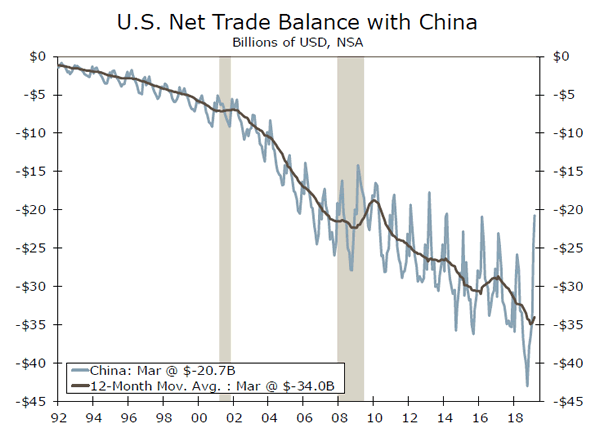
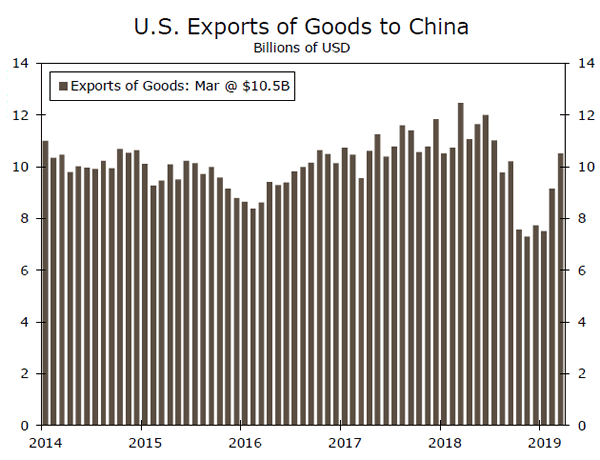
Amid a quasi-pause in the trade war with China as negotiations were progressing, the bilateral deficit with China narrowed in March to the smallest gap in about three years. Soybean exports, which had been caught in the crosshairs of the trade battle, jumped more than half a billion dollars, presumably contributing to the narrower deficit with China. With trade tensions flaring again and the possibility of retaliatory tariffs, exports to China may come under renewed pressure.
At Least Inflation Is Low…For Now
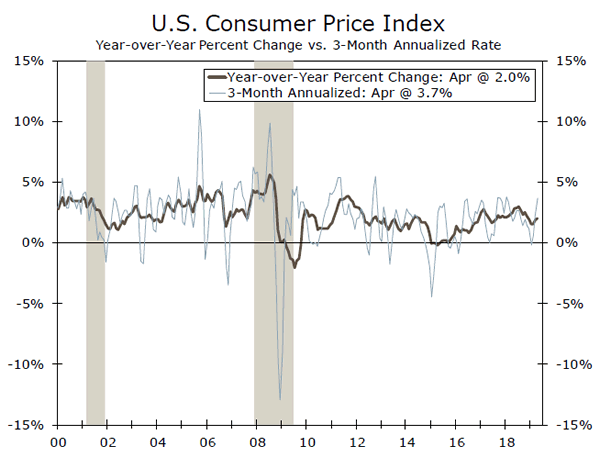
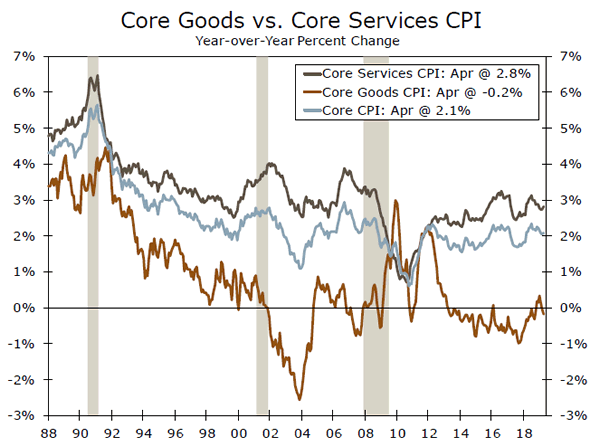
With tariffs back in the spotlight, the upside risks to inflation are back as well. We estimate that this week’s tariff hike could raise consumer price inflation up to 0.15 bps when measured on a year-ago basis. That is likely to be an upper bound, however, as reduced demand, a stronger dollar, existing contracts and some absorption by businesses limit the blow. If tariffs of 25% are extended to all imports from China, including many finished consumer goods, the impact to inflation would be more noticeable. For now, inflation remains relatively quiescent. Consumer prices rose 0.3% during April and 2.0% over the year, a somewhat softer increase than expected. The topline measure was boosted by higher energy prices, which saw a monthly increase of 2.9% alongside rising oil prices. Shelter prices gained 0.4% in April, stemming from higher rents of primary residences. However food, apparel and used vehicle prices each registered a monthly decline. Excluding volatile food and energy prices, prices rose 0.1% during the month but ticked up to a 2.1% gain over the past year.
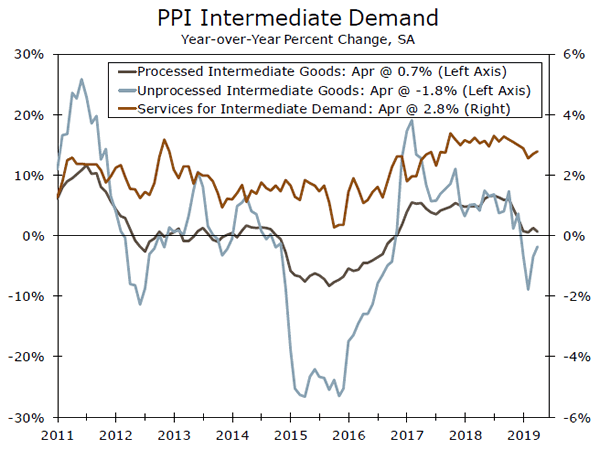
Producer prices were also fairly tame in April, but suggest inflation is edging up again. Prices for goods and services made by domestic producers increased more slowly than expected in March, but that was largely due to the volatile trade services component, which measures retail and wholesale margins. Our preferred measure of core PPI, which strips out food, energy and trades services, rose 0.4% and has turned up again on a year-over-year basis. At 2.2%, however, and with only moderate growth in input costs, the upturn does not suggest inflation is about to become unhinged.
And while the labor market remains solid, it is not tightening without abandon. Job openings rebounded in March, but remain off the highs reached last year. Initial jobless claims were also little changed from last week, pushing the four-week average back above 2018’s lows.
U.S. Outlook
Retail Sales • Wednesday
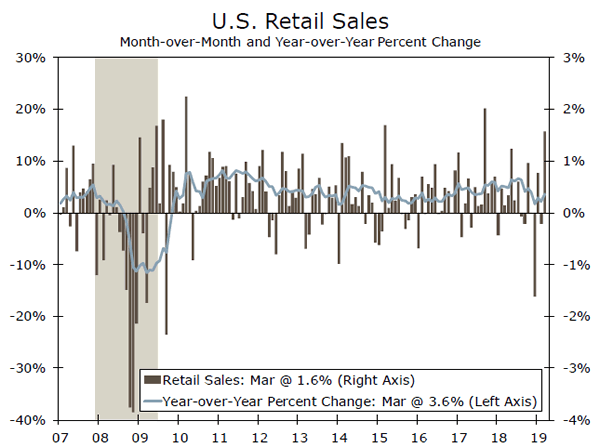
March retail sales rose 1.6% over the month with gains in every category except sporting goods. Headline sales were boosted by a 3.1% increase in motor vehicle sales and a gain at gas stations, largely due to higher prices at the pump in March. Excluding volatile components, the control group unexpectedly rose 1.0%, suggesting that the U.S. consumer has not gone into hiding. Online retailers saw monthly gains for the third straight month, after a soft patch in Q4-2018.
Consumer confidence also rose more than expected in April, providing some momentum for the consumer going into the second quarter. Consumers were able to regain some lost confidence after some positive developments in equity markets. Despite the strong data in March, it was not enough to prevent real consumption growth from slowing in the first quarter—PCE grew at an annualized pace of 1.2%. We look for a 0.2% increase in April retail sales.
Previous: 1.6% Wells Fargo: 0.2% Consensus: 0.2% (Month-over-Month)
Industrial Production • Wednesday
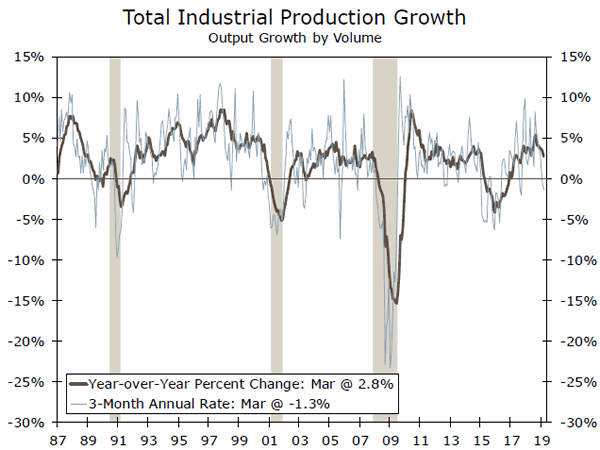
The industrial sector continues to lose momentum as total production edged down 0.1% month-over-month in March. The weakness was more pronounced in motor vehicle parts, which fell 2.5% and is down 4.5% over the past year. Mining output also softened 0.8% due to the drop in oil prices in late 2018 and reduced extraction of coal. We expect mining output to make modest positive contributions to growth, however, in the coming months.
The slowdown in production has raised concern about the outlook for manufacturing, as continued trade uncertainty and slower global growth have caused the sector to struggle.
We may see a flat number here in April, and any gains are likely to remain modest. We continue to monitor the ISM manufacturing index, which is lower on trend in recent months, despite not reaching recessionary territory.
Previous: -0.1% Wells Fargo: 0.0% Consensus: 0.0% (Month-over-Month)
Housing Starts • Thursday
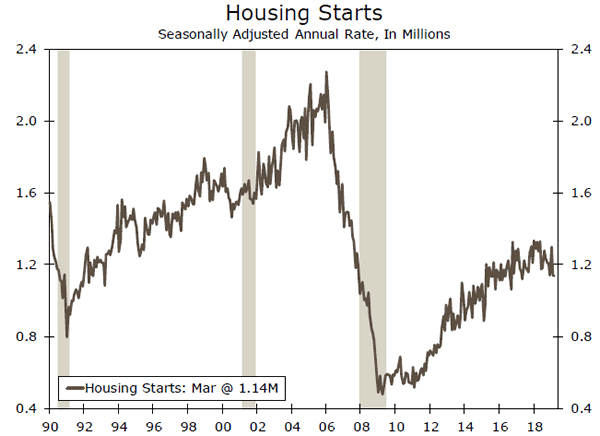
Housing starts continued to struggle in March, dropping 0.3% after declining 12% the prior month. Starts have fallen six out of the past seven months with permits showing a similar trend, falling for the past three months. Single-family permits fell 1.1% while multifamily permits fell an even-larger 2.7%. Despite the decline, permits for both single-family and multifamily homes remain well above starts, suggesting we should see an improvement in building activity later this year.
Homebuilding confidence has risen as expectations for single-family home sales over the next six months have improved slightly. Despite a sluggish first quarter, we do not think homebuilding is as slow as the data suggest. The weakened housing market has already slowed price appreciation and encouraged builders to undertake value engineering. The housing market will be watched closely as the spring selling season is upon us.
Previous: 1,139K Wells Fargo: 1,190K Consensus: 1,218K
Global Review
Global Trade Risks Reemerge
- The decision from U.S. President Trump to raise tariffs on Chinese goods this week increases the downside risks to global growth, and the pressure is now even higher on China and the United States to reach a trade deal. The latest tariff increase could shave about 0.2 percentage points off Chinese GDP growth in 2019, depending how Chinese policymakers respond.
- U.K. GDP growth was strong in Q1, and while some of that strength reflected inventory building, underlying domestic demand was more robust than expected. Canada’s employment data printed a bit soft, but the labor market is still generally holding up well despite weakening economic growth.
Not This Again…
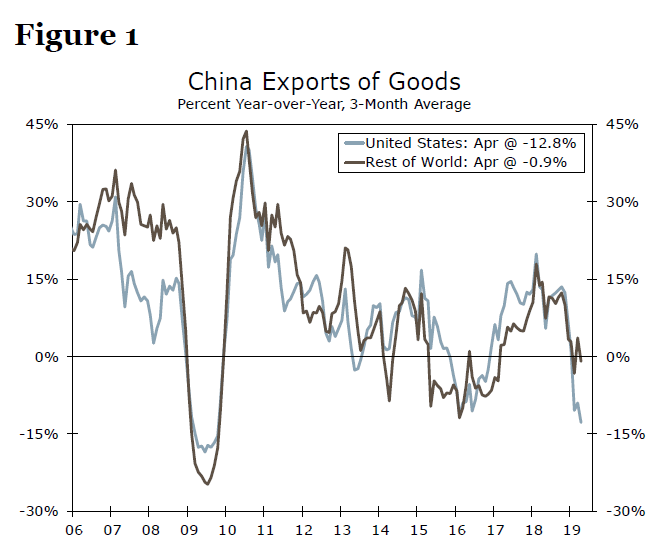
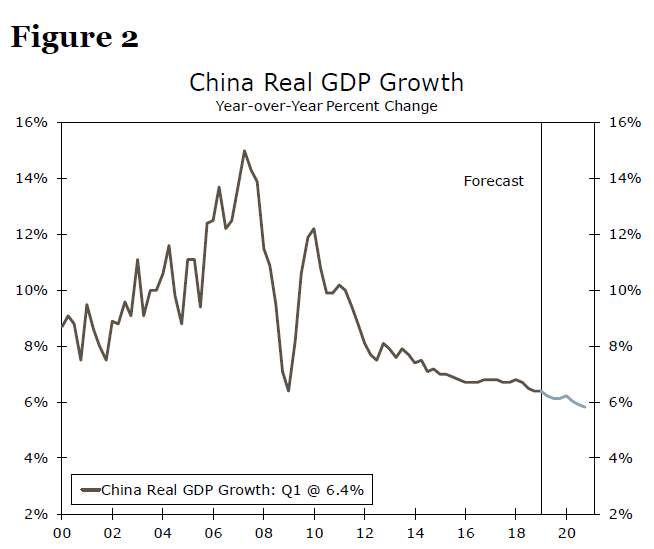
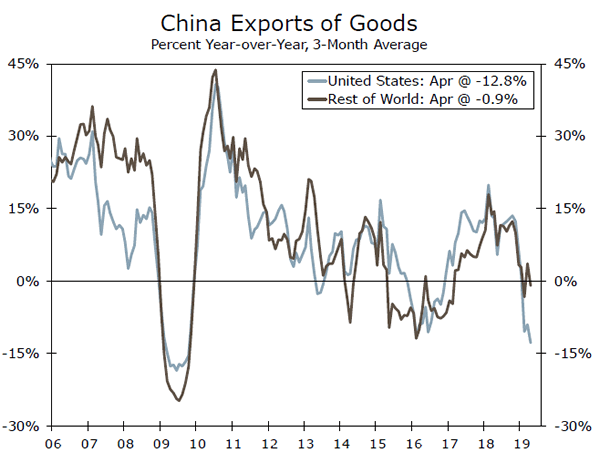
Global trade risk is back in focus after U.S. President Trump raised the 10% tariff on US$200 billion worth of Chinese goods to 25%. The reemergence and escalation in the U.S.-China trade tensions pose downside risk to our Chinese GDP growth forecast (currently 6.2% for 2019), as we think it could shave off around 0.2 percentage points off GDP growth this year depending on the policy response from Chinese authorities. China has previously hinted that it could dial back the degree of policy support it has been providing, likely a response to easing tariff risks and leverage concerns. However, now that trade risks have escalated, we would expect a commensurate response from Chinese authorities to contain the economic risks. Already this week, Chinese policymakers announced lower reserve requirement ratios (RRR) for small and mid-sized banks, and we would expect more measures to be forthcoming in the days and weeks ahead. Chinese trade data for April released this week showed the previously implemented tariffs may have already had a notable impact. The trade surplus narrowed to US$13.8 billion, driven by a sharp slowdown in exports and a jump in imports. Digging into the details, Chinese exports to the United States have shown considerably more weakness than exports to the rest of the world. Now that the tariffs have been raised, Chinese exports to the United States could come under even more pressure. The next steps are unclear—China threatened to retaliate earlier this week, but since then has not announced any specific countermeasures.
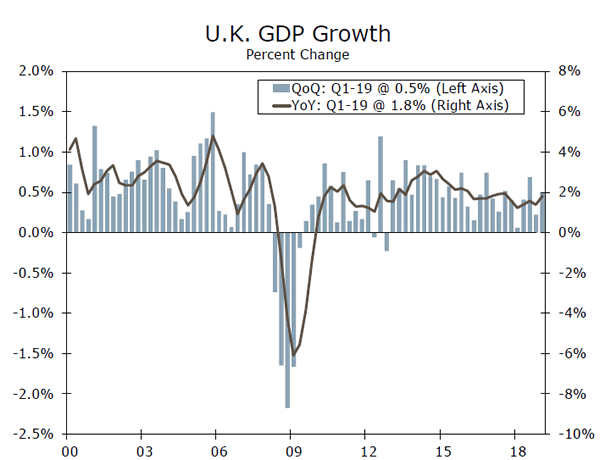
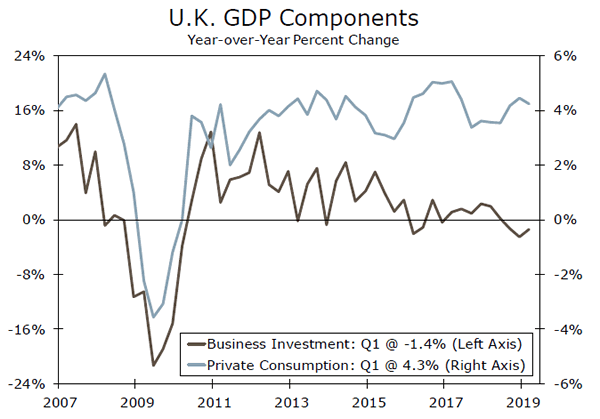
Shifting gears to Europe, data from the United Kingdom released this week showed strong growth for Q1. GDP rose 0.5% (not annualized) on a sequential basis during the quarter, matching expectations. A closer look at the data shows growth was partly driven by temporary inventory building ahead of Brexit, but underlying domestic demand was also stronger than expected. Private consumption rose 0.7% during the quarter, while business investment unexpectedly rose 0.5%, the first increase in more than a year. The data bode well for the U.K. economy, and run counter to the narrative that activity in Q1 was driven mainly by pre-Brexit stockpiling. We now see greater upside risks to our 2019 U.K. GDP forecast of 1.3%. On the political front, talks to resolve Brexit between the U.K. Conservative and Labour parties have thus far yielded nothing in the way of tangible results, and it seems the Brexit stalemate is poised to linger for the foreseeable future. The contrast between Brexit uncertainty and strong domestic growth is a bit difficult to square, but for now it seems the economy is determined to shrug off any concerns.
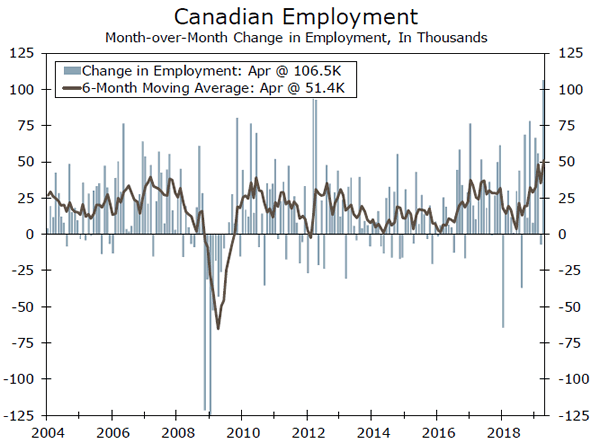
Making our way back around to North America, Canada’s jobs numbers for April came in well above expectations, as the monthly job gain of 106,500 was the largest on record. Full-time jobs accounted for the bulk of the gain, while the jobless rate edged lower to 5.7% even as labor force participation ticked higher. Canada’s labor market has been remarkably resilient despite weakness in economic growth, and we think labor market developments will be key to watch if growth continues to falter.
Global Outlook
Eurozone Industrial Output • Tuesday
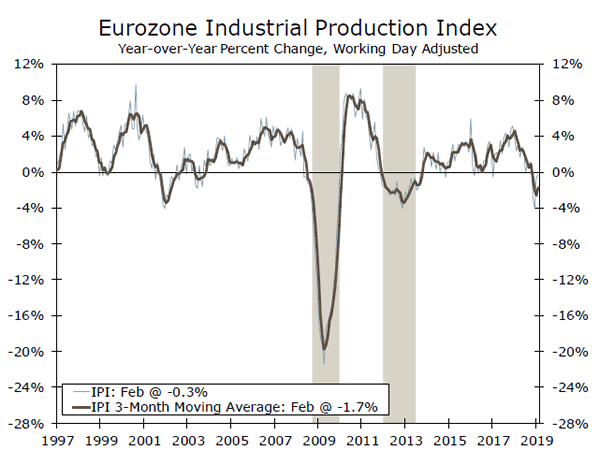
The Eurozone economy is starting to show tentative signs of stabilization, as Q1 GDP rose a more solid 0.4% (not annualized) on a sequential basis. A nearly 2% month-over-month jump in industrial output in January may have helped the overall growth print, but output fell modestly in February and the consensus expectation is for a 0.3% drop in March. These figures suggest the economy lost some momentum by the end of the quarter.
To be sure, retail sales were also strong in Q1, a positive sign for consumer spending activity. We will not get a full breakdown of GDP into its demand-side components for another month, so these monthly activity figures are one of the few ways to ascertain the drivers of demand growth for now. Business fixed investment and consumer spending were underwhelming in the second half of 2018, and it will be important to gauge the performance of these two components of domestic demand in Q1.
Previous: -0.2% Consensus: -0.3% (Month-over-Month)
China Economic Activity • Tuesday
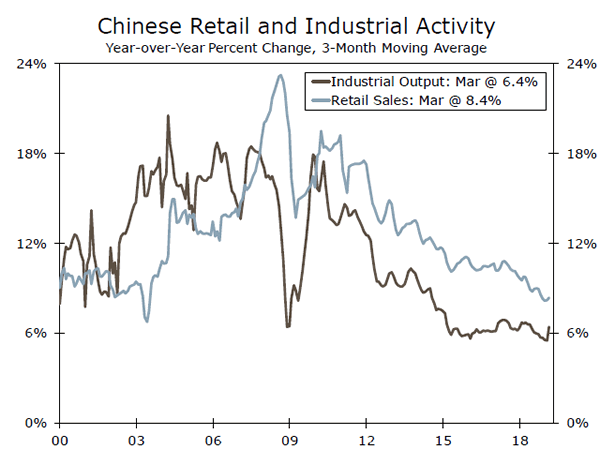
China is another economy that has shown some signs of more stable growth recently, as Q1 GDP growth beat expectations with a 6.4% year-over-year gain. Monthly activity figures, including industrial output and retail sales, were solid for March, suggesting the economy carried some momentum into Q2. In that sense, next week’s release of key activity figures for April, including industrial output and retail sales, will be important in gauging whether the Chinese economy kept that solid momentum going at the start of Q2.
These figures will not, however, capture any of the possible disruptions that could come from President Trump’s latest decision to raise tariffs on Chinese goods. We will have to wait until the release of the May PMIs at the end of the month before we can get a sense for how these actions affected sentiment. Until then, the financial market response will be more instructive.
Previous: Industrial Output 6.4%, Retail Sales 8.4% Consensus: Industrial Output 6.5%, Retail Sales 8.4%
Banxico Policy Announcement • Thursday
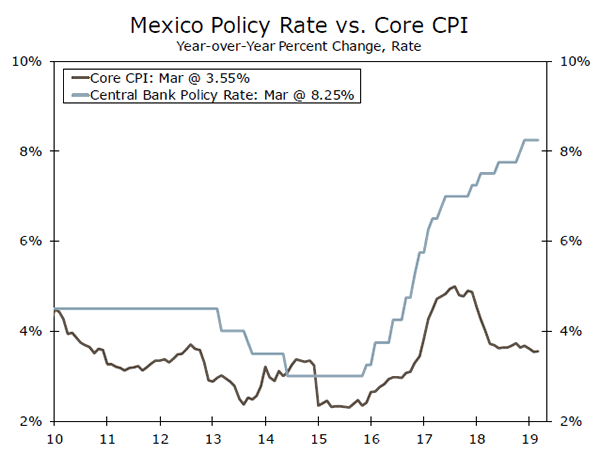
At a time when most central banks around the globe have turned more dovish, Mexico’s central bank has been hesitant to change its hawkish tune. That is particularly interesting given just how tight monetary policy is in Mexico right now—the policy rate currently stands at 8.25%, while core inflation is running at just 3.5%, implying a real policy rate of nearly 5%. The tightness of Mexican monetary policy highlights the concern among policymakers over upside inflation risks, but high real interest rates are increasingly showing signs of weighing on interest-rate sensitive sectors of the Mexican economy, such as investment spending.
Eventually, we expect the central bank to capitulate and start to signal rate cuts. The currency has been reasonably stable and concerns about Mexico’s political situation have lessened for now, and the central bank may take advantage of this relative stability in the domestic situation to ease policy.
Previous: 8.25% Consensus: 8.25%
Point of View
Interest Rate Watch
Higher Tariffs—Lower Rates?
President Trump’s tweet last week announcing his intention to boost tariffs on Chinese goods to 25% from 10% and possibly extend tariffs to virtually all Chinese imports rattled the financial markets this week. The prior thinking was that the trade negotiations were making progress and that a formal agreement would be signed in mid-June. That still may happen, but the latest rift, which appears to have been brought on by the inability to agree on an enforcement mechanism, has reintroduced considerable uncertainty as to when and if an agreement will be reached.
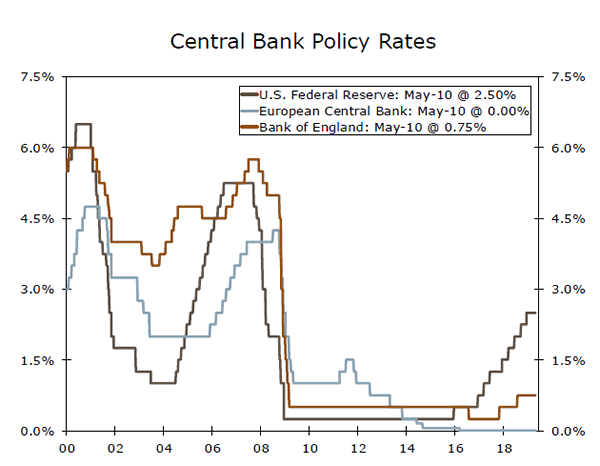
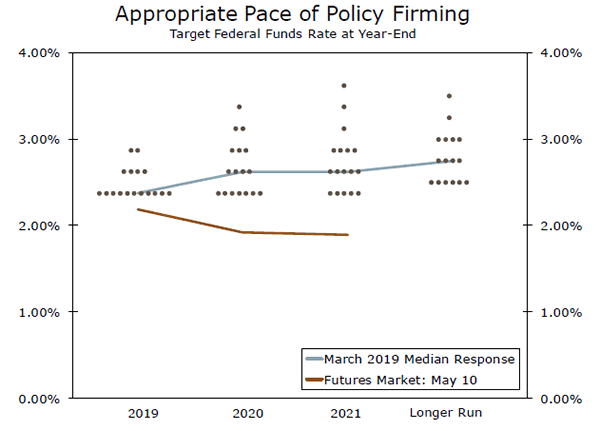
The lack of a trade deal and rise in tariffs will slow global economic growth even further, which means U.S. manufacturing activity and inflation are both likely to decelerate further as well. Long-term yields fell slightly over the week but the Treasury auctions went poorly, which has kept the slope of the yield curve solidly positive. With tariffs and the expanded trade war apparently worsening, the odds of a cut in the federal funds rate have increased. Federal funds futures currently imply two quarter-point rate cuts by the end of 2020. We currently have one rate cut, at the end of 2020, which might need to be pulled forward if the increased uncertainty causes real economic growth to slow, which seems likely.
The remarkably tame inflation data give the Federal Reserve plenty of room to maneuver. Both the PPI and CPI data came in slightly below expectations during April. The headline CPI rose 0.3%, largely behind a big increase in gasoline prices. Prices excluding food and energy rose just 0.1%, however, which was below expectations. The core CPI has risen 2.1% over the past year but the core PCE deflator, which is the Fed’s preferred price gauge, is up just 1.6%.
While some Fed participants have raised concerns about lower inflation, the economy continues to show a great deal of resilience. Solid job growth and an unemployment rate of just 3.6% likely create a fairly high bar for the Federal Reserve to cut rates. That said, growing concerns about trade likely raise the bar even further on any potential rate hikes.
Credit Market Insights
C&I Credit Crunch?
U.S. bank respondents reported to the Federal Reserve that demand decreased among all major loan categories in the first quarter. Banks were more willing to extend credit, however, likely reflecting the notably more dovish stance among global central banks. Credit standards are reported in the Senior Loan Officer Opinion Survey (SLOOS), which is released by the Federal Reserve and asks participating banks to gauge lending practices and behaviors.
Demand for Commercial & Industrial (C&I) loans was reported to be notably weaker in the first quarter. The net percentage of firms reporting strong demand for C&I loans from Large & Medium firms was -16.9%—the weakest since the Great Recession. Actual records of banks’ balance sheets, tracked by the Fed’s H.8 report, however, show credit is being extended. Indeed, C&I loans grew an annualized pace of 9.8% in Q1-2019.
The decreased demand hasn’t yet translated into lower lending volumes, but could this be the start of a C&I credit crunch? With demand for C&I loans steadily declining since 2014, we do not expect a renewed pick-up in demand. But, banks eased standards for such loans in the first quarter, likely providing some incentive to firms for impending investment. We would need to see a large retrenchment in banks’ willingness to extend credit, coupled with tightening of standards, before we became truly worried of a forthcoming suppression in C&I lending.
Topic of the Week
Doubling Down on Tariffs
The increase to 25% from 10% previously on $200 billion of various Chinese goods imports went into effect earlier today, and while some products in transit may be allowed in on a temporary basis, the hope that “cooler heads will prevail” was dashed once again.
Still, a new deal with China could emerge soon and the administration had positive remarks about a letter received from Chinese President Xi Jinping. For now, however, the Chinese trade delegation leaves Washington without a deal in hand and amid heightened financial market anxiety. The VIX index, a measure of volatility, is nearing levels last seen in December’s market swoon.
For now, the $325 billion in new tariffs on other Chinese imported goods has not yet gone into effect. Though the President said those tariffs would go into effect “shortly” and would also be at the higher 25% rate, U.S. law requires public hearings and a comment period.
Prior to the recent escalation from the President’s tweets over the weekend, there had actually been something of a détente in the trade war, with China agreeing to buy more U.S. soybeans, for example. Soybean exports jumped by more than half a billion dollars in March, meaning exports of that crop alone accounted for about a quarter of the $2.1 billion increase in overall goods exports. This has occurred alongside a rebound in U.S. exports to China (top chart). This could reverse if a deal is not reached soon.
Beyond just buying fewer U.S. soybeans, the Chinese government could increase the existing tariff rate on a variety of U.S. imported goods already subject to Chinese tariffs, which would likely put renewed pressure on U.S exports.
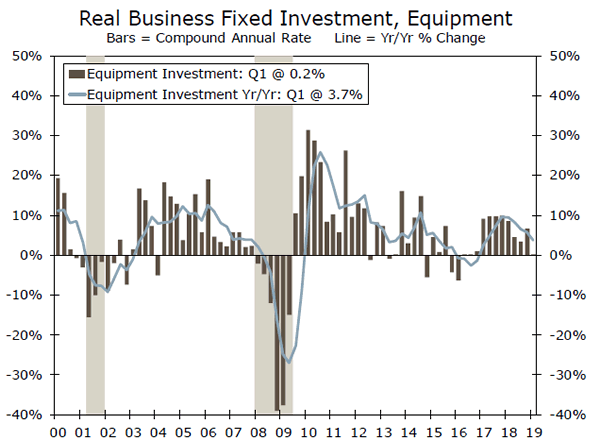
The increased trade tension with China could lead some businesses to infer that the administration is potentially embarking on a more aggressive trade policy stance. The deceleration in business investment in equipment in recent quarters could reflect, at least in part, uncertainty related to trade policy (bottom chart).
The Weekly Bottom Line: Record Job Gain Defies Expectations
HIGHLIGHTS OF THE WEEK
United States
- Effective today, the U.S. increased tariffs to 25% on $200bn worth of Chinese imports. The threat to extend a 25% tariff to virtually all Chinese imports “shortly” remains. This comes even as the two sides continue negotiations to reach a trade deal.
- The U.S. overall trade deficit edged higher in March to $50bn, even as the bilateral goods trade deficit with China declined to a five year low.
- Consumer price inflation continues to show little signs of accelerating, with both headline and core inflation around 2%. Things could change however, as tariff hikes filter through the economy.
Canada
- Today's Labour Force Survey release took the spotlight with an above-expectations net job gain of 106.5K that left the unemployment rate a tick lower at 5.7%.
- Canadian international trade bounced back to life in March. Unfortunately, this was eclipsed by substantial downward revisions to the prior month, resulting in an overall poor Q1.
- The economic calendar was also heavy on housing data. Starts surprised on the upside, whereas delayed home sales data from TREB showed encouraging signs of demand in Toronto.
UNITED STATES - Tariff Talks Teeter
With few data releases, the return of U.S.-China trade tensions captured attention. Financial markets were volatile, but largely down as President Trump tweeted over the weekend that an increase to tariffs on Chinese imports would go into effect Friday. These sentiments were reiterated by other high-ranking U.S. trade officials who accused Beijing of reneging on its promises in earlier negotiations. This rhetoric threatened to derail planned high-level talks with Chinese negotiators; however the Chinese delegation only delayed the meetings rather than cancelling them.
The U.S. administration officially implemented the tariff increase from 10% to 25% on approximately $200bn worth of Chinese imports on Friday. Additionally, President Trump has tweeted that he plans to levy the new 25% tariff on a further $325bn worth of Chinese goods “shortly”, a move that would cover virtually all U.S. imports from China. Even as China urged the U.S. to meet them halfway, they announced that countermeasures will be implemented, although specific details have not been revealed.
Despite the new developments, talks continued on Friday as the two sides try to salvage a deal. A sticking point for the U.S., however, is whether China will agree to implement legal changes so as to facilitate the trade deal and to make the details public. China has resisted this push, insisting that it impinges on their national sovereignty.
The new tariffs will result in a more significant drag on growth if they are sustained, impacting not only capital expenditure and consumer spending but also confidence. In a recent note, we estimate that U.S. growth could be lowered by -0.1% to -0.3% with the higher tariff. Growth could fall by as much as -0.6% if the threatened $325bn becomes a reality. The run-up in inventories witnessed in prior months partially reflected preparation by businesses for this possibility, and with additional tariffs to take effect, they are likely to pass on price increases to consumers.
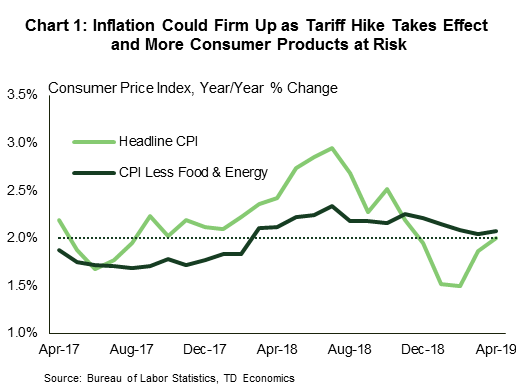
To date, inflationary pressures have been benign. Consumer prices in April rose 0.3% over the previous month and were up 2% year-on-year (Chart 1). However, the threatened escalation in tariffs could see inflationary pressures firm up. We estimate that consumer prices rose by 0.3ppts from tariffs already imposed and could rise by an additional 0.4ppts if the remaining $325bn of Chinese imports are made subject to 25% tariff (see note).
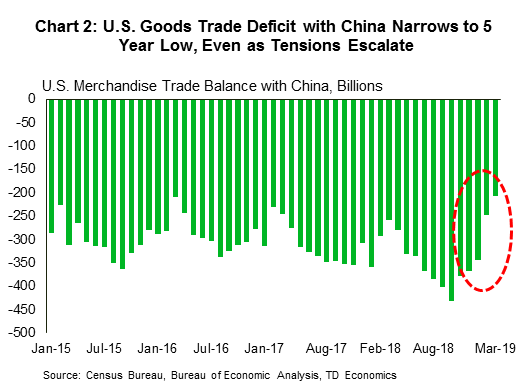
Despite the U.S.'s heavy use of tariffs to rebalance trade flows, their trade deficit edged up in March, reflecting the difficulties inherent in attempting to redirect international trade. Of note, the merchandise trade deficit with China, a special area of interest, has been declining for the past few months, and hit a five year low in March (Chart 2). This development may positively impact ongoing negotiations between the two economic powerhouses. All told, the U.S. and Chinese economies are at an important juncture. Decisions made now are likely to have significant implications for the global economic landscape in the future.
CANADA - Record Job Gain Defies Expectations
Canadian financial markets were mixed this week, with the S&P/TSX composite following global peers lower, dropping around 2.1% (as of writing), and the loonie moving sideways but remaining flat relative to last week. A mixed bag of data releases was joined by recent developments on the U.S.-China trade front. In a recent note, we highlight that the likely impact on Canadian growth if the recent increases in U.S. tariffs on Chinese goods persist sits in the 0.1%-0.2% range, with most of the impacts generated through confidence effects.
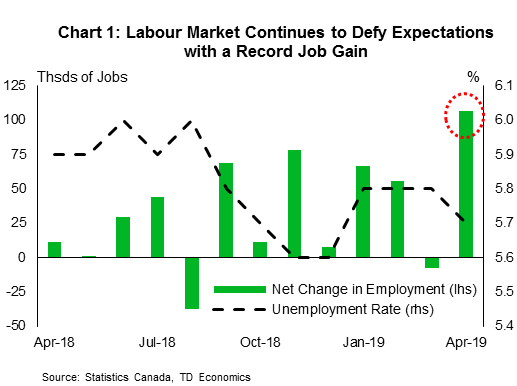
On the data front, today's Labour Force Survey release was the main event. Labour markets continued to defy the ongoing soft patch in the Canadian economy, with a record 106.5K job gain (Chart 1) that was staggeringly above expectations for a flat print. Details of the report were just as positive. For instance, wage gains advanced 2.6% (y/y). The composition of job gains was healthy, with private sector (+84K) and full-time (+73K) hiring doing the heavy lifting. Other details were also encouraging, including an uptick in the participation rate (to 65.9%), and an unexpected but welcome increase in Alberta's job gains (+21K).
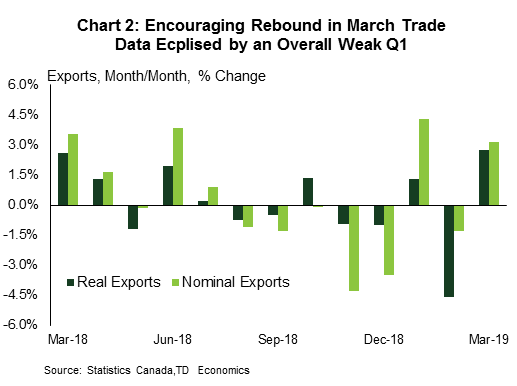
Meanwhile, March's international trade data offered a glimpse of hope (Chart 2). Export volumes rebounded 2.6%, and a pick-up in some consumer and investment-related import categories offered signs of optimism for domestic demand. The export bounce-back was also relatively broad-based, spanning 9 of the 11 categories, Unfortunately, much of this was eclipsed by a downward revision to already-weak February report, which left overall Q1 export volumes down 2.4%.
The economic calendar was also heavy on housing data. Housing starts surprised on the upside, surging 23% (m/m) in April to reach a 236K annualized pace. TREB data showed that Toronto home sales advanced 11% in April, an encouraging print given the subdued performance in Q1. Also grabbing attention was a speech by Governor Poloz highlighting the impacts of the B-20 regulations on the quality of new loans, and calling for changes in Canada's mortgage markets, including longer renewal terms and a private market for securitization.
On the whole, this week's data releases confirm that the economy's current soft patch is likely temporary. While certainly not a leading indicator, the continued health in Canada's labour markets should at least provide some reassurance on existing business sentiment and for consumer spending going forward. It is worth noting that the Bank of Canada's conservative Q1 assumption was primarily driven by a drag from exports, and to a lesser extent, housing. Data has confirmed outsized weakness in these categories in Q1, but the recent reversals, and the resulting handoff provide some early indications that Q2 will likely turn in a better performance - in line with the Bank of Canada's expectations (and our own).
U.S.: Upcoming Key Economic Releases
U.S. Retail Sales - April
Release Date: May 15, 2019
Previous: 1.6%, ex auto: 1.2%, control group: 1.0%
TD Forecast: 0.3%, ex auto: 1.1%, control group: 0.5%
Consensus: 0.2%, ex auto: 0.7%, control group: 0.3%
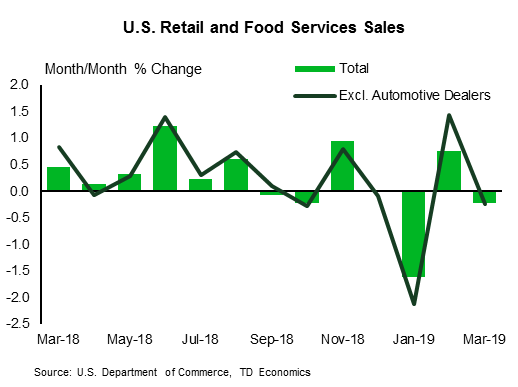
We expect another firm increase in sales in the control group (+0.5% m/m) to be the main driver behind a 0.3% rise in the headline measure for April. The increase in the latter would represent a mean-reversion in growth following the notable 1.6% jump in March that likely reflected, to a large extent, a normalization in tax refunds. We expect growth in sales in the key control group to be supported by solid real disposable income and a still humming labor market. In addition, we anticipate a 2.5% decline in auto sales to be a drag on headline growth, while food and gasoline station sales should continue to lend upside support to the headline measure.
Canada: Upcoming Key Economic Releases
Canadian Consumer Price Index - April
Release Date: May 15, 2019
Previous: 0.7% m/m, 1.9% y/y
TD Forecast: 0.4% m/m, 2.0% y/y, NSA Index: 136.0
Consensus: N/A
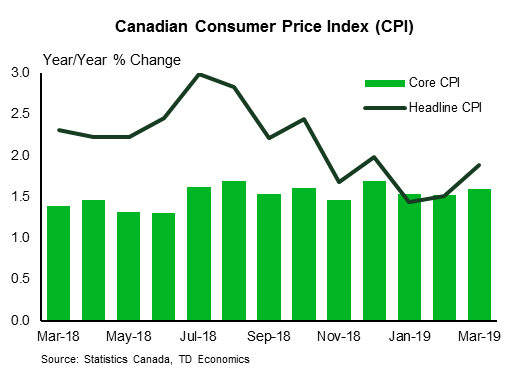
TD looks for headline CPI to firm to 2.0% y/y in April, leaving inflation at target for the first month since December. Our forecast is consistent with a 0.4% m/m increase, helped by a broad pickup in energy prices on the heels of the federal carbon backstop imposed on Ontario, Saskatchewan, Manitoba and New Brunswick on April 1st. This set the price for carbon emissions at $20/tonne and pushed gasoline prices higher by 4.4 cents per litre, contributing to another 10% m/m increase in the price at the pump following an 11.6% gain in March. The combination of carbon taxes alongside seasonal fluctuations and a pickup in oil prices has pushed gasoline prices above their Q4 highs to an average of $1.35 on April 29, just five cents shy of the record from 2014.
Looking past energy prices, we expect CAD depreciation to provide a tailwind to food products while ex. food and energy prices should see a soft 0.1% increase (0.2% seasonally adjusted); BoC measures of core inflation are likely to hold at 2.0% on average. Telephone services are a key upside risk after the Big 3 Telecoms raised internet prices throughout late March and early April while rent should also provide another source of strength following methodology changes that had seen rental CPI rise by 0.5% m/m in the last three months.
Canadian Manufacturing Sales - March
Release Date: May 16, 2019
Previous: -0.2%
TD Forecast: 1.6%
Consensus: N/A
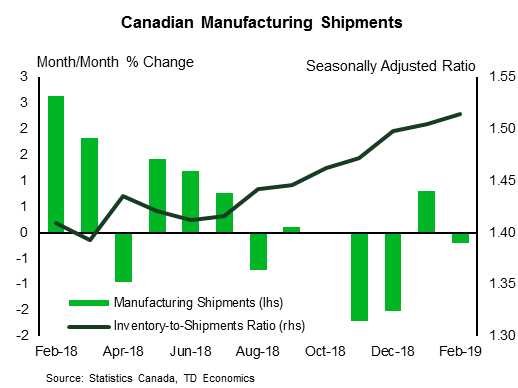
Manufacturing sales are forecast to rise by 1.6% in March, helped by a rebound in motor vehicle production and a significant increase in factory prices. Motor vehicle exports rose by 8% in March which fits with a rebound in preliminary production figures following a sharp pullback in February. Energy products will provide another source of strength for the nominal print on the heels of a 10% increase in gasoline prices. Excluding gasoline, industrial prices saw a more modest increase which will still provide support to the nominal series although the broad strength in real exports bodes well for manufacturing volumes.
Tariff Rumor Turns to Tariff Fact
Executive Summary
The United States moved ahead with an increase in tariffs on Chinese goods today. Risks are, unsurprisingly, to the downside for our current Chinese GDP forecast, although much will depend on how this fluid trade situation evolves as well as how Chinese policymakers respond. We also see key implications for other trade issues, including USMCA and auto tariffs.
Implications of Latest U.S. Tariffs for China, and More
Effective today, the United States raised the 10% tariff on $200B of imports from China to 25%. The currency market reaction thus far has been consistent with “buy the rumor, sell the fact,” as the dollar is broadly lower and riskier currencies are generally outperforming, more or less a mirror image of the reaction on Monday to the original tariff threats. In addition to the “sell the fact” dynamics, there may be some other reasons the market reaction has been subdued. For one, markets may be under the impression the tariff increase will not be in place for long. Trade talks between U.S. and Chinese negotiators still took place today, as there has not been a full-fledged breakdown in trade relations between the two nations. However, retaliatory measures from China are likely forthcoming, and we would be surprised if renewed tensions lead to the two sides suddenly reaching a final trade deal.
On the policy front, we expect Chinese authorities to continue providing monetary and fiscal policy support for the economy as long as trade tensions persist and the tariffs remain in place. There had previously been some reports that policymakers were considering dialing back the degree of policy support, but today’s tariff increase suggests authorities will maintain a steady drip of support for the Chinese economy. For that reason, we see only modest downside risks of around 0.2 percentage points to our current Chinese GDP forecast of 6.2% for 2019, although the risks are tilted toward a larger impact.
Lastly, we note two separate trade issues that could be affected by today’s tariff announcement. First is the USMCA, the replacement agreement for NAFTA. U.S. Congress seems to have made little to no progress in getting closer to an agreement on whether to ratify the USMCA, as one major hang-up seems to be the steel and aluminum tariffs imposed on Mexico and Canada last year. Influential U.S. policymakers have signaled the USMCA will not be considered until those tariffs are removed, and President Trump may be hesitant to do so given his recent decision to raise tariffs on China. Separately, Trump has until May 18 to decide whether to impose tariffs on U.S. auto imports. With his focus now on China, Trump may decide to delay this decision deadline beyond May 18, but there is still a small risk he moves ahead with auto tariffs next week.