

Sample Category Title
Yuan selloff accelerates in wake of trade talks deadlock
While trade talks between China and US might not have broken down, they's certainly going no where. Huge differences remain in fundamental issues that neither side is going to back down from. And rhetorics of both sides during the weekend confirmed that.
Asian markets opened the week sharply lower, led by China. The Shanghai SSE dripped to as low as 2892.17, and is currently down -0.72% at 2917. Nikkei is down -0.50% while Singapore Strait Times is down -1.14%.
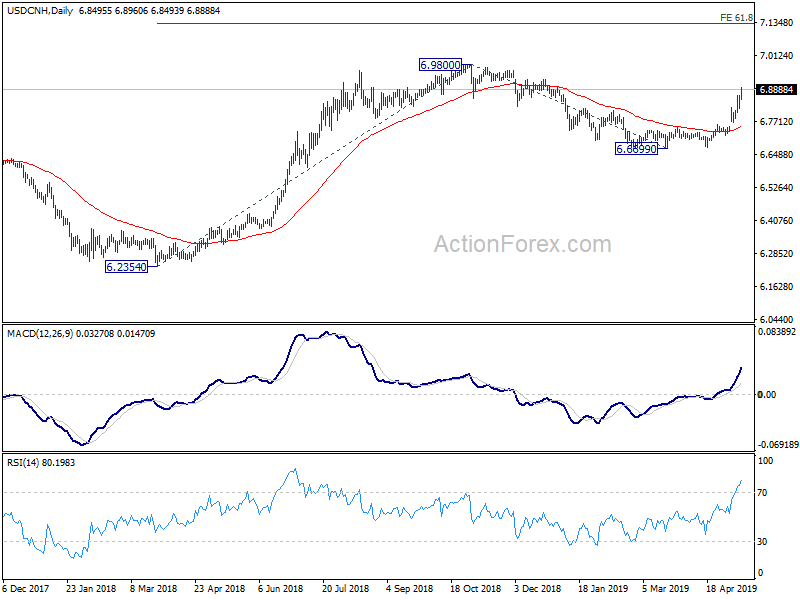
USD/CNH extends recently rally to as high as 6.8960 so far. The development is in line with our view that corrective pull back from 6.9800 has completed at 6.6699 already. Further rise should be seen (and might be rather quickly) to retest 6.9800 and important psychological level at 7.0000. Barring any government intervention to "halt" Yuan depreciation, USD/CNH should target 61.8% projection of 6.2354 to 6.9800 from 6.6699 at 7.1301.
CFTC Commitments of Traders – Traders Trimmed Bets (on Both Longs and Shorts) in Major Currencies as Trump Escalated...
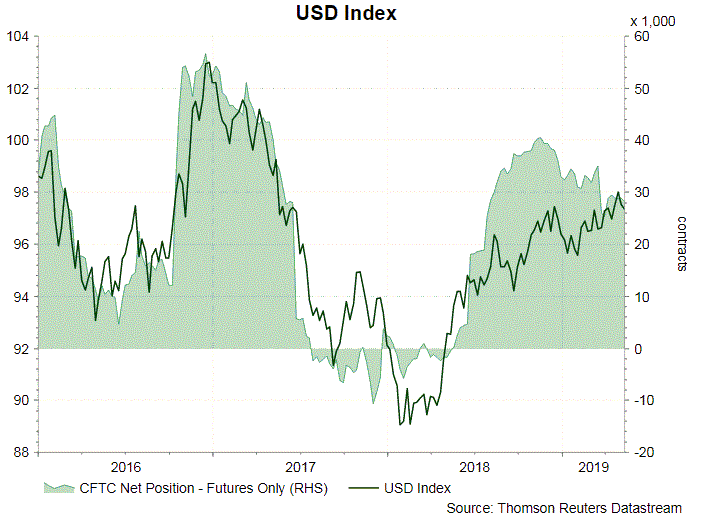
As suggested in the CFTC Commitments of Traders report in the week ended May 7, NET LENGTH in USD Index decreased -716 contracts to 28 233. Both speculative long and short positions fell during the week. All other major currencies stayed in NET SHORT positions.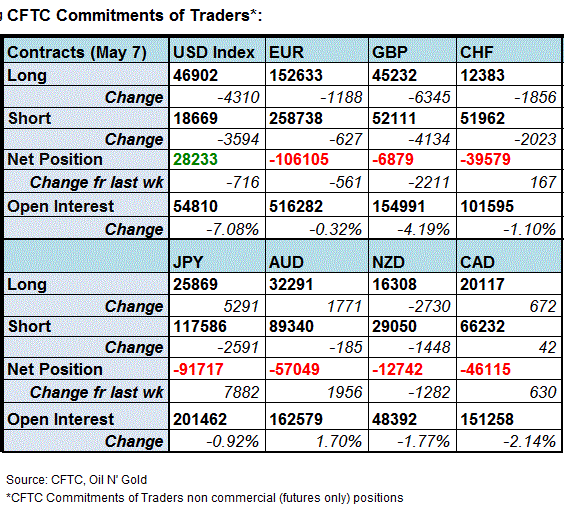
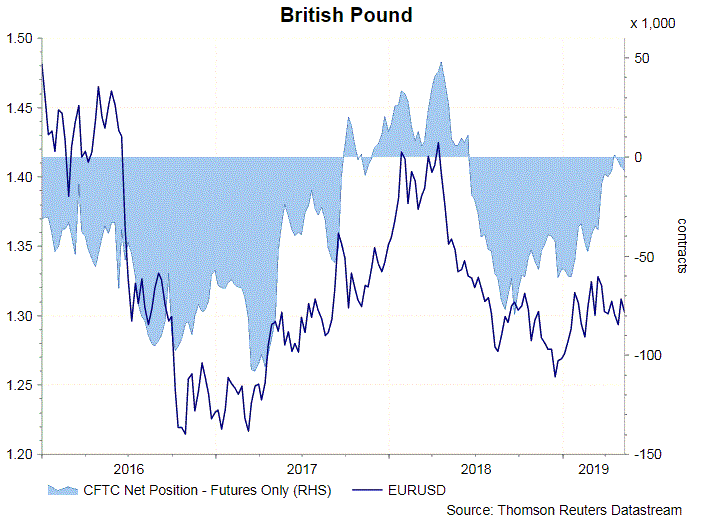
Concerning European currencies, NET SHORT for euro futures added +561 contracts to 106 105 with bets decreased on both sides. NET SHORT for GBP futures rose +2 211 contracts to 6 879. Speculative long positions fell -6 345 contracts while speculative shorts dropped -4 14 contracts for the week. 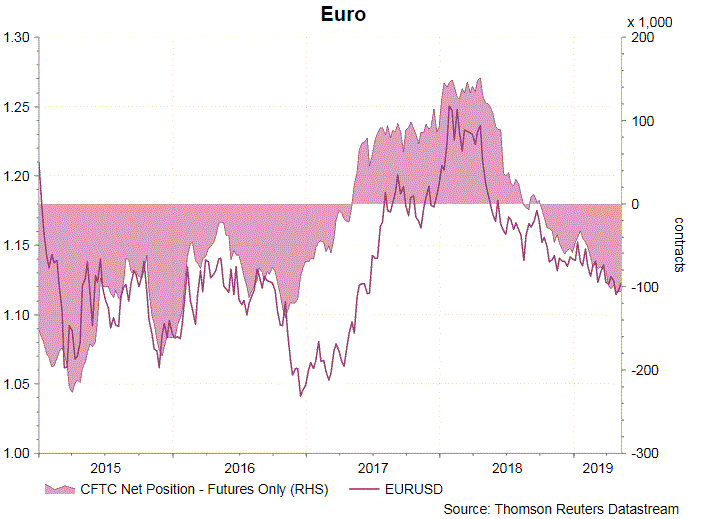
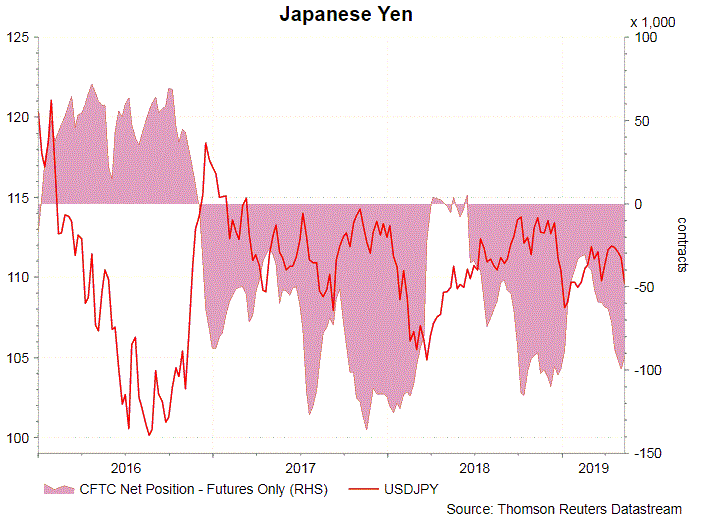
On safe-haven currencies, Net SHORT for CHF futures slipped -167 contracts to 39 579. NET SHORT for JPY futures plunged -7 882 contracts to 91 717 during the week. Speculative long positions rose +5 291 contracts while shorts fell -2 591 contracts. 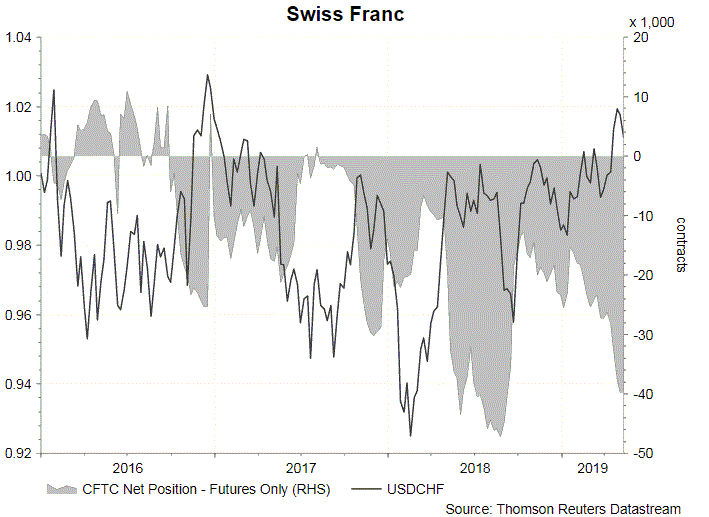
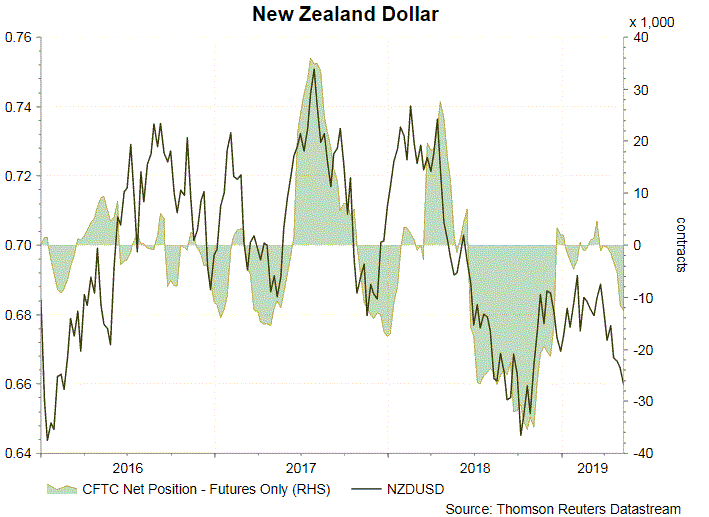
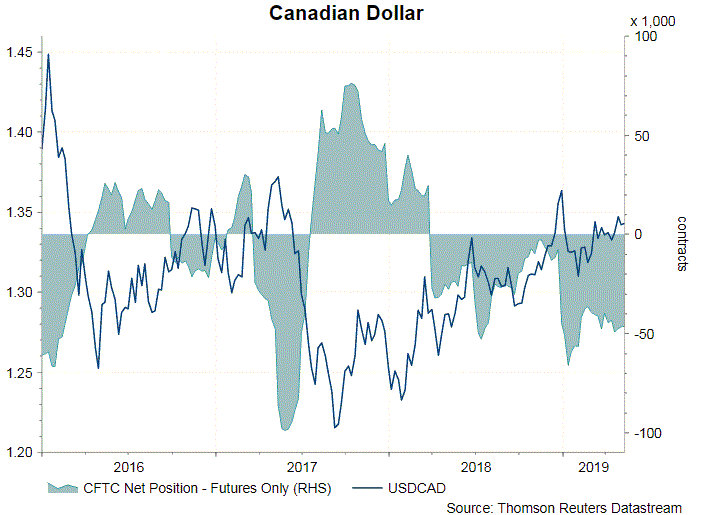
On commodity currencies . NET SHORT for AUD futures declined -1 956 contracts to 57 049. Speculative long positions gained +1 771 contracts while shorts dropped -185 contracts. RBA's inaction in its monetary policy in May helped curbing Aussie's weakness. Separately, NET SHORT for NZD rose to 12 742 contracts last week, with speculative long dropping -2 730 and shorts down -1 448 contracts. NET SHORT for CAD futures dropped -630 contracts to 46 115. 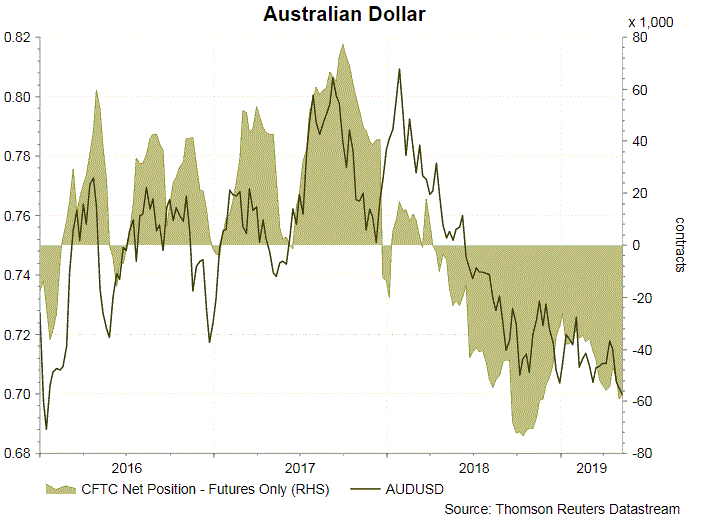
EUR/USD Sighting Larger Recovery Above 1.1280
Key Highlights
- The Euro found support near 1.1175 and corrected higher against the US Dollar.
- A major bullish trend line is forming with support at 1.1195 on the 4-hours chart of EUR/USD.
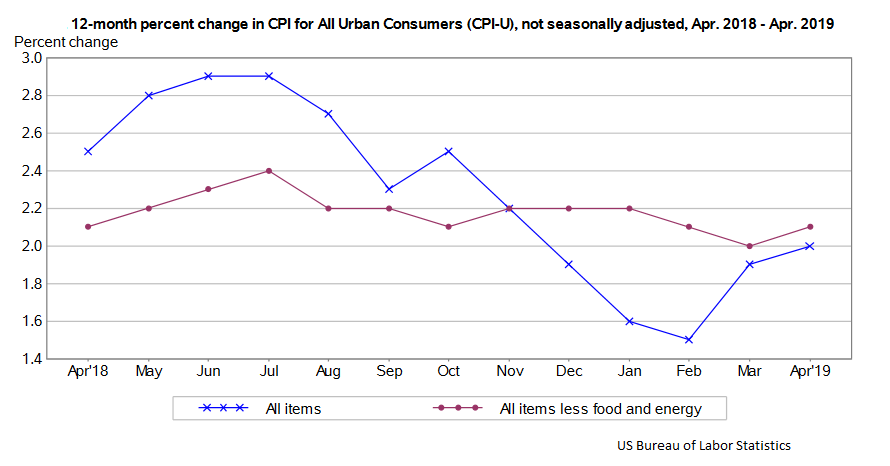
- The US CPI in April 2019 increased 2.0% (YoY), less than the +2.1% forecast.
- Canada's unemployment rate declined from 5.8% to 5.7% in April 2019.
EURUSD Technical Analysis
After trading as low as 1.1135, the Euro started a steady rebound against the US Dollar. The EUR/USD pair broke the 1.1175 and 1.1200 resistance levels to move into a short term positive trend.
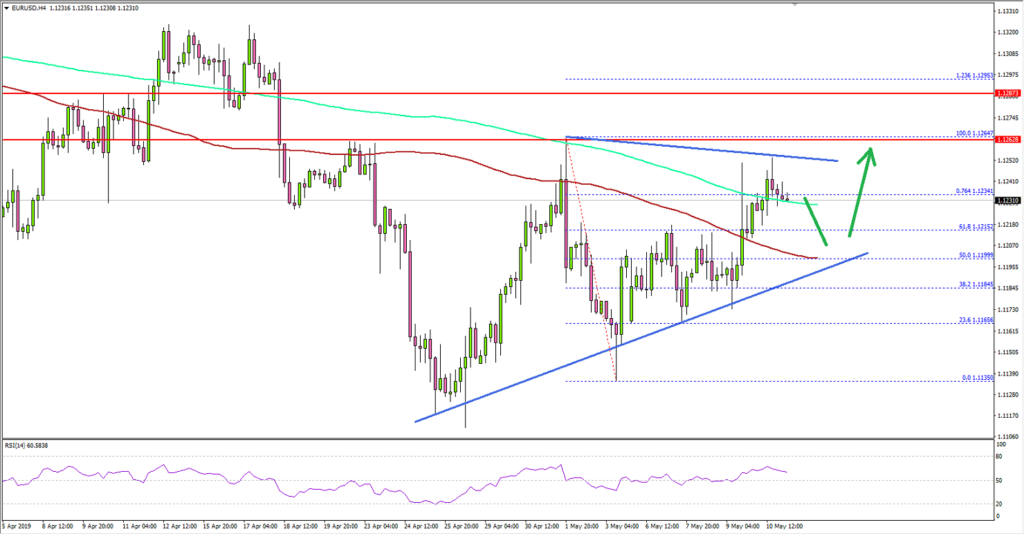
Looking at the 4-hours chart, the pair formed a strong support near the 1.1175 and 1.1180 levels. As a result, there was an upside break above the 1.1215 resistance, plus the 50% Fib retracement level of the major drop from the 1.1264 high to 1.1135 low.
The pair settled above the 1.1200 level and the 100 simple moving average (4-hours, red). It opened the doors for more gains above the 1.1230 level and the 61.8% Fib retracement level of the major drop from the 1.1264 high to 1.1135 low.
On the upside, the main resistance is near the 1.1260 and 1.1265 levels. If there is an upside break above the 1.1264 swing high, there are chances of a larger recovery towards the 1.1280, 1.1300 and 1.1320 levels.
On the downside, there is a strong support forming near the 1.1200 level. There is also a major bullish trend line in place with support at 1.1195 on the same chart. If there is a daily close below the trend line and 1.1180 support, the pair could move back in a bearish zone.
Fundamentally, the US Consumer Price Index for April 2019 was released by the US Bureau of Labor Statistics. The market was looking for a 2.1% rise in the CPI, compared with the same month a year ago.
However, the actual result was below the forecast, as the UP CPI increased 2.0%, but it was above the last 1.9%. Looking at the monthly change, it came in at 0.3%, down from the last 0.4%.
The report added:
The index for all items less food and energy increased 0.1 percent for the third consecutive month. The indexes for shelter, medical care, education, and new vehicles all rose in April. The indexes for used cars and trucks, apparel, and household furnishings and operations were among those that declined over the month.
Overall, EUR/USD could continue to recover in the short term, but pairs like AUD/USD and GBP/USD declined below key support levels recently and are trading in a bearish zone.
Economic Releases to Watch Today
Japan's Trade Balance March 2019 – Forecast ¥317.3B, versus ¥489.2B previous.
Japan's Current Account March 2019 – Forecast ¥2,679.0B, versus ¥2,676.0B previous.
Trump: Dreaming China hoping for sleepy Biden for trade negotiations
US-China negotiation ended last week with no progress but only indications that the deadlock will continue. Trump continued his hard stance with his tweets on Sunday. He said the US is "right where we want to be with China". And he criticized again that China "broke the deal with us & tried to renegotiate".
And the US is taking in "Tens of Billions of Dollars in Tariffs". He reiterated that the tariffs collected could be spend on "Great Patriot Farmers" and "distribute the food to starving people" in other nations.
Later, Trump also reiterated the conspiracy he created by his own. He said "China is DREAMING that Sleepy Joe Biden, or any of the others, gets elected in 2020. They LOVE ripping off America!"
On the other hand, the People's Daily, China's propaganda media, repeated that "at no time will China forfeit the country's respect, and no one should expect China to swallow bitter fruit that harms its core interests." This too, indicates that China is in no position to back down and rectify its own faults.
https://twitter.com/realDonaldTrump/status/1127715742898692097
https://twitter.com/realDonaldTrump/status/1127681373966409730
US-China Trade: Talks End In Washington With Signs Of Deadlock
- The US-China trade talks in Washington ended on Friday with what looks like a deadlock. The two sides both sent signals of cautious optimism but the underlying development suggests a bigger crisis in the negotiations.
- The trade teams have agreed to meet again in Beijing but not when. The US has given China a month to make concessions or otherwise face tariffs on all imports. In this case the tariffs could come into force in early August.
- We see an increasing risk that the trade talks drag out into H2 and that it will get worse before it gets better, see also China Weekly Letter – Chicken game is back on, 10 May 2019
Signals of cautious optimism after talks in Washington…
First the cautious optimism: US Treasury Secretary Stephen Mnuchin saying talks had been ‘constructive’ and China’s top negotiator Vice Premier Liu He said it went ‘fairly well’. Trump tweeted later that the conversations had been ‘candid and constructive’ and that ‘the relationship between President Xi and myself remains a very strong one, and conversations into the future will continue. In the meantime, the United States has imposed Tariffs on China, which may or may not be removed depending on what happens with respect to future negotiations’. The moderately positive signals led to a rebound in equity markets and strengthened the belief that maybe things are not so bad after all.
… but actual developments reveal a bigger crisis in the talks
However, the actual developments suggest something different and that the two sides were trying to play down the real difficulty of the situation in order not to stir up too much concern. Here is what we know happened during the two days based on media reports.
- The talks on Thursday were very short. They lasted for only one and a half hours and sources close to the negotiations said there was little to no movement. The sources said that China’s top negotiator Liu He had delivered the message that China was not willing to give the concessions the US wanted.
- On Friday 12:01am US tariffs come into force and China immediately vows retaliation.
- On Friday morning Trump launched a series of tweets among other things saying that the US is in no rush to make a deal and that the US economy will speed up while China’s economy will greatly slow down. He also stated the ‘the process has begun to place additional 25% on the remaining USD325 billion dollars’ (for some reason, the tweets were removed for a short period and then put back on).
- Trade talks continued on Friday but again lasted for only one and a half hours. The Chinese trade team leaves on a flight out of Washington at 4pm. The two sides agree to keep negotiating and meet in Beijing but with no set date.
- Supposedly the US gives China a month to make a deal or they will start the process of taxing the rest of imports from China, see Bloomberg, 10 May.
- After returning to China, Liu He for the first time revealed some of the sticking points in the negotiations in an interview with the national television CCTV where he spoke in an unusually frank manner, see Reuters 11 May and SCMP 11 May: 'Right now, both sides have reached mutual understanding in many things, but frankly speaking, there are also differences. We think these differences are significant issues of principle... We are very clear we cannot make concessions on matters of principle. We hope our US colleagues understand this' [our highlight].
On the key differences between the two sides he mentioned three points: 'China believes tariffs are the starting point of the bilateral trade disputes. If a deal is to be reached, the tariffs should all be eliminated. This is the first point.'
The second point regarded the size of Chinese purchases of US goods where an initial agreement was reached in Argentina in December but where the two sides according to Liu now have differing views on the volumes.
The third point was over how balanced the text of the draft agreement should be. 'Every nation has its’ dignity, so the text ought to be balanced'. Liu He also denied that China had reneged on promises saying it was normal to make changes before a final deal. Both sides had differing views on how to phrase it, he said. He expressed hope the issue could be resolved so it was unnecessary to 'overreact'.
Why things are getting tough again
While it is positive that the two sides express a desire to continue negotiations and view the talks as 'constructive' the fact that the two days only had 1½ hours of talks on each day is a sign that there was no movement on the Chinese side and that throwing tariffs at China is not making it easier for China to make concessions.
Although Liu He also expressed optimism that a deal would be reached, the interview suggests that there are some crucial differences between the two sides and some red lines for China that they will not cross.
The most important one is most likely the issue of whether Chinese law has to be changed. This seems to be what Liu He refers to when it comes to not making concessions on 'matters of principle'. Changing Chinese laws is not a straightforward thing and forcing China to do it would be felt as a loss of sovereignty and loss of dignity. The so-called unequal trade treaties from the period of the Opium Wars in the 19th century also play a role here. A Chinese concession to change its laws would be viewed domestically as China bowing to US bullying. An opinion in Global Times, the most nationalistic state media, said that 'China has always promoted trade negotiations with the US with highly responsible attitudes and utmost sincerity. But China will never yield to the US' extreme pressure and will never compromise on issues concerning the country's principles.'
However, for the US side it is seen as a fundamental issue because the US doesn’t trust China to live up to the agreement and sees implementation into Chinese law as a requirement for a deal. The risk is that China does not move enough and that the US takes the decision to go all in and put tariffs on all Chinese goods to use maximum pressure. This could be the last straw that broke the camels back and triggered a consumer boycott of US goods in China. Some Chinese netizens have already turned to social media to ask whether the Chinese should not just start boycotting US goods?
If the US starts the process of putting on tariffs on the rest of Chinese goods it will take around two months from the formal announcement. Since the US team has indicated it will wait a month with starting the process to see if China makes concessions, the earliest the tariffs could come into force would likely be three months from now. That takes us to early August.
Rising probability a deal drags out into H2
The concern is that the further escalation we have, the more hard liners seem to gain ground on both sides and the more nationalistic views get strengthened in both countries. Which makes it harder to make a deal.
Ultimately we do believe in a deal as the alternative of continued escalation is too painful. But the path to a deal is now be more difficult than is currently acknowledged in markets. We now see a rising probability that we will get into H2 before a deal is done and that we get more escalation before it is done. There is a rising risk that the only thing that will get serious talks going again is more pain in financial markets and the respective economies that adds the needed pressure to get the deal done.
Daily Markets Broadcast
Wall Street retreats as additional tariffs imposed
Wall Street looks set to give back Friday’s surprising gains today, with early trading pushing US indices into the red. Trump hiked tariff rates to 25% on $200 billion worth of Chinese goods, considers hikes on another $325 billion. China has yet to respond with the retaliatory measures it has promised.
US30USD Daily Chart
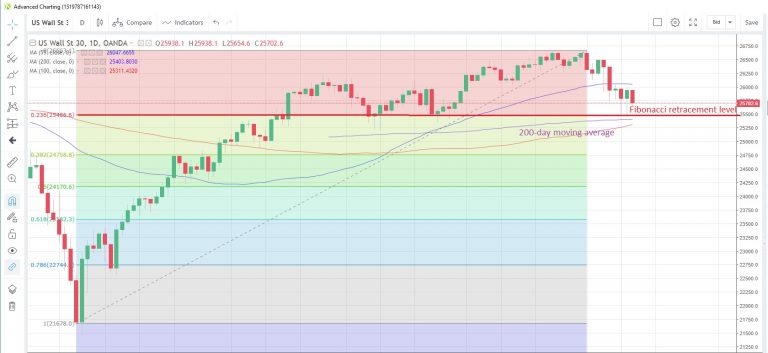
The US30 index has already given back Friday’s gains in early trading, as the uncertainty surrounding US-China trade negotiations impacts
The index is still above the 23.6% Fibonacci retracement of the December-May rally at 25,486, with the 200-day moving average at 25,403 below
Despite the latest tariff increase, China has invited US trade representative Lighthizer and Trade Secretary Mnuchin to China to continue trade talks. There are no data releases scheduled for today.
DE30EUR Daily Chart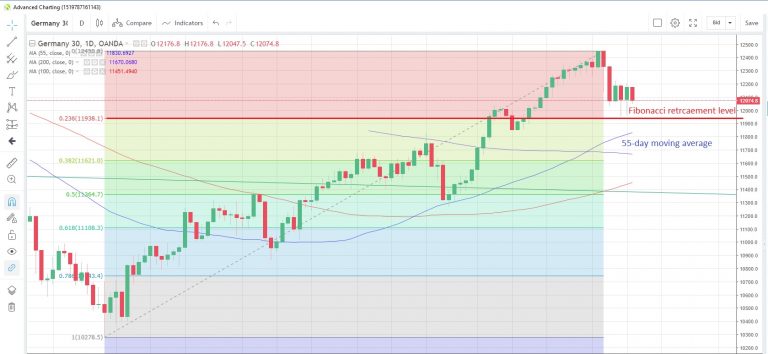
The Germany30 index also looks poised to give back Friday’s gains, trading in the red so far today
The index is still holding above the 23.6% Fibonacci retracement of the rally since December at 11,938
Germany’s trade surplus jumped to EUR20 billion in March, the highest in 10 months, beating economists’ estimates of a decline to EUR18.2 billion. There are no German or Euro-zone data releases scheduled for today.
CN50USD Daily Chart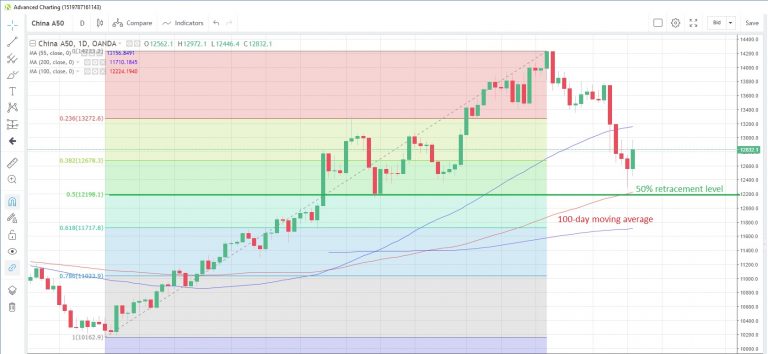
The China50 index snapped a four-day losing streak on Friday, despite Trump’s imposition of additional tariffs on Chinese goods. Looking at the moves in other indices, those gains could well be eroded at the open today
The index rebounded from a two-month low, with the convergence area of the 100-day moving average at 12,224 and the 50% retracement level of the 2019 rally at 12,198 remaining unbreached.
China is due to publish Foreign Direct Investment data for April today. Investment flows grew 6.5% y/y year-to-date in March.
First impressions: Australia March Housing Finance Approvals
Australia: number of owner occupier housing finance approvals ex refi down 2.8%, value of investor loan approvals ex refi down 2.7%.
Housing finance approvals weakened again in March more than reversing a modest gain in Feb, the update weaker than expected.
The total number of owner occupier loan approvals ex refi declined 2.8%mth vs consensus forecasts of a 0.5% decline. That followed a 0.5% rise in Feb and sharp declines over the second half of 2018, monthly moves running at –1.5%. Whereas the Feb report had suggested markets were finding a base, the March update clearly undermines that view. Approvals are down 13.8%yr and despite the Feb improvement have continued to trace a 13% annualised pace of decline over the first three months of the year.
The value of investor loans ex refi fell 1.5%mth, coming off a 0.9% decline in Feb, weak though an improvement on the average declines of 3.6%mth over the previous six months.
The combined total value of housing finance approvals across both owner occupier and investor segments (and excluding refi) fell 3.2%mth, more than reversing a 2% gain in Feb to be down 18.4%yr.
Overall, the March update was disappointing given the improved tone from auction market activity and an apparent slowing in price declines in recent months. That said, monthly data can be very uneven so the moderation, if genuine, may take time to show through more clearly in the finance data.
Details:
Owner–occupiers (no.) -2.5%mth, -11.3%yr
– ex-financing (no.) -2.8%mth, -13.8%yr
Construction of dwellings (no.) 0.1%mth, -1.8%yr
Purchase of newly built dwellings (no.) -4.7%mth, -33.5%yr
Value of loans:
Owner-occupiers ($bn) -2.6%mth, -12.4%yr
Investors ($bn) -1.5%mth, -22.8%yr
Total ($bn) -2.3%mth, -15.5%yr
Total ex refi ($bn) -3.2%mth, -18.4%yr
EURGBP Looks To Extend Gain On Price Reversal
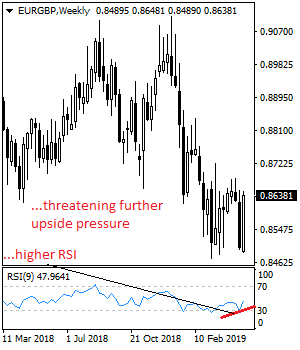
EURGBP looks to extend gain on price reversal following its strong rally the past week. On the downside, support stands at the 0.8600 level where a violation will turn focus to the 0.8550 level. A break below here will aim at the 0.8500 level. Conversely, resistance lies at the 0.8650 level. A violation if seen will turn risk towards the 0.8700 level. Further up, resistance comes in at 0.8750 level followed by the 0.8800 level. Its weekly RSI is bullish and pointing higher suggesting further upside pressure. All in all, EURGBP looks to extend gain on price reversal after its past week rally.
EURUSD Outlook Still Points Higher On Recovery
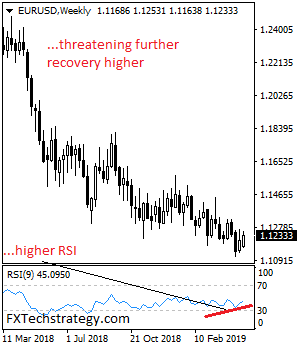
EURUSD outlook still points higher on recovery as we enter a new week. Support comes in at the 1.1200 where a violation will turn risk to the 1.1150 level. A break below here will target the 1.1100 level. Further down, support sits at the 1.1050. Conversely, on the upside, resistance resides at 1.1250 level with a break through there opening the door for further upside towards the 1.1.1300 level. Further up, resistance comes in at the 1.1350 level where a violation will expose the 1.1400 level. Its daily RSI is bullish and pointing higher suggesting more strength. All in all, EURUSD outlook still points higher on recovery.
Welcome To Your Delusion
Welcome to your delusion
That's certainly the feeling I had as Wall Street closed higher on Friday night. Financial markets are stubbornly refusing to reprice themselves to reflect the dangers of a populist world-trade agenda, led by the US as they hiked tariffs on USD200 billion of Chinese goods to 25% on Friday. Instead, the markets appear to be choosing hope disguised as optimism and refusing to believe the global bull market can end. Rallying on any crumbs of trade talk progress by the US President and his representatives, and burying their heads in the sand when the impending reality of a trade-war slowdown – as evidenced by the bond market all year – slaps them in the face.
The worst miscreants, of course, are the equity and oil markets, Equities, in particular, remain not too far off record highs and seem to be focusing on a possible Trump-Xi meeting at the upcoming G-20 meeting as a magical panacea to break the deadlock in each respective side's trade positions. The announcement that the US is “preparing the paperwork” for 25% tariffs on an additional USD325 billion of Chinese goods, or that China has stated it would prepare retaliatory measures, has been almost ignored due to the possibility of a handshake between the two world leaders. The saying goes that the market can remain irrational longer then you can stay solvent, and that certainly seems to be the case for now. A good dose of reality, should it ever bite on equity and energy markets, could be bitter medicine indeed.
On that theme, Wall Street enjoyed a positive Friday even though the much heralded Uber initial public offering (IPO) found surge pricing elusive, falling below its offer price on the first day of trading. The S&P rose 0.38%, the Nasdaq was up 0.08% and the Dow Jones jumped 0.45%. Bonds, gold and the dollar held steady, refusing to play the hope-versus-reality game championed by equities, although oil took the bait, with both contracts rising slightly on Friday.
US-China trade relations will continue centre stage this week with most other data and events relegated to a distant second place. China will no doubt announce retaliatory measures while the US may provide more concrete start dates for the newly-imposed tariffs. Markets can expect short-term whipsaw price action as the street hangs on every little comment emanating from Washington DC and Beijing. The data calendar has a mid-month look about it, with mostly tier-two releases backloaded to the second half of the week. Highlights will be Westpac Australian Consumer Confidence and China Retail Sales and Industrial Production on Wednesday, along with US Retail Sales.
Currencies
The dollar index finished almost flat on Friday with the Japanese yen continuing to outperform. Asian markets may well tentatively dip their toes in the water and unwind some of the last week's losses, as a quiet weekend on the Twitter front and a positive finish by Wall Street encourage the unwinding of long dollar positions.
That sentiment is very fragile however, and traders should be prepared for a rapid retreat back into dollars on any negative trade headlines.
Equities
China markets, unsurprisingly, were on the frontline of President Trump's tariff bombshells last week. With Wall Street closing in the green and much being made of a possible meeting between the two leaders at the upcoming G20. As such, China and by default the rest of Asia will likely start on a positive note. The lack of drama over the weekend has given Asia the chance to ignore reality, munch in the same way as Wall Street.
As with currencies, the recovery may be fragile though and will be vulnerable to headline bombs appearing on the news wires or social media.
Oil
Spot prices in both Brent and WTI enjoyed a gently positive day on Friday with choppy intra-day trading. Brent Crude rose 0.70% to USD71.10 a barrel and WTI rose to 0.30% to USD61.30 a barrel. Over the past week, both contracts appear to be tracing out consolidative patterns of their longer-term gains. This is tempered by the amount of geopolitical optimism built into the prices of both contracts at these levels. A sudden dose of trade-war reality could see a rapid repricing of oil lower.
Gold
Gold closed almost flat at USD1,285.00 an ounce on Friday, supported by safe-haven flows ahead of the weekend with gains offset by a strong dollar. The net effect is the yellow metal continues to be marooned in the USD1,280.00-1,290.00 an ounce regions, lacking the momentum to break out, one way or the other. Unfortunately, the situation is unlikely to change this week either.