Sample Category Title
China Weekly Letter – Chicken Game is Back On
- Six months of progress in trade talks have ended abruptly. There is now a clear risk that a deal will not be reached until H2 and a period of financial stress will be needed to get us there.
- CNY took a big hit this week and weakening pressure is set to persist short term.
- More data for April disappointed, confirming that key figures for March were too good to be true. The outlook is blurred by renewed trade tensions.
More tariffs set to restart the trade war
Our call last week that a trade deal was just around the corner turned out to be far too brave. Here is what we know happened over the past week based on media reports: The US trade team became angry over China backtracking on parts of the deal that the US saw as crucial. When China sent a revised draft deal on Friday evening (last week) with many changes, it triggered anger on the US side. Among other things, China declined to implement changes into Chinese law and Chinese Vice-Premier Liu He urged that the US trusted that China implement the particular elements through changes of regulation and administrative procedures. After the US trade representative had briefed Donald Trump on the revisions, a decision was taken to implement the tariffs to put pressure on China.
US Treasury Secretary Stephen Mnuchin said at a press conference that the tariffs would be implemented unless China offered concessions at planned talks on Thursday. However, following 1.5 hours of talks on Thursday night, the two sides separated and sources close to the talks said there was little to no progress. At 00:01 on Friday, the tariff increase from 10% to 25% on USD200bn of Chinese goods came into force. At 00.03, a Chinese spokesman from the Commerce Ministry said China deeply regretted the move and that China was forced to retaliate (see also China Notes - US hikes tariffs leaving high uncertainty in place , 10 May).
On Friday morning, Trump posted a long tweet threat saying the process has begun to place additional tariffs at 25% on the remaining USD325bn. In addition, he boasted how 'China would greatly slow down and we would automatically speed up!'. However, he deleted the tweet threat and then put it back on except the last bit about China greatly slowing down - until an hour later when he added that bit back too. In another tweet , he wrote 'This is not the Obama Administration, or the Administration of Sleepy Joe, who let China get away with 'murder!''.
Comment: The situation is getting very tricky because the hawks are strengthened on both sides and Trump is clearly escalating with his rhetoric on China (this will be seen as a humiliation) and starting the process of adding tariffs on the rest of Chinese imports . Our best guess is that talks will come to a halt and that the US and China could go into a war of attrition. On the US side, the hawks are now in the driver's seat , as they have a stronger case, saying that China cannot be trusted after it changed what the US viewed as a solid agreement. They may insist even more that Chinese laws change.
The Chinese side will find it harder to give concessions after Trump just raised tariffs and announced more is coming on the rest of Chinese exports. It would leave the impression the US can bully China into concessions. In addition, changing Chinese laws due to US pressure would be déjà vu to the Opium Wars in the 19th century, which resulted in China being forced into humiliating trade treaties with Western powers that violated Chinese sovereignty.
There is clear risk we need to see more pain from the trade war on both sides before serious talks are resumed and we may very well need to get into H2 before we reach a deal. Another bout of financial stress and economic damage may be needed to push Trump into a new attempt of reaching a deal. A new game of chicken could have started, which takes us closer to the brink of an all-out trade war. China may believe it has time on its side because Trump is heading into an election campaign and that Trump underestimates the pain that will be inflicted on the US economy by a full-blown trade war. If Trump carries out the tariffs on the rest of imports from China, Chinese consumers may react by boycotting US products. Businesses would feel more pain and question Trump’s strategy for getting concessions out of China even more.
USD/CNY moving sharply higher, risk of a further increase
The trade war escalation has led to a sharp weakening of the CNY, as the case for more monetary easing is increasing. Companies are probably also increasing their hedges of CNY income. The USD/CNH has increased more than USD/CNY, which is typically a sign that a lot of short selling and hedging is going on.
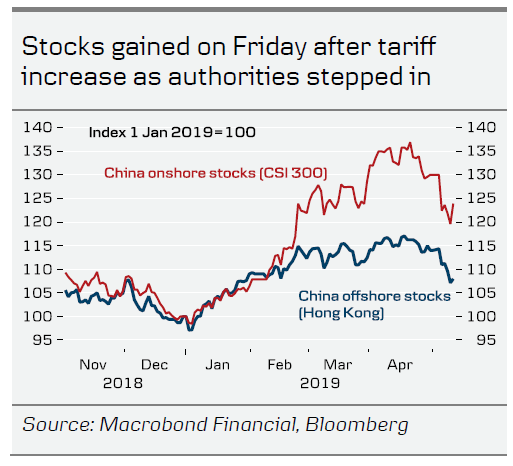
The Chinese stock market sold off this week and was under pressure following the tariff increase. However, equities turned around quickly, as authorities were said to support the market. Chinese stocks finished up 3.6% on Friday.
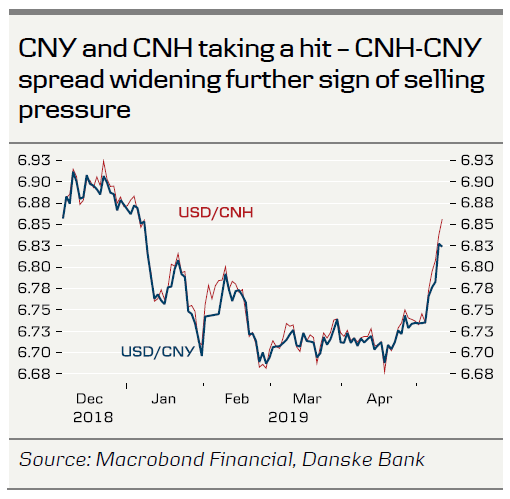
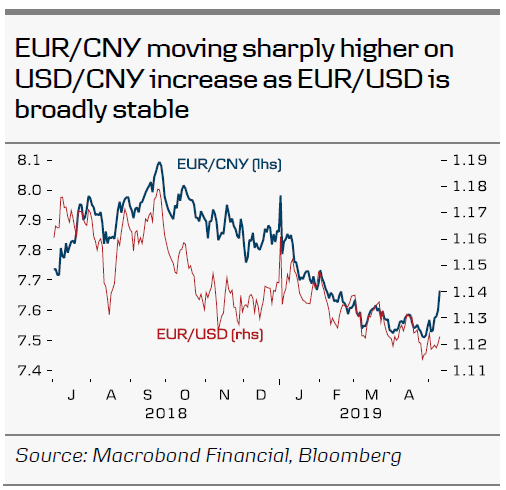
Comment: The fear of an all-out trade war is becoming visible in the currency market. With the risk that things in the trade talks get worse from here, we see scope for a further increase in USD/CNY in the short term. We intend to update our forecasts next week.
Although Chinese stocks have fallen a lot this week, we see a risk of further declines if trade talks derail.
Data for April disappoints across the board
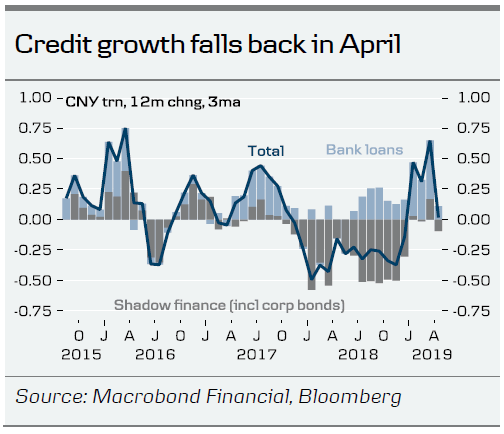
More data for April undershot expectations this week. Credit growth fell back in April after a very strong Q1. Money growth (M1) slipped back to 2.9% y/y from 4.6% y/y but is still up from the lows in January. Export growth fell back into negative territory at -2.7% y/y, down from 13.8% y/y in April. Metal prices slid further over the week as trade war tensions increased.
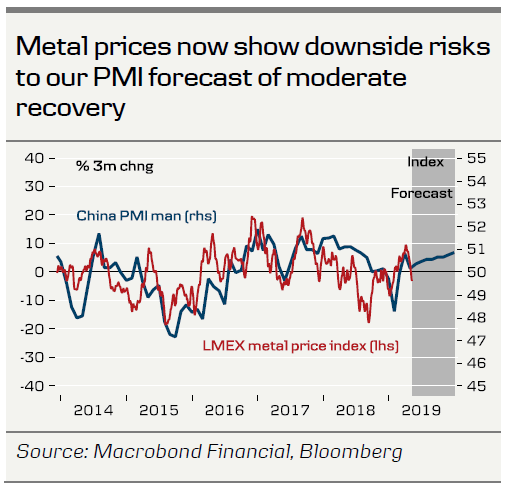
Comment: The setback in April was to be expected after very strong March data, so we are not too concerned about it. However, the escalation of the trade war is worrying. Unless things calm down quick, which is hard to see right now, then we should expect China to announce more easing measures soon – both a cut in the reserve requirement ratio and measures to lift consumption. We now see downside risks to the short-term picture in China, as uncertainty has gone up and companies and consumers will be reluctant to spend with the threat of 25% tariffs on all Chinese exports hanging in the air.
Euro Advances to New Weekly High after Weak US CPI
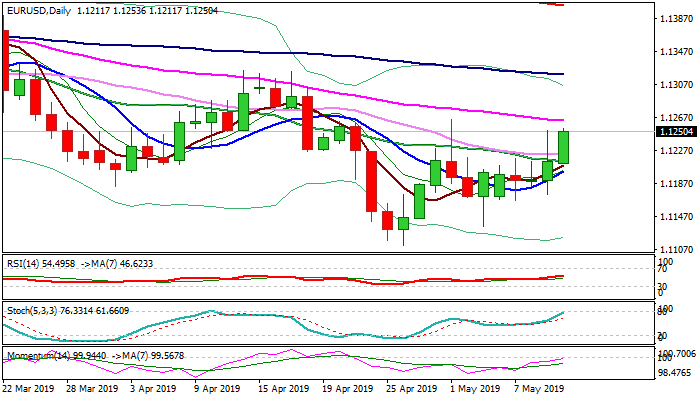
The Euro hits new weekly high following rally after weaker than expected US inflation data pushed dollar lower.
The single currency maintains bullish bias, despite Thursday’s strong upside rejection and is on track for the second consecutive weekly close in green.
Fresh advance probes again above important double-Fibo barrier at 1.1240/42 (38.2% of 1.1448/1.1111 / 61.8% of 1.1323/1.1111) and close above these levels will provide strong bullish signal for extension towards 1.1263 (55SMA) and 1.1283 (daily cloud base).
Rising momentum is about to break into positive territory and 5/10 SMA’s turned north, supporting the notion.
Markets will focus on the outcome of US/China trade talks for fresh signals.
Res: 1.1263; 1.1283; 1.1303; 1.1323
Sup: 1.1242; 1.1223; 1.1213; 1.1201
Week Ahead – US Retail Sales, Aussie Jobs, Chinese Industrial Output to Stand Out in Quiet Week
With market anxiety heightened about the direction of the US-China trade talks, economic data might struggle to distract traders next week given the shortage of top-tier releases. Still, there will be several major indicators that investors should keep an eye on, including Australian employment and wage figures, Chinese industrial output and retail sales readings, revised GDP estimates from the Eurozone, the UK jobs report and retail sales numbers out of the United States.
Australian jobs stats could be key for rate clues
The Reserve Bank of Australia held its cash rate unchanged at its policy meeting in the past week but signalled it will be keeping a very close watch on the labour market to assess whether a rate cut will be needed at one of its upcoming meetings. This means the April employment report, due on Thursday, will probably attract more attention than usual, but just as important will be the quarterly wage growth figures out a day earlier. Australia’s wage price index is expected to remain unchanged at 2.3% year-on-year in the first quarter. A weaker number would add pressure on the RBA to lower borrowing costs soon. However, if jobs growth continues to hold up – forecasts are for a gain of 14k positions in April – there would not be the urgency for the RBA to act early.
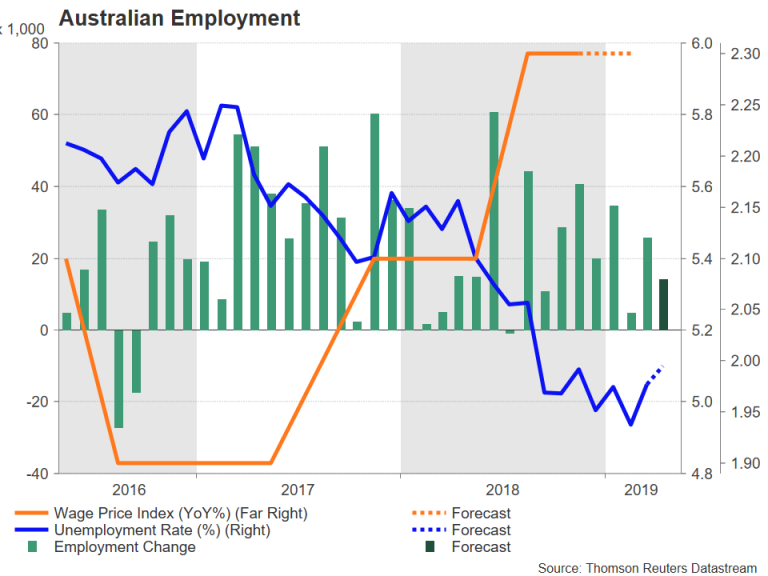
The Australian dollar, which is currently wallowing near 4-month lows, could extend its losses if next week’s labour market indicators are on the soft side. Politics could also influence the aussie next week as Australians go to the polls on May 18 for federal elections. The opposition Labour party are currently ahead in the polls but the race is tightening. The aussie could appreciate slightly if the polls change in favour of the incumbent coalition government led by Scott Morrison, who is promising bigger tax cuts.
Chinese data to be overshadowed by re-emerging trade tensions
A month ago, industrial output figures for March, which were published alongside the upbeat first quarter GDP print, caused much cheer in the markets as they pointed to a strong rebound in growth. That’s not looking to be the case for the April release coming up on Wednesday as apart from apparent signs that the March bounce back might have been a blip, trade frictions have returned, cutting short the market optimism.
Industrial output is expected to ease from the 8.5% y/y surge seen in March to 6.5% in April. Investment in urban areas is forecast to remain unchanged at 6.3% y/y in the year to April, while growth in retail sales is projected to moderate slightly to 8.6% y/y.
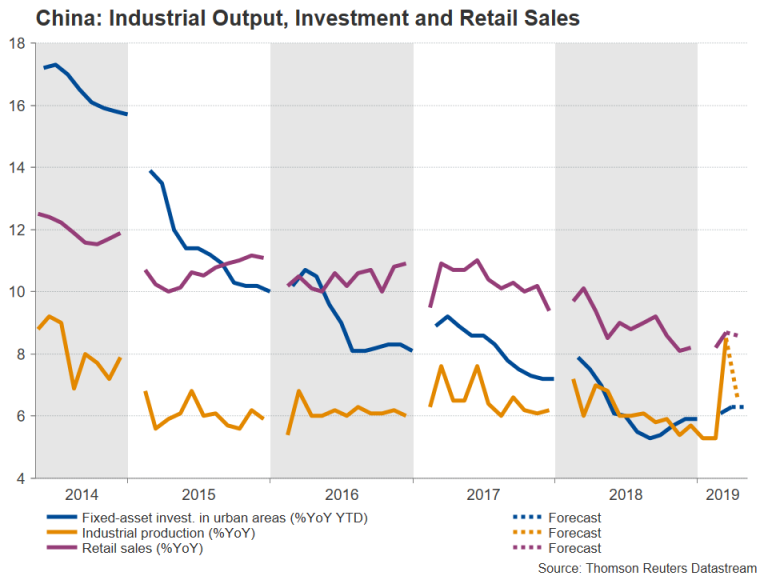
If industrial and retail activity slow by more than expected, it would raise fresh concerns about the growth outlook not just in China but globally as well, especially as a trade deal between the US and China is now in doubt. Investors will be hoping that American and Chinese negotiators will be able to get the talks back on track following this week’s setback. And while a complete breakdown in talks is looking less likely, it remains a real possibility and has the potential to deal a much bigger blow for risk assets than currently seen, in particular, for equities and the China-sensitive Australian dollar.
Eurozone calendar unlikely to provide much direction for euro
As China scrambles to prevent the trade talks from collapsing, European Union officials will be monitoring developments carefully as not only would higher tariffs hurt the Eurozone economy indirectly, but an ever-elusive deal would not bode well for EU-US negotiations, which have yet to formally start. A protracted trade war poses a danger to the Eurozone’s feeble economic recovery.
Growth in the euro area unexpectedly doubled to 0.4% quarter-on-quarter in the first three months of the year according to the preliminary reading. The second estimate of GDP growth, due on Wednesday, is anticipated to confirm this pace. Inflation figures are also expected to remain unrevised. The headline rate of CPI jumped to 1.7% in the flash estimate for April, which was the highest since November 2018. No change is forecast to the final reading out on Friday. Other Eurozone data to look at will be March industrial production on Monday and first quarter employment numbers on Wednesday.
A more forward-looking indicator to watch, though, will be the German ZEW economic sentiment gauge on Tuesday. The index has been steadily recovering from 6-year lows hit in 2018 but remains far below previous peaks, underlining the cautious mood among export-orientated German businesses. Economic sentiment is forecast to improve further in May, rising to 5.0.
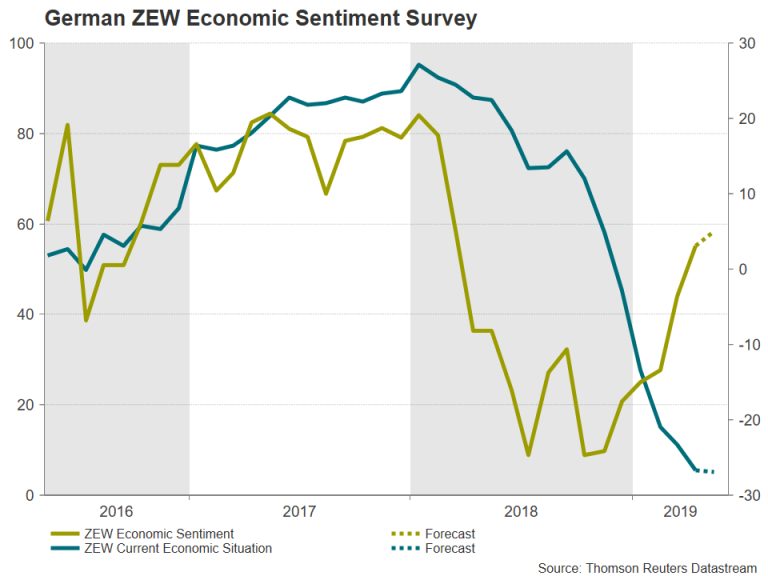
While next week’s data are unlikely to be enough to break the euro outside of its recent tight range against the US dollar, they could provide a modest boost if they support the view of a slowly improving economic picture.
UK to publish jobs numbers; Brexit talks continue
The only highlight for the pound next week will be the latest labour market report due on Tuesday. The UK jobs market has been fairly resilient even though economic growth has slowed notably from the ongoing Brexit uncertainty. Employment continues to expand at a healthy rate, lifting average earnings. Wage growth in the UK is currently at a 10-year high, which is good news for consumers who have been the main drivers of the British economy amid weakening overseas demand and falling business investment from Brexit.
If that trend is maintained in March, the pound might just be able to hold on to the $1.30 handle. Growing doubts about whether the cross-party talks aimed at breaking the Brexit deadlock will yield any results pushed cable to more than one-week lows this week, briefly dragging it below 1.30. Those loses could be more substantial should the opposition leader, Jeremy Corbyn, call off talks with Theresa May in the coming days, throwing the Brexit process into fresh turmoil.
US retail sales to cool after March surge
Over in the US, it will be a relatively busier week for data, but apart from retail sales, there may not be much else to excite the markets. The week will not really kick off until Wednesday when there will be a barrage of releases. Manufacturing activity will be in focus as the Empire State manufacturing index for May and industrial output figures for April are out. But most of the attention will fall on the retail sales report.
After soaring by 1.6% in March, retail sales are forecast to have risen by a more moderate 0.2% month-on-month rate in April. With consumption making up about 68% of US GDP, a negative surprise in the retail sales data would not do the US dollar any favours, especially now that investors have started to once again raise their expectations of a Fed rate cut by year-end as a US-China trade deal hangs in the balance.
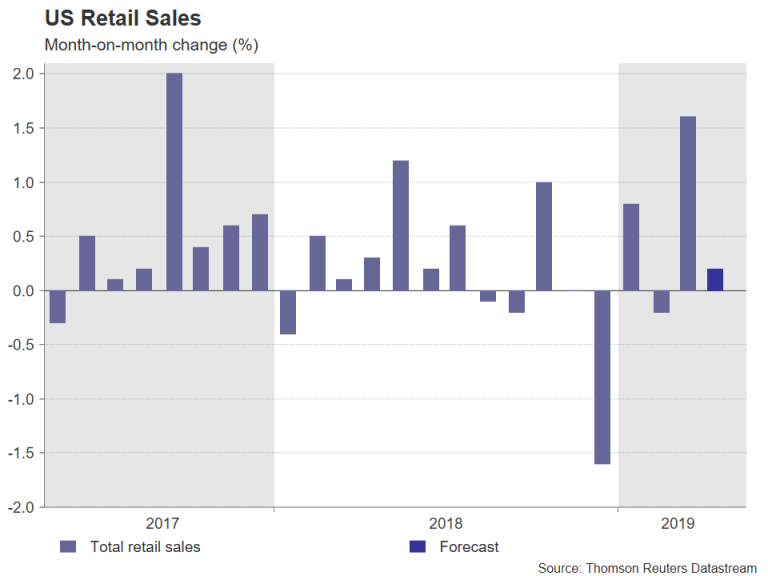
On Thursday and Friday, there will be more business surveys for May with the release of the Philly Fed manufacturing index and the University of Michigan’s preliminary print of the consumer sentiment index, respectively. Housing figures will also be under the spotlight; building permits and housing starts for April are both out on Thursday.
Loonie eyes Canadian inflation
North of the border, the main focal point for the Canadian dollar will be the April inflation numbers. The headline CPI rate jumped to 1.9% in March, while underlying measures of inflation also ticked higher. Further strength in consumer prices in April would certainly catch the attention of the Bank of Canada, which has not ruled out resuming its rate hike cycle, contrary to what the markets think. Investors are pricing in about a 50% probability of a rate cut before the year is out despite the bullish oil market and a neutral BoC. This suggests the loonie has room to move significantly in either direction should the incoming data support a rate cut or take it off the table.
Weekly Focus: Trade Heat is On – Bumpy Road Ahead
Market movers ahead
- We are set to get some information on the solid Q1 euro area GDP-growth. We expect to see durable domestic demand. March industrial production also ticks in along with the May ZEW index. We will be looking to see whether recent rising expectations have rubbed off on current conditions.
- In China, focus will continue to be on the trade talks. However, we will also look out for the April industrial production, retail sales and fixed asset investments.
- In Sweden, inflation will take centre stage. Our forecast for CPIF excluding energy is in line with the Riksbank's at 1.6% y/y.
- We are due to receive GDP figures out of Norway and Denmark. We expect the Norwegian figures to disappoint, with growth at 0.4% at the most. In Denmark, 0.4% growth is still solid and this is exactly what we expect for q1.
Weekly wrap-up
- The overriding theme this week was the U-turn in the US-China trade talks. We see a clear risk things will get worse before they get better but our baseline scenario is still a deal by the end of Q2, as further escalation would hurt both sides significantly.
- The EU Commission downgraded its growth projections for the euro area, especially on the back of a gloomier outlook for Germany.
- In the UK, pressure is mounting on Prime Minister Theresa May to resign after the Conservatives suffered a heavy defeat at the local elections.
- US and German 10-year yields have fallen again on the renewed uncertainty, as the downside risk to growth and inflation has increased.
Elliott Wave Analysis: USD/CHF Aims Higher After A Correction; AUD/NZD Expecting a Minor Consolidation
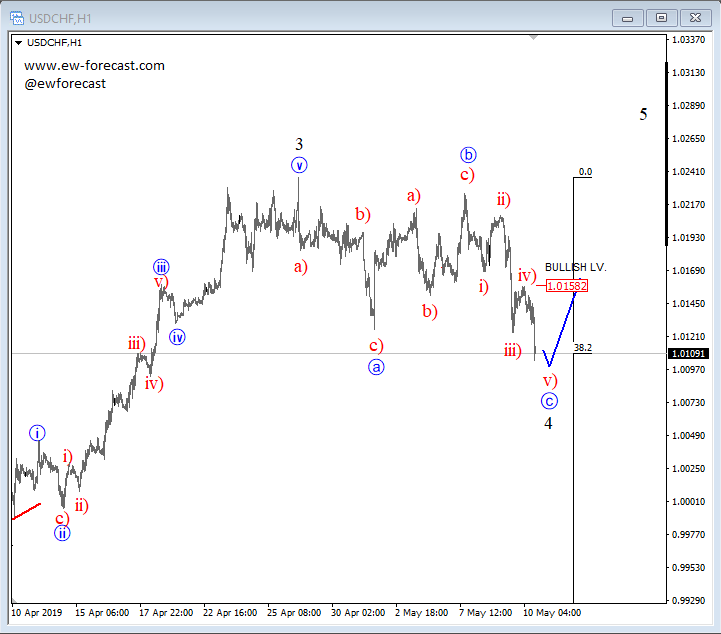
USDCHF just came into an important support area for wave 4 around ideal 38,2% Fibo. retracement and clearly with a three-wave a-b-c corrective decline. But, only if we see a strong bounce back above 1.0160 region, only then we may consider a completed correction and ongoing bullish continuation for wave 5.
USDCHF, 1h
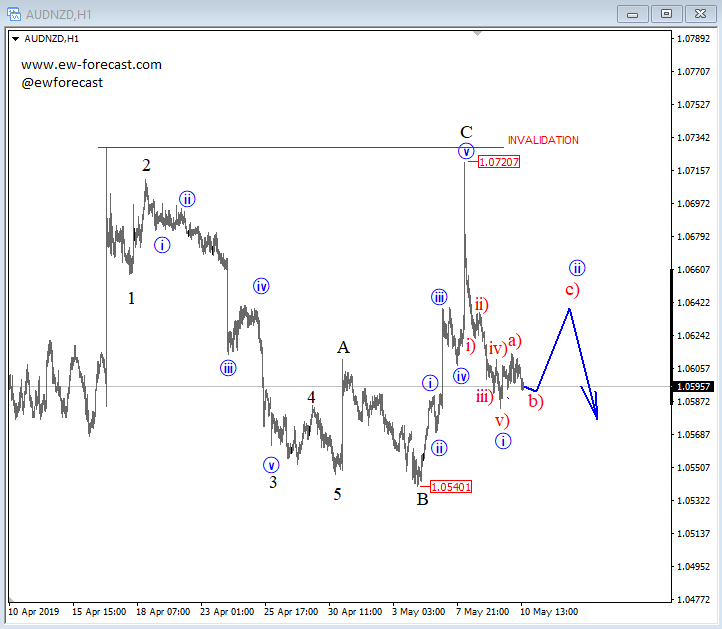
AUDNZD slowed down after a five-wave drop, so watch out for a bigger three-wave a)-b)-c) recovery into a potential wave »ii« before a bearish continuation back to the lows. Invalidation level remains at 1.0720.
AUDNZD, 1h
Sunset Market Commentary
Markets
Global core bonds are losing ground today. The US proceeded to raise tariffs on Chinese imports this morning, but the risk-off sentiment of late stabilized overnight. Asian equities were mixed with Chinese indices outperforming as investors remain hopeful that the US and China will eventually agree to some sort of a deal. That wasn’t enough to convince German Bunds as they traded with an upward bias overnight. EU equities jumped higher at opening while ECB’s Hansson sees no need to rush to add stimulus as he foresees that the EMU economic slowdown might finally be passing. German Bunds edged lower, with weak industrial production data in France and Italy having little to no impact. The German yield curve is moving higher with gains up to +1.6 bps (30-yr). After lunch time, risk appetite fled the markets with equities taking a step back and US Treasuries regaining the upward bias in a choppy trading. US President Trump said he’s in no hurry to strike a trade deal with China, suggesting the higher tariffs might stay in place for some time. US inflation data printed little below expectations and caused only a temporary uptick in US Treasuries. The US yield curve is mixed with changes in the range of-0.8 bps (2-yr) to +1.4 bps (30-yr). Peripheral spreads stabilize after yesterday’s widening with Greece (-5 bps) and Italy (-2 bps) outperforming.
EUR/USD initially held most of this week’s gains today. The pair hovered in the 1.1220/35 area for most of the European trading session. US CPI inflation printed slightly softer than expected (headline 2.0% VS 2.1% expected). US (short-term) yields declined marginally and so did the dollar. EUR/USD is trading in the 1.1240 area. USD/JPY is changing hands in the 109. 70 area. (FX) markets are look forward to the next steps in the US-China trade war (retaliation from China this weekend?). For now, the dollar suffers more from the trade war than the euro, probably as markets ponder the chance for Fed rate cuts further down the road.
The focus on UK markets turned temporary to the eco data today as the ONS published to Q1 UK growth data. The UK economy grew a solid 0.5% Q/Q in the January-March period. Part of this growth was due to stockpiling as companies prepared for the consequences of a (potential no-deal) Brexit scheduled for March 29. However, private consumption also printed strong at 0.7% Q.Q. Even business investment was better/less soft than expected. Last week at the publication of the inflation report, BOE’s Carney indicated that the market underpriced the chances for further rate hikes over the BoE policy horizon. Today’s Q1 GDP report supports this BoE narrative. However, sterling traders were not impressed. Sterling was unmoved. EUR/GBP is still trading in the 0.8630 area. Investors apparently assume that Brexit uncertainty will oblige the BoE to remain sidelined for quite a while. One can also raise the question how much room there will be for the BoE to raise rates in e.g. in 2020, if other central banks might consider easing policy to counter a slowdown in growth at that time. Cable gained a few ticks on USD weakness (1.3025 area).
News Headlines
The April Canadian labour market report surprised friend and foe. Net job creation amounted 106.5k, nearly tenfold of what was expected and the highest on record. Details showed a significant increase in especially full time (+73k), but also part time (33.6k) jobs. The unemployment rate fell to 5.7%, the lowest this year, despite an unexpected increase in the participation rate (65.9%). Average hourly wages rose faster than forecast (2.6% Y/Y vs 2.3% Y/Y). The Canadian dollar surged after the report, pulling USD/CAD below 1.34.
US April CPI inflation fell shy of forecasts. Headline inflation rose by 0.3% M/M and 2.1% Y/Y while the core gauge printed at 0.1% M/M and 2% Y/Y. Lower used-car and apparel costs played a role. The data align with the Fed’s view to stay sidelined as last year’s feared inflation pick-up didn’t occur.
SNB Jordan: Negative rates and intervention necessary as two pillars of policy
SNB Chairman Thomas Jordan said today that negative interest rate and market intervention remains important to protect Swiss economy. And the Swiss Franc remains "highly valued".
Jordan said “we don’t have negative interest rates because we love them, but it’s the best way to implement our monetary policy for the time being". And, “negative rates and our willingness to intervene in the currency markets as necessary are the two pillars of our policy.”
He also added, “what would happen if the SNB increased interest rates to zero? The overall results would be much worse than it is at the moment... the instruments we have don’t please everyone, but are necessary to fulfill the mandate of the SNB.”
On US-China trade tension, he said: “Everything that is harming global trade creates a more difficult environment for us. The likelihood that Switzerland will be impacted is very big.”
EU Tusk not giving up in convincing UK to stay in EU
European Council President Donald Tusk is known to prefer UK to stay in EU. He said in remarks published Gazeta Wyborcza daily that “the real debate on the consequences of Brexit started not before or during the referendum campaign, but after the vote." And, “paradoxically it is Brexit that triggered a pro-European movement in the UK". He added, “today, chances that there will be no Brexit are at 20-30%. That’s a lot.”
Tusk went further to explain that “month by month it is becoming clearer that the UK’s departure from the EU will look completely different than what the Brexit promoters had (forecast)".
To him: “I don’t see a reason to give up, even if we repeat that the referendum is an expression of the people’s will. Yes, the people’s will has to be respected. But the referendum in 2016 was not the first one on the UK’s membership in the EU.”
USD/CAD Outlook: Loonie Surges on Upbeat Canada’s Jobs Data, US CPI Miss
The pair fell sharply and hit the lowest levels since 1 May on Friday, after US inflation fell below expectation and upbeat Canada's labor data boosted loonie. US CPI rose 0.3% in Apr, missing 0.4% forecast after inflation rose by 0.4% in Mar and suggesting that underlying inflation remains muted that would keep Fed on hold for the time being.
On the other side, Canada added record 106.5K jobs in Apr, strongly overshooting forecast for 10K new jobs.
Canada's unemployment fell to 5.7% in Apr (the lowest in 2019) vs 5.8% forecast and Mar figure.
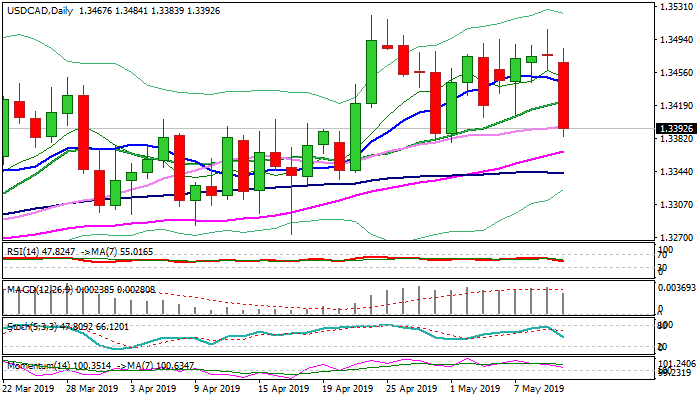
Fresh bearish acceleration from pre-data high (1.3467) dipped below 1.3400 round-figure support and eyes targets at 1.3376 (1 May trough) and 1.3368 (Fibo 61.8% of 1.3273/1.1.3520, reinforced by rising 55SMA).
Daily indicators turned south and support the action which also broke below daily 10/20 SMA's and looks for close 1.3376/68 pivots to confirm break out of two-week congestion between 1.3520 and 1.3467.
The pair is also on track for the second straight bearish weekly close that adds to negative outlook.
Res: 1.3423; 1.3444; 1.3484; 1.3505
Sup: 1.3376; 1.3368; 1.3336; 1.3300
USD/CHF Mid-Day Outlook
Daily Pivots: (S1) 1.0113; (P) 1.0163; (R1) 1.0203; More.....
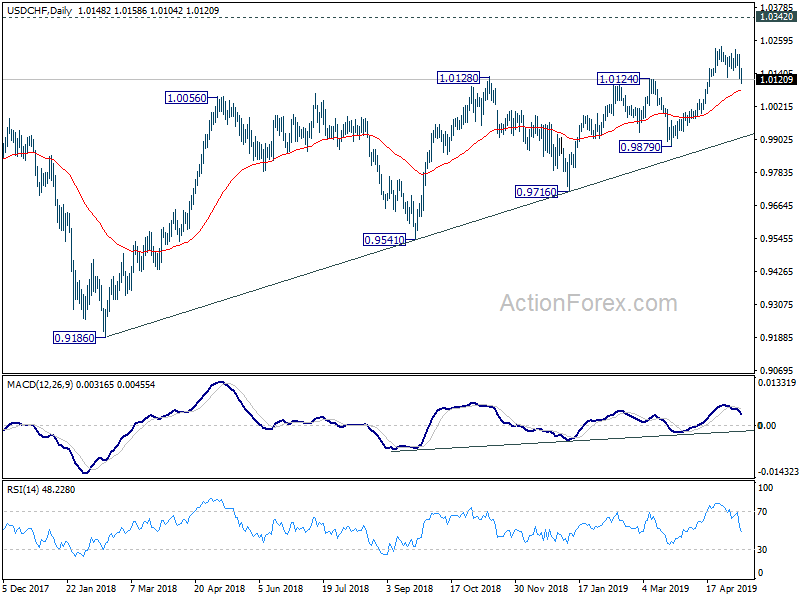
USD/CHF drops sharply as correction from 1.0237 extends. Intraday bias is mildly on the downside or 55 day EMA (now at 1.0081). But downside should be contained there to bring rebound. On the upside, break of 1.0237 will resume larger rise from 0.9186 to 1.0342 key resistance. However sustained break of the 55 day EMA would pave the way back to 0.9879 key support.
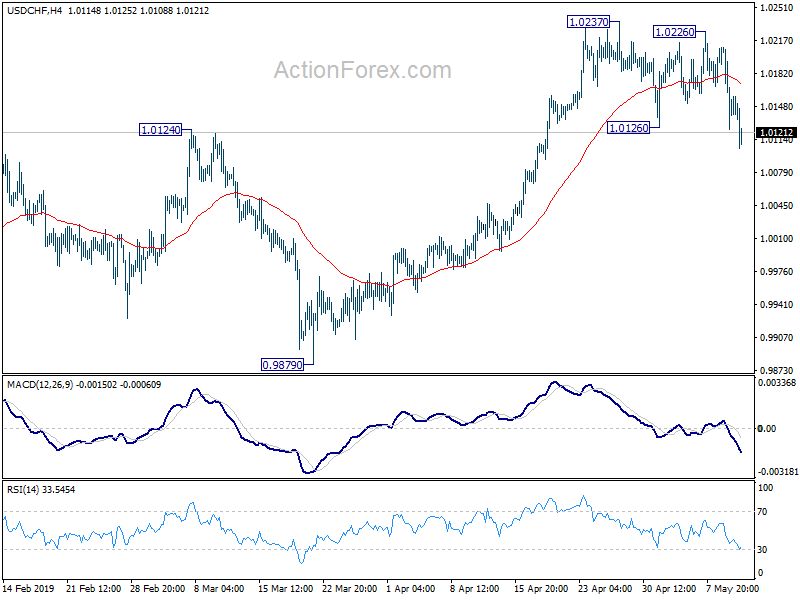
In the bigger picture, medium term up trend from 0.9186 is extending. Current rise should target 1.0342 resistance next. For now, we'd be cautious on strong resistance from there to limit upside, until we see medium term upside acceleration. On the downside, break of 0.9879 support is needed to indicate reversal. Otherwise, outlook will stay bullish in case of deep pull back.