Sample Category Title
Currencies: Dollar Underperforms As Trade Tensions Intensify
- Rates: Downside risks to US CPI inflation
US stock managed an intraday rebound, but we don't think that the correction lower already ran its course. We remain in favour of core bonds. Downside risks to today's US CPI reading could trigger further outperformance of US Treasuries against German Bunds. A speech by NY Fed governor Williams is interesting following dovish clues from his colleagues. - Currencies: Dollar underperforms as trade tensions intensify
The FX trends of earlier this week continued. The dollar underperformed against the euro and yen as the US currency lost further interest rate support. Trade tensions will continue to dominate global (FX) trading. For now, there is no reason to fight the established trading pattern. A softer than expected CPI might be an additional USD negative
The Sunrise Headlines
- US equity markets partly recovered from intraday losses yesterday as US President Trump received “a beautiful letter” from China president Xi Jinping. Asian shares are performing mixed with Chinese indices outperforming.
- The US officially proceeded to raise tariffs on $200 billion of Chinese imports to 25% this morning, although trade talks are continuing today in Washington. China said it is forced to retaliate without specifying how it will do so.
- Atlanta Fed President Raphael Bostic said that higher tariffs on Chinese imports could force US businesses to pass on the costs to consumers, suggesting that price pressures are building and that it could affect the economy.
- The US seized a North Korean cargo ship on suspects of violating on imposed economic sanctions. The move is meant to ramp up pressure on Pyongyang following their recent short-range, smaller missile tests.
- South Africa's ruling African National Congress (ANC) will secure just enough votes to give President Ramaphosa a definitive mandate. With 70% of the votes counted, the ANC leads with 57%, down from the 62% at the previous elections.
- Japanese wages dropped by the most in almost for years. Total labour cash earnings for March declined with 1.9% (Y/Y), well below the expected -0.5% decline. Real cash earnings dropped 2.5%, more than the -1.1% expectation.
- Today's economic calendar is fully equipped with consumer inflation data (Apr) in the US, labour data (Apr) in Canada and Q1 GDP results in the UK. Norway prints CPI's (Apr) as well. An avalanche of ECB and FED governs speak
Currencies: Dollar Underperforms As Trade Tensions Intensify
USD underperforms as trade tensions intensify
EUR/USD initially showed now clear bias yesterday as investors were looking for the next steps in the US-China trade dispute. Sentiment remained risk-off but again didn't help the dollar. During the US session, US yields declined further, substantially narrowing the US-German interest rate spread. This finally caused a new USD downleg. EUR/USD jumped beyond the 1.1215/20 ST resistance but closed the day at 1.1215, off the intraday top. USD/JPY drifted further below 110 to close at 109.74. Even so, the gain of the yen remained modest given the degree of global uncertainty.
This morning, the additional US tariffs have been implemented. China indicated it will retaliate. Asian equities initially tried to regain some of this week's loss, but are trading very volatile. The reaction of the major FX/USD cross rates is quite similar to earlier this week. The dollar is losing modest ground against the euro and the yen (EUR/USD 1.1225/30 area; USD/JPY 109.65 area). The decline of the yuan slowed, at least for now (USD/CNY in the 6.81 area).
There are second tier eco data in Europe today, but the US April CPI is interesting. Both core and headline CPI are expected to rise to 2.1%. This consensus expectations look reasonable. That said, the dollar reaction still might be a bit asymmetrical, with the US currency more sensitive to a negative surprise than to a positive surprise. However, trade tensions will again dominate global FX trading. For now, there is no reason to expect the recent pattern of USD underperformance to continue as US yields stay under pressure. Some gradual further EUR/USD gains in the 1.11/1.14 range are possible shortterm. Still it remains a bit unnatural to see the euro outperforming in a context of global trade uncertainty.
EUR/GBP extended this week's rebound yesterday. The move was partially EUR/USD inspired as the pair jumped higher during the US trading session. At the same time, there was little reason for sterling optimism as the Brexit negotiations between the government and the labour opposition still didn't yield any concrete progress. Today, the UK Q1 GDP growth is expected at a strong 0.5% Q/Q. However, this strong performance was probably mainly Brexit related (stock building etc). The impact on sterling should be limited. Maybe the UK currency might lose some further ground in case of a negative surprise.
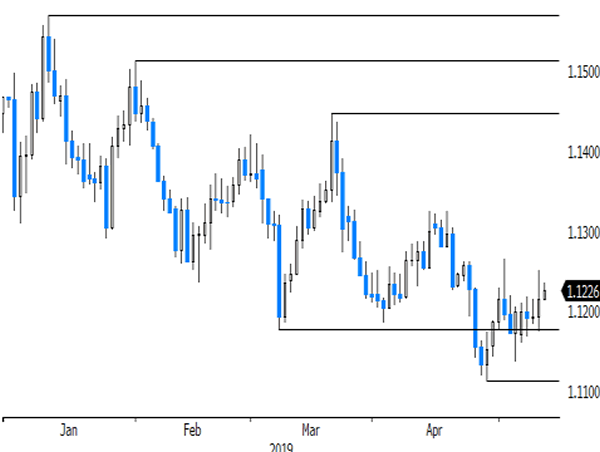
EUR/USD: USD underperforms as uncertainty on trade persists.
USDCAD Rebounds On 20-Day SMA But Indicators Look Weak
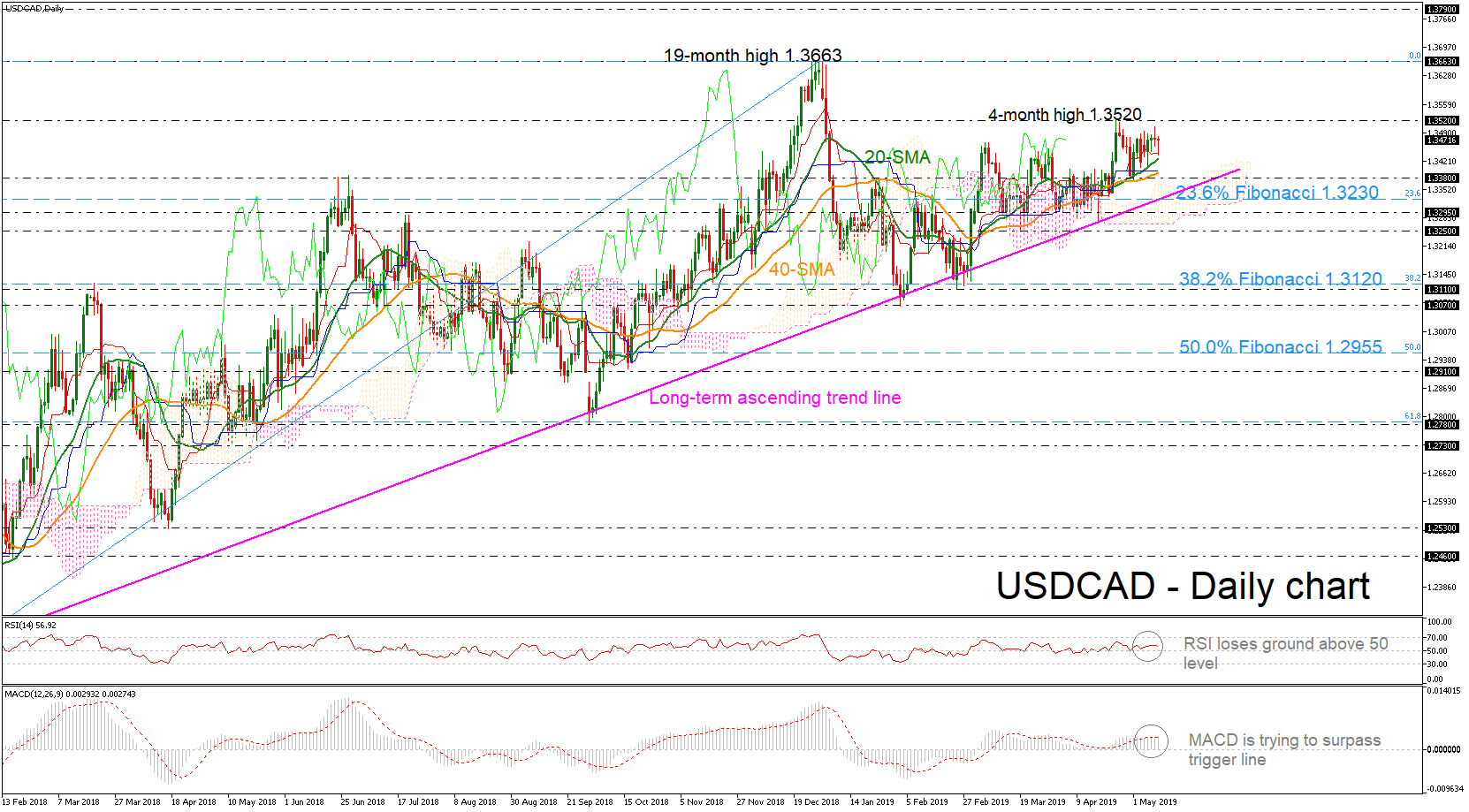
USDCAD rebounded on the 20-day simple moving average (SMA) several times in the preceding sessions, but it still remains below the four-month high of 1.3520. The risk is currently viewed as bullish-to-neutral as on the one hand the RSI seems to be changing direction southward to meet its 50 neutral mark, but the red Tenkan-sen is on a sideways move above the blue Kijun-sen and the MACD is trying to strengthen above its trigger line.
The bulls could set immediate target around the four-month high of 1.3520, while a break higher would open the way towards the 19-month high of 1.3663, reached on December 2018.
Otherwise, the 20-day SMA at 1.3430 could be watched in case of a negative correction. Should there be additional losses, the next support could be around the 1.3380 restrictive level, which stands near the 40-day SMA. A failure to hold above that number could then lead the price towards the 23.6% Fibonacci retracement level of the upleg from 1.2250 to 1.3663 around 1.3230, breaking the long-term ascending trend line.
In the long-term picture, USDCAD is strongly positive as long as the pair trades above the 16-month ascending trend line. Traders should wait for a daily close above 1.3520 for more bullish actions.
Nikkei Futures Decline Less Than 1% As US Tariff Increase On China To 25% (From 10%) Takes Effect
General Trend:
- China yet to announce specific trade countermeasures
- Trade-sensitive Chinese Telecom Services and IT sectors outperform; ZTE rises 3%
- Japanese wages extended declines in March
- RBA Quarterly Statement on Monetary Policy maintained Dec 2020 and June 2021 GDP forecasts, forecasts made on technical assumption that rates follow market pricing of two cuts to 1% (current cash rate is 1.50%)
- Aussie traders generally ignore RBA quarterly statement amid recent rate decision and focus on US/China trade
Headlines/Economic Data
Australia/New Zealand
- ASX 200 opened +0.2%
- (AU) RESERVE BANK OF AUSTRALIA (RBA) STATEMENT ON MONETARY POLICY (SOMP) : Forecasts made on technical assumption that rates follow market pricing of two cuts to 1% (current cash rate is 1.50%)
- (NZ) Reserve Bank of New Zealand (RBNZ) Dep Gov Bascand: Watching data and budget to asses if 2nd rate cut is needed; Needs 3% economic growth to meet inflation target
- (NZ) Outbreak of African swine fever in China could impact the dairy sector in New Zealand - NZ Press
China/Hong Kong
- Shanghai Composite opened +1%, Hang Seng +0.5%
- (CN) TRUMP IMPLEMENTATION OF TARIFFS ON $200B IN CHINA GOODS FROM 10% TO 25% TAKES EFFECT
- (CN) CHINA ANNOUNCES TO RETALIATE TO US TARIFF INCREASE (awaiting specifics)
- (US) White House Spokesman: US President Trump met with USTR Lighthizer and Treasury Sec Mnuchin to discuss the ongoing trade negotiations with China; Confirms Lighthizer and Mnuchin agreed with China Vice Premier Liu He to continue discussions on Friday morning (as expected)
- (CN) China Negotiator/Vice Premier Liu He: Additional Tariffs not a solution; comes to US with sincerity
- (CN) Pres Trump: Have just received a letter from China Pres Xi; plans to speak with Pres Xi by phone as trade talks continue
- (US) Customs & Border Protection: affected US-bound cargoes leaving China before 12:01AM tonight will pay the 10% tariff rate, not the higher 25% rate that goes into effect after that time
- (CN) China PBOC Adviser Ma Jun: US tariffs could cut GDP growth by 0.3%
- (CN) China PBoC sets yuan reference rate: 6.7912 v 6.7665 prior (weakest yuan fix since late Jan 2019)
- (CN) China PBoC Open Market Operation (OMO): Skips for second straight session: Net injection: CNY0B v CNY0B prior
- Sinopec: Suspends Iran oil purchases for May as US sanction waivers end (Chinese Press)
- (HK) IMF now sees Macau 2019 GDP growth at 4.3% v 5.3% in late Feb
Japan
- Nikkei 225 opened +0.1%
- (JP) Bank of Japan (BOJ) Summary of Opinions for Apr 23 and 24 meeting: Further declines in interest rates could aggravate demerits of monetary easing more than boosting economy
- (JP) JAPAN MAR REAL CASH EARNINGS Y/Y: -1.9% V -1.1%E (biggest drop since June 2015); LABOR CASH EARNINGS Y/Y: -2.5% V -0.5%E (biggest drop since June 2015)
- (JP) Magnitude 6.3 earthquake strikes Southern Japan; no tsunami threat - Japanese media
Korea
- Kospi opened +0.8%
- (KR) US Pentagon: Launches by North Korea earlier on Thursday were of multiple ballistic missiles that flew 300 KM into the ocean
- (KR) Bank of Korea (BOK) speculated to have sold US dollars in order to slow decline in Korean Won (KRW)
- (KR) South Korea Fin Min: Monitoring where there is herd behavior in FX offshore, won't sit back if there is any herd behavior in FX
- (KR) Bank of Korea: Uncertainty related to US-China trade talks is rising; will cooperate with government to stabilize markets
- (KR) South Korea Fin Min: Reiterates will respond to volatilities that may stem from US/China trade talks, monitoring markets 'around the clock'
- (KR) South Korea OECD does not expect hit 2019 or 2020 GDP targets - South Korea Press
Other
- (MY) Malaysia Mar Industrial Production Y/Y: 3.1% v 2.3%e
- (VN) Reportedly US Treasury considering labeling Vietnam as a currency manipulator and is also looking at other trading partners as potential FX manipulators - press
Levels as of 1:20 ET
- Nikkei 225, -0.6%, ASX 200 +0.2%, Hang Seng +0.7%; Shanghai Composite +1.4%; Kospi flat
- Equity Futures: S&P500 -0.4%; Nasdaq100 -0.5%, Dax -0.5%; FTSE100 +0.6%
- EUR 1.1236-1.1213 ; JPY 110.05-109.68 ; AUD 0.7019-0.6978 ;NZD 0.6614-0.6583
- Gold +0.1% at $1,286,/oz; Crude Oil +0.5% at $61.98/brl; Copper +0.3% at $2.774/lb
More Tariffs More Uncertainty
Market movers today
Markets will today scrutinise the Trump administration's decision to raise tariffs to 25% on about USD200bn of goods. Moody's has said that a full trade war could push the US economy into recession in 2020.
In Norway and Denmark, CPI inflation rates for April are due out this morning. In Norway, we expect base effects will pull inflation down. In Sweden, household consumption data is due out.
In the UK, monthly GDP data for March is due out and hence will provide a full overview of GDP growth in Q1. GDP growth was solid in January and February, so quarterly GDP growth was probably around 0.5% q/q. This is quite high, but growth was likely supported by companies making Brexit preparations. We expect GDP growth will slow again to around 0.2% q/q in the coming quarters.
In the US, we have CPI inflation for April. We expect CPI core rose +0.2% m/m in April, implying a small increase to 2.1% y/y from 2.0% y/y. The inflation data should not change the Fed being firmly on hold.
Selected market news
President Trump yesterday announced that tariffs would increase by 25% on more than USD200bn of goods from China. There was limited progress in the trade talks between the US and China. An article from Moody's Analytics said that an all-out trade war between the US and China could put the US economy into recession already in 2020. Read more in China Notes - US hikes tariffs leaving high uncertainty in place, 10 May 2019.
Hence, the markets continue to be dominated by the lack of a trade deal between the US and China. The US equity markets fell yesterday, but sentiment in the Asian equity markets is more mixed this morning as most markets are down, while some have risen.
This morning we have published two reports. The first is on inflation in the Euro area, where we expect inflation to bounce back. See more here . The second is a chart pack on the global economy.
Euro Extends Its Gains In The Asian Session
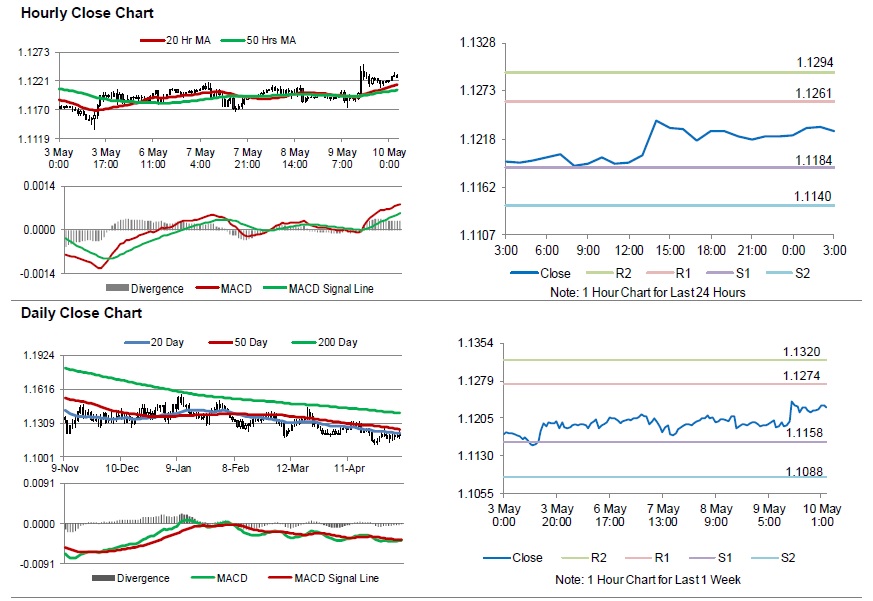
For the 24 hours to 23:00 GMT, the EUR rose 0.21% against the USD and closed at 1.1220.
In the US, data showed that the producer price index advanced 2.2% on an annual basis in April, undershooting market consensus for a rise of 2.3%. The index had registered a similar rise in the prior month. Moreover, the nation’s seasonally adjusted initial jobless claims declined to a level of 228.0K on a weekly basis in the week ended 04 May 2019, less than market expectations of a fall to a level of 220.0K. In the prior week, initial jobless claims had registered a level of 230.0K.
On the other hand, the US trade deficit widened to $50.0 billion in March, compared to a revised deficit of $49.3 billion in the previous month. Market participants had anticipated the nation to post a trade deficit of $50.1 billion.
In the Asian session, at GMT0300, the pair is trading at 1.1227, with the EUR trading 0.06% higher against the USD from yesterday’s close.
The pair is expected to find support at 1.1184, and a fall through could take it to the next support level of 1.1140. The pair is expected to find its first resistance at 1.1261, and a rise through could take it to the next resistance level of 1.1294.
Looking ahead, traders would await the Germany’s trade balance data for March, set to release in a few hours. Later in the day, the US consumer price index and monthly budget statement, both for April, will be on investors’ radar.
The currency pair is trading above its 20 Hr and 50 Hr moving averages.
British Pound Reverses Its Losses In The Morning Session
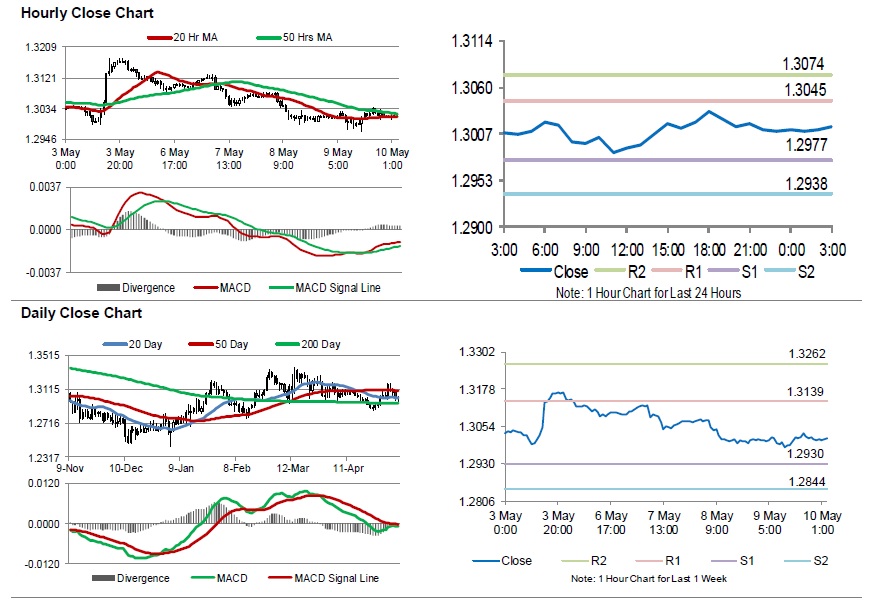
For the 24 hours to 23:00 GMT, the GBP slightly declined against the USD and closed at 1.3010, amid diminishing hopes for a Brexit breakthrough between the Conservative and opposition Labour parties.
In the Asian session, at GMT0300, the pair is trading at 1.3015, with the GBP trading marginally higher against the USD from yesterday’s close.
The pair is expected to find support at 1.2977, and a fall through could take it to the next support level of 1.2938. The pair is expected to find its first resistance at 1.3045, and a rise through could take it to the next resistance level of 1.3074.
Going forward, traders would closely monitor UK’s gross domestic product for 1Q alongwith industrial production, manufacturing production, construction output and trade balance data, all for March, scheduled to release in a few hours.
The currency pair is showing convergence with its 20 Hr and 50 Hr moving averages.
Japan’s Consumer Confidence Index Eased To A 3-Year Low Level In April
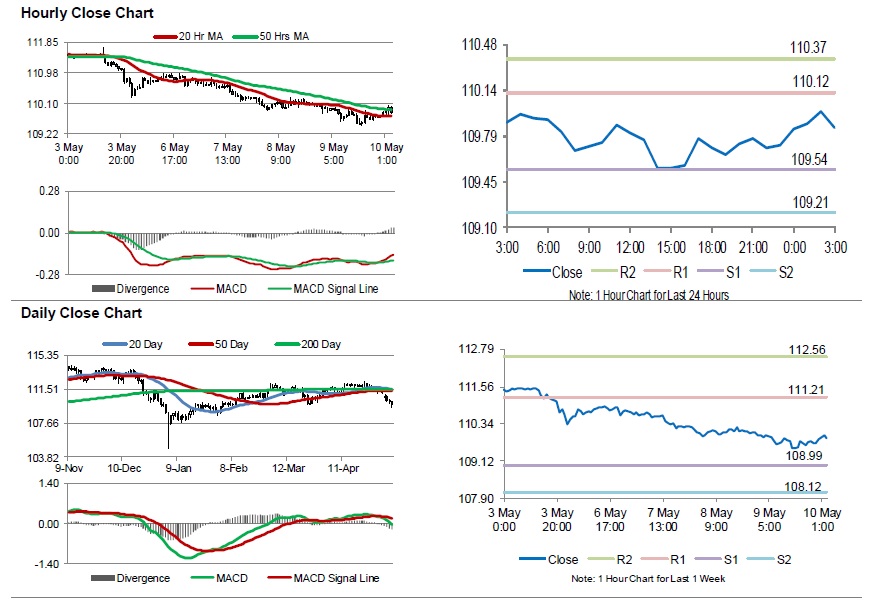
For the 24 hours to 23:00 GMT, the USD declined 0.31% against the JPY and closed at 109.72.
In economic news, Japan’s consumer confidence index eased to a 3-year low level of 40.4 in April and less than market expectations for a fall to a level of 40.3. The index had recorded a level of 40.5 in the prior month.
In the Asian session, at GMT0300, the pair is trading at 109.86, with the USD trading 0.13% higher against the JPY from yesterday’s close.
The Bank of Japan’s summary of April monetary policy meeting revealed that there continues to be risk that Japan may slide into recession depending on sales tax hike impact, overseas developments. Additionally, the bank stated that uncertainty on price outlook would persist through fiscal 2021.
Data showed that Japan’s household spending rose 2.1% on a yearly basis in March, more than market expectations. Household spending had recorded a rise of 1.7% in the previous month.
The pair is expected to find support at 109.54, and a fall through could take it to the next support level of 109.21. The pair is expected to find its first resistance at 110.12, and a rise through could take it to the next resistance level of 110.37.
Moving ahead, investors would keep an eye on Japan’s trade balance data and machine tool orders, set to release next week.
The currency pair is trading above its 20 Hr moving average and showing convergence with its 50 Hr moving average.
Swiss Franc Trading Slightly Lower In The Asian Session
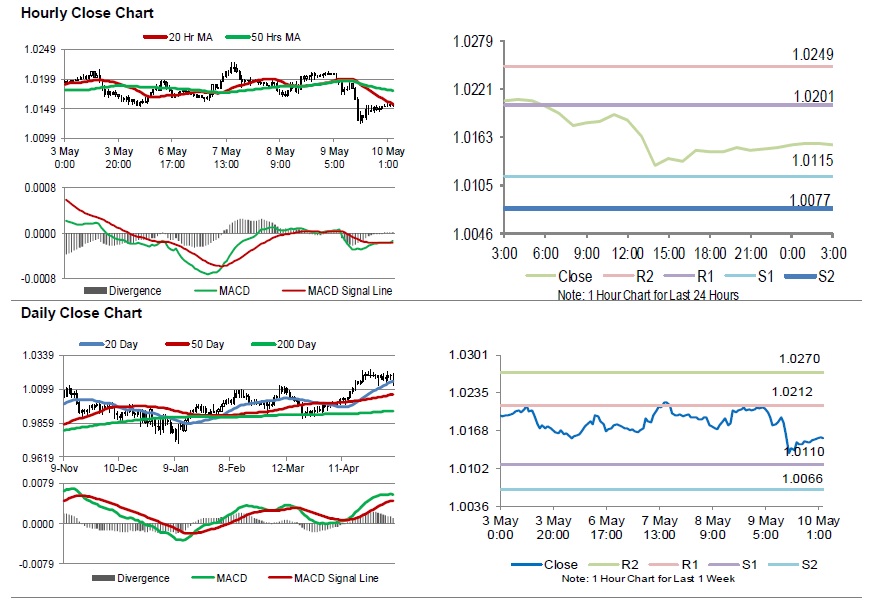
For the 24 hours to 23:00 GMT, the USD declined 0.53% against the CHF and closed at 1.0151.
In the Asian session, at GMT0300, the pair is trading at 1.0154, with the USD trading a tad higher against the CHF from yesterday’s close.
The pair is expected to find support at 1.0115, and a fall through could take it to the next support level of 1.0077. The pair is expected to find its first resistance at 1.0201, and a rise through could take it to the next resistance level of 1.0249.
The currency pair is showing convergence with its 20 Hr moving average and trading below its 50 Hr moving average.
Canada’s New Housing Price Index Rose As Estimated In March
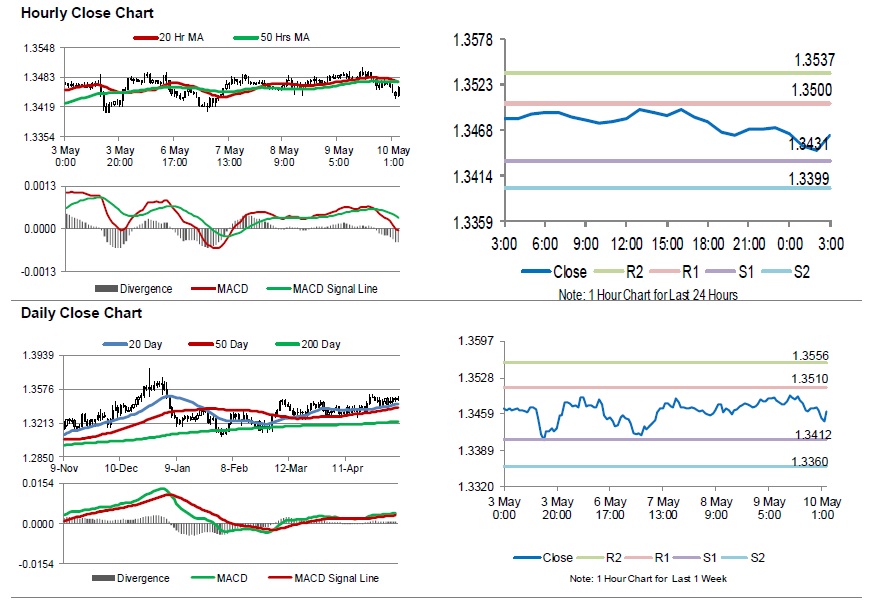
For the 24 hours to 23:00 GMT, the USD traded flat against the CAD and closed at 1.3472.
On the data front, Canada's new housing price index rose 0.1% on a yearly basis in March, at par with market expectations. In the prior month, the index had registered a similar rise.
In the Asian session, at GMT0300, the pair is trading at 1.3463, with the USD trading 0.07% lower against the CAD from yesterday's close.
The pair is expected to find support at 1.3431, and a fall through could take it to the next support level of 1.3399. The pair is expected to find its first resistance at 1.3500, and a rise through could take it to the next resistance level of 1.3537.
Trading trend in the Loonie today is expected to be determined by Canada's building permits for March and unemployment rate for April, slated to release later in the day.
The currency pair is trading below its 20 Hr and 50 Hr moving averages.
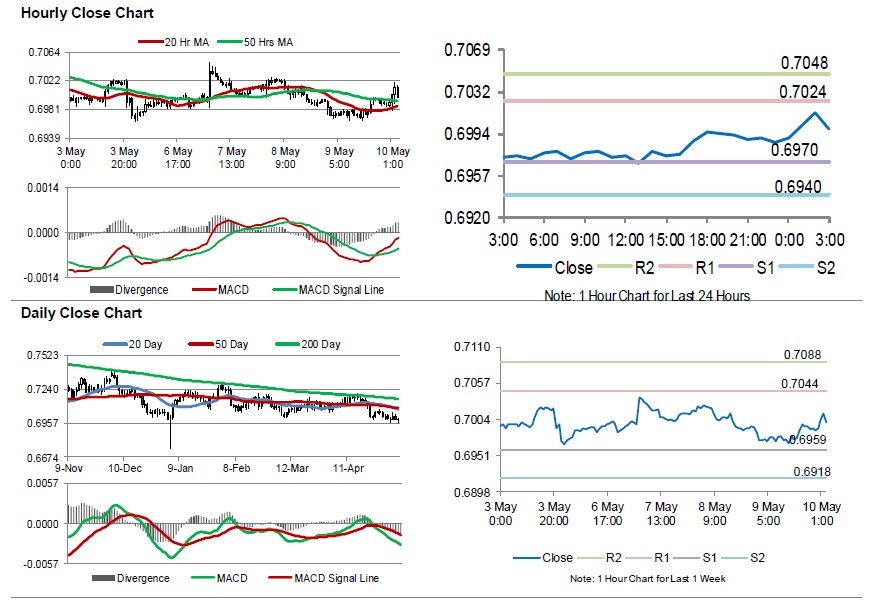
Aussie Trading Higher In The Morning Session
For the 24 hours to 23:00 GMT, the AUD declined 0.10% against the USD and closed at 0.6987.
LME Copper prices rose 0.2% or $9.0/MT to $6112.0/MT. Aluminium prices rose 0.3% or $5.5/MT to $1766.5/MT.
In the Asian session, at GMT0300, the pair is trading at 0.6999, with the AUD trading 0.17% higher against the USD from yesterday’s close.
The pair is expected to find support at 0.6970, and a fall through could take it to the next support level of 0.6940. The pair is expected to find its first resistance at 0.7024, and a rise through could take it to the next resistance level of 0.7048.
Amid lack of macroeconomic releases in Australia today, investors would focus on global macroeconomic releases for further direction.
The currency pair is trading above with its 20 Hr and 50 Hr moving averages.