

Sample Category Title
GBP/USD Daily Outlook
Daily Pivots: (S1) 1.2969; (P) 1.3003; (R1) 1.3037; More...
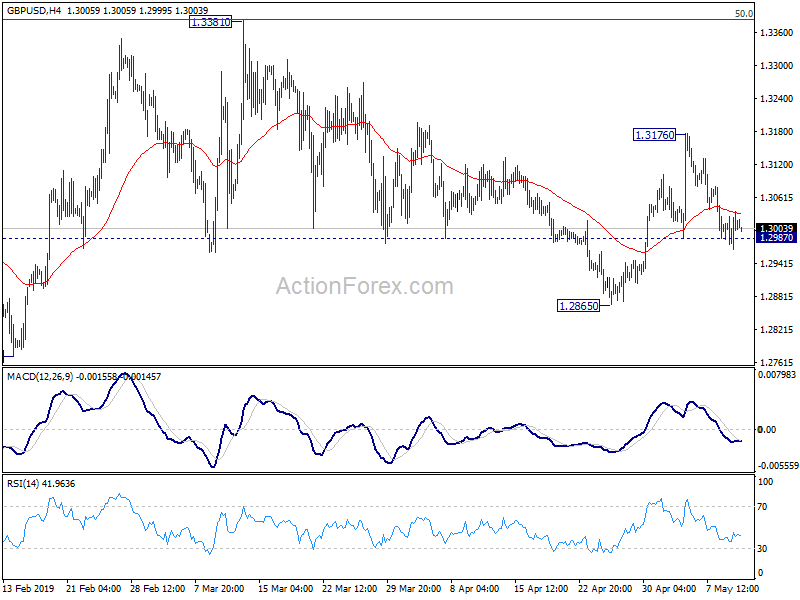
GBP/USD is losing downside momentum as seen in 4 hour MACD. But upside of recovery is capped by 4 hour 55 EMA so far. Focus remains on 1.2987 support. Decisive break there will confirm that rebound from 1.2865 has completed at 1.3176 already. More importantly, this will revive that bearish case that rebound from 1.2391 has completed at 1.3381. And intraday bias will be turned to the downside for 1.2865 support for confirming bearishness. Nevertheless, on upside, above 1.3176 will target a retest on 1.3381 high next.
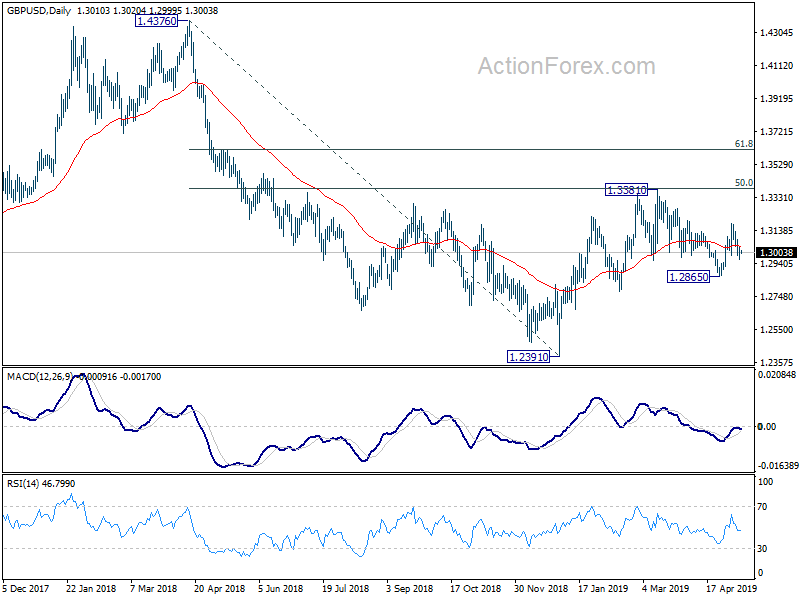
In the bigger picture, medium term decline from 1.4376 (2018 high) halted and made a medium term bottom after hitting 1.2391. Rebound from 1.2391 is seen as a corrective move for now. In case of another rise, strong resistance could be seen around 61.8% retracement of 1.4376 to 1.2391 at 1.3618 to limit upside. On the downside, break of 1.2773 support will suggests that such corrective rise is completed and bring retest of 1.2391 low first.
USD/CHF Daily Outlook
Daily Pivots: (S1) 1.0113; (P) 1.0163; (R1) 1.0203; More.....
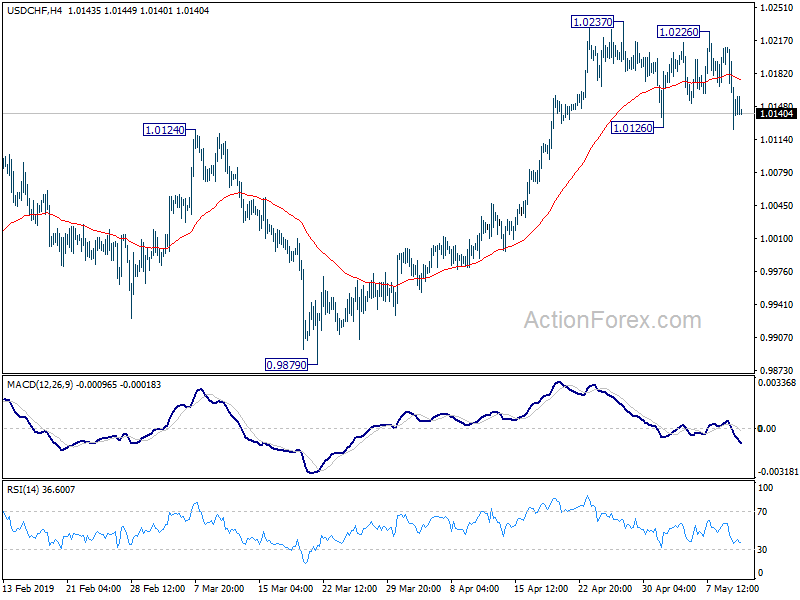
Intraday bias in USD/CHF remains neutral for the moment as consolidation from 1.0237 is extending. Current fall from 1.0226 might extend lower. Break of 0.0126 minor support will target 55 day EMA (now at 1.0081). But downside should be contained there to bring rebound. On the upside, break of 1.0237 will resume larger rise from 0.9186 to 1.0342 key resistance.
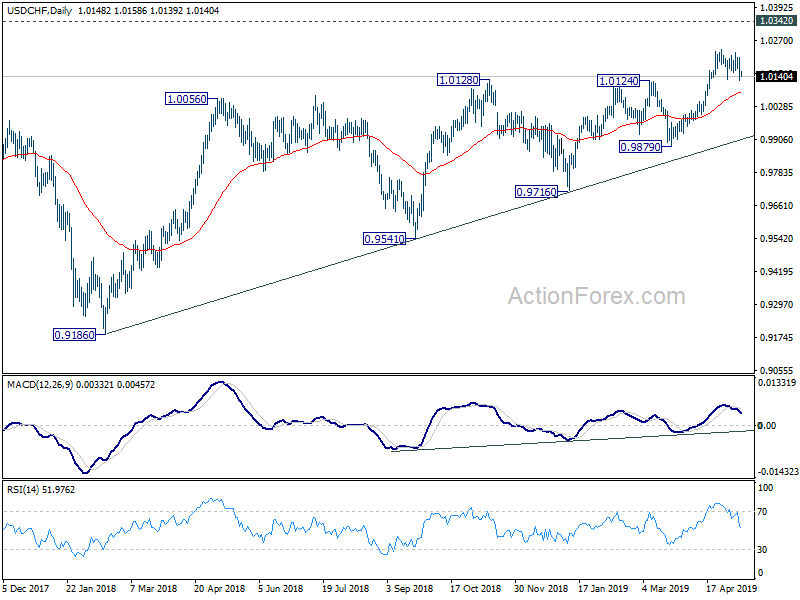
In the bigger picture, medium term up trend from 0.9186 is extending. Current rise should target 1.0342 resistance next. For now, we'd be cautious on strong resistance from there to limit upside, until we see medium term upside acceleration. On the downside, break of 0.9879 support is needed to indicate reversal. Otherwise, outlook will stay bullish in case of deep pull back.
USD/JPY Daily Outlook
Daily Pivots: (S1) 109.45; (P) 109.78; (R1) 110.10; More...
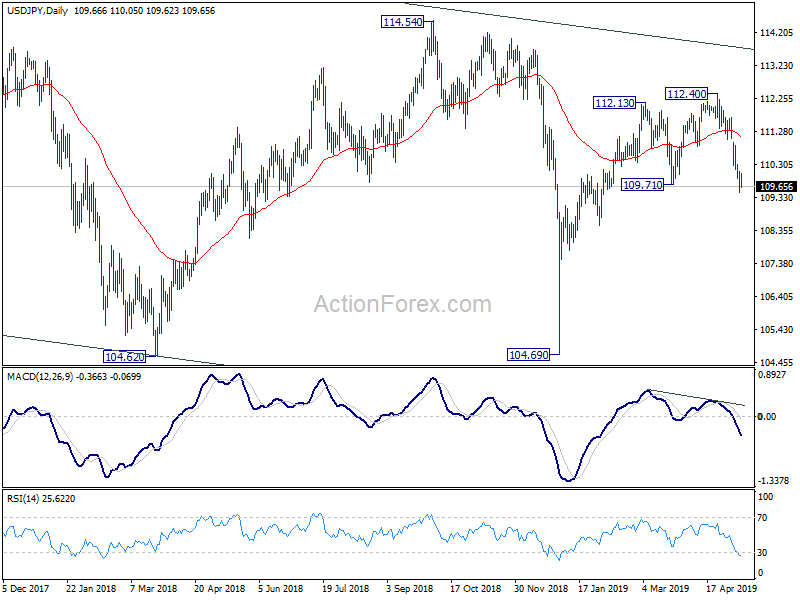
USD/JPY is losing some downside momentum, as seen is 4 hour MACD, as it's pressing 109.72 key support. Intraday bias stays on the downside as long as 110.28 minor resistance holds. Sustained break of 109.72 key support will confirm completion of rebound from 104.69 at 112.40 on bearish divergence condition in daily MACD. Deeper decline should then be seen back to retest 104.69 low. On the upside, though, rebound from current level and break of 110.28 minor resistance will mix up near term outlook. Intraday bias will be turned neutral in this case first.
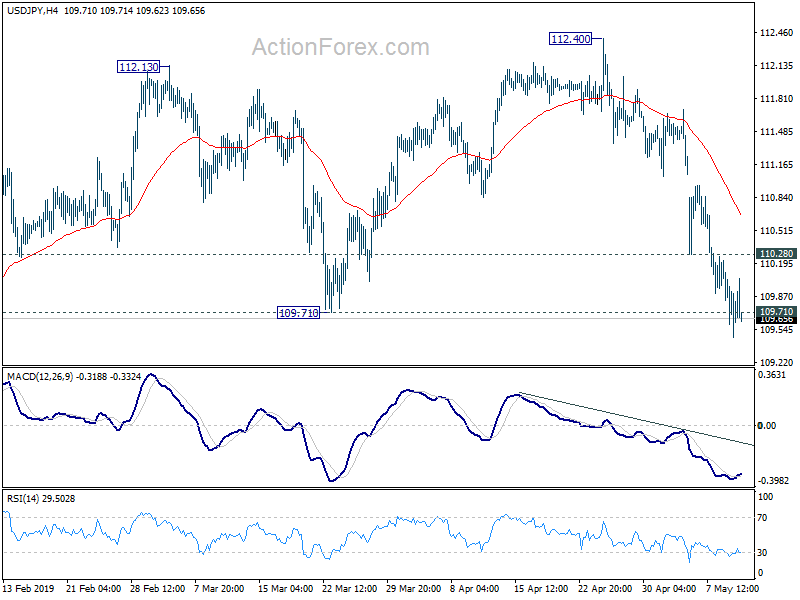
In the bigger picture, USD/JPY is staying inside falling channel from 118.65. Thus, there is no confirmation of trend reversal yet. Sustained break of 109.71 will argue that rebound from 104.69 is completed. And the down trend from 118.65 is still in progress. But at this stage, in case of break of 104.69, we'd expect strong support above 98.9 (2016 low) to contain downside an bring rebound.
Markets Steady as New Tariffs on China Take Effect, No Apparent Progress in US-China Negotiations
The financial markets are relatively steady today as new round of US-China trade war formally starts. Asian index are just mixed, with gains even seen in Hong Kong and Chinese stocks. In the currency markets, Dollar is currently trading as the weakest for today, followed by Sterling, and New Zealand Dollar. Australian Dollar was given a mild lift by RBA's Statement of Monetary Policy but the recovery quickly fades. After all, major pairs and crosses are bounded inside Friday's range and the picture could drastically change before weekly close.
For the week, Yen remains the strongest one on risk aversion. Euro displays a lot of resilience as the second strongest, followed by Swiss Franc on risk aversion. Sterling is the worst performing one on Brexit impasse. But it could have a turn around should GDP and productions surprise on the upside today. New Zealand and Australian Dollars are the weakest.
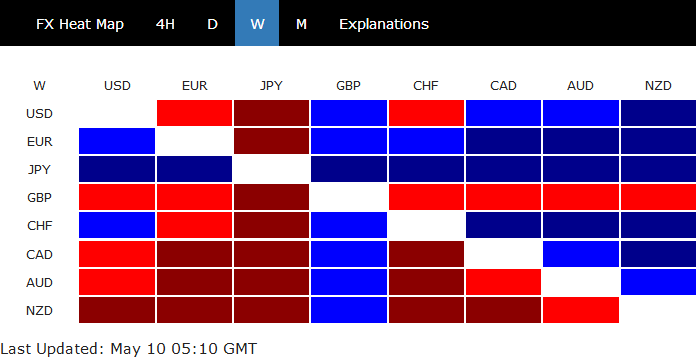
Technically, Yen is losing some upside momentum against Dollar, Euro and Sterling. Some retreats will be likely but for now, we'll assume any pull back to be brief first. AUD/USD recovered ahead of 0.6962, with no follow through buying. This support will remain in focus today and break will resume larger fall from 0.7295. EUR/USD, USD/CHF and USD/CAD remain in tight range despite yesterday's selloff in Dollar. For now, we'd still favor upside breakout in the greenback.
In Asia, currently, Nikkei is down -0.91%. Hong Kong HSI is up 0.17%. China Shanghai SSE is up 0.47%. Singapore Strait Times is down -0.17%. Japan 10-year JGB yield is down -0.001 at -0.047. Overnight, DOW closed down only -0.54% at 25828.36 after diving to as low as 25517.39. S&P 500 lost -0.30%. NASDAQ dropped -0.41%. 10-year yield dropped -0.025 to 2.457, after diving to 2.425.
It's formal, new US tariffs on China take effect
It's formal. The new US tariffs on Chinese imports take effect. Tariffs on USD 200B in Chinese goods are increased from 10% to 25%. Top 10 items affected include telecommunication equipment, computer circuit boards, processing units, metal furniture, computer parts, wooden furniture, static converters, vinyl tile floor coverings, seats with wooden frame and car parts. Paper work for taxing another USD 325B in Chinese goods has also started earlier this week.
In a brief statement China Ministry of Commerce said the country "deeply regrets" US decision. And, MOFCOM said China "will have to take necessary countermeasures", without elaboration. But it "hoped that the US and the Chinese side will work together and work together to resolve existing problems through cooperation and consultation."
Chinese VP Liu wrapped first day of negotiation with a smile as new tariffs will start shortly
Yesterday, Chinese Vice Premier Liu He wrapped his first day of meeting with US Trade Representative Robert Lighthizer and Treasury Secretary Steven Mnuchin. After 90 minutes meeting in the USTR office, they had a dinner together. Ahead of the meeting, Liu said: “We come here this time, under pressure, which shows China’s greatest sincerity, and want to sincerely, confidently, and rationally resolve certain disagreements or differences facing China and the United States. I think there is hope,”
Trump said he got a "beautiful letter" from Chinese President Xi Jinping and they' "probably" speak by phone. Trump reiterated his hard line and said “Our alternative is an excellent one, it’s an alternative I've spoken about for years. We’ve taken well over $100 billion from China in a year.”
For now, no phone call has been made yet, nor scheduled. White House just noted that the negotiations will continue on Friday morning in Washington.
BoJ opinions: Clarification on forward guidance strengthens confidence in powerful easing
Summary of opinions at the April 24-25 BoJ Monetary Policy Meeting is released today. At the statement of that meeting, BoJ added clarification of forward guidance for policy rates. It noted that BoJ intended to keet current levels of interest rates at least through around spring 2020.
The summary of opinions noted that "in order to strengthen public confidence in continuing with powerful monetary easing, it is appropriate to clarify forward guidance for policy rates, such as through making clear the specific period for which extremely low levels of interest rates will be maintained." Also, it is appropriate to consider revising forward guidance for policy rates, given, for example, that uncertainties regarding overseas economies have heightened compared to the time of its introduction.
Meanwhile BoJ also noted "there is a possibility that a further decline in interest rates will result in a greater risk of inducing side effects on the real economy, rather than positive effects". But BoJ dismissed the argument that QQE led to deterioration in banks' profitability. It's noted monetary easing has "brought about economic improvement, an increase in lending, a decline in credit costs, and an increase in profits stemming from stocks and bonds".
RBA SoMP: Slight downgrade of inflation, no imminent need to cut rates
In the Statement of Monetary Policy, RBA noted that the economy has "slowed" and inflation "remains "low". Also, "subdued" growth in household income and "adjustment" in housing markets affected consumer spending and residential construction. Still, labor market is "performing reasonably well". Underlying inflation came in lower than expected in Q1 and "with pricing pressures subdued across much of the economy".
Looking at the new economic projections, 2019 growth forecasts was revised down notably from 2.75% to 2.00%. But 2020 growth expectation was unchanged. Unemployment rate will stay longer at 5.00% through Dec 2020. Headline CPI was expected hit 2.00% in Dec 2019 and stay there throughout. Core CPI is revised slightly to 1.75% in Dec 2019 and 2.00% in Dec 2020.
All in all, while 2019 growth is expected to undershoot, it's expected to pick up quickly. The downward revision in core CPI was just showed a slower pickup back to target, not anything disastrous. Based on this outlook, RBA still has a lot of room to wait and see the developments, before cutting interest rates.
- GDP growth year average: 2019 at 2.00%, revised down from 2.75%; 2020 at 2.75%, unchanged.
- Unemployment rate: Dec 2019 at 5%, unchanged; Dec 2020 at 5%, revised up from 4.75%.
- CPI: Dec 2019 at 2.00%, revised up from 1.75%; Dec 2020 at 2.00%, down from 2.25%.
- Trimmed mean inflation:Dec 2019 at 1.75%, revised down from 2.00%; Dec 2020 at 2.00%, revised down from 2.25%.
RBNZ Bascand: Economy growing below potential, needs to be pumped up
RBNZ Deputy Governor Geoff Bascand said the economy is growing less than potential of 2.8%. And, there's just not enough pressure to get inflation up. “We think capacity pressures will just become a little less,” he said. “There is pressure there, there’s just not enough pressure to get inflation up. We need growth to be around 3% or more to keep being at or approaching our targets.”
Nevertheless, he added "nobody's talking gloom here" even though it was "getting a bit harder" to meet the inflation target. He said “the headwinds have become a bit stronger, the global economy has become a bit weaker, the domestic economy seems to have softened." Hence, "we’re going to be drifting away a little bit, not staying as close, there’s more chance of inflation ebbing than rising".
And, "because of that, we ended up coming to a view that we needed to help pump it up a bit more."
On the data front
Japan household spending rose 2.1% yoy in March, above expectation of 1.6% yoy. But labor cash earnings dropped sharply by -1.9% yoy, well below expectation of -0.50%.
UK data will be the major focus in European session today. GDP, productions, trade balance will be featured. Germany will also release trade balance.
Later in the data, US CPI and Canada employment will take center stage.
USD/JPY Daily Outlook
Daily Pivots: (S1) 109.45; (P) 109.78; (R1) 110.10; More...
USD/JPY is losing some downside momentum, as seen is 4 hour MACD, as it's pressing 109.72 key support. Intraday bias stays on the downside as long as 110.28 minor resistance holds. Sustained break of 109.72 key support will confirm completion of rebound from 104.69 at 112.40 on bearish divergence condition in daily MACD. Deeper decline should then be seen back to retest 104.69 low. On the upside, though, rebound from current level and break of 110.28 minor resistance will mix up near term outlook. Intraday bias will be turned neutral in this case first.
In the bigger picture, USD/JPY is staying inside falling channel from 118.65. Thus, there is no confirmation of trend reversal yet. Sustained break of 109.71 will argue that rebound from 104.69 is completed. And the down trend from 118.65 is still in progress. But at this stage, in case of break of 104.69, we'd expect strong support above 98.9 (2016 low) to contain downside an bring rebound.
Economic Indicators Update
| GMT | Ccy | Events | Actual | Consensus | Previous | Revised |
|---|---|---|---|---|---|---|
| 23:30 | JPY | Overall Household Spending Y/Y Mar | 2.10% | 1.60% | 1.70% | |
| 23:30 | JPY | Labor Cash Earnings Y/Y Mar | -1.90% | -0.50% | -0.80% | -0.70% |
| 23:50 | JPY | BOJ Summary of Opinions | ||||
| 1:30 | AUD | RBA Statement on Monetary Policy May | ||||
| 6:00 | EUR | German Trade Balance (EUR) Mar | 19.4B | 18.7B | ||
| 8:30 | GBP | GDP M/M Mar | 0.00% | 0.20% | ||
| 8:30 | GBP | GDP Q/Q Q1 P | 0.50% | 0.20% | ||
| 8:30 | GBP | Total Business Investment Q/Q Q1 P | -0.70% | -0.90% | ||
| 8:30 | GBP | Industrial Production M/M Mar | 0.10% | 0.60% | ||
| 8:30 | GBP | Industrial Production Y/Y Mar | 0.40% | 0.10% | ||
| 8:30 | GBP | Manufacturing Production M/M Mar | 0.00% | 0.90% | ||
| 8:30 | GBP | Manufacturing Production Y/Y Mar | 1.10% | 0.60% | ||
| 8:30 | GBP | Construction Output M/M Mar | -0.90% | 0.40% | ||
| 8:30 | GBP | Visible Trade Balance (GBP) Mar | -13.7B | -14.1B | ||
| 8:30 | GBP | Index of Services 3M/3M Mar | 0.40% | 0.40% | ||
| 12:30 | CAD | Building Permits M/M Mar | 2.30% | -5.70% | ||
| 12:30 | CAD | Net Change in Employment Apr | 15.0K | -7.2K | ||
| 12:30 | CAD | Unemployment Rate Apr | 5.80% | 5.80% | ||
| 12:30 | USD | CPI M/M Apr | 0.40% | 0.40% | ||
| 12:30 | USD | CPI Y/Y Apr | 2.10% | 1.90% | ||
| 12:30 | USD | CPI Core M/M Apr | 0.20% | 0.10% | ||
| 12:30 | USD | CPI Core Y/Y Apr | 2.10% | 2.00% |
Expecting Limited Price Impact of Trump’s Sanctions on Iran Metal Sector
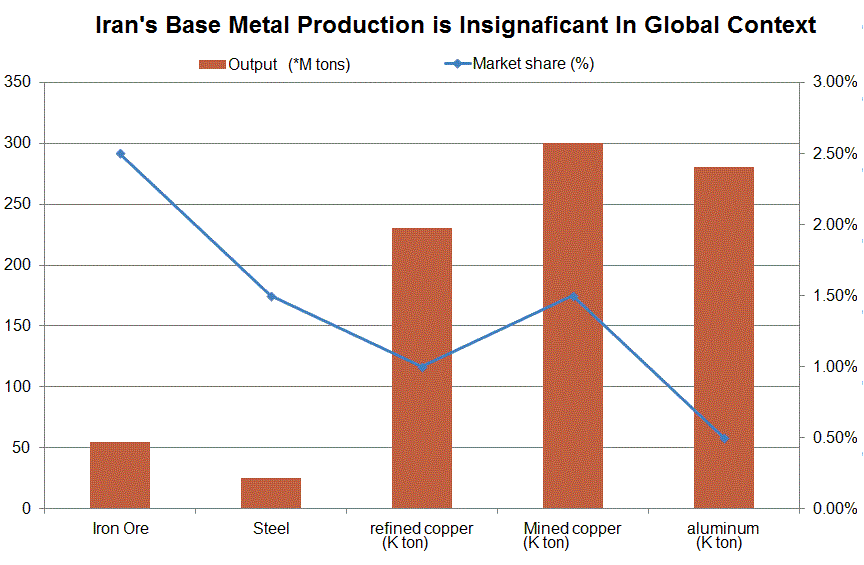
One year after US withdrawal from the Iran nuclear deal, Donald Trump has signed an executive order to impose sanction on Iran’s base metal sector. The sanction covers iron, steel, aluminum and copper. While the move might further cripple the Middle East country’s economic growth, its impact on the global metal market, either in terms of prices or the demand-supply balance, is limited. After all, Iran is a small metal producer, contributing less than 3% of each of the above-mentioned metals in world production. The contribution in exports is even small.
After targeting the oil market, the lifeblood of Iran’s economy, the US announced sanction on the country’s base metal industry. According to Trump, the action “targets Iran's revenue from the export of industrial metals - 10% of its export economy - and puts other nations on notice that allowing Iranian steel and other metals into your ports will no longer be tolerated”. Unlke previous sanctions on Iran’s oil exports, the sanction on metal should have limited impact on global balance, and hence prices. The charts below show that Iran’s production of the metals concerned is small in the global market. The biggest contributor is probably iron ore. However, it was only about 3% of world output. Exports of these metals are even smaller. Iran’s export of iron ore was estimated at 15-30M metric tons in 2018. Despite a key sector (amongst base metals) in Iran, it only represents 1-1.5% of overall iron ore trade in the world. Let’s take a closer look at Iran’s biggest trading partner, China, the destination of about 27% of Iran’s total exports. In 2018, Iranian shipment of copper concentrate to China was about 314K metric ton, about 2% of China’s total import of the commodity. Shipment of copper cathode to China was 15K metric ton in 2018. China’s import of the commodity during the period was 3.3M metric ton. Iran's aluminum export was insignificant. China imported 160 kg of aluminum foil from Iran last year.
Iran’s economy has been devastated by international sanctions against its oil exports. A deal reached in 2015 helped lift the country’s economic growth. GDP surged +12.3% in 2016, before moderating to +3.7% in 2017. Yet, renewed sanction by the US has sent the country’s recession again. According to IMF’s estimate, Iran’s GPD contracted -3.9% last year. The enormous impact of the sanction was due to the fact that Iran relies on oil exports. According to the EIA, Iran holds the world’s 4th proved crude oil reserves. Oil revenue has contributed to 80% of the country’s GDP. Iran’s metal market is way smaller than its oil market. Therefore, we expect Trump’s latest sanction would have milder impact on Iran’s economy than previous ones. Given Iran’s limited exposure in exports of base metals, the impact of the sanction on world metal price is negligible.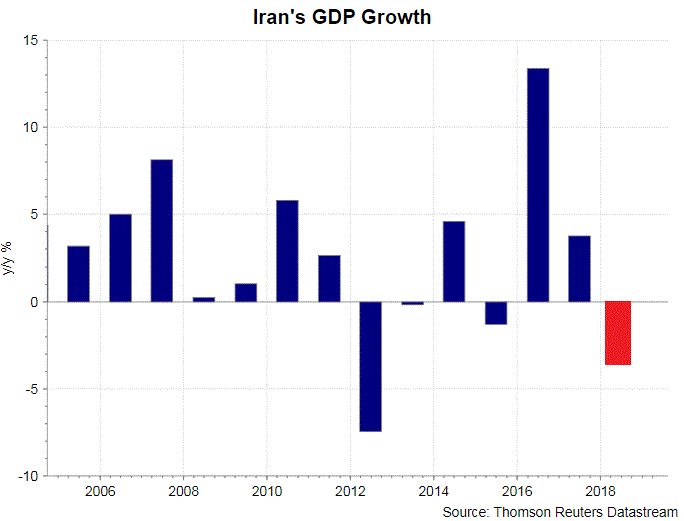
It’s formal, new US tariffs on China take effect
It's formal. The new US tariffs on Chinese imports take effect. Tariffs on USD 200B in Chinese goods are increased from 10% to 25%. Top 10 items affected include telecommunication equipment, computer circuit boards, processing units, metal furniture, computer parts, wooden furniture, static converters, vinyl tile floor coverings, seats with wooden frame and car parts. Paper work for taxing another USD 325B in Chinese goods has also started earlier this week.
In a brief statement China Ministry of Commerce said the country "deeply regrets" US decision. And, MOFCOM said China "will have to take necessary countermeasures", without elaboration. But it "hoped that the US and the Chinese side will work together and work together to resolve existing problems through cooperation and consultation."
RBA SoMP: Slight downgrade of inflation, no imminent need to cut rates
In the Statement of Monetary Policy, RBA noted that the economy has "slowed" and inflation "remains "low". Also, "subdued" growth in household income and "adjustment" in housing markets affected consumer spending and residential construction. Still, labor market is "performing reasonably well". Underlying inflation came in lower than expected in Q1 and "with pricing pressures subdued across much of the economy".
Looking at the new economic projections, 2019 growth forecasts was revised down notably from 2.75% to 2.00%. But 2020 growth expectation was unchanged. Unemployment rate will stay longer at 5.00% through Dec 2020. Headline CPI was expected hit 2.00% in Dec 2019 and stay there throughout. Core CPI is revised slightly to 1.75% in Dec 2019 and 2.00% in Dec 2020.
All in all, while 2019 growth is expected to undershoot, it's expected to pick up quickly. The downward revision in core CPI was just showed a slower pickup back to target, not anything disastrous. Based on this outlook, RBA still has a lot of room to wait and see the developments, before cutting interest rates.
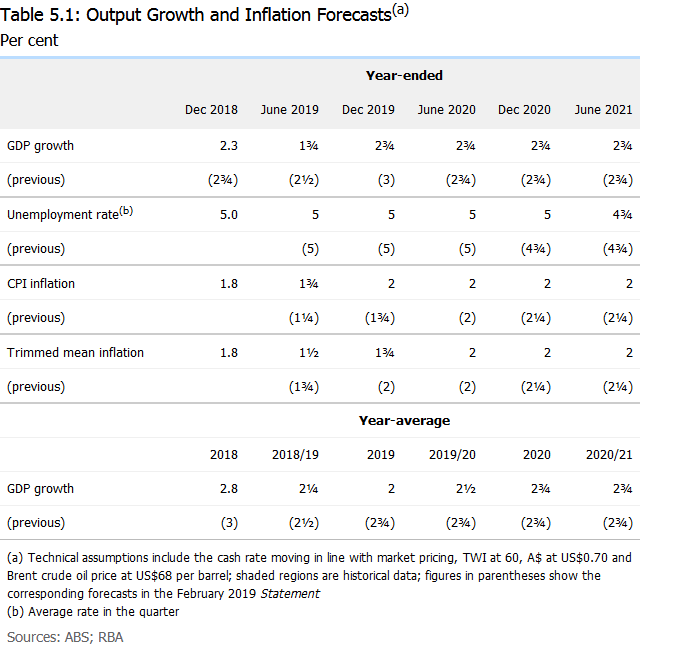
GDP growth year average:
- 2019 at 2.00%, revised down from 2.75%;
- 2020 at 2.75%, unchanged.
Unemployment rate:
- Dec 2019 at 5%, unchanged;
- Dec 2020 at 5%, revised up from 4.75%.
CPI:
- Dec 2019 at 2.00%, revised up from 1.75%;
- Dec 2020 at 2.00%, down from 2.25%. .
Trimmed mean inflation:
- Dec 2019 at 1.75%, revised down from 2.00%;
- Dec 2020 at 2.00%, revised down from 2.25%.
BoJ opinions: Clarification on forward guidance strengthens confidence in powerful easing
Summary of opinions at the April 24-25 BoJ Monetary Policy Meeting is released today. At the statement of that meeting, BoJ added clarification of forward guidance for policy rates. It noted that BoJ intended to keet current levels of interest rates at least through around spring 2020.
The summary of opinions noted that "in order to strengthen public confidence in continuing with powerful monetary easing, it is appropriate to clarify forward guidance for policy rates, such as through making clear the specific period for which extremely low levels of interest rates will be maintained." Also, "it is appropriate to consider revising forward guidance for policy rates, given, for example, that uncertainties regarding overseas economies have heightened compared to the time of its introduction."
Meanwhile BoJ also noted "there is a possibility that a further decline in interest rates will result in a greater risk of inducing side effects on the real economy, rather than positive effects". But BoJ dismissed the argument that QQE led to deterioration in banks' profitability. It's noted monetary easing has "brought about economic improvement, an increase in lending, a decline in credit costs, and an increase in profits stemming from stocks and bonds".
AUD/USD And NZD/USD Could Rebound Further
AUD/USD found a strong support near the 0.6960 level and recovered recently. NZD/USD is trading nicely and it could recover towards the 0.6650 level in the near term.
Important Takeaways for AUD/USD and NZD/USD
- The Aussie Dollar remained well supported above 0.6960 and recently bounced back against the US Dollar.
- There was a break above a key bearish trend line with resistance at 0.6990 on the hourly chart of AUD/USD.
- NZD/USD dipped strongly towards the 0.6525 level and later bounced back above 0.6570.
- There was a break above a major declining channel with resistance at 0.6595 on the hourly chart.
AUD/USD Technical Analysis
After a strong decline, the Aussie Dollar found support near the 0.6960 area against the US Dollar. The AUD/USD pair started a strong upward move and traded above the 0.6985 and 0.6700 resistance levels.
The hourly chart suggests that the pair traded as low as 0.6964 on FXOpen and recently climbed sharply above the 0.7000 level and the 50 hourly simple moving average.
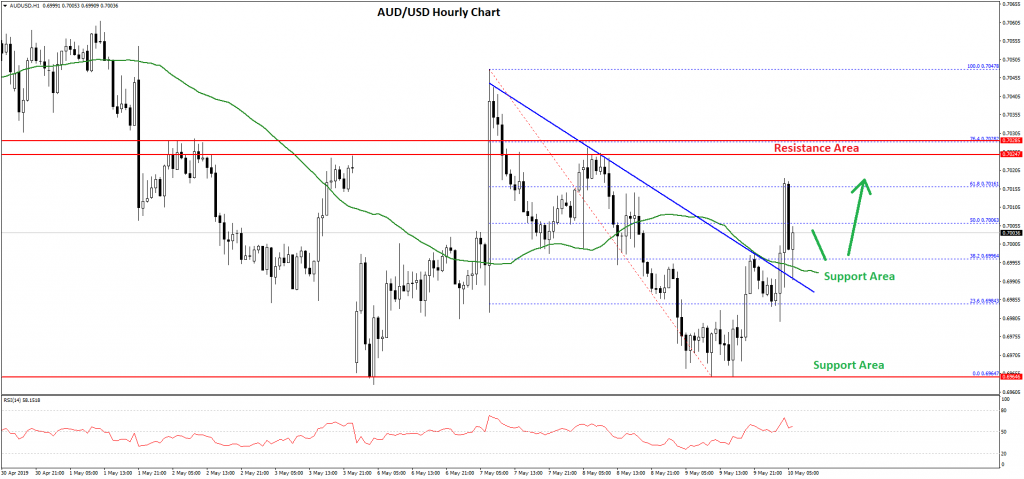
During the upside move, the pair broke the 50% Fib retracement level of the last decline from the 0.7047 high to 0.6964 low. Moreover, there was a break above a key bearish trend line with resistance at 0.6990 on the hourly chart of AUD/USD.
The pair tested the 76.4% Fib retracement level of the last decline from the 0.7047 high to 0.6964 low. It retreated from highs and tested the broken resistance near 0.6990 and the 50 hourly simple moving average.
The bulls seem to be protecting declines below the 0.7000 and 0.6990 support levels. As long as the pair is above 0.6990, the pair could bounce back.
On the upside, an initial resistance is near the 0.7015 level. However, the main resistances on the upside are near the 0.7030 and 0.7040 levels.
NZD/USD Technical Analysis
The New Zealand Dollar declined steadily from the 0.6680 resistance area against the US Dollar. The NZD/USD pair came under a lot of pressure and broke the 0.6600 and 0.6560 support levels.
The decline was such that the pair declined below 0.6540 and traded as low as 0.6527. Finally, there was a sharp rebound and the pair recovered above the 0.6580 level.
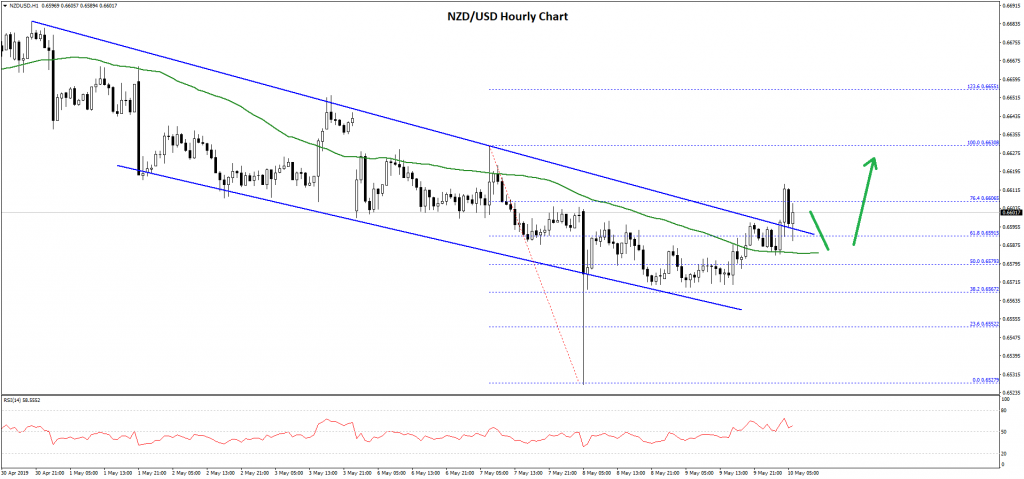
During the recent recovery, there was a break above a major declining channel with resistance at 0.6595 on the hourly chart. The pair settled above the 0.6600 level and the 50 hourly simple moving average.
Moreover, it tested the 76.4% Fib retracement level of the last decline from the 0.6630 high to 0.6527 low. However, the upside move was capped by the 0.6618-0.6620 zone. As a result, the pair is currently correcting gains and trading near the broken channel at 0.6595.
If the pair starts a fresh upward move, there could be a break above the 0.6620 level. The next key resistance on the upside is near the 0.6630 level or the previous swing high.
On the downside, an initial support is near the 0.6595 level and the 50 hourly SMA. If there is a downside break below 0.6590, the pair could decline or extend losses towards the next key support at 0.6570 in the coming sessions.
RBNZ Bascand: Economy growing below potential, needs to be pumped up
RBNZ Deputy Governor Geoff Bascand said the economy is growing less than potential of 2.8%. And, there's just not enough pressure to get inflation up. “We think capacity pressures will just become a little less,” he said. “There is pressure there, there’s just not enough pressure to get inflation up. We need growth to be around 3% or more to keep being at or approaching our targets.”
Nevertheless, he added "nobody's talking gloom here" even though it was "getting a bit harder" to meet the inflation target. He said “the headwinds have become a bit stronger, the global economy has become a bit weaker, the domestic economy seems to have softened." Hence, "we’re going to be drifting away a little bit, not staying as close, there’s more chance of inflation ebbing than rising".
And, "because of that, we ended up coming to a view that we needed to help pump it up a bit more."