

Sample Category Title
Sterling Surged as UK Politicians Could Finally Drop Differences to Deliver Brexit
Sterling was the star winner last week as boosted by renewed hope of a Brexit deal between the government and opposition. Poor results for both Conservatives and Labours are piling pressure on both parties to end the Brexit standoff and drama as soon as possible. In short, Conservatives lost more than 1300 seats. But despite the results, Labour didn't gain anything, but instead lost around 80 seats. That's seen as a wake up call to the two major parties on how deeply the public is dissatisfied by them.
Prime Minister Theresa May stepped up calls on Labour leader Jeremy Corbyn to agree on a cross-party deal to leave the EU. May said in a Sunday newspaper party: “To the Leader of the Opposition I say this: Let’s listen to what the voters said in the local elections and put our differences aside for a moment. Let’s do a deal". May is expected to offer new concessions to Labour as talks with restart on coming Tuesday. It's perceived that both sides are getting closer and closer and a deal could be done within days.
New economic projections as presented in the quarterly Inflation Report was somewhat Sterling neutral. BoE voted unanimously to leave the Bank rate unchanged at 0.75% and the asset purchase program at GBP 435B . Besides see the economy to expand +0.5% in 1Q19, up from +0.2% in 4Q18, the staff has upgraded GDP growth in 2019 through 2020. The unemployment rate is expected to fall further from the current multi-decade low level. Meanwhile, inflation forecasts were revised lower.
Economic data from UK were generally positive but could be due to pre-Brexit stockpiling mainly. Q1 GDP rose 0.5% qoq versus expectation of 0.2% qoq. PMI manufacturing dropped to 53.1, down from 55.1 in April. But construction PMI rose to 50.5, up from 49.7. Services PMI also rose to 50.4, up from 48.9.
Euro lifted as better than expected Q1 and resurgence of inflation
Euro followed as second strongest as economic data showed that Q1's slowdown was not as bad as originally expected. Meanwhile, there were signs of pickup in inflation in Eurozone. Most importantly, Eurozone GDP grew 0.4% qoq in Q1, up from Q4's 0.2% and beat expectation of 0.3% qoq. France GDP growth was steady at 0.3% qoq. Italy GDP turned back to 0.2% qoq growth. Spain GDP grew 0.7% qoq, up from 0.6% qoq.
On inflation, Eurozone CPI accelerated to 1.7% yoy in April. up from 1.4% yoy and beat expectation of 1.6% yoy. CPI core accelerated to 1.2% yoy, up from 0.8% yoy and beat expectation of 1.0% yoy. Germany CPI accelerated to 2.0% yoy, up from 1.3% yoy and beat expectation of 1.5% yoy. France CPI also accelerated slightly to 1.2% yoy from 1.1% yoy.
It's too early to confirm that the worst is over for Eurozone. But at least, things are getting better. The next batch of May PMIs will be crucial in solidifying a positive outlook.
EUR/GBP could finally have downside breakout
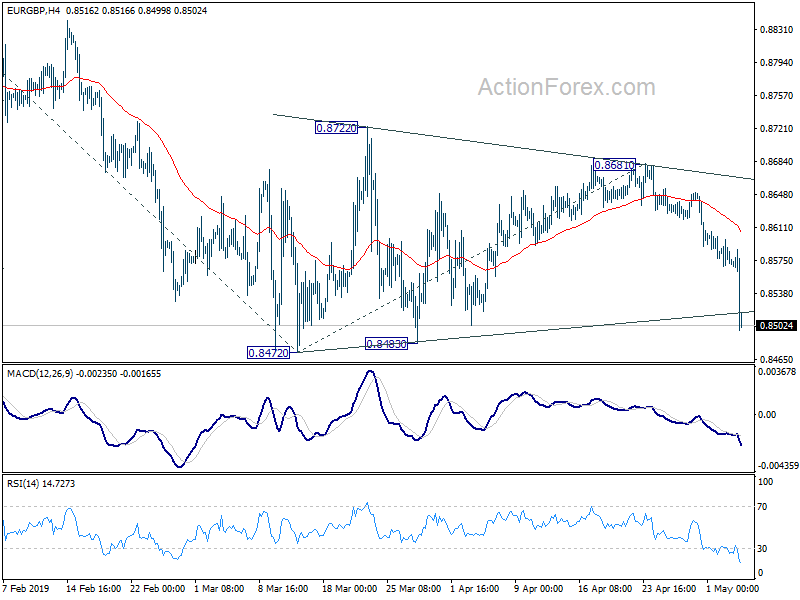
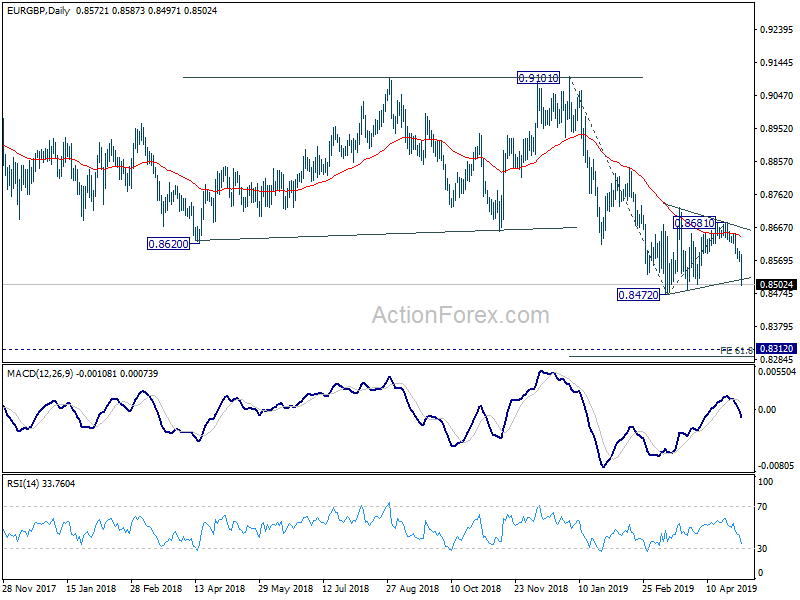
EUR/GBP will be an interesting pair to watch after last week's steep decline. Current development argues that consolidation from 0.8472 has completed with three waves up to 0.8681 already, after failing to sustain above 55 day EMA. Immediate focus is on 0.8472 support this week. Firm break there will resume the fall from 0.9101 to 61.8% projection of 0.9101 to 0.8472 from 0.8681 at 0.8292, which is close to 0.8312 key medium term support.
Dollar failed to ride on Powell's comments, sluggish inflation dragged
Dollar ended the week as the third weakest ones even though Fed Chair Jerome Powell talked down the chance of rate cut in the post FOMC meeting press conference. Weak inflation and, more important, wage growth, dragged down the greenback.
The FOMC rate decision itself was rather listless. Policymakers decided unanimously to keep the target range for the fed funds rate unchanged at 2.25-2.50%. Meanwhile, the IOER was lowered to 2.35% from 2.4%. The slight change in the accompanying statement showed a more upbeat assessment on the economic developments, despite softening inflation.
Powell elaborated at the press conference, the members “suspect that some transitory factors may be at work” regarding the recent slowdown in inflation. As such, the baseline view remains that, “with a strong job market and continued growth, inflation will return to 2% over time and then be roughly symmetric around our longer-term objective”. Meanwhile, Powell suggested that risks to global economic outlook “have moderated somewhat”. Most importantly, Powell noted that “our policy stance is appropriate at the moment” and emphasized “we don’t see a strong case for moving it in either direction."
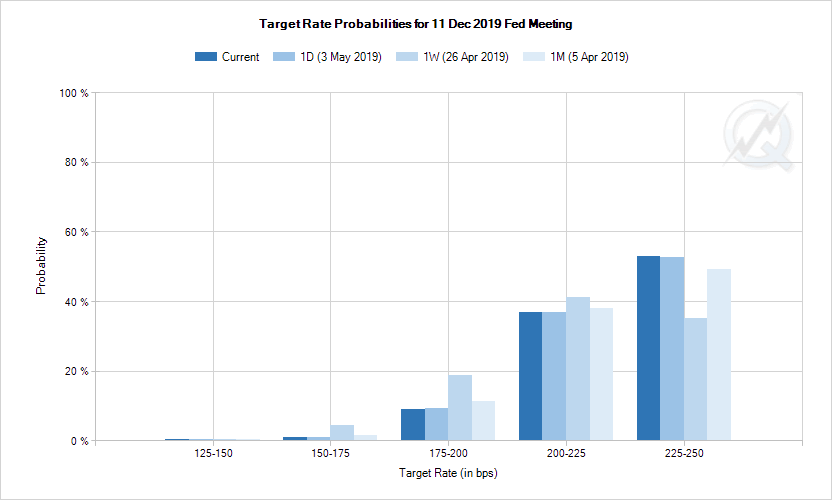
Markets' bet on rate cut receded after the comments. As of end of Friday, fed funds futures are pricing in on 47% chance of a cut by December meeting, comparing with 75% chance a week ago.
Employment data were also strong too. Non-farm payroll employment grew strongly by 263k in April, well above expectation of 185k. Unemployment dropped to 3.6%, lowest level since December 1969. But that was more due to drop in participation rate by -0.2% to 62.8%. Wage growth however, disappointed as average hourly earnings rose 0.2% mom, below expectation of 0.3% mom.
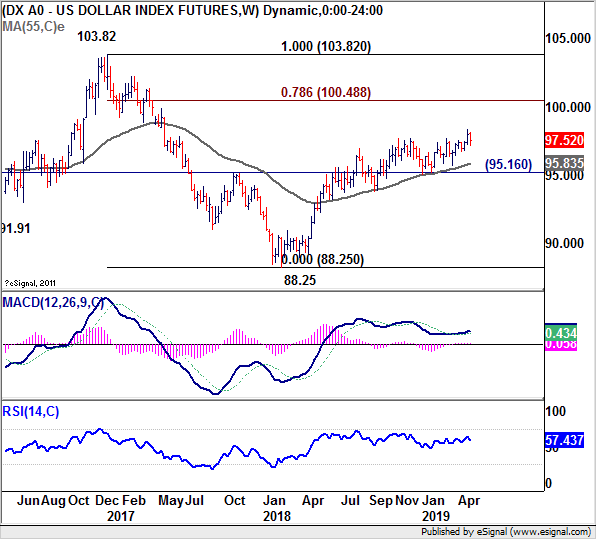
Further rise remains in favor in Dollar index in medium term as long as 95.16 support holds. But based on current weak momentum, strong resistance could be seen at around 100 handle, which is close to 78.6% retracement of 103.82 to 88.25 at 100.39 to limit upside. And break of 95.16 will be a strong sign of bearish reversal.
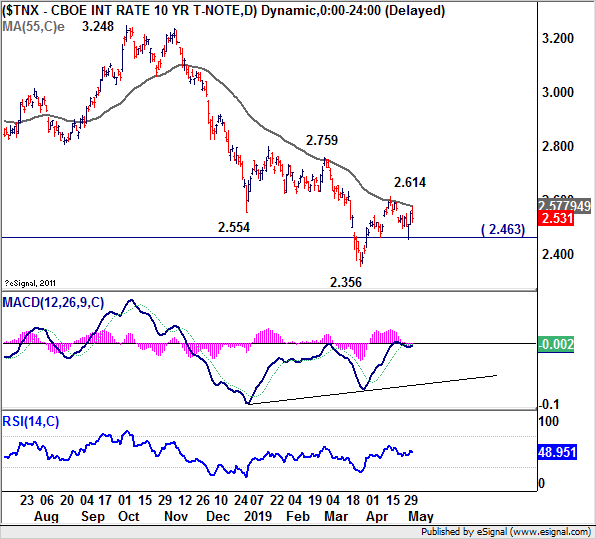
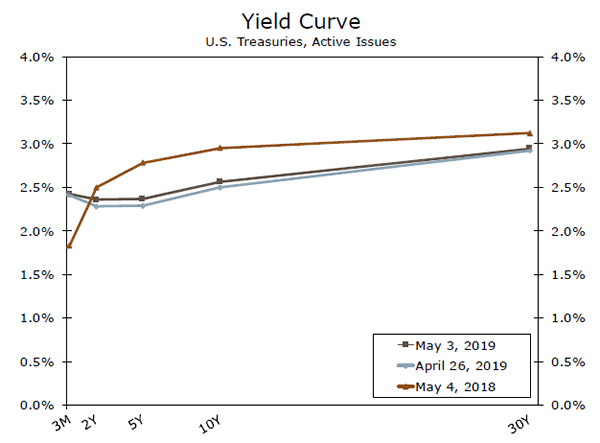
10-year yield was also rather in decisive. TNX drew support from 2.463 last week and rebounded. But then, it failed to break through falling 55 day EMA again on another attempt. Near term outlook is mixed for now. On the downside, firm break of 2.463 should add much credence to case that fall from 3.248 is resuming through 2.356 low. However, considering, bullish convergence condition in daily MACD, firm break of 2.614 resistance will be a strong indication of bullish trend reversal. It may takes a while for the picture to clear itself.
RBNZ to cut this week, would RBA do too?
Australian and New Zealand Dollar were the two weakest currencies last week. Both were pressured by expectations of rate cut by respective central banks. RBNZ has turned dovish for some time, and Q1 inflation and employment data added further support for a cut in May. Must weaker than expected Australian CPI also added to the case of an RBA cut. Additionally, weaker than expected China PMIs also raised doubt that the seasonal recovery in March was just false dawn.
Both central banks will meet this week. RBNZ is almost sure to cut. RBA will come first opinions are divided on whether it will act now, or wait till August meeting. We believe it all depends on the new economic projections to be previewed on Tuesday with the statement, with details on Friday. If RBA does forecast sharp deterioration in inflation, there should be enough reason for a pre-emptive cut. Otherwise, it could just turn a bit dovish to pave the way for a move later in the year.
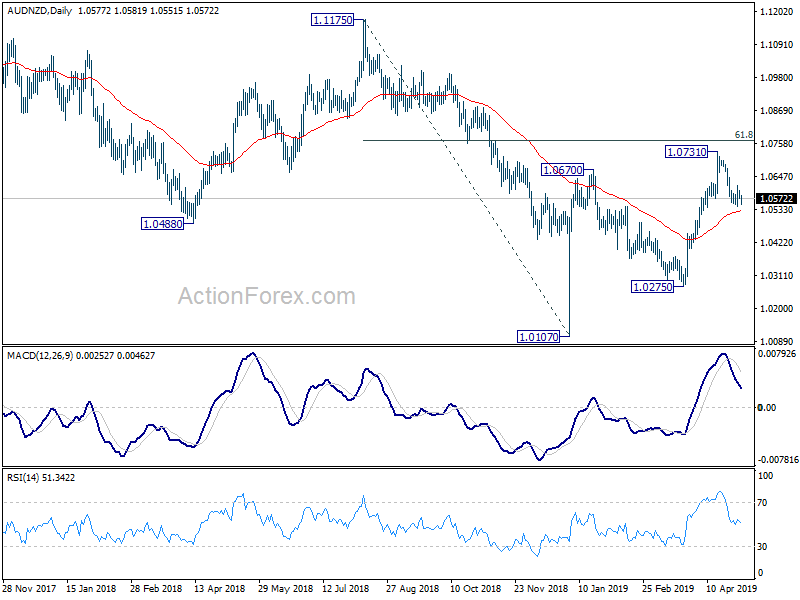
The outcome for AUD/NZD is rather uncertain, very much depending and what RBA would do. For now, AUD/USD's pull back from 1.0731 is seen as a corrective move only. And rise rise from 1.0107 flash crash low is in favor to extend through 61.8% retracement of 1.1175 to 1.0107 at 1.0767. However, sustained break of 55 day EMA (now at 1.0530) will argue that the rise from 1.0275 has completed. Deeper decline will be seen back to retest 1.0275. That would also open the case that rebound from 1.0107 has totally completed ahead of 1.0767 fibonacci resistance.
GBP/USD Weekly Outlook
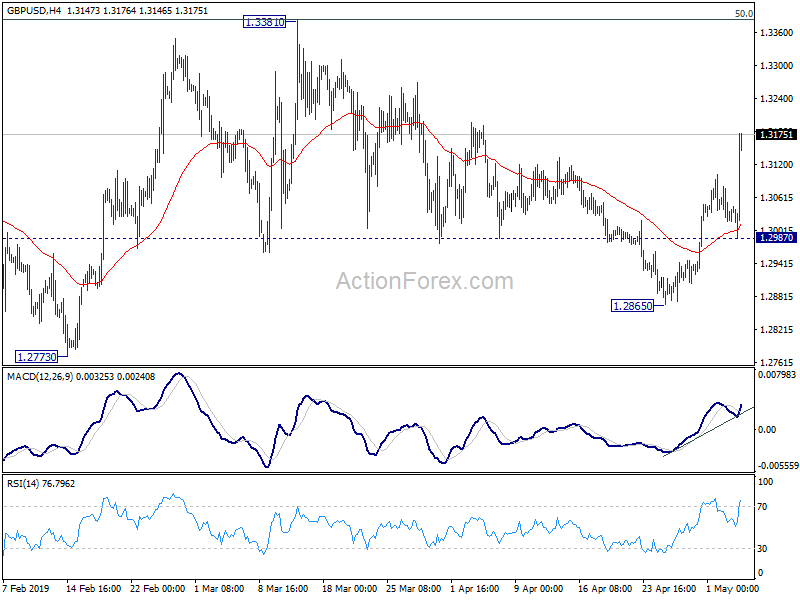
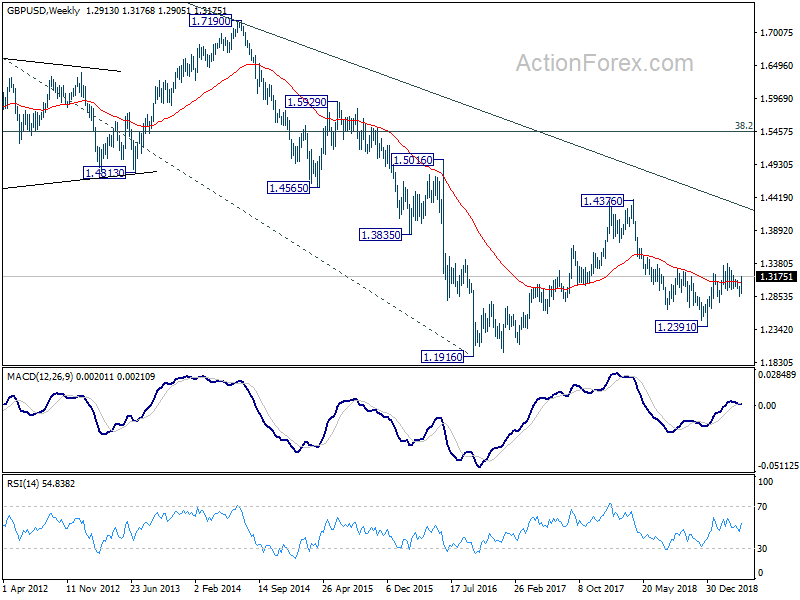
GBP/USD's strong rally last week suggests that corrective decline from 1.3381 has completed at 1.2865 already. Also, 1.2774 key support level was defended. Rise from 1.2391 is likely in progress. Intraday bias is now on the upside this week for retesting 1.3381 high. On the downside, below 1.2987 minor support will turn bias back to the downside for 1.2865 support instead.
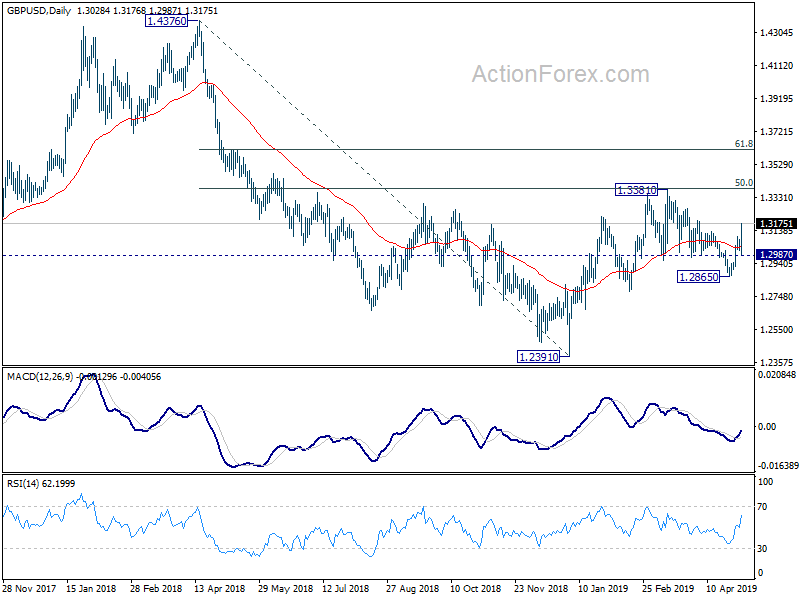
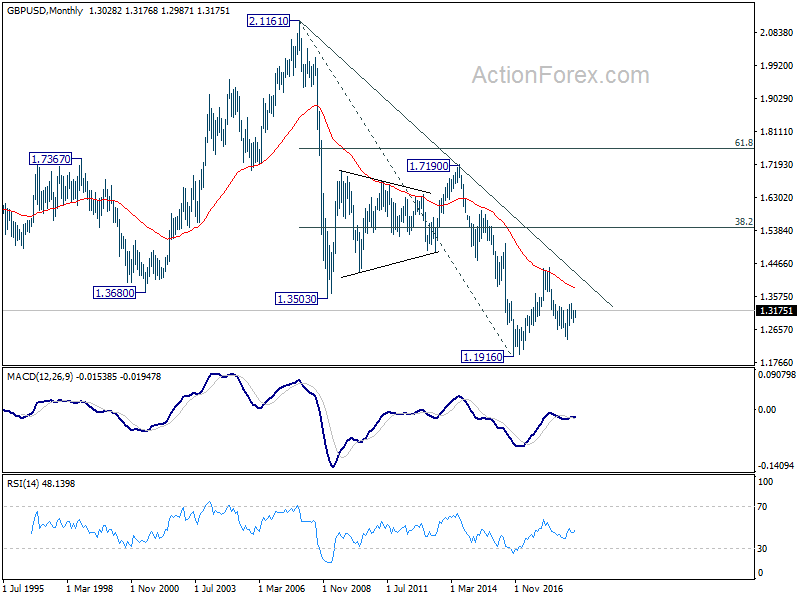
In the bigger picture, medium term decline from 1.4376 (2018 high) halted and made a medium term bottom after hitting 1.2391. Rebound from 1.2391 is seen as a corrective move for now. In case of another rise, strong resistance could be seen around 61.8% retracement of 1.4376 to 1.2391 at 1.3618 to limit upside. On the downside, break of 1.2773 support will suggests that such corrective rise is completed and bring retest of 1.2391 low first.
In the longer term picture, consolidative pattern from 1.1946 (2016 low) is still in progress. For now, we'd expect any downside attempt to be contained by 1.1946 low first. But decisive break of 38.2% retracement of 2.1161 (2007 high) to 1.1946 at 1.5466 is needed to indicate long term reversal. Otherwise, an eventual downside breakout will remain in favor.
Summary 5/6 – 5/10
Monday, May 6, 2019
[php_everywhere instance="1"]
Tuesday, May 7, 2019
[php_everywhere instance="2"]
Wednesday, May 8, 2019
[php_everywhere instance="3"]
Thursday, May 9, 2019
[php_everywhere instance="4"]
Friday, May 10, 2019
[php_everywhere instance="5"]
Weekly Economic and Financial Commentary: The Economy is Not in Danger of Stalling Anytime Soon
U.S. Review
The Economy is Not in Danger of Stalling Anytime Soon
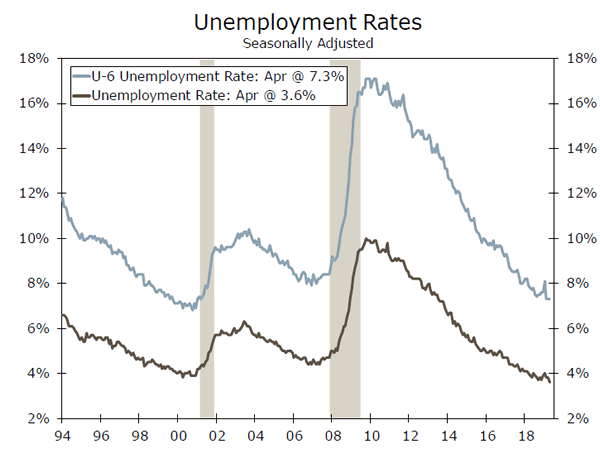
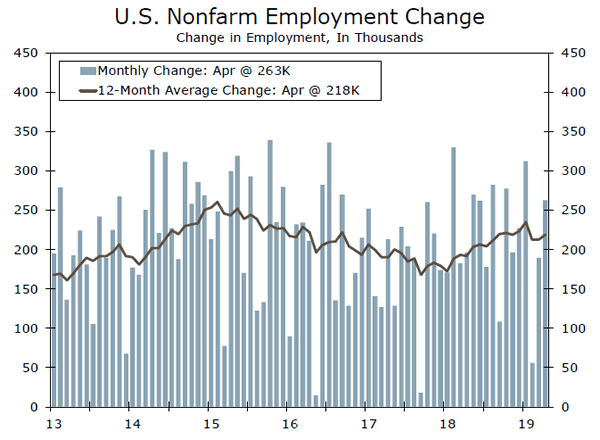
- Employers surpassed expectations, adding a whopping 263,000 jobs in April. The unemployment rate trended lower to 3.6%, but that was due entirely to a drop in the labor force participation rate. Nonetheless, the jobs market remains tight.
- Following the dip in the core PCE deflator, the FOMC has maintained its pledge to be patient, and left rates unchanged this week. For a detailed look at inflation, and whether the recent softness is, as Powell characterized it, “transient” we direct you to our Topic of the Week section on Page 7.
- Our main take this week: Despite the labor market remaining tight, with inflation low we still expect the FOMC to refrain from raising rates this year.
The Economy is Not in Danger of Stalling Anytime Soon
We wrote last week that the underlying details of economic growth in the first quarter were not as strong as the headline GDP growth rate would suggest. While we stand by that deduction, data this week confirm our second stated conclusion: the economy is not in danger of stalling anytime soon.
There were two events that captured markets’ attention this week: the FOMC policy meeting and the April nonfarm payrolls report. The meeting was of particular focus, not because of the widely expected outcome for rates to be left unchanged, but for any changes in the policy statement and Powell’s post-meeting press conference. The notable change to the statement was the downgrade to the inflation assessment, which followed the drop in the core PCE deflator to 1.6% on a year-ago basis in March—the lowest level in a year and a half. When questioned about the recent weakness in inflation, Powell emphasized “transient” factors as the culprit behind the pull-back. Is the recent weakness in inflation exaggerated relative to its trend? Please see our Topic of the Week on page 7 for further analysis of this topic.
Here we turn your attention to the other end of the Fed’s dual mandate—employment. Employers added a whopping 263,000 jobs in April—beating the consensus expectation of a 190,000 job gain. The unemployment rate fell to 3.6%, the lowest in almost 50 years. But, the underemployment rate, which includes those marginally attached to the labor force, held steady at 7.3%, and average hours worked nudged down to 34.4 hours. The drop in unemployment therefore stems entirely from the give-back in labor force participation.
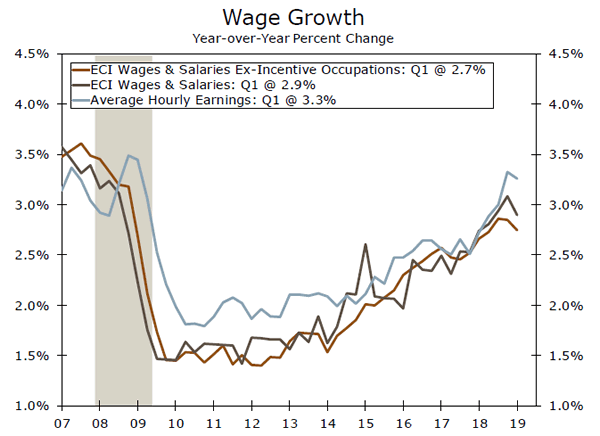
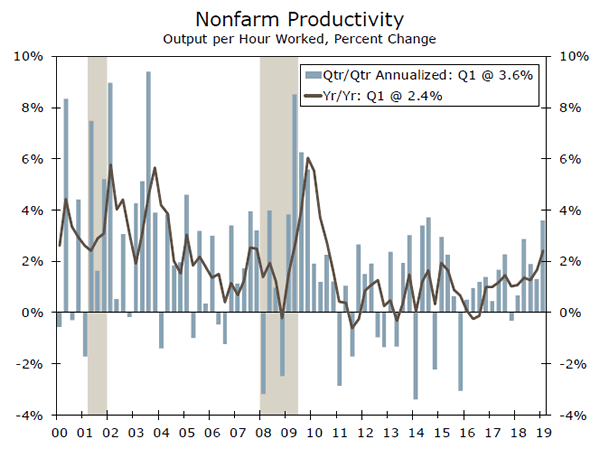
In a recent report we discuss how the recent rebound in participation, which has kept wage pressures from building to the point where labor costs would set off higher inflation, has provided the FOMC another reason it can be patient with additional rate hikes. Indeed, average hourly earnings rose only 0.2% in April from the prior month. But given they were likely held down by the timing of the survey week as well as more working days than average last April, we expect the upward trend in average hourly earnings to resume over the next couple of months. More broadly, the first look at the employment cost index in the first quarter suggested employment costs remained in line with the recent trend. With the labor market still tight, we expect to see labor costs pick up a bit in coming quarters. Even such, the trend is likely to remain fairly tame, and not pose much threat to inflation, especially given the rebound in productivity. Indeed, productivity leaped 3.6% in the first quarter, which was the strongest gain since Q3-2014. Productivity is expected to moderate in coming quarters, but will prevent gains in unit labor costs from driving inflation above the FOMC’s target. So, despite the labor market remaining tight, with inflation low we still expect the FOMC to refrain from raising this year.
With low inflation and the continued increase in payrolls and wages, real consumer spending looks to rebound from the 1.2% rate registered in the first quarter. Further, personal spending surged 0.9% in March; the largest one-month increase since 2009. Perhaps of more consequence, the bump in March spending gives PCE momentum headed into the second quarter, and likely puts to bed any lingering worries of a prolonged retrenchment in spending, which was perhaps suggested by the still-curious drop in December spending.
U.S. Outlook
JOLTS • Tuesday
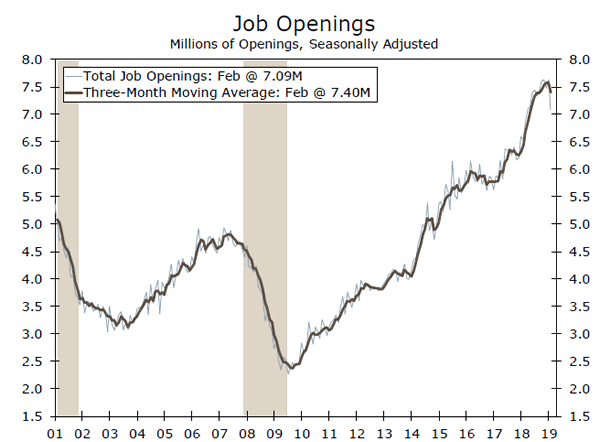
As recently as November of last year, the number of job openings was riding high, comfortably north of 7.5 million jobs and setting a new record. However, the number of available jobs has slowed since then with 7.09 million job openings reported in February.
When March numbers are released on Tuesday, there are mixed signals for what to expect. This week’s consumer confidence report showed that consumers’ impression of jobs being plentiful rose more than 4 percentage points in April after slipping a few points in March. The JOLTS report is for March, so it is unclear whether or not we will see the improvement reflected here. Weekly jobless claims figures have been spotty as well and offer no firm signal.
The labor market is still historically tight, but questions have arisen in recent weeks about a potential loss of momentum. The JOLTS report will provide the latest data points to consider that debate.
Previous: 7.09M Consensus: 7.35M
International Trade • Thursday
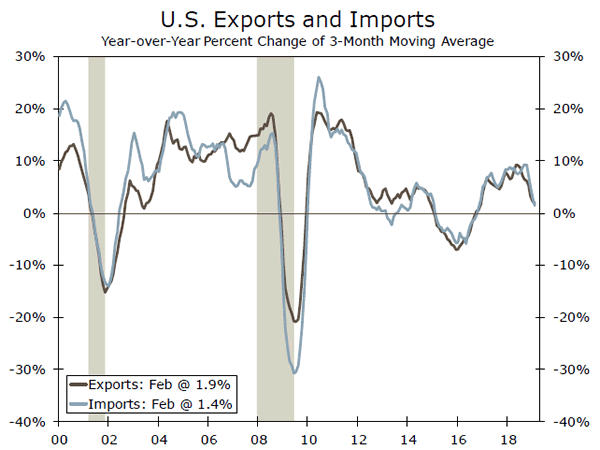
Trade added a full percentage point to GDP growth in Q1. In four out of the five prior quarters, trade was a net drag on the economy. The BEA has to estimate the March trade numbers in its advance GDP estimate, so when the actual trade figures for March print on Thursday of next week we will get a sense of how close those estimates came. We expect to see a modest widening in the trade deficit for March.
As the nearby chart shows, both import and export growth have been slowing on trend since the expansion of trade tariffs went into effect late last year. This has occurred alongside a drying up in global trade that has pulled global export volume growth into negative territory, a key factor identified by the IMF in its most dour forecast for global GDP growth since the global recession.
Previous:-$49.4B Wells Fargo: -$51.3B Consensus: -$51.2B
CPI • Friday
After raising rates four times last year and despite having guided expectations toward further rate hikes in 2019, the Fed pivoted and, citing a need for patience, opted to sit on hold so far this year and has even played down expectation, for any rate hike this year.
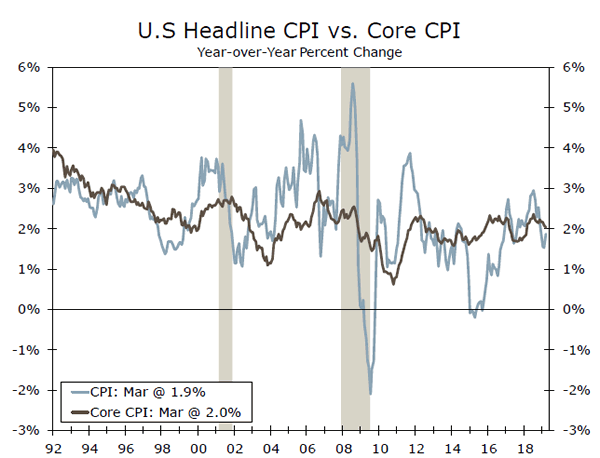
The Fed’s shift can be explained, at least in part, by the deterioration in the inflation numbers. A recent example: we learned earlier this week that the PCE deflator came in at just 1.5% year-over-year and the core deflator came in at 1.7%, which was below already modest expectations.
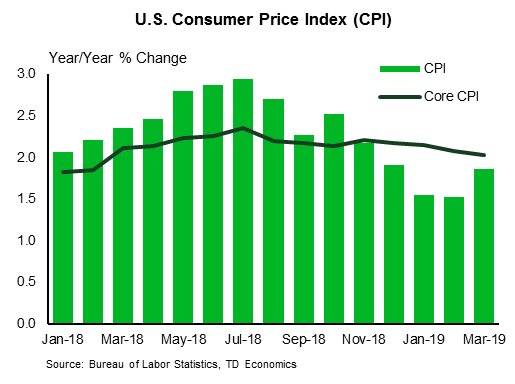
The CPI measure, which takes a basket-of-goods approach as opposed to actual spending, has been running a little hotter. On Friday of next week, we get the latest read on CPI inflation and expect to see both headline and core come in at 2.1% year-over-year.
Previous: 1.9% Wells Fargo: 2.1% Consensus: 2.1% (Year-over-Year)
Global Review
ECB and BoE Likely Still on Hold
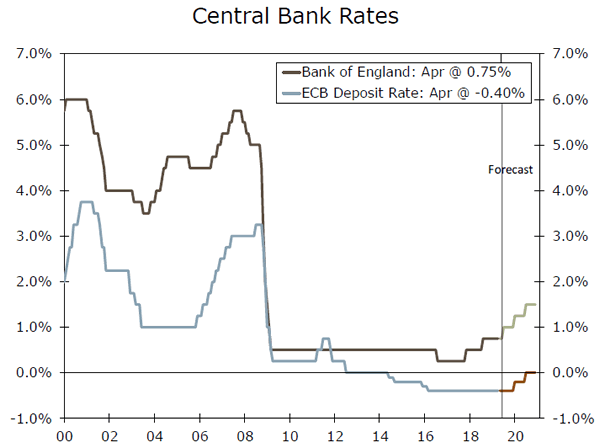
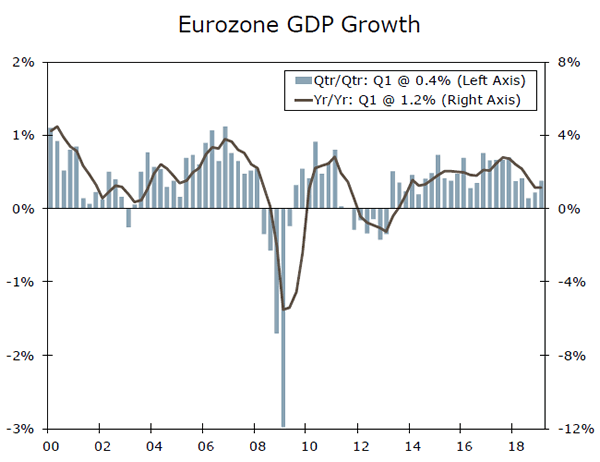
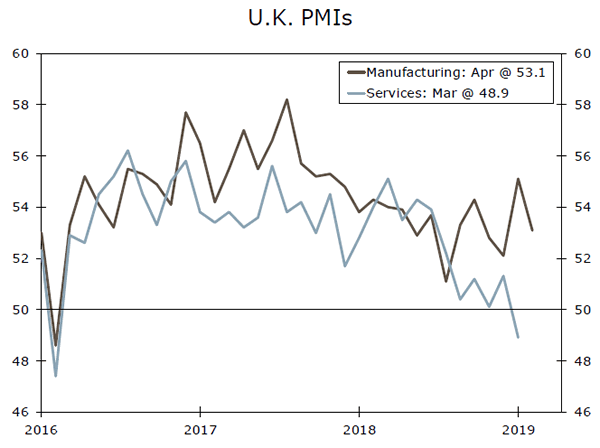
- Eurozone GDP rebounded in Q1, with the broader European economy avoiding recession and showing some improvement, while U.K. PMIs experienced slight declines. Despite improved data, we believe the Eurozone is not out of the woods yet and the ECB is on hold for now, while the Bank of England may look to hike rates if an orderly Brexit materializes.
- Chinese PMIs experienced a slight decline in April, although manufacturing and non-manufacturing PMIs remain in expansion territory. We expect the economy to gradually slow; however, additional stimulus measures and a potential trade deal with the U.S. will likely help China avoid a hard landing.
Eurozone Economy Shows Some Stability
GDP growth in the Eurozone outperformed expectations this week, with the broader European economy steering away from recession. Q1 data revealed the Eurozone grew 0.4% quarter-over-quarter, higher than consensus forecast of 0.3%. This week’s data provided markets with some optimism for ongoing growth across Europe, as Italy officially exited technical recession, while Spanish GDP growth firmed to 0.7%. Also contributing to the improved sentiment was the final Eurozone manufacturing PMI for April, which was revised slightly higher, while Germany, Spain and Italian manufacturing PMIs all improved. Despite improved GDP and sentiment data, we still believe it is too early to call for a turn to robust growth for the European economy. While the manufacturing PMI recovered in April, it still remains in contraction territory. We continue to believe the ECB will keep policy rates on hold until a stronger recovery starts to materialize, and will eventually look to hike rates starting in Q1-2020.
U.K. Economy Resilient Despite Brexit Headwinds
Sentiment data in the United Kingdom were also released this week, with the April manufacturing PMI falling to 53.1, down from 55.1 in March. The decline in the manufacturing PMI was largely expected, and we believe the U.K. economy will remain resilient despite the challenges that Brexit presents. As of now, we think the U.K. economy will grow around 1.3% in 2019, and given our view for a Brexit deal to eventually be made and uncertainty to be lifted off the U.K. economy, we see a pickup in growth heading into 2020. The Bank of England (BoE) reflected this view at its meeting this week, raising its GDP forecasts for this year as well as in 2020. Although citing a “no-deal” Brexit as still a possibility, BoE policymakers also suggested that interest rates would likely need to be raised more than markets are currently anticipating if a smooth Brexit were to occur. As of now, markets are currently pricing around one full 25 bps rate hike over the next 24 months. We share a similar perspective and maintain our view that the BoE will begin to hike rates after a Brexit deal is agreed upon (likely by Q4 of this year), with the first rate hike likely to come in early 2020.
Stimulus Measures Likely to Support China’s Economy
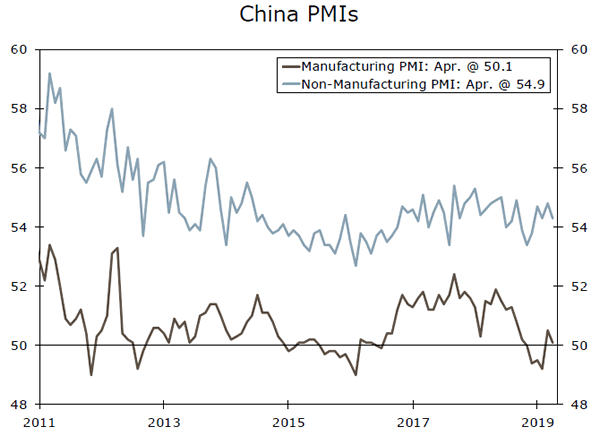
China PMIs were weaker than expected in April, with the official manufacturing PMI falling to 50.1, while the Caixin manufacturing PMI unexpectedly softened to 50.2. The services PMI also declined unexpectedly in April, falling to 54.3; however, it remains comfortably in expansion territory. Despite the weaker-thanexpected PMIs, we continue to believe the slowdown in China’s economy will be gradual. Chinese authorities continue to suggest that additional stimulus measures may be introduced into the economy, while some economic activity data indicate current stimulus efforts may be starting to have an effect on the economy. While the prospects for a long-term trade deal between China and the United States remain encouraging overall, recent headlines have been slightly mixed. A trade deal, along with additional stimulus, would likely stabilize China’s economy and keep GDP growth above 6% for the time being. As of now, we forecast GDP in China to grow at 6.2% in 2019 and to slow slightly to 6.0% in 2020.
Global Outlook
Reserve Bank of Australia • Tuesday
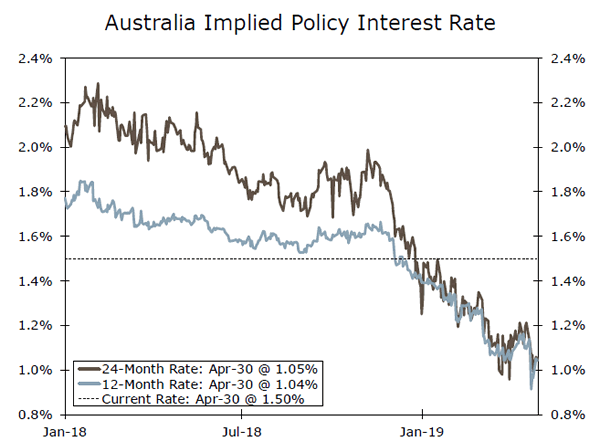
The Reserve Bank of Australia (RBA) will meet next week to make its latest monetary policy assessment. Australian economic data have been relatively soft as of late, with a deteriorating domestic housing market weighing on the country’s growth prospects. Recent CPI inflation data reflect the slowdown as well, with the Q1 CPI softening to 1.3% year-over-year, much lower than the consensus forecast, and a sharp slowdown from Q4. The Reserve Bank of Australia has noted the deceleration in the economy, with recent commentary more dovish than markets had expected. A weaker-than-expected inflation print will likely result in additional dovish statements from the RBA, while we will be focused on any indications that downside risks to the outlook are increasing. A rate cut at next week’s meeting is viewed as likely, with markets currently pricing in two policy rate cuts over the next 24 months.
Previous: 1.50% Consensus: 1.25%
Reserve Bank of New Zealand • Wednesday
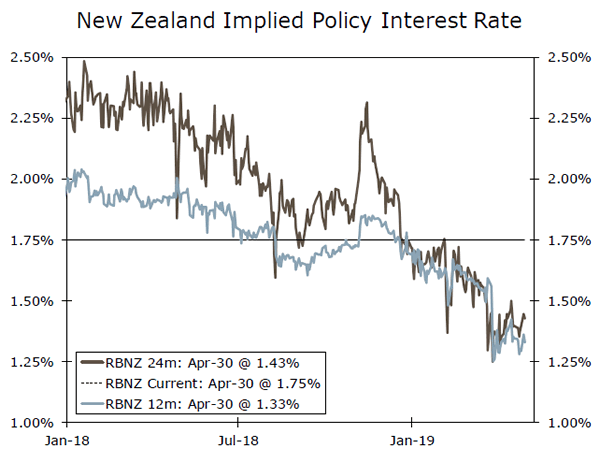
New Zealand’s economy has underperformed recently, with the most recent evidence being this week’s softer-than-expected labor market data. Despite the Q1 jobless rate falling to 4.2%, employment data were much weaker than forecast, declining 0.2% quarter-overquarter, while wage growth slowed as well. In response to a weaker economic outlook, the Reserve Bank of New Zealand (RBNZ) has turned more dovish, explicitly stating at its March meeting that the likely direction for the next Official Cash Rate move would probably be down. This week’s soft labor market data likely reinforce this bias, with markets currently expecting the RBNZ to eventually ease monetary policy as well. As of now, markets are implying about two interest rate cuts from the RBNZ over the next 12-24 months. We view a rate cut at next week’s meeting to be likely, while the consensus leans toward the central bank moving forward with a rate cut as well.
Previous: 1.75% Consensus: 1.50%
Mexico CPI Inflation • Friday
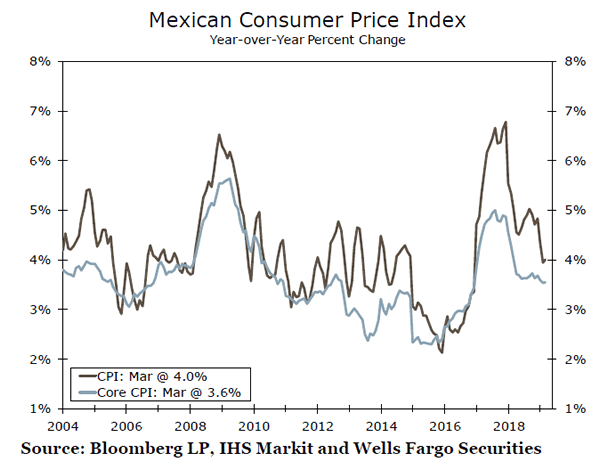
Since early 2018, CPI inflation in Mexico has been on a downward trajectory. This has primarily been a result of significant policy rate hikes from the Central Bank of Mexico, a trendless currency and relatively subdued oil prices. The economic conditions that resulted in lower inflation may start to turn, however, as the central bank is on hold for now and oil prices have moved higher. Given this, we think CPI inflation may finally start to move higher as well. In addition, the deceleration in Mexico’s economy should provide the central bank with some scope to start cutting interest rates, which might also boost inflation over time. We also expect the peso to gradually weaken, which should contribute to inflationary pressures, while we think geopolitical tensions that should pull some excess oil supply out of the market could potentially boost oil prices further. For April, we expect CPI inflation to quicken up to around 4.4% year-over-year.
Previous: 4.0% Wells Fargo: 4.4% (Year-over-Year)
Point of View
Interest Rate Watch
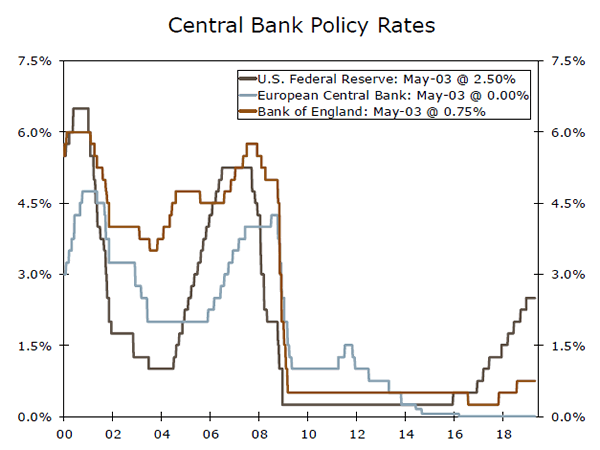
The FOMC Is Still Patient
As expected, the FOMC left the fed funds rate unchanged at its meeting this week. The committee appeared less concerned about growth than it did at its March meeting. The statement characterized GDP growth as “solid” once again, while Chair Powell expected business investment and consumer spending to bounce back in Q2, supporting “healthy GDP” growth this year.
Less upbeat in the statement was the FOMC’s read on inflation following a dip in core PCE inflation and continued weakness in inflation expectations. With inflation still flagging, the FOMC maintained its pledge to be “patient” with future adjustments to policy.
The recent slowdown in inflation has been viewed as a potential reason the FOMC may cut rates in upcoming months even as risks surrounding the growth outlook, like trade policy and a slowdown abroad, had subsided. Heading into this week’s meeting, markets had priced in about a 50/50 chance of a rate cut by the FOMC’s September 18 meeting.
Powell pushed back on the weakness in inflation, emphasizing “transient” factors as the reason for the slowdown. We agree to a large extent and discuss those factors in more detail in our Topic of the Week on the next page. With Powell indicating that he does not believe the weakness is likely to persist, and that “we don’t see a strong case for a rate move in either direction,” market expectations for a rate cut have been pared back. A 50/50 probability is not priced in until the December 11 meeting now.
However, yet again, inflation is missing to the downside of the FOMC’s “symmetric” target. Moreover, other committee members have expressed more concern about the persistent shortfall.
We see low inflation as the key reason the FOMC is likely to refrain from raising rates the rest of this year and the first half of 2020. But a rate cut this year continues to look premature, in our view. Not only is recent softness in core PCE inflation somewhat exaggerated, but financial conditions have eased considerably since the start of year, and should continue to support above-trend growth.
Credit Market Insights
Not That Kind of Cut
At its meeting this week, the FOMC announced a 5 bps cut to the interest on excess reserves (IOER) rate, yet Chair Powell made sure to emphasize that this was merely a “small technical adjustment” that should not imply any monetary policy loosening on behalf of the FOMC. The IOER, which the Fed pays to depository institutions on the excess reserves they hold at the central bank, had previously functioned as the ceiling of the fed funds target range. However, the effective fed funds rate—or the actual, marketdetermined rate on overnight interbank loans—has recently drifted up toward the top of the FOMC’s 25 bps target range for the fed funds rate, and has in fact been above the IOER for the past month. To bring the effective fed funds rate under greater control within the intended range, the FOMC has now thrice tweaked the IOER, with this week marking the first adjustment without any accompanying change to the fed funds target range. By reducing the incentive for banks to park funds at the Fed, a lower IOER thereby increases the supply of loanable overnight funds, easing upward pressure on the effective fed funds rate and helping to keep it within its intended range. We view this merely as a technical adjustment that should keep the effective fed funds rate closer to the midpoint of its target range as the Fed remains on hold. However, as we have previously written, it further raises the prospect of a reconfiguration of the Fed’s monetary policy toolkit in a post-Great Recession world.
Topic of the Week
How “Transient” Is the Slowdown in Inflation?
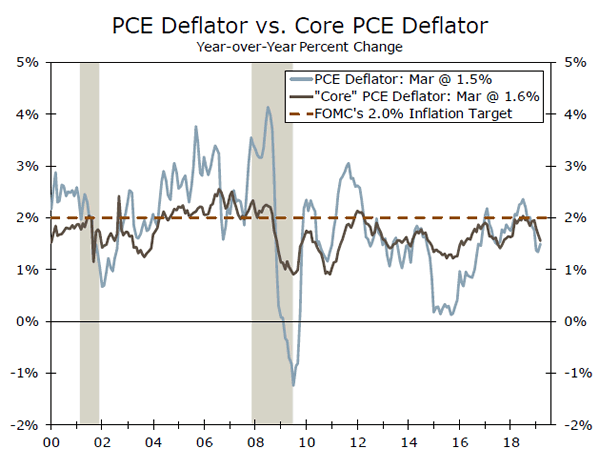
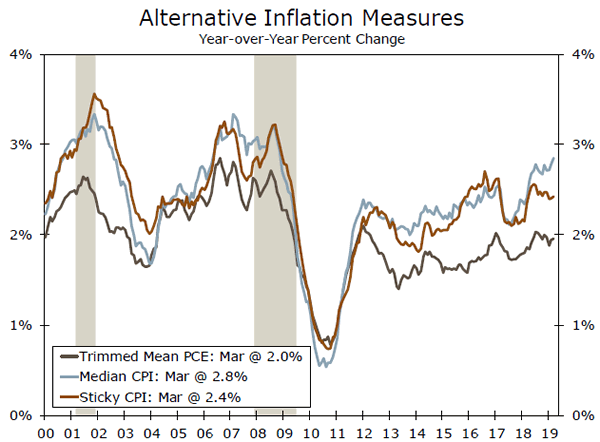
The FOMC’s preferred measure of trend inflation, the PCE deflator ex-food and energy, slipped further below the Fed’s 2% target in March, easing to 1.6% on a yearago basis. Federal Reserve Chair Jerome Powell, however, downplayed the recent easing in core inflation in his post-FOMC meeting press conference this week.
Powell characterized the recent softness as “transient,” and we agree that the weakness in inflation since the start of the year is exaggerated relative to the trend. In January, the cost of “portfolio management and investment advice” tumbled 4.6%, which was enough to shave off almost a full tenth from the core index. This is an imputed measure tied heavily, albeit with a lag, to changes in equity markets which are now at fresh highs. In addition, a new methodology was introduced for collecting prices at department stores in March, which contributed to the largest ever one-month decline in apparel prices.
Alternative measures show the trend in inflation holding up better. Powell cited the Dallas Fed’s Trimmed Mean PCE deflator, which currently sits at 2.0%. In the Trimmed Mean PCE, items are sorted based on their monthly price change, with items at the tails of the distribution thrown out. Unlike a traditional “core” index, food and energy can therefore be included if monthly changes are moderate. The Atlanta Fed’s Sticky CPI has also been steady in recent months. The index captures items that do not change prices frequently and therefore helps filter out the “noise” of recent moves. Meanwhile, the median price change within the CPI has strengthened.
The resilience of the alternative inflation indexes suggests the slowdown in the core PCE deflator overstates recent weakness in inflation. Nevertheless, inflation continues to come up short of the FOMC’s target. Although likely to edge back up in the coming months, we do not expect the core PCE deflator to re-visit 2.o% this year. Even as the labor market continues to tighten, the pickup in productivity growth has kept inflation pressures muted, while historically low inflation expectations point to price changes remaining modest.
The Weekly Bottom Line: Inflation Undershoots, Jobs Overshoot, Fed Stays Put
U.S. Highlights
- Apart from vehicle sales, recent data paint a positive narrative for consumer-related industries at the start of spring. Real consumer spending and pending home sales surged in March, while consumer confidence improved in April.
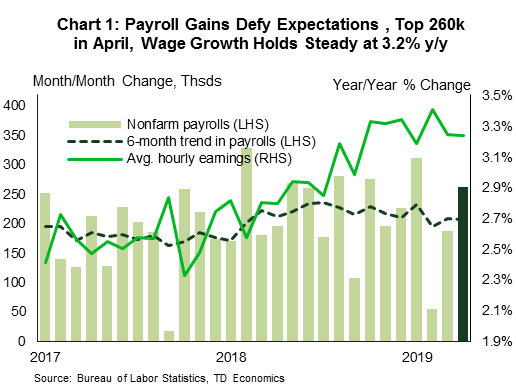
- Payrolls were up 263k in April, much better than expected; wage growth held steady at 3.2% y/y and the unemployment rate fell to a near-50 year low of 3.6%. A drop in the labor force participation rate assisted the latter.
- The Fed held rates steady this week, with an emphasis put on inflation running below target. But in the press conference, Fed Chair Powell noted that inflation was driven down by "transient" factors, adding that there is no strong case "for moving in either direction". Indeed, for now, all of the tea leaves suggest that the Fed will remain on hold for some time.
Canadian Highlights
- It was a soft week for Canadian markets, partially reflecting a generally lackluster view on near-term economic prospects.
- This was confirmed in the data. Economic activity pulled back in February, setting the economy up for another soft quarterly expansion to start 2019.
- Early data for the second quarter also points to softness, with April auto sales falling month-on-month for the first time in three months alongside a weak PMI report. Growth acceleration still appears likely, but it now looks more like another sub-trend performance is in store.
U.S. - Inflation Undershoots, Jobs Overshoot, Fed Stays Put
It was a busy week for those keeping a careful watch on the U.S. economy. A volley of first-tier economic data and an FOMC rate decision took center stage, while trade developments reverberated in the background.
While the consumer had a soft showing overall in the first quarter, a two-month data dump this week provided added detail on recent momentum. Real consumer spending was flat in February, before surging 0.7% in March. This spending upswing points to consumers shaking off the adverse effects of the prolonged government shutdown, and provides a solid handoff to consumption in the second-quarter.
The (mostly) positive narrative on consumer-related industries at the start of spring was further bolstered by a 3.8% m/m surge in pending home sales in March and a pickup in consumer confidence in April. The former leads existing home sales by 1-2 months, and points to further stabilization in the housing market. However, vehicle sales were disappointing, falling 6% m/m in April to 16.4M units. Despite this, overall consumer spending is still tracking a 3% annualized pace in the second quarter, a sharp acceleration from the 1.2% clip in the first quarter. This will provide support to overall economic activity as other temporary factors that boosted growth in the first quarter fall off.
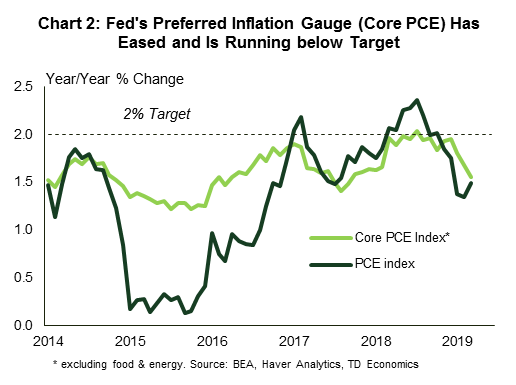
Healthy consumer spending is being supported by a strong labor market. Payrolls rose 263k in April, beating expectations (190k) once again (Chart 1). The jobless rate moved down to a near-50 year low of 3.6%. However, that was driven by a disappointing decline in the labor force participation rate. Wage growth held steady at 3.2% y/y. But with softer inflation (see Chart 2), wage gains look even better in real terms. Given the current tightness, we expect wage pressures to remain, but job gains to slow to a more sustainable sub-150k per month through the remainder of 2019.
Rounding out the April data reports were the ISM indices. Both moderated on the month but continue to hover around the 55-point mark, which is in tune with the broader narrative of slower, but still decent, growth this year.
With the labor market and economic growth not looking too shabby, inflation remains the Fed's key concern and main reason for holding rates steady, as it did this week. The FOMC statement emphasized that inflation has run below target. But in the press conference, Fed Chair Powell noted that inflation was driven down by "transient" factors, adding that there is currently no strong case "for moving in either direction". We agree with the Fed's assessment. Given that inflation has persistently undershot the Fed's target, it would take a notable acceleration in price pressures to push the Fed to hike. We do not expect inflation to accelerate that quickly, and all of the latest data support our view that the Fed is likely to remain on hold for quite some time.
Canada - Slump Prolonged
It was something of a down week for Canadian markets. The S&P/TSX composite index fell gradually through the week, while the loonie, despite some mid-week swings, looks set to end the week close to where it began. In oil markets, the benchmark WTI contract fell roughly US$2 per barrel to $61, within the range that we expect to persist for the next while. From a Canadian oil perspective, we look for the heavy oil discount to widen somewhat, consistent with the economics of crude by rail, which, for the time being, seems like the only game in town for getting a marginal barrel of oil to market. This will have a modestly negative impact on revenues, but should help clear out still sizeable inventories.
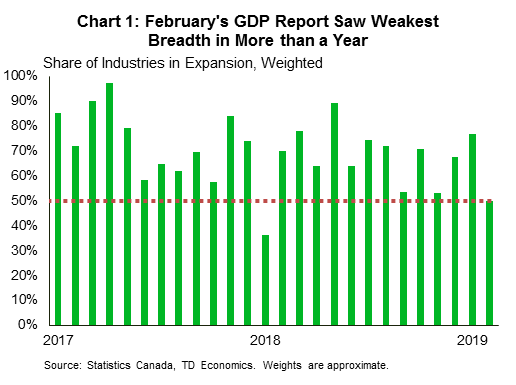
On the data front, the main event this week was monthly GDP, which came in below market expectations for a flat print, contracting by 0.1% month-on-month (See commentary). Weather was partially to blame, causing issues in the transportation and real-estate sectors, among others, but doesn't explain all of the weakness. Mining activity dropped again, and the broader mining, quarrying, oil & gas sector is now down 5% year-on-year. The breadth of the pullback was best evidenced by the share of growing industries hitting its lowest level in more than a year (Chart 1).
The GDP data appears to confirm what we'd been suspecting: that the Canadian economy likely again struggled to eke out growth at the start of the year. We now track first quarter growth at 0.6% q/q, annualized, just a bit above the Bank of Canada's 0.3% view. If there is a silver lining, it is that some of the details look decent, with signs of life in investment after a disappointing 2018. Nevertheless, with the first half of the year shaping up to come in soft, the Bank of Canada's more dovish turn seems appropriate.
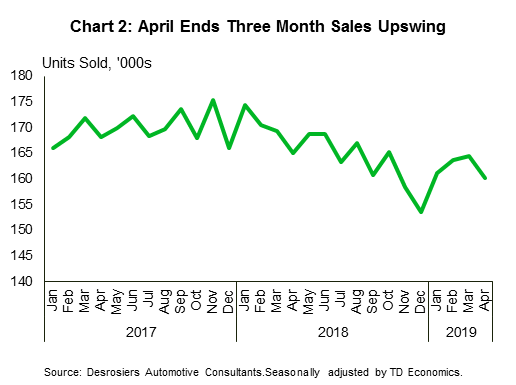
More signs of first-half softness were evident in the very early indicators for the second quarter. Canadians bought fewer cars in April, once seasonal variation is taken into account (Chart 2). The three-month upswing we saw at the start of the year has come to an end, and the level of sales now sits more or less in line with the downtrend that began last year. To be sure, this data can be noisy, so we shouldn't read too much into a single month, but it hardly provides a positive start to the second quarter.
Other, relatively second-tier data also indicated softness. April housing resale activity in Vancouver fell 29.1% year-on-year, with the benchmark price dropping 8.5%, and the Markit Manufacturing Purchasing Managers Index (PMI) fell below the 50 'no-change' mark for the first time since early 2016 on weak details. We won't get too carried away with this data – it is worth noting that despite soft housing markets (resale activity fell 32% last year), British Columbia's economy overall turned in an impressively strong growth performance last year, expanding 2.4% on fairly broad-based strength. All this is to say that some of the challenges facing the Canadian economy are unlikely to be resolved quickly, so expect the subpar performance to continue for a bit longer - it's a slow slog back home.
U.S.: Upcoming Key Economic Releases
U.S. Consumer Price Index - April
Release Date: May 10, 2019
Previous: 0.4% m/m; core 0.1% m/m
TD Forecast: 0.4% m/m; core 0.2% m/m
Consensus: 0.4% m/m; core 0.2% m/m
We look for headline CPI to pick up two tenths to 2.1% in April on the back of a strong 0.4% seasonally-adjusted monthly increase. The main driver behind the monthly gain is another sizable jump in gasoline prices (+10.2% m/m). Furthermore, we anticipate core CPI inflation to register another "soft" 0.2% m/m gain (2.1% y/y), as a firm 0.2% increase in core services prices will likely offset a third consecutive monthly decline in prices in the core goods segment (which we pencil in at -0.1% m/m). We expect OER to remain largely steady at 0.3% m/m and for the ex-shelter segment to improve marginally on a monthly basis.
Canada: Upcoming Key Economic Releases
Canadian Housing Starts - April
Release Date: May 8, 2019
Previous: 192.5k
TD Forecast: 197k
Consensus: N/A
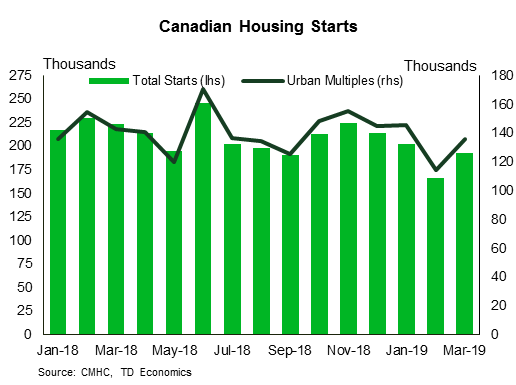
TD looks for housing starts to rise to a 197k pace in April on pickup in both single and multi-unit construction. Permit issuance for single family homes has started to recover from post-crisis lows, suggesting some more upside to construction activity after starts registered their first increase since November last month. We also see scope for further gains in multi-unit starts even after a 20% rebound last month; multi-unit urban starts remain well off their peak from mid-2018 and while we are unlikely to retest such levels anytime soon, low vacancy rates and affordability constraints continue to underpin demand for apartment units.
Canadian International Trade - March
Release Date: May 9, 2019
Previous: -$2.90bn
TD Forecast: -$2.30bn
Consensus: N/A
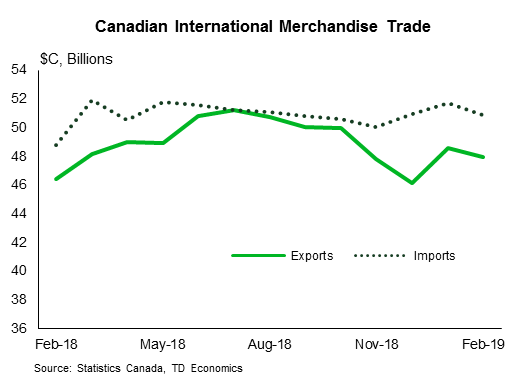
TD looks for the merchandise trade deficit to narrow to $2.3bn in March, helped by a further recovery in crude oil prices and a rebound in non-energy exports following the broad pullback last month. Adjusted to Canadian dollars, WTI prices rose by 7% in March while WCS prices rose by 12%. However, energy export volumes will be challenged by tight WCS spreads which continued to hold near $10 throughout the month, a level that discourages rail shipments while pipelines continue to operate at full capacity. We also expect a broad recovery in non-energy exports from March although forestry products should remain under pressure due to continued weakness in residential construction south of the border. Stronger exports should be partially offset by a pickup in import activity while real export growth will come in well below the nominal advance due to higher industrial prices.
Canadian Employment - April
Release Date: May 10, 2019
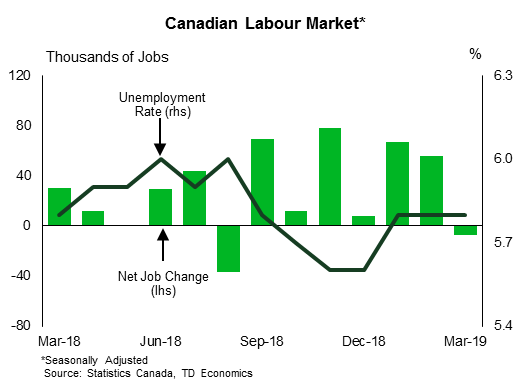
Previous: -7.2k, unemployment rate: 5.9%,
TD Forecast: -10k, unemployment rate: 5.9%
Consensus: N/A
TD looks for the economy to give back 10k jobs during month of April, which will help nudge the pace lower after averaging 36k for the six months through March. We have argued that recent labour market gains are unwarranted by current economic backdrop, and while it is difficult to predict the timing of a giveback, we think this tilts the risks towards a soft print. Full-time employment should drive the pullback, which will add to the downbeat tone of the report, while the goods-producing sector should account for most of the jobs lost during the month with manufacturing in the spotlight after Markit PMI tipped into contractionary territory for the first time in three years. Job losses of 10k should see the unemployment rate edge higher to 5.9% assuming modest labour force growth while we expect wage growth to hold at 2.3% y/y.
Dollar Softens on Wage Focus; RBA and RBNZ Easing Eyed
The US dollar reversed earlier gains on a blockbuster headline employment number as market participants focused on the slightly lower than expected wage growth. The nonfarm payroll report showed April employment created 263,000 new jobs, well above all estimates. Wage growth for the prior year slowed to 3.2%, down from the 3.4% high of the current cycle. The US economy remains the most attractive spot for equity traders, but the greenback may be at a critical turning point. The US dollar may take a backseat at the start of the week as the focus shifts to live rate decisions from the RBA and RBNZ.
- Earnings – Softbank, Disney, Toyota, Tyson Foods, and Anheuser-Busch Invev on tap
- AUD – RBA to switch to an easing bias
- RBNZ – First cut expected in over two years
- Mexico – Higher inflation to support bank’s tightening bias
- Oil – Demand arguments improve on strong US data
- Gold – Fifth weekly decline in six weeks
Earnings
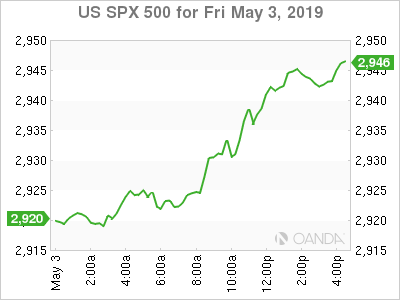
Roughly 10% of the S&P 500 companies will report earnings in the last full week of earnings results. Technology earnings will come from SoftBank, Wirecard and JD.com. Toyota, Honda, BMW, and Subaru will wrap the automobile results. Big media names, such as Disney, Viacom and News Corp will report as well.
Heading into the final week, Financials and Technology stocks have outperformed this earnings season, delivering 3.3% and 2.5% returns respectively, while Energy, Materials and Real Estate disappointed with negative price returns.
AUD
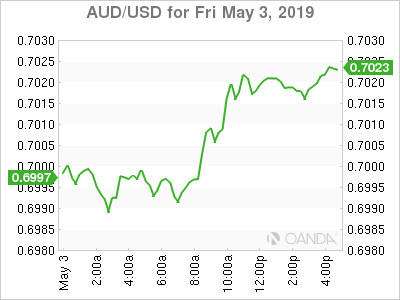
The Reserve Bank of Australia (RBA) rate decision is a live event that will likely see rates kept steady with a shift to an easing bias. Current implied probabilities are pricing in a 38% chance the RBA will cut interest rates by 25 basis points on Tuesday. Positive signs for both the domestic and global outlook may have the RBA take a patient stance on delivering rate cuts.
The RBA could downgrade their forecasts following softer Australian and Chinese data over the past month. While inflation has softened, economic growth and building approvals saw steep declines, retails sales, consumer confidence and employment change all posted significant rebounds.
RBNZ
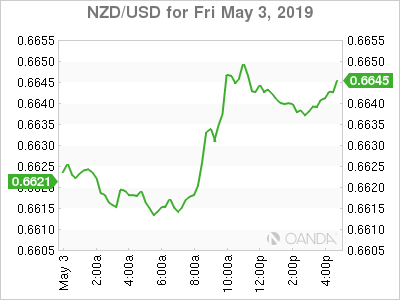
The Reserve Bank of New Zealand is expected to cut rates at its May 8th policy meeting as inflation and economic activity have fallen off a cliff in recent months. The labor market is showing signs of weakening and dismal wage growth might warrant two rate cuts this year by the RBNZ.
RBNZ Governor Adrian Orr switched to an easing bias in March, highlighted a mixed picture in April, and since then the data has been soft, probably solidifying a rate cut in the near future for the bank. The last time New Zealand cut rates was back in November 2016.
Mexican Peso
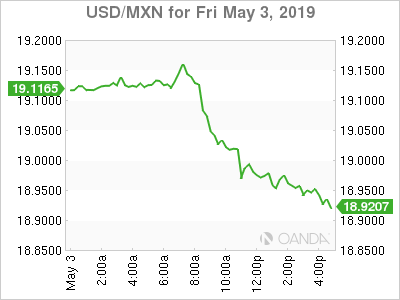
Mexican inflation is expected to remain high and Thursday’s reading could support the Mexico Central Bank (Banxico) bias for high interest rates. The central bank is in a tightening cycle that last saw a rate rise in December. While other economic indicators are showing a deceleration in growth and domestic demand, rising inflation will keep the bank on hold. Hotter inflation could help the peso target the lower boundaries of the 2019 range of 18.80 and 19.60.
Oil
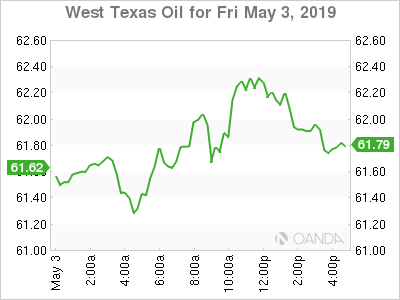
Oil prices got a boost from an impressive US nonfarm payroll employment report. The better than expected data should alleviate some falling demand concerns, but it will not likely shift the focus away from the supply side risks. West Texas Intermediate posted its second consecutive weekly decline after a string of 7 straight weeks of gains.
The Venezuelan situation remains volatile and will likely see opposition leader Guaido push for further protests and attempts to gain more military support. It appears he is still pretty far away from gaining momentum in ousting Maduro.
Gold
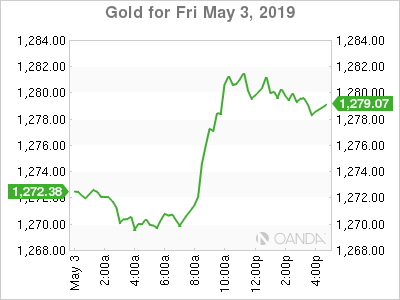
The precious metal remains vulnerable after delivering a fifth weekly loss in six weeks. The Friday rally was mainly attributed to the softer wage data that suggested that low inflation is transitory. Wages however are still close to cycle highs and we will not likely see this be the key catalyst to support a sustained rebound for gold prices.
Monday, May 6th
- 3:00am ET EUR Spain Unemployment Rate
- 4:30am ET EUR Eurozone Sentix Investor Confidence
- 9:30pm ET AUD Retail Sales and Trade Balance data
Tuesday, May 7th
- 12:30am ET AUD RBA Interest Rate Decision
- 2:00am ET EUR Germany Factory Orders m/m
- 3:30am ET GBP Halifax House Prices m/m
- 10:00pm ET NZD RBNZ Interest Rate Decision
- 11:00pm ET NZD Inflation Expectations
- 11:00PM ET NZD RBNZ Press Conference
Wednesday, May 8th
- CNY Trade Balance
- 2:00am ET EUR Germany Industrial Production m/m
- 2:00am ET NOK Norway Industrial Production data
- 7:00am ET USD MBA Mortgage Applications
- 10:30am ET DOE US Crude Oil Inventories
- 9:30pm ET CNY CPI y/y
Thursday, May 9th
- 8:30am ET USD PPI m/m
- 8:30am ET USD Trade Balance m/m
- 8:30am ET USD Initial Jobless Claims
- 9:00am ET MXN CPI m/m
- 9:30pm ET AUD RBA Monetary Policy Statement
Friday May 10th
- 2:00am ET EUR Germany Trade Balance
- 2:00am ET NOK Norway CPI m/m
- 2:45am ET EUR France production data
- 4:00am ET EUR Italy production data
- 4:30am ET GBP GDP q/q
- 4:30am ET GBP Trade and Production data
- 8:30am ET USD CPI m/m
- 8:30am ET CAD Net Change in Employment
Fed Bullard: Monetary policy seems a little tight
St. Louis Fed President James Bullard said in a CNBC interview that Fed's monetary policy seems "a little tight". Though, he wasn't pushing for a change in monetary policy yet. Bullard said he's willing to be patient for now.
Also, lowered expectation of future short-term rate path has brought down 10-year yield. Bullard said "you've got to wait and see how big an impact this has on the economy."
So far Bullard, said slowdown won't be as bad as expected. GDP growth could decelerate only to around 2.5% this year, which is stronger than earlier forecasts of 2.0%. Bullard admitted there is upside potential too.
Fed Evans: Low core inflation elevated my concerns
Chicago Fed President Charles Evans warned that "core inflation has retreated to relatively low levels over the past three months, elevating my concerns over the outlook for inflation." Additionally, US economy also "faces many uncertainties and risks". In particular "consumption and business fixed investment were quite soft in Q1, despite 3.2% GDP growth. And there is "distinct risk" that inflation expectation are "too low" and will be "slow to recover" to target.
On inflation, Evans elaborated and noted, since December, core consumer inflation has fallen and is now just a bit above 1-1/2 percent. And, underlying inflation trends may be mired below 2 percent. he emphasized "we cannot declare victory yet on our inflation mandate."
Evans also noted that "given how muted inflationary pressures appear today, core PCE inflation rising to 2-1/4 to 2-1/2 percent is not a big concern to me at the moment." That indicates he's not ready to push for a rate hike even if inflation might overshoot temporarily.
On the other hand, Evans was concerned that "if activity softens more than expected or if inflation and inflation expectations continue to run too low, then policy may have to be left on hold—or perhaps even loosened—to provide the appropriate accommodation to obtain our objectives."
Evan's full speech "On Risk and Credibility in Monetary Policy".
Can I Leave Orders Open over Weekends?
Friday is the end of the working week for traders as well. Ahead is the weekend and rest, after which again Monday comes, and the new working week herewith. Many traders are concerned about the question "What to expect from the new Monday?" What happens over the weekend? Should I leave trades open on Friday or close them? Let's find out answers to these questions.
Trading on Forex on Friday is possible and necessary, but at the same time, you should remember some issues that can protect your deposit from unwanted losses. You can also leave trades open for the weekend, but consider some points that we will discuss next.
Friday Market Closing
The first thing to consider when trading Forex on Friday is the closing time of the Forex market. The exact time of your terminal can be found in the Market Watch window.
In most cases, trading ends when this watch shows 23:59. Some brokers close trades an hour or two hours before midnight. You can find out the exact information about closing a week session with your broker from its website or ask a support team about this.
The fear of gap
You probably know the fact that news affects trading in the foreign exchange market. But Forex news on Friday is another story. Some events that take place on this day can shock the market. For example, when trading in the US dollar, you should familiarise yourself with the news calendar, and especially pay attention to the time of 15:30 (GMT+3).
In the USA, at this time, important news is released, in particular, on the first Friday of the month - NonFarm Payrolls: the number of new jobs in the non-farm sectors of the economy over the past month. In the calendar, such news is marked with three red dots (or other icons). It is better not to trade on this day, and it is recommended to close open positions before such news.
Many traders are afraid that due to the release of important news or for other reasons, the market on Monday will open with a big gap, which in turn will adversely affect the balance. Fear of the traditional gap at the beginning of the trading week makes the trader take a decision, at least on Friday evening. The price gap sometimes amounts to several dozen points, which can critically influence open deals. Professionals with large deposits that trade in long-term, usually do not pay attention to such trifles, a gap of 30-50 points is perceived as market noise.
When should I leave trades open for the weekend?
In order not to be afraid of gaps, it is worthwhile to work out the medium-term tactics of your actions on small amounts, for example, on the Standard or Mini account. We also have a few tips on how not to be afraid of gaps and leave deals open for the weekend:
- always set Stop Loss and Take Profit;
- close only profitable deals on Friday, fix the rest at the opening of the new week;
- close orders only by the signal of your trading system and, if necessary, leave open for the weekend.
The last option seems the most reasonable if there is a floating loss on current transactions, but you are sure that according to the TS they should go into profit. If current deals are in profit, but the price has not reached Take Profit, then it is better to close them.
We need to assess the fundamental situation on the weekend: business meetings can take place, comments from political and financial figures are possible, statistics may be released (for example, in China) - these factors, as well as unpredictable events and news, form a price gap on Monday.
In any case, a steady income in the network depends on your psychology, confidence in your strategy and ability to trade in the market. Instead, do not trade in situations that you can not predict.
China Weekly Letter – 75% Chance We Have a Trade Deal by the End of Next Week
- If everything goes right we expect to see a trade deal by the end of next week.
- Economic data are still in line with a moderate recovery.
- USD/CNY is stable ahead of the trade war endgame, EUR/CNY is lower on USD strength.
75% chance of Xi-Trump summit announcement next week
This week the US and China continued trade talks in Beijing ahead of what both sides hope to be the endgame in Washington. The goal is to close a deal by the end of next week and announce a signing summit between Chinese President Xi Jinping and US President Donald Trump to be held later this month or in early June . Politico/SCMP wrote that 'Trump's increasing desire to strike a quick agreement could result in a deal in principle announced by the end of next week, according to several people close to the discussions'.
The two sides kept their cards close to their chests after the latest round of talks in Beijing, providing few details on the talks (see Global Times , 2 May). This led to some speculation that the talks might be reaching an impasse. However, US Treasury Secretary Stephen Mnuchin continued to call the talks 'productive' when he left Beijing this week (see Reuters , 1 May).
The Politico article also reported that the US will not get China to roll back subsidies as much as it would like to . The Head of International Affairs of the US Chamber of Commerce Myron Brilliant said during a call with reporters, 'I'm not sure we're going to get all the progress we want' but that the Chamber was 'sanguine' about the progress made on subsidies.
Comment: We see a 75% probability that a signing meeting between Trump and Xi will be announced at the end of the talks next week , probably by Trump himself in the Oval office. The two sides seem to have agreed on 95% of the content and, although a few difficult issues are left, we very much doubt that Trump will walk away from a deal . It would be too costly in terms of falling stock markets and economic uncertainty and Trump would miss out on important gifts to voters in key swing states such as Iowa (agriculture) and Michigan (auto industry). The 2020 election campaign is increasingly gaining steam and Trump needs all the tailwind he can get from the economy and stock markets to go after re-election.
We cannot rule out the two sides failing to reach a deal in Washington next week but, in our view, this would be likely to trigger a big decline in stock markets, which would put pressure on the two sides to get back at the negotiating table and get the deal done.
Softer April PMI but no need to despair
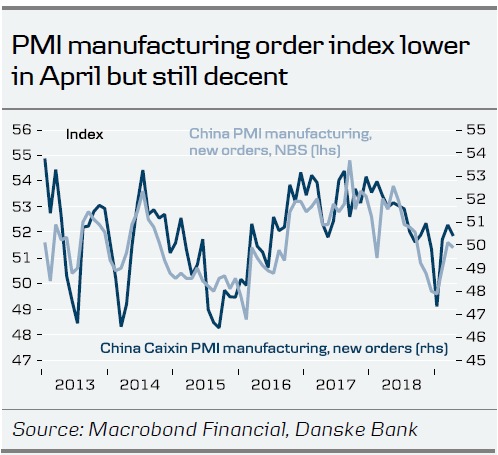
As we warned in China Weekly Letter - Xi to visit White House 'soon', data confirm recovery , 26 April, April PMI turned out to be a disappointment. After a surge in March, both the official version and the Caixin PMI manufacturing fell back in April (see Flash Comment China - PMI lower but moderate recovery on track , 30 April). On a more positive note, profit growth for March rebounded to 13% y/y, verifying that the economy turned better in Q1.
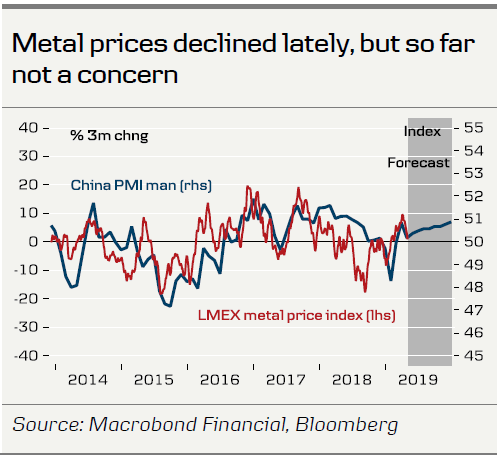
Encouraging news also came to the surface in the housing market, where the CRIC home sales of 100 developers pointed to a strong rise in home sales in April (see SCMP, 1 May). CRIC also reported an increase in land sales. Another gauge of economic activity we follow closely is metal prices. These have turned a bit lower this week.
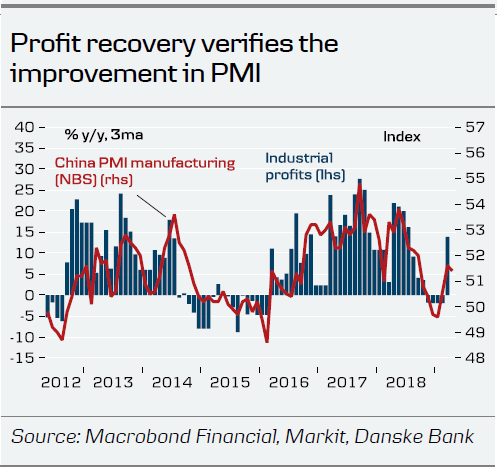
Comment: While April PMI disappointed, this came after very strong March data and we still see the development as in line with a moderate recovery (see China Leading Indicators – moderate recovery still on track, 2 May). Stronger home sales reflect the easing of monetary policy and we expect to see a further gradual improvement in housing this year. It is encouraging to see the reports of rising land sales, as the official data has been quite weak lately. We intend to keep a close eye on metal prices. While the decline this week is not yet enough to be a real concern, we would not like to see metal prices fall much further from here. This it would place uncertainty on the Chinese recovery.
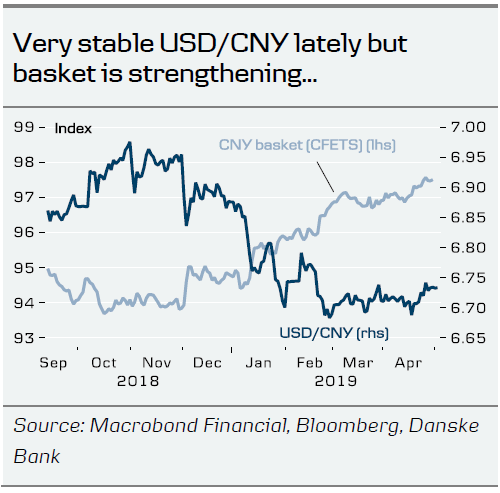
USD/CNY very stable as trade talks reach the endgame
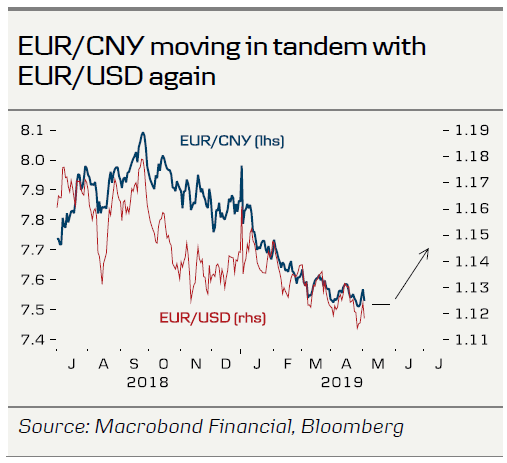
Chinese leaders seem keen on keeping USD/CNY stable in order to provide a good climate for the trade talks. As the USD has been strengthening on an overall basis, it also means that the trade-weighted CNY basket has strengthened. This has been reflected in lower EUR/CNY, which has resumed trading with a very high correlation to EUR/USD (see chart).
Comment: As long as the downward pressure on EUR/USD persists, we expect the same to be the case for EUR/CNY, so a stronger CNY. However, we still forecast EUR/USD will move higher later this year, which should pave the way for an increase in EUR/CNY as well. Our forecast for EUR/CNY in 12 months is thus still 7.72, an increase from the current level of 7.51. For USD/CNY, we expect stability to continue but believe that a trade deal and Chinese recovery will push it lower to 6.60 in 12 months.
Other selected China news of the week
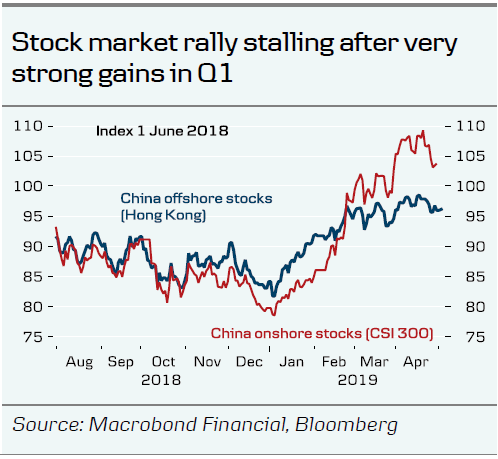
The onshore stock market corrected lower this week. The equity market rally has stalled lately following very strong gains in Q1 and we believe stocks will be choppy for a while before moving higher again later this year.
China announced further easing of rules for foreign banks and insurers (see SCMP, 1 May). The new rules remove existing caps on both foreign and domestic investments in local commercial banks. This is yet another step in China's gradual opening up.
Apple iPhone sales in China picked up towards the end of the fiscal second quarter (see Reuters, 30 April). The rise came after Apple slashed prices but it may also be a sign that Chinese consumers are spending more following household tax cuts and of lower uncertainty related to the trade war. The Apple stock rallied on the news and the California company regained the spot as the most valuable company in the world, pushing Microsoft off the throne again.
Former Chairman of Morgan Stanley Asia Stephen Roach wrote an interesting piece in Project Syndicateon 'America's false narrative on China', 26 April. He argues that Washington 'has been loose with facts, analysis and conclusions about China'.
On Sunday, Chinese President Xi Jinping proposed a five-point initiative on promoting green development at a ceremony in Beijing. He said industrialisation had created unprecedented material wealth but caused serious ecological damage. He said, 'We should pursue prosperity based on green development' (see China Daily, 28 April).
Week Ahead – Aussie and Kiwi Braced for Dovish RBA and RBNZ Meetings; UK Q1 GDP also Eyed
Central bank policy meetings in Australia and New Zealand will be the main focus next week with investors anticipating a further dovish tilt. Out of all the central banks that have turned dovish this year, the Reserve Bank of New Zealand is the most likely to cut rates and analysts are predicting a move as early as next week. In terms of economic indicators, UK growth figures for the first quarter will be the most important release followed by US inflation, Canadian employment and Chinese trade numbers.
RBA meets; is a rate cut getting closer?
The Reserve Bank of Australia reluctantly dropped its tightening bias earlier this year and gave its clearest signal at the April policy meeting that a rate cut would be on the cards if inflation declines and unemployment picks up. The latest data on prices and the labour market have been mixed; inflation fell more than expected in the first quarter, but employment rose sharply in March.
However, markets clearly think the weakening inflation picture will be significant enough to force the RBA to slash rates over the coming months even if employment continues to rise at healthy levels. Interest rate futures imply a full 25 basis point rate reduction by July.
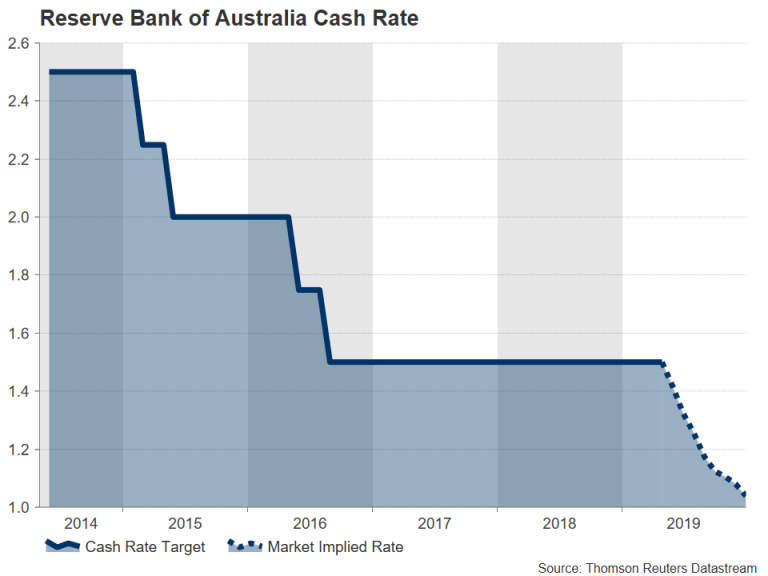
The Australian dollar has slipped in line with the market’s pricing of a rate cut and broke below the $70 level this week. These losses, however, make the aussie more susceptible to upside shocks should the RBA refrain from providing more explicit signals of a rate cut when it announces its latest policy decision on Tuesday. It’s more than possible the RBA will still not want to commit to lowering rates just yet, which would disappoint the aussie bears.
Meanwhile, March stats on retail sales and the trade balance will also be watched on Tuesday, a few hours before the RBA’s decision.
RBNZ could deliver first rate cut in 2½ years
Unlike the RBA, the Reserve Bank of New Zealand hasn’t been as hesitant in shifting to a dovish stance and flagged a rate cut at its last meeting in March. With both the latest CPI and jobs reports out of New Zealand coming in below expectations, there’s a high probability the RBNZ will lower its official cash rate by 25 bps to 1.50% on Wednesday. The RBNZ has a dual mandate of targeting both inflation and employment so weakness in both indicators would justify looser monetary policy.
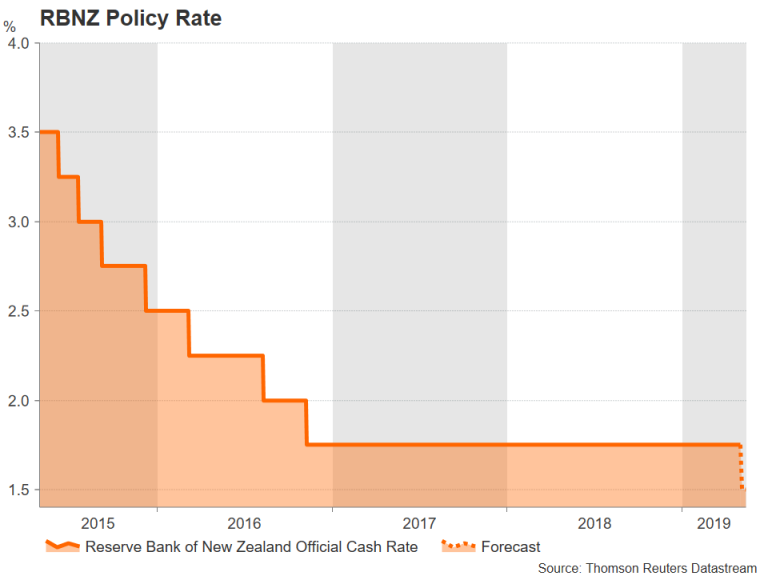
With markets betting just under a 60% chance of a rate reduction next week, the New Zealand dollar has room to slide further, especially if any cut is accompanied by a dovish statement.
China to publish export data as trade talks enter endgame
Exports from China are expected to have moderated in April after surging by 14.2% in March. They are forecast to have risen by 2.3% year-on-year, though imports probably shrank again, falling by 3.6% according to consensus forecasts. The data is due on Wednesday and will be followed on Thursday by the consumer and producer price indices for April.
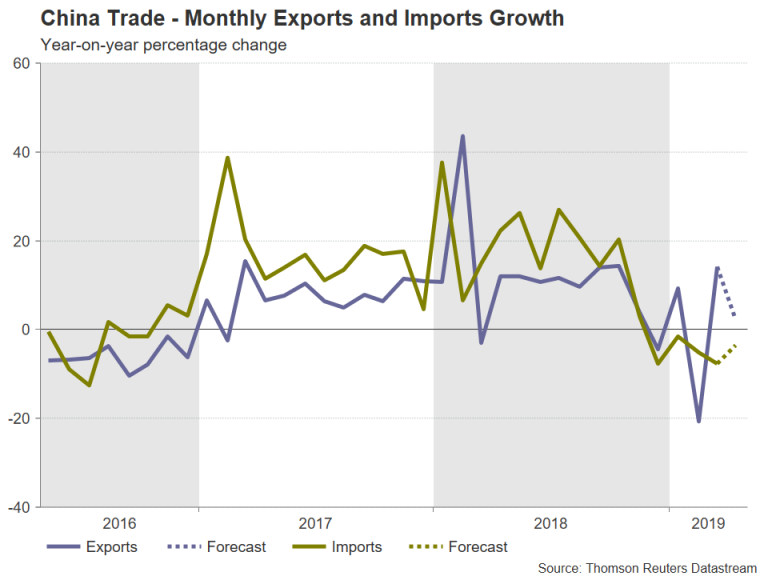
Better-than-expected numbers from China would be positive for risk sentiment, which has been somewhat subdued lately. But a bigger boost to risk appetite could come from the conclusion of trade talks between the United States and China, ending a year-long trade dispute that has seen tariffs between the two nations go up. There have been some reports this week hinting that a deal could be achievable by the end of next week.
Japan’s markets to reopen after long Golden Week break
Japanese traders will return to their desks after a 10-day holiday to celebrate the new Emperor’s ascension to the throne. However, the Japanese calendar is unlikely to create much excitement with only the Bank of Japan’s Summary of Opinions of the April meeting on Wednesday and household spending and pay growth numbers on Friday to look forward to. Household spending is forecast to have increased by 0.5% month-on-month in March, keeping the annual rate unchanged at 1.7%. Next month’s figures will be more interesting to watch as it’s hoped consumption would have been boosted by the extended Golden Week holiday.
For the coming week, however, there will be little out of Japan to move the yen, and so market sentiment will be the dominant driver of the safe-haven currency.
Quiet week for the Eurozone
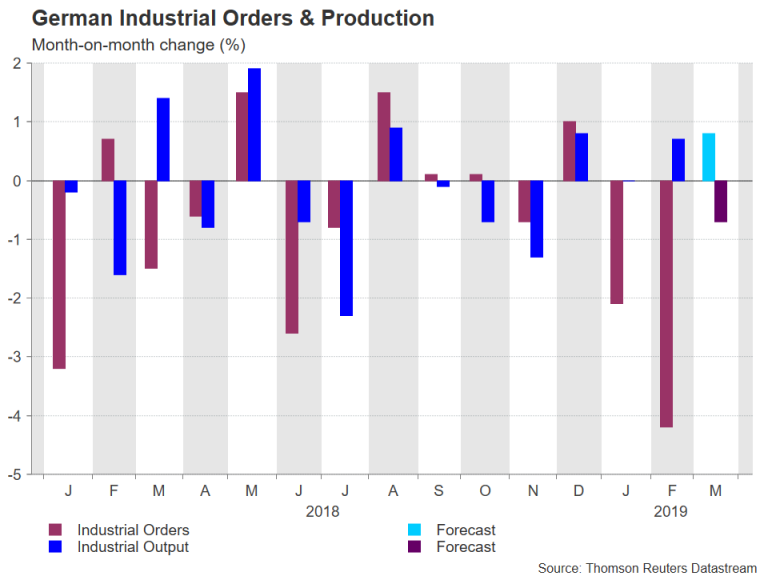
There was some rare good news for the Eurozone economy this week after first quarter GDP beat expectations to grow by 0.4% over the quarter. The data gave the euro a modest lift, with many traders still cautious about the Eurozone’s growth prospects. German numbers due on Tuesday could reaffirm the need for caution. Industrial orders are expected to have rebounded by 0.8% m/m in March, following two months of sharp declines, but industrial production is forecast to have dropped by 0.7% m/m during the same period, reversing the prior month’s 0.7% gain.
For the euro area as a whole, the sentix index for May and retail sales for March could attract some attention on Monday. The European Central Bank’s minutes of the April policy meeting are unlikely to generate much reaction either on Wednesday. Given that policymakers did not discuss introducing a tiered system for the deposit rate and there were no new economic projections available, the minutes are anticipated to produce few surprises.
Norges Bank to hold rates
Much to the ECB’s envy, one central bank that has been in a position to raise interest rates is the Norges Bank. Norway’s central bank hiked rates back in March for the second time since September and will likely reiterate its plans to tighten policy further later this year. The Norges Bank will announce its policy decision on Thursday and is expected to keep rates unchanged this time. However, any changes to the bank’s projected rate path could cause sharp swings in the Norwegian Krone, particularly against the euro, which has rallied strongly over the past week versus the Nordic currencies.
UK to report Q1 GDP growth
It will be the UK’s turn on Friday to publish GDP data for the first quarter. The British economy is forecast to have expanded by 0.5% quarter-on-quarter in the first three months of the year. With estimates for China, the US and the Eurozone all impressing, a disappointing or a steady UK figure would leave Britain missing out on the growth rebound, with Brexit uncertainty no doubt being the potential culprit.
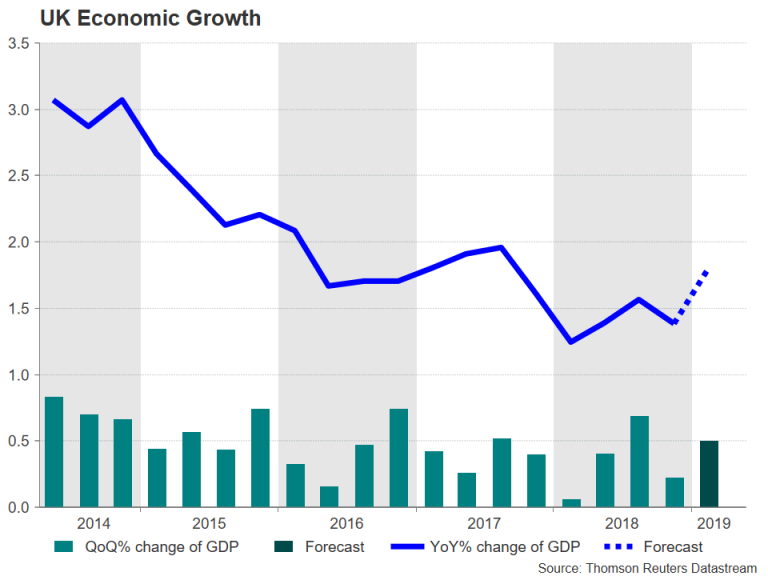
Friday will be a busy day as apart from the GDP estimates, monthly trade, industrial and manufacturing output numbers will also be published.
A broadly strong set of data would be positive for the pound, especially after Bank of England Governor Mark Carney told reporters this week that markets are under-pricing the chances of a rate hike this year. But unsurprisingly, Brexit could once again steal the show as next week could prove crucial for the government and the Labour party to find a common ground on Brexit in their ongoing talks. If no significant progress is made, the two sides may decide to abandon the talks, killing any hope of a quick end to the Brexit deadlock.
US inflation and Canadian jobs to be North American highlights
A not-so-dovish Fed Chairman lifted the US dollar from its lows this week and the greenback will probably find more support next week from the latest US consumer and producer inflation figures. The PPI numbers are out first on Thursday and the CPI data will be released on Friday. The headline rate of CPI is expected to edge higher from 1.9% to 2.1% y/y in April, while the core rate is also forecast to rise slightly to 2.1%.
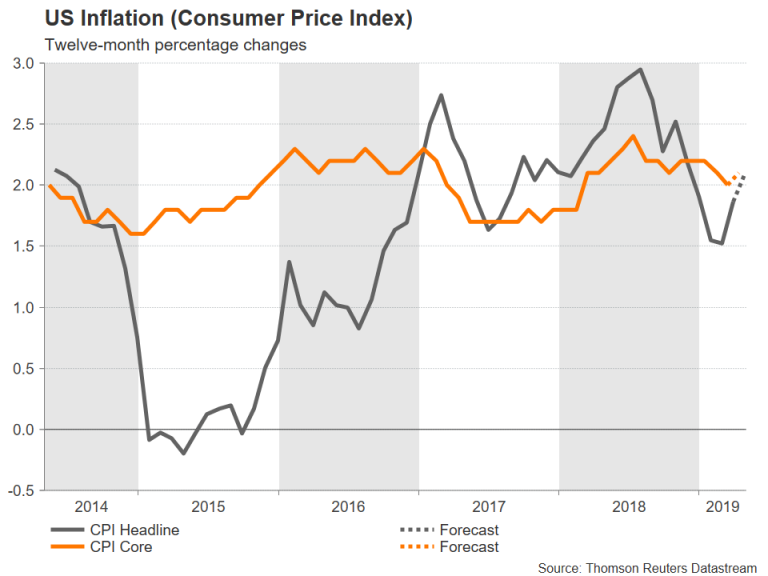
Although the Fed pays more attention to the core PCE price index, which has been trending lower, any modest increase in the CPI rate would ease worries of a sustained downtrend in PCE inflation, hence supporting Chairman Powell’s remarks that the current weakness is transitory.
Across the border in Canada, the April employment report will be the loonie’s focal point. The Canadian dollar has seesawed during the past week as the Bank of Canada’s governor, Stephen Poloz, kept rate hike hopes alive in comments to parliament, reversing some of the bearish moves following last week’s dovish BoC meeting. The loonie could recover further if jobs figures on Friday point to a strong labour market.