

Sample Category Title
Weekly Focus – Reaching the Endgame in US-China Trade Talks
Market movers ahead
- US-China trade talks are set to reach the endgame in Washington next week. We see a high probability that the talks will end with an announcement of a Xi Jinping-Donald Trump signing meeting in late May or early June.
- German industrial production for March should give more clues as to the state of European industry. So far, 'soft data' (surveys) have been weaker than 'hard data'.
- Focus in the EU Commission spring forecast will be on fiscal policy and the projections for Italy.
- In China, data on exports should add more information about the simmering recovery. CPI inflation is likely to push higher due to an increase in pork prices as African swine fever has intensified recently.
- We expect US core CPI inflation to show an unchanged rate of 2.1% in April.
- In Scandinavia, focus turns to the Riksbank minutes and inflation out of Norway, where we look for a decline in core inflation.
Weekly wrap-up
- Euro area GDP for Q1 beat expectations, painting a slightly brighter picture of the economy than survey data suggest. US GDP for the first quarter also came out stronger than expected. Chinese PMI data was lower following very strong March readings.
- There were no major changes to Fed policy this week. The Fed is firmly on hold, with no policy bias in either direction.
- Oil prices had a volatile week on Trump tweet and supply concerns following the military coup attempt in Venezuela. Risk appetite is in decline as markets reassess the cyclical outlook and scope for a global recovery.
Sunset Market Commentary
Markets
Global core bonds gain modest ground today. The bond market lost additional ground yesterday in the wake of a less soft signal by Fed chief Powell. Today, investors showed a cautious carving for risk, pushing equities higher and German Bunds lower at the EU opening. EMU CPI’s printed well above the market consensus but had little market impact. US Treasuries continued the downward bias throughout European dealings ahead of the US labour market data. The US payrolls report printed well above expectations, confirming the tight labour market. However, that does not translate into accelerating wage growth yet. Average hourly earnings rose 0.2% (M/M), below the 0.3% (M/M) expectation. Thus, US inflation shouldn’t expect any support of accelerating wages any time soon. The report also didn’t support Powell’s assessment on Wednesday, as he indicated that soft inflation was probably transient. US Treasuries initially lost some additional ground on the strong payrolls, but paired those losses afterwards, nearing opening levels. As US equity markets opened higher, core bonds continued the upward move, entering intraday-gains territory. A disappointing ISM non-manufacturing gauge for April pushed bonds even higher. The US yield curve is moving lower with changes in the range of -1.8 bps (30-yr) and -3.3 bps (5-yr). The German yield curve moves tentatively lower as well, with changes up to -2.3 bps (30-yr). Peripheral spreads over the German 10 yr-yield remains stable.
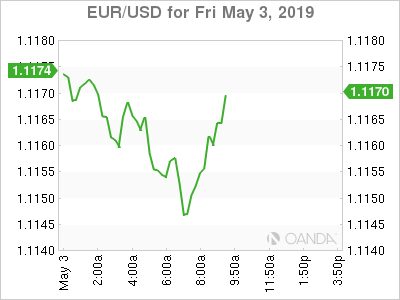
The post-Fed/Powell USD rebound continued this morning. EUR/USD drifted further south in the 1.11 big figure. EMU CPI printed well above the market consensus. However, European yields were little changed and so was EUR/USD. Markets see this up-tick as mainly due to temporary/seasonal factors. The pair even declined slightly further on ongoing USD strength going into the US payrolls. The report was strong but the tight labour market conditions still didn’t translate into faster wage growth. The market assumes that the Fed will have to maintain a soft wait-and-see stance as long as prices and wage pressure remain soft. This was also visible in the reaction of the dollar. EUR/USD dipped to the 1.1135 area upon the publication of the release but the dollar almost immediately reversed this initial gain. EUR/USD returned to the 1.1150/60 area. USD/JPY was again locked in the mid 111 area. A soft non-manufacturing ISM suggests further dollar profit-taking going into the weekend.
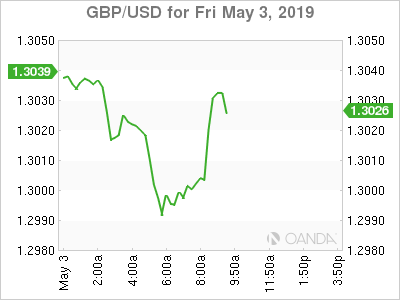
There was no unequivocal story to explain the sterling price action today. The UK currency lost some modest ground against the euro and the dollar this morning, maybe as both the conservative party and labour lost in local elections. The UK services PMI rebounded from 48.9 to 50.4, more or less as expected. The report initially didn’t help sterling but, in technical trade, sterling later reversed initially weakness. EUR/GBP is again trading in the 0.8675 area. Cable regained the 1.30 handle. At least, for now, GBP investors aren’t impressed by yesterday’s ‘warning’ of BoE’s Carney that the market is underpricing the probability of BoE monetary tightening further out.
News Headlines
April payrolls surprised friend and foe with 263k net job creation, beating the already elevated consensus (190k). Previous two months’ data faced a combined 16k upward revision. The unemployment rate fell to the lowest level since November 1969 (3.6%), but against the background of lower participation rate (62.8% from 63%). Wages rose less than expected (0.2% M/M and 3.2% Y/Y) and spoil the payroll party.
Euro area inflation accelerated more than expected in April (1.7% Y/Y for the headline measure and 1.2% Y/Y for the core reading). The pick-up is at least partly driven by Easter-related temporary factors like package holidays.
The UK services PMI rebounded out of contraction territory, rising from 48.9 to 50.4 in April. New business rose from 48.4 to 49 but records a 4th consecutive sub-50 reading. The UK composite PMI rose from 50 to 50.9.
ISM non-manufacturing dropped to 55.5, employment and price declined
US ISM non-manufacturing composite dropped to 55.5, down from 56.1 and missed expectation of 57.0.
Look at the details:
- Business Activity Index increased rose from 57.4. to 59.5.
- New Orders Index dropped from 59.0 to 58.1.
- Employment Index dropped from 55.9 to 53.7.
- Prices Index dropped from 58.7 to 55.7.
- 15 non-manufacturing industries reported growth.
ISM noted: "The non-manufacturing sector has experienced an uptick in business activity, but in general, there has been a leveling off. Respondents are still mostly optimistic about overall business conditions, but concerns remain about employment resources."
‘Goldilocks’ US Jobs Report Weakens Dollar
The Dollar turned volatile and unpredictable on Friday afternoon as investors digested the mixed US jobs report for April.
Prices initially jumped higher as market players cheered the fact that the United States added an impressive 263,000 jobs to its economy last month. With the unemployment rate dropping to its lowest level since December 1969, to 3.6%, one would have expected the Dollar to aggressively appreciate against its major counterparts. However, the market reaction suggests that investors are clearly more concerned with wage growth figures which came in at 0.2% month-over-month, slightly below the expected 0.3%. All in all, today’s report is unlikely to pull the Federal Reserve away from the sidelines and this reality continues to be reflected in the Dollar’s price action.
USD/JPY Mid-Day Outlook
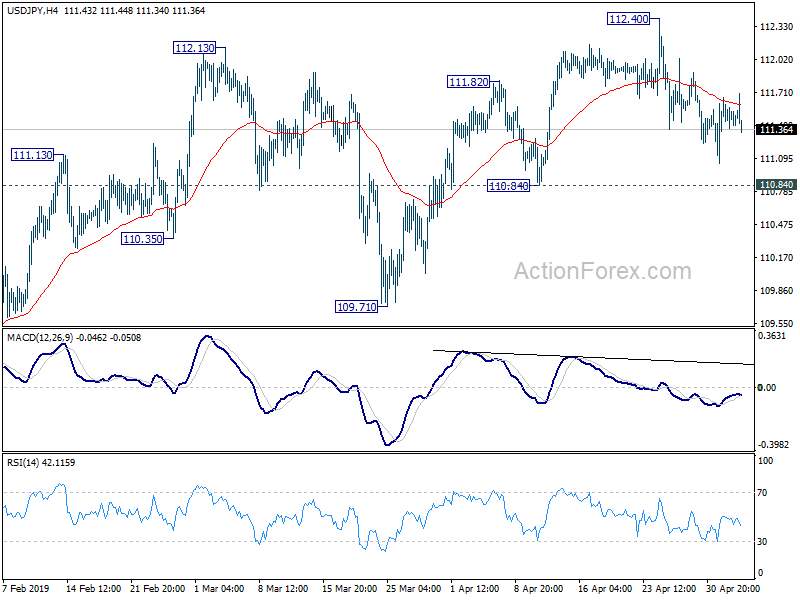
Daily Pivots: (S1) 111.34; (P) 111.51; (R1) 111.67; More...
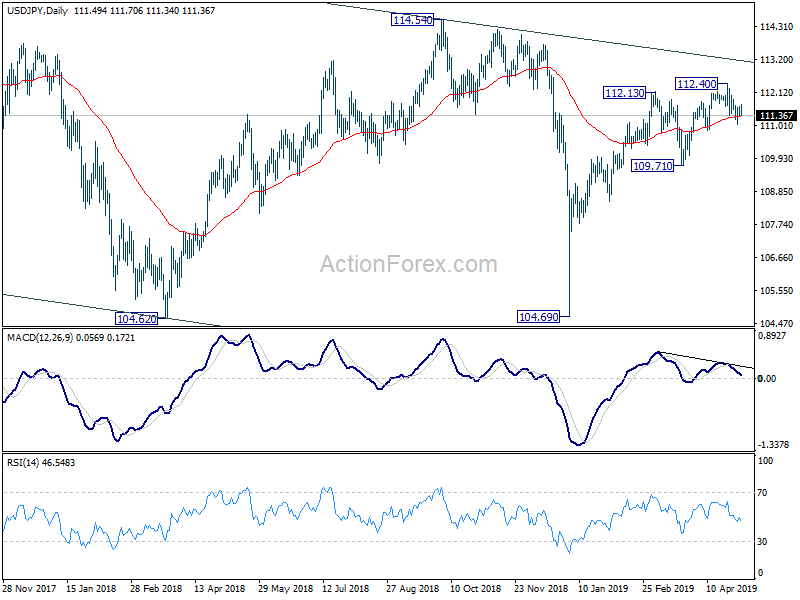
Intraday bias in USD/JPY remains neutral and outlook remains unchanged. Considering bearish divergence condition in daily MACD, risks remain on the downside as long as 112.40 resistance holds. On the downside, decisive break of 110.84 support will add to the case of bearish reversal and target 109.71 support and below. On the upside, firm break of 112.40 resistance will resume the rise from 104.69 instead.
In the bigger picture, medium term outlook in USD/JPY remains a bit mixed as it's staying inside falling channel from 118.65, but there are signs of bullish reversal. On the upside, break of 114.54 resistance will revive the case the corrective fall from 118.65 has completed with three waves down to 104.69. And whole rise from 98.97 (2016 low) is resuming for 118.65 and above. But before that, outlook stays neutral first.
USD/CHF Mid-Day Outlook
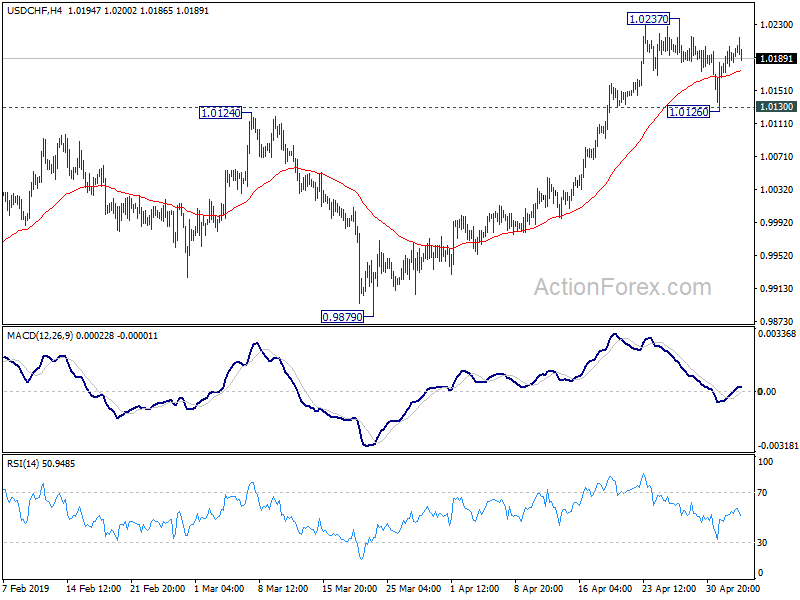
Daily Pivots: (S1) 1.0173; (P) 1.0188; (R1) 1.0209; More...
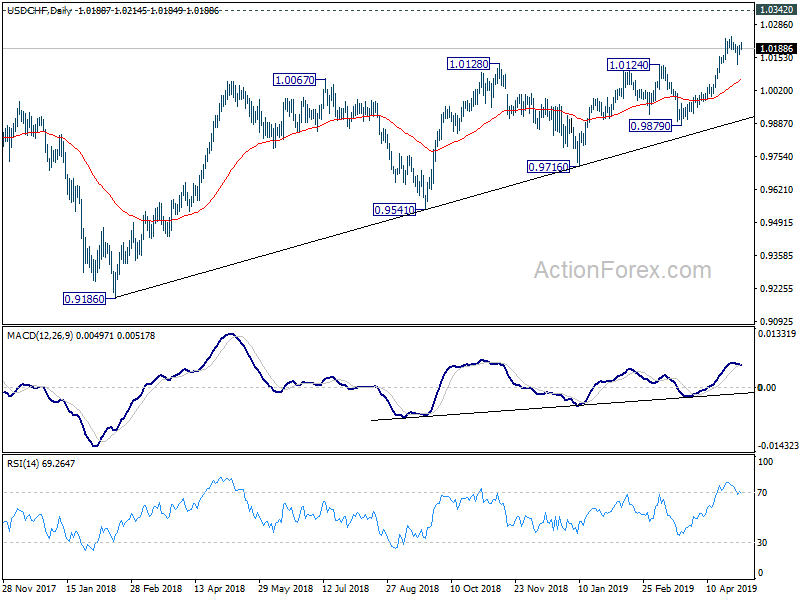
USD/CHF is staying in consolidation from 1.0237 and intraday bias stays neutral first. With 1.0130 support intact, further rise is expected. On the upside, break of 1.0237 will resume larger up trend to 1.0342 key resistance. However, sustained break of 1.0130 will confirm short term topping. In that case, deeper pull back would be seen back to 55 day EMA (now at 1.0064) and below.
In the bigger picture, medium term up trend from 0.9186 is extending. Current rise should target 1.0342 resistance next. For now, we'd be cautious on strong resistance from there to limit upside, until we see medium term upside acceleration. On the downside, break of 0.9879 support is needed to indicate reversal. Otherwise, outlook will stay bullish in case of deep pull back.
GBP/USD Mid-Day Outlook
Daily Pivots: (S1) 1.3007; (P) 1.3044; (R1) 1.3069; More....
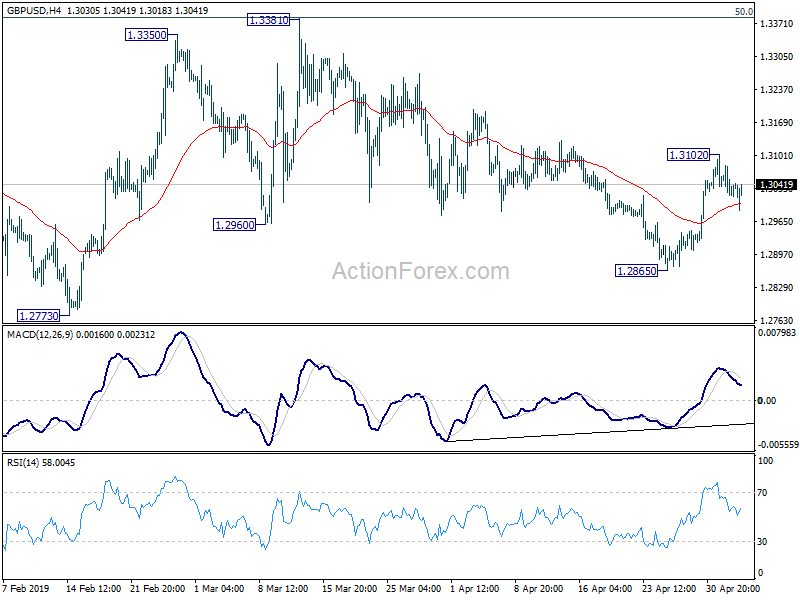
GBP/USD is staying in consolidation below 1.3102 temporary top and intraday bias remains neutral first. The corrective pull back from 1.3381 should have completed at 1.2865 already. On the upside, above 1.3102 will target 1.3381 resistance first. Break will resume whole rebound from 1.2391. On the downside, though, break of 1.2865 will target 1.2773 key support instead.
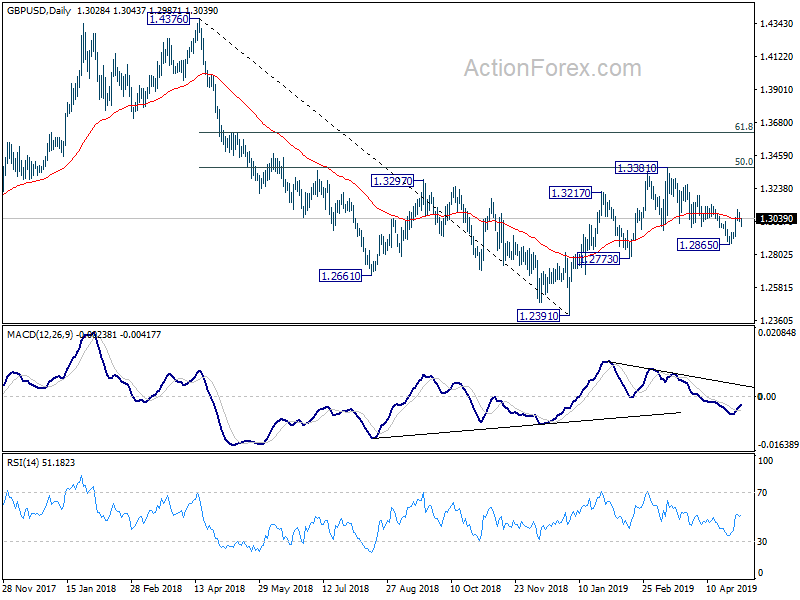
In the bigger picture, medium term decline from 1.4376 (2018 high) halted after hitting 1.2391. The structure of the rebound from 1.2391 suggests that it's a corrective move. In case of another rise, strong resistance could be seen around 61.8% retracement of 1.4376 to 1.2391 at 1.3618 to limit upside. On the downside, break of 1.2773 support will suggests that such corrective rise is completed and bring retest of 1.2391 low first.
US: Strong Jobs Gain Defies Slowing Narrative
The American economy gained an impressive 263k new jobs in April, much higher than the 190k tally analysts were expecting. The unemployment rate also fell to 3.6% – the lowest level in almost 50 years.
Strength was fairly broad based, with hiring accelerating for both good and services. Professional and business services (+76k), construction (+33k), and health care (+27k) all saw notable gains. The retail sector continued to be an area of weakness, shedding 12k jobs in April. Employment in the sector is down 0.3% versus a year ago.
The labor force participation rate continued to move downwards, and is now at 62.8%. The civilian labor force has been shrinking steadily since the beginning of the year, and is now in line with its year ago level. Somewhat discouraging was a further decline in the participation rate for prime aged Americans (25-54 years), which dipped from 82.5% to 82.2% in April. However, this measure remained above its year-ago level.
Growth in average hourly earnings was up a modest 0.2% in April. That left wage gains steady at 3.2% on a year-on-year basis.
Key Implications
The labor market once again defied expectations for softer hiring tallies and further raised the bar for Fed rate cuts. While most of the focus recently has been on inflation undershooting the Fed's 2% target, the labor market is clearly in no need of stimulus. Wage growth did not accelerate in April, but at 3.2% it still looks pretty good. With softer inflation, it is even better in real terms, providing a solid base for a rebound in consumer spending in the second quarter.
We still expect hiring will slow over the course of 2019. Economic growth is slowing from its 3% pace over the past year and is likely to average around 2% over the remainder of this year. With the unemployment near a record low, supply constraints will begin to bind. This will mean more muted monthly payroll gains, consistent with a mature phase of the economic cycle. We expect job gains to slow below 150k per month through the remainder of 2019.
Stellar NFP and Steady Wages Show Fed Was Right About Transitory Effects
The US dollar initially extended gains following the release of US non-farm payrolls and wage data. The strong headline payrolls reading saw a bigger than expected increase in hiring and steady wages, which saw softness in Manufacturing and Retail, led Fed fund futures to see the chances of a rate cut be pushed into 2020.
- US Data – Labor market remains unstoppable
- EUR- Core inflation rises to 6-month high
- Brexit – Conservative and Labour lose big
- Stocks – S&P slight rebound after biggest selloff in 5 weeks
- Oil – OPEC on verge of collapse according to Iran
- Gold – Settling higher after NFP report
US Data
The Fed may have been right about the transitory effects we are seeing with inflation. The economy is performing nicely, wages did not go up as much as economists expected, but steady wages could help inflation stabilize in the coming months. The headline number for nonfarm payroll report was 263,000 jobs were added, bringing the unemployment rate down to 3.6%, the lowest levels since 1969. Wages stayed steady at 3.2%, slightly below expectations of 3.3%. The dollar initially surged against all of its major trading partners following the better than expected labor data.
Today’s wrath of economic data points that business investment could be coming back on the backdrop of continued solid gains in the labor market. The key report of wages showed that consumer inflation is coming along, albeit not as fast as economists were targeting. This does not change the patient stance that will require us to see data throughout the summer before the Fed signals the next policy move.
EUR
The April flash estimate for eurozone inflation rose to the highest level since November at 1.7%, a tick above the consensus, and 0.3% above the March reading. Core inflation, which strips out volatile components also rose to a 6-month high at 1.2%. The euro posted a little reaction following the release, but if we continue to see better data from the euro area along with higher inflation, that will be a turning point for the euro.
Brexit
Conservatives and Labour both had a tough night with results from local elections. The key message sent was that the public is frustrated with the current leaderships handling of Brexit. Early tallies show Pro-EU Liberal Democrats thrived, gaining 304 seats, while Conservatives lost 450 seats and Labour saw roughly 80 spots go other parties.
Oil
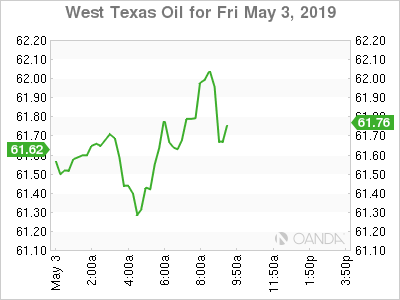
Iran’s oil minister can tell his country is feeling the pain of the US sanctions. Today, he warned OPEC that they are the verge of collapse as Saudi Arabia appears set to take on their lost crude sales. Despite a shortage in spare capacity to make up for the immediate shortfall, oil remains under pressure.
Crude prices remain vulnerable on concerns OPEC + will not be able to maintain a meaningful production cut agreement going forward and on the backdrop that we are likely to see increases in production from the US, Saudis and Russians. Brent crude is finding tentative support from the $70 level and West Texas Intermediate crude is seeing buyers ahead of the $60 level.
Earlier bullish catalysts are no longer dominating the headlines, Eastern Europe has found replacements for contaminated Russian crude and the Venezuelan turmoil does not appear to reaching a key climax just yet.
Oil is poised for a second weekly decline and if we continue to see the US production pickup in velocity, crude prices could see a sustained pullback here. Oil did get a boost following the impressive US labor and wage data.
Gold
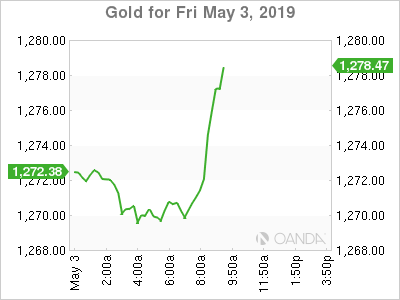
The precious metal is not benefiting from a strong US economy and expectations global growth concerns will continue to be alleviated from a trade deal between the US and China. Gold prices initially spiked lower following the labor report but settled slightly higher as the dollar was not able to hold onto its gains.
FTSE: Financials Send Index Sharply Higher
The FTSE index has posted sharp gains on Friday. In the North American session, the pair is at 7,413, up 0.92% on the day. The pair lost over 1.0% on Wednesday, but has recovered most of these losses. In economic news, British Services PMI rose to 50.4 in April, up from 48.9 in March.
HSBC reported an excellent first quarter on Friday, helping boost the blue-chip FTSE. The bank reported that Q1 net profit jumped 33.7% on a year-to year basis. Net profit rose to $4.13 billion, beating the estimate of $3.70 billion. There was further positive news from Anglo American, a mining company which is the world’s largest producer of platinum. Shares of the company have climbed 2.3% on Friday.
All eyes were on the BoE on Thursday, as the bank held its monthly policy meeting. The bank maintained interest rates, but BoE Governor Mark Carney had a hawkish message (warning?) for the markets. Carney said that there could be a number of rate hikes from the bank, if Brexit is resolved and growth and inflation point higher. The markets have priced in just one rate hike until 2021. Carney’s comments didn’t make much of an impact on investors, as the pound was unchanged on Thursday.
The BoE followed the lead of the Federal Reserve, which left rates unchanged on Wednesday. The rate statement noted that inflation pressures are muted and that the FOMC would remain patient regarding future rate movements. Jerome Powell reinforced this stance at a follow-up press conference, saying “we don’t see a strong case for moving in either direction”. The Fed is already on record as saying it does not expect to raise rates before 2020, and with inflation levels persistently below the Fed’s target of 2.0%, the Fed can afford to continue its wait-and-see stance.