

Sample Category Title
GBP/JPY Needs A Reversal Pattern Confirmation To Bounce From The POC Zone
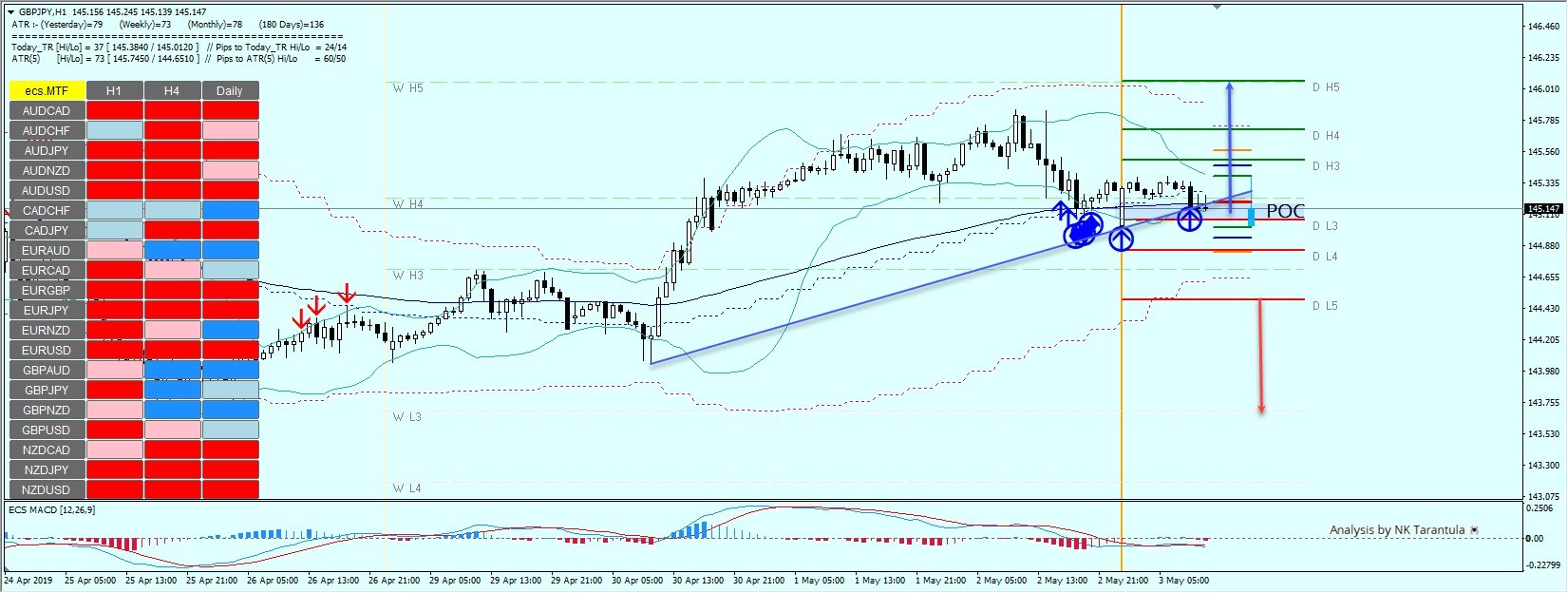
The GBP/JPY has reached the POC zone so we might see a bounce. Bounce is possible only if the pair makes a bullish reversal formation.
145.00-15 is the zone where the popular “Dragon” might bounce. We see a lot of confluence factors including HTF confirmation, ascending trend line, ATR pivot and D L3 camarilla. What is missing is a bullish reversal pattern. If we see it then the price might continue towards 145.75. However, today is the NFP with Unemployment Rate and Average Hourly Earnings data. This data release should provide needed volatility boost in the Forex markets where the GBP/JPY will be affected too. A drop below 144.45 will possibly target 144.00 and W L3 143.70 if the price gains a momentum and triggers stops below.
Dollar Stands Tall Ahead Of US Jobs Report
The Dollar was thrown an unexpected lifeline mid-week, as solid US data and a slightly more hawkish Federal Reserve dampened expectations of a rate cut in the near-term.
Investors were forced to re-evaluate the Federal Reserve's monetary policy path for 2019 after Jerome Powell stated that lower inflation was “transitory”. With the recent string of positive data also easing concerns over the health of the US economy and boosting the Dollar's safe-haven status, bulls are likely to remain in the driver's seat in the near-term.
Today's main risk event for the Dollar will be the all-important jobs report which should offer fresh insight into the health of the US labour force. Markets expect the US economy to have added 180k jobs in April, with wage growth projected to rise 0.3% month-on-month while the unemployment rate is anticipated to remain unchanged at 3.8%. While every element of the jobs report is important, there will be a special focus on wage growth which could shape interest rate expectations. Any signs of wage growth cooling could rekindle speculation over the Fed cutting interest rates – something that will punish the Dollar.
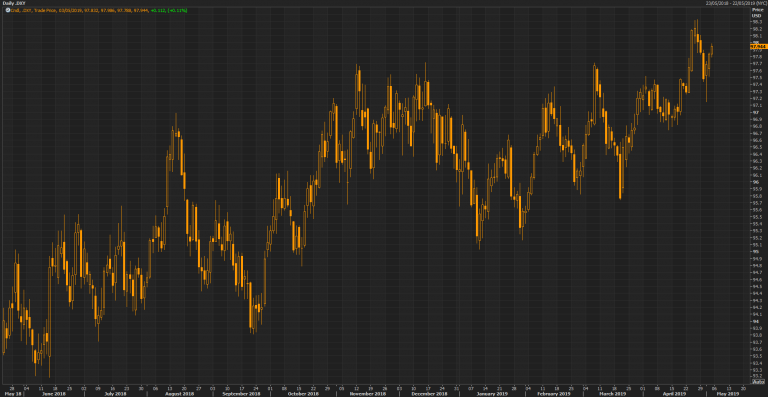
Looking at the technical picture, the Dollar Index (DXY) is trading marginally below 98.00 as of writing. A weekly close above this level may inject bulls with enough inspiration to attack 98.33.
Gold to continue testing $1,270 support line
Gold remains stuck in its bearish channel after Fed Chair Jerome Powell pushed back against calls for a US interest rate cut.
Such rhetoric has contributed to a firmer Dollar, which in turn is making it tougher for Gold to climb. The precious metal also remains suppressed by rising risk appetite, on news that a US-China trade deal may be sealed by next week, even though similar headlines have been oft-repeated in recent months. However, broader uncertainties over the global growth outlook may cushion Gold's decline in the near-term, even as it continues to test the psychological $1,270 support level.
Commodity spotlight – WTI Oil
WTI Oil is on route to achieving two consecutive weeks of losses for the first time in 2019.
Despite US sanction waivers on Iran's Oil being lifted this week, Oil prices continued to fall as US Crude inventories rose to their highest levels since 2017. This implies that OPEC+ producers have their work cut out in trying to rebalance global Oil markets and may extend the existing production cuts program past June, even as Russia failed to comply with targets set for April. Hence, the $60/bbl psychological level will be an important support in the immediate term, to see whether Oil bulls can regain control of the narrative and reverse the slump.
European Update – Attention Turns To US Jobs Data
US jobs report to show fears are overhyped?
It's been an action-packed week in the markets, particularly over the last couple of days and fortunately, that's not letting up today.
The US jobs report is arguably the most important and widely followed economic report each month and this month is no different. It's been a weird year so far when it comes to the jobs report, with the government shutdown likely being responsible for playing havoc with the data. That appeared to have settled down last month, with job creation being more in line with the norm and unemployment and wage growth being back on track.
We're expecting another strong report this month – unemployment 3.8%, 180,000 new jobs and 3.4% earnings increase – which begs the question, is the economy really as vulnerable as so many seem to fear? The Fed may have come around to the idea that the risks are mounting and the inverted yield curve may well have given it the creeps but they're not yet bowing to the idea that rate cuts are warranted.
In going against the market, the Fed provided a big lift to the dollar this week just as it was experiencing something of a correction. Now we're back near the highs and it's become a question of whether today's report will spur it on further or just convince traders that the Fed is wrong and will eventually come around to the markets way of thinking.
DAX Hits 7-Month High As Eurozone Inflation Climbs Higher
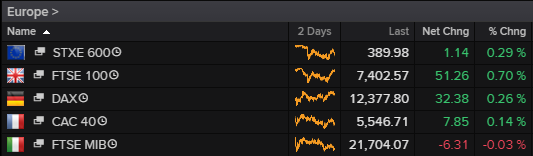
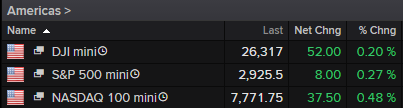
The DAX index has posted gains in the Friday session. Currently, the DAX is at 12,384, up 0.32% on the day. The DAX punched above the 12,400 level earlier on Friday, for the first time since late September. In economic news, eurozone CPI Flash Estimate improved to 1.7% in April, up from 1.4% a month earlier. The core release climbed to 1.2%, compared to 0.8% in March. Both indicators beat their estimates.
Eurozone inflation is expected to climb to 1.7% in April, marking a 5-month high. The stronger reading is a reflection of higher oil prices, which has pushed prices higher. Inflation is moving closer to the ECB target of close to 2 percent, and if the upward trend continues, ECB rate-setters will have to give some thought to raising interest rate levels. The bank recently announced that no rate hikes were planned before the spring of 2020, and this dovish stance makes the euro less attractive to investors.
It was all April flowers for the blue-chip DAX, which soared 7.1% last month. This marked the best monthly gain for the index since December 2016. The gain is all the more impressive, considering that the eurozone is gripped in slowdown and the German locomotive is also showing some soft numbers. The DAX is up a whopping 16% since the start of the year, and has benefited from a sluggish euro, which has declined 2.5% since January 1.
Manufacturing remains a sore spot in Germany and the rest of the eurozone, as underscored by the April manufacturing PMIs. The indicators continue to point to contraction in the manufacturing sector, although there was some slight improvement in April, compared to the March scores. Weaker global demand and taken a heavy toll on exports from Germany and the eurozone, which has damaged the manufacturing sectors. German retail sales declined in March, as nervous consumers held tight to their purse strings.
EUR/USD – Eurozone CPI Jumps But Euro Loses Ground
EUR/USD is pointing lower for a third straight day. Currently the pair is trading at 1.1156, down 0.15% on the day. On the release front, eurozone CPI Flash Estimate improved to 1.7% in April, up from 1.4% a month earlier. The core release climbed to 1.2%, compared to 0.8% in March. Both indicators beat their estimates. In the U.S., the focus is on employment numbers. Nonfarm payrolls is expected to slow to 181 thousand. Will we see a repeat performance of the ADP release, which also was expected in at 181 thousand but soared to 275 thousand? Wage growth is expected to climb to 0.3% in April, after a negligible gain of 0.1% a month earlier.
Eurozone inflation is expected to climb to 1.7% in April, marking a 5-month high. The stronger reading is a reflection of higher oil prices, which has pushed prices higher. Inflation is moving closer to the ECB target of close to 2 percent, and if the upward trend continues, ECB rate-setters will have to give some thought to raising interest rate levels. The bank recently announced that no rate hikes were planned before the spring of 2020, and this dovish stance makes the euro less attractive to investors.
The Federal Reserve maintained the benchmark rate, as expected. The rate statement noted that inflation pressures are muted and that the FOMC would remain patient regarding future rate movements. Jerome Powell reinforced this stance at a follow-up press conference, saying “we don’t see a strong case for moving in either direction”. The Fed is already on record as saying it does not expect to raise rates before 2020, and with inflation levels persistently below the Fed’s target of 2.0%, the Fed can afford to continue its wait-and-see stance.
Bitcoin About To Cross $6,000
Traders have taken their focus off from the biggest event of the day because of Bitcoin. They are completely dazzled, the Bitcoin price has crossed the level of 5,700 and this is all due to the strong price momentum which have been building up for the last few weeks. If you have not paid attention to the Bitcoin price action, now is the time. The price has been trading above the 200-day moving average, a major bull signal. Another significant bull signal also comes from the 242-day moving average, the back test results on a daily time frame shows some solid results.
Another reason which has instigated this move is the news that Facebook would be using cryptocurrency for its platform, this a huge development. We all know that Uber IPO is the most hyped for this year, but the fact which hasn’t gained much attention is that Uber also has strong commitments to develop a digital wallet and this means cryptocurrency. All of this support the demand for Bitcoin
In terms of price action, I think the doors are wide open for the price to kiss the level of 6,000 and then 6,500 but the price levels which are going to bring the real excitement in the market are when it breaks above 8,000 and 10,000. This is because it would trigger a massive FOMO among retail and institutional clients and the compounding effect may take it further if the ETF gets approved in around that time.
How US NFP Can Impact The Dollar
Today is the most important day for traders who would be looking at the U.S. Non-Farm payroll data. This particular number has the ability to dictate the market action for the rest of the month. This is why it is considered as the mother of all the data. Last week, we saw the US GDP number thrashing the forecast: the actual reading was 3.2 percent while the forecast was 2.2 percent. Ever since speculators have been fueling the markets with rumors that the Fed may no longer hold it's dovish stance towards the monetary policy.
Their argument seems even more plausible if you start to factor in the latest U.S. consumer confidence data which was much stronger than the forecast. The reading came in at 129.2 beating the forecast of 126.2. But, let's put things in perspective: the price formed a high of 98.33 on April 26th, and by April 30th it declined nearly 0.90 percent.
So, despite those rumors and strong data, the dollar index actually lost its value. It was the FOMC press conference on Wednesday which brought the life back for the dollar index. The Fed made a technical adjustment to Interest On Excess Reserves (IOER). The market was already expecting this from the Fed so the upward move in the dollar index wasn’t because of this adjustment.
The Fed maintained its “patient” guidance and acknowledged weakness in consumer spending and business investment, but marked this as transitory. This particular move pushed the dollar index higher. The take away from the Fed meeting was that the next move (with respect to the interest rate) could be upward or downward.
Overall, the Fed still characterize the US growth as strong and it is in this essence that the upcoming U.S. NFP is of critical importance. The expectation is for the unemployment rate to stay steady at 3.8 percent, the average hourly earnings m/m to improve to 0.3 percent from 0.1 percent and the non-farm employment change to come in at 181K. But, before we focus more on these numbers, let's look for the clues from the existing important data released this week.
The ISM manufacturing index usually gives us a good inside about the US nonfarm payroll number. The reading for the month of April disappointed, it fell to the lowest level since October 2015 but remained in the expansion territory. The decline was pretty much broad-based, It includes, production, new export orders, and new orders. This suggests that factory-sector has cooled off considerably because of the inventory overhang.
The Analytical Overview Of The Main Currency Pairs
The EUR/USD currency pair
Technical indicators of the currency pair:
Prev Open: 1.11970
Open: 1.11713
% chg. over the last day: -0.19
Day's range: 1.11583 – 1.11775
52 wk range: 1.1111 – 1.2009
Demand for USD remains high. The EUR/USD quotes updated the local minimums. Jerome Powell mentioned earlier that the regulator will keep the current monetary policy. This statement disproven the previous idea that the Central Bank is willing to review the lowering of the key interest rates. USD is additionally supported by the growth of the US Treasury obligations. The quotes are currently consolidating around 1.11600-1.11850. The investors are waiting for he US labour report
The Economic News Feed for 03.05.2019:
Consumer Price Index (EU) – 12:00 (GMT+3:00);
Labour Market Report (EU) – 15:30 (GMT+3:00);
Business Activity in the US non-Industrial Sector (EU) – 17:00 (GMT+3:00);
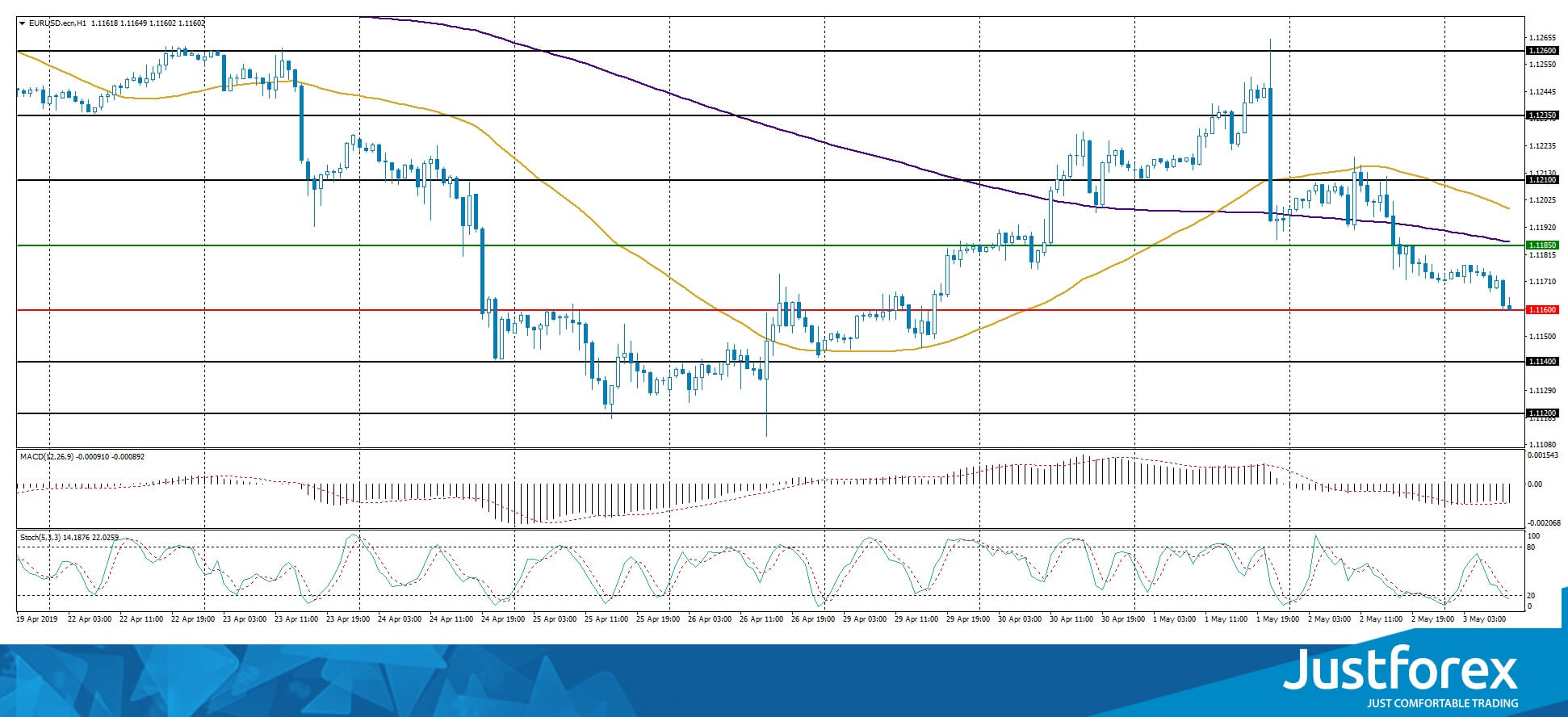
The price fixed below 50 MA and 200 MA which points to the power of the buyers.
The MACD histogram is in the negative zone and keeps falling which gives a strong signal to sell EUR/USD.
The Stochastic Oscillator is in the neutral zone, the %K line is below the %D line which points to the bearish mood.
Trading recommendations
Support levels: 1.11600, 1.11400, 1.11200
Resistance levels: 1.11850, 1.12100, 1.12350
If the price fixes below 1.11600, expect further fescend toward 1.11200-1.11000.
Alternatively, the quotes can grow toward 1.12000-1.12300.
The GBP/USD currency pair
Technical indicators of the currency pair:
Prev Open: 1.30518
Open: 1.30276
% chg. over the last day: -0.13
Day's range: 1.30152 – 1.30438
52 wk range: 1.2438 – 1.3631
GBP/USD started to descend after a long rally. The demand for USD has significantly grown. The Bank of England, as expected, kept the key monetary policy parameters at the same level. Right now GBP is consolidating. The key support and resistance levels are 1.30100 and 1.30450. The trading instrument can correct further. Keep an eye on the US labour report for April. You should open positions from the key levels.
At 11:30 the UK has published a business activity index in the Service industry.
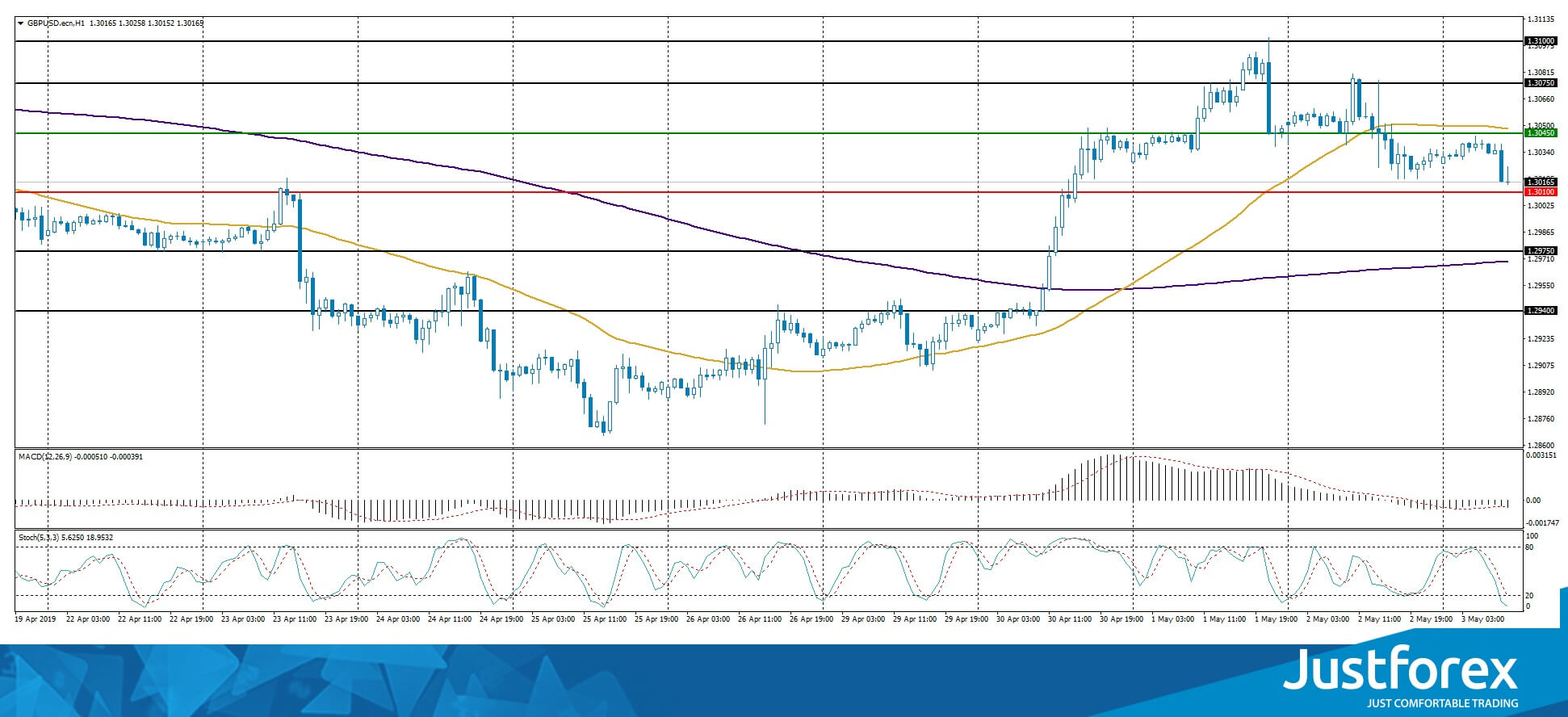
The indicators do not provide precise signals, the price fixed between 50 MA and 200 MA.
The MACD histogram is in the negative zone and keeps falling which gives a strong signal to sell GBP/USD.
The Stochastic Oscillator is near the oversold zone, the %K line is below the %D line which also points to a bearish mood.
Trading recommendations
Support levels: 1.30100, 1.29750, 1.29400
Resistance levels: 1.30450, 1.30750, 1.31000
If the price fixes below 1.30100, expect further descend toward 1.29750-1.29500.
Alternatively, the quotes can grow toward 1.30700-1.31000.
The USD/CAD currency pair
Technical indicators of the currency pair:
Prev Open: 1.34303
Open: 1.34657
% chg. over the last day: +0.20
Day's range: 1.34629 – 1.34740
52 wk range: 1.2727 – 1.3664
The USD/CAD technical picture is ambiguous. CAD is consolidating around 1.34450-1.34750. An additional pressure is caused by agressive sales on the oil market. The US trading report for April is in the spotlight. You should open positions from the key levels.
The Economic News Feed for 03.05.2019 is calm.
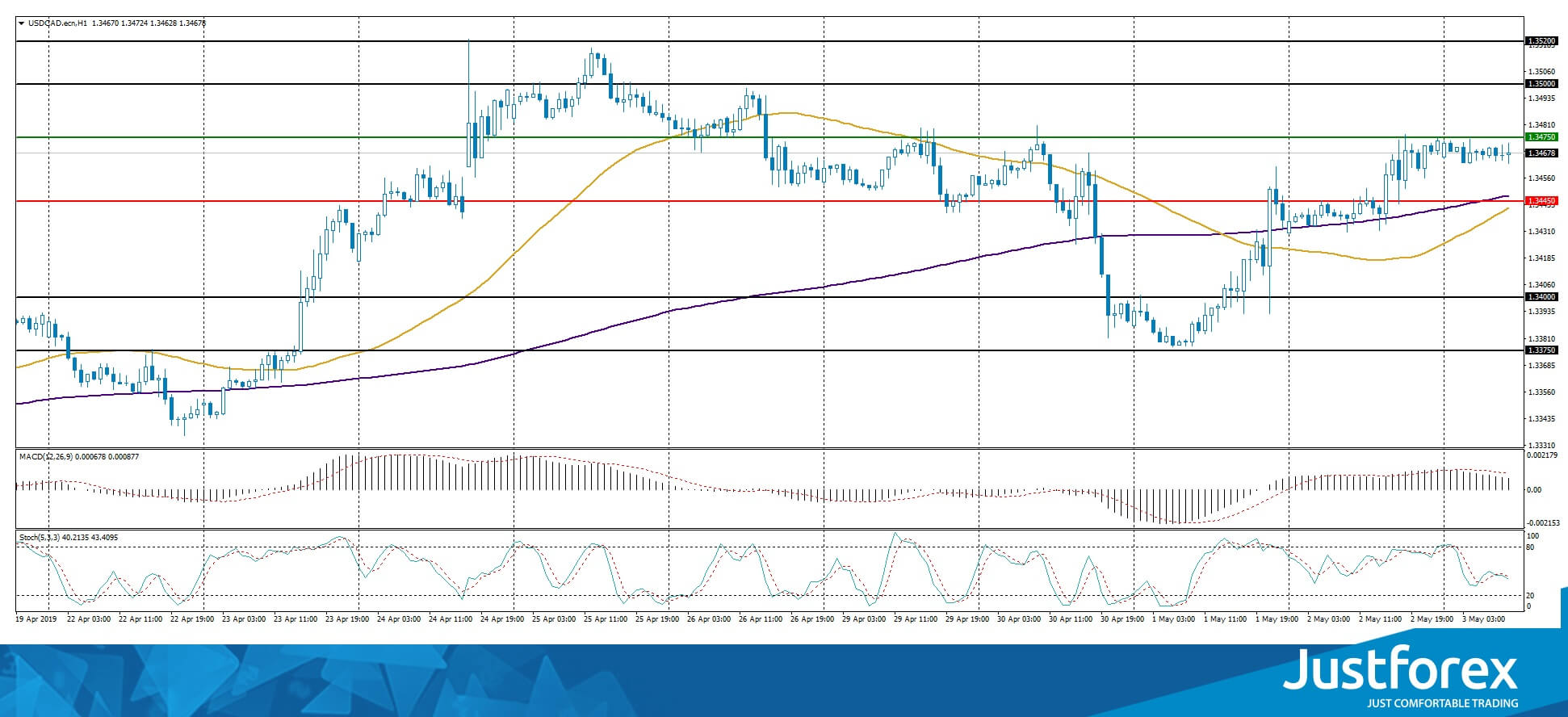
The indicators do not provide precise signals: 50 MA started to cross 200 MA.
The MACD histogram is in the positive zone but below the signal line which gives a weak signal to buy USD/CAD.
The Stochastic Oscillator is in the neutral zone, the %K line is crossing the %D line. There are no signals at the moment.
Trading recommendations
Support levels: 1.34450, 1.34000, 1.33750
Resistance levels: 1.34750, 1.35000, 1.35200
If the price fixes above 1.34750, consider selling USD/CAD. The price will move toward 1.35200-1.35500.
Alternatively, the quotes can fall toward 1.34200-1.34000.
The USD/JPY currency pair
Technical indicators of the currency pair:
Prev Open: 111.380
Open: 111.488
% chg. over the last day: +0.09
Day's range: 111.407 – 111.542
52 wk range: 104.97 – 114.56
USD/JPY keeps consolidating. There is no defined trend. The trading instrument is testing the local support and resistance levels at 111.400 and 111.650. The market participants are waiting for additional drivers. Keep an eye on the US Treasury bonds' yield. You should open positions from the key levels.
The Japanese markets are closed due to holidays.
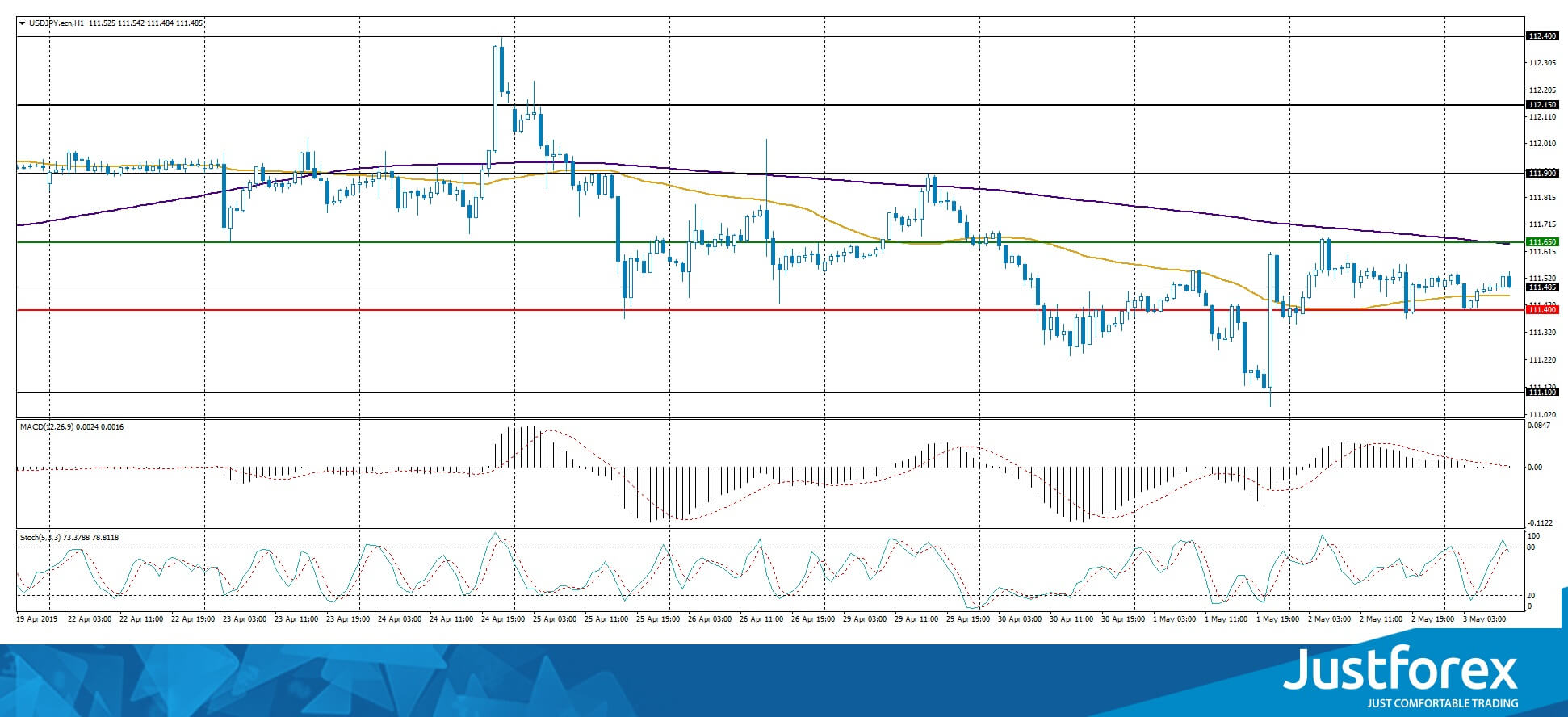
The indicators do not provide precise signals: the price fixed between 50 MA and 200 MA
The MACD histogram is close to 0.
The Stochastic Oscillator is in the neutral zone, the %K line is crossing the %D line. There are no signals at the moment.
Trading recommendations
Support levels: 111.400, 111.100
Resistance levels: 111.650, 111.900, 112.150
If the price fixes below 111.400, expect further descend toward 111.000.
Alternatively, the quotes can grow toward 111.900-112.150.
Eurozone CPI accelerated to 1.7%, core CPI rose to 1.2%
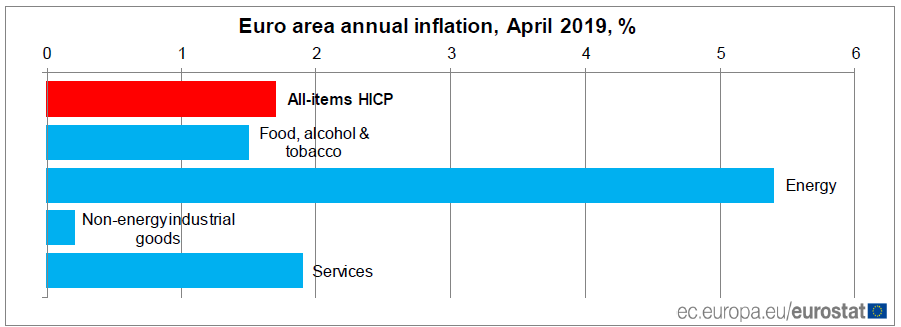
Eurozone CPI accelerated to 1.7% yoy in April, up fro 1.4% yoy and beta expectation of 1.6% yoy. CPI core also accelerated to 1.2% yoy, up from 0.8% yoy and beat expectation of 1.0% yoy.
Looking at the main components of euro area inflation, energy is expected to have the highest annual rate in April (5.4%, compared with 5.3% in March), followed by services (1.9%, compared with 1.1% in March), food, alcohol & tobacco (1.5%, compared with 1.8% in March) and non-energy industrial goods (0.2%, compared with 0.1% in March).
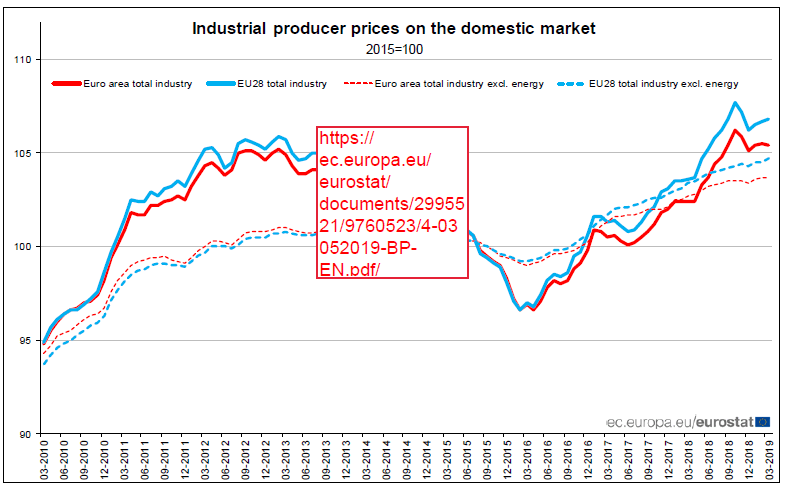
Also released, PPI dropped -0.1% mom, rose 2.9% yoy in March, versus expectation of 0.0% mom, 3.0% yoy.
Demand For The US Currency Is Still High. Labor Statistics From The US Is In The Spotlight
The US dollar continued to strengthen against a basket of major currencies after the Fed announced that it did not plan to consider the issue of lowering interest rates in the near future. Fed Chairman, Jerome Powell, said that the regulator did not see compelling reasons to increase or decrease the interest rate. The Fed believes that the slowdown in inflation and consumer demand in the first quarter were temporary. In fact, Powell did not agree with the demands by US President, Donald Trump, to reduce the interest rate. The dollar index (#DX) closed in the positive zone (+0.18%). Investors have taken a wait-and-see attitude before the publication of a report on the US labor market for April.
As expected, the Bank of England left the interest rate unchanged at 0.75% yesterday. The regulator also made it clear that the market underestimated the prospects for raising rates in the next three years. The base rate will probably be raised only once – up to 1% – by 2021. However, the Bank of England Governor, Mark Carney, believes that more than one interest rate increase may be needed. The Central Bank lowered inflation forecasts for 2019 and 2020, but kept the forecast for 2021.
The "black gold" prices significantly decreased after it became known that oil production in the US reached a new record high of 12.3 million barrels per day. At the moment, futures for the WTI crude oil are testing the mark of $61.70 per barrel.
Market Indicators
- Yesterday, the bearish sentiment was observed in the US stock market: #SPY (-0.22%), #DIA (-0.48%), #QQQ (-0.43%).
- The 10-year US government bonds yield is recovering. Currently, the indicator is at the level of 2.55-2.56%.
The news feed on 2019.05.03:
- UK services PMI at 11:30 (GMT+3:00);
- Eurozone consumer price index at 12:00 (GMT+3:00);
- Labor market statistics in the US at 15:30 (GMT+3:00);
- ISM non-manufacturing PMI at 17:00 (GMT+3:00).