Sample Category Title
US Unemployment Hit New Cycle-Low in April
- Headline employment surged 263k in April, bringing the year-to-date average increase per month to 205k
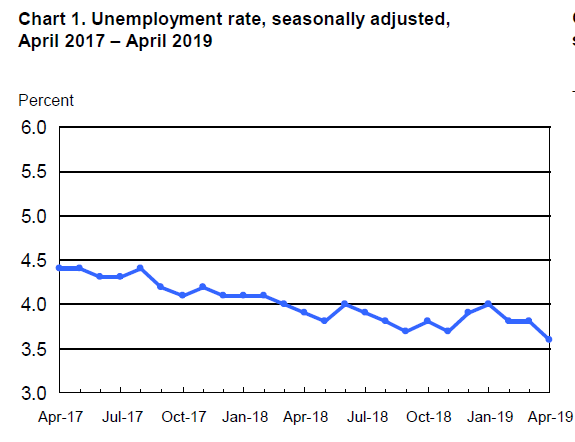
- The unemployment rate fell to a new cycle-low 3.6% -- that is the lowest since December 1969.
There was little to dislike in the April job numbers. The headline employment count is often volatile, but the 205k average per-month year-to-date gain (and 218k per month increase over the last year) is still very strong for this point in the economic cycle. The unemployment rate hit a new cycle low. The monthly dip might at first glance be attributed to the dip in labour force participation in April, but there is little evidence at this point that worker discouragement is a significant factor pushing people out of the labour force. Indeed, quite the opposite. Looking through monthly wiggles, broader measures of unemployment have fallen more quickly than the ‘official’ unemployment rate. The ‘U6’ rate (which includes discouraged workers) was unchanged from March in April but is down half a point from a year ago compared to 0.3 ppts for the unemployment rate.
Of course, the policymakers at the Federal Reserve already knew that domestic labour markets were looking solid when they moved decidedly to the sidelines in terms of future interest rate hikes. Consumer price inflation trends still look quite benign. Wage growth has been okay, but the 3.2% year-over-year rate in April is still not a pace that would be expected to generate significant upside inflation pressures. And past interest rate hikes mean that current rates are not so far off the long-run levels the Fed would normally associate with a full-employment economy. We don’t expect one more month of strong labour market data to change the Fed’s view significantly at this point – and we don’t expect any further rate hikes from the Fed through 2020 in our base-case. But it does reinforce the view that a cut is probably less-likely than is currently being priced into markets.
EUR/USD Mid-Day Outlook
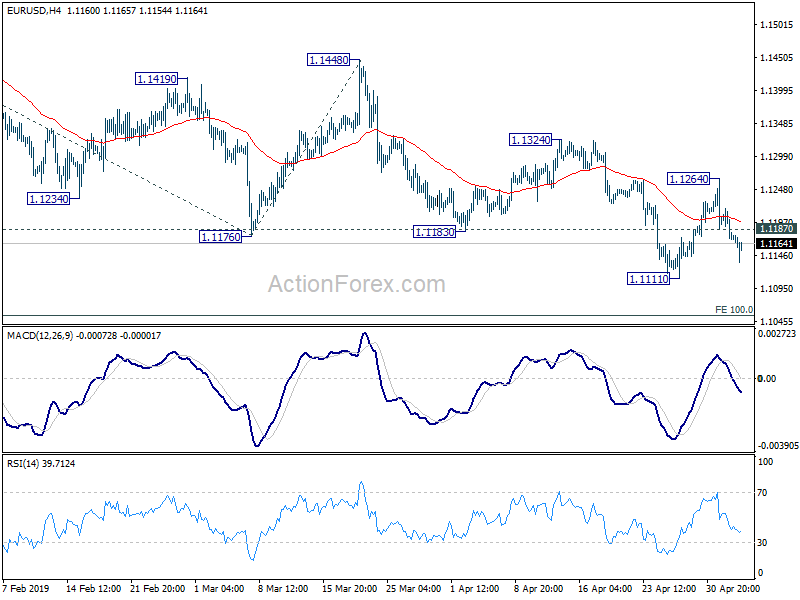
Daily Pivots: (S1) 1.1156; (P) 1.1187; (R1) 1.1204; More.....
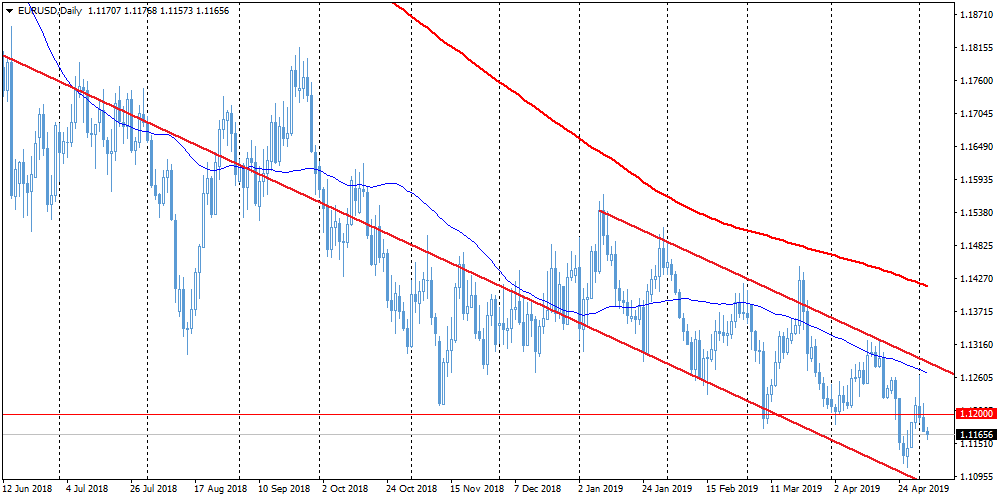
Intraday bias in EUR/USD remains on the downside for 1.1111 low. Firm break there will resume larger down trend from 1.2555. Next target will be 100% projection of 1.1569 to 1.1176 from 1.1448 at 1.1105 next. On the upside, above 1.1187 minor resistance will turn intraday bias neutral for more consolidation. But in case of another recovery, upside should be limited below 1.1324 resistance to bring down trend resumption eventually.
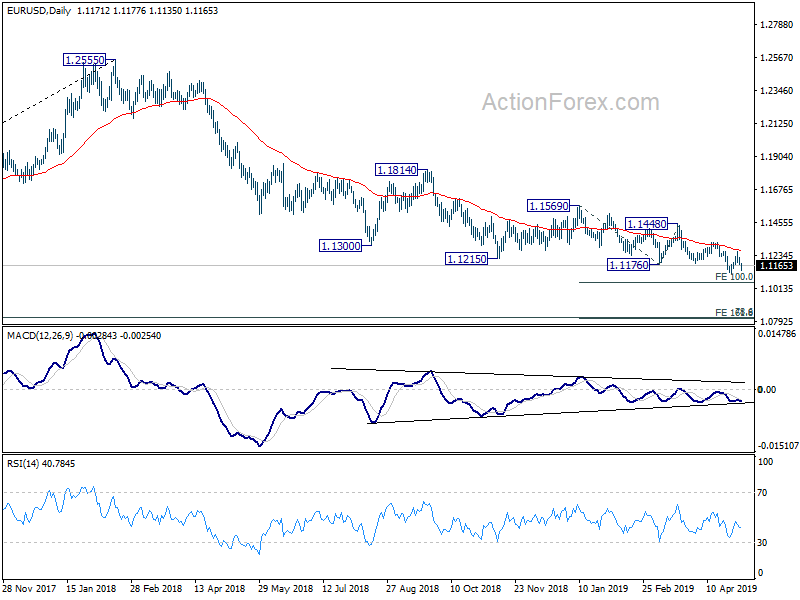
In the bigger picture, down trend from 1.2555 (2018 high) has just resumed. Current fall should now target 78.6% retracement of 1.0339 (2016 low) to 1.2555 (2018 high) at 1.0813. Sustained break there will pave the way to retest 1.0339. On the downside, break of 1.1448 resistance is needed to be the first sign of medium term bottoming. Otherwise, outlook will stay bearish in case of rebound.
Dollar Inaction to Strong NFP, Wage Growth Offsets Strong Job Number
Even though US non-farm payroll report came in much stronger than expected. There is no apparent buying in Dollar as initial reactions. Weaker than expected wage growth seems to be a factor that's capping the greenback's strength. On the other hand, stocks are apparently boosted with DOW futures trading up 140 pts at the time of writing. 10 yield yield was shot up to above 2.56 but quickly dips back to 2.54. Traders would need some more time to digest the implications.
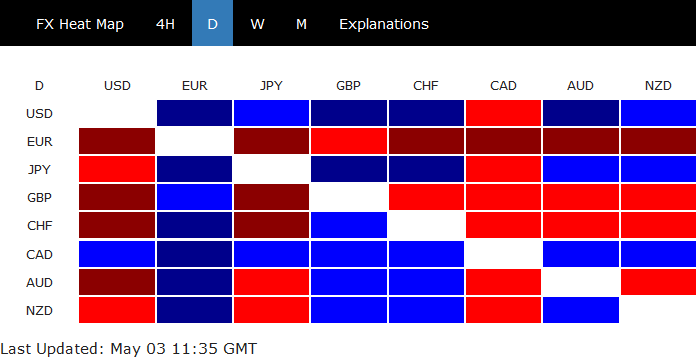
In the currency markets, commodity currencies are indeed the strongest ones at the time of writing, with help from stock futures rally. Euro remains the weakest for today, followed by Sterling and then Swiss Franc. Dollar and Yen are mixed.
In Europe, currently, FTSE is up 0.82%. DAX is up 0.52%. CAC is up 0.37%. German 10-year yield is flat at 0.033. Earlier in Asia, Hong Kong HSI rose 0.46%. China Shanghai SSE rose 0.52%. Singapore Strait Times dropped -0.03%. Japan stayed in 10-day holiday.
US NFP grew 263k, unemployment rate dropped to 3.6%, lowest since 1969
US non-farm payroll employment grew strongly by 263k in April, well above expectation of 185k. Prior month's figure was revised slightly down from 196k to 189k. Unemployment dropped to 3.6%, down from 3.8% and beat expectation of 3.8%. That's the lowest level since December 1969. Participation rate dropped by -0.2% to 62.8%. Average hourly earnings rose 0.2% mom, below expectation of 0.3% mom. But prior month's figure was revised up from 0.1% mom to 0.2% mom.
Eurozone CPI accelerated to 1.7%, core CPI rose to 1.2%
Eurozone CPI accelerated to 1.7% yoy in April, up fro 1.4% yoy and beta expectation of 1.6% yoy. CPI core also accelerated to 1.2% yoy, up from 0.8% yoy and beat expectation of 1.0% yoy.
Looking at the main components of euro area inflation, energy is expected to have the highest annual rate in April (5.4%, compared with 5.3% in March), followed by services (1.9%, compared with 1.1% in March), food, alcohol & tobacco (1.5%, compared with 1.8% in March) and non-energy industrial goods (0.2%, compared with 0.1% in March).
Also released, PPI dropped -0.1% mom, rose 2.9% yoy in March, versus expectation of 0.0% mom, 3.0% yoy.
UK PMI services rose to 50.4, marginal expansion only
UK PMI services rose to 50.4 in April, up from 48.9 and matched expectations. March's reading was a 32-month low. Markit noted marginal rise in service sector business activity. New work dips for the fourth month in a row. Input cost inflation accelerates to its highest since January.
Chris Williamson, Chief Business Economist at IHS Markit said in the release: "A near-stagnant service sector in April means that all three major parts of the economy were struggling to grow in April. Although the service sector joined construction in reporting a return to growth, in both cases the expansions were only marginal. An upturn in manufacturing is meanwhile showing signs of waning, as a temporary boost from Brexit-related stockpiling faded in April.
"The resulting rise in business activity signalled collectively by April's PMI surveys was only marginal, suggesting the economy remained more or less stalled at the start of the second quarter. "The disappointing start to the second quarter follows a first quarter in which the average PMI reading was the lowest since late 2012 and indicative of the economy flat-lining."
Swiss CPI unchanged at 0.7% yoy, consumer sentiment dropped to -6
Swiss CPI rose 0.2% mom 0.7% yoy in April, matched expectations. Core CPI rose 0.3% mom, 0.5% yoy. The 0.2% mom increase in headline CPI compared with the previous month can be explained by several factors including rising prices for fuel and for air transport. In contrast, prices for hotel accommodation, glasses and contact lenses decreased.
Swiss SECO consumer confidence dropped to -6 in April, down from -4 and missed expectation of -3. SECO noted that: "Swiss consumer sentiment has worsened slightly. The index now comes in only just above average. The labour market has still been assessed positively. However, the likelihood of consumers making major purchases remains low.
EUR/USD Mid-Day Outlook
Daily Pivots: (S1) 1.1156; (P) 1.1187; (R1) 1.1204; More.....
Intraday bias in EUR/USD remains on the downside for 1.1111 low. Firm break there will resume larger down trend from 1.2555. Next target will be 100% projection of 1.1569 to 1.1176 from 1.1448 at 1.1105 next. On the upside, above 1.1187 minor resistance will turn intraday bias neutral for more consolidation. But in case of another recovery, upside should be limited below 1.1324 resistance to bring down trend resumption eventually.
In the bigger picture, down trend from 1.2555 (2018 high) has just resumed. Current fall should now target 78.6% retracement of 1.0339 (2016 low) to 1.2555 (2018 high) at 1.0813. Sustained break there will pave the way to retest 1.0339. On the downside, break of 1.1448 resistance is needed to be the first sign of medium term bottoming. Otherwise, outlook will stay bearish in case of rebound.
Economic Indicators Update
| GMT | Ccy | Events | Actual | Forecast | Previous | Revised |
|---|---|---|---|---|---|---|
| 22:30 | AUD | AiG Performance of Service Index Apr | 46.5 | 44.8 | ||
| 01:30 | AUD | Building Approvals M/M Mar | -15.50% | -12.50% | 19.10% | |
| 05:45 | CHF | SECO Consumer Confidence Apr | -6 | -3 | -4 | |
| 06:30 | CHF | CPI M/M Apr | 0.20% | 0.20% | 0.50% | |
| 06:30 | CHF | CPI Y/Y Apr | 0.70% | 0.70% | 0.70% | |
| 08:30 | GBP | Services PMI Apr | 50.4 | 50.4 | 48.9 | |
| 09:00 | EUR | Eurozone PPI M/M Mar | -0.10% | 0.00% | 0.10% | |
| 09:00 | EUR | Eurozone PPI Y/Y Mar | 2.90% | 3.00% | 3.00% | |
| 09:00 | EUR | Eurozone CPI Estimate Y/Y Apr | 1.70% | 1.60% | 1.40% | |
| 09:00 | EUR | Eurozone CPI Core Y/Y Apr A | 1.20% | 1.00% | 0.80% | |
| 12:30 | USD | Advance Goods Trade Balance Mar | -71.45B | -73.0B | -72.0B | -80.38B |
| 12:30 | USD | Wholesale Inventories M/M Mar P | 0.00% | 0.20% | 0.20% | |
| 12:30 | USD | Change in Non-farm Payrolls Apr | 263K | 185k | 196k | 189K |
| 12:30 | USD | Unemployment Rate Apr | 3.60% | 3.80% | 3.80% | |
| 12:30 | USD | Average Hourly Earnings M/M Apr | 0.20% | 0.30% | 0.10% | 0.20% |
| 13:45 | USD | Services PMI Apr F | 52.9 | 52.9 | ||
| 14:00 | USD | ISM Non-Manufacturing/Services Composite Apr | 57 | 56.1 |
US NFP grew 263k, unemployment rate dropped to 3.6%, lowest since 1969
US non-farm payroll employment grew strongly by 263k in April, well above expectation of 185k. Prior month's figure was revised slightly down from 196k to 189k. Unemployment dropped to 3.6%, down from 3.8% and beat expectation of 3.8%. That's the lowest level since December 1969. Participation rate dropped by -0.2% to 62.8%. Average hourly earnings rose 0.2% mom, below expectation of 0.3% mom. But prior month's figure was revised up from 0.1% mom to 0.2% mom.
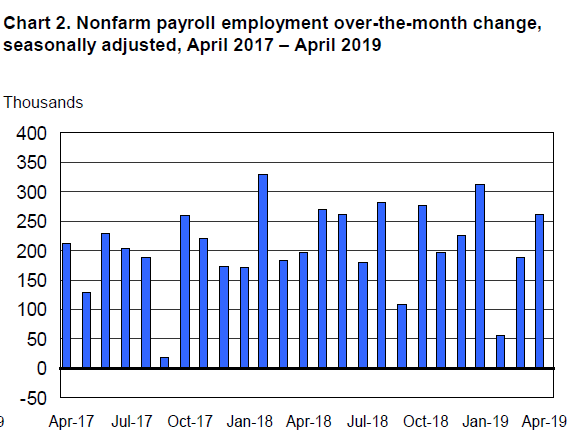
The set of job data is rather solid. But at the time of writing. there is no apparent strength in Dollar yet.
US 30 Index Eases Below 6-Month High; Indicators Suggest Bearish Bias
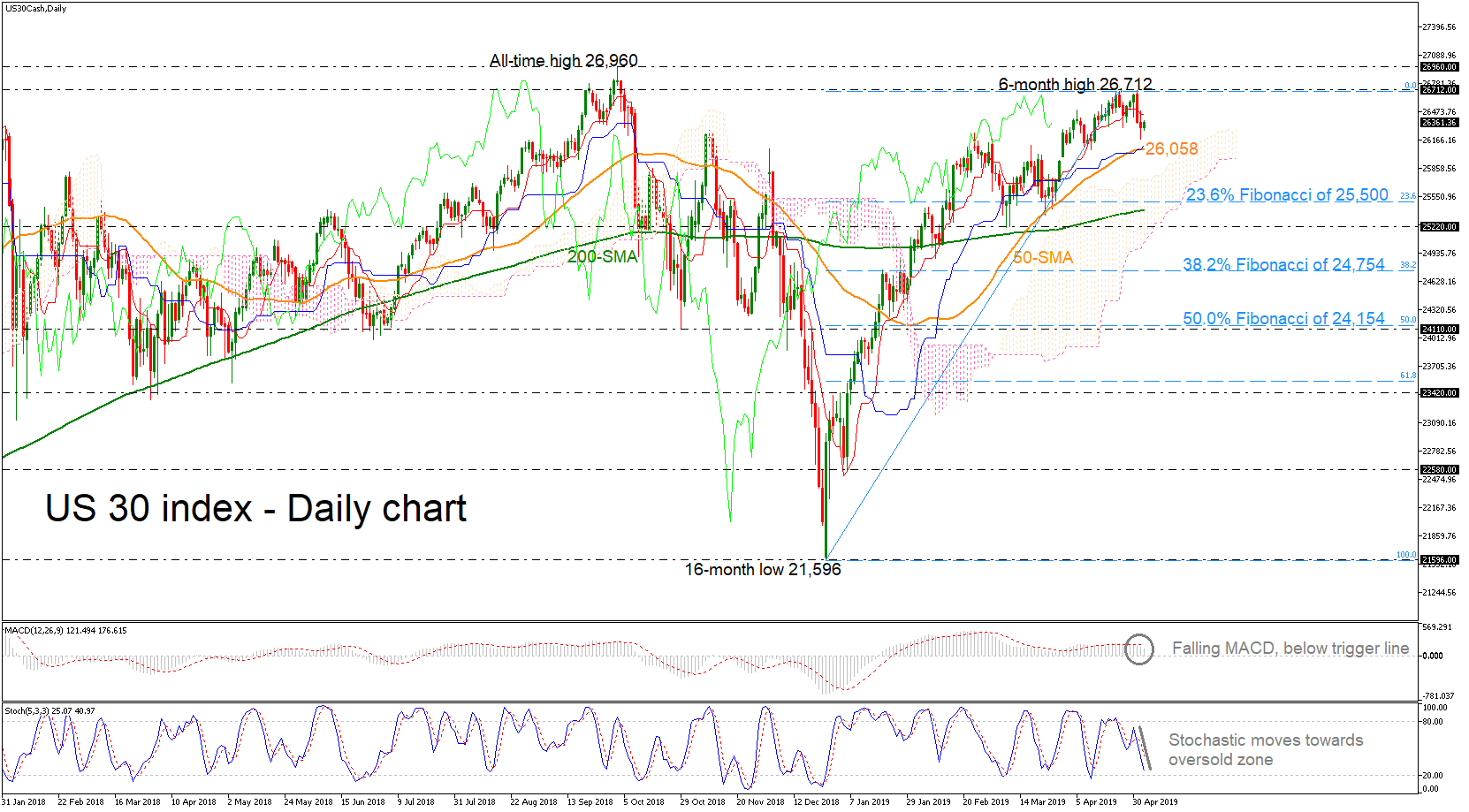
The US 30 index is trading below the six-month high of 26,712, remaining well above the ‘golden cross’ between the 50- and 200-day simple moving averages (SMAs). The index is on the back foot and the technical indicators suggest that the market could ease a little bit in the short-term; the MACD is easing in the positive zone, while the stochastic is approaching the oversold zone.
In case of a correction lower, preliminary support may be initially found in the crossroads of the 50-day SMA and the blue Kijun-sen line, around at 26,058, and then near 25,500 which is where the 23.6% Fibonacci retracement level of the upleg from 21,596 to 26,712 and the 200-day SMA are currently located. Falling towards the 25,220, the medium-term picture would shift from bullish to neutral.
On the other hand, if the bulls maintain control, immediate resistance could come around the six-month high of 26,712, where the rally topped on April 24. If buyers pierce above that, the next obstacle may be the all-time high of 26,960.
Summarizing, in the near-term, the momentum indicators point to a possible bearish retracement, however, the index is still creating higher highs and higher lows over the last couple of months, which augurs well for the medium-term.
Brent Crude – Correction Over Or Just Beginning
How low will oil go?
It's been a pretty woeful week for oil prices, now off more than 5% from last Friday's peak and showing little sign of letting up.
Trump may be able to claim responsibility for this correction – with his bizarre claims last week that he'd spoken with OPEC undoubtedly being the initial catalyst – but the reality is that this was already a very overbought market that just needed a nudge in the right direction and the inventory data we've seen this week just compounded that. Perhaps that was Trump's real intention all along.
Brent Daily Chart
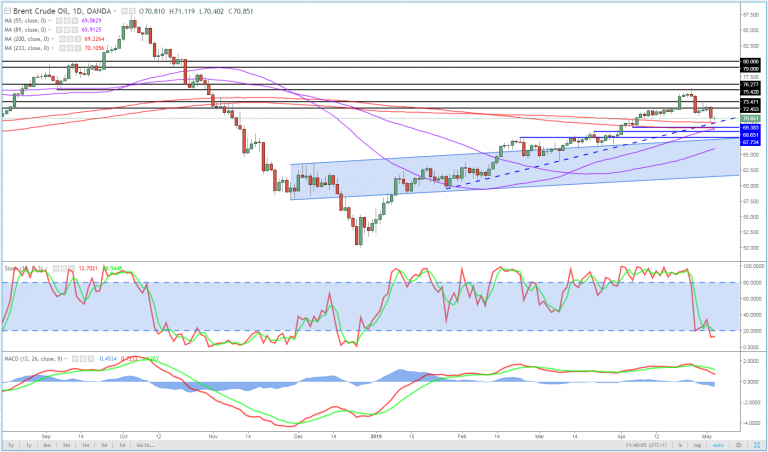
Now it’s simply a question of how big a correction we’re facing and whether recent moves will knock the confidence of oil bulls or has presented an opportunity to add at cheaper prices. The fundamentals are clearly a mixed bag.
On the one hand we have record US output and slower growth. On the other, Iranian waivers have now expired and OPEC+ compliance with the output cut has been strong. One unknown is whether that continues beyond June. Perhaps current levels are pretty adequate under the circumstances.
What about the technical picture?
As you can see on the daily chart above, we’ve clearly now stumbled upon a very interesting area in Brent. The 55, 200 and 233 all combine here to make this a notable support zone. The fact that this also coincides with prior support and resistance and a rising trend line just makes it more interesting again.
Brent 4-Hour Chart
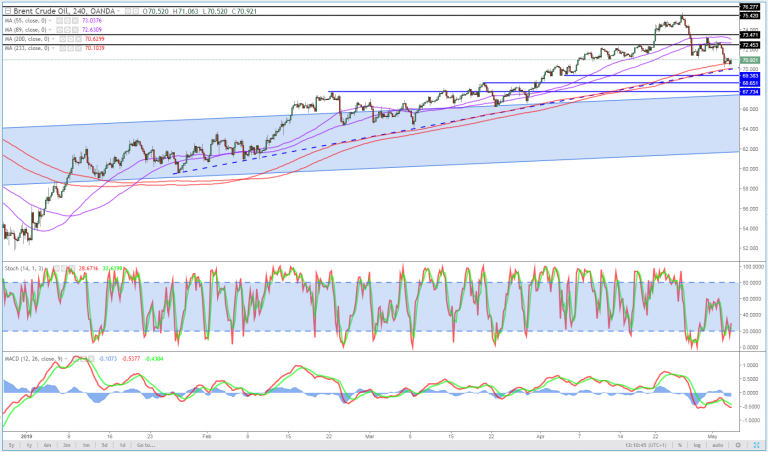
A look at the 4-hour chart suggests it doesn’t end there. Since breaking above the 200 and 233 simple moving average at the start of the year, price has stayed above here and rotated higher on each approach. We haven’t really seen a major test of it until now. Should we break below here and the trend line, which has been tested repeatedly, it could well be a bearish signal and provide an earlier indicator than the daily chart.
Gold – Bulls Putting Up Another Fight
Gold threatening more lows
Gold is trading back near its recent lows and looking vulnerable on Friday.
Recent gains in the dollar have further weighed on the yellow metal, with this week’s assessment from the Federal Reserve not quite dovish enough to satisfy the gold bulls that are still hanging on.
US Dollar Index

It is worth noting that momentum may be fading in the decline, something that was evident when it hit the lows last week as well, which makes the area around $1,260 all the more interesting.
Gold Daily Chart

A break below here may bring some of that momentum flowing back, although continued declining momentum into it may strongly indicate that there’s not yet the appetite there to see gold breach these levels. Of course, if the dollar is going to continue to outperform on the upside, the gold bulls may be fighting against the tide.
Euro Zone Apr CPI Beats Expectations, Focus On US Payroll Data
Notes/Observations
- UK Apr Services PMI data moves back into expansion territory
- Euro Zone Apr flash CPI beats expectations; Swiss inflation stayed ultra-low
- Focus on upcoming US jobs report for Apr
Asia:
- China said to have reserved dates on President Xi Jinping's official calendar for a trip to Washington in June concerning a trade deal. (said to signal that govt believed it was close enough to a trade agreement being done that they could start planning a trip
Europe/Mideast:
- ECB's Weidmann (Germany): Expects slowdown in German growth to be temporary. German economy to pick up speed after slow down
- ECB's Rehn (Finland): ECB should not jump the gun after the first signs of stronger data
- EU's Juncker: ECB's Weidmann is a suitable candidate for the ECB president position when Draghi leaves
- Early results in the UK local elections showed that both the Conservatives and Labour have lost support due to Brexit with smaller parties and independents taking seats across the country
Americas:
- President Trump: Stephen Moore is withdrawing consideration for the Fed
- Congressional Budget office: sees US deficits averaging 4.3%/GDP from 2020-2029. US debt growing to 92% of GDP from 78% in 2019. Lower rates would still push up national debt because of large annual deficits
- Chamber of Commerce official: US and China were in the endgame of trade talks, continued to make progress on a range of issues in trade negotiations
SPEAKERS/FIXED INCOME/FX/COMMODITIES/ERRATUM
Equities
- Indices [Stoxx600 +0.41% at 390.38, FTSE +0.70% at 7,402.75, DAX +0.37% at 12,392.30, CAC-40 +0.33% at 5,556.86, IBEX-35 +0.25% at 9,442.16, FTSE MIB +0.19% at 21,751.50, SMI +0.26% at 9,771.80, S&P 500 Futures +0.36%]
Market Focal Points/Key Themes:
Equities
- European Indices trades higher across the board, following on from a positive session in Asia and higher US futures.
- Earnings continue to take center stage with Banking giant HSBC trading higher after a strong top and bottom line beat; French Banking name Societe General and Axa also higher after Revenues beat forecasts, German Chemical giant BASF trades little changed while Adidas trades sharply higher on earnings.
- Meanwhile Air France falls after a higher then expected loss, Intercontinental Hotels also falls on a Q1 update, while Intu Group declines sharply following a cut in forecasts.
- In other news Freenet falls on an analyst downgrade; Iliad rises almost 4% on an upgrade at Morgan Stanley; Duerr also gains on an upgrade at Commerzbank.
- Looking ahead notable earners include Fiat Chrysler, Dish Network, Dominion Energy and American Axle among others.
- Consumer discretionary: adidas [ADS.DE] +7% (earnings), Air France-KLM [AF.FR] -4% (earnings), Intu Properties [INTU.UK] -6.5% (profit warning)
- Consumer staples: ICA Gruppen [ICA.SE] +6.5% (earnings)
- Energy: Equinor [EQNR.NO] +1.5% (earnings), Spectrum [SPU.NO] +17% (to be acquired)
- Healthcare: Novo Nordisk [NOVOB.DK] -0.5% (earnings)
- Financials: Societe Generale [GLE.FR] +2% (earnings), HSBC [HSBA.UK] +2.5% (earnings), Axa [CS.FR] +2% (earnings)
- Materials: Wienerberger [WIE.AT] +4.5% (earnings)
- Industrials: BASF [BAS.DE] -0.5% (earnings), DNB [DNB.NO] -2.5% (earnings)
- Technology: Siltronic [WAF.DE] +4% (earnings)
- Telecom: Iliad [ILD.FR] +3.5% (analyst action)
Speakers
- BoE Deputy Gov Broadbent reiterated MPC stance that expected rates to rise in a limited and gradual manner. Market expectations for rates were lower. Fall back in market interest rate expectations was main reason for stronger BoE forecasts
- ECB's Weidmann (Germany) stated that tiering debate could harm normalization expectations. Banks pay only marginal sums to ECB on negative rates thus relief from any tiering would be negligible. Reiterated despite solid Q1 GDP growth there was still no overall improvement in economy. German growth dip proving to be more persistent than initially thought and added that 2019 GDP growth of 0.5% as very plausible
- UK Labour Party Finance Spokesman Mcdonnell: Message from local election was that Brexit needs to be sorted, 'Message received'
- EU Leaders said to be planning a special summit on May 28th following the EU parliamentary elections
Currencies/ Fixed Income
- USD held onto gains in a quiet session ahead of the release of US payroll data. The greenback supported by speculation that US gains were solid in April
- A week of improving data for the Euro Zone failed to provide any sustainable momentum for the Euro currency and was unable to regain any position above the key 1.13 level. The Euro Zone flash CPI and Core readings beat expectation but did little to aid the Euro upside. Pair at 1.1160 just ahead of the NY morning.
- GBP was softer after local UK elections results showed that both the Conservatives and Labour parties have lost support due to Brexit. UK Apr PMI Services data moved back into expansion territory but could not provide the legs for a stronger GBP currency.
Economic Data
- (CH) Swiss Apr SECO Consumer Confidence: -6 v -3e
- (DK) Denmark Mar Gross Unemployment Rate: 3.7% v 3.7% prior; Unemployment Rate (Seasonally Adj): 3.1% v 3.1% prior
- (NO) Norway Mar Credit Indicator Growth Y/Y: 5.8% v 5.7%e
- (FI) Finland Mar House Price Index M/M: -1.1% v +2.0% prior; Y/Y: 0.7% v 1.4% prior
- (CH) Swiss Apr CPI M/M: 0.2% v 0.2%e; Y/Y: 0.7% v 0.7%e; CPI Core Y/Y: 0.5% v 0.5%e
- (CH) Swiss Apr CPI EU Harmonized M/M: 0.6% v 0.3% prior; Y/Y: 1.1% v 0.7% prior
- (TR) Turkey Apr CPI M/M: 1.7% v 2.4%e; Y/Y: 19.5% v 20.4%e; CPI Core Index Y/Y: 16.3% v 17.1%e
- (TR) Turkey Apr PPI M/M: 3.0% v 2.0%e; Y/Y: 30.1% v 28.9%e
- (NO) Norway Apr Unemployment Rate: 2.3% v 2.3%e
- (UK) Apr Services PMI: 50.4 v 50.3e (moves back into expansion); Composite PMI: 50.9 v 50.6e
- (UK) Apr Official Reserves Changes: $1.5B v -$172M prior
- (HK) Hong Kong Mar Retail Sales Value Y/Y: -0.2% v +2.5%e; Retail Sales Volume Y/Y: -0.8% v +1.5%e
- (EU) Euro Zone Apr CPI Estimate Y/Y: 1.7% v 1.6%e; Advance CPI Core Y/Y: 1.2% v 1.0%e
- (EU) Euro Zone PPI M/M: -0.1% v +0.1%e; Y/Y: 2.9% v 3.0%e
Fixed Income Issuance
- None seen
Looking Ahead
- (ZA) South Africa to sell ZAR760M in I/ L 2029, 2033 and 2050 bonds
- 05:30 (IN) India to sell combined INR170B in 2021, 2026, 2031, 2039 and 2059 bonds
- 06:00 (UK) DMO to sell €4.0B in 1-month, 3-month and 6-month bills £0.5B, £1.5B and £2.0B respectively)
- 06:45 (US) Daily Libor Fixing
- 08:00 (BR) Brazil Mar Industrial Production M/M: -0.7%e v +0.7% prior; Y/Y: -4.6%e v +2.0% prior
- 08:00 (UK) Baltic Bulk Index
- 08:00 (EU) ECB SSM chief SSM's Enria on panel in Florence
- 08:00 (IN) India announces upcoming bill issuance (held on Wed)
- 08:00 (ES) Spain Debt Agency (Tesoro) announces upcoming bond issuance for Thursday, may 9th
- 08:30 (US) Apr Change in Nonfarm Payrolls Apr +190Ke v +196K prior; Change in Private Payrolls: +188Ke v +182K prior; Change in Manufacturing Payrolls: +10Ke v -6K prior
- 08:30 (US) Apr Unemployment Rate: 3.8%e v 3.8% prior; Underemployment Rate: No est v 7.3% prior; Labor Force Participation Rate: 63.0%e v 63.0% prior
- 08:30 (US) Apr Average Hourly Earnings M/M: 0.3%e v 0.1% prior; Y/Y: 3.3%e v 3.2% prior; Average Weekly Hours: 34.5e v 34.5 prior
- 08:30 (US) Mar Advance Goods Trade Balance: -$73.0Be v -$79.5B prior (Dec)
- 08:30 (US) Mar Preliminary Wholesale Inventories M/M: 0.2%e v 0.2% prior; Retail Inventories M/M: 0.1%e v 0.3% prior
- 09:00 (SG) Singapore Apr Purchasing Managers Index (PMI): 50.6e v 50.8 prior; Electronics Sector Index: No est v 49.8 prior
- 09:00 (MX) Mexico Mar Leading Indicators M/M: No est v -0.02 prior
- 09:00 (MX) Mexico Apr Vehicle Domestic Sales: No est v 117.1K prior
- 09:00 (CL) Chile Mar Retail Sales Y/Y: 1.0%e v 0.7% prior; Commercial Activity Y/Y: No est v 4.8% prior
- 09:45 (US) Apr Final Markit Services PM: 52.9e v 52.9 prelim; Composite PMI: No est v 52.8 prelim
- 10:00 (US) Apr ISM Non-Manufacturing Index: 57.0e v 56.1 prior
- 10:15 (US) Fed's Evans (dove, voter)
- 11:00 (EU) Potential sovereign ratings after European close
- 11:30 (US) Fed's Clarida (moderate, voter)
- 13:00 (US) Weekly Baker Hughes Rig Count data
- 13:45 (US) Fed's Williams (moderate, voter)
- 14:00 (CO) Colombia Central Bank Apr Minutes
- 15:00 (US) Fed's Bowman (voter)
- 19:45 (US) Fed members Bullard, Daly, Kaplan and Mester at Stanford University
Into US session: European majors weak ahead of NFP
Entering into US session, European majors are generally the weakest ones despite some positive data. UK PMI services rose back above 50 in April. Eurozone CPI and core CPI accelerated more than expected. But Euro and Sterling are so far the weakest ones for today. On the other hand, Canadian, Yen and Dollar are the strongest ones, and it's hard to tell who's better yet.
Non-farm payroll report will be the main focus today and will be released within an hour. Any upside surprise, in particular in wage growth, will further lower the chance of a Fed rate cut. Dollar and treasury yields should be boosted in this case naturally. The main question is whether stocks would indeed react negatively to a good set of NFP numbers. If that happens, Yen could jump together with Dollar, with EUR/JPY taking out 124.09 temporary low. AUD/USD could finally make up its mind to get rid of 0.7 handle decisively.
In Europe, currently:
- FTSE is up 0.78%.
- DAX is up 0.35%.
- CAC is up 0.27%.
- German 10-year yield is up 0.0091 at 0.041, staying positive.
Earlier in Asia:
- Hong Kong HSI rose 0.46%.
- China Shanghai SSE rose 0.52%.
- Singapore Strait Times dropped -0.03%.
- Japan stayed in 10-day holiday.
Nonfarm Payrolls May Stop The Dollar Growth
Over the past month, the American currency has been developing its uptrend due to relatively strong macroeconomic data, which made dollars assets more attractive. This dynamic received a new impetus in the middle of the week after the Fed meeting.
However, the Friday's U.S. labour market report is able to put into question, or, conversely, strengthen the USD growth trend.
The American economy is set to create about 180K jobs in April, according average analysts' estimates. This is insignificantly worse than the average monthly growth over the last 12 months. During the week we see some controversial data: the ADP announced a strong employment growth in the private sector, but weekly unemployment claims and Manufacturing ISM point to a cooler growth compared to previous months.
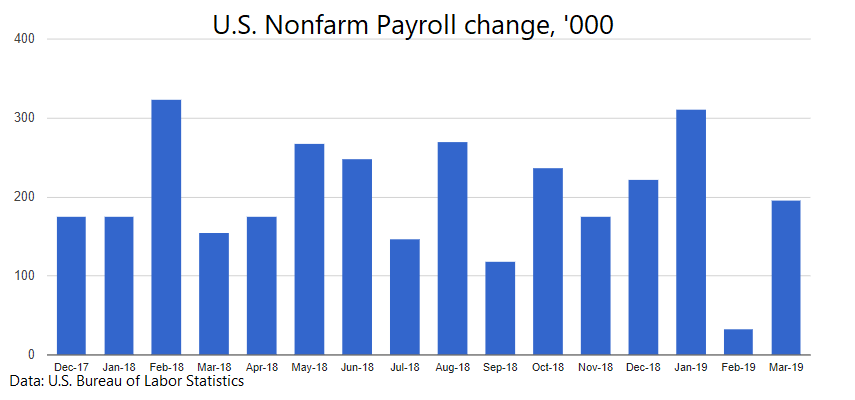
Additionally, the auto and housing markets show a decline in sales, which one more evidence of a consumer confidence drop. Thus, macroeconomic data indicates that the situation in employment is getting a little cooler. And this can be a serious obstacle to the USD growth. 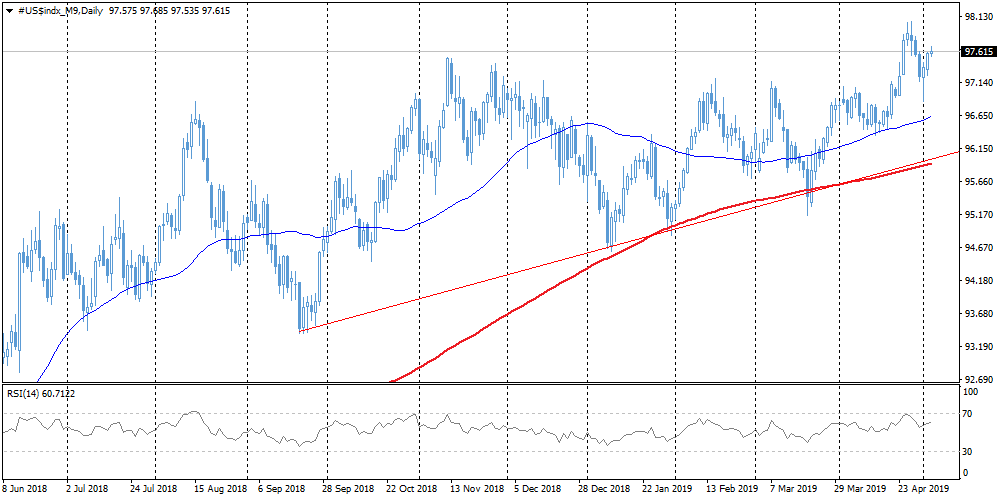
Against a trade-weighted basket of 6 major currencies, the dollar rose to 2-year highs last week. But for the further dollar growth, this employment report may need to significantly exceed the expectations. However, indirect indicators are set to a "slightly worse than average" report, potentially creating space for a retreat of the USD.