Sample Category Title
Markets Talk: Demand For Risks Began To Decline
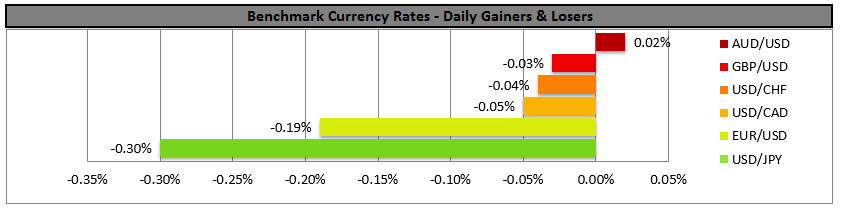
The stock market growth had stalled by the end of the week. Friday's profit-taking could save EUR and GBP from the further decline.
Stocks
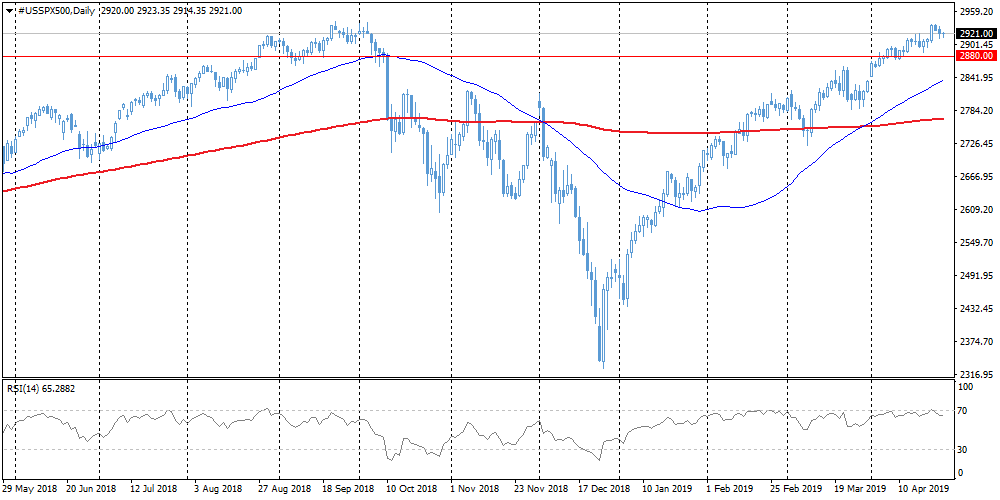
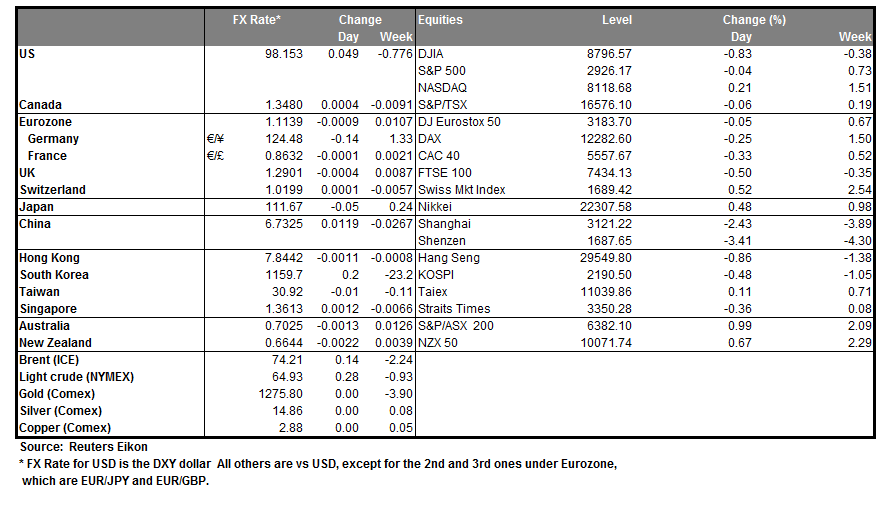
The S&P 500 futures lost 0.6% from their peak levels earlier in the week. China A50 Index is losing ground throughout the week, dropping more than 5% erasing earlier April growth. As an additional warning sign, one should consider a turn to the growth of the VIX index. Also known as the fear index, this indicator increased over the week by 10% to 13.50. Growth from levels around 10 in recent years has often become the first sign of a subsequent deep correction.
EURUSD
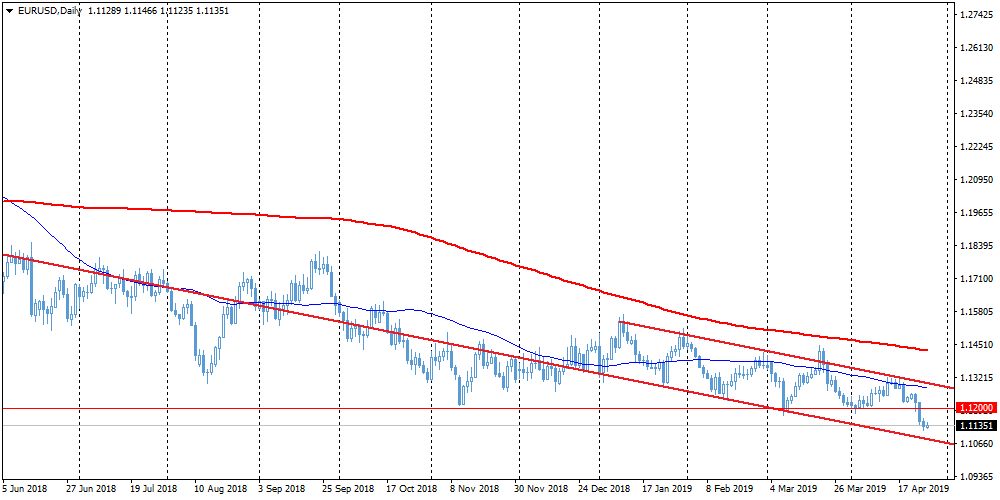
The pair has continued to decline on Thursday, showing intraday lows near 1.1117. These are the lowest levels since mid-2017. The target of the bears may be the lower limit of the downward channel, which is currently passing through 1.1080. At the same time, a corrective pullback of EURUSD in the form of a careful profit taking after an impressive dynamic during the week cannot be ruled out.
GBPUSD
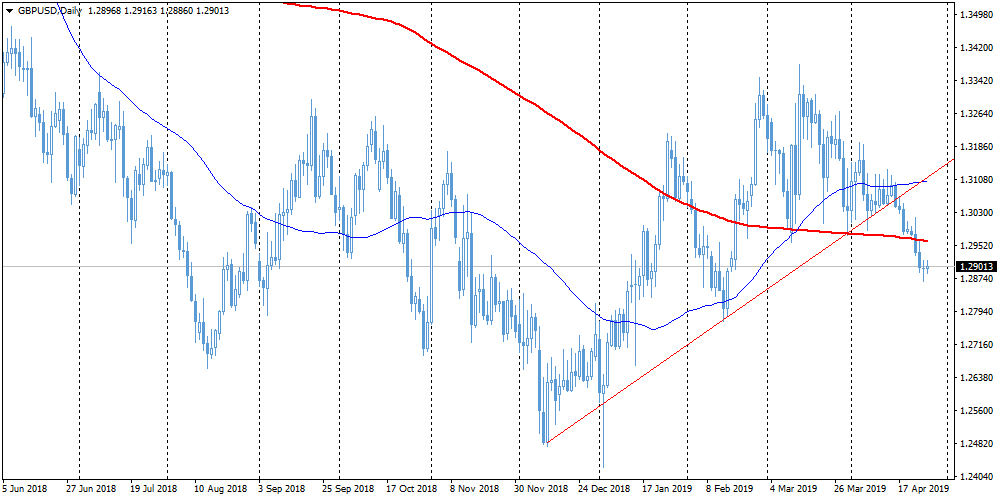
The British pound received support near the 1.2900 level. The CBI strong retail sales estimates provided support for the currency. As in the case with the euro, the pound was helped by players' desire to close part of their positions on Friday before the weekend. At the same time, the medium-term technical picture remains unfavourable for the pound, which broke the uptrend and fell below the MA(200).
Gold
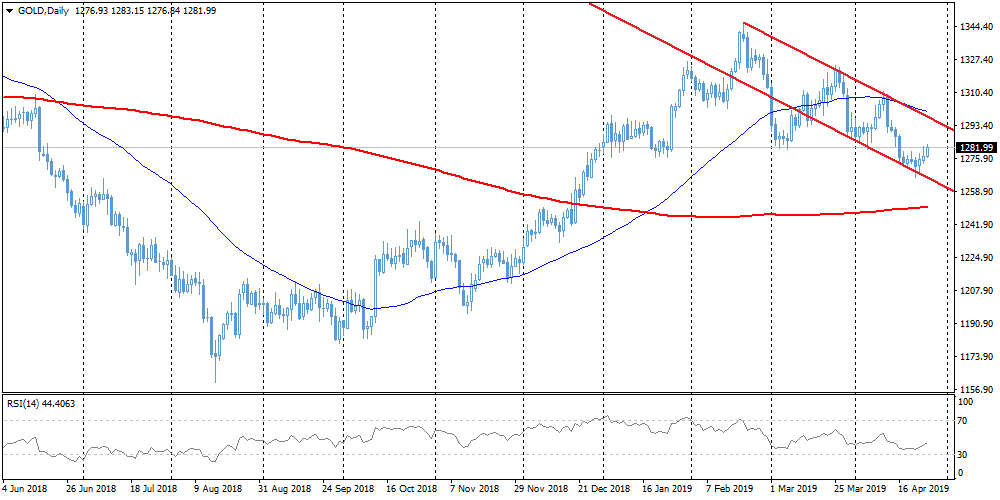
Demand for defensive assets allowed gold to show a rebound in the second half of the week from the level of support of the downward channel. In case of increasing pressure on the markets, the gold bulls may turn to 1290 levels against the current 1282. Higher growth will question the current downtrend and could potentially open the way to 1300. However, according to the technical analysis, the likelihood of further reversal seems to be more likely, with potential targets for bears around 1250, where MA(200) passes.
Asia Note – Can You Hear The Doves Fernando?
Doves in control
It was doves and not drums we could hear in Stockholm overnight as the Swedish Riksbank belted out a chorus that said, “lower for longer,” which is clearly a very popular song among central banks at the moment. In fact, I heard almost the same song from both the Turkish central bank and the Bank of Japan yesterday.
The world’s two-speed economy slapped the markets in the face overnight, with Sweden extending its -0.25% repo rate until the end of 2020, the Bank of Japan holding rates at -0.1% until late 2020 and the Turkish Central Bank removing the hawkish bias completely from its rate-decision comments. In Turkey’s case, rates are 24%, which is the only thing keeping the Turkish lira (TRY) alive. Strip out the country’s risk premium, which is around 24%, and you’re left with 0%. You get the picture.
The world’s two-speed economy is in full cry, with the big block V8 engine we call the US equity market firing on all cylinders, while an ever-increasing number of central banks globally (including the US Federal Reserve), tell us all is not right in Denmark, or maybe that’s Sweden. Thankfully the US bond market and the US dollar have held steadfast, preferring the bigger picture rather than the equity-driven fast-money view.
With China moving to more surgical rather than blank-cheque blanket stimulus measures, the divergence between the equity versus currency and bond markets seems to be growing more pronounced each day. This may not be a story for next week or even next month, but those doves will turn into drums in 2019 Fernando.
Wall Street itself had a mixed bag of a day on the earnings front. The Dow Jones dropped 0.5%, dragged lower by industrial titan 3M. The tech-heavy Nasdaq rose 0.2% after Microsoft outperformed and the S&P 500 stayed flat. Tonight’s US GDP print takes on much greater importance now with so much good news pumped into equity markets, and a downside miss could provoke an outsized correction lower to finish the week.
Asian markets diverged from a bullish Wall Street yesterday and may do so again this morning. Japanese Preliminary Industrial Production has just been released and has failed with a much worse-than-expected 4.6% YoY. This is unlikely to give regional markets the jump start to finish the week they would have hoped for. After a busy morning, we can likely expect activity in Asia to slow this afternoon as Japan heads into its extended Golden Week holiday.
FX
The FX markets awoke from their slumber overnight as a dovish Swedish Riksbank saw the Swedish krona (SEK) plunge against the dollar. This had a knock-on effect, with the euro dropping to 1.1135 and the British pound (GBP) falling to 1.2895 this morning. Emerging markets also struggled in the overnight session as central bank unease about growth saw currency traders continue rotating back into USD.
For now, there is no reason to change this thesis in the short-term. With the US markets performing well, offering high yields and safe-haven status, it’s hard to construct a bearish case on the dollar for now.
Equities
Japan is unlikely to be impressed with this morning’s Industrial Production data, following on from a very circumspect BOJ yesterday. With Golden Week upon us, Tokyo could see long positioning trimmed as investors reduce risk.
With such a mixed bag of results from Wall Street overnight and heavyweight GDP data due this evening, regional markets could adopt a cautious approach today, preferring to continue lightening risk after an extended bullish run.
Oil
After reaching six-month highs, profit-taking has hit oil contracts. Brent Crude fell 0.50% to USD74.20 a barrel while WTI dropped 1.40% to USD65.00 a barrel. After such an impressive run higher, a pause for breath is both welcome and expected. The underlying supply situation, especially for Brent, remains constructive overall however and dips should be supported in Asia trading today.
Gold
Gold climbed to USD1,277.50 an ounce overnight – a 0.20% gain. Gold received support from a procession of wavering central banks overnight and an increasingly likely economic crisis in Argentina, helping to offset a stronger US dollar. The yellow metal could remain supported in Asia today ahead of the weekend and holiday season starting next week.
The Dollar Index Is Testing Two-Year Highs. Investors Expect US GDP Data
Demand for the US currency is still high. Yesterday, the US dollar strengthened slightly against the basket of major currencies. At the moment, the dollar index (#DX) has become stable near two-year highs. The United States has published mixed economic releases. Core durable goods orders rose by 0.4% in March, although investors expected growth by only 0.2%. However, initial jobless claims increased to 230K instead of 199K. Today, investors have taken a wait-and-see attitude before the publication of US GDP data for the first quarter of 2019. We recommend taking into account the difference between the actual and forecasted values.
The euro has stabilized after aggressive sales the day before. Yesterday, ECB Vice President, Luis de Guindos, said that the regulator was ready to resume a quantitative easing program (QE) to stimulate inflation in the Eurozone. The official also added that he expected growth in the Eurozone economy by 1.1-1.2% in 2019.
The "black gold" prices have moved away from annual highs. In the near future technical correction is not excluded after a protracted rally. At the moment, futures for the WTI crude oil are testing the mark of $64.90 per barrel.
Market Indicators
- Yesterday, there was a variety of trends in the US stock market: #SPY (-0.06%), #DIA (-0.52%), #QQQ (+0.41%).
- The 10-year US government bonds yield is at the level of 2.52-2.53%.
The news feed for 2019.04.26:
- US GDP data at 15:30 (GMT+3:00).
USD Steadies Ahead Of US GDP Release
USD steadied yesterday, as upbeat US financial releases supported it. It would be indicative that the USD Index reached an almost two year high yesterday, as well as the USD against EUR. US financial releases showed that orders for capital goods have increased the most in 8 months and if combined with the recent favorable retail sales growth rates, fears of a possible sharp slowdown in the US economy seem to ease. Analysts point out that the difference in economic fundamentals, is a key driver for currencies, as the Fed along with other central banks have a more dovish stance in place now. We expect the market's focus to be on the US GDP release today, which could provide further clues as for the USD's direction and despite some analyst's optimism, we maintain some reservations about the outcome. EUR/USD dropped yesterday and tested the 1.1125 (S1) support line without successfully breaking it. We could see the pair maintain a sideways movement today, yet it may prove to be quite sensitive to the US GDP release during the American session and we wouldn't be surprised to see some bullish tendencies. Please note that the pair finds its self at the lowest position June 2017. Also please note that the RSI indicator in the 4 hour chart remains below the reading of 30implying a rather overcrowded short position. Should the pair be under the market's selling interest once again, we could see it breaking the 1.1125 (S1) support line and aim for the 1.1075 (S2) support barrier. Should the market favor the pair's long positions on the other hand, we could see the pair aiming if not breaking the 1.1175 (R1) and should that be breached, we could see it aiming for the 1.1220 (R2) resistance level.
WTI prices drop on hopes for OPEC to curtail production cuts
Oil prices drop yesterday and during today's Asian session as hopes for extended output levels by OPEC rose. Despite the drop analysts point out that the oil market remains tight amid supply disruptions and rising geopolitical concerns. It should be noted that the US is expected to mount the pressure on Saudi Arabia to lift its production to cover for any supply gap created by the sanctions on Iranian oil imports. Never the less, Turkey, India and China may continue to import Iranian oil and despite US efforts to drive Iranian exports to zero, we may see some Iranian oil continuing to slip out of Persia. Analysts seem to continue to have faith in the bulls for the oil market as they consider that the tight markets will ultimately push prices up. WTI prices dropped yesterday, breaking the 65.30 (R1) support line (now turned to resistance) and is aiming for the upward trendline incepted since the 26th of December 2018. Should the price action clearly break the prementioned upward trendline, we would switch our bullish bias for a sideways outlook of the commodity's direction. Should the bulls maintain control of WTI's price action, we could see it breaking the 65.30 (R1) resistance line and aim for the 66.50 (R2) resistance barrier. Should on the other hand, the bars take over we could see WTI prices dropping, breaking the prementioned trendline, the 63.80 (S1) support line and aim for lower grounds.
Other economic highlights, today and early tomorrow
Today during the American session we get the US preliminary GDP growth rate for Q1 as well as the final reading of the University of Michigan Consumer Sentiment indicator for April. Also later we get the Baker Hughes oil rig count for the past week. On Monday, no major financial releases are to be expected during the Asian session, yet traders should be on their guard, as the Japanese markets will be closed for an extended holiday period and thin trading risks, will be present.
EUR/USD H4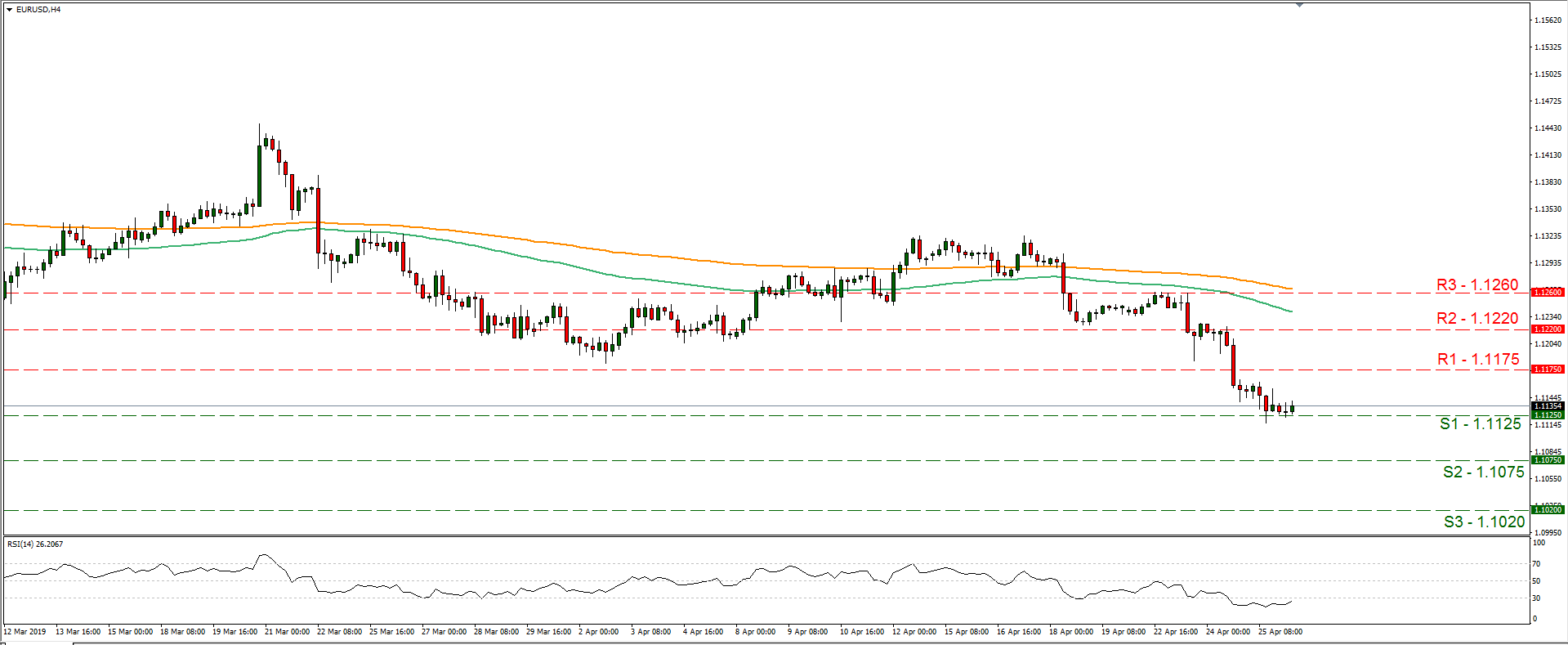
Support: 1.1125 (S1), 1.1075 (S2), 1.1020 (S3)
Resistance: 1.1175 (R1), 1.1220 (R2), 1.1260 (R3)
WTI H4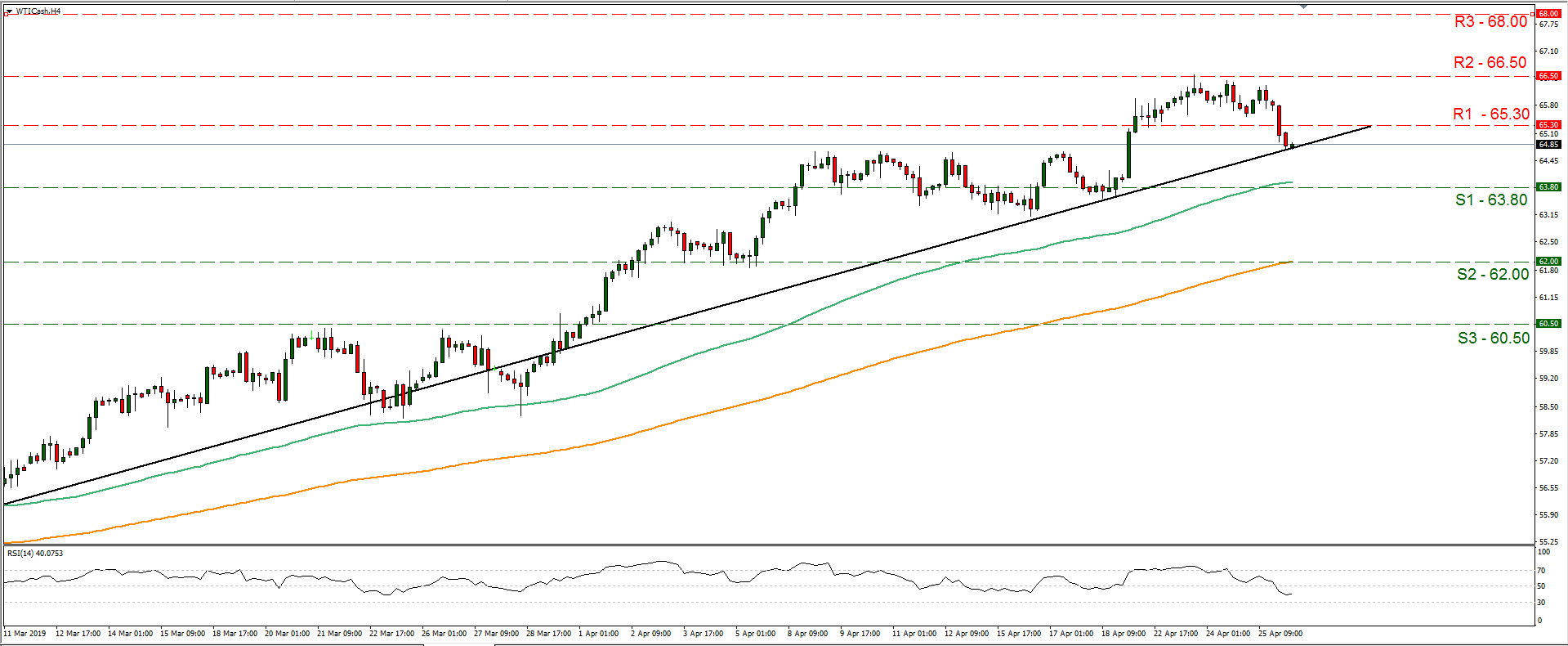
Support: 63.80 (S1), 62.00 (S2), 60.50 (S3)
Resistance: 65.30 (R1), 66.50 (R2), 68.00 (R3)
EUR/JPY Likely To Aim For 50-Hour SMA
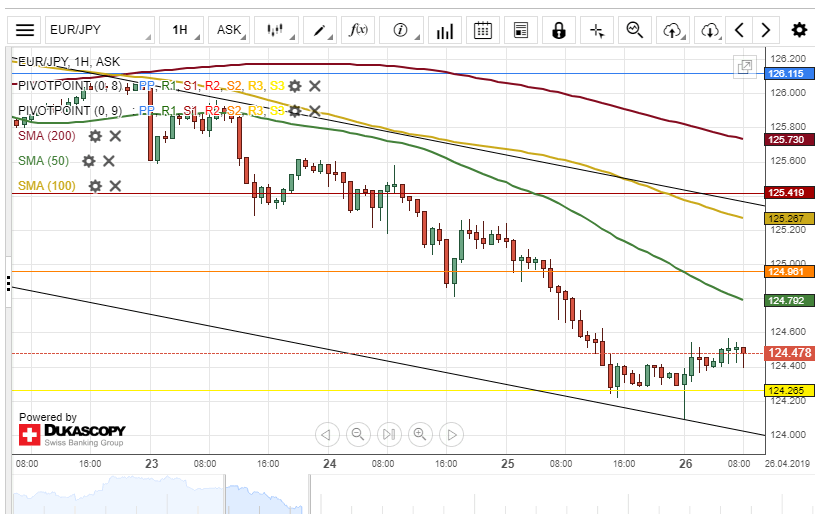
The common European currency depreciated about 97 base points against the Japanese Yen on Thursday. The decline was stopped by a support level formed by the weekly S3 at 124.26.
As for the near future, it is likely that the EUR/JPY currency pair slightly move higher towards a resistance cluster formed by the 50-hour simple moving average and the weekly S2 at 124.96.
However, given that the currency exchange rate is trading near the lower boundary of a descending channel pattern, a breakout could be expected during the following trading session.
AUD/USD Breaches 50-Hour SMA
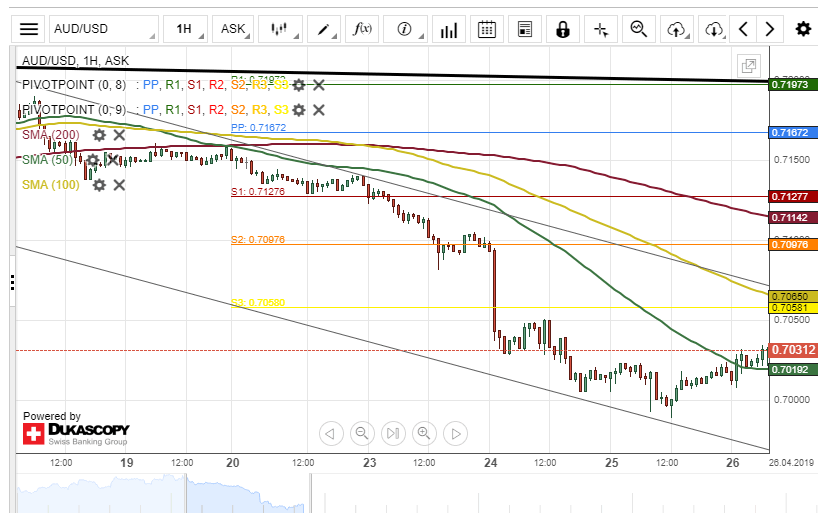
The Australian Dollar has continued to trade in a descending channel pattern against the US Dollar. The currency pair tested the lower boundary of the channel at 0.6991 during yesterday's trading session.
Everything being equal, it is likely that the AUD/USD exchange rate will aim of the upper band of the channel pattern within this session.
If the descending channel pattern holds, the currency exchange rate will make a retracement south.
However, if a breakout occurs, the next target for bullish traders will be near the 200-hour SMA at 0.7116.
USD/CAD Could Edge Lower
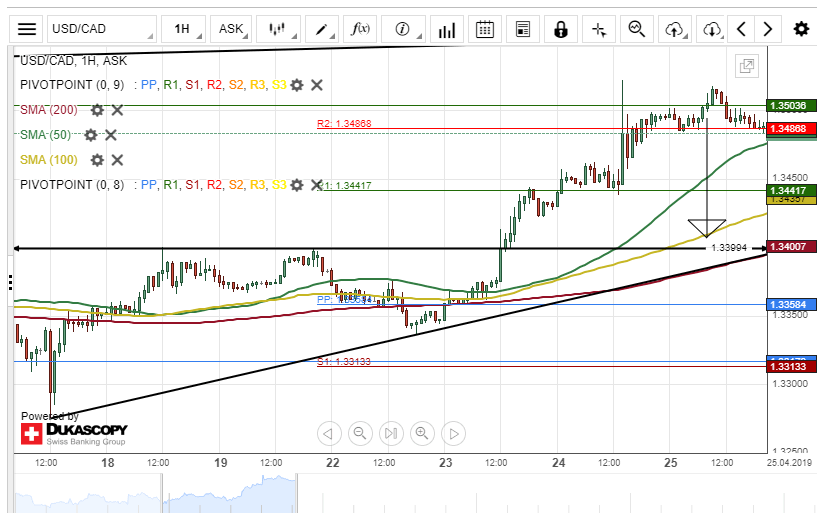
The US Dollar has been trading with low volatility against the Canadian Dollar since yesterday's trading session. The currency pair depreciated about 41 base points on Thursday.
As for the near future, it is likely that the currency exchange rate edges lower towards a support level at 1.3399. The 50-hour simple moving average could pressure the pair down today.
However, technical indicators demonstrate that the USD/CAD currency pair will continue its bullish momentum within this trading session.
NZD/USD Aims For 200-Hour SMA
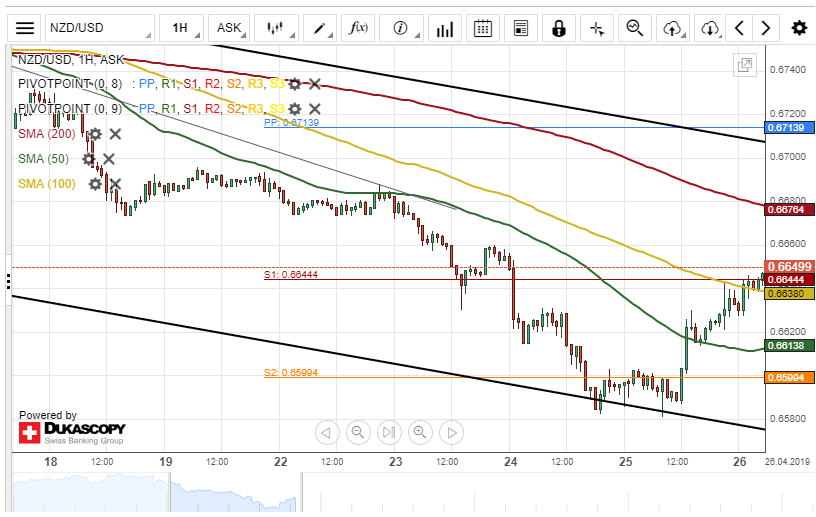
The New Zealand Dollar bounced off the lower boundary of a descending channel pattern at 0.6580 on Thursday. The Kiwi has gained about 69 base points against the US Dollar since yesterday's trading session.
The currency pair breached has breached both the 50– and 100-hour SMAs and currently aiming for the 200-hour simple moving average at 0.6678. Most likely, the rate will hit that level within this session.
However, technical indicators demonstrate that the currency exchange rate will maintain the medium-term descending channel pattern during the following trading session.
EUR/USD Outlook: Bears Take A Breather Above New 22-Mth Low Ahead Of US Data
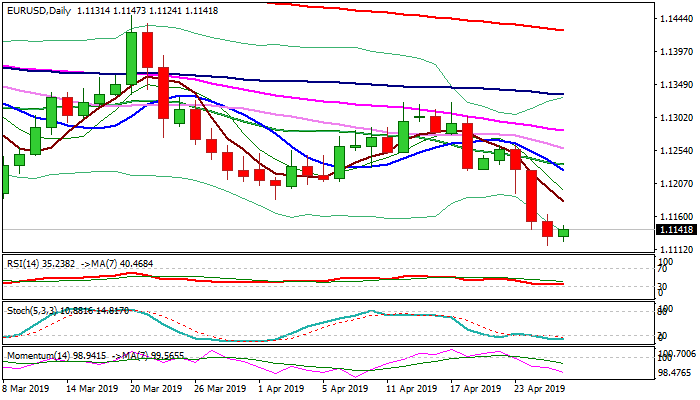
The Euro is consolidating above new multi-month low at 1.1118 (also low of 20 Jun 2017) on Friday, following strong bearish acceleration in past three days, when the single currency lost 1.1%.
Broadly stronger dollar keeps the Euro under pressure, which is reinforced by weaker than expected data from Germany and break of pivotal Fibo support.
Bearish studies on daily / weekly chart add to negative outlook, as the pair is on track for second consecutive bearish weekly close.
Test of 1.1118 support unmasks targets at 1.1070 (the neckline of asymmetric Head & Shoulders pattern on weekly chart) and psychological 1.10 support.
Markets await release of US Q1 GDP data, due later today, for fresh signals, which could further boost dollar, on better than expected results.
Forecasts show 2% rise in the first quarter, compared to 2.2% in Q4 2018 and markets expect data to underline steadiness in economic recovery, as recent US data have eased fears about strong slowdown if the economy.
The price may recover further as traders take profit of three-day fall ahead of data, which would provide fresh signal.
Broken key supports at 1.1180 mark initial resistance, followed by falling 10SMA (1.1225) which is expected to cap and keep bears in play.
Res: 1.1147, 1.1186, 1.1200, 1.1225
Sup: 1.1118, 1.1070, 1.1058, 1.1000
More Aussie And Cad Weakness, Then Reversal
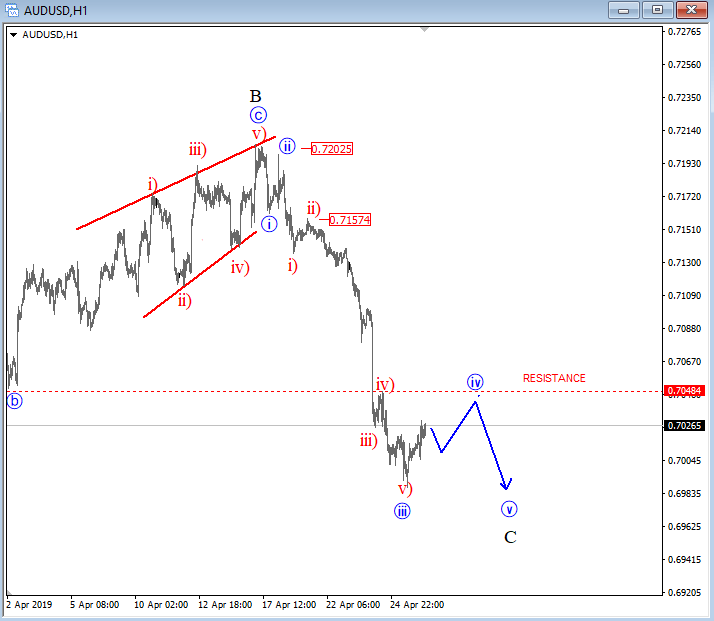
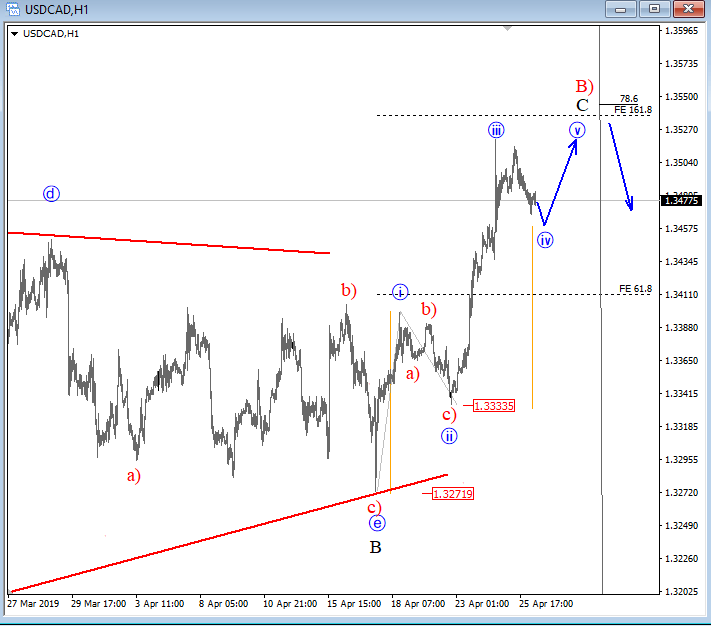
AUDUSD and USDCAD remain bearish to complete a higher degree wave C. Both are seen in fourth wave set-backs at the moment, so be aware of more Aussie weakness down to 0.6950 area after possible retest of 0.7050 resistance, while USDCAD can be on the way up to 1.3530/50 area where bears may wake up.
Once AUDUSD will complete current wave C of a corrective decline, I will start looking for a turn to the upside and possible long set-ups in May.