

Sample Category Title
USD/JPY Mid-Day Outlook
Daily Pivots: (S1) 111.24; (P) 111.74; (R1) 112.12; More...
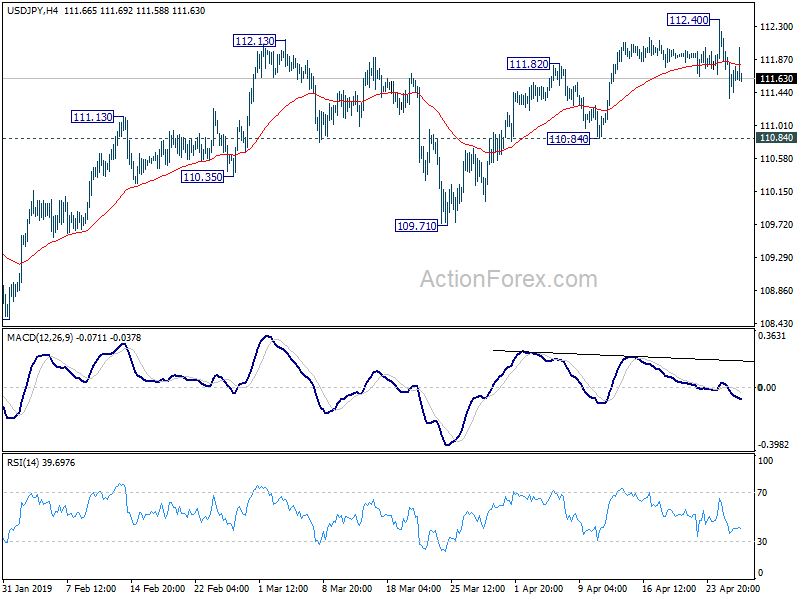
Intraday bias in USD/JPY remains mildly on the downside at this point. A short term top was formed at 112.14 on bearish divergence condition in 4 hour MACD. Deeper decline would be seen to 110.84 support first. Break will add to the case of reversal and target 109.71 support and below. On the upside, decisive break of 112.40 is needed to confirm resumption of rise from 104.69. Otherwise, risk will stay mildly on the downside.
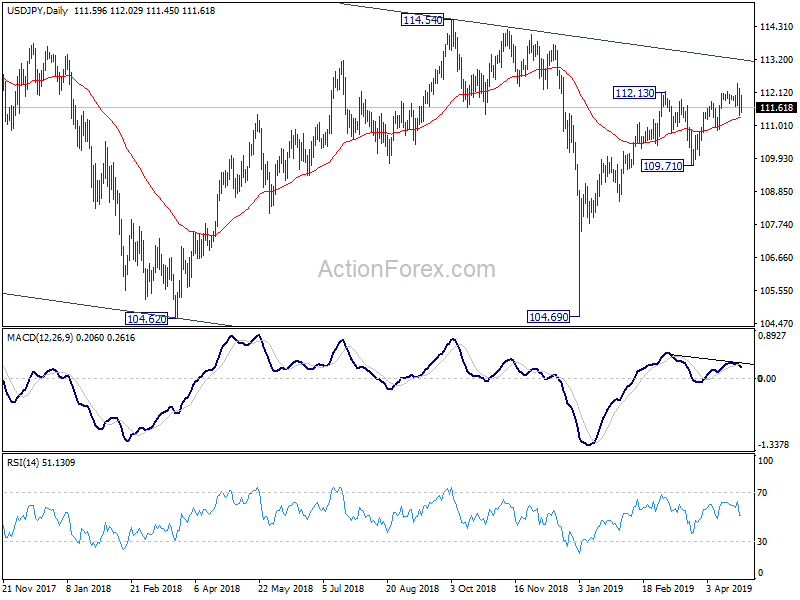
In the bigger picture, medium term outlook in USD/JPY remains a bit mixed as it's staying inside falling channel from 118.65, but there are signs of bullish reversal. On the upside, break of 114.54 resistance will revive the case the corrective fall from 118.65 has completed with three waves down to 104.69. And whole rise from 98.97 (2016 low) is resuming for 118.65 and above. But before that, outlook stays neutral first.
USD/CHF Mid-Day Outlook
Daily Pivots: (S1) 1.0188; (P) 1.0208; (R1) 1.0224; More...
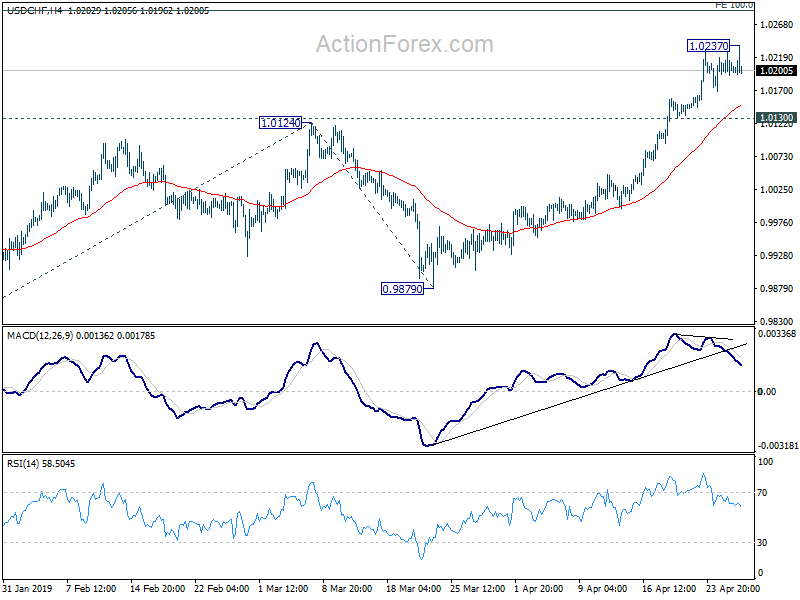
USD/CHF edged higher to 1.0237 but lacks follow through selling. Intraday bias remains neutral and some more consolidations would likely be seen first. Downside of retreat should be contained by 1.0130 minor support to bring rise resumption. On the upside, above 1.0237 will extend recent rally to 100% projection of 0.9716 to 1.0124 from 0.9879 at 1.0287, and then 1.0342 key resistance. However, break of 1.0130 will indicate short term topping and bring deeper retreat first.
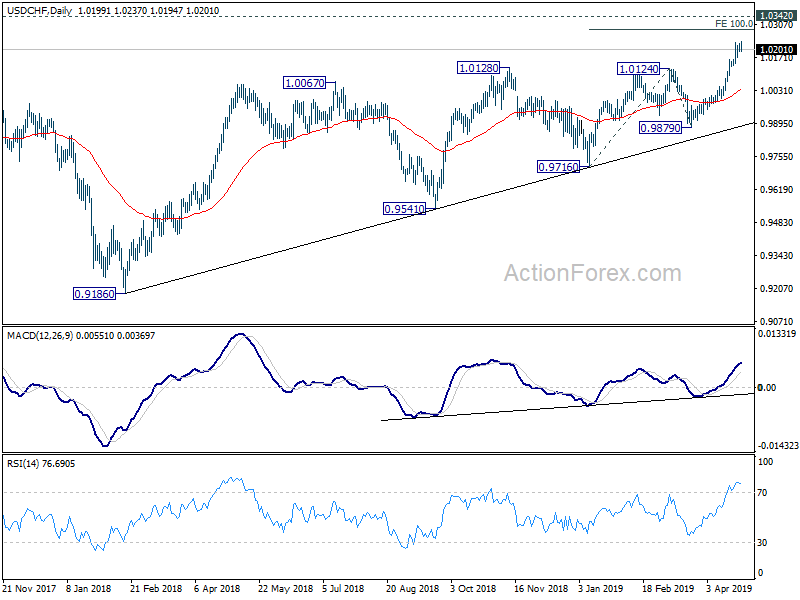
In the bigger picture, medium term up trend from 0.9186 is extending. Current rise should target 1.0342 resistance next. For now, we'd be cautious on strong resistance from there to limit upside, until we see medium term upside acceleration. On the downside, break of 0.9879 support is needed to indicate reversal. Otherwise, outlook will stay bullish in case of deep pull back.
GBP/USD Mid-Day Outlook
Daily Pivots: (S1) 1.2868; (P) 1.2893; (R1) 1.2920; More....
Intraday bias in GBP/USD remains neutral for consolidation above 1.2865 temporary low. Upside of recovery should be limited by 1.3019 minor resistance to bring fall resumption. On the downside, break of 1.2865 will target 1.2773 support first. Decisive break there will confirm that corrective rebound from 1.2391 has completed earlier than expected at 1.3381. Further decline should then be seen to 1.2391 low again. On the upside, however, break of 1.3019 resistance will dampen this bearish case and turn bias back to the upside for recovery first.
In the bigger picture, medium term decline from 1.4376 (2018 high) halted after hitting 1.2391. Rise from 1.2391 could have completed after just missing 50% retracement of 1.4376 to 1.2391 at 1.338. Such rebound could be a correction to fall from 1.4376 only. Break of 1.2773 support will affirm this bearish case and target 1.2391. Break of 1.2391 will resume the fall from 1.4376 to 1.1946 (2016 low).
US: Temporary Factors Boost First Quarter Growth to 3.2%
- In contract to expectations only a few short weeks ago, the U.S. economy accelerated to 3.2% (annualized) in the first quarter, from 2.2% in the final quarter of 2018. However, the acceleration was built on shaky foundations, as half of the quarter's growth was due to a buildup inventories (0.7 percentage points) and a decline in imports, which meant net trade added one percentage point to growth.
- Stripping these effects away, final domestic demand was up a softer 1.5% in Q1, a modest slowing from 2.1% in Q4.
- Much of the weakness in domestic demand was due to a soft consumer spending. As expected, PCE rose only 1.2%, less than half of the fourth quarter's pace. Durable goods fell 5.3%, after rising 3.6% in the fourth quarter. Spending on nondurable goods (+1.7%) and services were also soft (+2.0%).
- At the same time, personal disposable income growth remained sturdy (3.0%), so weak spending lifted the personal savings rate to 7.0% from 6.8% in Q4.
- Business investment rose 2.7%, down from 5.4% in the fourth quarter, but still better than we had been expecting. Spending on intellectual property was up briskly (+8.6%), while equipment outlays cooled to 0.2% gain (after advancing 6.6% in Q4). As expected, investment in structures fell (-0.8%) for the third straight quarter, on broad based declines.
- Residential investment fell (-2.8%) for the fifth consecutive quarter, entirely due to weakness in single-family home construction. Other components of residential investment rose (activity in the resale market, and multifamily construction).
- Government spending rose 2.4% as strong outlays at the state and local level (+3.9%) and on national defense (+4.1%), offset a 5.9% drop in nondefense federal spending, likely due to the government shutdown.
- Exports growth was a little stronger than expected, up 3.7%. however, a hefty 3.7% decline in imports meant that net trade added a full percentage point to growth.
- Finally, price pressures were also a bit softer than expected in the first quarter, with the core PCE deflator up only 1.3% annualized.
Key Implications
- GDP growth in the first quarter is quite the mixed bag. On the one hand, underlying growth is not as strong as the headline suggests, as the boost from inventories and weakness in imports are likely to be reversed in the second quarter, dampening economic growth. On the other hand, the 1.5% pace of domestic demand was also held back by temporary factors like the government shutdown, and is likely to improve in the second quarter.
- As we try to see the forest amidst a thicket of trees, underlying momentum in the U.S. economy has cooled from the tax-cut driven boost of 2018, but remains solid and roughly in line with our latest forecast.
- Today's report does not banish the downside risks looming in the global economy. It looks like the worst case scenario on the China-U.S. tariff escalation won't come to pass, but it is unclear if current tariffs will be lifted. Fiscal risks in Washington still loom as the year progresses.
US GDP Jumped 3.2% in Q1
- US GDP increased a stronger-than-expected 3.2% in Q1 – above expectations for a 2% increase
- More than half the increase was accounted for by big adds from net trade and inventories that aren’t likely to be repeated, but consumer spending and business investment growth will also probably post stronger growth than in Q1 going forward.
The composition of growth isn’t particularly solid. More than half of the headline 3.2% GDP gain came from a lumpy surge in net exports and a build in inventories – neither of which is likely to be repeated any time soon. But a 1.2% increase in consumer spending also looks understated given rising wages and still-strong employment growth trends. The Federal Reserve’s abrupt move to the sidelines in terms of the rate hiking cycle in recent months, though, had more to do with external growth concerns and muted inflation pressures than domestic economic data. With the fed funds target range currently not that far from the longer-run neutral rate and inflation pressures benign, there is little pressuring the Fed to move more quickly on rates. Stronger economic growth data does, however, argue against market pricing implying that the next move is more likely to be a cut than a hike.
EUR/USD Mid-Day Outlook
Daily Pivots: (S1) 1.1113; (P) 1.1138; (R1) 1.1157; More.....
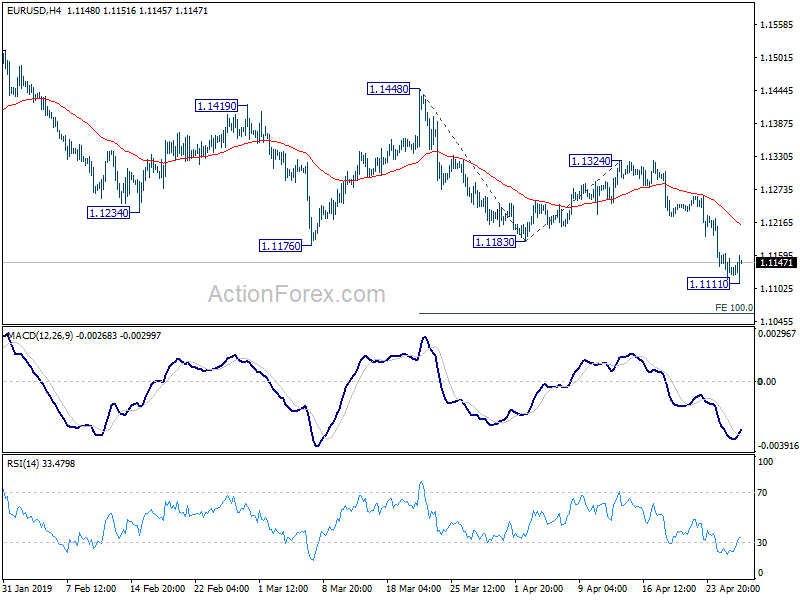
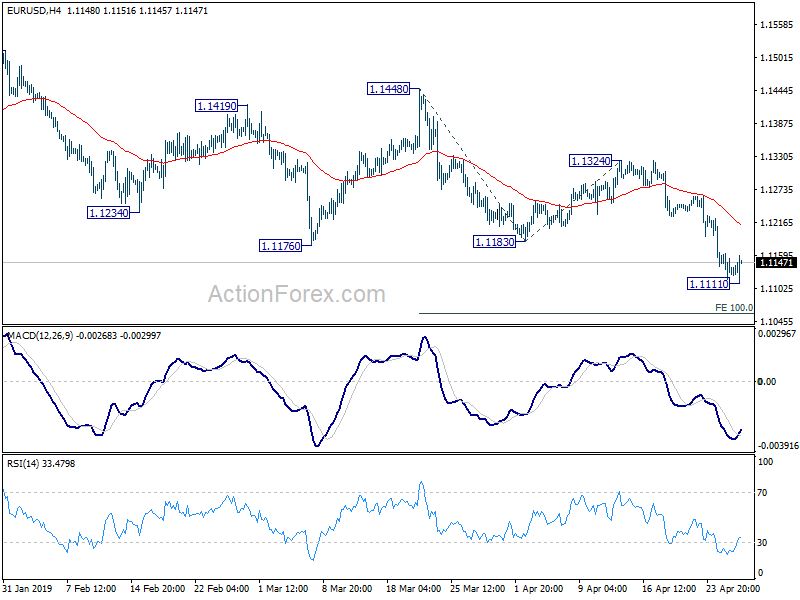
With 4 hour MACD crossed above signal line, a temporary low is in place at 1.1111 in EUR/USD. Intraday bias is turned neutral for some consolidations. But recovery should be limited below 1.1324 resistance to bring fall resumption. On the downside, break of 1.1111 will resume the down trend to 100% projection of 1.1448 to 1.1183 from 1.1324 at 1.1059. Break will target 161.8% projection at 1.0895.
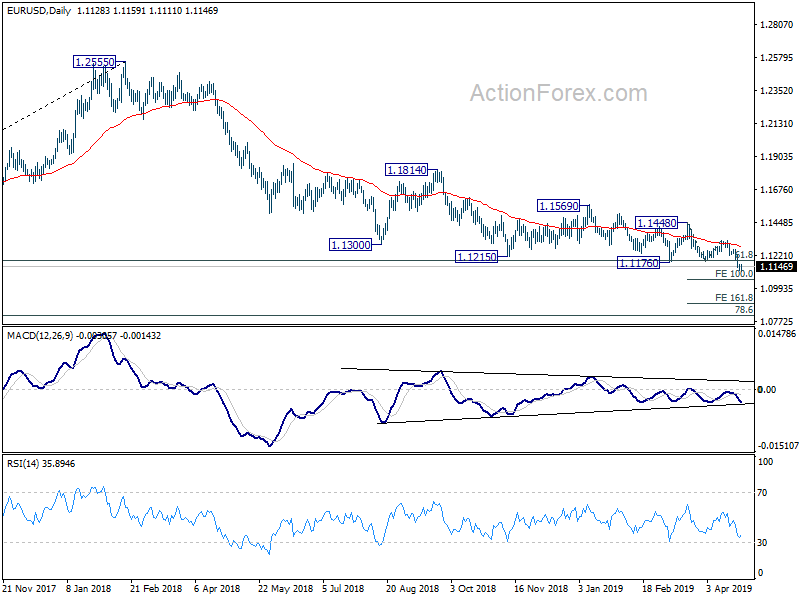
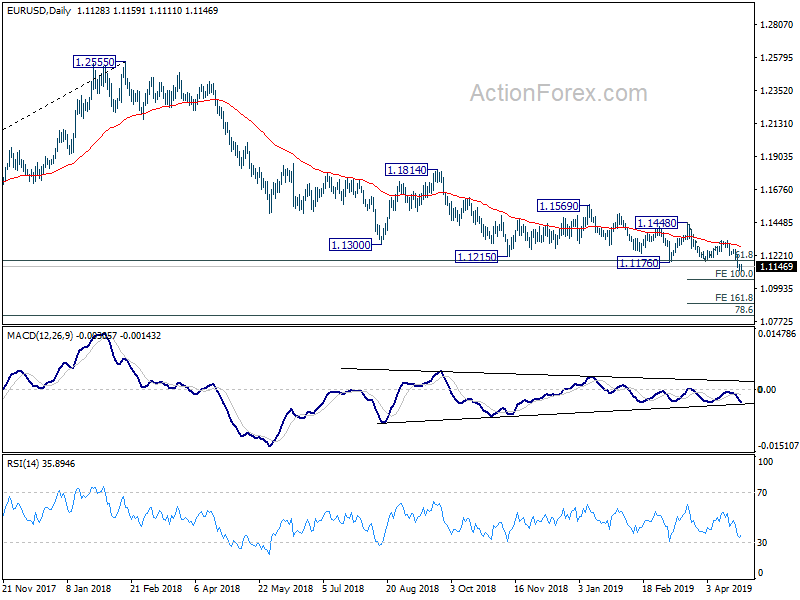
In the bigger picture, down trend from 1.2555 is now resuming with break of 61.8% retracement of 1.0339 (2016 low) to 1.2555 (2018 high) at 1.1186. Medium term also remains with EUR/USD staying well below falling 55 week EMA. Next downside target will be 78.6% retracement at 1.0813. Sustained break there will pave the way to retest 1.0339. On the downside, break of 1.1448 resistance is needed to be the first sign of medium term bottoming. Otherwise, outlook will stay bearish in case of rebound.
Strong US GDP With Weak Details Send Dollar Lower, 10-Yr Yield Breaks 2.5
Dollar spikes higher in early US session as Q1 GDP grew much more than market expectations. However, the greenback quickly pulled back as details are seen as much weaker than the headline number suggests. It's actually a set of data welcome by stock traders as Fed will likely stay cautious. DOW futures rebound strongly after the release while NASDAQ futures point to extending record run. US 10-year yield falls sharply and breaches 2.5% handle.
Back to the currency markets, Yen is the weakest one for today, followed by Dollar and Swiss Franc. New Zealand Dollar is the strongest, followed by Australian. But for the week, Yen remains the strongest, followed by Dollar. Aussie is the weakest, followed by Euro.
In Europe, currently, FTSE is down -0.08%. DAX is up 0.15%. CAC is up 0.18%. German 10-year yield is down -0.012 at -0.018. Earlier in Asia, Nikkei dropped -0.22%. Hong Kong HSI rose 0.19%. China Shanghai SSE dropped -1.2%. Singapore Strait Times rose 0.20%. Japan 10-year yield dropped -0.0169 to -0.046.
US GDP grew 3.2% in Q1, blows past expectations
US real GDP grew 3.2% annualized in Q1, way better than expectation of 2.2%. However, the underlying details are seen by some economists as much weaker than the headline number suggests. Personal consumption expenditures grew merely 1.2%, much lower than Q4's 2.5%. Fixed investment growth also slowed to 1.5%, down from 3.1%. Core PCE, Fed's preferred inflation measures, slowed to 1.3%, well below 2% target.
ECB Rehn: Some policymakers want to keep low interest rates a little longer
ECB Governing Council member Olli Rehn said stubbornly low inflation expectations could be a result of investors' doubt of the central bank's policy. he said "firstly, long-lasting slow inflation may have lowered inflation expectations durably, and even so that they are easily moving downwards". And "secondly, markets may find that monetary policy measures are not, under the current circumstances, effective enough to accelerate inflation."
Additionally, Rehn hinted that some policymakers could prefer to keep interest rate at current level beyond the end of this year. He said "some of us were of the opinion that the low interest rate policy could have been pursued even a little longer". And, "in this situation of economic uncertainty and weaker growth, there are reasons to pursue a very stimulating monetary policy."
SNB Jordan: Negative interest rate and willingness to intervene remain both essential and appropriate
SNB Chairman Thomas Jordan warned that situation on financial and foreign exchange markets remains "fragile". And, "against the current backdrop, our unconventional monetary policy with the negative interest rate and our willingness to intervene in the foreign exchange market as necessary remains both essential and appropriate". He is optimistic that eventually, interest rate will turn positive again. But he added "I cannot tell you now when exactly that will be".
Separately, head of the SNB Council, Jean Studer emphasized "the SNB can only fulfil its statutory mandate if it retains full independence in monetary policy matters". He warned "a politicized central bank would no longer be able to carry out its tasks in the best interests of the country as a whole."
Japan: Large contraction in industrial production raises recession risk
In March, Japan industrial production dropped -0.9% mom, below expectation of 0.0% mom. For the whole of Q1, industrial production contracted -2.6% yoy. The overall contraction in industrial production in Q1 was the largest in nearly five years, since Q2 2014. The data suggested that Japanese economy could have suffered a mild recession as external demand was hurt by US-China trade war.
Also released, unemployment rate also rose to 2.5%, up from 2.3% and was higher than expectation of 2.4%. Nevertheless, retail sales rose 1.0% yoy, above expectation of 0.8% yoy. Housing starts rose 10.0% yoy, above expectation of 5.5% yoy. In April, Tokyo CPI accelerated to 1.3% yoy, up from 1.1% yoy and beat expectation of 1.1% yoy.
New Zealand exports hit record NZD 5.7B in March, NZD/USD recovers
In March in New Zealand, exports jumped 19% yoy to NZD 5.7B, hitting a record for any month. Imports, on the other hand, dropped -3.4% yoy to NZD 4.8B. Trade balance came in at a NZD 922m surplus, highest since April 2011, and beat expectation of NZD 131m. International statistics manager Tehseen Islam said, "exports to China were the leading contributor to increases in several primary sector commodities including dairy products, beef, lamb, and forestry products."
From Australia, import price dropped -0.5% qoq in Q1 versus expectation of -1.1% qoq. PPI slowed to 1.9% yoy versus expectation of 2.0% yoy.
IMF Lagarde: China's Belt and Road should only go where it's needed and sustainable
IMF Managing Director Christine Lagarde called for greater balance in the next phase of China's Belt and Road Initiative. She borrowed from a Chinese proverb "It is easy to start a venture — the more difficult challenge is what comes next."
Lagarde warned that "history has taught us that, if not managed carefully, infrastructure investments can lead to a problematic increase in debt". And, "to be fully successful, the Belt and Road should only go where it is needed. I would add today that it should only go where it is sustainable, in all aspects."
Also she emphasized, BRI 2.0 can also benefit from "increased transparency, open procurement with competitive bidding, and better risk assessment in project selection."
EUR/USD Mid-Day Outlook
Daily Pivots: (S1) 1.1113; (P) 1.1138; (R1) 1.1157; More.....
With 4 hour MACD crossed above signal line, a temporary low is in place at 1.1111 in EUR/USD. Intraday bias is turned neutral for some consolidations. But recovery should be limited below 1.1324 resistance to bring fall resumption. On the downside, break of 1.1111 will resume the down trend to 100% projection of 1.1448 to 1.1183 from 1.1324 at 1.1059. Break will target 161.8% projection at 1.0895.
In the bigger picture, down trend from 1.2555 is now resuming with break of 61.8% retracement of 1.0339 (2016 low) to 1.2555 (2018 high) at 1.1186. Medium term also remains with EUR/USD staying well below falling 55 week EMA. Next downside target will be 78.6% retracement at 1.0813. Sustained break there will pave the way to retest 1.0339. On the downside, break of 1.1448 resistance is needed to be the first sign of medium term bottoming. Otherwise, outlook will stay bearish in case of rebound.
Economic Indicators Update
| GMT | Ccy | Events | Actual | Forecast | Previous | Revised |
|---|---|---|---|---|---|---|
| 22:45 | NZD | Trade Balance Mar | 922M | 131M | 12M | -68M |
| 23:30 | JPY | Unemployment Rate Mar | 2.50% | 2.40% | 2.30% | |
| 23:30 | JPY | Tokyo CPI Core Y/Y Apr | 1.30% | 1.10% | 1.10% | |
| 23:50 | JPY | Industrial Production M/M Mar P | -0.90% | 0.00% | 0.70% | |
| 23:50 | JPY | Retail Trade Y/Y Mar | 1.00% | 0.80% | 0.40% | 0.60% |
| 01:30 | AUD | PPI Q/Q Q1 | 0.40% | 0.60% | 0.50% | |
| 01:30 | AUD | PPI Y/Y Q1 | 1.90% | 2.00% | 2.00% | |
| 01:30 | AUD | Import price index Q/Q Q1 | -0.50% | -1.10% | 0.50% | |
| 05:00 | JPY | Housing Starts Y/Y Mar | 10.00% | 5.50% | 4.20% | |
| 08:30 | GBP | BBA Loans for House Purchase Mar | 39980 | 38675 | 39083 | 39207 |
| 10:00 | GBP | CBI Reported Sales Apr | -5 | 3 | 1 | |
| 12:30 | USD | GDP Annualized Q/Q Q1 A | 3.20% | 2.20% | 2.20% | |
| 12:30 | USD | GDP Price Index Q1 A | 0.90% | 1.30% | 1.70% | |
| 14:00 | USD | U. of Mich. Sentiment Apr F | 97 | 96.9 |
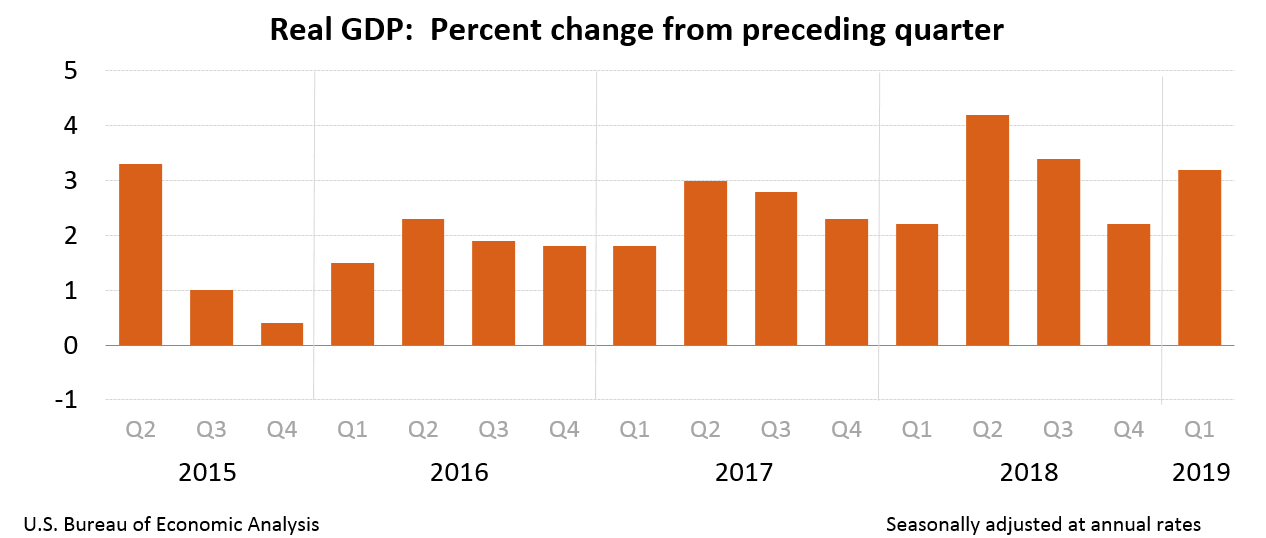
US GDP grew 3.2% in Q1, blows past expectations
US real GDP grew 3.2% annualized in Q1, way better than expectation of 2.2%. BEA noted: "The increase in real GDP in the first quarter reflected positive contributions from personal consumption expenditures (PCE), private inventory investment, exports, state and local government spending, and nonresidential fixed investment. Imports, which are a subtraction in the calculation of GDP, decreased. These contributions were partly offset by a decrease in residential investment."
Also: "The acceleration in real GDP growth in the first quarter reflected an upturn in state and local government spending, accelerations in private inventory investment and in exports, and a smaller decrease in residential investment. These movements were partly offset by decelerations in PCE and nonresidential fixed investment, and a downturn in federal government spending. Imports, which are a subtraction in the calculation of GDP, turned down."
SNB Jordan: Negative interest rate and willingness to intervene remain both essential and appropriate
SNB Chairman Thomas Jordan warned that situation on financial and foreign exchange markets remains "fragile". And, "against the current backdrop, our unconventional monetary policy with the negative interest rate and our willingness to intervene in the foreign exchange market as necessary remains both essential and appropriate". He is optimistic that eventually, interest rate will turn positive again. But he added "I cannot tell you now when exactly that will be".
Separately, head of the SNB Council, Jean Studer emphasized "the SNB can only fulfil its statutory mandate if it retains full independence in monetary policy matters". He warned "a politicized central bank would no longer be able to carry out its tasks in the best interests of the country as a whole."
ECB Rehn: Some policymakers want to keep low interest rates a little longer
ECB Governing Council member Olli Rehn said stubbornly low inflation expectations could be a result of investors' doubt of the central bank's policy. he said "firstly, long-lasting slow inflation may have lowered inflation expectations durably, and even so that they are easily moving downwards". And "secondly, markets may find that monetary policy measures are not, under the current circumstances, effective enough to accelerate inflation."
Additionally, Rehn hinted that some policymakers could prefer to keep interest rate at current level beyond the end of this year. He said "some of us were of the opinion that the low interest rate policy could have been pursued even a little longer". And, "in this situation of economic uncertainty and weaker growth, there are reasons to pursue a very stimulating monetary policy."