

Sample Category Title
Big downside surprise in Australia CPI adds to case for RBA cut, AUD dives
Australian Dollar is sold off sharply after much weaker than expected consumer inflation data.
- Headline CPI rose 0.0% qoq, 1.3% yoy in Q1, down from 0.5% qoq, 1.8% yoy, missed expectation of 0.2% qoq, 1.5% yoy. The 1.3% annual rate is also the slowest since September 2016.
- RBA trimmed mean CPI rose 0.3% qoq, 1.6% yoy, below expectation of 0.4% qoq, 1.7% yoy. Annual rate is slowest since December 2016.
- RBA weighted median CPI rose 0.1% qoq, 1.2% yoy, well below expectation of 0.4% qoq, 1.6% yoy.
The weak inflation data heighten the prospect of RBA rate cut in May, together with RBNZ. But for now, it still seems a bit early for RBA to act given relative resilience in job data. May is more an ideal occasion for RBA to turn dovish with new economic projections and SoMP. If it happens, the case for a cut in August would be secured.
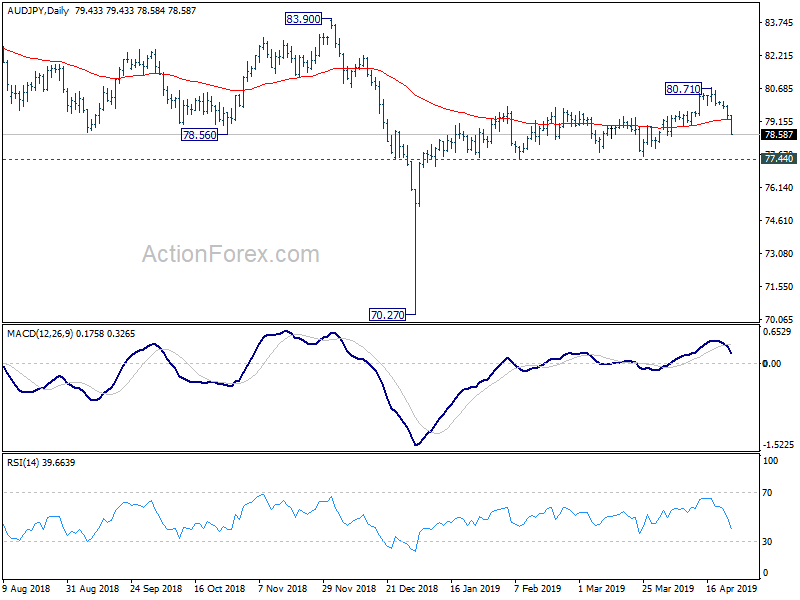
AUD/USD's steep decline and acceleration through 0.7052 support confirms that corrective recovery from 0.7003 has completed with three waves up to 0.7205. Decline from 0.7295 should be ready to resume through 0.7003 support, towards 0.6722 low.
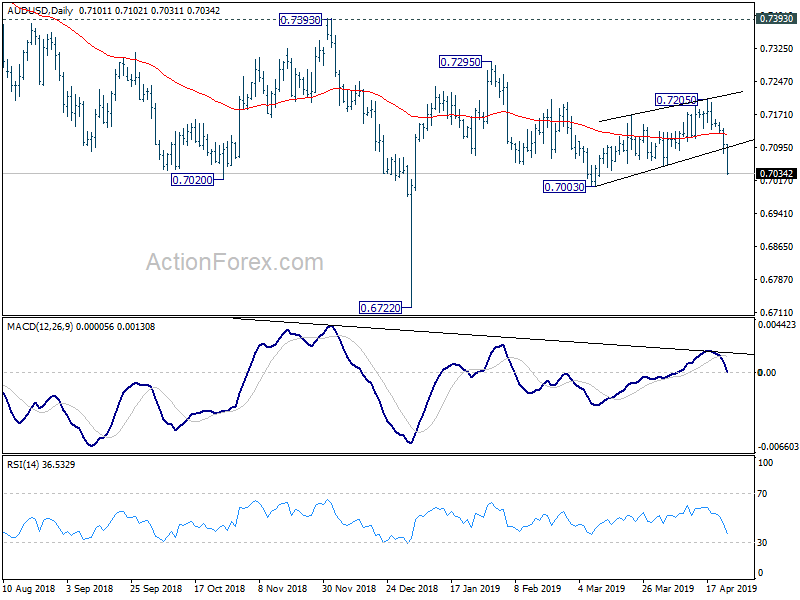
EUR/AUD's strong rally also suggests that corrective fall from 1.6765 has completed with three waves down to 1.5683, well ahead of 1.5346 key support. Further rise should be seen to 1.6122 resistance next. Break will pave the way back to 1.6765.
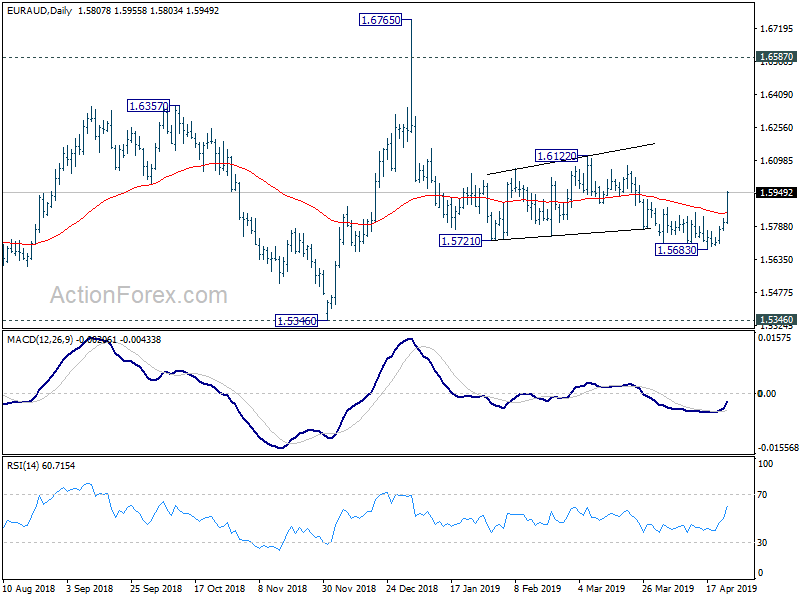
AUD/JPY's rebound from 70.27 was relatively stronger than AUD/USD. But even so, it was limited well below 83.90 key resistance. Thus, it's more likely that such rebound is merely a correction. Today's sharp decline is raising the prospect that it's already completed. We'd expect deeper fall to retest 77.44 support first. Decisive break there will revive medium term bearish outlook for 70.27 low.
Market Morning Briefing: The Aussie Has Come Down Sharply On Dollar Strength
STOCKS
US equities are gaining momentum but the Asians are looking mixed. Nikkei is range bound with a bullish bias while the Shanghai is moving down within its sideways range. Sensex and Nifty has key supports near current levels which has to hold to prevent them from further fall.
Dow (26656.39, +145.34, +0.55%) has negated our expectation for an intermediate dip to 26250. Instead the index has risen from around 26500 itseld. The bullish outlook is intact for a test of 26750. A strong break above 26750 will then pave way for a test of 26900 and 27000.
DAX (12235.51, +13.12, +0.11%) is inching higher and is heading towards its crucial 12275-12300 resistance region. Whether the index breaks above 12300 or not will be crucial. Inability to breach 12300 can trigger a corrective fall to 12100 or even lower thereafter.
Nikkei (22264.50, +4.76, +0.02%) retains its 22050-22350 range. As mentioned yesterday, the bias is bullish within this range for the index to break 22350 and rise to 22700 in the coming days.
Shanghai (3183.45, -15.14, -0.47%) trades below 3200 and can dip to test 3150 in the near term. A bounce thereafter will keep the 3150-3280 sideways range intact.
Sensex (38564.88, -80.30, -0.21%) has an immediate support at 38500 which if holds can trigger a bounce to 39000 in the coming sessions. But a break below 38500 can drag it further lower to 38000.
Nifty (11575.95, -18.50, -0.16%) has support near 11550 a break below which can target 11500. A bounce from 11550 can test 11650 or even 11700 in the near term.
COMMODITIES
A surge in the US dollar index coupled with the rally in the equities have dragged gold and silver lower. Copper is hovering around a crucial suppport. Oil is holding higher on the US ending the waivers on Iran exports. But we expect the rally to lose steam soon. A close watch is needed on the US pressuring the OPEC to increase the supply and whether the OPEC has any plans on the same front to ease the situation.
Gold (1270) seems to have resumed its down move after taking a breather for a couple of days. The bearish view is intact for a fall to 1265 and 1260.
Silver (14.81) has tumbled below 14.90. Immediate support is at 14.75. If it holds, a bounce to 14.9 is possible. But a break below it will see silver tumbling towards 14.5 and even 14 in the short term.
Copper (2.89) fell to test 2.88 and has bounced slightly from there. A strong rise past 2.90 will see a rise to 2.95-2.96 and will keep the sideways move intact. But, inability to move above 2.90 from current levels will be negative. It will keep the possibility high of copper tumbling to 2.84 and 2.82 breaking below 2.88 in the coming days.
Brent (74.12) is holding higher. Though there is still room on the upside, the current rally could be capped at 75.50-76. A corrective fall to 73-72 is possible thereafter.
Similarly, WTI (65.95) has strong resistance around 67 which can halt the current rally and trigger a reversal. A pull-back from 67 can target 65-64.
FOREX
US Dollar is trading strong against major currencies while Euro and Aussie have fallen and look weak for the near term. Dollar-Yen is stable unable to decide which direction to take. Failure to fall from here could take it higher towards 113. Chinese Yuan and Indian Rupee could see some weakness.
The Dollar Index (97.66) tested 97.78 yesterday, breaking above the multi-month resistance near 97.70/75 before closing the session at 97.59. The rise was boosted by a stronger than expected US new home sales data at 692K against market expectation of 647K. Previous data for Feb’19 has been revised lower from 667K to 662K. Fears of economic slowdown could possibly get reduced while data shows positive indication. The US 1st quarter GDP data is due on Friday and would be crucial. A stronger than expected GDP would be positive for Dollar Index in the coming sessions taking it towards 98 or higher in the medium term.
The Euro (1.1213) has held below resistance as expected and now looks weak towards 1.12-1.1170 in the coming sessions.
The Euro-Yen (125.44) has broken below immediate support near 125.5 and while the pair sustains lower, it could test 125 in the next 2-3 sessions. Clear break below 125 would open up 124.
Dollar-Yen (111.87) has been stable without any major movement. While above 111.70, the pair is expected to move higher towards 112.50-113.00 in the near term. Rejection from resistance at 112 is yet to be seen, if any. We need to be cautious and look for a break on either side for more directional clarity.
The Aussie (0.7036) has come down sharply on Dollar strength. The fall was also boosted by a fall in CPI data (for Q1) which came at 0% (Q/Q) against expectation of 0.5%. The Y/Y figure came in at 1.3% against expectation of 1.5%. While Aussie trades below 0.7050, it could test 0.70 or even lower in the next few sessions.
USDCNY (6.7180) has moved up and is nearing upper resistance of 6.72/73. A break above 6.73 would give clear bullish indication for the medium term with an upside target of 6.75; else a fall from 6.73/72 would push it back towards 6.70. Preference is for a rise towards 6.75.
Dollar-Rupee (69.62) moved up to test 69.83 before the pair came down after the 3yr USDINR buy/sell swap results came out in the last hour of the trading session yesterday. While Dollar-Rupee trades above 69.50, it could test 70.0-70.2 in the near term. Fall below 69.50 would take it down towards 69.30. Upside looks more likely.
INTEREST RATES
The US yields dipped yesterday. The 2Yr (2.35%), 5Yr (2.36%), 10Yr (2.56%) and 30Yr (2.98%) fell from 2.39%, 2.39%, 2.59% and 2.99% seen yesterday. The 5Yr could fall towards 2.35-2.32% while the 10Yr could test 2.54/50% in the next few sessions. The 30Yr could fall towards 2.95/90%.
The US-JGB 10YR (2.60%) is testing immediate resistance and if falls sharply from here, could pull down Dollar-Yen too from current resistance near 112. But at the same time Dollar strength could keep Yen stable. It would be important to see if the spread comes down from current levels and brings in a fall in USDJPY too in the near term.
The 10Yr GOI (7.6148%) is looking bullish towards 7.65/70% in the near term. Downside is likely to be limited at 7.55%.
Australian Q1 Inflation – CPI Flat In The Quarter Highlighting Very Little Inflationary Pressure
March Quarter CPI Headline CPI 0.0%qtr/1.3%yr Trimmed mean 0.28%qtr/1.6%yr Weighted median 0.10%qtr/1.2%yr
Inflation surprises to the downside – the return of Godot
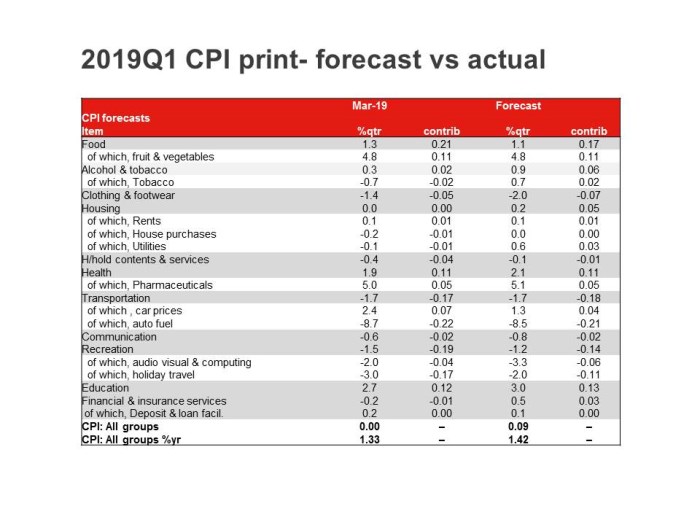
The March Quarter CPI was flat (0.0%) compared to the market median of 0.2% and Westpac’s forecast for 0.1%. At two decimal places the CPI was also flat (0.0%qt) with the annual rate dropping to 1.3%yr (from 1.8%yr) the slowest annual pace since September 2016. With another subdued print, the six month annualised pace is now just 1.1%yr (using seasonally adjusted data) the slowest pace since June 2016 highlighting that the inflationary pulse continues to remain well under the bottom of the RBA’s target band.
Following the December quarter report we argued that while we may have found a bottom for the disinflationary pulse it was too early to call an emergence of an inflationary pulse. The March quarter report confirms that a lack of widespread inflationary pressure and that the unfolding correction in housing is an ongoing dampener for core inflation.
The average of the RBA’s core measures, which are seasonally adjusted and exclude extreme moves, rose 0.2%qtr below market expectations for 0.4% and Westpac’s forecast for 0.3%. In the quarter, the trimmed mean gained 0.28% while the weighted median lifted 0.10%. The annual pace of the average of the core measures printed 1.4%yr the slowest pace of core inflation since December 2016.
Incorporating revisions, the six month annualised growth in core inflation is now just 1.2%yr, well below the bottom of the RBA target band and the slowest pace since December 1997.
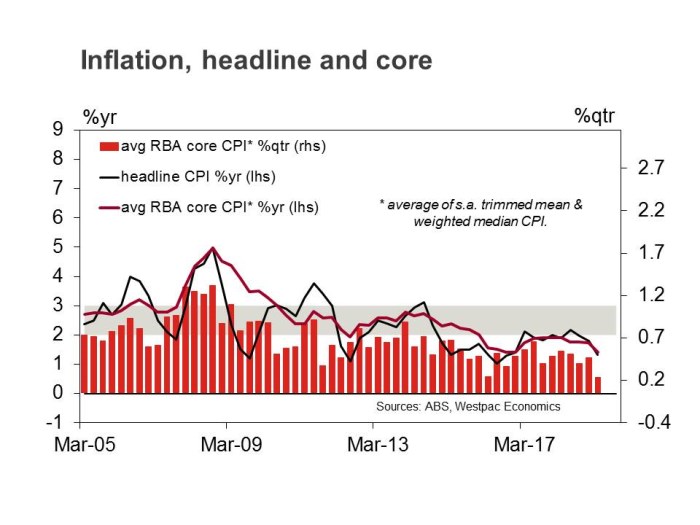
Hard to find any upside price pressure
Standouts in the quarter were: on the positive or high side of expectations there was very few:
Food rose 1.3% vs 1.1% expected, with drought and adverse weather conditions continuing to reduce the supply of a selection of fruits and vegetables added to higher input costs placing upward pressure on other food items such as poultry and bread. Clothing & footwear fell 1.4% vs. –2.0% forecast.
Prices that fell or where on the low side of expectations:
Tobacco prices surprised with a 0.7% fall (+0.7% expected), housing was flat (0.2% forecast) on falling house purchases and utilities, household contents fell 0.4% vs. –0.1% forecast, health rose 1.9% vs. 2.1% forecast and recreation fell 1.5% vs. –1.2% forecast due to a larger than expected fall in holiday travel.
The softer than expected housing cost print reflected the fall in dwelling prices (–0.2% vs forecast for a flat print – this reflected a significant fall in Victorian dwelling prices of 1.2%qtr) rents reported a modest 0.1% rise as expected while utilities surprised with a 0.1% fall.
There remains a significant near term negative risk around dwelling purchases prices in NSW. Prices are already falling in Victoria as are rents in NSW. Given that rents and dwelling purchases together are worth around 15% of the CPI, this is a significant risk for headline inflation, and even more so for core where the weight is somewhat higher.
Tradables rose 0.4% in the March quarter. The tradable goods component fell 0.6% due to automotive fuel (-8.7%). The tradable services component fell 2.0% due to international holiday, travel & accommodation (-2.1%). It is worth noting that petrol prices have been rising solidly in recent weeks on the back of surging crude oil prices.
Non-tradables component rose 0.3% in the March quarter. The non-tradable goods component rose 0.4%, due to pharmaceutical products (5.0%). The non-tradable services component rose 0.3% due to secondary education (4.2%).
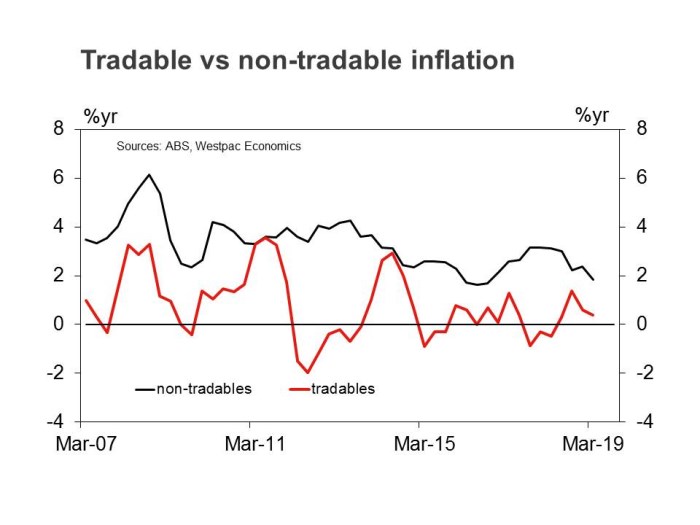
Inflation is stuck well below the target band with little reason to expect it to return there anytime soon.
It was hard to find even some isolated inflationary pressures; even tobacco prices surprised with a fall in the quarter. Clothing and footwear may not have fallen as much as expected but they are not a galloping inflationary pulse either.
Housing has a significant group weighting in the CPI (22%) so it has a meaningful impact on both inflation and core inflation. With such a modest outlook for housing costs we can find little to suggest any risk of a meaningful acceleration in core inflation from below the bottom of the RBA's target band.
S&P 500 and NASDAQ closed at records, no follow through in Asia
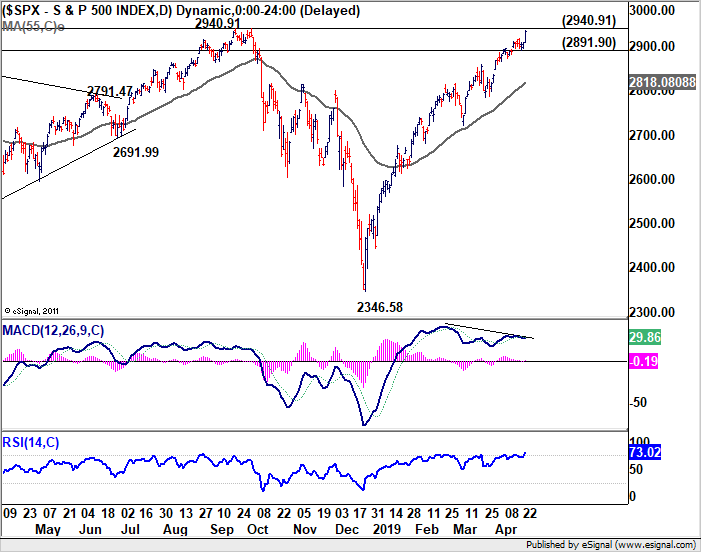
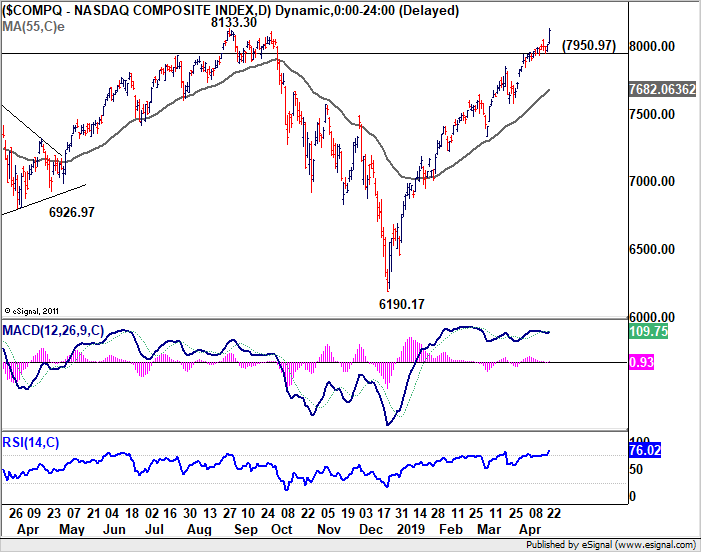
US stocks enjoyed strong rally overnight as boosted by solid corporate earnings from Coca-Cola to Twitter. S&P 500 and NASDAQ closed at records of 2933.68 (up 0.88%) and 8120.82 (up 1.32%) respectively. Though, they're both held below intraday highs. DOW also gained 0.55% to 26656.39.
Technically, the strong momentum suggests that both S&P 500 and NASDAQ will easily take out intraday records at 2490.91 and 8133.30. That could likely pull DOW upward to equivalent level at 26951.81. Yet, we're still not too convinced that the indices are in long term up trend resumption yet.
Two developments give us some doubts over the underlying momentum of the global markets. Firstly, Asian markets are not following and with major indices, except Singapore Strait Times, turned red after initial gains today. Secondly, Yen is the strongest one for the week so far while USD/JPY is stuck in tight range only, which isn't the usually development seen in strong risk on market. Thus, there will be a lot of caution in the next move up.
Anyway, for now, near term outlook in SPX will release bullish as long as 2891.90 support holds. Firm break of 2490.91 should at least bring a test on 3000 psychological level.
Similarly, near term outlook in NASDAQ will remain bullish as long as 7950.97 support holds. Firm break of 8133.30 will confirm long term up trend resumption.
US-China trade talks to resume in Beijing on Apr 30, Kudlow said cautiously optimistic but not there yet
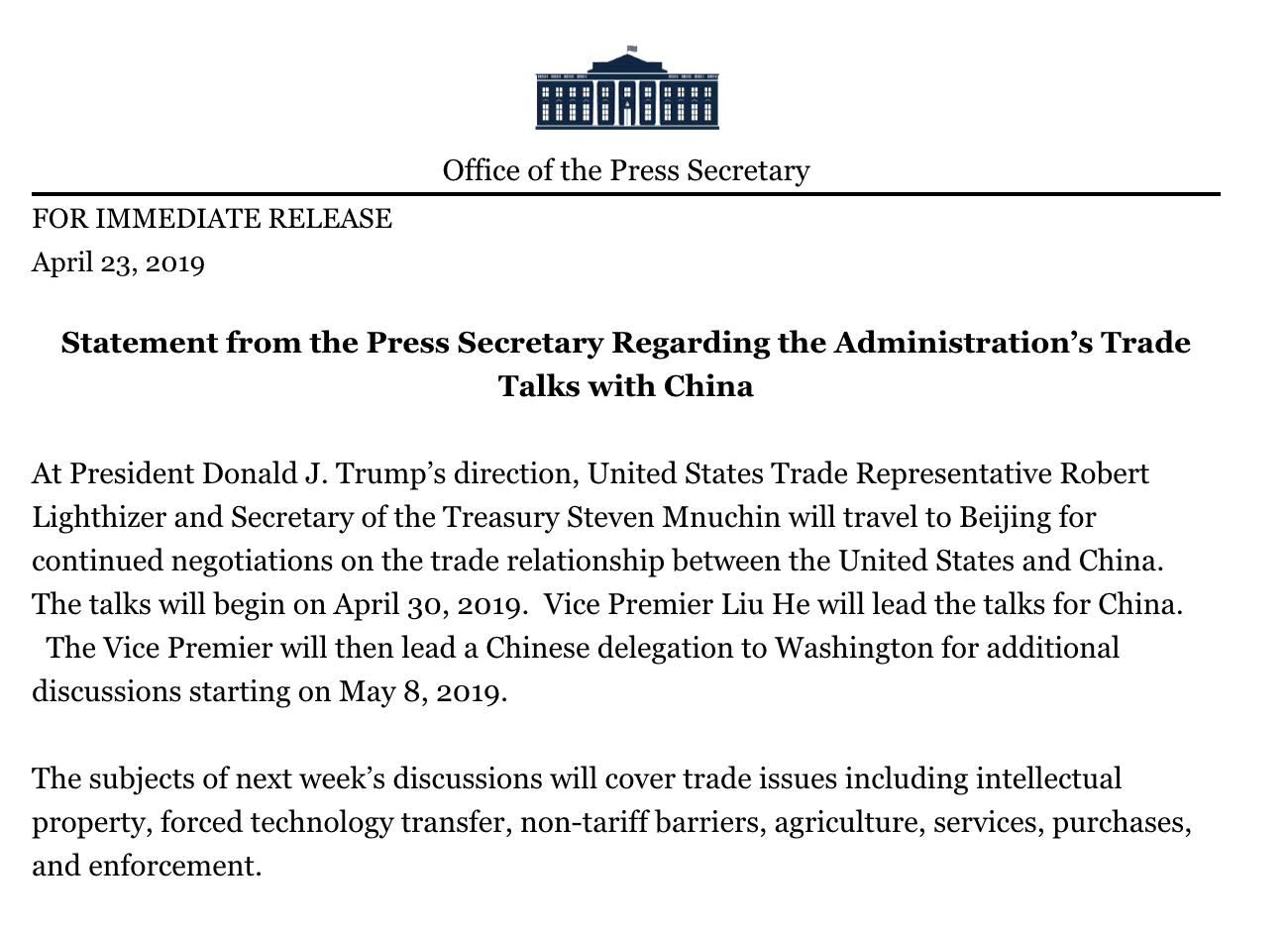
The White House announced that Trade Representative Robert Lighthizer and Treasury Secretary Steven Mnuchin will travel to Beijing to on April 30 to continue trade talks. China's team will again be led by Vice Premier Liu He. Liu is expected to fly to Washington on May 8 for additional discussions. In the statement, it's noted that "the subjects of next week's discussions will cover trade issues including intellectual property, forced technology transfer, non-tariff barriers, agriculture, services, purchases, and enforcement."
Earlier yesterday, Larry Kudlow, Director of the White House National Economic Council, said the negotiations were making progress and he was "cautiously optimistic" on striking a deal. He hailed that "we've come further and deeper, broader, larger-scale than anything in the history of U.S.-China trade."
But Kudlow also noted that “We’re not there yet". "We're still working on the issues, so-called structural issues, technology transfers". Also, "ownership enforcement is absolutely crucial. Lowering barriers to buy and sell agriculture and industrial commodities. It's all on the table."
Bank of Japan Expected To Keep Policy Steady, May Downgrade Forecasts
The Bank of Japan will conclude its two-day policy meeting on Thursday and will be publishing its quarterly outlook report along with its decision statement. The Bank does not provide a precise time for its announcement, but they tend to be made around 0300 GMT. As the global economic slowdown continues to drag on Japanese exporters, policymakers are in a bind as after years of easy monetary policy, inflation is far below the BoJ's 2% target and growth remains sluggish. The Bank is expected to keep policy unchanged in April with limited reaction anticipated in the yen.
There was some good news for the BoJ on Friday from the latest inflation numbers that showed core CPI, which excludes fresh food prices, ticked up to 0.8% year-on-year in March. But with few signs that prices are about to shoot substantially higher and doubts about the sustainability of the growth momentum, which has been weakening, the Bank will likely predict in its quarterly report that inflation will stay below the 2% target until the end of the current forecast period in March 2022.
Growth forecasts could also be revised lower, particularly for the current fiscal year of 2019/20. Japan's massive manufacturing sector has been hit hard by trade tensions and the sharp slowdown in China and elsewhere at the end of last year. But despite some tentative signs of a turnaround in China and the United States, Japanese exports continued to decline in the first few months of 2019 and were down 2.4% in the 12 months to March.
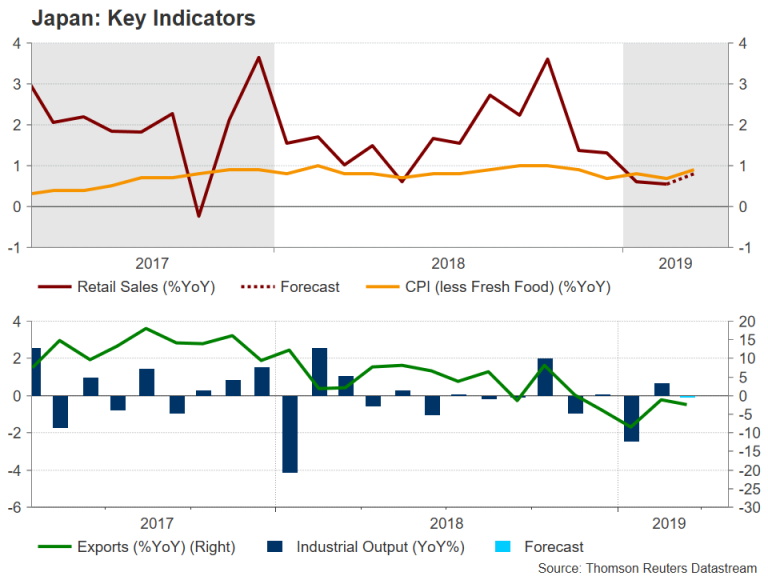
Data due on Friday is expected to show industrial output contracted again in March after spurting out monthly growth of 0.7% in February. Retail sales numbers out the same day are not projected to be upbeat either. Annual growth in retail sales is forecast to edge up modestly from 0.6% to 0.8% in March, having decelerated sharply from 3.6% in October.
With a sales tax increase looming in October, there are fears the economy could tip into recession if growth hasn't rebounded by then. In the meantime, BoJ policymakers keep reassuring investors that there is room for further easing if needed. While this may keep some downward pressure on the yen, most analysts think the Bank is unlikely to announce additional easing unless there's a much more severe deterioration in the economy.
Governor Haruhiko Kuroda will probably stick to familiar script when he briefs reporters on the BoJ's decision on Thursday. But investors will still be on the lookout for any increased concerns on the outlook as well as on the emphasis on the possible side-effects of a prolonged period of ultra-loose monetary policy on the banking system.
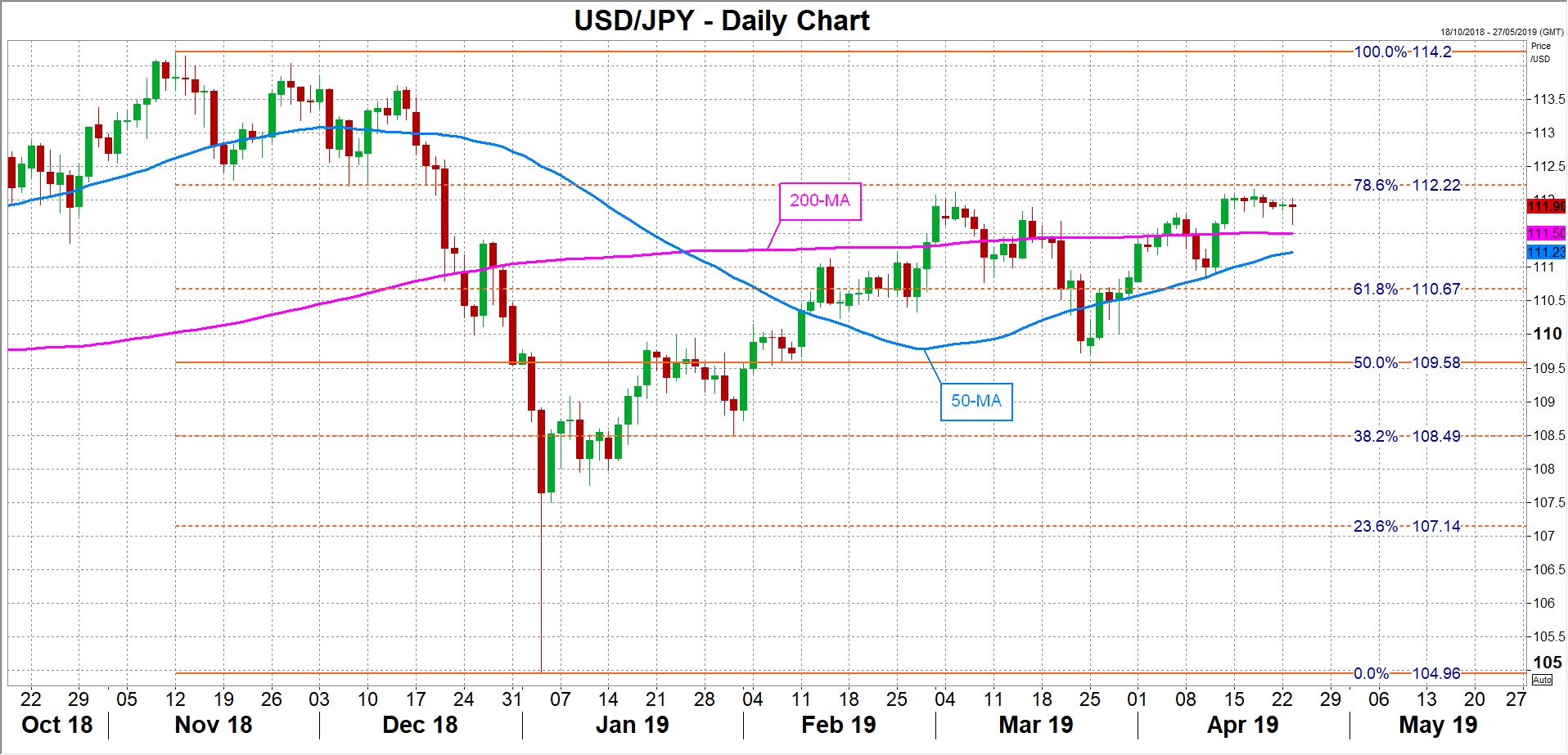
The yen could weaken slightly against the US dollar if there are downward revisions in the BoJ's economic projections and/or Kuroda puts greater weight on the downside risks to inflation than on the side-effects of unconventional policy. In such a scenario, dollar/yen has the potential to break above immediate resistance around 112.20, near the 78.6% Fibonacci retracement of the downleg from 114.20 to 104.96.
However, if there are only minor revisions in the Bank's forecasts and Kuroda offers few clues on the likelihood of fresh stimulus should conditions worsen, the yen could appreciate slightly, driving dollar/yen towards key support in the 111.20 region, where the 50-day moving average lies.
Looking ahead over the coming months, trade talks between the US and Japan will become the main focus for local businesses, and potentially the BoJ too, just as the Trump administration appears to be closing in on a deal with China. This could weigh on sentiment in corporate Japan even if growth does start to rebound globally.
BoC Meeting: Cautious, But Less Than Markets Expect
The Bank of Canada (BoC) will announce its latest policy decision on Wednesday at 14:00 GMT. No action is expected, so all eyes will be on the accompanying statement, updated forecasts, and Governor Poloz's tone. Markets seem to expect an overly dovish message, and while the Bank is indeed likely to appear cautious overall, it is unlikely to go as far as abandon its rate-hike plans completely – which generates an upside risk for the loonie.
The Canadian economy hit a soft patch in recent months, with wage growth slowing and house prices declining, which spells bad news for home-owning consumers. The BoC's own business survey for Q1 was also downbeat, with the headline index dipping into negative territory, indicating that firms are growing pessimistic.
In this environment, market expectations for rate increases by the BoC evaporated, giving way to speculation for rate cuts. A quarter-point rate cut by December is now priced in with a ~30% probability. Yet, the loonie has been consolidating lately, trading sideways against the dollar as the gloom in the rates market was offset by a surge in oil prices – Canada's biggest export.
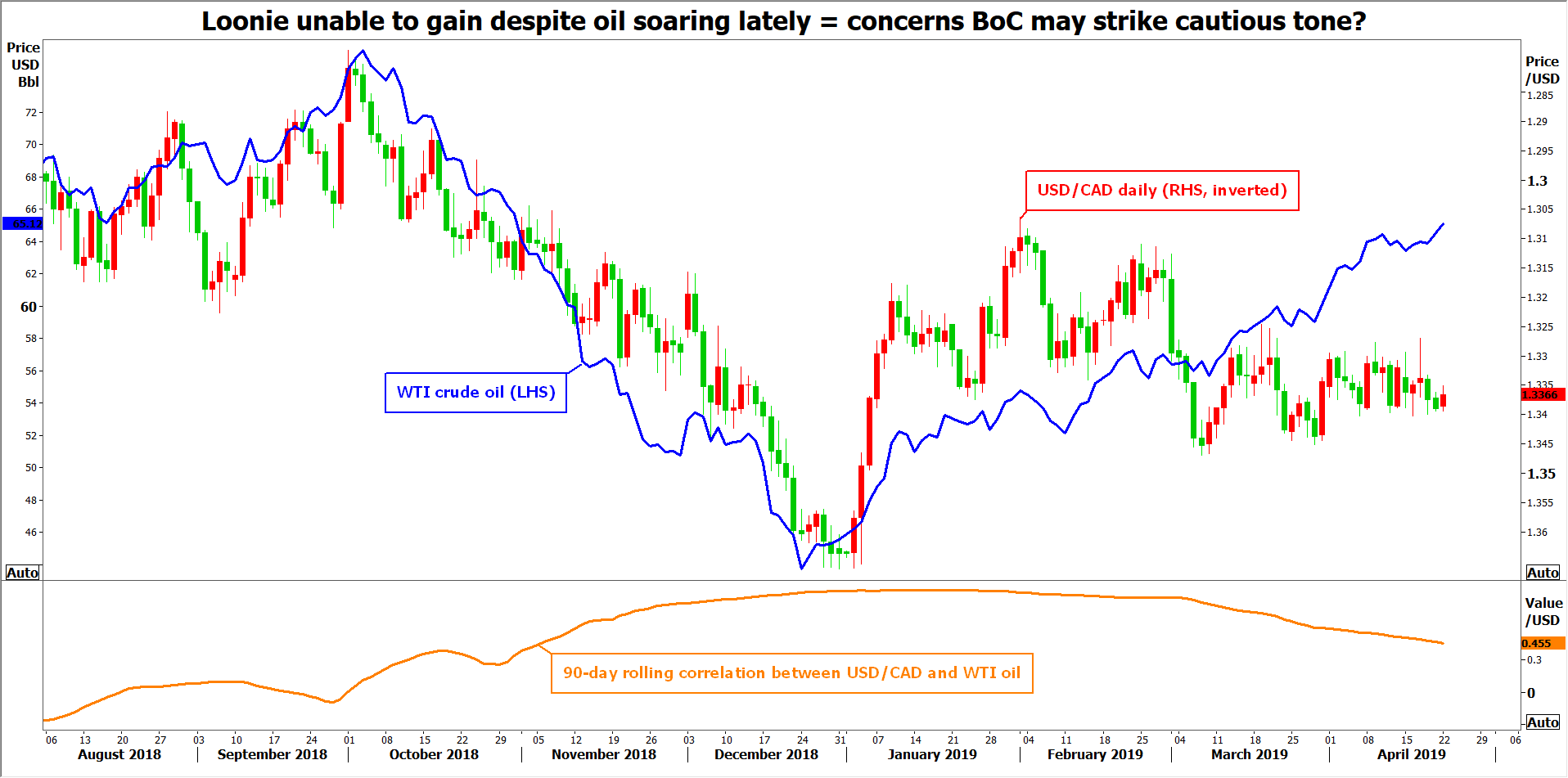
This brings us to this week's meeting. Markets seem to expect Poloz and his colleagues to strike a much more cautious tone, possibly by removing any surviving reference to rate hikes and effectively shifting to a neutral bias. Such a shift would probably reinforce expectations that the next move in rates will be lower, and potentially weigh on the loonie.
However, it may be too early for such a change. Policymakers are indeed likely to communicate a more cautious message, but it could be a touch less dovish than markets expect. They may not go as far as take rate hikes completely off the table. For one, the sustained surge in oil prices paints a much brighter picture for the nation's energy sector. Meanwhile, the latest CPI data showed underlying inflation picking up, which provides a ray of hope. Separately, the officials already recalibrated their policy bias at the last meeting, so they may want to retain some optionality in case the economy does rebound, like the Fed has.
In brief, markets expect an overly-dovish BoC, and although recent developments haven't been encouraging, they also haven't been terrible enough to warrant another substantial shift in guidance. Perhaps more dovishness ‘on the edges', but not abandoning hikes altogether.
As for the loonie, if this assessment proves accurate, the currency could soar. Not so much due to any massive change in the outlook for monetary policy but rather because with the risk of a dovish BoC out of the way, traders will have one less thing to worry about when adding to their long-loonie exposure, and the currency could finally play catch-up with the oil rally.
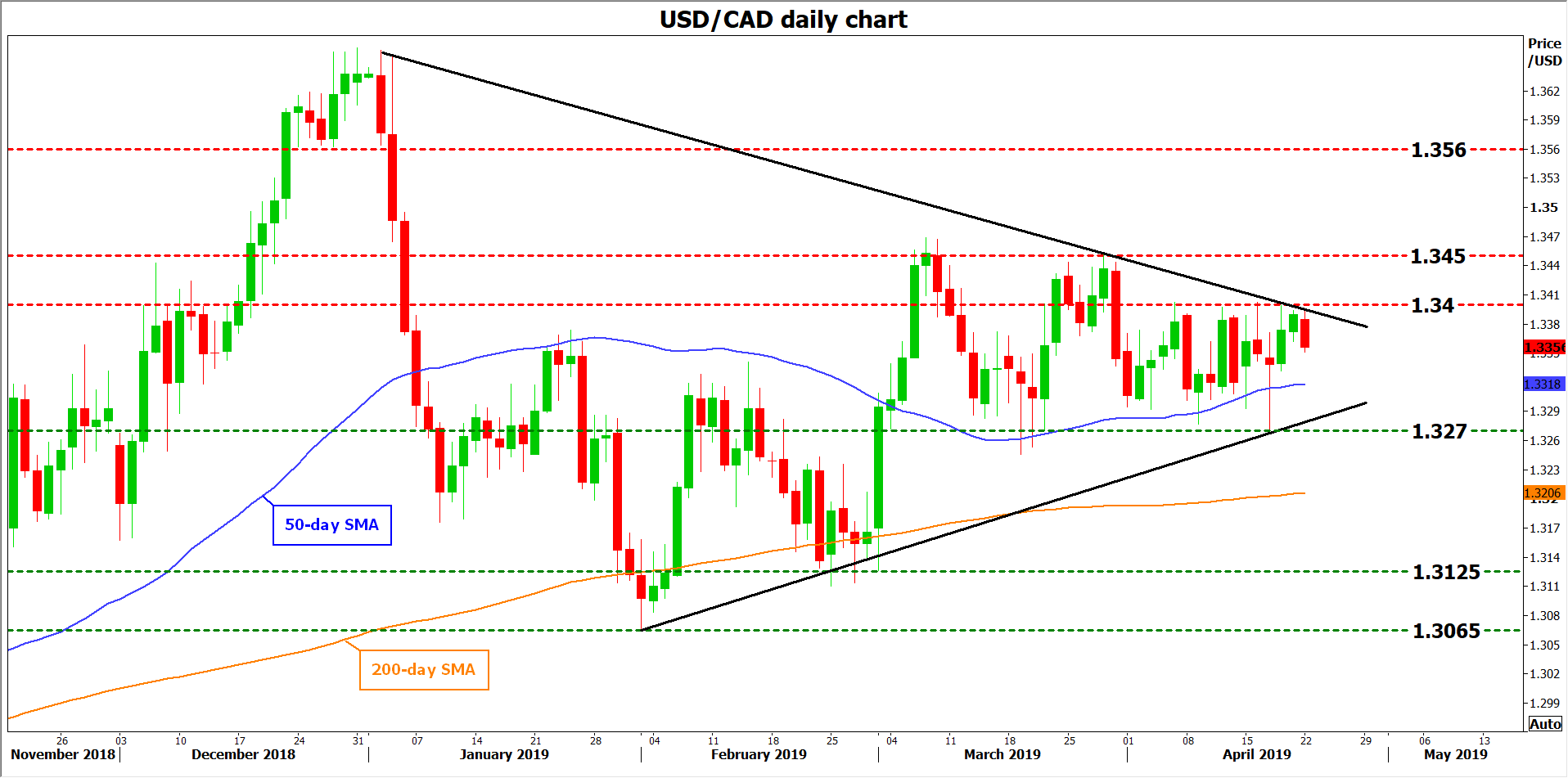
Technically, declines in dollar/loonie could encounter a first wave of support around 1.3270, marked by the April 17 low.
On the flipside, resistance to advances may come near 1.3400, a level that capped multiple bullish moves in April.
USD/CHF Rallies To New 3-Year High
Key Highlights
- The US Dollar rallied and traded to a new 3-year high above 1.0200 against the Swiss Franc.
- USD/CHF broke a crucial ascending channel near 1.0060 on the 4-hours chart and surged higher.
- The US New Home Sales in March 2019 increased 4.5% (MoM), whereas the forecast was -2.5%.
- The BoC Interest Rate Decision will be announced today (forecast – no change from 1.75%).
USDCHF Technical Analysis
The US Dollar started a strong uptrend from the 0.9980 support area against the Swiss Franc. The USD/CHF pair climbed steadily, followed a bullish path, and recently rallied to trade to a new 3-year high above 1.0220.
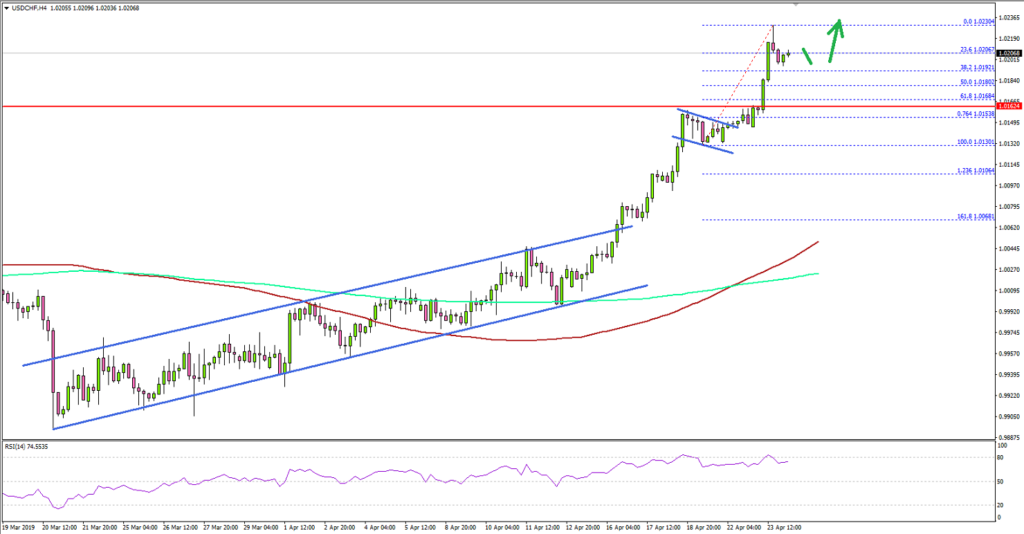
Looking at the 4-hours chart, the pair started a significant upward move from the 0.9978 swing low. There was a steady rise inside a crucial ascending channel. Finally, there was an upside break above the channel resistance at 1.0060.
It opened the doors for further gains above 1.0100, the 100 simple moving average (4-hours, red), and the 200 simple moving average (4-hours, green). Intermediately, there were bullish continuation patterns formed, and the pair rallied above the 1.0200 resistance level.
The pair even broke the 1.0220 level and traded as high as 1.0230. The pair is currently trading in a strong uptrend and dips towards the 1.0200 and 1.0160 levels remain supported. On the upside, the next key resistance are near 1.0250 and 1.0275.
Fundamentally, the US New Home Sales report for March 2019 was released by the US Census Bureau. The market was looking for a decline of 2.5% in sales in March 2019, compared with the previous month.
The actual result was positive as there was a strong rise of 4.5% in sales. Besides, the last reading was revised up from 4.9% to 5.9%.
The report added that:
The seasonally‐adjusted estimate of new houses for sale at the end of March was 344,000. This represents a supply of 6.0 months at the current sales rate.
Overall, the US Dollar remains in a strong uptrend and pairs like EUR/USD and GBP/USD may continue to struggle in the near term.
Economic Releases to Watch Today
- German IFO Business Climate Index April 2019 – Forecast 99.9, versus 99.6 previous.
- Swiss ZEW Survey Expectations April 2019 – Forecast -24.0, versus -26.9 previous.
- BoC Interest Rate Decision – Forecast 1.75%, versus 1.75% previous.
Wall Street Earnings Its Keep
Wall Street earnings its keep
The good news kept rolling in on Wall Street overnight with a steady stream of positive earnings from a plethora of heavyweights such as Twitter and Coca Cola. US new home sales also outperformed, rising a very unexpected 4.5% for March as the Land of the Free continues to defy slowdown sceptics and likely even, the Federal Reserve. US markets shrugged off higher oil prices and an oil futures curve in backwardation (implying higher prices) with the S&P and Nasdaq recording record closes. The S&P rose 0.88% to 2966.67, the Dow Jones jumped 0.55% to 26656.46, and the Nasdaq shot up by an impressive 1.32% to 8120.82.
This evening we have another heavyweight bout on the cards, with Microsoft, Facebook, Tesla and Boeing all reporting. While concerning, Boeing’s woes are unlikely to spoil the party, with the US economy V8 big block apparently firing on all cylinders. The US bond market is also falling into line since the inversion scare of last month, with the yield curve continuing to slope gently upwards. This should be positive for US bank earnings in Q2.
The US dollar unsurprisingly (to me anyway) continues to outperform as other parts of the world look on enviously. The greenback keeps rising against the majors, most notably the euro (EUR) and the British pound (GBP). With the exception of petro-currencies, the story is the same across Tier 2 countries and also emerging markets. The exception being Canada where the CAD fell ahead of what is expected to be a dovish central bank rate decision this evening.
Apart from being this year’s high-yielder of choice, the dollar will be supported by higher oil prices. The maths is simple: most oil transactions are conducted in US dollars. The higher oil goes, the more dollars need to be bought to pay for it. With the US economy seemingly humming along on in a moderate inflation nirvana, oil producers are unlikely to be looking far for places to reinvest.
On Monday Taiwan exports fell by a higher than expected 9.0% for March and followed this up yesterday with lower than forecast retail sales and industrial production. Singapore’s March inflation also came in below expectations at 1.40%. This follows previously weak export data from both Singapore and South Korea. While the world speculates on the longevity of China’s latest stimulus hit, it’s essential to realise that not all parts of the world are performing as gloriously as the US and China at the moment. A casual glance at Europe and Japan should reinforce that notion, and this divergence likely explains the dovish tendencies of central banks globally.
Today’s highlight in Asia will be this morning’s Australian CPI data at 0930 Singapore time. Despite employment holding up, the Reserve Bank of Australia (RBA) is faced with a slowing housing market and stubbornly-low inflation – the latter being a familiar conundrum to many central banks around the world. An undershoot of the 1.50% expected print will see the rate cut noise rise to a cacophony and add to the downward pressure on the currency.
Currencies
The US dollar continues to reign supreme against the majors, and we see no reason for this to change in the immediate future. The EUR has sunk to 1.1220 this morning as Brussels can only look across the Atlantic in envy. The GBP continues to sag, trading at 1.2935 this morning, weighed down by Brexit inaction and a possible leadership coup.
Emerging markets have become rather more interesting following the continued oil rally. Petro currencies such as the Mexican and Columbian pesos have outperformed while non-oilers such as the South African rand (ZAR) have not. Asia has yet to see this flow into the Indonesian rupiah (IDR) and Malaysian ringgit (MYR) – the latter releasing inflation data today – but we could yet see divergence among the emerging market currency block going forward.
Equities
Not much to say here today, the performance of Wall Street should be a green light for regional stock markets to track higher this session. Higher oil prices have somewhat surprisingly, failed to dampen the enthusiasm of Asian markets. In all likelihood, with attention focused on Wall Street earnings, this will be the story for another day.
Oil
Oil continued its Iran-induced ascent overnight. Brent Crude climbed 0.60% to USD74.50 a barrel and WTI rose an impressive 1.15% to USD66.30 a barrel, both six-month highs. The black gold was supported by rumours that Saudi Arabia would not necessarily open the oil spigots to make up for an Iranian shortfall, preferring to wait until it saw concrete evidence of such demand.
Gold
Gold remains mired in a USD1,270.00/1,275.00 per ounce range, supported by geopolitical tensions on one side, and capped by a strong dollar and buoyant equities on the other. Until this status quo materially changes, gold is likely to remain the forgotten man of the investment world.
Eco Data 4/24/19
[php_everywhere instance="1"]