

Sample Category Title
China Q1 GDP grew 6.4%. Production, sales, investment rebound. But no one cares except AUD
Another batch of data from China released today surprised on the upside. GDP growth came in at 6.4% yoy in Q1, unchanged from prior quarter and beat expectation of 6.3% yoy.
In March, industrial production rose strongly by 8.5% ytd yoy, accelerated from 5.3% and beat expectation of 5.6%. Retail sales rose 8.7% ytd yoy, up fro 8.2% and beat expectation of 8.3%. Fixed asset investment rose 6.3% ytd yoy, up from 6.1% yoy and matched expectation of 6.3%. Jobless rate also improved from 5.3% to 5.2%.
Recent data from China continued to paint the picture of stabilization in slowdown, and raised hope that recovery is on the way. That's an important condition for improvement in global outlook.
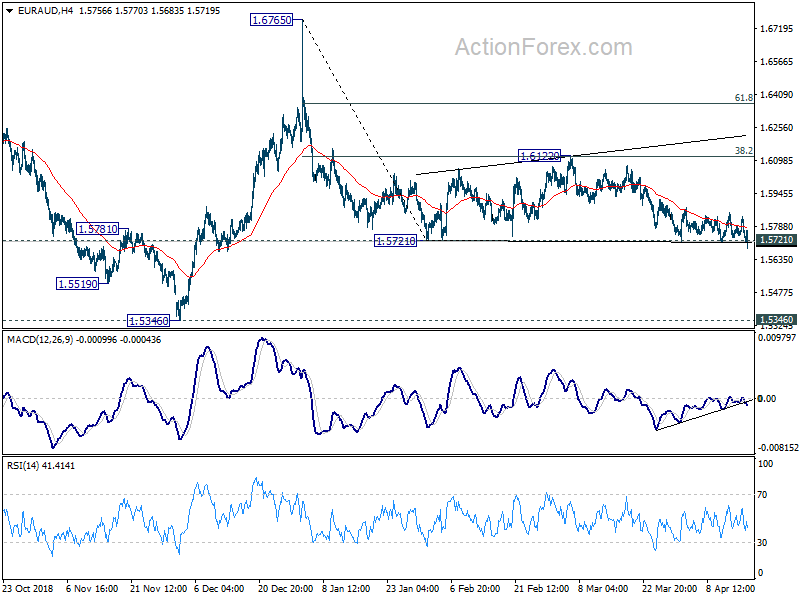
Australian Dollar jumps notably after the release. In particular, EUR/AUD drops through 1.5721 key support and whole decline from 1.6765 might be resuming.
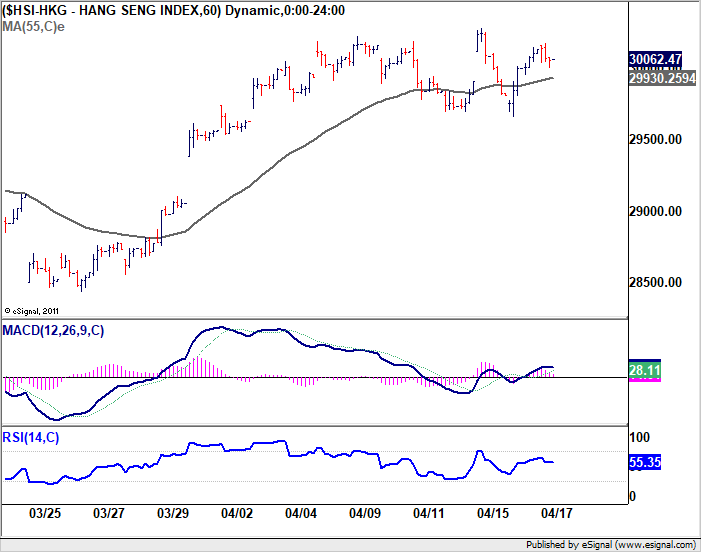
However, reactions elsewhere are rather muted. At the time of writing, China Shanghai SSE is just flat. Hong Kong HSI is even down -0.23%.
Risk On As China Growth Beats Estimates
Aussie surges as growth tops forecasts
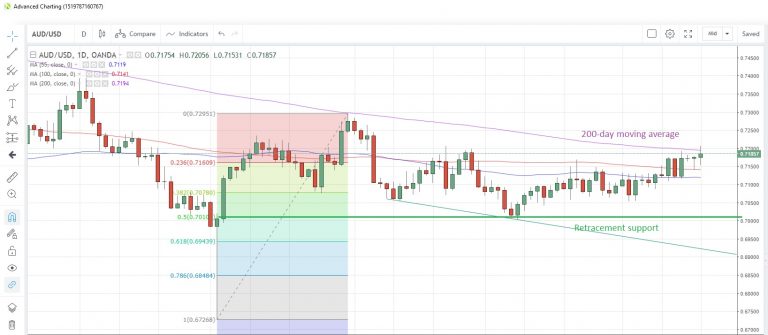
AUD/USD climbed to the highest in almost two months after the Chinese economy grew more than expected in the first quarter. The economy expended 6.4% from a year earlier, beating economists’ forecasts of a 6.3% increase and equaling the growth seen in Q4 2018. On a quarterly basis, growth matched estimates of a 1.4% gain.
Other data released simultaneously also came in better than forecast, with March retail sales gaining 8.7% from a year earlier and industrial production rising 8.5% y/y. Expectations were for +8.4% and +5.9%, respectively.
The better-than-expected numbers saw a pickup in risk appetite, with the Aussie rising across the board and equities advancing further. AUD/USD traded above the 200-day moving average at 0.7195 for the first time in 13 months. The NAS100 index edged up to 7,685, ever closer to its record high of 7,702 hit last October. The exception to the bullish mode were China and Hong Kong indices, which both slipped in to the red. Gold held steady at 1,277.
Kiwi slumps as inflation slows more than forecast
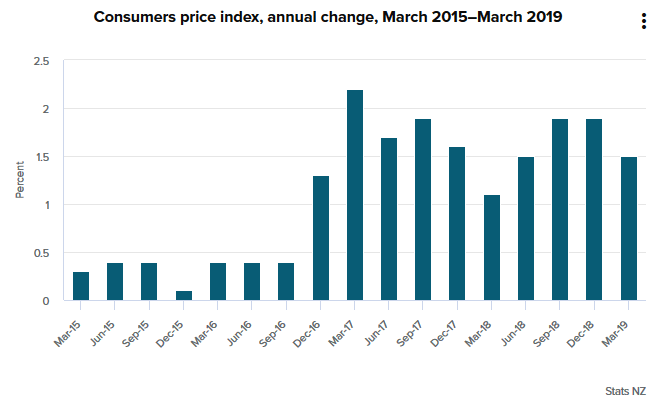
Inflation in New Zealand fell to its lowest level in three quarters in the first three months of this year. CPI rose 1.5% y/y, less than the 1.7% rate economists had expected and a marked slowdown from the 1.9% pace seen in Q4 2018.
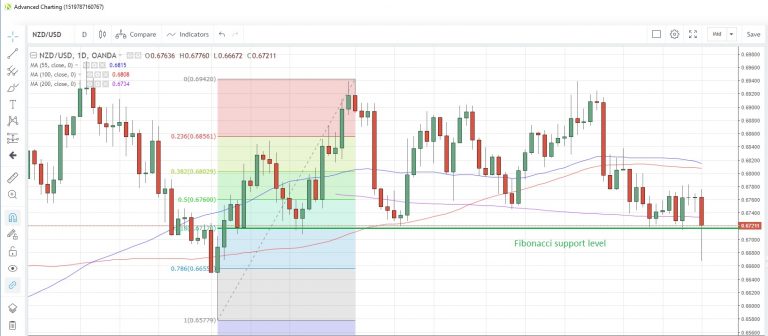
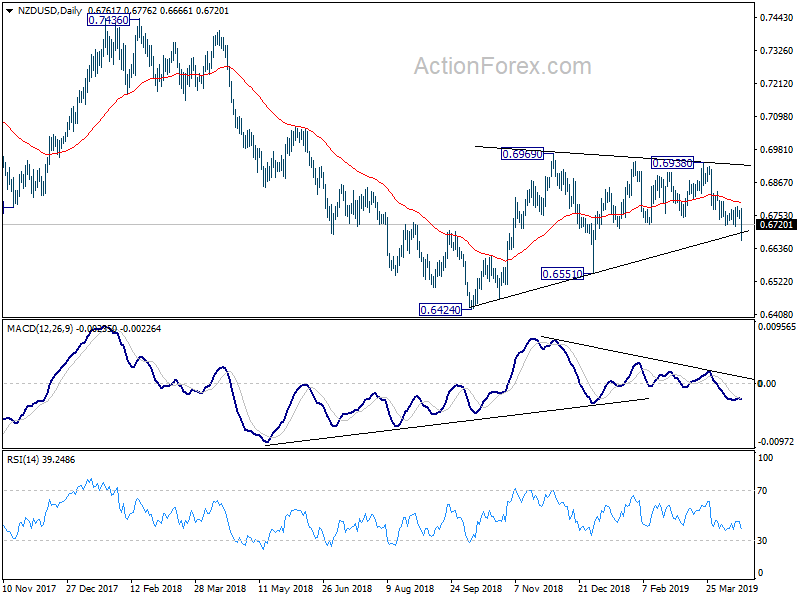
The New Zealand dollar tumbled to its lowest level since January 3 versus the US dollar and the lowest since February 13 versus the Japanese yen. NZD/USD has broken below the 61.8% Fibonacci retracement of the January-February rally at 0.6717 and now has sights set on the 78.6% retracement of the same move at 0.6656. The 55-day moving average looks poised to cross below the 100-day moving average by the end of this week. That would be the first time since December 4.
NZD/USD Daily Chart
Consumer prices in focus
Euro-zone consumer prices are expected to spike higher to +1.0% m/m in March, the highest in a year while UK prices are forecast to rise 2.0% y/y, the second monthly uptick in a row after five months of slowing inflation. UK retail sales are forecast to slow to +0.2% m/m from +0.7% in February.
Over in North America, the US trade deficit is seen widening to $53.7 billion in February following a $51.1 billion deficit the previous month. Canada’s trade balance is expected to come in at –C$3.50 billion from –C$4.25 billion in January. Inflation in Canada is expected to increase to +1.9% y/y in March from +1.5% in February. That would be the highest in three months and the second monthly increase in a row.
GBP/JPY Remains Supported On Dips Near 145.60
Key Highlights
- The British Pound traded higher recently and tested 147.00 against the Japanese Yen.
- GBP/JPY surpassed two key bearish trend lines near 145.90 on the 4-hours chart.
- The UK Claimant Count in March 2019 changed 28.3K, more than the 20.0K forecast.
- The UK Consumer Price Index in March 2019 (YoY) could increase 2.0%.
GBPJPY Technical Analysis
The British Pound started a fresh increase from the 144.78 low against the Japanese Yen. The GBP/JPY pair broke the 145.20, 145.60 and 146.20 resistance levels to move into a positive zone.
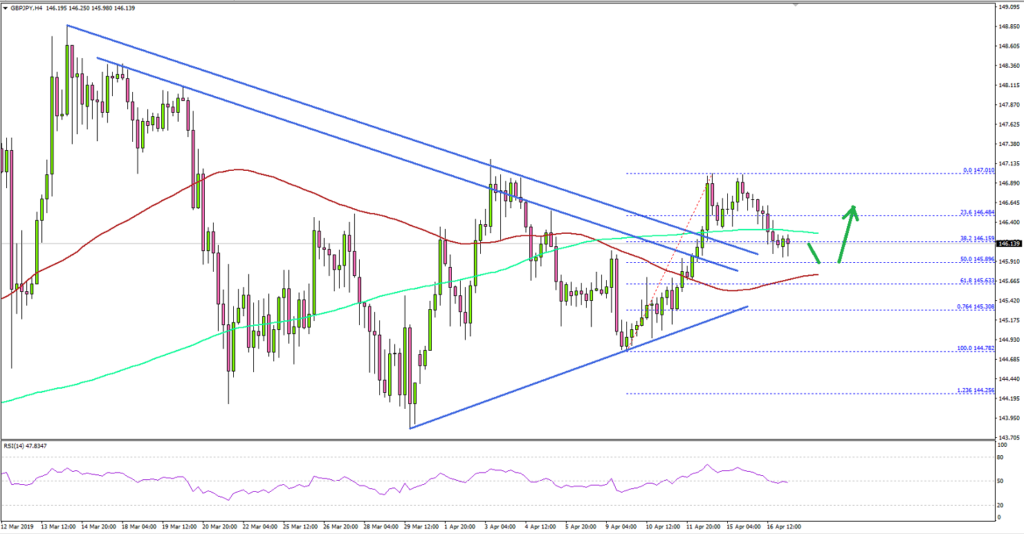
Looking at the 4-hours chart, the pair formed a solid support above 145.00 and climbed higher steadily after it broke the 145.60 resistance and the 100 simple moving average (4-hours, red).
During the rise, the pair surpassed two key bearish trend lines near 145.90 on the same chart. The upward move was strong as the pair even broke the 146.80 level and tested the 147.00 resistance area.
A new swing high was formed at 147.01 before the pair corrected below 146.80 and the 23.6% Fib retracement level of the last wave from the 144.78 low to 147.01 high. However, there are many supports on the downside near the 146.00 and 145.80 levels.
Moreover, the 100 simple moving average (4-hours, red) is likely to act as a strong support near the 145.60 level. Therefore, the pair remains well supported above 145.60 and it may soon resume its upward move towards 147.00 or even 147.50.
Fundamentally, the UK Claimant Count report for March 2019 was released by the National Statistics. The market was looking for a change of 20.0K in March 2019, less than the last 27.0K.
The actual result was disappointing as the change was more than the forecast at 28.3K. The last reading was revised down from 27.0K to 26.7K. Besides, the ILO Unemployment Rate remained stable at 3.9%.
The report added that:
The UK economic inactivity rate was estimated at 20.7%, lower than for a year earlier (21.2%) and the joint-lowest figure on record. The UK employment rate was estimated at 76.1%, higher than for a year earlier (75.4%) and the joint-highest figure on record.
Both GBP/USD and GBP/JPY declined after the release, but it seems like dips in GBP/JPY remain well supported above 145.60.
Economic Releases to Watch Today
- UK Consumer Price Index March 2019 (YoY) – Forecast +2.0%, versus +1.9% previous.
- UK Core Consumer Price Index March 2019 (YoY) – Forecast +1.9%, versus +1.8% previous.
- Euro Zone CPI for March 2019 (YoY) – Forecast +1.4%, versus +1.4% previous.
- Euro Zone CPI for March 2019 (MoM) – Forecast +1.0%, versus +0.3% previous.
- Canadian Consumer Price Index March 2019 (MoM) – Forecast +0.7%, versus +0.7% previous.
- Canadian Consumer Price Index March 2019 (YoY) – Forecast +1.9%, versus +1.5% previous.
EURGBP Pressure Still Remains Higher
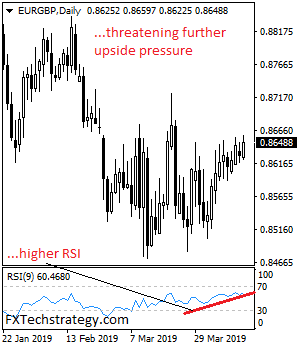
EURGBP pressure still remains higher as it looks to extend its recovery higher. On the downside, support stands at the 0.8600 level where a violation will turn focus to the 0.8550 level. A break below here will aim at the 0.8500 level. Conversely, resistance lies at the 0.8650 level. A violation if seen will turn risk towards the 0.8700 level. Further up, resistance comes in at 0.8750 level followed by the 0.8800 level. Its daily RSI is bullish and pointing higher suggesting further strength. All in all, EURGBP pressure still remains higher on further bull pressure.
New Zealand CPI slowed to 1.5%, solidifies need for imminent RBNZ easing
New Zealand Dollar drops sharply after worse than expected consumer inflation data. CPI rose 0.1% qoq in Q1, below expectation of 0.3% qoq. Annually, CPI slowed to 1.5% yoy, down from 1.9% yoy and missed expectation of 1.7% yoy. Tradeable CPI dropped -0.4% yoy while non-tradeable CPI rose 2.8% yoy.
CPI has been persistently weak and remained below mid-point of RBNZ's 1-3% target range for the eight consecutive quarter. Indeed, CPI has only breached 2% level once in Q1 2017 (2.2%) since 2011. Yesterday, RBNZ Governor Adrian Orr noted that "possibilities of first quarter inflation numbers being undershot have already being factored in the RBNZ's dovish bias". The downside surprise is giving Orr an even worse picture and solidifies the imminent need for policy easing.
NZD/USD drops sharply to as low as 0.6666 after the release, then recovered on strong Chinese data. Nevertheless, break of 0.6713 support confirms resumption of whole decline from 0.6938. Failure to sustain above falling 4 hour 55 EMA EMA also affirms near term bearishness.
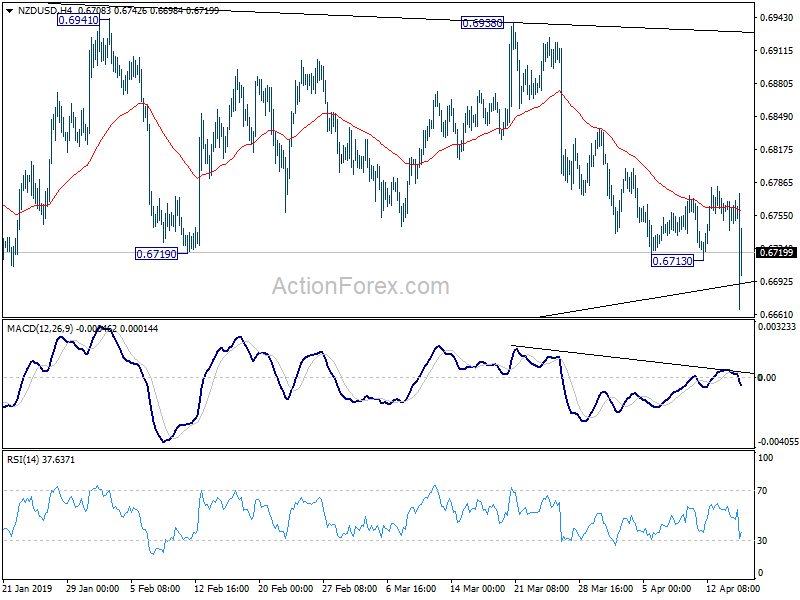
NZD/USD should now be on track to 0.6551 support next.
Daily Markets Broadcast
Wall Street rebounds on earnings
US indices rallied yesterday with some better-than-expected earnings driving the move. The US30 index hit six-month highs while the NAS100 index came within a whisker of its record high. China’s Q1 GDP growth data are due today which will determine near-term direction.
US30USD Daily Chart
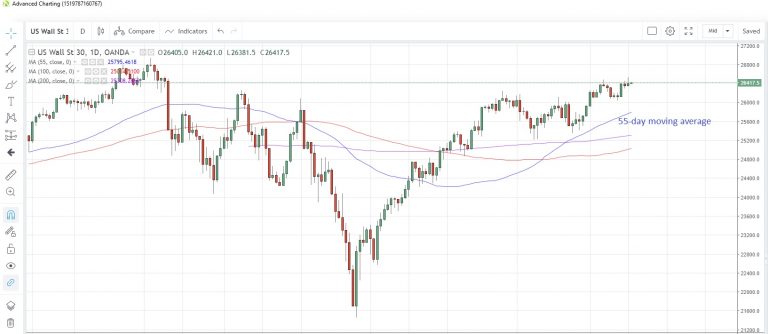
The US30 index touched the highest since October 9 yesterday, as strength in the financial sector overcame weakness in the healthcare sector
The rising 55-day moving average support is at 25,795 today
The US trade deficit is seen widening to $53.7 billion in February from $51.1 billion the previous month.
DE30EUR Daily Chart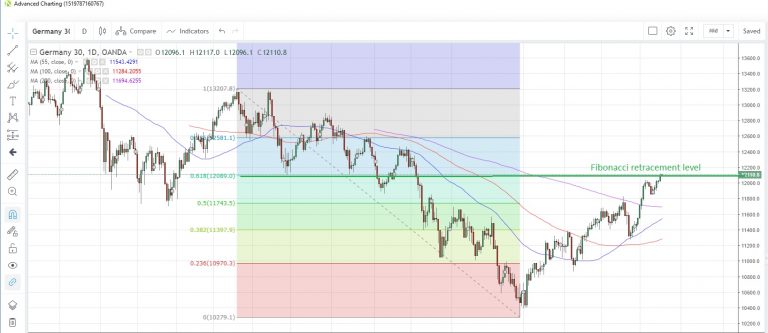
The Germany30 index extended its recent gains to a fifth day yesterday and early trading this morning has seen it climbing further
The index touched the highest since October 8 yesterday and is testing the 61.8% Fibonacci retracement level of the May-December drop at 12,089
Euro-zone consumer prices are seen spiking 1.0% higher from a month earlier in March following a 0.3% gain in February. That would be the highest in a year.
CN50USD Daily Chart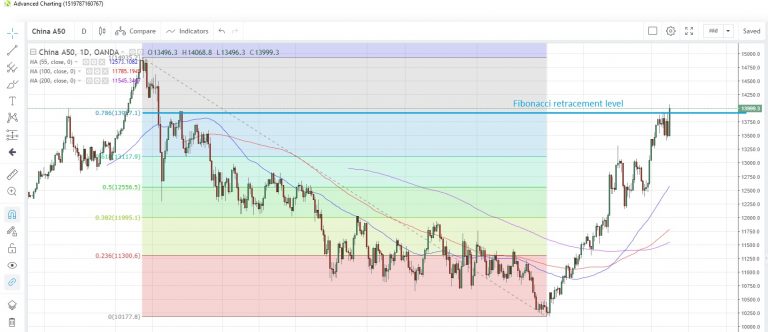
China shares surged the most since February 25 yesterday amid rising expectations for strong growth numbers in Q1
The index touched the highest since February 7, 2018 yesterday. The 78.6% Fibonacci retracement of the January 2018-January 2019 drop is at 13,917
The Chinese economy is seen expanding 6.3% y/y in Q1, a slower pace than the 6.4% recorded in Q4. A better-than-expected number could encourage risk appetite and drive indices higher.
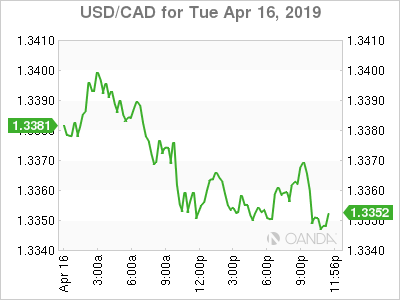
USD/CAD Canadian Dollar Rebounds After Higher Oil Prices
The Canadian dollar rose on Tuesday. The loonie was not helped by positive domestic data as factory sales were down 0.2 percent in February coming in lower than expected at no gain. Oil prices were the major factor in the CAD rebound. Supply disruptions took crude prices higher as the OPEC+ continues to limit production.
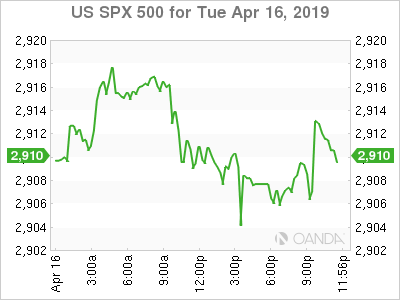
The rise in crude prices helped offset the dovish results from the Bank of Canada (BoC) business survey published on Monday. The loonie had a great start to 2019, but as major central banks are pumping the breaks so too has the BoC joined the dovish choir. Economic data is expected to be mixed going forward with the CAD traders awaiting inflation and trade data.
The US dollar was mixed against major pairs on Tuesday. The greenback was lower against the AUD, NZD and JPY as Chinese data encouraged riskier assets. ECB dovish comments showcased a lack of confidence in the European economy despite the positive indicators this week taking the EUR lower. The GBP continues to be sensitive to Brexit headlines despite the Halloween extension. Opposition leader Jeremy Corbyn said that talks between the two major parties are stalling. The European Council has been supportive of more talks, and even of reversing Article 50, but the UK parliament has not rallied behind a single cause, leading to a vicious circle where a no-deal exit it not wanted, but supporting a single option is not viable.
Crude Rises on Supply Concerns and Lower US Inventories
Oil prices rose on Tuesday as supply disruptions ended up boosting WTI more than 1 percent and Brent 0.7 percent. The API report showed a 3.6 million drawdown in crude stocks ahead of the report by the Energy Information Administration (EIA) on Wednesday. The forecast calls for a buildup in US crude inventories but after the mixed report last week, a drawdown would be positive for crude prices.
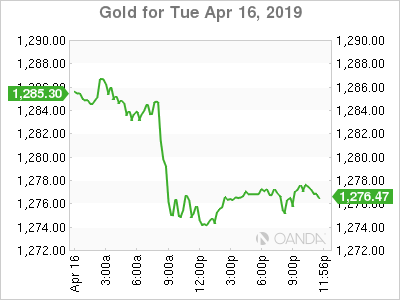
The US dollar is gathering some momentum, after a dovish ECB, but not enough to derail crude. Oil prices could continue to climb higher if there is a significant drawdown of crude in the US. The OPEC+ deal continues to be the stabilizing factor that is pushing against rising US output. The disruptions have played in favor of the production cut agreement but have also made some members wonder if the time is now, before extending the deal, to start ramping up production. 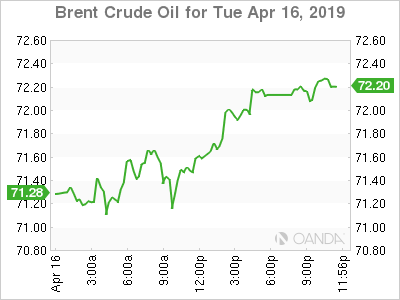
The Trump administration has shown a willingness to support the US energy sector, and with low oil prices as one of its main selling points shale producers could once again put the OPEC in a tough situation.
Dollar Recovery Hurts Gold
Gold lost 0.9 percent on Tuesday. The yellow metal was under pressure as investors were seeking riskier assets and sold their safe haven positions. Lower inflation in the US also reduces the appeal of gold as the Dallas Fed outlined that the gig economy could be the x-factor keeping wages low despite a strong employment.
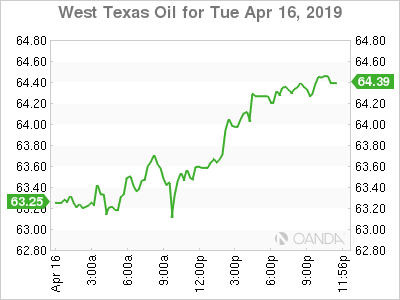
An extension to Brexit and positive comments on US-China and even US-EU trade deals have put gold on the back foot in the short term. Geopolitics will continue to create uncertainty that could eventually lead to gains on gold positions, but for now risk is the name of the game as the global outlook looks more stable.
Global Stocks Rise on Risk Appetite Return
Global Indices had another positive session. Healthcare stocks in the US beat expectations and overall equities continue to defy analyst forecast of a slowdown. Updated guidance to the downside is partly responsible as the bar has been lowered, but companies are still posting positive results.
Apple and Qualcomm settled their patent lawsuit, which was a huge positive for the chipmaker rising 15 percent, while the iPhone maker ended up with a 1 percent gain after agreeing to pay and entering into a six-year chip supply agreement.
Netflix fell after beating estimates on its Q1 earnings. It also added 1.74 million subscribers, but its future guidance was of only 0.55 earnings per share. The market was focused on increased competition in the space with Disney and Apple ready to step in this year. Netflix dismissed those concerns in a note seeing “We don’t anticipate that these new entrants will materially affect our growth because the transition from linear to on demand entertainment is so massive and because of the differing nature of our content offerings”. Analysts are not as optimistic on Netflix being able to fend off the threat from a content powerhouse like Disney and a hardware leader like Apple.
Japan exports slumped in March, raised concerns of Q1 GDP contraction
In March, in trend terms, Japan's exports dropped -2.4% yoy to JPY 7.20T. Imports rose 1.1% yoy to JPY 6.67T. Trade surplus came in at JPY 0.53T, up from prior month's JPY 0.33T. In seasonally adjusted terms, exports dropped -1.0% yoy to JPY 6.61T. Imports rose 2.1% yoy to JPY 6.78T. Trade deficit was at JPY -0.18T.
Exports to China, Japan's largest trading partner, dropped -9.4% yoy, reversing from 5.6% growth in February. Exports to Asia as a whole dropped -5.5% yoy, a fifth straight month of decline. The slump in exports could drag down capital expenditure and private consumption growth . And it raised concerns that the economy contracted again in Q1.
Amamiya: BoJ mindful of risks including financial imbalances
BoJ Deputy Governor Masayoshi Amamiya said the central bank is "ready to respond" financial crisis threatens the stability of the banking system.
He pointed to experience in the late 1980s, and noted "one of the factors that led to Japan's asset-inflated bubble was the fact we kept monetary policy easy even as the economy continued to expand". Hence, "the BOJ must be mindful of the potential risks to the economy and prices, including financial imbalances,"
Regarding monetary policy, Amamiya said "we're ready to respond if financial problems have a big impact on the economy."
US raised very large trade deficit with Japan during trade talks
The US Trade Representative issued a statement regarding the meeting of USTR Robert Lighthizer and Japan's Economic Revitalization Minister Toshimitsu Motegi on April 15-16 in Washington.
In the statement, it's noted that US and Japan "discussed trade issues involving goods, including agriculture, as well as the need to establish high standards in the area of digital trade". Also, US raised its "very large trade deficit with Japan – $67.6 billion in goods in 2018." Both sides agreed to meet again in the "near future to continue these talks".
Motegi said yesterday that no agreement has been made. But he hoped to reach a "good result" on the talks "at an early stage." There will be further discussions next week before the US-Japan summit. Meanwhile, discussions regarding exchange rate would be left to finance ministers.