Sample Category Title
Eco Data 4/17/19
[php_everywhere instance="1"]
US NAHB index rose to 63, industrial production dropped -0.1%; Canada manufacturing sales dropped -0.2%
US NAHB housing market index rose to 63 in April, up from 62, but missed expectation of 64. Industrial production dropped -0.1% mom in March, below expectation of 0.3% mom. Capacity utilization dropped to 78.8%.
From Canada, manufacturing sales dropped -0.2% mom in February, below expectation of -0.1% mom. International securities transactions dropped to CAD 12.05B in February, versus expectation of CAD 27.34B.
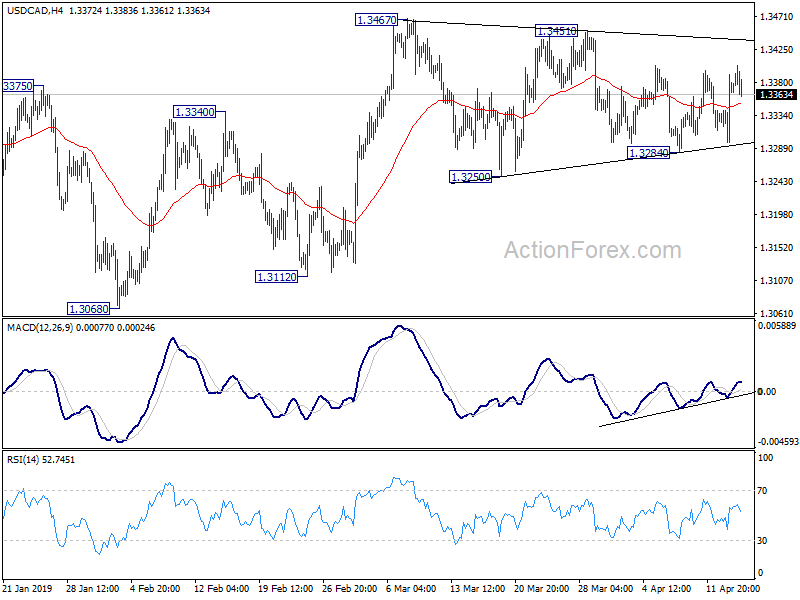
USD/CAD weakens mildly after the releases. But there is no sign of breakout from recent range from 1.3467 yet.
XAU/USD Outlook: Spot Gold Falls to 4 1/2 Month Low, Pressured by Strong Risk Mode
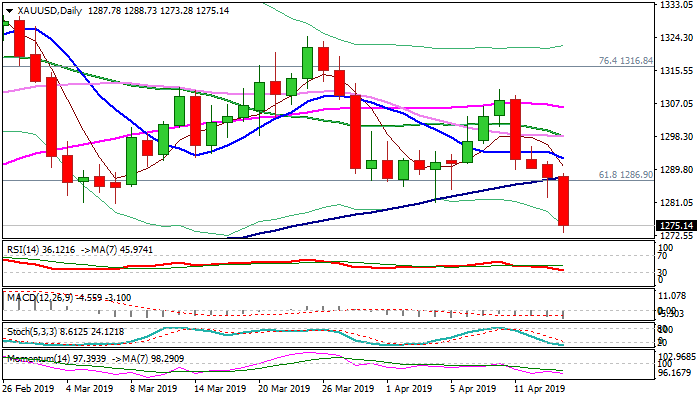
Spot gold holds in red for the fourth straight day and accelerates lower in early US trading on Tuesday. Fresh weakness hit new 4 1/2 month low, marking daily loss of 0.93% until now. Solid economic data from major economies and fresh optimism over US/China trade talks boosted risk sentiment, reducing significantly safe-haven demand. Fresh bears cracked important supports at $1276/75 (21/23 Jan higher base/Fibo 38.2% of $1160/$1346) and close below would generate bearish signal for extension steep fall from $1309 lower top towards $1263 (weekly cloud top). Daily techs are in full bearish setup and maintain strong negative momentum which boosts bears. Oversold stochastic marks initial warning of corrective action that could be expected in coming session.
Res: 1276; 1280; 1287; 1292
Sup: 1274; 1263; 1256; 1253
Sunset Market Commentary
Markets
Global core bonds lost ground today with US Treasuries underperforming German Bunds. Global core bonds opened today’s session with a neutral bias. German Bunds edged lower as European investors chose riskier assets over safe haven paper. Around the publication of the mixed ZEW Survey (see below) and stronger February EMU construction output, Reuters reported that a “significant minority” of ECB officials expressed doubts that the eurozone economy will rebound in the second half of the year. The German Bund jumped higher. However, German Bunds paired gains after ECB officials were said to lack enthusiasm for tiering of negative interest rates. The German yield curve is mixed with changes varying between -1.1 bp (2-yr) and +0.3 bps (10-yr). US Treasuries moved sideways throughout EU dealings, but lost ground ahead of the US opening as strong corporate earnings are lifting sentiment. US factory output for March little disappointed, putting a floor under UST’s for now. The US yield curve edges higher with the belly of the curve underperforming the wings, with changes up to 2.3 bps (10-yr). Bank of Italy chief economist Eugenio Gaiotti warned that Italy’s budget deficit would rise to 3.4% in 2020 if the government won’t increase the VAT. Italian BTP futures fell, pushing the Italian spread over the German 10-yr yield back to 255 bps (+4 bps).
A strong Asian trading session set the tone for this morning. European stocks moved swiftly higher. The constructive risk climate also supported euro buying. However, Reuters reporting that several ECB officials doubt the long projected growth recovery in the second half this year dented sentiment. Shortly after, Bloomberg reports suggested that there’s little enthusiasm within the ECB to introduce a so-called tiered deposit system to counter the side effects of sub-zero interest rates. It might mean markets projected the ECB’s “lower for even longer” too far into the future. EUR/USD was whipsawed but eventually turned south despite investor optimism and weaker than expect US industrial data. The couple struggles to hold ground above the 1.13 handle. USD/JPY hovers close to 112.
Sterling’s price action was again confined to a tight trading range today. Brexit temporarily moved to the background as British MP’s are enjoying their Easter holidays. We looked for UK’s February job report to provide impetus to trading. Readings were strong (179 000 jobs created, unemployment rate at 3.9% and wage growth at 3.4% YoY) yet too close at consensus to trigger any significant market moves. At the same time the bar for sterling to post additional (data driven) gains has risen dramatically over since the start of the year. EUR/GBP is currently testing the upper side of the narrow sideways range at 0.865. Cable manages to stay below 1.31 (1.3060 at the moment).
News Headlines
Reuters cites four sources with direct knowledge of ECB discussions who say that several ECB policymakers think the bank’s economic projections are too optimistic as growth weakness in China and trade tensions linger. The “significant minority” thinks that the long projected growth recovery won’t be coming in the second half of the year.
German ZEW investor sentiment weakened further in April, declining to 5.5 from 11.1 (vs 8.5 expected). It’s the 7th consecutive monthly drop to the lowest level since 2014. The forward looking “expectations” component did improve though, rising for a sixth consecutive month from -3.6 to 3.1. It’s the first positive figure since March 2018.
The UK unemployment rate was unchanged at 3.9% in February, the lowest level since 1974. The UK economy added 179k jobs in the 3 months to February, with woman accounting for 80% of the increase. Average weekly wages, excl. bonuses, rose 3.4% over the same period (3M Avg Y/Y), matching the fastest pace since the end of 2008.
EURNZD Finds Wall Near 1.6725; Bullish Cross Between SMAs
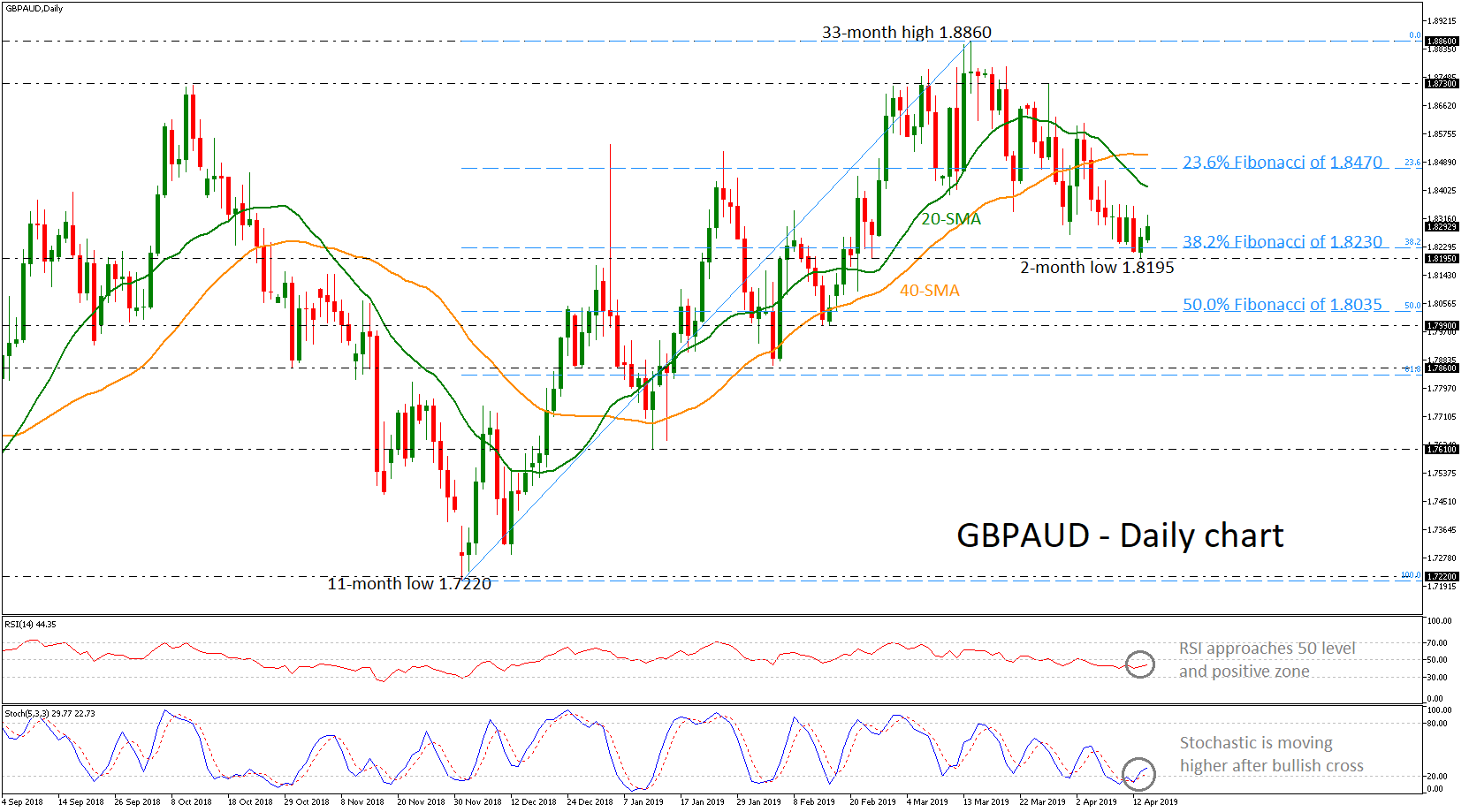
EURNZD has found strong resistance level around the 1.6725 barrier, as it failed several times in the past days to have a daily close above it. The 20- and 40-simple moving averages (SMAs) recorded a bullish crossover in the daily timeframe, increasing possibilities for more upside pressure. The technical indicators though, are flattening in the positive area, confirming the past two neutral days.
In case the pair maintains its short-term direction to the upside after the bounce off the 18-month bottom of 1.6885, the bulls will probably challenge the previous top at 1.6850. A break higher could last until the 38.2% Fibonacci retracement level of the downleg from 1.7925 to 1.6880 of 1.6915.
On the flipside, declines may drive the price towards the 20- and 40-SMAs near 1.6565 before the 1.6420 support comes into view. Beneath the latter, the 18-month low of 1.6885 which rejected the market’s bearish action recently could be another level in focus.
Overall, in the short-term, if the price surpasses 1.6725 and has a daily close above this level, it could open the door for more bullish orders until the next resistance.
Canadian Manufacturing Sales Down in February, Led by Auto Sector
- Canadian manufacturing sales fell 0.2% in February, following a downwardly revised 0.8% increase in January. The release came against consensus expectations for a smaller 0.1% decline. After accounting for price changes, volumes fell 0.5%.
- Durable good sales fell 1.4% led by declines in motor vehicle assembly (-4.4%) and wood products (-5.9%). Non-durable goods rose 1.2%. Excluding motor vehicles, total sales were up 0.2%
- Regionally, manufacturing sales fell in six of ten provinces. Ontario (-1.7%) and Saskatchewan (-6.3%) were the biggest contributors to the decline. This was offset by gains in Quebec (+3.7%) and New Brunswick (+7.7%).
- Inventories increased for a third month, up 0.5%, with the inventory-to-sales ratio at 1.51 (up slightly from 1.5 in January). New orders rose 1.5%, led by transportation equipment (+7.1%).
Key Implications
- It’s a one step forward, two steps back story for the Canadian manufacturing sector. The pullback in February marks the third decline in four months, and while sales were strong in January, the first quarter will be hard pressed to see an increase, making it two consecutive quarters of retreating sales.
- For the overall Canadian economy, this echoes other indicators in pointing to a soft quarter for growth. We're tracking real GDP growth just below the 1% annualized mark, making for a slow start to 2019. Relief may be some way away, as temporary auto plant closures in April will keep a lid on activity heading into the second quarter.
Canadian Manufacturing Sales Edged Lower in February after January Jump
- Headline nominal sales slipped 0.2% lower after a 0.8% January increase
- Controlling for price effects, the volume of sales fell 0.5% after a 1.5% increase in January.
The drop in volume sales in February left the measure down slightly (0.2%) from a year-ago – led by a pullback in the motor vehicle sector. Still, bad weather may be partly to blame. A record number of work hours were lost due to weather in February. The U.S. industrial sector – with which Canada’s manufacturing sector is highly integrated – still looks like it’s doing okay. And unfilled order volumes are still up 11% from a year-ago, suggesting there is some room for growth in manufacturing sales going forward.
Headline GDP growth is still likely to be soft in Q1 at around 1% but also still in part due to transitory disruptions to oil production and bad weather effects, both of which should reverse going forward. That has long been expected. The Bank of Canada’s dovish pivot in recent months had more to do with risks around the global economic outlook going forward and benign inflation trends. On the latter, data more recently has added heft to the central bank’s argument that, even with the unemployment rate right around multi-decade lows, there is room for the economy to grow further without stoking significant inflation pressures. The capacity utilization rate for the manufacturing sector is down 3 percentage points from a year ago as of February – adding to yesterday’s pullback in measures of capacity pressures in the Business Outlook Survey. In short, underlying economic trends are probably still a little better than headline economic growth numbers will show in Q1, but there is still little pushing the Bank of Canada to move interest rates higher at the moment.
DAX Climbs to 6-Month High on Strong German ZEW Economic Sentiment
The DAX index has posted strong gains on Tuesday. Currently, the DAX is at 12,106, up 0.72% on the day. Earlier in the day, the index touched its highest level since October 1. In economic news, German ZEW Economic Sentiment improved to 3.1, beating the estimate of 0.9. The all-eurozone indicator followed suit, rising to 4.2, above the forecast of 1.2 points. On Tuesday, the eurozone releases CPI and OPEC members hold a meeting in Vienna.
The well-respected German ZEW economic sentiment survey is a key gauge of investor confidence and can have a strong effect on market direction. This was the case on Tuesday, as a strong score has sent the DAX higher. The indicator has been mired in negative territory for the past 12 months, and finally climbed into territory in April. The score of 3.1 points to slight optimism on the part of institutional investors and analysts. The eurozone indicator showed a similar trend, climbing to 4.5 points, its first gain since May. The improvement in investor mood is attributable to the Brexit extension, which will give the parties time until October to try to reach a resolution to the deadlock. The ZEW said that investors were hopeful that the global economy would develop “less poorly” than expected. At the same time, eurozone growth remains weak and Germany is expected to cut its growth forecast for 2019, a result of a drop in exports.
The economic slowdown in China has rocked equity markets worldwide, but there are signs that the world’s second largest economy is moving upwards. There was relief on the weekend, as China’s trade surplus surged to USD 32.64 billion. Last week, Chinese CPI posted a gain of 2.3%, its best gain in 5 months. A key test is on Tuesday, with the release of Chinese GDP. Third-quarter growth edged lower to 6.4%, and the estimate for Q4 stands at 6.3%. Although these are very strong growth rates, the downward trend has investors worried, and a weak GDP reading could send equities lower.
EUR/USD Mid-Day Outlook
Daily Pivots: (S1) 1.1293; (P) 1.1307; (R1) 1.1317; More.....
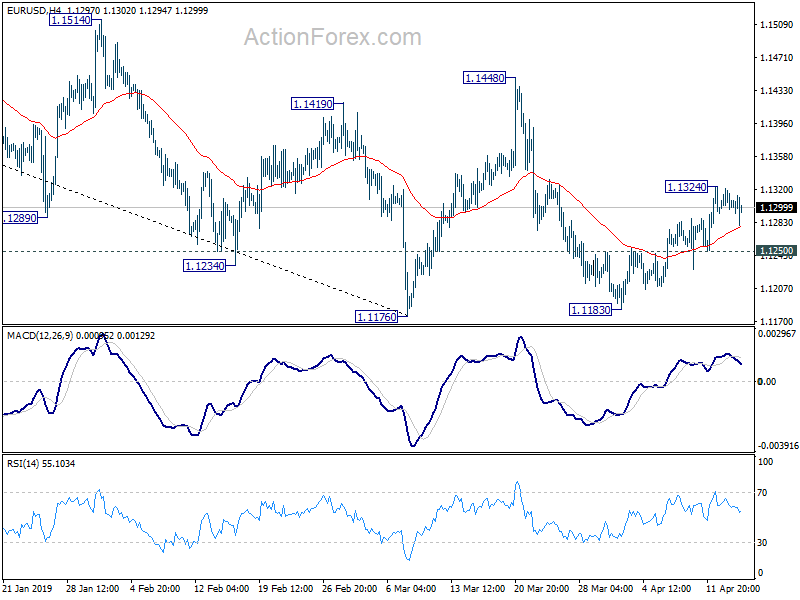
Intraday bias in EUR/USD is turned neutral again with today's retreat. With 1.1250 minor support intact, further rise is in favor to 1.1448 resistance and above. But in that case, we'd expect strong resistance between 1.1448/1569 to limit upside. On the downside, below 1.1250 minor support will turn bias to the downside. Decisive break of 1.1176 will resume the down trend from 1.2555.
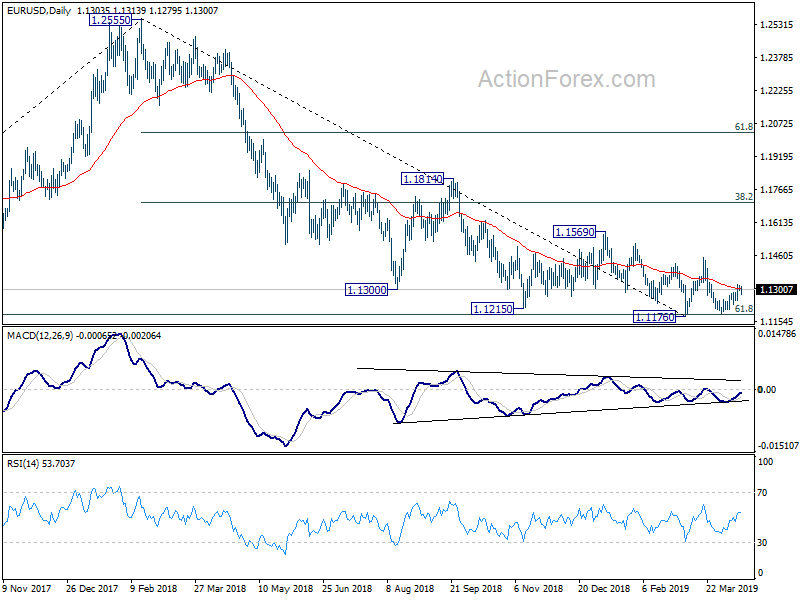
In the bigger picture, EUR/USD has been losing downside momentum around 61.8% retracement of 1.0339 (2016 low) to 1.2555 (2018 high) at 1.1186. But for now, there is no clear sign of medium term reversal yet. Downside from 1.2555 is expected to resume sooner or later as long as 1.1569 structural resistance holds. Decisive break of 1.1186. could pave the way back to 1.0339 low.
GBP/USD Mid-Day Outlook
Daily Pivots: (S1) 1.3074; (P) 1.3097; (R1) 1.3122; More....
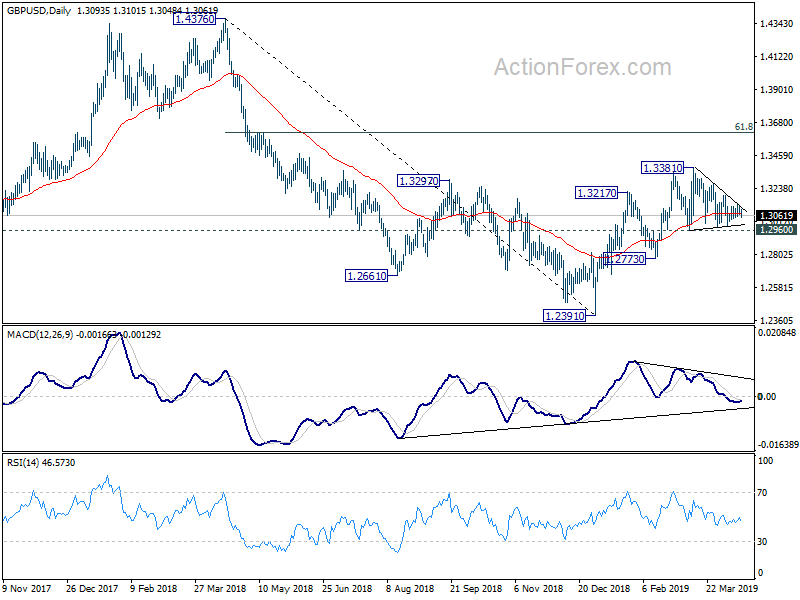
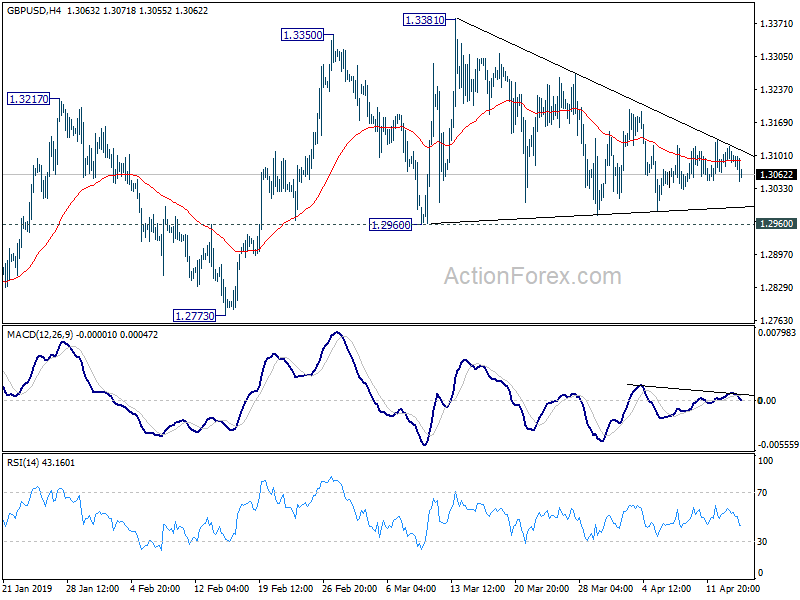
GBP/USD is staying in consolidation from 1.3381 and intraday bias remains neutral. More sideway trading could be seen. Further rise is expected as long as 1.2960 support holds. On the upside, decisive break of 1.3381 resistance ill resume whole rise from 1.2391. Next target will be 61.8% retracement of 1.4376 to 1.2391 at 1.3618 next. However, on the downside, sustained break of 1.2960 will indicate that rebound from 1.2391 has completed earlier than expected. Deeper fall would then be seen to 1.2773 support for confirmation.
In the bigger picture, medium term decline from 1.4376 (2018 high) should have completed at 1.2391. Rise from 1.2391 is seen as the third leg of the corrective pattern from 1.1946 (2016 low). Further rise could be seen through 1.4376 in medium term. On the downside, though, break of 1.2773 support will dampen this view. Focus will be turned back to 1.2391 low and break will resume the fall from 1.4376 to 1.1946.