

Sample Category Title
UK’s Average Earnings Including Bonus Advanced At Its Fastest Pace In A Decade In December-February 2019
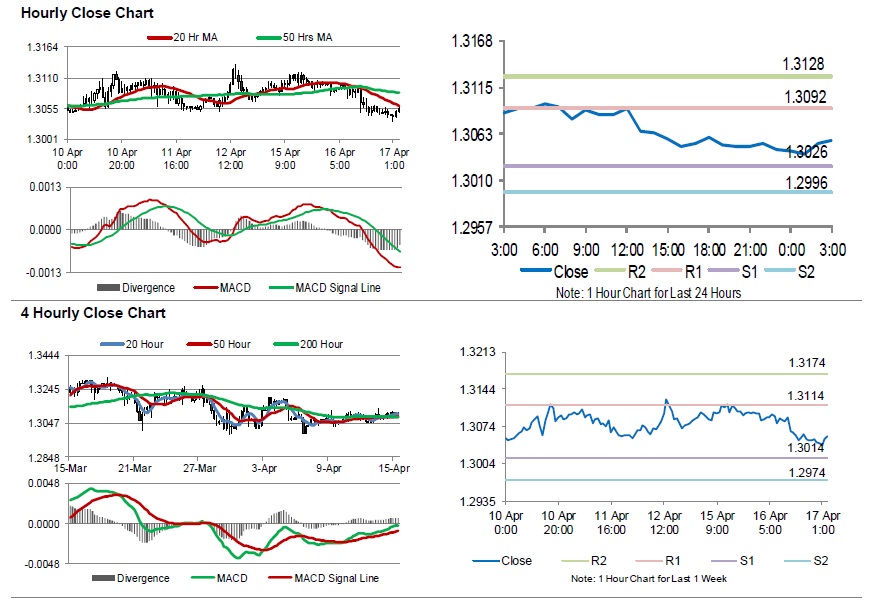
For the 24 hours to 23:00 GMT, the GBP declined 0.42% against the USD and closed at 1.3045, amid interruption in further Brexit discussions between UK Prime Minister Theresa May’s government and the opposition Labour Party.
Data showed that UK’s ILO unemployment rate remained unchanged at 3.9% in the three months ended February 2019, in line with market anticipation. Meanwhile, Britain’s average earnings including bonus advanced 3.5% on a yearly basis in the December-February 2019 period, rising at its fastest pace in a decade and more than market expectations for a rise of 3.4%. In the November-January 2019 period, the average earnings including bonus had registered a revised similar rise.
In the Asian session, at GMT0300, the pair is trading at 1.3055, with the GBP trading 0.08% higher against the USD from yesterday’s close.
The pair is expected to find support at 1.3026, and a fall through could take it to the next support level of 1.2996. The pair is expected to find its first resistance at 1.3092, and a rise through could take it to the next resistance level of 1.3128.
Looking ahead, traders would await UK’s consumer price index, retail price index, producer price index, all for march along with house price index for February, scheduled to release in a few hours.
The currency pair is trading below with its 20 Hr and 50 Hr moving averages.
Japan’s Trade Surplus Widened Beyond Estimates In March
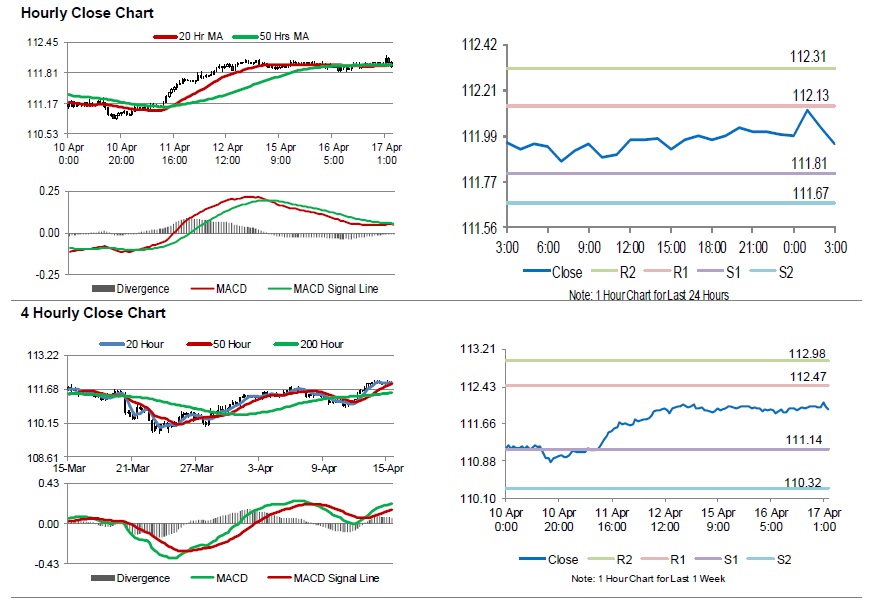
For the 24 hours to 23:00 GMT, the USD marginally rose against the JPY and closed at 112.00.
In the Asian session, at GMT0300, the pair is trading at 111.95, with the USD trading slightly lower against the JPY from yesterday's close.
Overnight data showed that Japan's merchandise (total) trade surplus widened to ¥528.5 billion in March, compared to a surplus of ¥339.0 billion in the prior month. Markets participants had expected the nation to post a surplus of ¥363.2 billion. Meanwhile, the nation's final industrial production in Japan eased 1.1% on a yearly basis in February, following a rise of 0.3% in the preceding month. The preliminary figures indicated that the industrial production fell 1.0%.
The pair is expected to find support at 111.81, and a fall through could take it to the next support level of 111.67. The pair is expected to find its first resistance at 112.13, and a rise through could take it to the next resistance level of 112.31.
The currency pair is showing convergence with its 20 Hr and 50 Hr moving averages.
Swiss Franc Reverses Its Losses In The Morning Session
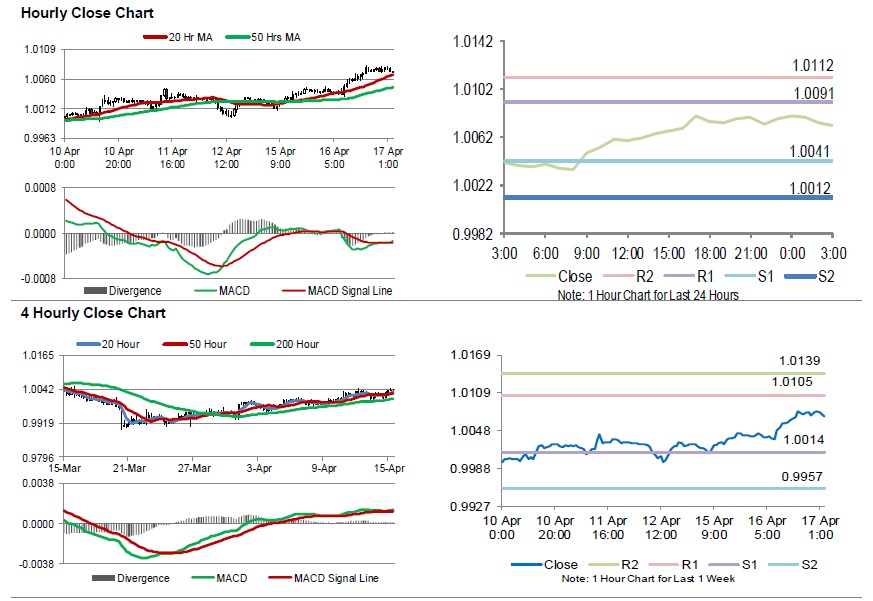
For the 24 hours to 23:00 GMT, the USD rose 0.38% against the CHF and closed at 1.0077.
In the Asian session, at GMT0300, the pair is trading at 1.0071, with the USD trading 0.06% lower against the CHF from yesterday’s close.
The pair is expected to find support at 1.0041, and a fall through could take it to the next support level of 1.0012. The pair is expected to find its first resistance at 1.0091, and a rise through could take it to the next resistance level of 1.0112.
With no macroeconomic releases in Switzerland today, investors would look forward to global macroeconomic releases for further direction.
The currency pair is trading above its 20 Hr and 50 Hr moving averages.
Canada’s Manufacturing Shipments Declined More-Than-Expected In February
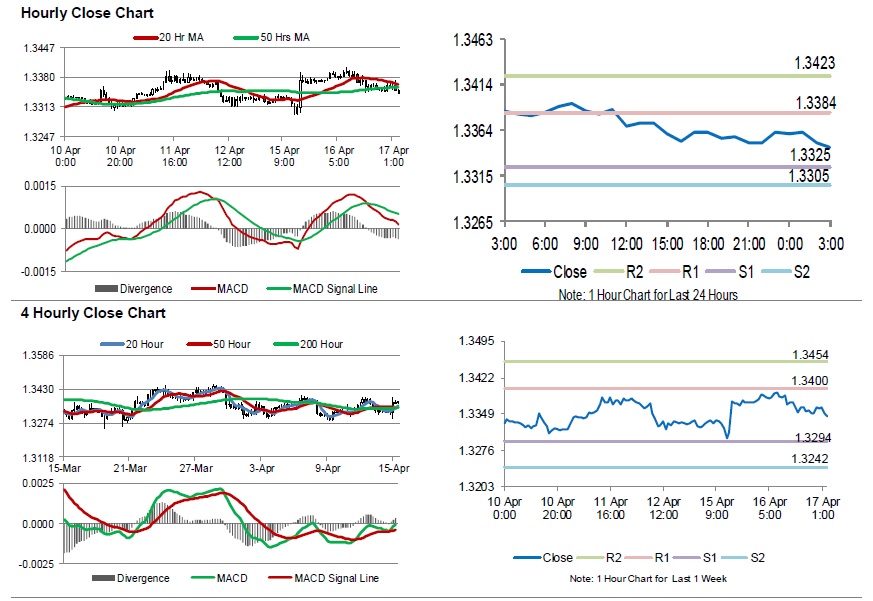
For the 24 hours to 23:00 GMT, the USD declined 0.08% against the CAD and closed at 1.3362.
On the macro front, Canada's manufacturing shipments declined 0.2% on a monthly basis in February, compared to a revised rise of 0.8% in the prior month. Market participants had anticipated for manufacturing shipments to fall 0.1%.
In the Asian session, at GMT0300, the pair is trading at 1.3345, with the USD trading 0.13% lower against the CAD from yesterday's close.
The pair is expected to find support at 1.3325, and a fall through could take it to the next support level of 1.3305. The pair is expected to find its first resistance at 1.3384, and a rise through could take it to the next resistance level of 1.3423.
Amid lack of economic releases in Canada today, traders would focus on global macroeconomic events for further direction.
The currency pair is trading below its 20 Hr and 50 Hr moving averages.
Aussie Reverses Its Losses In The Asian Session
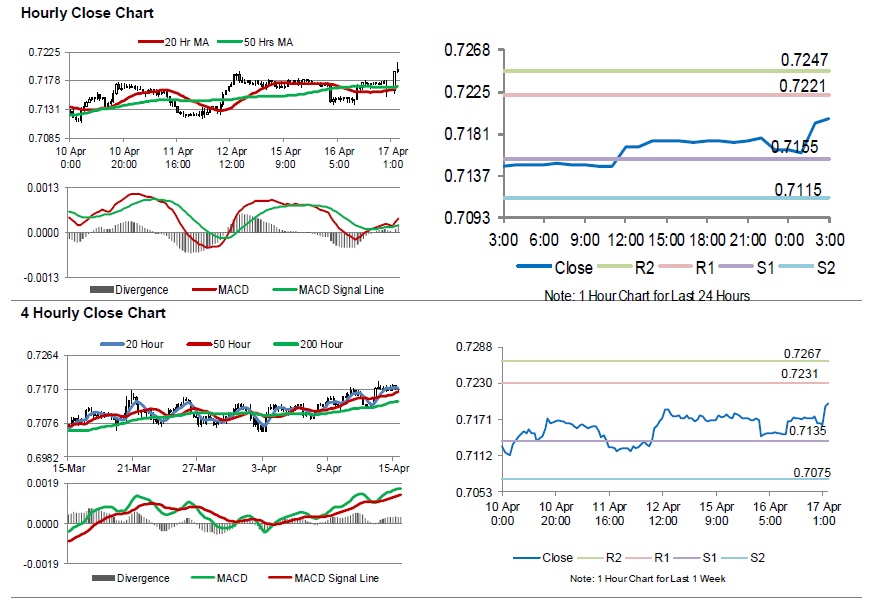
For the 24 hours to 23:00 GMT, the AUD declined 0.08% against the USD and closed at 0.7164.
LME Copper prices rose 0.1% or $4.0/MT to $6460.0/MT. Aluminium prices declined 0.2% or $4.5/MT to $1839.0/MT.
In the Asian session, at GMT0300, the pair is trading at 0.7196, with the AUD trading 0.45% higher against the USD from yesterday’s close.
Elsewhere in China, Australia’s largest trading partner, China’s gross domestic product (GDP) rose 6.4% on an annual basis in 1Q 2019, compared to a similar rise in the prior quarter. Market participants had expected the GDP to increase 6.3%. Also, the nation’s industrial production rose 8.5% on an annual basis in March, higher than market consensus for an advance of 6.0%. In the prior month, industrial production had registered a similar gain. Moreover, retail sales advanced 8.7% on a yearly basis in March, surpassing market expectations for a rise of 8.4%. Retail sales had recorded a rise of 8.2% in the prior month.
The pair is expected to find support at 0.7155, and a fall through could take it to the next support level of 0.7115. The pair is expected to find its first resistance at 0.7221, and a rise through could take it to the next resistance level of 0.7247.
Going forward, traders will keep a tab on Australia’s NAB business confidence for the first quarter and unemployment rate for March, slated to release overnight.
The currency pair is trading above its 20 Hr and 50 Hr moving averages.
Gold: Yellow Metal Trading Marginally Higher In The Asian Session
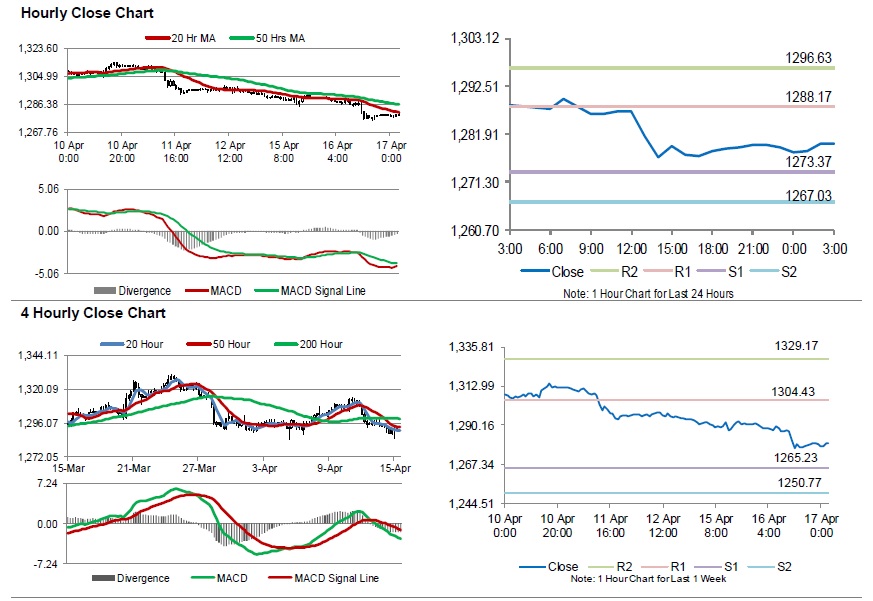
For the 24 hours to 23:00 GMT, Gold declined 0.89% against the USD and closed at USD1279.60 per ounce, amid strength in the US dollar.
In the Asian session, at GMT0300, the pair is trading at 1279.70, with gold trading a tad higher against the USD from yesterday’s close.
The pair is expected to find support at 1273.37, and a fall through could take it to the next support level of 1267.03. The pair is expected to find its first resistance at 1288.17, and a rise through could take it to the next resistance level of 1296.63.
The yellow metal is showing convergence with its 20 Hr moving average and trading below its 50 Hr moving average.
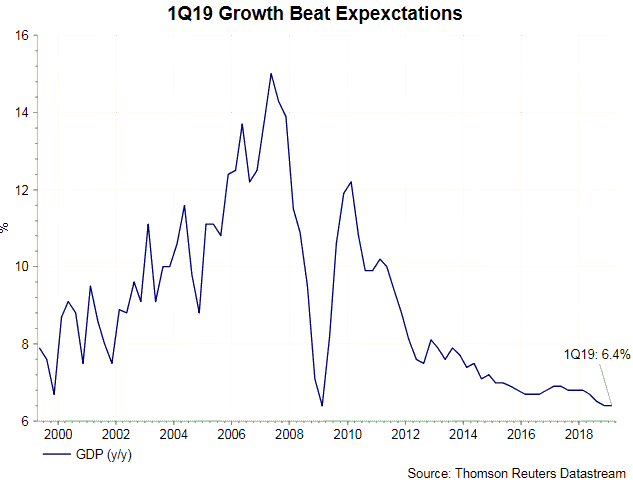
China First Quarter GDP Growth Beat Expectations. Key Macro Data Rebounded in March, albeit from Low Base
China’s GDP expanded +6.4% y/y in 1Q19, same pace as 4Q18 but beating consensus of +6.3%. Major macroeconomic data showed strong rebound in March and exceeded expectations. Over the past weeks, data flow in China has already signaled improvement in China’s economy: Both headline CPI and PPI markedly recovered in March while incremental credit reached new record high in 1Q19. T
hese have triggered speculations of a less loosening monetary policy by the PBOC. In its latest quarterly report, the central bank noted economic recovery in the first quarter and acknowledged the effects of recent easing measures. While pledging to maintain sizable liquidity in the market, PBOC would likely be more cautious in adding further stimulus.
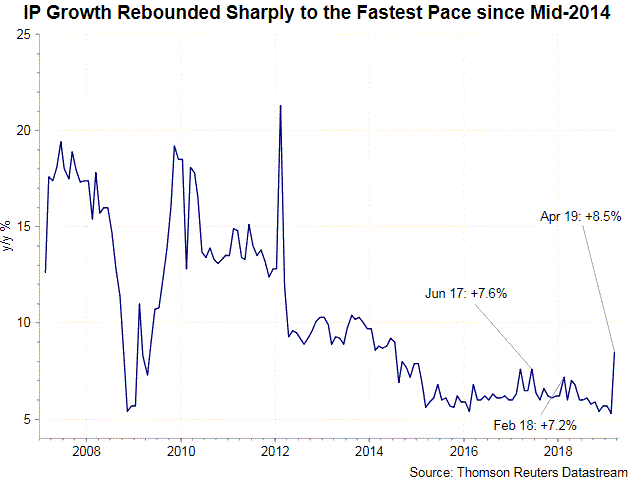
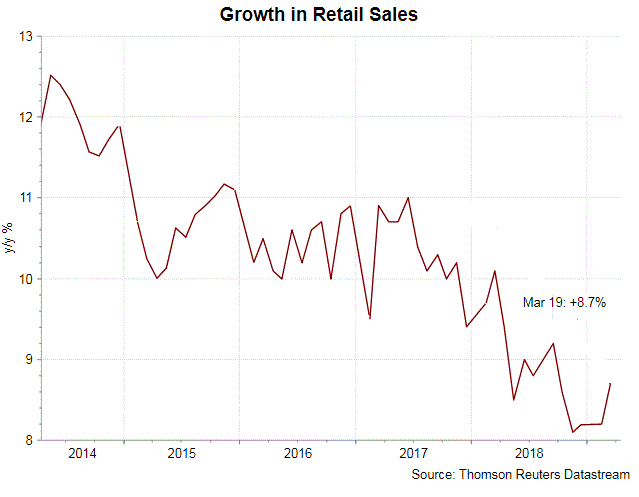
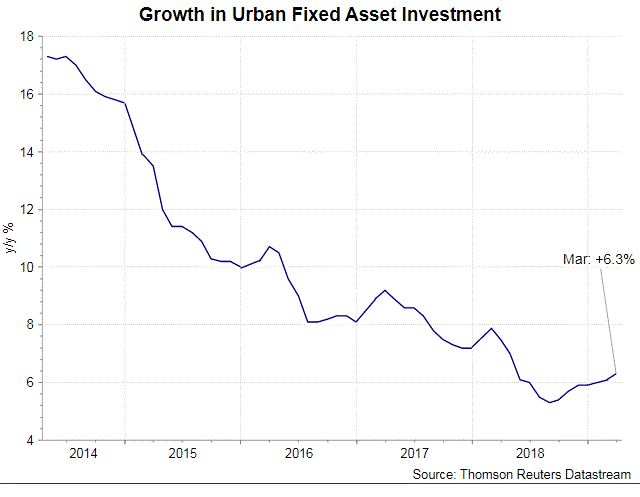
Economic developments generally improved in March. Industrial production jumped +8.5% y/y in March, beating consensus of +5.9% and marking the fastest growth since July 2014. Retail sales gained +8.7% y/y, compared with expectations of +8.4%. Urban fixed asset investment (FAI) expanded +6.3% y/y in the first 3 months of the year. The growth came in line with expectations but improved from the +6.1% growth in the first two months of the year.
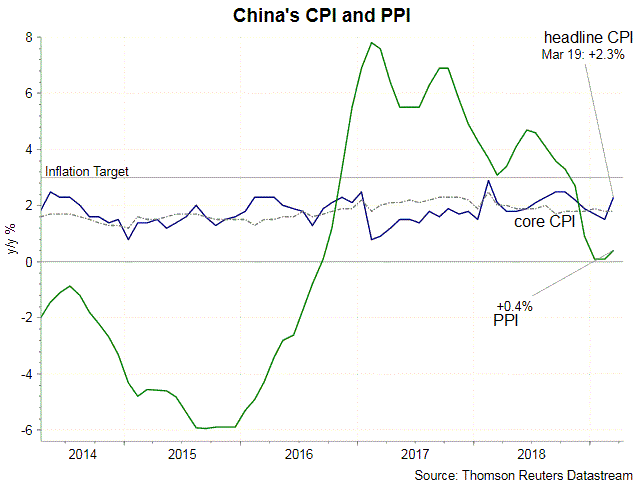
 Released in the prior week, Headline CPI rebounded to +2.3% y/y in March, from the average of +1.6% in January- February. This also improved from +2.2% in 4Q18. Yet, the strong price level was lifted by the sharp increases in pork prices and energy prices. Note that core inflation remained relatively stable at +1.8%, as volatile food and energy prices were excluded. For the months ahead, although food and energy prices could still boost headline inflation, this would be partly offset by VAT cut. Effective April 1, the government has lowered the manufacturing sector VAT by 3 percentage point to 13%. All in all, the net effect could still cap China’s inflation below the +3% target.
 The credit report in March also shed a positive light. Total social financing improved to RMB 2, 860B in March, from RMB 703B a month ago, predominantly driven by acceleration in bank lending. Money supply M2 expanded +8.6% y/y, accelerating from +8% in February.
The apparently strong recovery in March has lifted the first quarter GDP growth. This has also raised speculations that PBOC would adopt a less accommodative policy. We refrain from overtly optimistic about China’s economic outlook. After all, the improvement in March is compared with a low base. A relatively-stronger March has been far from indicating China’s slowdown has ended. As such, we do not expect PBOC to shift from its easing monetary stance. Rather, it would be more cautious in adding more stimulus, while maintaining sufficient liquidity, to the market.
Silver: White Metal Trading On A Stronger Footing This Morning
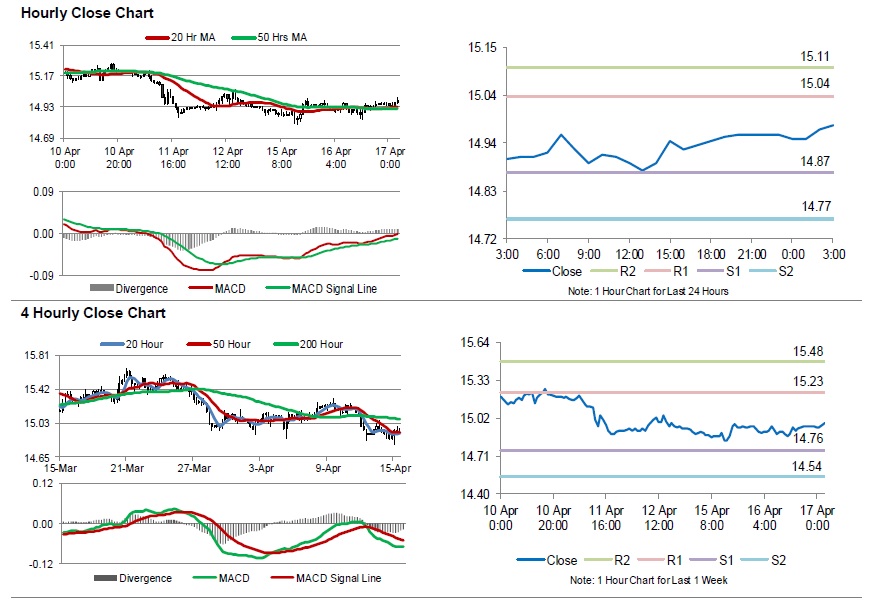
For the 24 hours to 23:00 GMT, Silver traded flat against the USD and closed at USD14.96 per ounce.
In the Asian session, at GMT0300, the pair is trading at 14.98, with silver trading 0.13% higher against the USD from yesterday’s close.
The pair is expected to find support at 14.87, and a fall through could take it to the next support level of 14.77. The pair is expected to find its first resistance at 15.04, and a rise through could take it to the next resistance level of 15.11.
The white metal is trading above its 20 Hr and 50 Hr moving averages.
Crude Oil: Oil Trading Higher, Ahead Of EIA’s Weekly Crude Oil Stockpiles Data
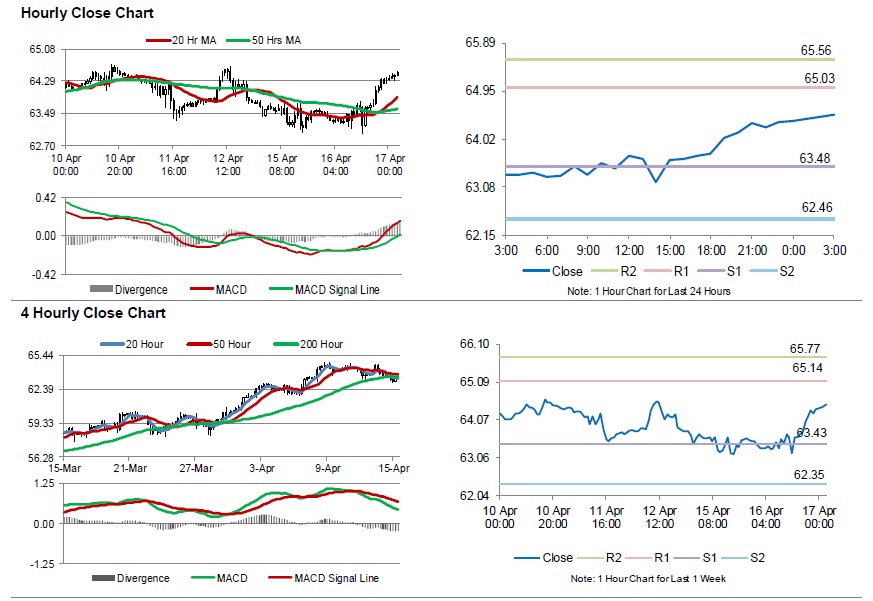
For the 24 hours to 23:00 GMT, Crude Oil rose 1.34% against the USD and closed at USD64.35 per barrel, after the American Petroleum Institute (API) reported that US crude oil inventories unexpectedly fell by 3.1 million barrels to 452.7 million barrels in the week ended 12 April 2019.
In the Asian session, at GMT0300, the pair is trading at 64.50, with oil trading 0.23% higher against the USD from yesterday's close.
The pair is expected to find support at 63.48, and a fall through could take it to the next support level of 62.46. The pair is expected to find its first resistance at 65.03, and a rise through could take it to the next resistance level of 65.56.
Going ahead, investors will keep a close watch on the weekly crude inventories data from the Energy Information Administration (EIA), due later in the day.
Crude oil is trading above its 20 Hr and 50 Hr moving averages.
EUR/USD And USD/CHF Remain Supported On Dips
EUR/USD is trading nicely above the 1.1280 support and it could continue to move higher. USD/CHF is currently correcting lower, but it remains supported on dips near 1.0050.
Important Takeaways for EUR/USD and USD/CHF
- The Euro traded higher recently and tested the 1.1320 resistance area against the US Dollar.
- There is a major contracting triangle in place with resistance near 1.1305 on the hourly chart of EUR/USD.
- USD/CHF climbed higher recently above the 1.0000 and 1.0050 resistance levels.
- There is a crucial bullish trend line formed with support at 1.0050 on the hourly chart.
EUR/USD Technical Analysis
The Euro started a solid rebound after forming a support base above the 1.1200 and 1.1220 levels against the US Dollar. The EUR/USD pair climbed above the 1.1250 and 1.1280 resistance levels to move into a positive zone.
The pair even broke the 1.1300 resistance area and formed a high near the 1.1323 level on FXOpen. Later, the pair started a downside correction below the 1.1300 level and the 50 hourly simple moving average.
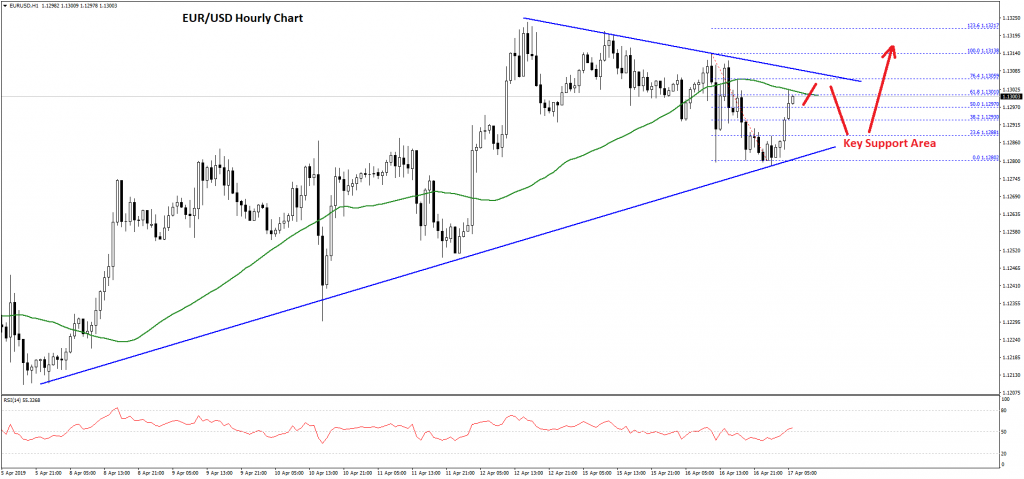
The last swing low was formed near 1.1280 and the pair is currently moving higher. It broke the 50% Fib retracement level of the recent decline from the 1.1313 high to 1.1280 low.
However, the pair is facing a tough resistance near the 1.1300 level and the 50 hourly simple moving average. Besides, the 61.8% Fib retracement level of the recent decline from the 1.1313 high to 1.1280 low is acting as a resistance.
More importantly, there is a major contracting triangle in place with resistance near 1.1305 on the hourly chart of EUR/USD. The pair could continue to trade in a range for some time before it could make an attempt to clear the 1.1300 and 1.1305 resistance levels.
If there is an upside break, the pair could trade towards 1.1320 and 1.1340. On the other hand, if there is a downside break, the pair could decline sharply towards the 1.1250 and 1.1225 support levels.
USD/CHF Technical Analysis
The US Dollar started a strong uptrend from the 0.9980 support level against the Swiss franc. The USD/CHF pair traded above the 1.0000 and 1.0050 resistance levels to move into a positive zone.
The recent upward move was convincing since there was a close above the 1.0050 level and the 50 hourly simple moving average. The pair traded close the 1.0100 resistance and formed a high at 1.0082.
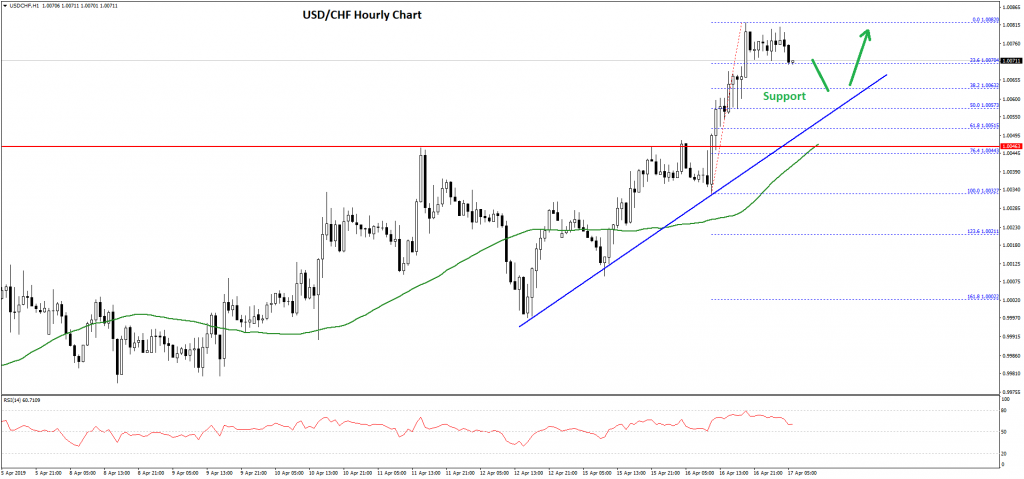
At the moment, the pair is correcting lower and trading near the 23.6% Fib retracement level of the recent wave from the 1.0032 low to 1.0082 high. On the downside, there are many supports near the 1.0060 and 1.0050 levels.
The main support is near 1.0055 and the 50% Fib retracement level of the recent wave from the 1.0032 low to 1.0082 high. There is also a crucial bullish trend line formed with support at 1.0050 on the hourly chart.
Therefore, if the pair corrects lower, it is likely to find buyers near the 1.0060 and 1.0050 levels. On the upside, an initial resistance is near the 1.0080 level, above which USD/CHF could test the 1.0100 level in the near term. Any further gains could push the pair towards the 1.0120 in the near term.