Sample Category Title
USD/JPY Mid-Day Outlook
Daily Pivots: (S1) 111.91; (P) 112.01; (R1) 112.12; More...
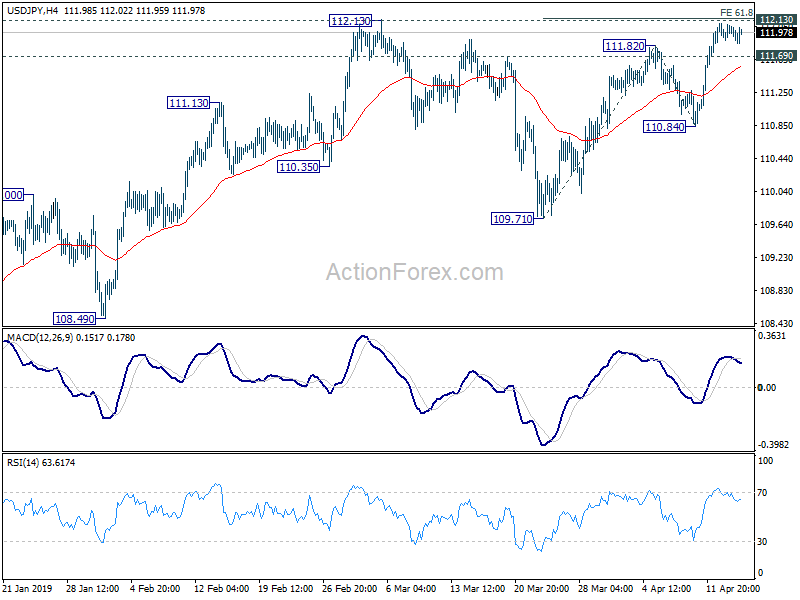
Intraday bias in USD/JPY remains neutral with focus on 112.13 key resistance. Sustained break will resume whole rise from 104.69 for 100 % projection of 109.71 to 111.82 and 110.84 at 112.95 first. On the downside, below 111.69 minor support will turn bias to the downside for 110.84 support. Break will bring deeper fall back to 109.71 support.
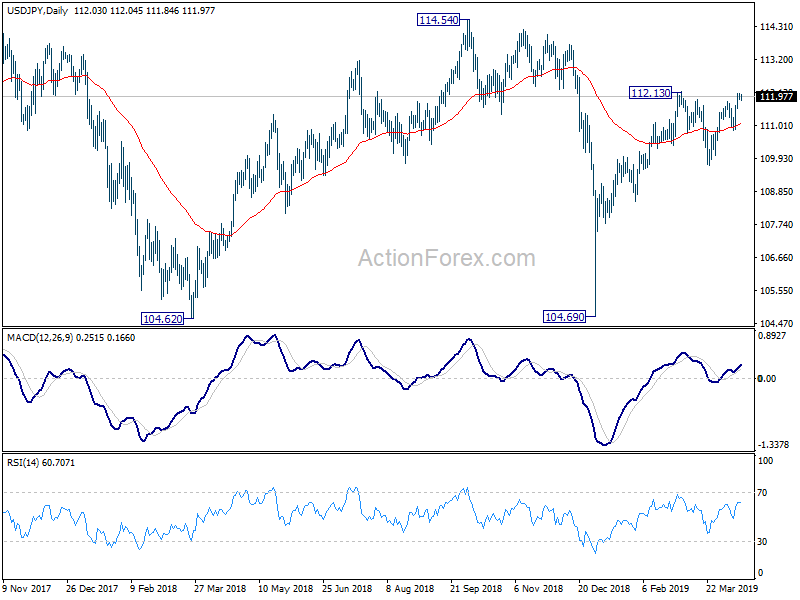
In the bigger picture, medium term outlook in USD/JPY remains a bit mixed as it's staying inside falling channel from 118.65, but there are signs of bullish reversal. On the upside, break of 114.54 resistance will revive the case the corrective fall from 118.65 has completed with three waves down to 104.69. And whole rise from 98.97 (2016 low) is resuming for 118.65 and above. But before that, outlook stays neutral first.
WTI Oil Outlook: Pullback Holds above 10SMA ahead of Oil Inventories
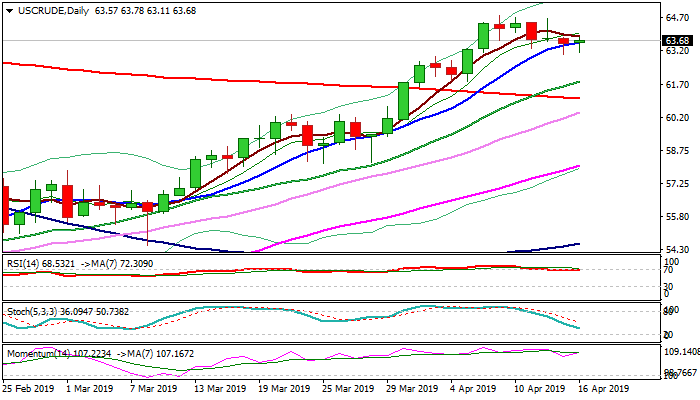
WTI oil price holds slight bid tone on Tuesday following double downside rejection ($63.02/11 on Fri/Mon) and Monday's close above 10SMA ($63.45) which also formed Hammer candle, generating initial signal of stall of pullback from $64.77 peak. Repeated close above 10SMA today would reinforce signal and increase hopes of reversal. Bullish momentum and daily MA positive setup keep overall bullish structure intact and favor scenario of shallow correction ahead of fresh advance. Today's repeated close above 10SMA and formation of second Hammer would confirm scenario. Traders focus release of American Petroleum Institute (API) crude stocks report, due later today and Wednesday's release of official government report from Energy Information Administration for fresh signals. Expectations point to another build in crude stocks that will be the third consecutive increase, which would increase pressure on oil prices. Negative signals could be also expected from rising worries that Russia may pull out from agreement between top oil exporters, to reduce oil production and tighten oil market, on OPEC meeting in Jun
Res: 63.82; 64.77; 65.00; 65.37
Sup: 63.57; 63.02; 62.26; 61.85
USD/CHF Mid-Day Outlook
Daily Pivots: (S1) 1.0018; (P) 1.0033; (R1) 1.0056; More...
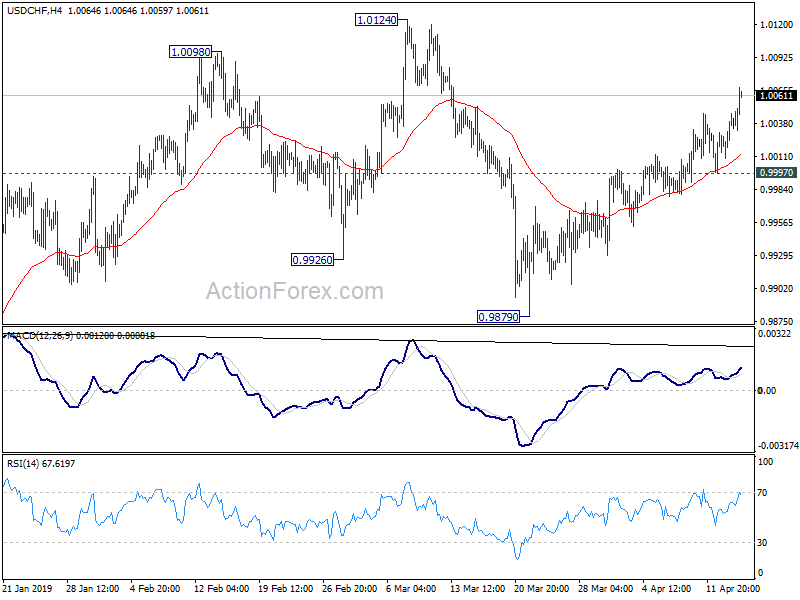
USD/CHF's choppy recovery from 0.9879 resumed after brief consolidation and reaches as high as 1.0068. Intraday bias is back on the upside for 1.0124/8 resistance. . However, as the structure of the rise is corrective looking, we'd expect strong resistance from 1.0124 to limit upside to bring another decline. On the downside, below 0.9997 minor support will turn bias to the downside for 0.9879 support.
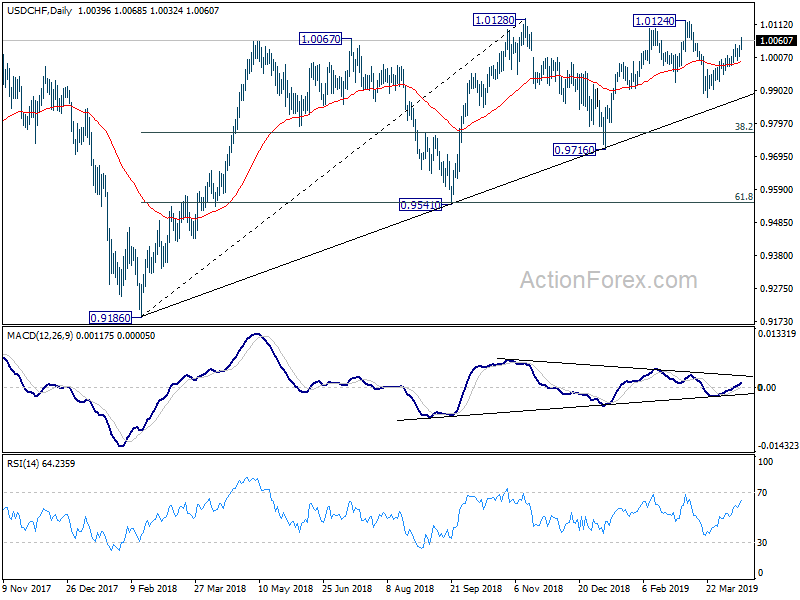
In the bigger picture, loss of upside momentum is seen is bearish divergence in daily MACD. But there is no clear sign of bearish reversal in USD/CHF yet. Rise fro 0.9186 is likely still in progress. Decisive break of 1.0128 resistance will resume this medium term rally to 1.0342 resistance next. This will remain the preferred case now, as long as 0.9716 support holds.
Funds Flowing Out of Safe Haven Swiss Franc, Gold and Bonds
Funds are flowing out notably from safe haven assets today. Gold dives through 1280 handle and is resuming fall from 1346.71 high. German 10-year yield is up for another day at 0.067. US 10-year yield is also trading stronger at 2.575, possibly targeting 2.6 handle. In the currency markets, Swiss Franc is suffering broad based selloff and is the weakest one. Apparently, funds are flowing back into Dollar, even though Yen and Euro are not weak at all.
Technically, USD/CHF is picking up upside momentum for 1.0124/8 resistance zone. EUR/CHF is also on track for 1.1384 and then 1.1444 resistance. USD/JPY retreated mildly earlier today but there was no follow through selling. Focus remains on 112.13 key resistance. Both EUR/USD and AUD/USD dipped earlier today but stayed above near term support level at 1.1250 and 0.7115 respectively. Further rise remains mildly in favor in both pairs.
In Europe, FTSE is currently up 0.53%. DAS is up 0.70%. CAC is up 0.18%. German 10-year yield is up 0.0085 at 0.068. Earlier in Asia, Nikkei rose 0.24%. Hong Kong HSI rose 1.07%. China Shanghai SSE rose 2.39%. Singapore Strait Times rose 0.19%. Japan 10-year JGB yield rose 0.0119 to -0.019.
German ZEW: Sentiments improved but current situation deteriorated considerably
German ZEW Economic Sentiment improved to 3.1 in April, up from -3.6 and beat expectation of 0.5. Current Situation index, however, dropped to 5.5, down from 11.1 and missed expectation of 8.5. Eurozone ZEW Economic Sentiment Rose to 4.5, up from -2.5. Eurozone Current Situation index dropped -6.6 pts to 13.2.
ZEW President Professor Achim Wambach: "The slight improvement recorded by the ZEW Indicator of Economic Sentiment is largely based on the hope that the global economic environment will develop less poorly than previously assumed. The postponement of the Brexit deadline may also have contributed to buoy the economic outlook. By contrast, the latest figures regarding incoming orders and industrial production in the German industry point to a rather weak economic development."
UK unemployment rate unchanged at 3.9%, wage growth matched expectations
UK unemployment rate was unchanged at 3.9% in February, matched expectations. It's the lowest level since 1975. Average weekly earnings including bonus rose 3.4% 3moy, matched expectation. Average weekly earnings ex-bonus rose 3.4% 3moy, also matched expectations. Claimant count rose 28.3k in March, above expectation of 20.0k.
EU Tusk: Everyone is exhausted with Brexit
European Council President Donald Tusk "on both sides of the Channel, everyone, including myself, is exhausted with Brexit, which is completely understandable." However, he emphasized it's not an excuse to say "let's get it over with, just because we're tired."
He explicitly responded to a leader of a EU state who had warned "dreamers" not to think "Brexit could be reversed". Tusk said: "At this rather difficult moment in our history, we need dreamers and dreams. We cannot give in to fatalism. At least I will not stop dreaming about a better and united Europe."
European Commission Jean-Claude Juncker said it was not his working assumption that Brexit could be reversed or extended beyond a new Oct. 31 deadline.
AUD tumbles as RBA said lower interest rates could be expected
Australian Dollar tumbles sharply in Asian session after dovish RBA minutes set out the conditions for a rate cut. It's seen as another step towards more monetary easing ahead, as markets are expecting two cuts this year.
The most important part of the minutes is that RBA confirmed there could be a need for rate cut. It said "a lower level of interest rates could still be expected to support the economy through a depreciation of the exchange rate and via reducing required interest payments on borrowing, freeing up cash for other expenditure". Also, in a scenario where " inflation did not move any higher and unemployment trended up", "a decrease in the cash rate would likely be appropriate in these circumstances"."
Nevertheless, "members agreed that there was not a strong case for a near-term adjustment in monetary policy". It suggested RBA would wait-and-see, likely at least through Q2.
Suggested readings on RBA.
- (RBA) Minutes of the Monetary Policy Meeting of the Reserve Bank Board
- RBA Minutes – Confirming Dovish Monetary Policy Stance. Low Inflation Raises the Chance of Rate Cut
- RBA Board Minutes Set Out the Conditions for a Rate Cut
RBNZ Orr: Q1 inflation undershot "already" factored in dovish bias
RBNZ Governor Adrian Orr said today that monetary easing bias remains in place for now. And softer economic conditions in US, Europe and China are having a role in the dovish tone.
Also, Orr added that "possibilities of first quarter inflation numbers being undershot have already being factored in the RBNZ's dovish bias". The comments came just ahead of New Zealand's CPI release tomorrow. Headline inflation is expected to slow from 1.9% yoy to 1.7% yoy in Q1.
NZD/USD is a touch lower after the comments. However, Orr said that inflation undershot was already factored in. Thus, there is prospect of a mild rebound should tomorrow's CPI release meets expectations.
OECD: China at a crossroad, should lower external and internal barriers
In an OECD survey report, Deputy Secretary-General Ludger Schuknecht, warned that "China is at a crossroads, facing serious domestic and external challenges to maintaining its strong position over the long-term.". He urged that "policy should seek to ensure a better functioning economy that delivers stable and inclusive growth for all."
OECD said China should aim to "further lower import tariffs and dismantle non-tariff barriers and barriers on the entry and conduct of foreign firms, in particular requirements to form joint ventures or transfer technology." Also, "ongoing fiscal stimulus should avoid directing credit to state-owned enterprises and local governments"
Additionally, there are :wide scope to improve efficiency across the economy, notably by reducing the internal barriers that hinder product market competition and labour mobility.". And measures include "stronger protection of intellectual property rights; gradual removal of implicit guarantees to state-owned enterprises, allowing them to default; and reduction of state ownership in commercially-oriented, non-strategic sectors."
USD/CHF Mid-Day Outlook
Daily Pivots: (S1) 1.0018; (P) 1.0033; (R1) 1.0056; More...
USD/CHF's choppy recovery from 0.9879 resumed after brief consolidation and reaches as high as 1.0068. Intraday bias is back on the upside for 1.0124/8 resistance. . However, as the structure of the rise is corrective looking, we'd expect strong resistance from 1.0124 to limit upside to bring another decline. On the downside, below 0.9997 minor support will turn bias to the downside for 0.9879 support.
In the bigger picture, loss of upside momentum is seen is bearish divergence in daily MACD. But there is no clear sign of bearish reversal in USD/CHF yet. Rise fro 0.9186 is likely still in progress. Decisive break of 1.0128 resistance will resume this medium term rally to 1.0342 resistance next. This will remain the preferred case now, as long as 0.9716 support holds.
Economic Indicators Update
| GMT | Ccy | Events | Actual | Forecast | Previous | Revised |
|---|---|---|---|---|---|---|
| 01:30 | AUD | RBA Minutes | ||||
| 04:30 | JPY | Tertiary Industry Index M/M Feb | -0.60% | -0.20% | 0.40% | 0.60% |
| 08:30 | GBP | Jobless Claims Change Mar | 28.3K | 17.3K | 27.0K | 26.7K |
| 08:30 | GBP | Claimant Count Rate Mar | 3.00% | 2.90% | ||
| 08:30 | GBP | ILO Unemployment Rate 3Mths Feb | 3.90% | 4.00% | 3.90% | |
| 08:30 | GBP | Average Weekly Earnings 3M/Y Feb | 3.50% | 3.50% | 3.40% | 3.50% |
| 08:30 | GBP | Weekly Earnings ex Bonus 3M/Y Feb | 3.40% | 3.40% | 3.40% | 3.50% |
| 09:00 | EUR | German ZEW Economic Sentiment Apr | 3.1 | 0.5 | -3.6 | |
| 09:00 | EUR | German ZEW Current Situation Apr | 5.5 | 8.5 | 11.1 | |
| 09:00 | EUR | Eurozone ZEW Economic Sentiment Apr | 4.5 | 1.2 | -2.5 | |
| 12:30 | CAD | International Securities Transactions (CAD) Feb | 12.05B | 27.34B | 28.40B | 28.59B |
| 12:30 | CAD | Manufacturing Sales M/M Feb | -0.20% | -0.10% | 1.00% | 0.80% |
| 13:15 | USD | Industrial Production M/M Mar | 0.30% | 0.10% | ||
| 13:15 | USD | Capacity Utilization Mar | 79.20% | 78.20% | ||
| 14:00 | USD | NAHB Housing Market Index Apr | 64 | 62 |
Gold breaks 1280, confirming medium term bearish reversal?
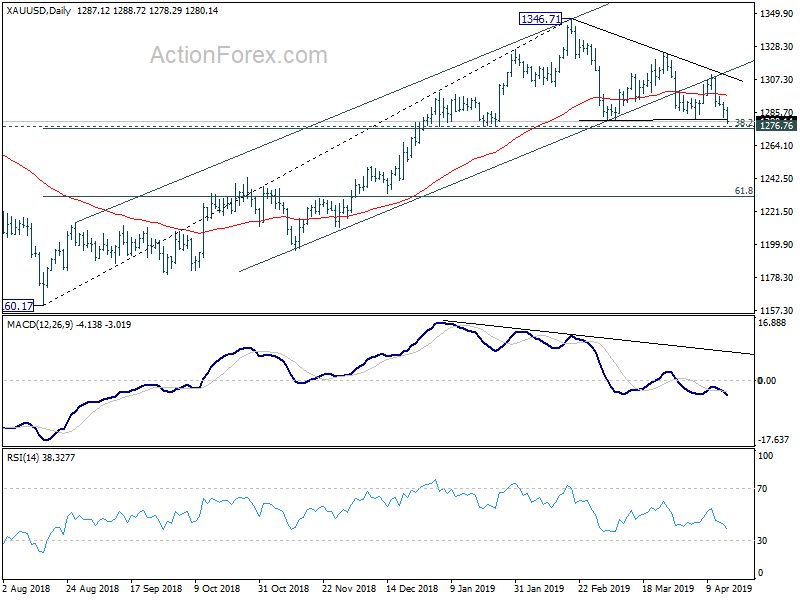
Gold drops notably today to as low as 1278.29 so far. Immediate focus is back on 1276.76 cluster support (38.2% retracement of 1160.17 to 1346.17 at 1275.45).
Sustained break of 1275.45/1276.76 should confirm completion of whole rise from 1160.17. Deeper decline should then be seen to 61.8% retracement at 1234.42 and below.
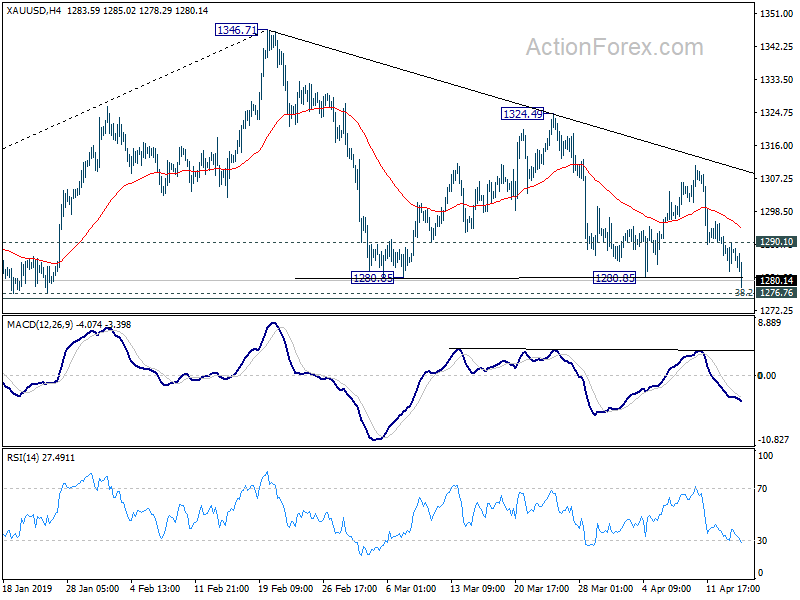
Nevertheless, break of 1290.10 minor resistance will argue that 1275.45/1276.76 is defended again. Another rise would be seen to extend the consolidation pattern from 1346.71.
GBPAUD Rebounds on 2-month Low; Downside Correction in Near Term
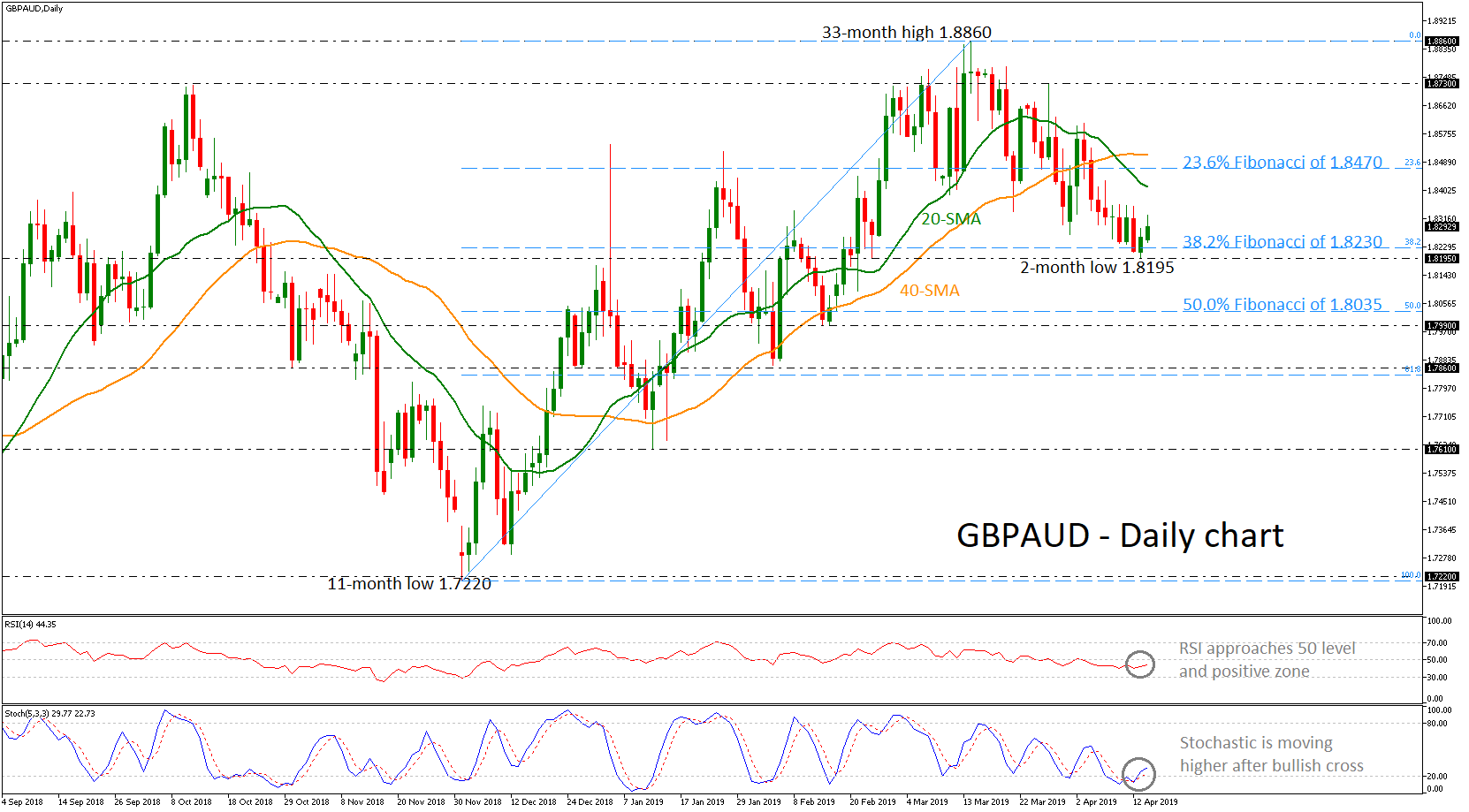
GBPAUD rebounded on the two-month low of 1.8195 on Monday, sending prices above the 38.2% Fibonacci retracement level of the upleg from 1.7220 to 1.8860, around 1.8195. The RSI is turning slightly higher approaching the 50 level, while the stochastic seems to be strongly bullish as the %K line and the %D line completed a positive cross in the oversold zone.
On the upside, resistance could come around the 20-day simple moving average (SMA) currently at 1.8415 while next the price could flirt with the 23.6% Fibonacci of 1.8470. Higher still, the 40-day SMA around 1.8515 could halt bullish sentiment but a jump above this line, the 1.8730 resistance could attract traders’ attention.
On the other hand, significant declines below the two-month low may meet support near the 50.0% Fibonacci of 1.8035 before edging lower towards the 1.7990 support.
In the very short-term, GBPAUD seems to be in negative correction following the pullback on the 33-month low of 1.8860. If the price remains below the short-term SMAs, investors could turn their focus to the downside.
German ZEW Economic Sentiment Punches into Positive Territory, But Euro Subdued
EUR/USD continues to have a quiet week. On Tuesday, the pair is trading at 1.1297, down 0.06% on the day. On the release front, German ZEW Economic Sentiment improved to 3.1, beating the estimate of 0.9. The all-eurozone indicator followed suit, rising to 4.2, above the forecast of 1.2 points. There are no major U.S. events on the schedule. On Tuesday, the eurozone releases CPI and OPEC members hold a meeting in Vienna.
There was positive news from the ZEW economic sentiment survey, a key gauge of investor confidence. The indicator has been mired in negative territory for the past 12 months, and finally climbed into territory in April. The score of 3.1 points to slight optimism on the part of institutional investors and analysts. The eurozone indicator showed a similar trend, climbing to 4.5 points, its first gain since May. The improvement in investor mood is attributable to the Brexit extension, which will give the parties time until October to try to reach a resolution to the deadlock. The ZEW said that investors were hopeful that the global economy would develop “less poorly” than expected. At the same time, eurozone growth remains weak and Germany is expected to cut its growth forecast for 2019, a result of a drop in exports.
OECD: China at a crossroad, should lower external and internal barriers
In an OECD survey report, Deputy Secretary-General Ludger Schuknecht, warned that "China is at a crossroads, facing serious domestic and external challenges to maintaining its strong position over the long-term.". He urged that "policy should seek to ensure a better functioning economy that delivers stable and inclusive growth for all."
OECD said China should aim to "further lower import tariffs and dismantle non-tariff barriers and barriers on the entry and conduct of foreign firms, in particular requirements to form joint ventures or transfer technology." Also, "ongoing fiscal stimulus should avoid directing credit to state-owned enterprises and local governments"
Additionally, there are :wide scope to improve efficiency across the economy, notably by reducing the internal barriers that hinder product market competition and labour mobility.". And measures include "stronger protection of intellectual property rights; gradual removal of implicit guarantees to state-owned enterprises, allowing them to default; and reduction of state ownership in commercially-oriented, non-strategic sectors."
Loonie Awaits Canadian Data As Oil Rally Takes Breather
The loonie has traded sideways lately, as support from a rally in oil prices was offset by growing speculation for rate cuts by the Bank of Canada (BoC). In this context, the inflation data due on Wednesday and the retail sales figures on Thursday could be pivotal for the currency. Overall, downside risks have intensified, so the BoC could strike a more cautious tone when it meets again next week.
The Canadian currency has been consolidating in recent weeks, trading in a narrow range against its US counterpart, even despite continued gains in oil prices. Canada is a major producer and exporter of oil, so its currency typically benefits from increases in crude prices.
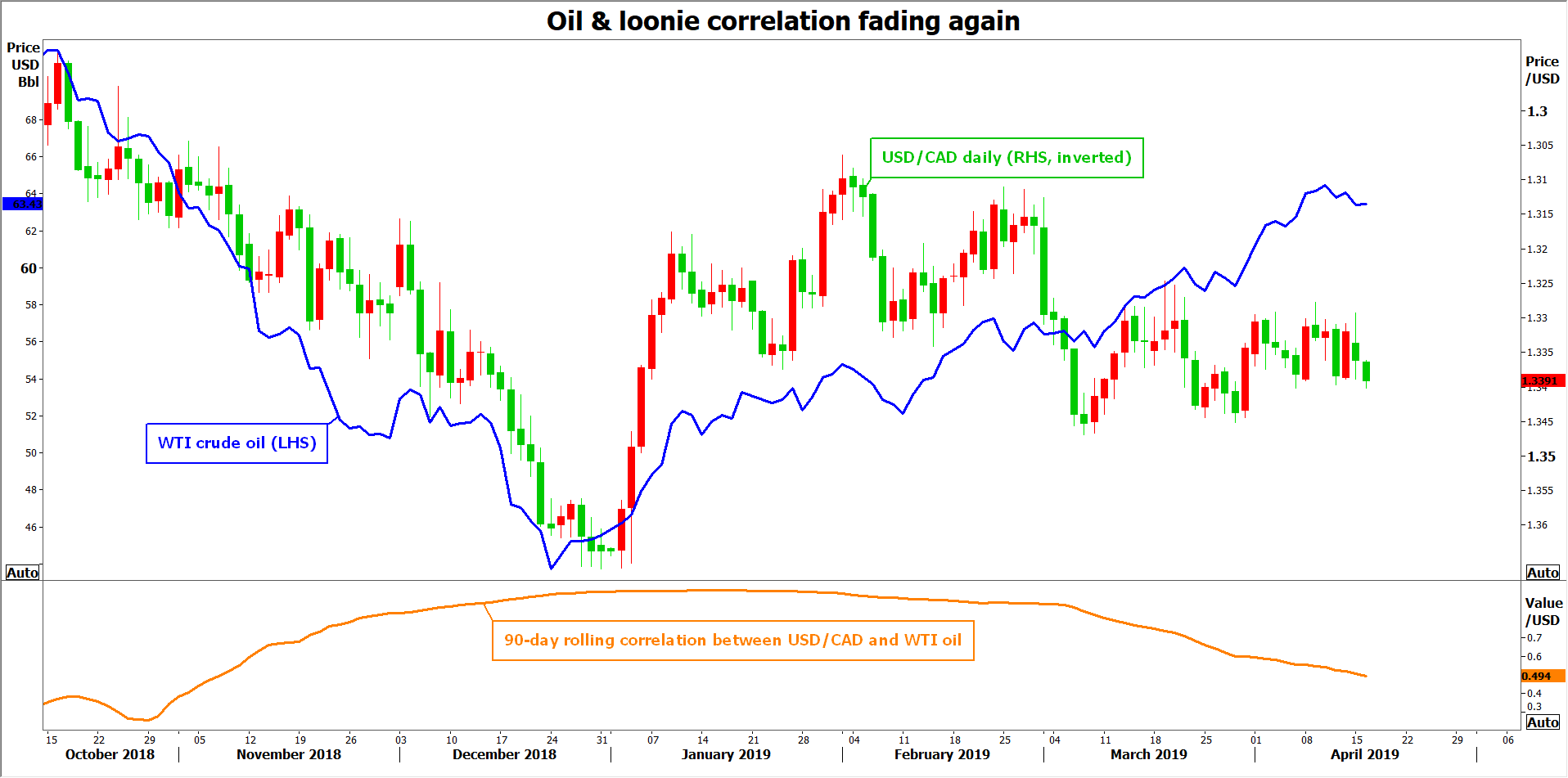
While the loonie has advanced in 2019, its 1.7% gain versus the US dollar year-to-date seems miniscule in comparison to the 38% rise in WTI crude oil prices over the same period. Moreover, the correlation between the two has been declining lately, although it remains fairly significant.
The loonie's inability to rally more convincingly is owed to monetary policy. The Canadian economy is going through a soft patch, with wage growth slowing down and house prices declining – a toxic cocktail for home-owning consumers. Hence, markets think the BoC could start easing its policy again soon, with the implied probability for a quarter-point rate cut by December now resting at ~35%. The rising likelihood for cuts is pushing down on Canada's long-term interest rates, reducing the loonie's appeal. Against this backdrop, the upcoming inflation and retail sales data may prove crucial.
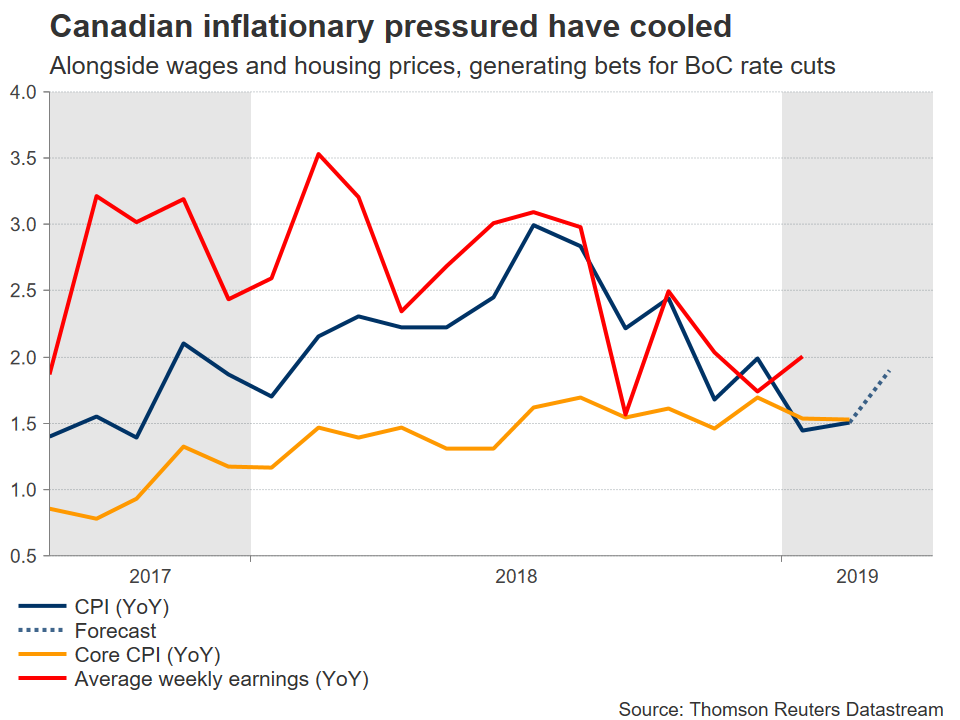
The nation's headline CPI rate is forecast to have risen to 1.9% on a yearly basis in March, from 1.5% previously. Underlying inflation measures – core, trimmed mean, and weighted CPIs – are also due out, though no forecast is available for any of these. Meanwhile, retail sales are expected to have risen in February, with the monthly rate projected at 0.4%, a rebound following a 0.3% decline earlier. The ‘core' metric that excludes automobile sales is anticipated to have picked up speed to 0.2%, from 0.1% in January.
If the actual figures meet or beat the forecasts, that would likely dampen expectations for rate cuts, and thus boost the loonie. Looking at dollar/loonie technically, initial support to declines may be found near 1.3290, an area that halted several bearish moves lately. A downside break could see sellers challenge the March lows at 1.3245.
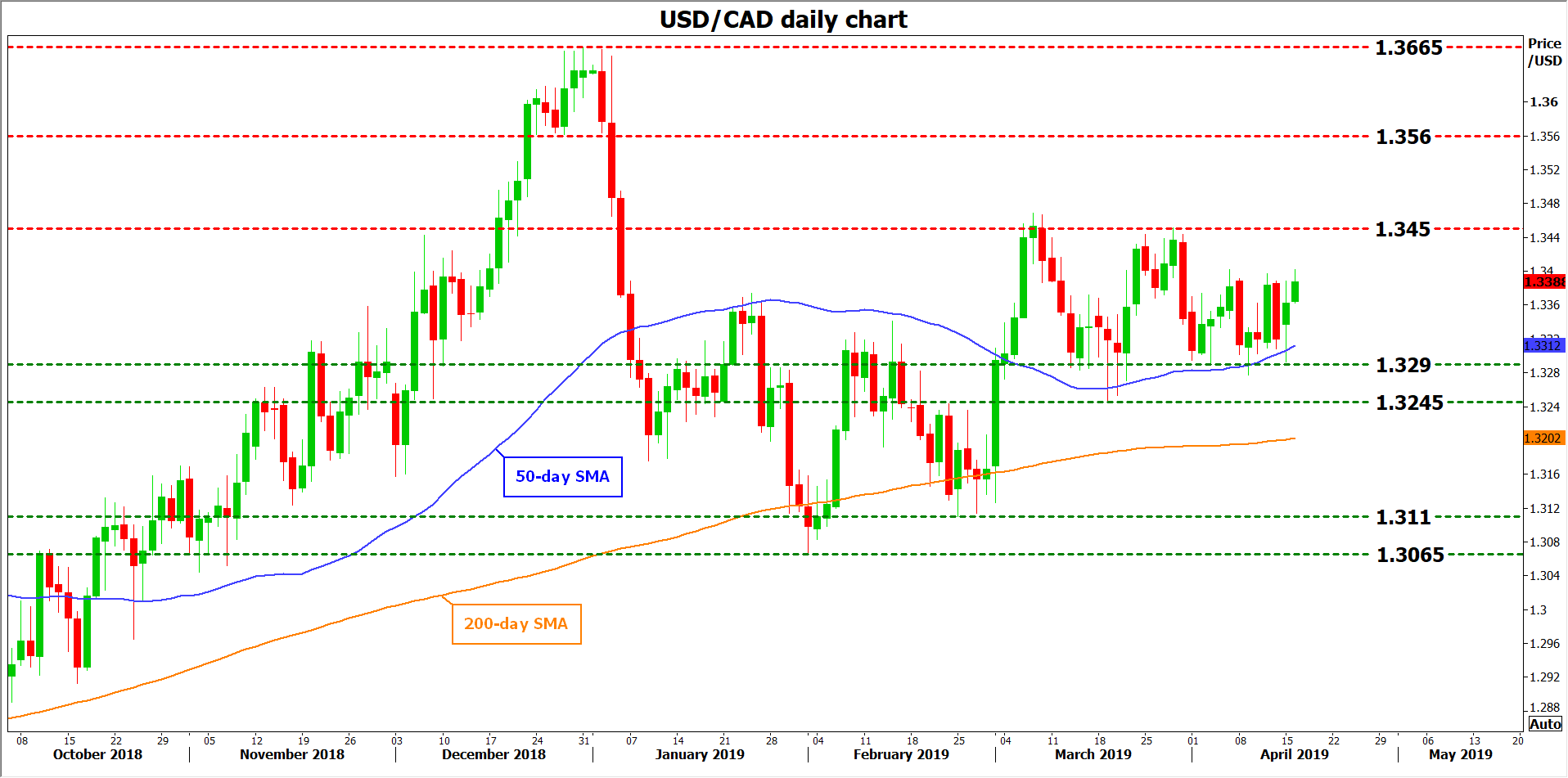
On the flipside, weaker-than-expected data could weigh on the currency. Resistance to advances may come at 1.3450, the March 28 peak, with an upside break opening the door for a test of 1.3560 – a zone marked by the inside swing low in late December.
In the bigger picture, the outlook for the loonie doesn't seem particularly bright. Oil prices have already come a long way from their lows, implying that the rally may be exhausted. Meanwhile, the domestic economy is losing steam, Canadian companies are turning pessimistic as highlighted by the BoC's own business survey for Q1, and the global trade picture remains grim. As such, it wouldn't be a surprise to see the central bank strike a more cautious tone when it meets again next week.
GBPUSD Remains Trapped
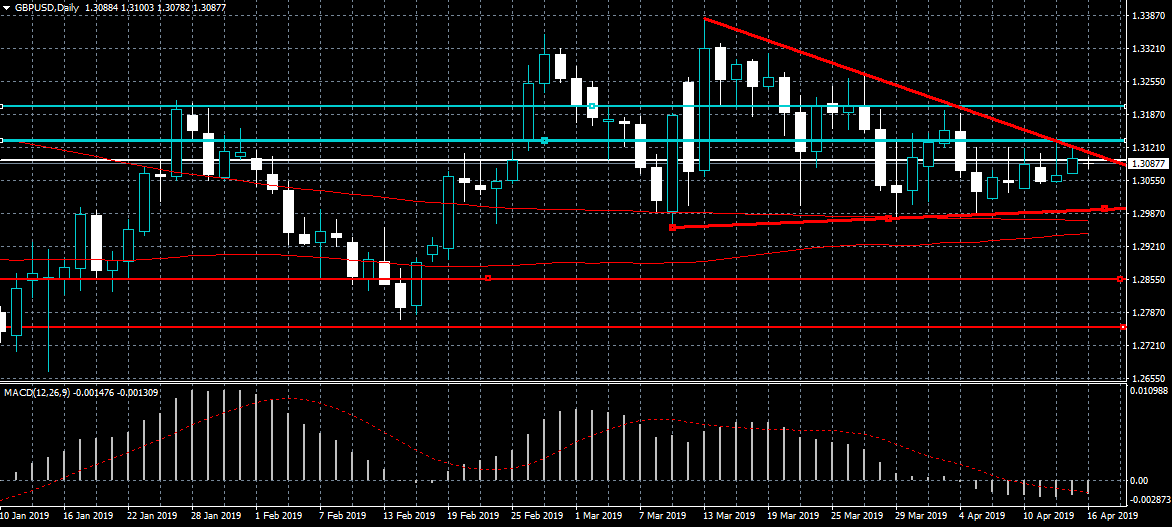
The British pound is still confined to narrow trading conditions against the US dollar following the release of important wage and jobs data from the United Kingdom economy this morning. The GBPUSD pair has failed to move above the 1.3100 level and remains trapped within a triangle pattern on the four-hour time frame. The neutral trading pattern is showing that major technical support for the GBPUSD pair is located at the 1.3000 level.
The GBPUSD pair is only bullish while trading above the 1.3100 level, key intraday resistance remains at the 1.3125 and 1.3200 levels.
If the GBPUSD pair trades under the 1.3100 level, key intraday support is found at the 1.3055 and 1.3000 levels.