

Sample Category Title
Silver: White Metal Trading On A Weaker Footing In The Morning Session
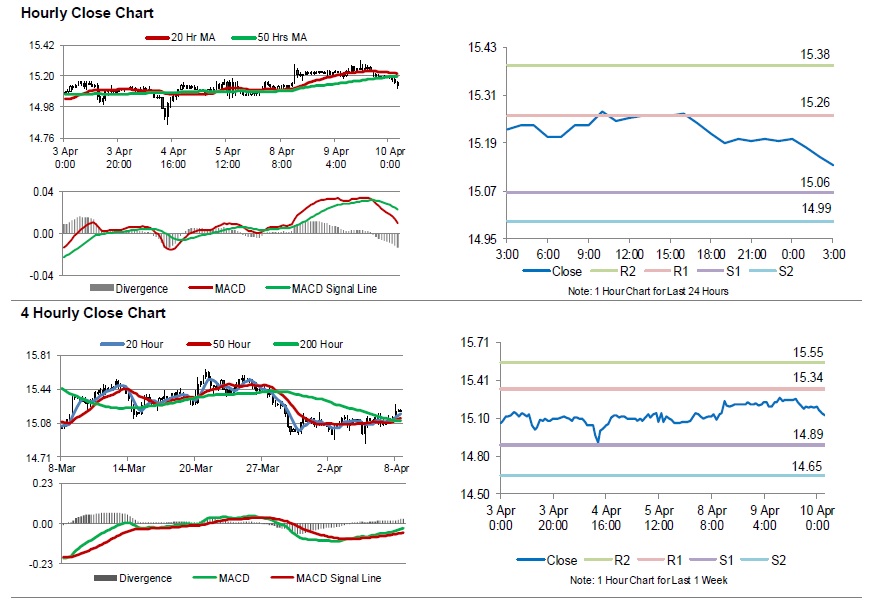
For the 24 hours to 23:00 GMT, Silver declined 0.20% against the USD and closed at USD15.19 per ounce.
In the Asian session, at GMT0300, the pair is trading at 15.13, with silver trading 0.39% lower against the USD from yesterday’s close.
The pair is expected to find support at 15.06, and a fall through could take it to the next support level of 14.99. The pair is expected to find its first resistance at 15.26, and a rise through could take it to the next resistance level of 15.38.
The white metal is trading below its 20 Hr and 50 Hr moving averages.
Crude Oil: Oil Trading Lower, Ahead Of EIA’s Weekly Crude Oil Stockpiles Data
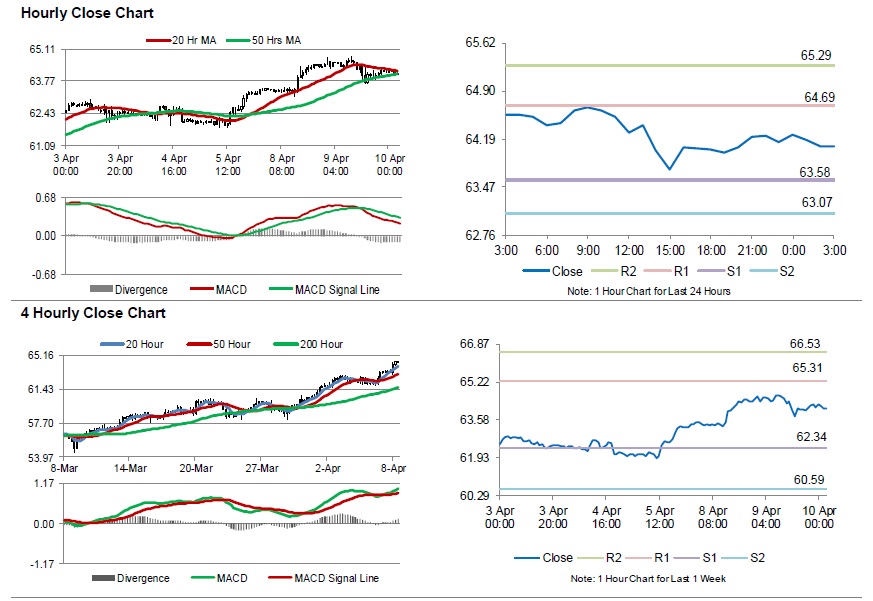
For the 24 hours to 23:00 GMT, Crude Oil declined 0.39% against the USD and closed at USD64.14 per barrel, after Russia suggested an end of the OPEC-led production cuts deal after the end of June. Also, the American Petroleum Institute (API) reported that US crude oil inventories rose by 4.1 million barrels in the week ended 05 April 2019. Additionally, the Energy Information Administration, in its Short-term Energy Outlook report, increased its US crude output forecasts by 0.7% and 0.5% for 2019 and 2020, respectively.
In the Asian session, at GMT0300, the pair is trading at 64.08, with oil trading 0.09% lower against the USD from yesterday's close.
The pair is expected to find support at 63.58, and a fall through could take it to the next support level of 63.07. The pair is expected to find its first resistance at 64.69, and a rise through could take it to the next resistance level of 65.29.
Crude oil is showing convergence with its 20 Hr and 50 Hr moving averages.
EUR/JPY Daily Outlook
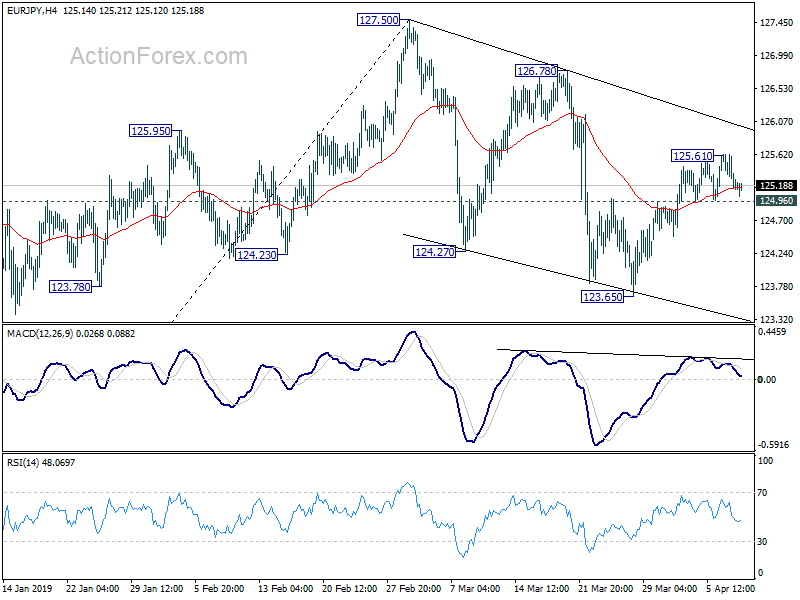
Daily Pivots: (S1) 125.14; (P) 125.33; (R1) 125.79; More....
EUR/JPY's rebound from 123.65 resumed after brief consolidation and intraday bias is back on the upside. Current rise could target 126.78/127.50 resistance zone. However, on the downside, break of 124.96 minor support will argue that the rebound is completed. And, intraday bias will be turned back to the downside for 123.65 support instead.
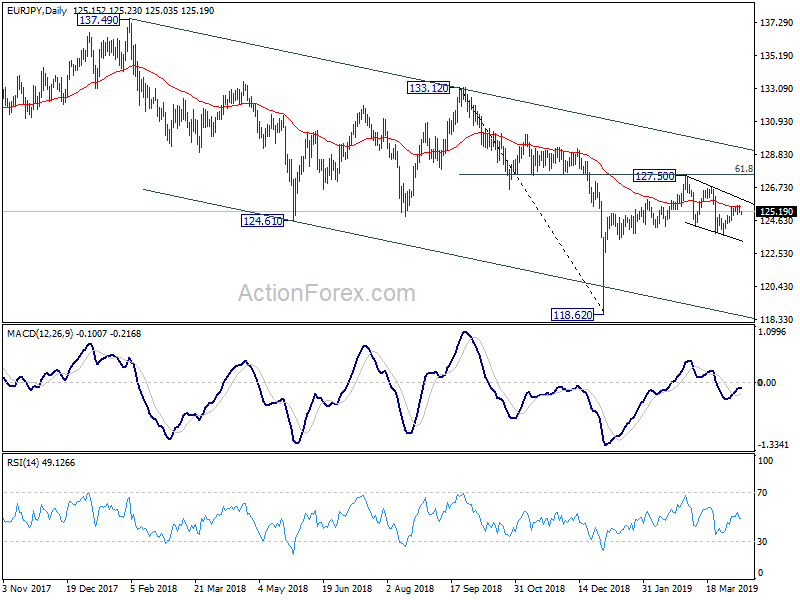
In the bigger picture, EUR/JPY is staying well inside medium term falling channel from 137.49 (2018 high). It's also held below 55 week EMA (now at 127.53). Thus, down trend from 137.49 might still extend lower. Break of 118.62 will target 109.03/114.84 long term support zone. On the upside, however, break of 127.50 will solidify the case of medium term bullish reversal. Rise from 118.76 should extend to 133.12 key resistance instead.
Yen Digests Gain as Trade War Threats Continue to Weigh on Sentiments, ECB to Stand Pat
The forex markets are relatively steady in Asian session today. For the week, Yen is so far the strongest, following mild risk aversion. Investors are concerned that the US is going to escalate trade war with EU, while they haven't even finished negotiations with China. The punitive and retaliation tariffs of US and China are staying there as the talks drag on. Extra tariffs between US and EU will be another huge blow to the global economy.
Australian Dollar is currently following as the second strongest for the week. It quickly reversed earlier loss today after RBA Deputy Guy Debelle didn't bring additional dovishness with his speech. Economists continue to expect two RBA cut this year. But with the first one expected in August, it's a bit early for RBA to turn full-blown dovish yet.
Dollar is currently the weakest one for the week, together with Swiss Franc. Selloff in US stocks this week, with 10-year yield back below 2.5 handle, is weighing down on the greenback. Sterling is mixed as EU is expected to grant UK and one-year flexible Article 45 extension. Euro is also mixed while ECB announcement might bring little news.
Technically, downside momentum in Dollar diminished somewhat after yesterday's selloff. But more downside in Dollar remains in favor against Euro and Yen. Also, as Yen might gather some more strength, 124.96 minor support in EUR/JPY will be in focus. Break will indicate completion of rebound from 123.65 and bring retest on this support.
In Asian markets, Nikkei is currently down -0.57%. Hong Kong HSI is down -0.31%. China Shanghai SSE is down -0.08%. Singapore Strait Times is up 0.11%. Japan 10-yer yield is down -0.0091 at -0.054. Overnight, DOW dropped -0.72%. S&P 500 dropped -0.61%. NASDAQ dropped -0.56%. 10-year yield dropped -0.02 to 2.499, below 2.5 handle.
EU Tusk proposes 1-year flexible Brexit extension, UK free to leave whenever it's ready
In a letter to European Council member, President Donald Tusk urged EU27 states to considering UK's request for Article 50 extension at the meeting on Wednesday, to "do our utmost" to avoid disorderly Brexit.
However, Tusk noted that there is "little reason to believe" that ratification of the Withdrawal Agreement would be completed by the end of June. He also warned granting extension to June 30 would "increase the risk of a rolling series of short extensions and emergency summits, creating new cliff-edge dates."
Thus, Tusk proposed a "flexible extension", which would last only as long as necessary and no longer than one year. UK is free to leave "whenever it is ready". And, importantly, a long extension would provide more certainty and predictability, while UK is allowed to rethink its Brexit strategy.
Tusk also laid out the conditions for the extension: no re-opening of the Withdrawal Agreement; no start of the negotiations on the future, except for the Political Declaration; the UK would have to maintain its sincere cooperation also during this crucial period, in a manner that reflects its situation as a departing member state.
EU and China reaffirms comprehensive strategic partnership with post summit joint statement
The EU-China Summit in Brussels, with European Commission President Jean-Claude Juncker, European Council President Donald Tusk, and Chinese Premier Li Keqiang, concludes with a seven-page joint statement yesterday.
EU said that both sides reaffirm the strength of their Comprehensive Strategic Partnership, their resolve to work together for peace, prosperity and sustainable development and their commitment to multilateralism, and respect for international law and for fundamental norms governing international relations, with the United Nations (UN) at its core. The two sides commit to uphold the UN Charter and international law, and all three pillars of the UN system, namely peace and security, development and human rights."
In short, the two sides pledged their joint commitment to uphold and update rule based orders, including WTO reform. Also bilateral talks will be setup for industrial subsidies. Both promised to have no forced transfer of technologies as price for investment. And both commit to create a level playing field.
Fed Clarida: Flatter Philips curve makes anchoring long-run inflation expectations more important
In a speech, Fed Vice Chair Richard Clarida said neutral interest rates appear to have fallen in the US and abroad. And, "this global decline in r* is widely expected to persist for years". He emphasized the importance of the trend as "all else being equal, a fall in neutral rates increases the likelihood that a central bank's policy rate will reach its effective lower bound (ELB) in future economic downturns. " And that in turn "could make it more difficult during downturns for monetary policy to support household spending, business investment, and employment, and keep inflation from falling too low."
Clarida pointed to another key development in decreasing responsiveness of inflation to resource slack. That is, "short-run Phillips curve appears to have flattened, implying a change in the dynamic relationship between inflation and employment". He warned that a flatter Philips curve increases the cost of reversing unwelcome increase in long-run inflation expectations. And "a flatter Phillips curve makes it all the more important that longer-run inflation expectations remain anchored at levels consistent with our 2 percent inflation objective."
Kuroda: BoJ seeking to create positive economy cycle, not just rise in inflation
Speaking to the parliament, BoJ Governor Haruhiko Kuroda said the central bank isn't seeking to push up inflation alone. Instead, it's aiming at creating to situation where wage and employment conditions improve with corporate profits too. That is, creating a "positive economy cycle".
Meanwhile, Kuroda added the 2% inflation target helps in long-run currency stability. But for now, inflation is likely hover around 1% since wages growth is not fast enough yet.
Separately, Finance Minister Taro Aso also told the parliament that pushing up inflation alone "won't do any good" without improvement in people's livelihoods.
RBA Debelle: Lenses of labor market and GDP in sharp contrast, business surveys sit in between
Australian Dollar rebounds after initial selling as speech of RBA Deputy Governor Guy Debelle echoed much of recent communications. There was no extra dovishness in his comments.
He noted that the weaker than expected GDP growth in second half of last year was primarily due to considerable slower growth in consumption. The main explanation is low growth in household income, and an increasing expectation that it is likely to remain low
However, other parts of GDP have evolved broadly as we had expected. Business investment outside mining has been "growing at a rate". Exports have "continued to grow as expected". Residential construction is at a "historically high level". Also, labor market has been "surprisingly strong".
Debelle noted that "the two lenses on economic growth provided by the labour market and the GDP data are in stark contrast". Meanwhile, "a third lens, in the form of business surveys, sits in between the two". And he noted that "the tension highlighted by these different lenses on economic growth is of crucial importance. Hopefully we will get some resolution of this tension in the coming months with the incoming flow of data."
IMF lowers 2019 global growth forecast to 3.3%, but expects pick up in H2
In the World Economic Outlook report, IMF revised down global growth forecasts as weakness in the second half of 2018 is expected to persist into the first half of 2019. IMF expects slowdown in 70% of world economy. Global growth would dropped from 3.6% in 2018 to 3.3% in 2019, revised down by -0.2%. There were negative revisions for several major economies including the euro area, Latin America, the United States, the United Kingdom, Canada, and Australia.
Nevertheless, IMF still expects growth to pickup again in second half of the year. There will be support from "significant monetary policy accommodation by major economies". Fed, ECB, BoJ and BoE have "all shifted to a more accommodative stance". Meanwhile, China has ramped up its fiscal and monetary stimulus. Outlook for US-China trade tensions has also "improved as the prospect of a trade agreement take shape". "Global recession is not in the baseline projections,
However, IMF maintained "there are many downside risks", including trade tensions that could "could flare up again and play out in other areas (such as the auto industry), with large disruptions to global supply chains.: Growth in Eurozone and China "may surprise on the downside". Brexit risks remain "heightened".
Here is a summary of the growth forecasts (comparing with January forecasts):
- World in 2019 at 3.3% (down -0.2%)
- World in 2020 at 3.6% (unchanged).
- US in 2019 at 2.3% (down -0.2%)
- US in 2020 at 1.9% (up 0.1%)
- Eurozone in 2019 at 1.3% (down -0.3%)
- Eurozone in 2020 at 1.5% (down -0.2%).
- Japan in 2019 at 1.0% (down -0.1%).
- Japan in 2020 at 0.5% (unchanged).
- China in 2019 at 6.3% (up 0.1%).
- China in 2020 at 6.1% (down -0.1%).
ECB to stand pat and maintain forward guidance
ECB rate decision and press conference are two major focuses in a busy day. UK GDP and productions, US CPI and FOMC minutes will also be featured. ECB will keep monetary policies unchanged, without a doubt. There shouldn't be any change in ECB's plan on forward guidance too. That is, it will indicate to keep interest rates unchanged at least through the end of 2019. Details regarding the TLTRO III should be released later in June, rather than at this meeting.
Though, markets might be eager to know more on two topics. Firstly, March meeting minutes revealed that some members indeed favored to extend forward guidance until first quarter of 2020. President Mario Draghi would be asked to elaborate more on the discussions. Secondly, members' comments over the past weeks have given rise to the possibility of a move to a "tiered deposit rate" system in order to save bank profitability.
Here are some suggested readings:
- ECB to Hold Policy Steady at April Meeting as Euro Edges Up
- ECB Preview – More Warning on Downside Risk, No Big Move Until June
- ECB Preview: No New Policy Actions Expected As 'Inflation I Delayed, Not Derailed'
On the data front
Japan domestic CGPI rose 1.3% yoy in March versus expectation of 1.0% yoy. Machine orders rose 1.8% mom in February versus expectation of 2.9% mom. Australia Westpac consumer confidence rose 1.9% in April.
UK GDP, trade balance, industrial and manufacturing production, and construction output will be featured in European session. Later in the day, US will release CPI and FOMC minutes.
EUR/JPY Daily Outlook
Daily Pivots: (S1) 124.98; (P) 125.31; (R1) 125.49; More....
EUR/JPY lose momentum after hitting 125.61 and intraday bias is turned neutral first. On the downside, break of 124.96 minor support will suggests that rebound from 123.65 has completed. And choppy decline from 127.50 is still in progress. Intraday bias will be turned to the downside for 123.65 support first. On the upside, above 125.61 will resume the rebound from 123.65 for 126.78/127.50 resistance zone.
In the bigger picture, EUR/JPY is staying well inside medium term falling channel from 137.49 (2018 high). It's also held below 55 week EMA (now at 127.53). Thus, down trend from 137.49 might still extend lower. Break of 118.62 will target 109.03/114.84 long term support zone. On the upside, however, break of 127.50 will solidify the case of medium term bullish reversal. Rise from 118.76 should extend to 133.12 key resistance instead.
Economic Indicators Update
| GMT | Ccy | Events | Actual | Forecast | Previous | Revised |
|---|---|---|---|---|---|---|
| 23:50 | JPY | Domestic CGPI Y/Y Mar | 1.30% | 1.00% | 0.80% | 0.90% |
| 23:50 | JPY | Machine Orders M/M Feb | 1.80% | 2.90% | -5.40% | |
| 0:30 | AUD | Westpac Consumer Confidence Apr | 1.90% | -4.80% | ||
| 6:00 | JPY | Machine Tool Orders Y/Y Mar P | -29.30% | |||
| 8:30 | GBP | Visible Trade Balance (GBP) Feb | -12.5B | -13.1B | ||
| 8:30 | GBP | Industrial Production M/M Feb | 0.10% | 0.60% | ||
| 8:30 | GBP | Industrial Production Y/Y Feb | -0.80% | -0.90% | ||
| 8:30 | GBP | Manufacturing Production M/M Feb | 0.20% | 0.80% | ||
| 8:30 | GBP | Manufacturing Production Y/Y Feb | -0.70% | -1.10% | ||
| 8:30 | GBP | Construction Output M/M Feb | -0.30% | 2.80% | ||
| 8:30 | GBP | GDP M/M Feb | 0.00% | 0.50% | ||
| 8:30 | GBP | Index of Services 3M/3M Feb | 0.40% | 0.50% | ||
| 11:45 | EUR | ECB Rate Decision | 0.00% | 0.00% | ||
| 12:30 | EUR | ECB Press Conference | ||||
| 12:30 | USD | CPI M/M Mar | 0.40% | 0.20% | ||
| 12:30 | USD | CPI Y/Y Mar | 1.80% | 1.50% | ||
| 12:30 | USD | CPI Core M/M Mar | 0.20% | 0.10% | ||
| 12:30 | USD | CPI Core Y/Y Mar | 2.10% | 2.10% | ||
| 14:30 | USD | Crude Oil Inventories | 2.8M | |||
| 18:00 | USD | FOMC Meeting Minutes | ||||
| 18:00 | USD | Monthly Budget Statement (USD) Mar | -194.7B | -234.0B |
RBA Debelle: Lenses of labor market and GDP in sharp contrast, business surveys sit in between
Australian Dollar rebounds after initial selling as speech of RBA Deputy Governor Guy Debelle echoed much of recent communications. There was no extra dovishness in his comments.
He noted that the weaker than expected GDP growth in second half of last year was primarily due to considerable slower growth in consumption. The main explanation is low growth in household income, and an increasing expectation that it is likely to remain low
However, other parts of GDP have evolved broadly as we had expected. Business investment outside mining has been "growing at a rate". Exports have "continued to grow as expected". Residential construction is at a "historically high level". Also, labor market has been "surprisingly strong".
Debelle noted that "the two lenses on economic growth provided by the labour market and the GDP data are in stark contrast". Meanwhile, "a third lens, in the form of business surveys, sits in between the two". And he noted that "the tension highlighted by these different lenses on economic growth is of crucial importance. Hopefully we will get some resolution of this tension in the coming months with the incoming flow of data."
EUR/USD And USD/JPY: Dollar Bulls Might Struggle
EUR/USD rebounded recently and climbed above the 1.1250 resistance area. USD/JPY is currently declining and it may continue to slide towards the 110.90 support area.
Important Takeaways for EUR/USD and USD/JPY
- The Euro managed to recover above the 1.1220 and 1.1250 resistance levels.
- There is a crucial bullish trend line in place with support at 1.1255 on the hourly chart of EUR/USD.
- USD/JPY started a solid downside move from well above the 111.80 level.
- There is a declining channel in place with resistance near the 111.30 on the hourly chart.
EUR/USD Technical Analysis
After a major drop, the Euro found a strong buying interest near the 1.1180 and 1.1185 levels against the US Dollar. The EUR/USD pair started a substantial recovery and climbed above the 1.1220 and 1.1250 resistance levels.
There was even a close above the 1.1250 level and the 50 hourly simple moving average. The pair broke the 1.1280 level and traded as high as 1.1284 on FXOpen. Later, there was a downside correction below the 1.1265 level.
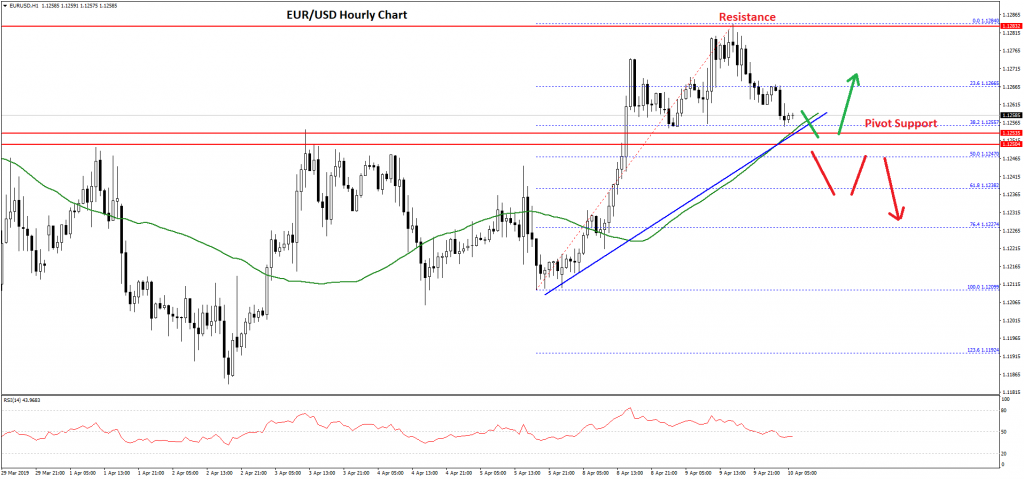
The pair traded below the 23.6% Fib retracement level of the recent wave from the 1.1209 low to 1.1284 high. However, the previous resistance near the 1.1255 level is acting as a solid support.
There is also a crucial bullish trend line in place with support at 1.1255 on the hourly chart of EUR/USD. The trend line coincides with the 50 hourly simple moving average and the 50% Fib retracement level of the recent wave from the 1.1209 low to 1.1284 high.
Therefore, the pair is likely to bounce back as long as it is above the 1.1255 and 1.1250 support levels. An initial resistance is near the 1.1265 level, above which the price could trade towards the 1.1285 level.
On the downside, if there is a successful close below the 1.1250 support, EUR/USD might slide towards the 1.1220 support level in the near term. The next main support is at 1.1200, where bulls may emerge.
USD/JPY Technical Analysis
The US Dollar faced a strong resistance near the 111.80 zone and recently declined against the Japanese Yen. The USD/JPY pair traded below the 111.60 and 111.20 support levels to move into a bearish zone.
The pair even settled below the 111.20 level and the 50 hourly simple moving average. It traded as low as 110.98 before starting an upside correction. Bulls pushed the pair above the 111.10 level and the 23.6% Fib retracement level of the last decline from the 111.57 high to 110.98 low.
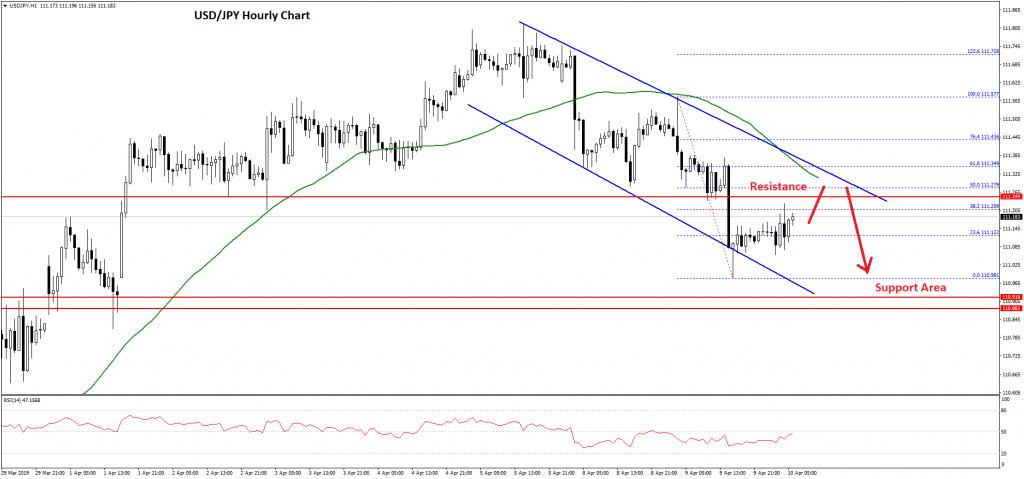
However, there is a strong resistance waiting on the upside near the 111.30 level. There is also a declining channel in place with resistance near the 111.30 on the hourly chart.
Besides, the 50% Fib retracement level of the last decline from the 111.57 high to 109.98 low is also near the 111.30 level. Therefore, USD/JPY sellers are likely to protect more gains above the 111.30 level.
If the pair fails to move above the 111.30 resistance, it is likely to resume its decline towards the 111.00 and 110.90 levels. The next key support is at 110.65.
On the other hand, a successful close above 111.30 and the 50 hourly SMA might push the pair into a positive zone towards the 111.50 and 111.60 levels.
Global Growth Downgrade Hits Sentiment
IMF downgrades 2019 growth forecast
In its latest World Economic Outlook report, the IMF trimmed its 2019 global growth forecast to 3.3% from 3.5% in its previous report in January. That would be the weakest growth rate in a decade and the most recent downgrade is the third in six months.
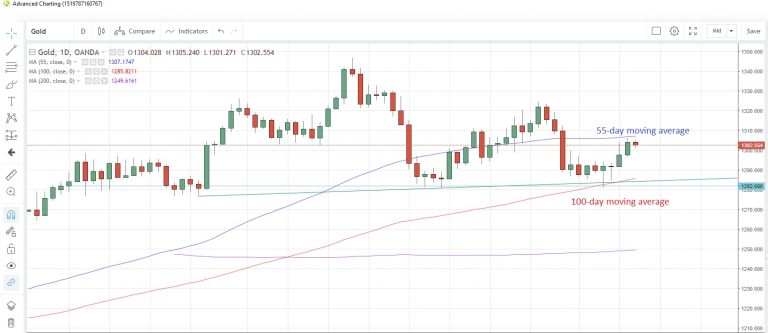
It was a mixed performance across equity markets, with some markets echoing the weak sentiment on Wall Street while others were immune. US index futures flitted between positive and negative in muted trading. On the currency front, the US dollar was generally better bid with the Australian dollar suffering the most. AUD/USD was down 0.16% by mid-morning while gold fell 0.2% but still held on to the 1,300 handle. It has been capped below the 55-day moving average since the end of March.
Gold Daily Chart
Australia consumer confidence rebounds
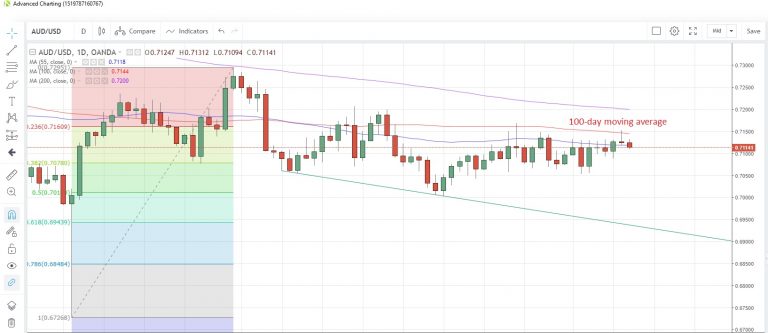
There was a slight uptick in consumer confidence in Australia in April as the Westpac index rose 1.9% 100.7 following a 4.8% decline in March. The accompanying notes stated that the survey was conducted in the April 1-5 period and reflected positive reactions to the Federal budget. The Aussie could not benefit from the improvement however and traded heavy on the back of deteriorating risk appetite. AUD/USD has once again failed to push above the 100-day moving average at 0.7144. This average has capped prices on a closing basis since February 26.
AUD/USD Daily Chart
Trump takes the trade war to Europe
In another of his tweets, US President Trump highlighted that the WTO found EU subsidies to Airbus have adversely impacted the US, to the tune of $11 billion. As a result he threatened to impose tariffs on $11 billion worth of EU goods.
What will the ECB say next?
It’s been a month since the ECB announced a re-introduction of its targeted loans measures to underpin a shrinking economy. Since then the economic data has tended to err to the downside so markets are on heightened watch for any hints of additional measures to come. Q1 GDP growth numbers for Europe will be released next Monday. Will the ECB have a sneak preview of the data?
NOTE: EUR1.12 billion worth of 1.1200 EUR puts expire tomorrow
The rest of the European data calendar includes February’s industrial and manufacturing production numbers for February along with trade data for the same month. The US session features CPI and the budget statement for March and a speech from Fed’s Quarles. The minutes of the last FOMC meeting will finish off the session
Market Morning Briefing: Euro-Yen Has Dipped Slightly
STOCKS
The International Monetary Fund (IMF) revising the global growth outlook lower again is weighing on the equities. Asians are trading in the red. Dow has declined below a key support overnight and has room to dip in the near term. DAX, as mentioned yesterday DAX remains weaker among all and looks vulnerable for further fall.
Dow (26150.58, -190.44, -0.72%) has declined below the key level of 26250. It is likely move further lower to 26000 after which a bounce-back move to 26200-26250 is possible.
DAX (11850.57, -112.83, -0.94%) has come-off sharply and is heading towards 11800 as expected. Though an intermediate bounce from 11800 to 11900 or even higher levels cannot be ruled out, the broader view will remain negative for a fall to 11600 and 11550 in the short term.
Nikkei (21647.82, -154.77, -0.71%) tumbled to a low of 21545 but has bounced from there. A test of 21700 looks likely. However, Nikkei has to breach 21750 to regain strength and rally to 21900 and 22000. While below 21750, a test of 21500 and 21400 is possible in the near term.
dc - Shanghai (3216.3, -23.26, -0.72%) has a key support at 3200. If it manages to sustain above this support, a bounce to 3250 and 3280 can be seen in the near term. But a break below 3200 will trigger a corrective fall to 3150 and 3130.
Sensex (38939.22, +238.69, +0.62%) and Nifty (11671.95, +67.45, +0.58%) have been stuck in a narrow range of 38500-39000 and 11550-11710 respectively over the last few days. It will have to be seen whether they can retain this range amid the broader weakness in the global equities. A break below 38500 can take Sensex lower to 38000. Nifty can fall to 11500 and 11450 on a break below 11550.
COMMODITIES
Weakness in equities has helped gold to move higher. Silver looks relatively weaker than gold and may see a dip in the near term. Copper can continue to consolidate in a sideways range. Oil continues to remain positive in spite of a pause in its rally yesterday.
Gold (1303) has risen breaking above 1300 and keeps our near-term view intact for a test of 1310. Immediate support is at 1300. A break below it can drag gold to 1295.
Silver (15.18) has come-off from its high around 15.34 and can fall to 15.10 and 15.05 in the near term.
Copper (2.93) has come-off after testing 2.96 and can retain its 2.89-2.96 sideways range for some more time. As mentioned yesterday, copper needs a strong break above 2.96 to gain strength and move higher to 3.0. The bias is positive to see copper breaking above 2.96 in the coming days.
WTI (64.1) has immediate supports at 64 and 63.7. An intermediate dip to test these supports cannot be ruled out. A bounce thereafter will see WTI rallying to 66.
Brent (70.68) has been oscillating around 71 over the last couple of days. An immediate support is at 70.2. As long as Brent sustains above this support, a rally to test 72.7 - the 61.8% Fibonacci retracement resistance is likely in the near term. Supports below 70.2 are poised at 69.8 and 69.45.
FOREX
Dollar Index has fallen slightly but while above support near 96.75/80, Dollar could trade in a range for sometime.
Dollar-Index (97.06) may hold above 21-day Ma support near 96.80 and while that holds, Dollar Index could inch up a bit towards 97.30/40. Only on a sustained break below 96.80/75, we would look at further downside for the near term. For now 96.75/80 is likely to hold as decent support.
Euro (1.1258) tested 1.12843 yesterday before coming off from there. Note that levels near1.1285-1.130 could produce near term rejection pushing Euro back towards 1.12.
Euro-Yen (125.15) has dipped slightly. There is immediate resistance at 126 which if holds could bring in a sharp rejection towards 124 in the medium term.
Dollar Yen (111.16) has not been able to rise above 111.30 instead it has dipped slightly. Unless the pair bounces from 111, we may look for near term bearishness towards 110.5.
Aussie (0.7112) has risen sharply and could head towards 0.7180-0.7200 levels in the near term. Note interim resistance is seen near 0.72 which if breaks could make Aussie bullish in the longer run.
Pound (1.3054) has also dipped a bit but has support at 1.30 which could keep the Pound higher for the next few sessions. Trade within 1.30-1.3150 is likely to continue for some more sessions.
USDCNY (6.7169) has moved up and could test 6.72-6.73 levels before falling back towards 6.70 in the medium term.
Although Dollar-Rupee (69.30) held below 69.75 as expected but did not pause at 69.40/35, instead moved down lower to test 69.25 on the downside. While the currency pair sustains a break below 69.40, levels of 69.25/00 come into the picture for the near term. We could see a test of 69.25/00 before Dollar-Rupee again bounces back to higher levels of 69.60+
INTEREST RATES
The US yields saw a slight rise yesterday but could not sustain to continue its upmove. Although there is room towards 3% and 2.58% on the 30Yr (2.91%) and 10Yr (2.49%) yield respectively, while the yields remain below 2.92% and 2.52%, the yields could fall towards 2.88% and 2.45% respectively, resuming the longer term downtrend. The 5YR and 2YR yield trades at 2.29% and 2.33% respectively.
The German-US 2YR yield spread (-2.93%) is bouncing from support levels and while that moves up, it could indicate a rise in Euro as well in the coming sessions. It would be important to watch if Euro moves up towards 1.13 or falls towards 1.12 now. MArkets await ECB meeting due today.
The 10Yr GOI (7.5312%) saw a high of 7.5823% but could not sustain to rise to 7.60%. While the yield trades lower, it could come down towards 7.45% pulling down Dollar-Rupee along.
ECB to stand pat and maintain forward guidance. Some previews
ECB rate decision and press conference are two major focuses in a busy day. UK GDP and productions, US CPI and FOMC minutes will also be featured. ECB will keep monetary policies unchanged, without a doubt. There shouldn't be any change in ECB's plan on forward guidance too. That is, it will indicate to keep interest rates unchanged at least through the end of 2019. Details regarding the TLTRO III should be released later in June, rather than at this meeting.
Though, markets might be eager to know more on two topics. Firstly, March meeting minutes revealed that some members indeed favored to extend forward guidance until first quarter of 2020. President Mario Draghi would be asked to elaborate more on the discussions. Secondly, members' comments over the past weeks have given rise to the possibility of a move to a "tiered deposit rate" system in order to save bank profitability.
Here are some previews:
Fed Clarida: Flatter Philips curve makes anchoring long-run inflation expectations more important
In a speech, Fed Vice Chair Richard Clarida said neutral interest rates appear to have fallen in the US and abroad. And, "this global decline in r* is widely expected to persist for years". He emphasized the importance of the trend as "all else being equal, a fall in neutral rates increases the likelihood that a central bank's policy rate will reach its effective lower bound (ELB) in future economic downturns. " And that in turn "could make it more difficult during downturns for monetary policy to support household spending, business investment, and employment, and keep inflation from falling too low."
Clarida pointed to another key development in decreasing responsiveness of inflation to resource slack. That is, "short-run Phillips curve appears to have flattened, implying a change in the dynamic relationship between inflation and employment". He warned that a flatter Philips curve increases the cost of reversing unwelcome increase in long-run inflation expectations. And "a flatter Phillips curve makes it all the more important that longer-run inflation expectations remain anchored at levels consistent with our 2 percent inflation objective."