

Sample Category Title
Kuroda: BoJ seeking to create positive economy cycle, not just rise in inflation
Speaking to the parliament, BoJ Governor Haruhiko Kuroda said the central bank isn't seeking to push up inflation alone. Instead, it's aiming at creating to situation where wage and employment conditions improve with corporate profits too. That is, creating a "positive economy cycle".
Meanwhile, Kuroda added the 2% inflation target helps in long-run currency stability. But for now, inflation is likely hover around 1% since wages growth is not fast enough yet.
Separately, Finance Minister Taro Aso also told the parliament that pushing up inflation alone "won't do any good" without improvement in people's livelihoods.
EU Tusk proposes 1-year flexible Brexit extension, UK free to leave whenever it’s ready
In a letter to European Council member, President Donald Tusk urged EU27 states to considering UK's request for Article 50 extension at the meeting on Wednesday, to "do our utmost" to avoid disorderly Brexit.
However, Tusk noted that there is "little reason to believe" that ratification of the Withdrawal Agreement would be completed by the end of June. He also warned granting extension to June 30 would "increase the risk of a rolling series of short extensions and emergency summits, creating new cliff-edge dates."
Thus, Tusk proposed a "flexible extension", which would last only as long as necessary and no longer than one year. UK is free to leave "whenever it is ready". And, importantly, a long extension would provide more certainty and predictability, while UK is allowed to rethink its Brexit strategy.
Tusk also laid out the conditions for the extension: no re-opening of the Withdrawal Agreement; no start of the negotiations on the future, except for the Political Declaration; the UK would have to maintain its sincere cooperation also during this crucial period, in a manner that reflects its situation as a departing member state.
Australia Consumer Sentiment Shows Budget Well Received
The Westpac-Melbourne Institute Index of Consumer Sentiment rose 1.9% to 100.7 in April from 98.8 in March.
The survey was conducted over the period April 1 to 5 and captures consumer reactions to the Federal Budget. While the month to month rise in sentiment is fairly muted, the survey detail suggests the Budget was well-received. Sentiment over the course of the week showed a clear boost, with sentiment amongst those surveyed post-Budget 7.7% higher than sentiment amongst those surveyed pre-budget – the most positive turnaround since we began tracking pre and post Budget responses in 2011.
The key issue will be whether this boost from the Budget is sustained. Certainly the ‘pre Budget’ print of 96.8 showed a further deterioration in sentiment from the previous print of 98.8, despite what was already quite a sharp 4.8% fall in March. Persistent weak wages growth; falling house prices; and the perceived rising cost of living are all weighing on consumers. This is best captured in the component of the Index – ‘family finances compared to a year ago’ – which declined 4.9% in April (showing little movement between pre and post Budget responses) and is down 9.6% on a year ago. That compares to the headline Index which is only down by 1.6% over the same period.
The month’s survey included an additional question asking consumers about the impact they expect the Budget to have on their finances over the next 12 months. Responses again suggest the 2019 Budget was well-received. Around 15% of consumers expected it to improve their finances; 51% expected no change; and 22% expected it to worsen their finances. While the overall balance is negative, consumers appear to carry a consistent negative view around budget assessments. At –8.5% the net improve/worsen reading is less negative than last year’s net –10.4% and easily the ‘best’ response we have seen since we began running this question in 2010 (the average reading being –26.6%).
Tax relief was again a key feature of this year’s Federal Budget with new measures building on the seven–year personal income tax plan announced last year. The main near term measures are clearly targeted at ‘low and middle income earners’. Accordingly it is no surprise that sentiment showed more positive responses amongst consumers in these income groups – both the post-Budget lift and assessed impact on family finances were markedly more positive amongst consumers with incomes in the $60–100k a year range.
Other factors that may have impacted sentiment in April include: a continued lift in the ASX, now up nearly 10% from its late 2018 levels; but negatives around petrol prices (average pump prices nationally up 18¢/litre since early February) and continued declines in house prices.
The month to month gain in sentiment was driven by a solid rise in expectations for the economy and family finances with some offsetting drag from weaker assessments around current finances and ‘time to buy a major household item’.
The Budget appeared to shore up confidence around the economy, which has had a shaky start to the year with choppy reads in the previous three months. The ‘economic outlook, next 12 months’ sub-index rose 6.2% in April, regaining most of the ground lost in March. The ‘economic outlook, next five years’ sub-index also rose 5.9%, retracing all of the previous month’s decline. Both sub-indexes are again in net positive territory above 100 and well above long run averages.
Daily Markets Broadcast
Wall Street dips as Trump takes the trade war to Europe
US President Trump threatened to impose tariffs on $11 billion of EU products due to subsidies to Airbus. Wall Street indices declined with the SPX500 index snapping a four-day rising streak. An IMF downgrade to global growth this year also impacted.
US30USD Daily Chart
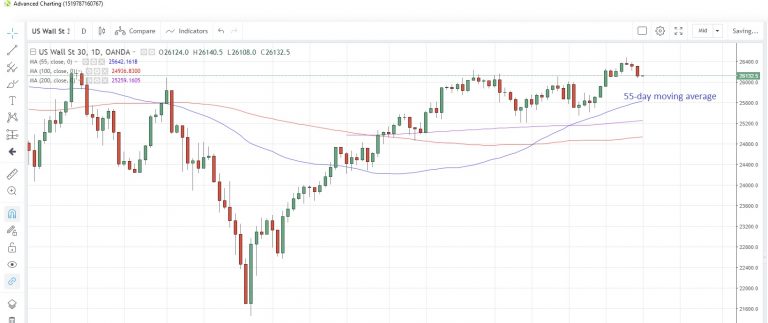
The US30 index fell the most in 2-1/2 weeks yesterday as risk appetite deteriorated on the back of the Trump threat. The IMF downgraded its 2019 global growth forecast to 3.3% from 3.5% in January. That would be the weakest growth rate in a decade.
The index is falling toward the 55-day moving average at 25,642
US consumer prices are expected to rise 0.3% m/m in March, an acceleration from February's 0.2%, but is unlikely to give the Fed a headache. Fed's Quarles is scheduled to speak but the markets will be waiting for the release of the latest FOMC minutes late in the session.
DE30EUR Daily Chart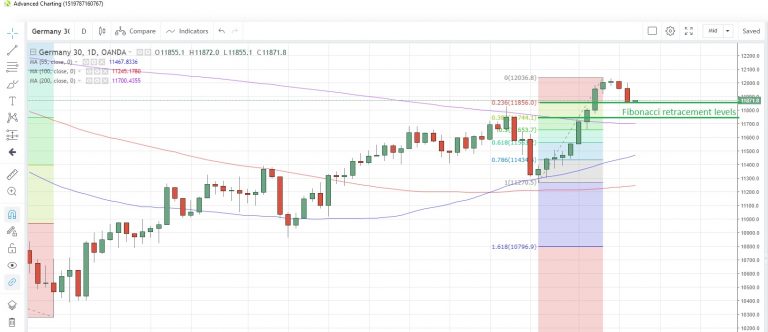
The Germany30 index tumbled the most in 2-1/2 weeks yesterday with Airbus seeing some pressure from the tariff threat
The index has reached the 23.6% Fibonacci retracement of the March 22 – April 4 rally at 11,856. The 38.2% retracement is at 11,744
It's the ECB rate meeting today and, with data worsening since the last meeting where they announced a reintroduction of targeted loans, the market will be looking for a hint of additional easing measures.
CN50USD Daily Chart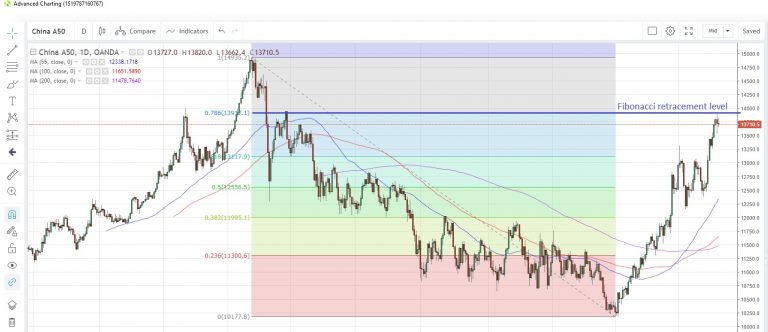
China shares retreated further from 13-month highs yesterday amid broader equity weakness across Asia. The China50 index had touched the highest since February 27, 2018 on Monday
The rally stalled just ahead of the 78.6% Fibonacci retracement of the 2018 decline at 13,917
China's new loans data are due tomorrow and are expected to rebound to 1.2 trillion yuan from 886 billion yuan in February. This could be a good indication that official stimulus measures are filtering through to the economy.
Can Gold Price Continue Higher Heading Into FOMC Minutes?
Key Highlights
- Gold price started a solid rebound after trading as low as $1,280.80 against the US Dollar.
- There was a break above a crucial declining channel with resistance at $1,292 on the 4-hours chart of XAU/USD.
- The US NFIB Business Optimism Index increased from 101.7 to 101.8 in March 2018.
- The US Consumer Price Index in March 2019 could increase 0.3% (MoM), less than the last 0.2%.
Gold Price Technical Analysis
After a sharp decline, gold price found support near the $1,280 level against the US Dollar. The price started a strong rebound recently and climbed above the $1,290 and $1,294 resistance levels.
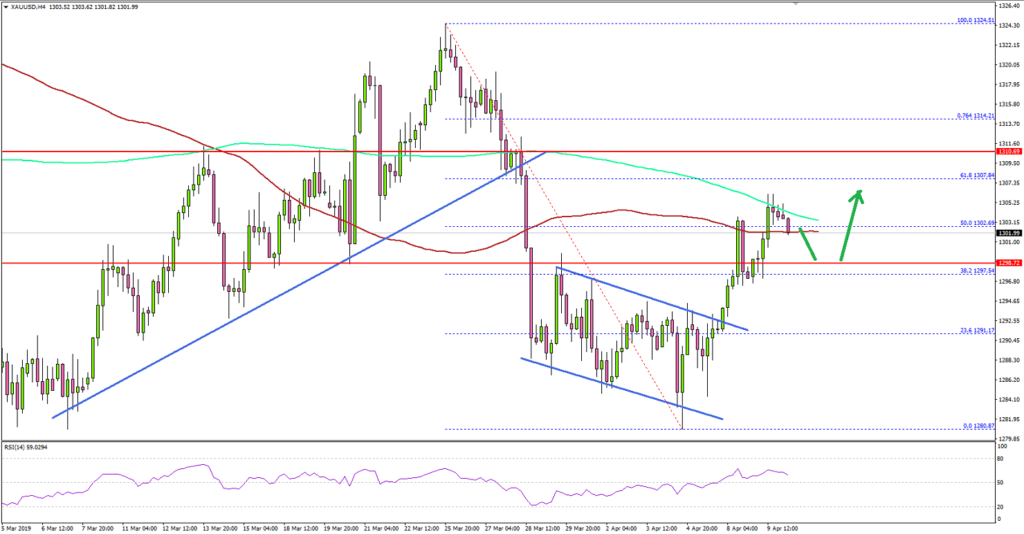
The 4-hour chart of XAU/USD indicates that the price broke a strong resistance area near the $1,290 and 1,291 levels. The price also surpassed the 23.6% Fib retracement level of the last decline from the $1,324 high to $1,280 low.
Moreover, there was a break above a crucial declining channel with resistance at $1,292 on the same chart, opening the doors for more gains. Recently, the price broke the $1,300 resistance, the 100 simple moving average (red, 4-hours) and the 50% Fib retracement level of the last decline from the $1,324 high to $1,280 low.
All these are positive signs, but there are many hurdles on the upside near the $1,310 level. Besides, there are many important economic releases lined up in the US today, including the CPI report and FOMC meeting minutes.
If gold price continues to move higher and clears the $1,310 resistance, it could revisit the $1,324 high. On the flip side, a close below the $1,294 support might trigger a fresh drop.
Looking at the major pairs, EUR/USD rebounded above the 1.1240 level, but GBP/USD is still struggling below the 1.3150 resistance.
Economic Releases to Watch Today
- UK Industrial Production for Feb 2019 (MoM) – Forecast +0.1%, versus +0.6% previous.
- UK Manufacturing Production for Feb 2019 (MoM) – Forecast +0.2%, versus +0.8% previous.
- ECB Interest Rate Decision – Forecast 0%, versus 0% previous.
- US Consumer Price Index March 2019 (MoM) – Forecast +0.3%, versus +0.2% previous.
- US Consumer Price Index March 2019 (YoY) – Forecast +1.8%, versus +1.5% previous.
- US Consumer Price Index Ex Food & Energy March 2019 (YoY) – Forecast +2.1%, versus +2.1% previous.
- FOMC Meeting Minutes.
GOLD Eyes 1,310.00 Resistance Zone On Bull Pressure
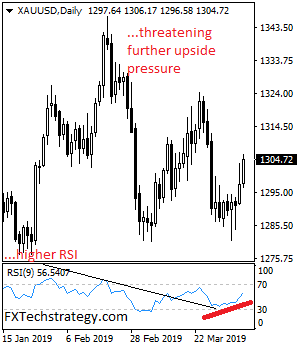
GOLD eyes 1,310.00 resistance zone on further strength. On the downside, support comes in at the 1,290.00 level where a break will turn attention to the 1,280.00 level. Further down, a cut through here will open the door for a move lower towards the 1,270.00 level. Below here if seen could trigger further downside pressure targeting the 1,260.00 level. Conversely, resistance resides at the 1,310.00 level. Further out, resistance resides at the 1,320.00 level where a break will aim at the 1,330.00 level. A turn above there will expose the 1,340.00 level. Further out, resistance stands at the 1,350.00 level. Its daily RSI is bullish and pointing higher suggesting further strength. All in all, GOLD eyes 1,310.00 resistance zone on bull pressure.
Eco Data 4/10/19
[php_everywhere instance="1"]
EU and China reaffirms comprehensive strategic partnership with post summit joint statement
The EU-China Summit in Brussels, with European Commission President Jean-Claude Juncker, European Council President Donald Tusk, and Chinese Premier Li Keqiang, concludes with a seven-page joint statement today.
EU said that both sides reaffirm the strength of their Comprehensive Strategic Partnership, their resolve to work together for peace, prosperity and sustainable development and their commitment to multilateralism, and respect for international law and for fundamental norms governing international relations, with the United Nations (UN) at its core. The two sides commit to uphold the UN Charter and international law, and all three pillars of the UN system, namely peace and security, development and human rights."
In short, the two sides pledged their joint commitment to uphold and update rule based orders, including WTO reform. Also bilateral talks will be setup for industrial subsidies. Both promised to have no forced transfer of technologies as price for investment. And both commit to create a level playing field.
https://twitter.com/EU_Commission/status/1115619139660537858
ECB to Hold Policy Steady at April Meeting as Euro Edges Up
The European Central Bank will announce its latest policy decision on Wednesday at 11:45 GMT, to be followed by a press conference by President Mario Draghi at 12:30 GMT. Unlike the March gathering when the Bank made significant adjustments to its policy and forward guidance, the April meeting is looking like it will be a less eventful one, with no changes being anticipated. That’s not to say the euro is safe from any dovish remarks by Draghi, as the single currency attempts to rebound from its recent lows.
At the March meeting, the ECB performed a dramatic U-turn, making a dovish pivot just a few months after ending its quantitative easing program in December. The Bank announced a new round of targeted longer-term refinancing operations (TLTRO-III) aimed at boosting lending across the euro area. But the biggest reaction was to the surprise decision to modify the forward guidance on interest rates.
Having previously signalled a rate hike some time after the summer of 2019, the ECB is now not expecting to lift rates before the end of the year. The euro touched a 20-month low of $1.1174 in the aftermath of the meeting, and after see-sawing, came close to hitting that trough again last week as investors continue to lower their outlook on the Eurozone economy.
Eurozone economy still weak
European exporters, particularly German ones, are still struggling amid a slowdown in China and anxiety over a hard Brexit. Also casting a shadow over businesses is the threat the US will set its sights on the European Union for a trade fight once the dispute with China is resolved.
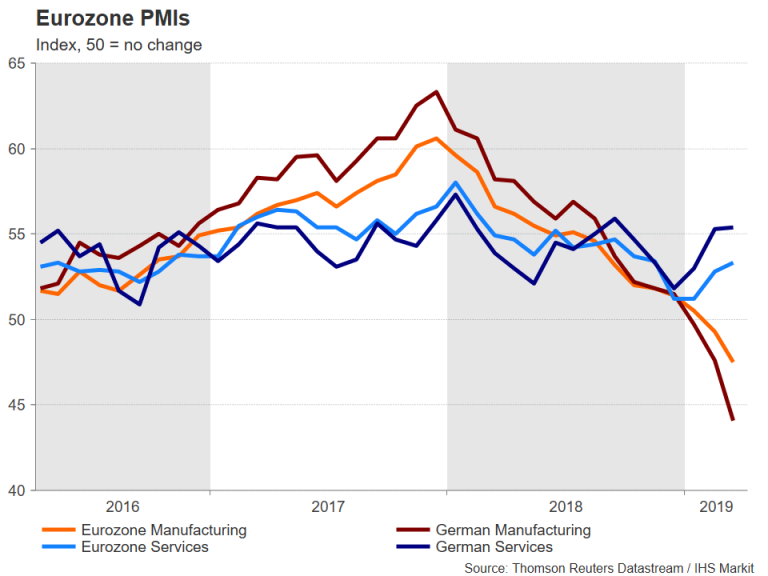
However, while the manufacturing sector continues to act as a major drag on the economy, there are some signs that services activity is picking up as domestic demand holds up considerably well amid the broader slowdown. IHS Markit’s services PMI for March showed an unexpected strong bounce, rising for the second straight month.
Will Draghi give markets cause for optimism?
But that’s unlikely to be enough for policymakers to upgrade their views just yet and Draghi is expected to maintain that the risks to the Eurozone economy are tilted to the downside. If Draghi gives investors little reason to be optimistic and reiterates that the timing of a rate hike could be pushed back again if conditions worsen, the euro would likely come under pressure, cutting its recovery short.
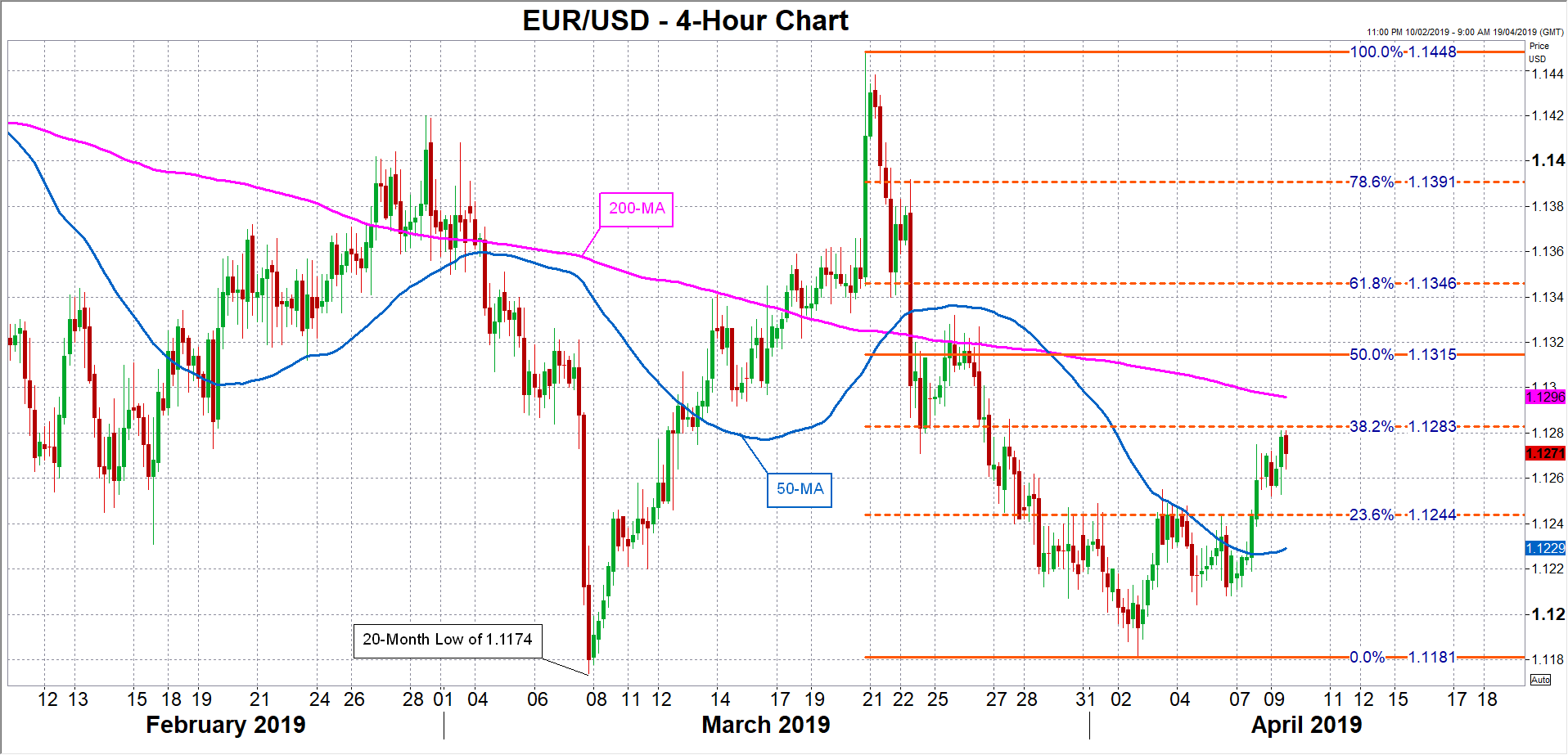
Euro/dollar’s rebound is already facing resistance at the 38.2% Fibonacci of the downleg from 1.1448 to 1.1181, at 1.1283. A fresh selling round from a downbeat Draghi could pull the pair initially towards the 23.6% Fibonacci at 1.1244 before testing the 50-period moving average (MA) in the 4-hour chart around 1.1230. A drop below this line would put the 2019 low of 1.1174 back into scope.
Tiered deposit rate could be long way off
On the other hand, a somewhat more confident ECB chief could help push euro/dollar above the 1.1283 resistance. Further upside is possible if Draghi downplays the likelihood of introducing a tiered system for the ECB’s negative deposit rate, which has been hurting banks’ profitability in the euro bloc. Euro/dollar could climb above the 200-period MA just below the 1.13 handle before aiming for the 50% Fibonacci at 1.1315 if the prospects for a tiered deposit rate start to recede.
The latest reports suggest discussions for a tiered deposit rate are still only at staff level and it could be several months before any proposals reach the Governing Council to be debated. By which point, the Eurozone economy could already be rebounding and with Draghi’s term coming to an end at the end of October, such a policy may be up to the next president to decide.
US Inflation Data and Fed Minutes in Focus as Rate-Cut Bets Rise
The two main releases for the dollar this week will be the US CPI data and the minutes from the Fed’s March meeting, due out on Wednesday at 12:30 and 18:00 GMT respectively. Attention could fall primarily on the inflation data, where forecasts appear overly optimistic – thereby posing a downside risk for the US currency. In the big picture, markets are quietly pricing in Fed rate cuts. Yet, that has failed to substantially weaken the greenback, mainly because other major currencies still lack appeal.
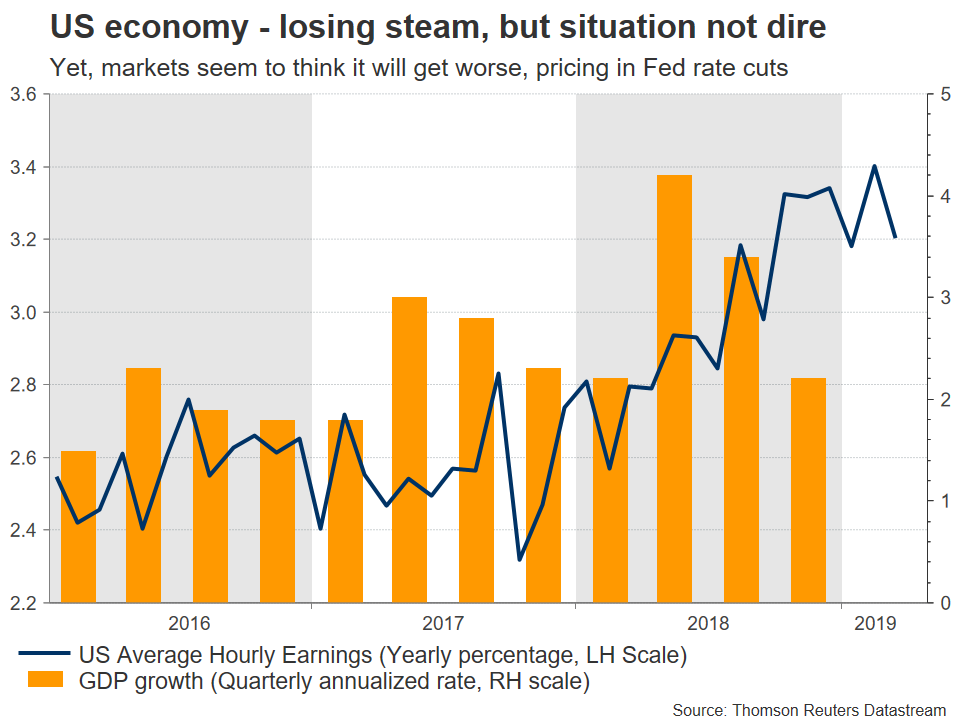
Whether correct or not, markets appear increasingly convinced that the Fed will be cutting rates before long. According to the Fed funds futures, the probability for a quarter-point rate cut by December now rests near ~70%, a number that has been rising recently. This stands in sharp contrast with remarks by Fed officials, who insist that rates will stay unchanged for now, and that they would consider a cut only if the economy took a turn for the worse.
Down, but not out
The economy is indeed slowing down – albeit not dramatically. Retail sales and wage growth both disappointed lately, implying that the American consumer may be experiencing a soft patch, which is an ominous sign for future growth. Still, business surveys like the PMIs remain at healthy levels, consistent with solid GDP growth in Q1, so the situation isn’t dire either. Investors seem to believe the environment is likely to worsen further as the year progresses, leading the Fed to open the stimulus taps once more.
The inflation data for March, due on Wednesday, will provide the latest piece in this puzzle. The headline CPI rate is projected to have risen to 1.8% in annual terms, from 1.5% in February, while the core rate is expected to have held steady at 2.1%. Overall though, the risks surrounding these forecasts may be tilted to the downside, since the Markit PMI surveys for March showed that prices charged by firms rose at the slowest pace since 2017. Any disappointment could further amplify expectations for Fed cuts, and hence weigh on the dollar.
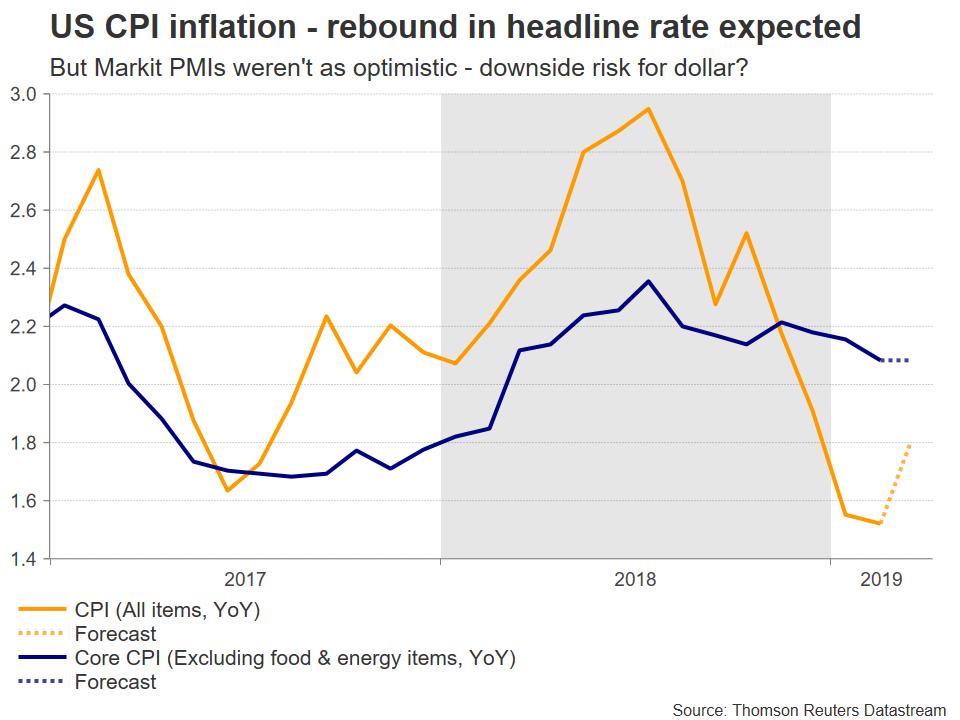
A few hours later, the minutes from the Fed’s March meeting will attract attention. This was the meeting where policymakers signaled they don’t intend to raise rates this year, so the minutes will likely contain an air of caution. That could also weigh on the greenback, but perhaps not much, as markets already have a good sense of where the Fed stands.
Only game in town
In the big picture, even though expectations for Fed easing have been growing, one would hardly know just by looking at a chart of the dollar. The reserve currency has held up very well, mainly because its other major peers – notably the euro, pound, and yen – aren’t attractive enough. The European economy is in much worse shape than the US, the pound continues to be tormented by Brexit uncertainties, and Japan offers interest rates so low that the yen can’t gain traction without a major risk-off event.
Until one of these narratives starts to change, especially the European growth story, the dollar may remain ‘the only game in town’ and is unlikely to experience massive downside even if Fed rate-cut expectations grow a little further.
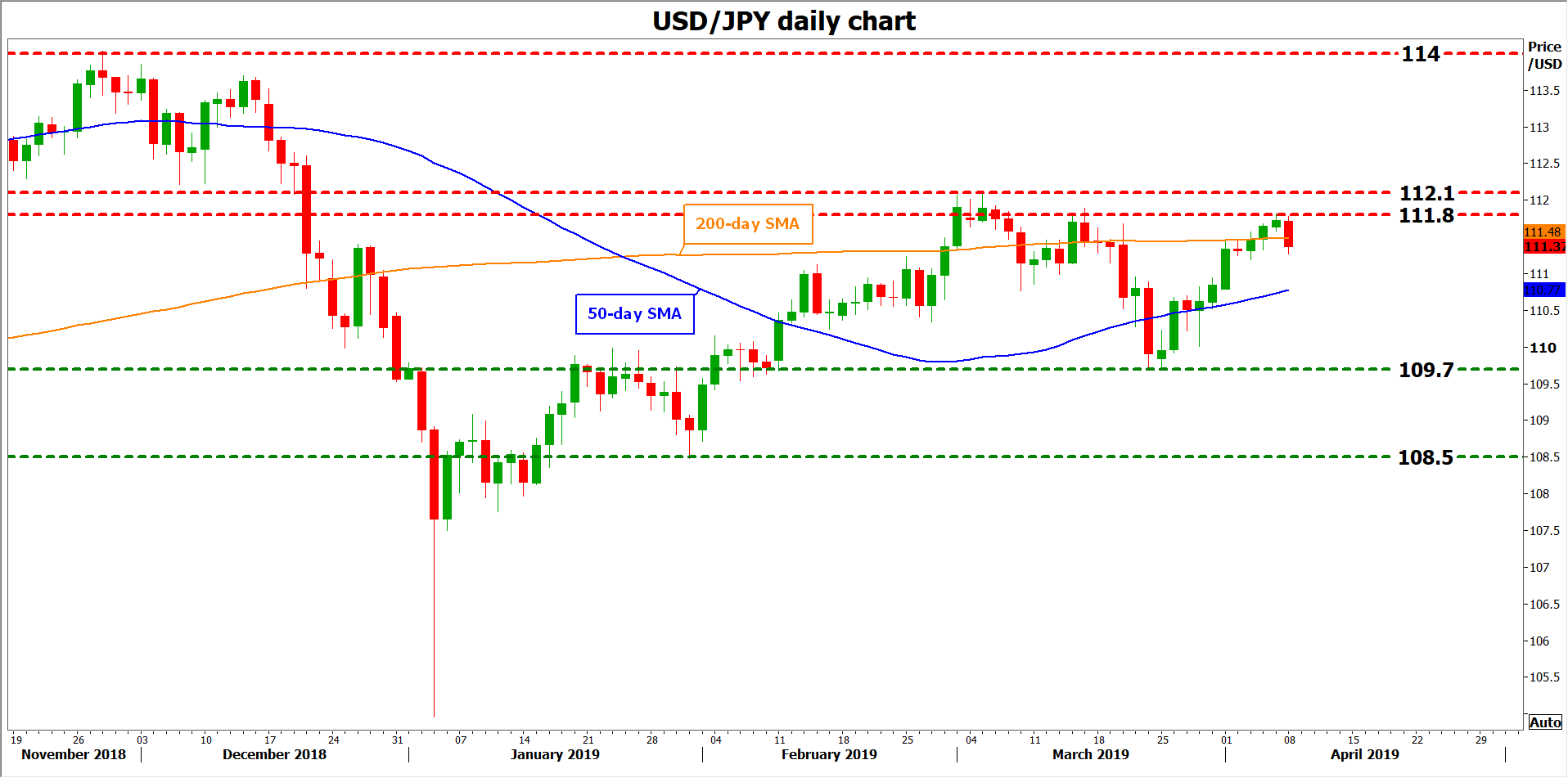
Looking at dollar/yen technically, initial support to declines may be found near the 50-day simple moving average (SMA), currently at 110.77. A downside break could open the door for a test of the March lows near 109.70.
On the other hand, immediate resistance to advances in the pair could come from the 111.80 – 112.10 territory. If the bulls manage to overcome it, the next obstacle may be around 114.0.