Sample Category Title
Oil Surges ahead of OPEC and IEA Reports
Oil is pushing higher again this week, with the rally in the last couple of sessions taking us through technical resistance and providing a further catalyst for gains.
Brent stumbled at $70, but not for long, while WTI is now running into resistance around $65. Dollar weakness may be contributing to the surge, while the potential for supply disruptions in Libya may also add to the bullish case.
Brent Daily Chart
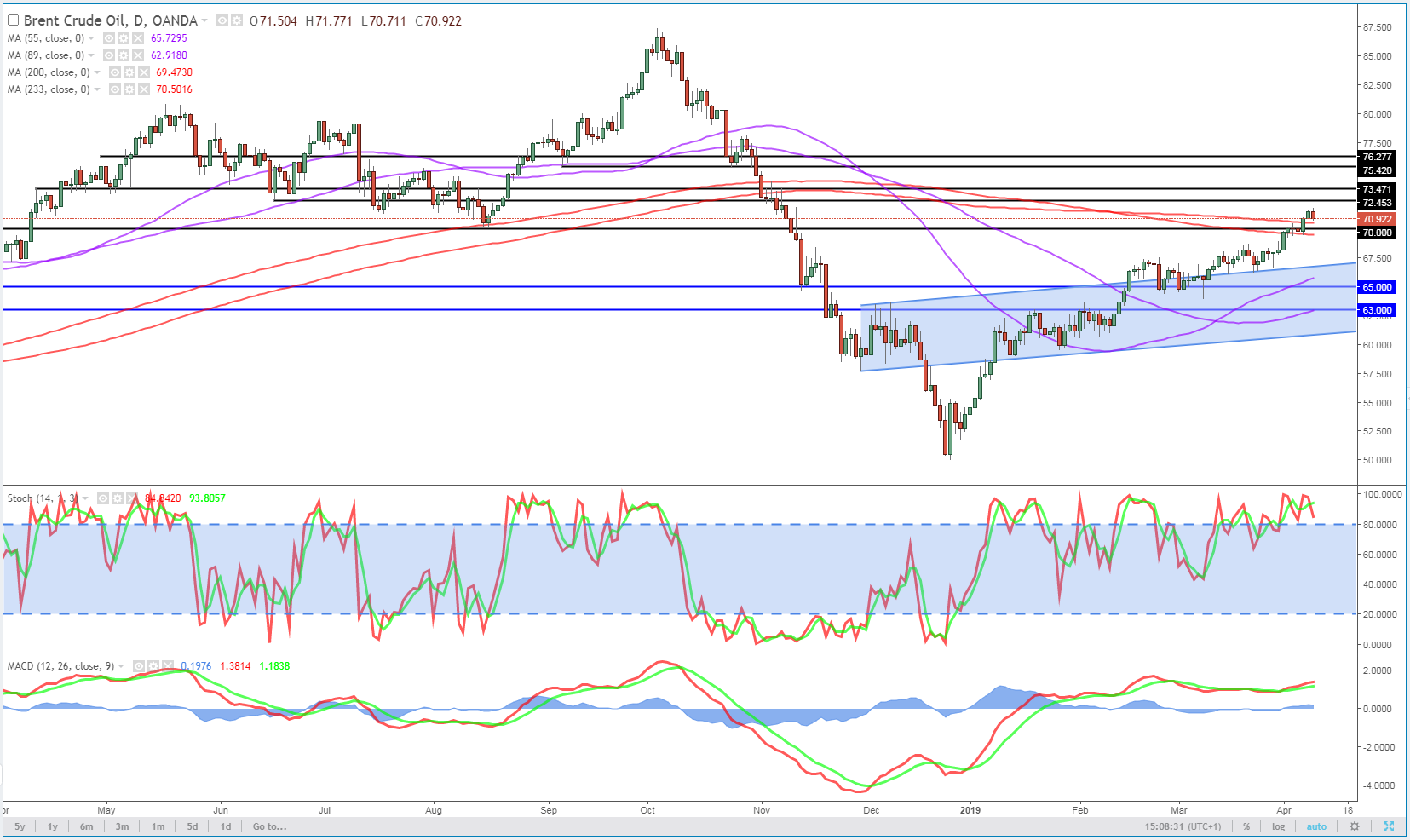
With prior resistance and the 200/233 simple moving average combination now overcome, further resistance ahead could lie around $72.50-73.50, with $75.50-76.25 being notable above here. A keen eye will remain on momentum indicators for any indication that it’s slipping as we scale new highs.
It promises to be an interesting week for oil though, with the usual inventory data being accompanied by reports from OPEC and IEA which should provide additional insight on the latest production numbers and expectations for demand.
Japanese Yen Gains Ground on Soft U.S. Jobs Report
USD/JPY has posted losses in the Tuesday session, continuing the downward movement seen on Monday. In the North American session, the pair is trading at 111.06, down 0.38% on the day. On the fundamental front, U.S. JOLTS Jobs Openings dropped sharply to 7.09 million, down from 7.58 million a month earlier. This reading was well short of the forecast of 7.58 million. Later in the day, Japan releases Core Machinery Orders, which is expected to rebound with a gain of 3.0%. As well, PPI is projected to improve to 1.0%. On Wednesday, the U.S. releases consumer inflation data. CPI is expected to improve to 0.3% and Core CPI is projected to climb to 0.2%. As well, the FOMC releases the minutes of the March policy meeting.
On Wednesday, investors will be keeping a close look at Federal Reserve, which releases the minutes of the March meeting. At the meeting, the Fed said it would start tapering the reduction of its balance sheet in May. This marks a loosening of policy, and comes in response to weaker economic data out of the U.S. in recent months. The minutes should be treated as a market-mover, and if investors don’t like what they hear, risk apprehension could jump and the safe-haven yen could gain ground.
The Japanese economy remains fragile, as weak global demand has taken a toll on Japanese exports and manufacturing output. This was reflected in a Bank of Japan forecast on Monday, which downgraded its assessment for three of the country’s nine regions. All three regions are dependent on electronic exports to China, which has been gripped by an economic slowdown in recent months. Despite the pessimistic report, BoJ Governor Haruhiko Kuroda remained optimistic, saying that stronger domestic demand would offset the decline in exports, which would enable the economy to grow at a moderate pace. Kuroda also said that he was confident that inflation would gradually accelerate towards the BoJ’s target of 2 percent.
USD/JPY Cracks Strong Support on Fresh Weakness Driven by Trade Fears
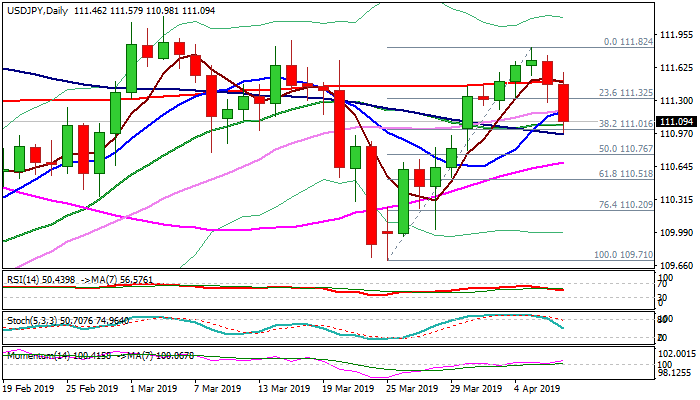
Fresh trade fears pushed the dollar lower to crack pivotal supports at 111 zone in early US session trading on Tuesday, following the latest threats of US President Trump on imposing tariffs on imports from the EU, just a day after US officials proposed a list of EU products to target, in extension of existing dispute in aircraft industry.
Trade concerns weakened dollar across the board as traders switched to less risky yen until get clearer picture. Violation of strong supports at 111 zone 20SMA/Fibo 38.2% of 109.71/111.82/100SMA/converged Tenkan/Kijun-sen) would signal further weakness on clear break, however, a massive daily cloud (top of the cloud lays at 110.78) offers very strong support. This marks the key point and focus will be on today's closing, as break and close below cloud top would generate fresh negative signal for extension of pullback from 111.82 high. Rejection above cloud top and close above 111 zone is needed to keep broader bulls in play for fresh attempts higher. Broken 200SMA (111.47) marks key barrier, close above which is needed to confirm an end of corrective phase.
Res: 111.20; 111.47; 111.58; 111.82
Sup: 110.98; 110.78; 110.68; 110.51
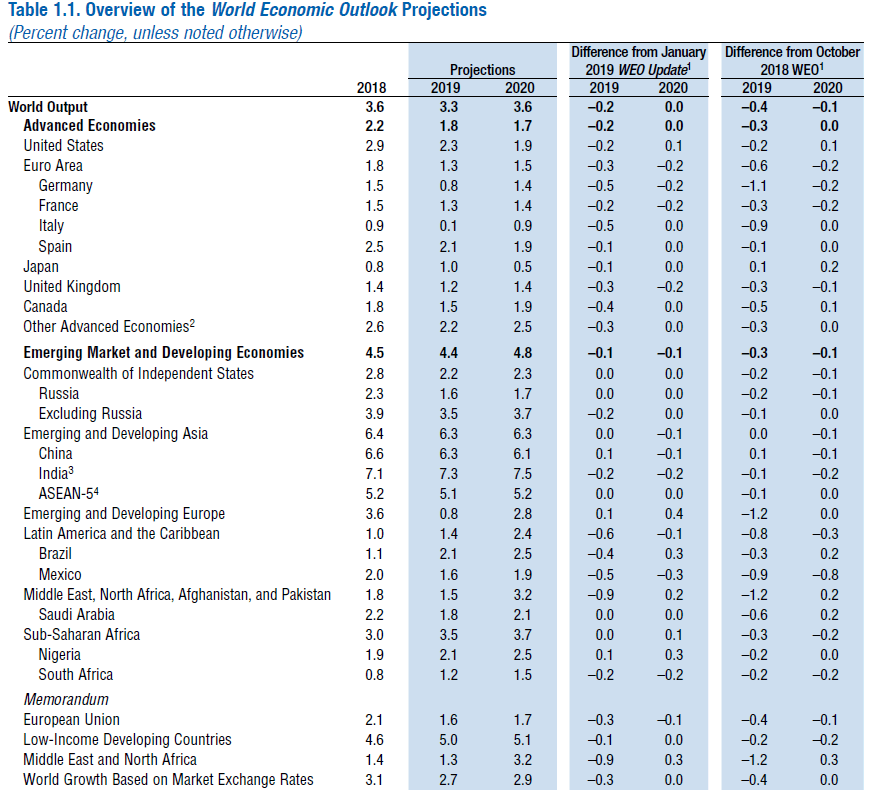
IMF lowers 2019 global growth forecast to 3.3%, but expects pick up in H2
In the World Economic Outlook report, IMF revised down global growth forecasts as weakness in the second half of 2018 is expected to persist into the first half of 2019. IMF expects slowdown in 70% of world economy. Global growth would dropped from 3.6% in 2018 to 3.3% in 2019, revised down by -0.2%. There were negative revisions for several major economies including the euro area, Latin America, the United States, the United Kingdom, Canada, and Australia.
Nevertheless, IMF still expects growth to pickup again in second half of the year. There will be support from "significant monetary policy accommodation by major economies". Fed, ECB, BoJ and BoE have "all shifted to a more accommodative stance". Meanwhile, China has ramped up its fiscal and monetary stimulus. Outlook for US-China trade tensions has also "improved as the prospect of a trade agreement take shape". "Global recession is not in the baseline projections,
However, IMF maintained "there are many downside risks", including trade tensions that could "could flare up again and play out in other areas (such as the auto industry), with large disruptions to global supply chains.: Growth in Eurozone and China "may surprise on the downside". Brexit risks remain "heightened".
Here is a summary of the growth forecasts (comparing with January forecasts):
- World in 2019 at 3.3% (down -0.2%)
- World in 2020 at 3.6% (unchanged).
- US in 2019 at 2.3% (down -0.2%)
- US in 2020 at 1.9% (up 0.1%)
- Eurozone in 2019 at 1.3% (down -0.3%)
- Eurozone in 2020 at 1.5% (down -0.2%).
- Japan in 2019 at 1.0% (down -0.1%).
- Japan in 2020 at 0.5% (unchanged).
- China in 2019 at 6.3% (up 0.1%).
- China in 2020 at 6.1% (down -0.1%).
EUR/CHF Mid-Day Outlook
Daily Pivots: (S1) 1.1221; (P) 1.1239; (R1) 1.1267; More...
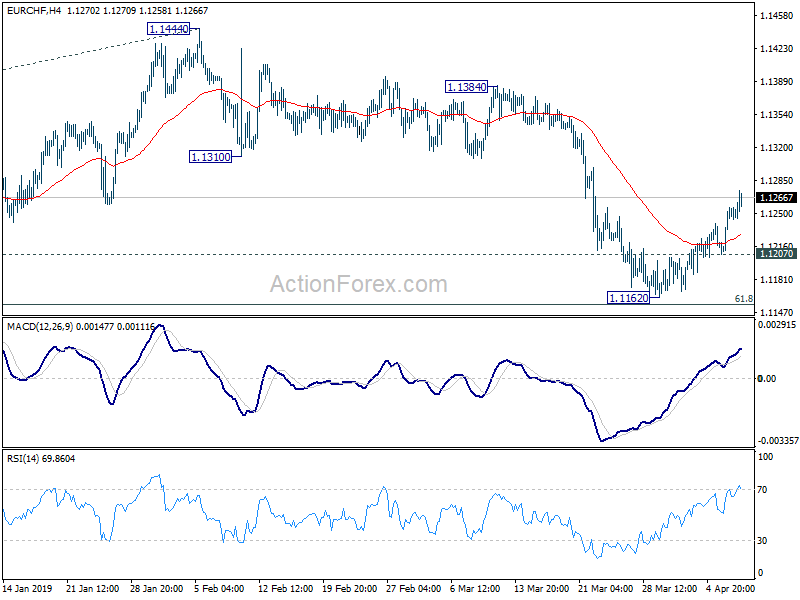
EUR/CHF's rebound from 1.1162 extends higher today and break of 1.1256 minor resistance suggests short term bottoming at 1.1162, ahead of 1.1154 key fibonacci support. Intraday bias is back on the upside for 1.1310 support turned resistance first. Break will target 1.1444. On the downside, below 1.1207 minor support will turn bias back to the downside for 1.1154 instead.
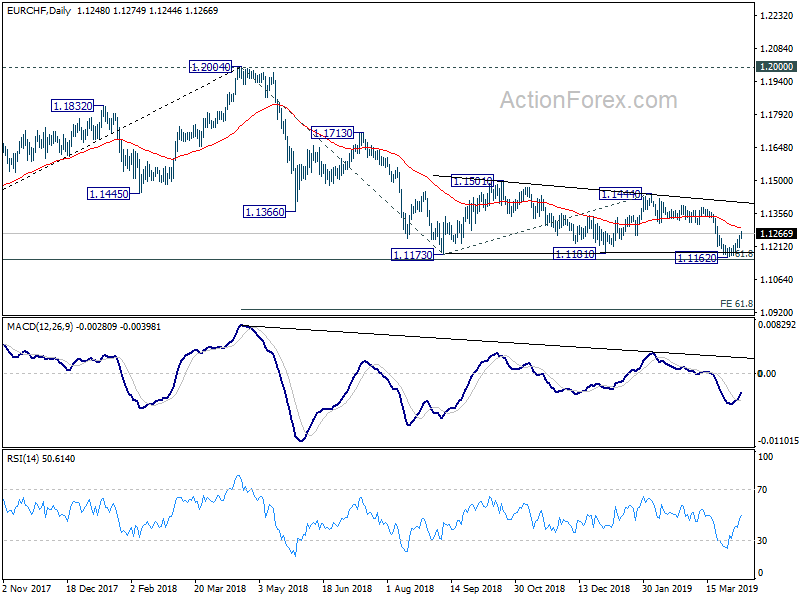
In the bigger picture, multiple rejection by 55 week EMA indicates medium term bearishness. Focus remains on 1.1154/98 support zone (2016 high and 61.8% retracement of 1.0629 to 1.2004 at 1.1154). Decisive break there will confirm resumption of whole down trend from 1.2004 and long term bearish reversal. EUR/CHF should then target 1.0629 support and below. This will now remain the favored case as long as 1.1444 resistance holds.
US: Small Business Confidence Edges Higher
The NFIB's small business optimism index increased slightly by 0.1 points to 101.8 in March, keeping it above its historical average of 98. The modest improvement however, disappointed market expectations for a 102 point reading.
Movements among the survey's subcomponents were marginally positive this month, with five improving, three declining and two remaining unchanged. Firms expecting higher real sales increased by three points, while those planning to increase employment rose by two points. The percent of firms with positions they were unable to fill also rose by two points. On the other hand, firms who thought inventories were too low pulled back by four points.
Expectations of improving economic conditions (+11%) and plans for capital expenditures (+27%) were unchanged from the previous month.
Labor market indicators were mixed. The net addition of workers per firm came off an all-time high reached in February, but still remained elevated, while job openings rose two points to 39%. Additionally, quality of labor concerns, though declining (-1 point to 21%), remained the top problem facing small businesses.
After retreating in February, the number of firms planning to increase employment increased by two points to 18% in March. Firms who raised compensation (33%) and those planning to raise compensation in the next three months (20%) both advanced by two points. Firms, however, continued to face headwinds as the percent reporting few or no qualified applicants for open positions rose five points to 54%.
Key Implications
The slip in small business confidence following the government shutdown does not seems to have caused long-lasting harm to business optimism. In fact, the Uncertainty Index declined by six points to 79, which is a more normal reading for the index in recent years.
The report shows that tightness in the labor market is a real issue for small businesses. The return to solid job gains in March's national employment report, while encouraging, is likely to become more difficult to sustain, given this challenge.
All said, the recent incremental gains in the index implies solid growth, but at a more staid pace than the fiscal-stimulus-fueled past year. This is not necessarily a bad thing. With a 'Goldilocks'-like rate of growth, inflation pressures will remain benign and policy supportive of a prolonged economic expansion.
Sunset Market Commentary
Markets
Global core bonds gain ground with US Treasuries outperforming German Bunds. Risk sentiment initially remained resilient despite messages that the US considers tariffs on $11bn of EU import, acting on a WTO report that indicates the EU is unrightfully subsidizing Airbus, adversely impacting the US. Investors largely ignored the news, possibly as the US retaliatory actions are WTO-backed and suggest these actions of protectionism could be a one-off. German Bunds lost minimal ground in early trading. Rumors that German chancellor Merkel was open to support a 5-year time limit on the Irish backstop, possibly breaking the Brexit deadlock, lifted sentiment and pushed core bonds down. However, the German ministry later denied the news, re-directing core bonds to opening levels. The German yield curve is mixed with changes ranging from -2.3 bps (10-yr) to +0.4 bps (2-yr). Before the WS opening, US President Trump personally confirmed the tariffs on EU imports. He added that the EU has taken advantage of the US on trade for many years and added he’ll put an end to that. Moreover, the IMF cuts the global growth outlook to the lowest level since the financial crisis. Investors sentiment slid away, pushing core bonds higher. The US yield curve is moving lower with change up to -3.8 bps (10-yr).
The dollar traded in the defensive yesterday and this trend continued today. Yesterday we interpreted the move as mainly technical in nature. A further rise of the oil price supported commodity currencies and also weighed on the dollar overall. The oil price rally stalled today. Still, the dollar lost modestly further ground against most other majors. This was also visible in EUR/USD. The pair extended its rebound in the 1.12 big figure and trades currently in the 1.1275 area. We indeed interpret the move as mainly USD softness. That said, the euro traded quite resilient given today’s news flow. The US preparing tariff hikes on $1bn worth of European imports following the dispute on aircraft subsidies could have been a euro negative. This also applies to Italy raising its 2019 budget deficit forecast to 2.5%. Today, it hardly affected EUR/USD. Maybe the prospect of a long Brexit delay caused some unwinding of euro shorts. Interest rate differentials also narrowed slightly in favour of the euro/in disadvantage of the dollar. The dollar is also losing further ground against the yen. USD/JPY is trading in the low 111 area.
EUR/GBP trading was again some kind of erratic in nature as markets await the outcome of the next phase(s) in the Brexit saga. EUR/GBP initially hovered in the 0.8620 area. Sterling temporary gained a few ticks on rumours that German Chancellor Merkel was considering an (albeit long) time-limit to the Irish backstop. However, the rumour was denied. Most EU officials indicate that a long delay remains preferred. The UK still aims a Brexit delay till June 30, but at least for now there is no indication that a compromise might be found in the UK Parliament anytime soon. The UK currency is slightly losing ground. EUR/GBP is trading in the 0.8635 area going into tomorrow’s EU summit on Brexit. Cable hovers in the mid 1.30 area, but this sterling resilience is partially masked by USD softness.
News Headlines
Mere hours after US’ Lighthizer proposed a levy on a range of EU products in response to European subsidies given to Airbus, the European Commission is said to ask the WTO to determine the bloc’s retaliation rights, adding that the US countermeasures are “greatly exaggerated”. The move risks escalating trade tensions at a time trade negotiations about cuts in industrial tariffs have yet to start.
The IMF cut its outlook for global growth this year from 3.5% in January to 3.3% with risks skewed to the downside. That is the weakest rate since 2009. US growth in 2019 was revised downwardly to 2.3% (vs. 2.5% earlier) but was upgraded to 1.9% for 2020 on the Fed’s dovish shift. The euro area saw its 2019 outlook slashed to 1.3% (down from 1.6%) with notable changes to German and Italian growth (both -0.5% points). China is expected to grow 6.3% this year, marginally higher vs. January.
USD/JPY Mid-Day Outlook
Daily Pivots: (S1) 111.27; (P) 111.51; (R1) 111.75; More...
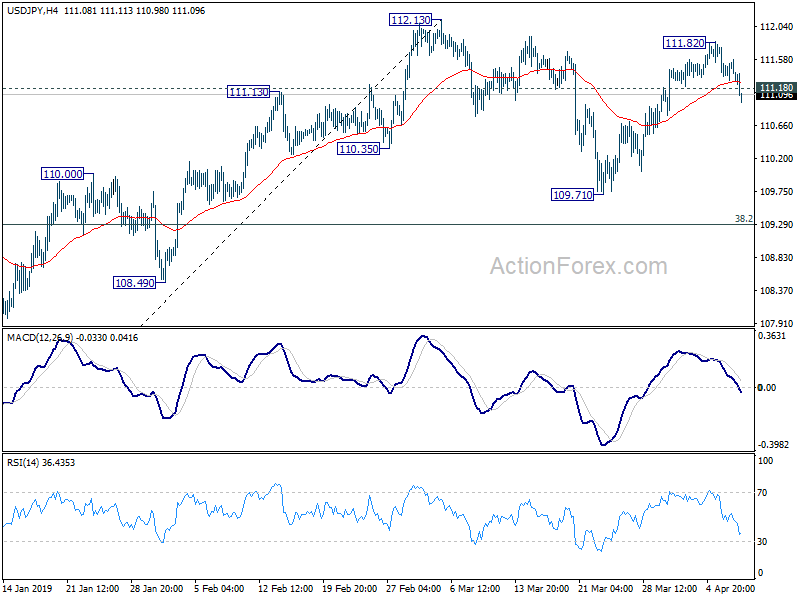
USD/JPY's break of 111.18 support suggests that rebound from 109.71 has completed at 111.82. Also, the consolidation pattern from 112.13 is starting the third leg. Intraday bias is back on the downside for 109.71 and possibly below. But downside should be contained by 104.69 to 112.13 at 109.28 to bring rebound. On the upside, decisive break of 112.13 will resume whole rally from 104.69 and target 114.54 resistance next.
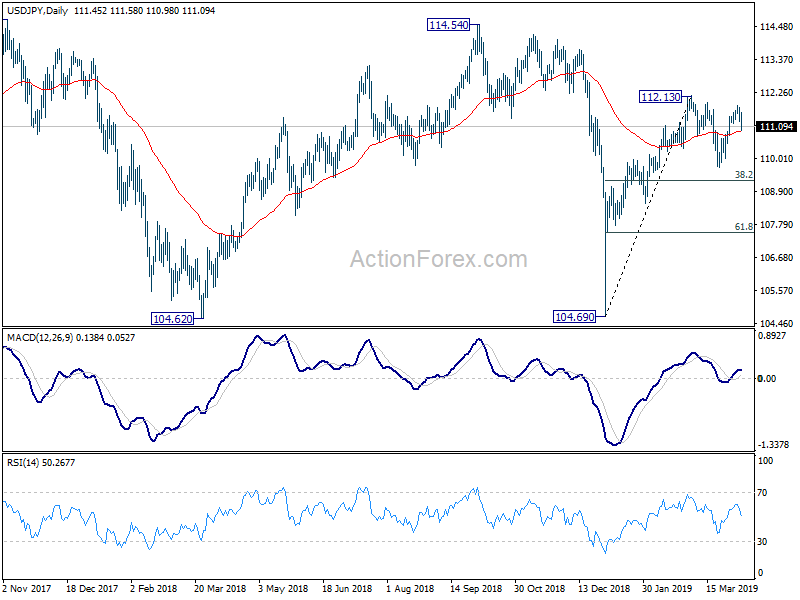
In the bigger picture, medium term outlook in USD/JPY remains a bit mixed as it's staying inside falling channel from 118.65, but there are signs of bullish reversal. On the upside, break of 114.54 resistance will revive the case the corrective fall from 118.65 has completed with three waves down to 104.69. And whole rise from 98.97 (2016 low) is resuming for 118.65 and above. But before that, outlook stays neutral first.
USD/CHF Mid-Day Outlook
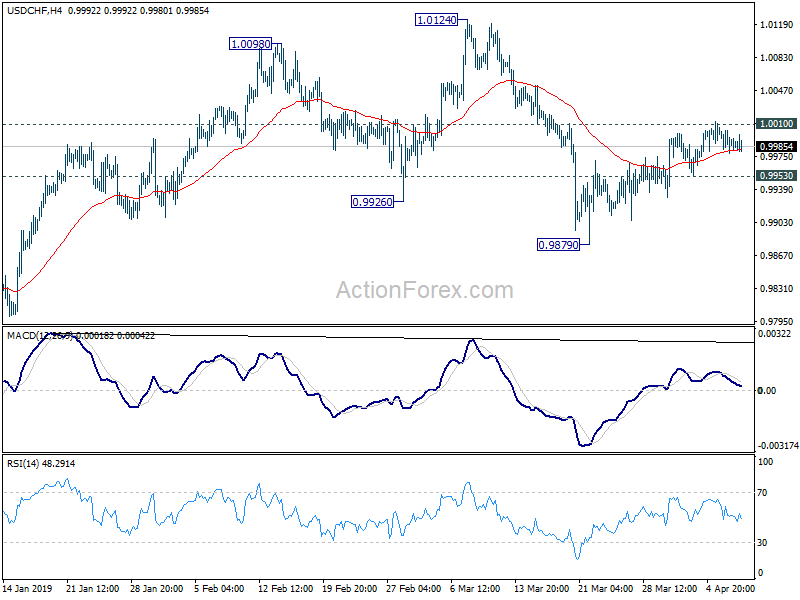
Daily Pivots: (S1) 0.9976; (P) 0.9991; (R1) 1.0005; More...
No change in USD/CHF's outlook and intraday bias remains neutral first. On the upside, sustained break of 1.0010 will suggest that pull back from 1.0124 has completed. Intraday bias will be turned back to the upside for 1.0124/28 resistance zone. However, break of 0.9953 minor support will indicate rejection by 1.0010 and turn bias to the downside for 0.9879. Break there will resume the fall from 1.0124 to 0.9716 key support.
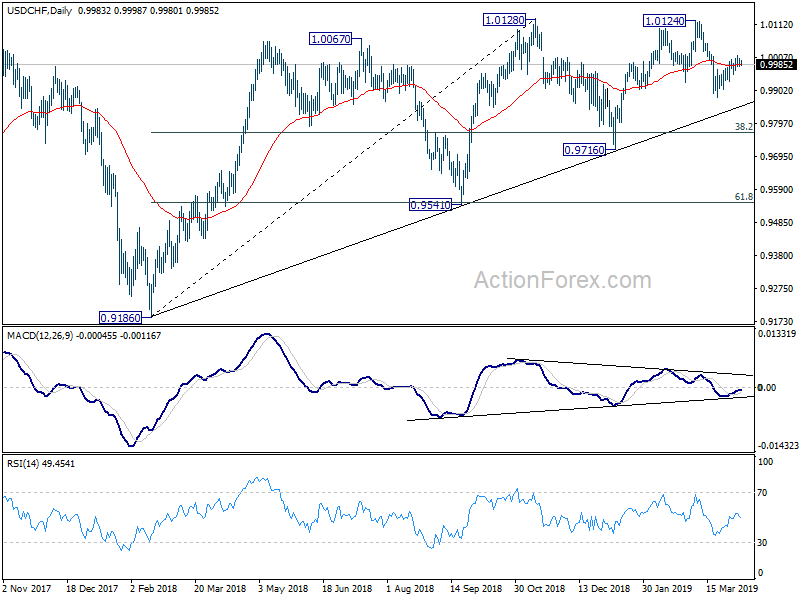
In the bigger picture, focus is back on medium term trend line (now at 0.9865). Decisive break there will argue that whole rise from 0.9186 has completed. Further break of 0.9716 will confirm reversal and target next support level at 0.9541. Nevertheless, there is still a chance that price action from 1.0128 are forming a consolidative pattern with fall from 1.0124 as third leg. If this is the case, stronger support should be seen between 0.9716 and the trend line to contain downside.
GBP/USD Mid-Day Outlook
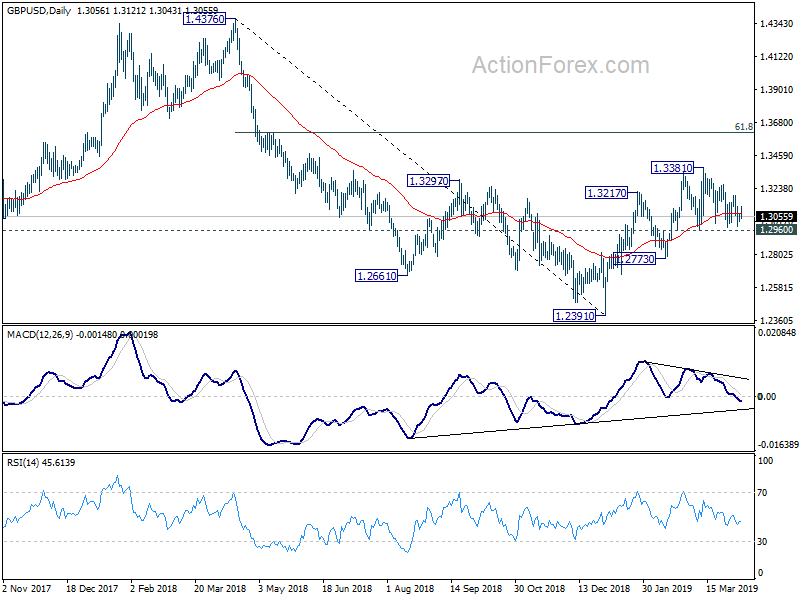
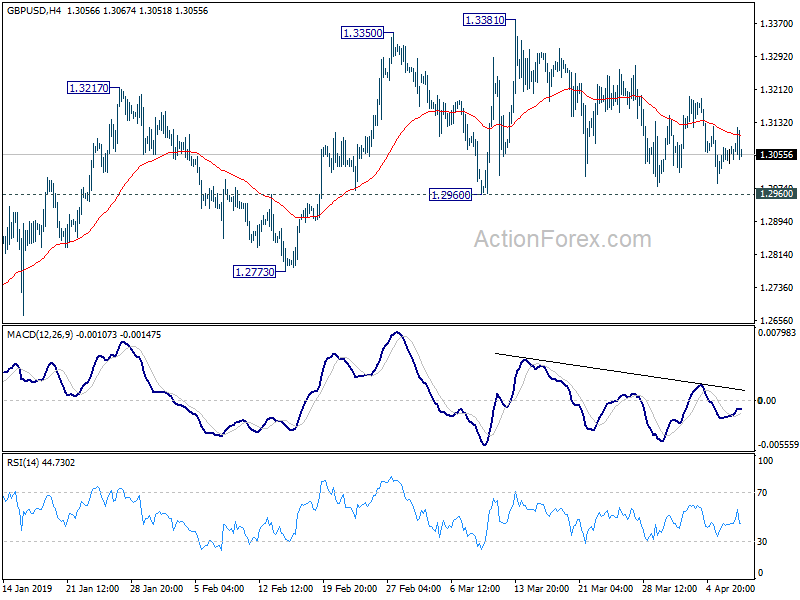
Daily Pivots: (S1) 1.3034; (P) 1.3055; (R1) 1.3082; More....
No change in GBP/USD's outlook and intraday bias remains neutral first. More sideway trading could be seen. For now, further rise is still mildly in favor as long as 1.2960 support holds. On the upside, decisive break of 1.3381 will extend the rise from 1.2391 and target 61.8% retracement of 1.4376 to 1.2391 at 1.3618 next. However, on the downside, sustained break of 1.2960 will indicate that rebound from 1.2391 has completed earlier than expected. Deeper fall would then be seen to 1.2773 support for confirmation.
In the bigger picture, medium term decline from 1.4376 (2018 high) should have completed at 1.2391. Rise from 1.2391 is seen as the third leg of the corrective pattern from 1.1946 (2016 low). Further rise could be seen through 1.4376 in medium term. On the downside, though, break of 1.2773 support will dampen this view. Focus will be turned back to 1.2391 low and break will resume the fall from 1.4376 to 1.1946.