

Sample Category Title
USD/CAD Forecast: Greenback Advances Against Loonie on Strong US and Weaker Canada’s Jobs Data
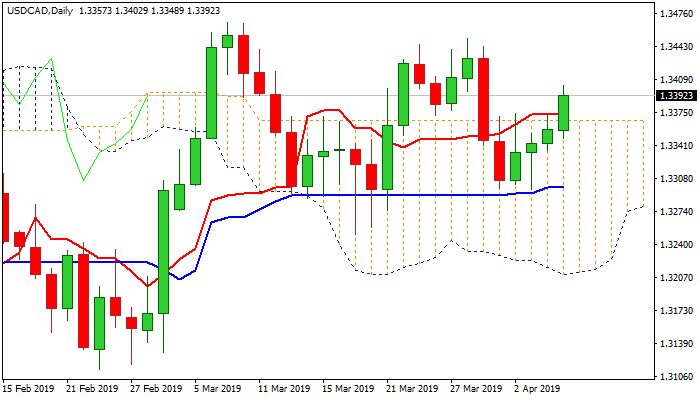
The pair rallied to one-week high at 1.3402 after US / Canada jobs data, but fresh bulls were so war unable to hold high levels Impact from stronger than expected NFP (Mar 196K vs 175K f/c / 20K Feb) was partially offset by slowdown in earnings growth (AHE Mar 0.1% m/m vs 0.2% f/c; y/y3.2% vs 3.4% f/c), while unemployment came in line with expectation and unchanged from previous month at 3.8%. on the other side, loonie was depressed by disappointing employment data which showed that Canada lost 7.2K jobs in Mar, compared to previous month's creation of 55.9K new jobs, although March figure was better than expectation (-10K). The greenback may fall further after markets fully digest results, as upbeat jobs figure suggest that the US economy is performing well in the labor sector, while retreat in AHE growth cools down and suggests that Fed will remain sideways. Today's post-data acceleration broke above daily cloud top (1.3366) following several unsuccessful attempts this week and generated further bullish signals on cracking pivotal barriers at 1.3391 /1.3400 (Fibo 61.8% of 1.3450/1.3296 bear-leg / psychological barrier) that require confirmation on close above these levels. That would open way towards key barriers at 1.3437 (Fibo 61.8% of larger 1.3664/1.3068 descend and 1.3450/67 (28 Mar / 7 Mar highs.). Bullish momentum and MA's turning to positive setup on daily chart, support scenario. Only return and close below daily cloud top would soften the structure.
Res: 1.3402; 1.3437; 1.3450; 1.3467
Sup: 1.3366; 1.3348; 1.3336; 1.3317
America’s Job Market Rebounds in March
America's job market shook off its February blahs, rebounding with 196k new jobs in March. February's showing was also revised up a bit, with net revisions for the prior two months up 14k. The unemployment rate remained unchanged at 3.8% in March.
Notable job gains occurred in health care (+49k) and professional and technical services (+34k). Hiring in leisure and hospitality also bounced back from a loss in February, rising by 33k positions.
There was further evidence that at least some of February's hiring weakness was due to the weather. In February there were 78k more workers than average who were unable to work due to bad weather. In March the figure fell back below average.
The overall labor force participation rate was down two ticks to 63.0% in March. The civilian labor force has shrunk in each of the first three months of the year. The participation rate is still a tick above its year ago level, but as baby boomers increasingly move into retirement, there will continue to be downward pressure on the headline participation rate.
Growth in average hourly earnings was a tad soft, up 0.1% in March. On a year-on-year basis, wages were still up a healthy 3.2% in March, down from a 3.4% pace in February.
Key Implications
America's job market can take a licking and keep on ticking. Solid job gains in March provide reassurance that February's weakness was a one-off. Still, zooming out on broader trends, the three-month average pace of hiring has slowed from about 240k jobs per month in the middle of 2018 to 180k in the first quarter.
Get used to hiring tallies below 200k per month. Economic growth is slowing from its 3% pace over the course of 2018 to just over 2% this year. This process will mean more muted monthly payroll gains, consistent with a mature phase of the economic cycle. We expect job gains to slow below 150k per month through the remainder of 2019. Still, this softer pace of hiring will be enough to see the unemployment rate fall a bit further below its current level, and keep wage gains healthy for workers.
Canada: A Blasé March Jobs Report
The Canadian economy shed 7.2k net jobs in March, ending a six-month streak of net gains. The unemployment rate held steady at 5.8% as slightly fewer Canadians engaged with labour markets.
Given the small change, the breakdown has less meaning than normal, but the drop was largely in full-time employment (-6.4k), and in the private sector (-17.3k). Public sector employment (+4.2k) and self-employment (+6.0k) held up in March.
On an industry basis, it was a mixed bag. The goods-producing sectors (+1.6k in aggregate) were roughly unchanged. Conversely, modest declines in some service sectors, notably health care (-20.0k), business support services (-14.3k) were offset by small gains in other categories, leaving the sector as a whole down 8.8k net positions.
The net drop in employment was largely a Quebec (-12.9k) and Ontario (-8.8k) story. B.C. provided some offset (+7.9k), with the remaining provinces even closer to no-change readings.
On the wage front we saw a slight uptick, to 2.3% year-on-year for permanent employees (February: +2.2%). Total hours worked rose 1.0% month-on-month, the strongest gain in more than a year, but not enough to offset the prior three months' declines.
Looking beyond the monthly noise, the six month trend remained solid at 35.5k per month. Employment was up 1.8% year-on-year in March.
Key Implications
Yawn. The story of the March jobs report was one of statistical zeros pretty much across the board. The end of a six month streak of job gains is sure to catch headlines, but given the strength we've seen over the past half year, a flat report isn't really surprising and indeed makes some sense given the relatively modest performance of other economic indicators in recent months.
If there is a bigger area to watch, it is hours worked. The 1% monthly climb in March is encouraging, but came after weather-induced softness in February, and was insufficient to reverse the prior three months of declines. This is despite adding a net 123.3k jobs over this time, with more than half in full-time work.
For the Bank of Canada, the key area of today's report is likely wages, where growth was effectively unchanged at 2.3% y/y. This is pretty close to the historic average, suggesting they have little to worry about from an inflation perspective (and at the same time, hardly indicative of tight labour markets). This again suggests that the current setting of the policy rate may be just about right, underscoring our view that the Bank of Canada may be on hold for quite some time to come.
EUR/USD Mid-Day Outlook
Daily Pivots: (S1) 1.1200; (P) 1.1225; (R1) 1.1245; More.....
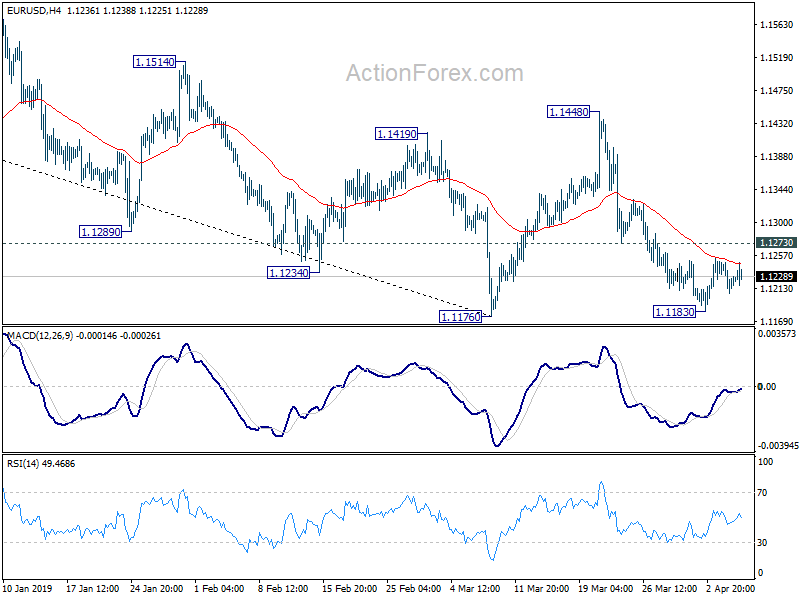
Intraday bias in EUR/USD remains neutral for the moment. More consolidations could be seen. Still, further decline is in favor as long as 1.1273 minor resistance holds. Sustained break of 1.1176 low will resume whole decline from 1.2555. On the upside, however, break of 1.1273 support turned resistance will confirm short term bottoming. Intraday bias will be turned back to the upside for 1.1448 resistance instead.
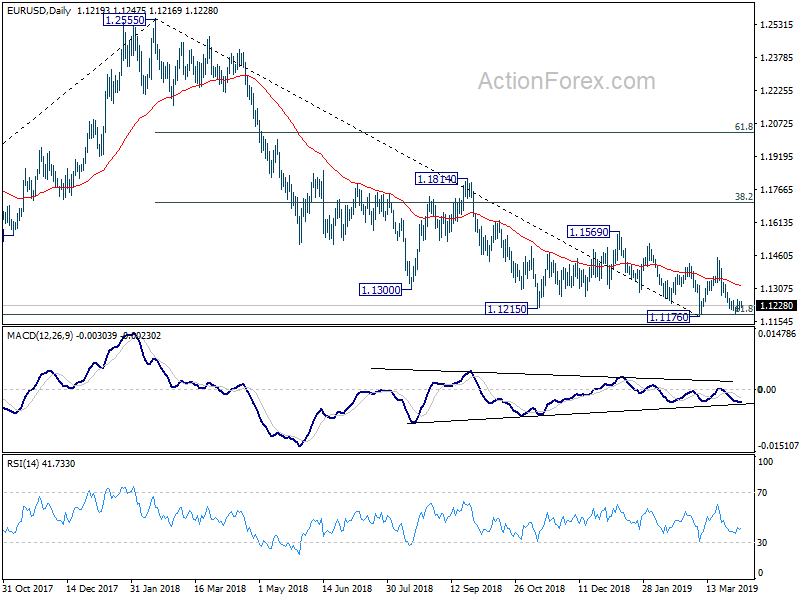
In the bigger picture, medium term weakness was revived as the weak rebound from 1.1176 was rejected well below 55 week EMA and failed to sustain above 55 day EMA. Focus is back on 1.1176 low, with 61.8% retracement of 1.0339 (2016 low) to 1.2555 (2018 high) at 1.1186. Decisive break there will resume whole down trend from 1.2555. Such decline target 1.0339 low next. On the upside, firm break of 1.1569 resistance is needed to be the first sign of medium term bottoming. Otherwise, downside breakout will be in favor.
GBP/USD Mid-Day Outlook
Daily Pivots: (S1) 1.3025; (P) 1.3109; (R1) 1.3157; More....
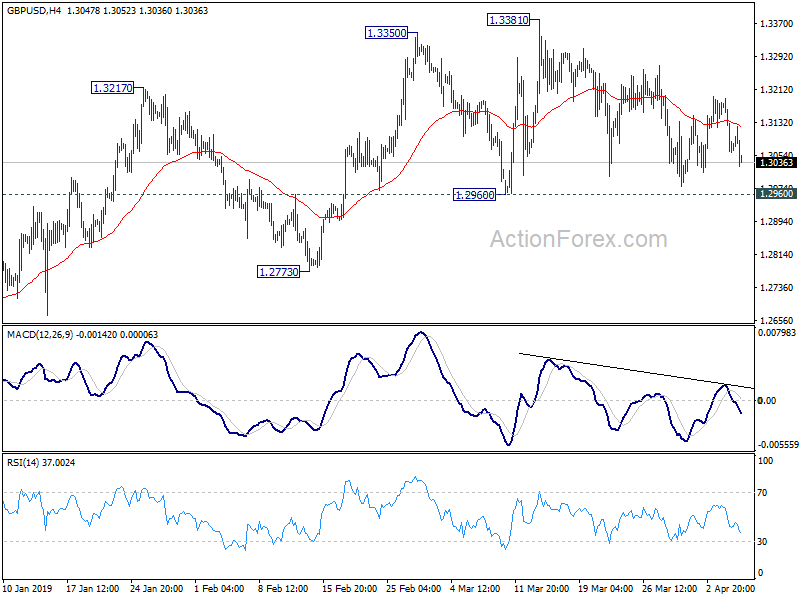
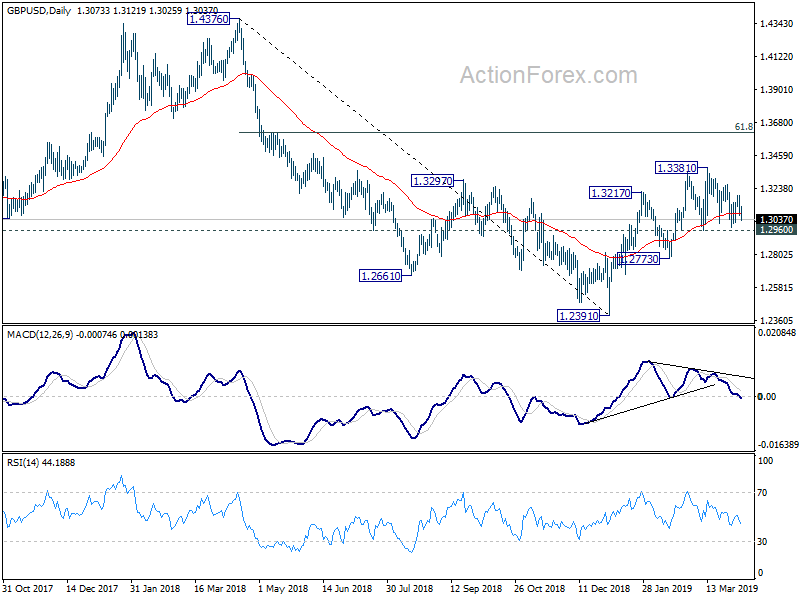
GBP/USD is staying in consolidation from 1.3381 and intraday bias remains neutral first. On the upside, firm break of 1.3381 will target 61.8% retracement of 1.4376 to 1.2391 at 1.3618 next. However, on the downside, firm break of 1.2960 will indicate that rebound from 1.2391 has completed earlier than expected. Deeper fall would then be seen to 1.2773 support for confirmation.
In the bigger picture, medium term decline from 1.4376 (2018 high) should have completed at 1.2391. Rise from 1.2391 is seen as the third leg of the corrective pattern from 1.1946 (2016 low). Further rise could be seen through 1.4376 in medium term. On the downside, though, break of 1.2773 support will dampen this view. Focus will be turned back to 1.2391 low and break will resume the fall from 1.4376 to 1.1946.
USD/JPY Mid-Day Outlook
Daily Pivots: (S1) 111.27; (P) 111.42; (R1) 111.65; More...
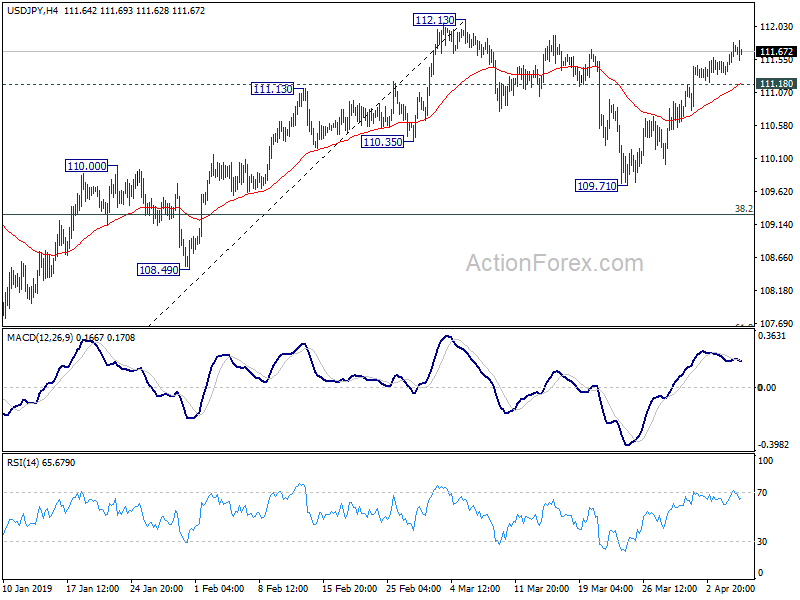
USD/JPY's rise from 109.71 is still in progress. Intraday bias stays on the upside for 112.13 resistance. Decisive break of 112.13 resistance will resume whole rise from 104.69 to 114.54 key resistance next. On the downside, however, break of 111.18 minor support will argue that rebound from 109.71 might be completed. Intraday bias will be turned back to the downside for 109.71, and possibly further to 38.2% retracement of 104.69 to 112.13 at 109.28.
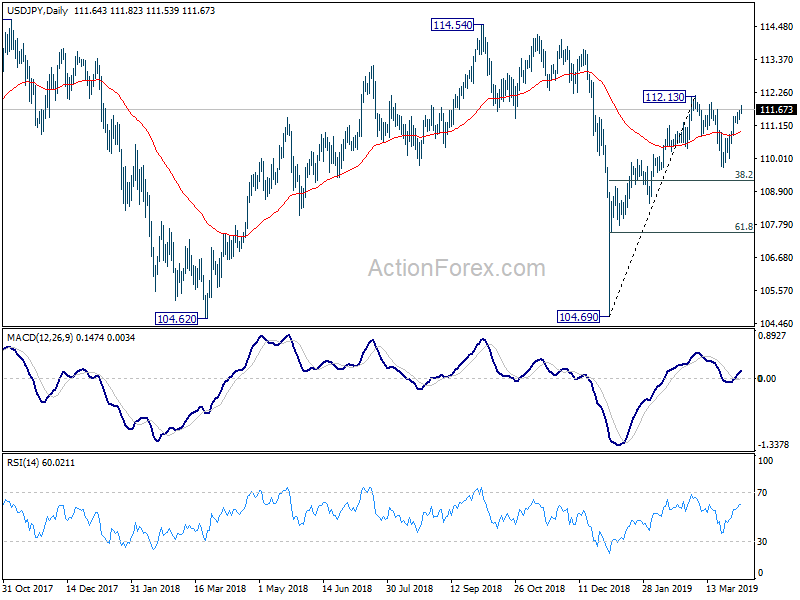
In the bigger picture, medium term outlook in USD/JPY remains a bit mixed as it's staying inside falling channel from 118.65, but there are signs of bullish reversal. On the upside, break of 114.54 resistance will revive the case the corrective fall from 118.65 has completed with three waves down to 104.69. And whole rise from 98.97 (2016 low) is resuming for 118.65 and above. But before that, outlook stays neutral first.
ECB Preview – More Warning on Downside Risk, No Big Move Until June
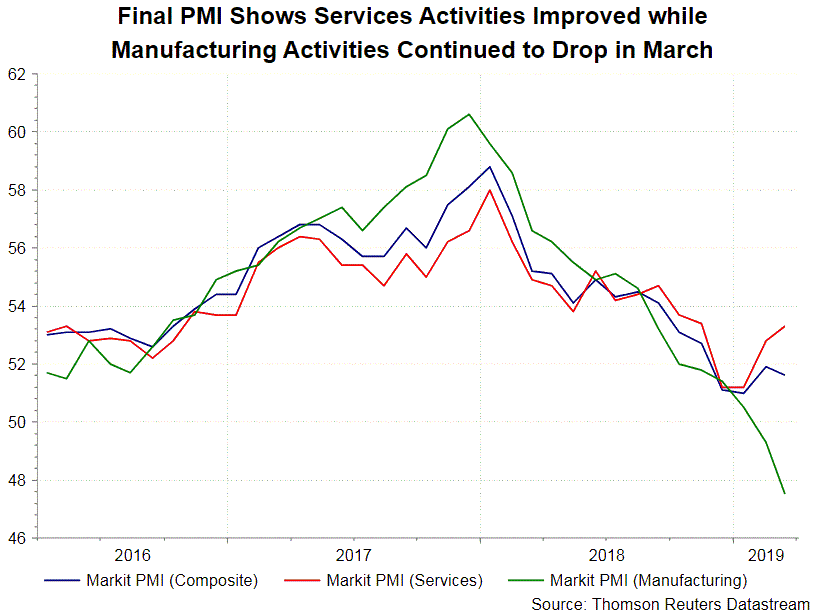
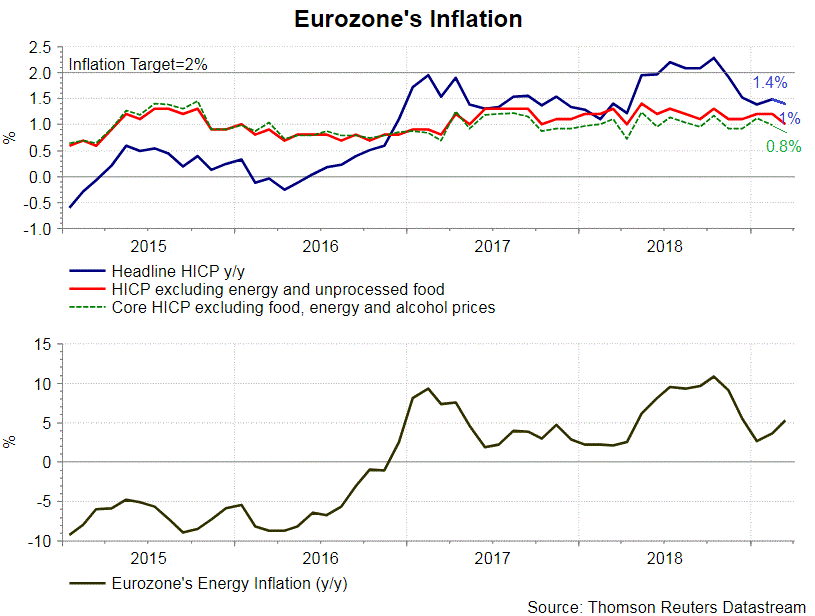
Despite some improvements in the economic data released since the March ECB meeting, the overall picture remains mixed and inflation pressure is still soft. There have been plenty of discussions about ECB’s future monetary policy since the last meeting.
First, the central bank made no elaboration on the details after announcing that a new batch of Targeted Long-Term Refinancing Operations (TLTROs) would be launched. Second, members’ comments over the past weeks have given rise to the possibility of a move to a “tiered deposit rate” system in order to save bank profitability. Third, the freshly-released March meeting minutes revealed that although the forward guidance was extended until the end of 2019, some members indeed favored to extend until first quarter of 2020.
With Eurozone’s inflation showing little sign of improvement year to date, and given the officials discussion on the “tiered deposit rate”, it is reasonable for one to speculate that the ECB would further extend the forward guidance, i.e.: pledging that the historically low interest rates would stay for longer.
We expect details of all the above issues, including adjustment to the forward guidance, would be announced in June (the meeting with updated economic projections).
For the meeting next week, ECB would leave the main refi rate, the marginal lending rate and the deposit rate unchanged at 0%, 0.25% and -0.40%, respectively. Meanwhile, it would likely intensify its cautious tone on the downside risk to the economic outlook, while more questions about TLTROs and the tiered deposit rate system are expected at the Q&A session of the press conference.
Targeted Long term Refinancing operations (TLTROs)
Last month, ECB announced the launch of “a new series of quarterly targeted longer-term refinancing operations (TLTRO-III)” from September 2019 to March 2021, “each with a maturity of two years”. Draghi noted that “the operation will help to preserve favourable bank lending conditions”. While the market is awaiting the technical details of the operations, we expect no update until June.
Tiered Deposit Rate System
It appears over the past weeks that the policymakers have become more vocal about the potential detrimental of negative interest rate to banks' profitability.
Peter Praet, the ECB’s chief economist, indicated in a Bloomberg interview that “the perspective of low rates for longer has triggered the debate about the side effects of a negative rates". He noted that the central bank is examining the issue of tiering, with some of banks’ excess reserves exempt from the lowest rate, adding that no action is a done deal.
President Draghi also admitted that "if necessary, we need to reflect on possible measures that can preserve the favorable implications of negative rates for the economy, while mitigating the side effects, if any".
Yet, the feasibility of the tiering system is debatable among the members. For instance, Klass Knot , the hawkish Dutch central bank head, suggested that, while some banks are exempted from negative interest rates, others are not. This is "implicitly telling all banks with a different business model that they will bear these costs for longer". He added that "there must at least be some evidence" to show that negative rates are "disrupting the impact of monetary policy through their effect on bank profitability" before implementing tools to mitigate it.
Since discussion of the tiering system remains in rather initial stage, we do not expect the ECB to provide any detail at the upcoming meeting.
Forward Guidance
In March, ECB noted that the policy rates would “remain at their present levels at least through the end of 2019”, pushing back the timing from “at least through the summer of 2019” previously.
As noted at the meeting minutes, “a number of members” proposed to extend “the forward guidance through the end of the first quarter of 2020”. They argued that the shift would “provide additional accommodation and would be more in line with the markets’ pricing of a first interest rate increase, compared with survey-based expectations”. They believed that this should provide “a clear easing signal” that is “important in view of the significant downward revisions to the ECB staff projections”.
All in all, the members “agreed to extend the Governing Council’s forward guidance through the end of 2019”, together with announcement on the reinvestment of QE and the TLTROs.
With regard to how frequently the forward guidance should be adjusted, it was concluded that “bringing the calendar-based leg of forward guidance more into line with market expectations of a later date for the first interest rate increase was widely seen as appropriately reflecting the Governing Council’s assessment of the inflation”.
Meanwhile, the state-based leg “automatically implied a shift in rate expectations if the economic conditions for an interest rate increase were not yet in place”.
We expect the ECB to keep the forward guidance unchanged in April. Depending on the economic developments, the members might further delay the timing for the first rate hike in June, when the updated economic projections would be released.
CAD Falls on Canadian Jobs Report and Stronger NFP
- Canada March net change in employment: -7.2K vs. +6ke
- Unemployment rate: +5.8% vs. +5.8%e
- Full time employment change: -6.4k vs. +5.4ke
- Part time employment: -0.9k vs. +7.0ke
- Participation rate: +65.7 % vs. +65.7%e
- Hourly wage rate Y/Y: +2.3% vs. 2.2%e
Data from Stats Canada this morning showed that Canada’s jobs market contracted slightly last month, coming in below expectations after two-months of exceptionally strong gains.
On a seasonally adjusted basis, Canada lost a net -7.2k jobs. Market expectations ranged from +6k to +10k new jobs.
Canada’s jobless rate was unchanged from the previous month at +5.8%, matching expectations.
In Q4 2018 and Q1 2019, Canadian data has revealed a period of weakness, which Governor Poloz at the Bank of Canada (BoC) has referred to as “a detour,” and said in March that he “anticipates growth will get back on track later this year.”
The loonie is currently trading at the low of the day outright, just shy of the C$1.3400 handle at C$1.3384. with stronger commodity prices, the market seems interested in buying CAD on USD rallies above C$1.3410-20 in the short term.
The ‘big’ dollar has been well bid in early trading on a strong non-farm payroll (NFP) headline print (+196k vs. +172k). It’s the ideal report for supporting risky assets – strong hiring, combined with muted wage growth (average hourly earnings +0.1% m/m vs +0.2e). There is nothing in today’s report to suggest the U.S labor market is rolling over nor is there anything to suggest that inflation could pick up at a pace that pushes the Fed to rethink its dot plan.
US Employment Growth Rebounded in March
- US payroll employment rose 196,000 in March, slightly ahead of expectations after a surprisingly weak 33,000 gain in February
- Average job growth of 180,000 for the first quarter is solid, but slower than we saw throughout 2018
- The unemployment rate was unchanged at 3.8%, having flattened out over much of the last year
- Wage growth edged down to 3.2% year-over-year but is still close to cycle highs
As expected, February’s slowdown in job growth proved to be an aberration with payrolls picking up nicely in March. Another quarter of robust job gains supports our view that the slowdown in Q1 GDP growth will be transitory (as we’ve seen in other years when the US economy seems to get off to a slow start). We think household spending will be key in the return to above-2% growth. While the stimulative effect of personal income tax cuts will fade this year, a strong labour market should continue to support consumers. Low unemployment is driving wages higher, and aggregate weekly payroll growth is still north of 5% year-over-year. And the household savings rate is well above levels seen in the late stages of the last two cycles. While the best consumer spending growth is likely behind us, it looks like households can continue to propel the US economy forward against the dampening effect of higher interest rates.
Canada Employment Edged Down 7k in March after Strong Earlier Gains
- Headline employment dipped 7k in March – a relatively small change given normal volatility in the monthly measure and retracing little of the 290k gain over the prior 6 months.
- The unemployment rate held steady at 5.8%, still right around multi-decade lows.
- Wage growth ticked up slightly and hours worked rebounded as a jump in the number of hours lost due to weather in February reversed.
A dip in headline employment is not surprising given what looked like overstated earlier gains – employment was up 290k over the prior 6 months. The 7k drop is small given typical confidence bands around the headline job growth numbers and doesn’t do much to change recent trends. The unemployment rate held close to multi-decade lows at 5.8% and wage growth ticked modestly higher, although at 2.4% year-over-year is still lower than one would ordinarily expect given what still look ostensibly like quite tight labour markets. And hours worked rebounded 1.0% after falling 0.7% in February as the number of hours of work lost to bad weather fell after jumping higher the earlier month. The data should do little to change the broader narrative that labour markets in Canada still look pretty solid. But wage growth is still slower than it should be. There is little evidence that underlying inflation trends are at any risk of jumping higher. And higher interest rates alongside regulatory changes have already contributed to significantly slower household debt growth and housing markets. That leaves the Bank of Canada with plenty of flexibility to stay on the sidelines in terms of any interest rate hikes for now.