

Sample Category Title
Summary 4/8 – 4/12
Monday, Apr 8, 2019
[php_everywhere instance="1"]
Tuesday, Apr 9, 2019
[php_everywhere instance="2"]
Wednesday, Apr 10, 2019
[php_everywhere instance="3"]
Thursday, Apr 11, 2019
[php_everywhere instance="4"]
Friday, Apr 12, 2019
[php_everywhere instance="5"]
Weekly Economic and Financial Commentary: Stronger PMI Readings Temper Global Growth Fears
U.S. Review
Softer First Quarter Coming Into Focus
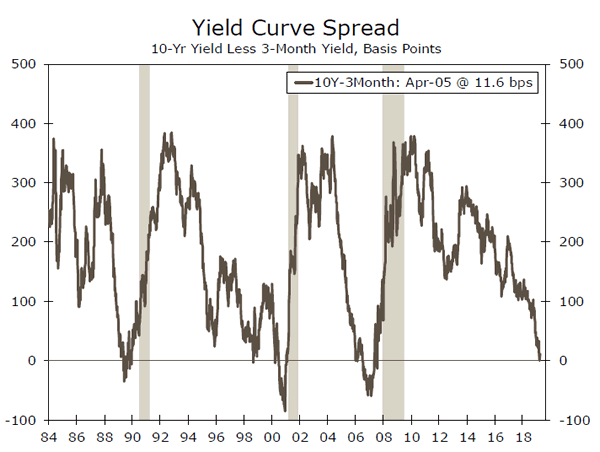
- The recent—but temporary—inversion of the yield curve deepened worries that the next recession could be sooner than many forecasters are anticipating.
- Recent data continue to suggest a softer first quarter, but with the underlying fundamentals of the U.S. economy generally solid at present, talk of an imminent recession is a bit overdone, in our view.
- With the moderation in job growth, and wage growth showing no further signs of acceleration in March, it remains unlikely that the FOMC will alter its "patient" stance any time soon.
Softer First Quarter Coming Into Focus
Weaker economic data have sparked fear of recession, and the recent—but temporary—inversion of the yield curve (chart on front page) deepened worries that the next recession could be sooner than many forecasters are anticipating. Recent data continue to suggest a softer first quarter, but with the underlying fundamentals of the U.S. economy generally solid at present, talk of an imminent recession is a bit overdone, in our view. Absent some unforeseen shock, "talking" ourselves into a recession seems to be the most realistic way the U.S. economy could experience one in the foreseeable future. Nevertheless, the economy is certainly losing momentum.
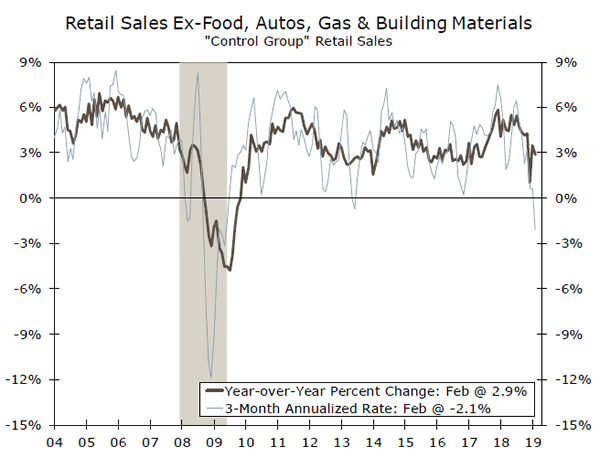
A main area of concern is the consumer. Accounting for almost 70% of GDP, a large retrenchment in consumer spending would materially weigh on economic growth. Consumer spending data have been extraordinarily choppy in recent months, and the mixed February retail sales report served as the latest affirmation that the consumer is in a bit of a soft patch. Retail sales declined 0.2% in February, but January's gain was revised more than three times higher than initially reported. Control group sales—which feed into the calculation of personal consumption expenditures in GDP estimates—also fell 0.2%. That nudged the three-month annualized rate to -2.1%, a rate not seen outside of a recession in the past 15 years (top chart). Other data suggest risks are stacked to the downside for Q1 consumer spending, but our sense is that this weakness is likely temporary.
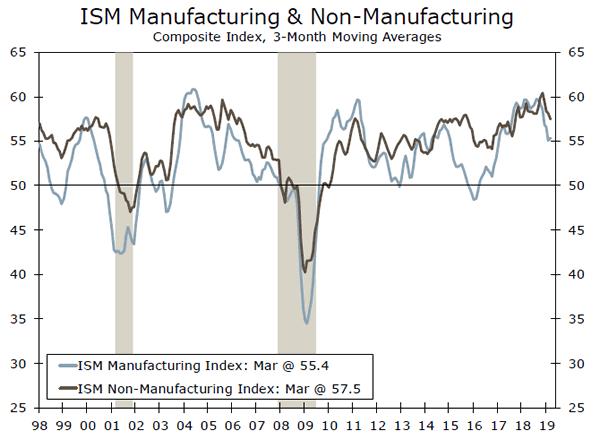
Equipment spending is also shaping up to be a weak spot in the first quarter, as U.S. manufacturing activity is under pressure from slower domestic demand and the still-uncertain trade environment. Durable goods orders fell 1.6% in February, and while nondefense capital goods shipments rose 0.6%, the 1.5% drop in January suggests only a tepid pace of equipment spending in the first quarter. While the manufacturing sector still faces challenges, the ISM manufacturing survey allayed some fears that U.S. factory activity is slowing dramatically. The ISM nonmanufacturing index, on the other hand, fell to a 20-month low in March. However, both the manufacturing and non-manufacturing indices remain firmly in expansion territory (middle chart), consistent with the economy continuing to grow, just at a slower rate than last year.
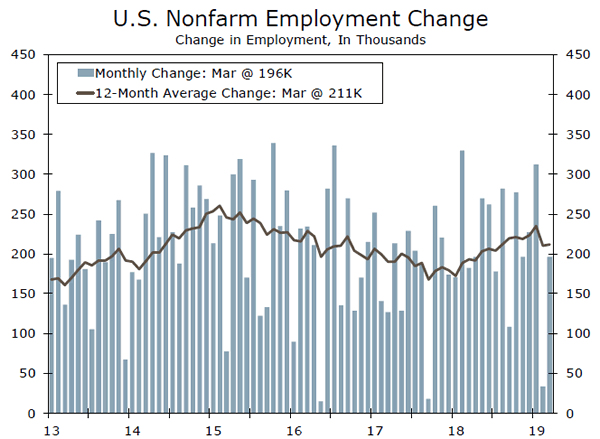
The employment picture remained positive. Employers added 196,000 jobs in March—welcome news after the largely disappointing gain in February (bottom chart). While the most recent print was slightly stronger than expected, it still suggests that the overall trend in hiring is moderating from the robust pace of job growth we saw last year. But by just about any measure, the labor market remains exceptionally tight, adding to our view that a prolonged retrenchment in consumer spending remains unlikely. With the moderation in job growth, and wage growth showing no further signs of acceleration in March, it remains unlikely that the FOMC will alter its "patient" policy stance any time soon. Economic growth is set to moderate this year. But after what we suspect to be a weak first quarter, GDP growth should return to a trend-like pace in the second quarter.
U.S. Outlook
Factory Orders • Monday
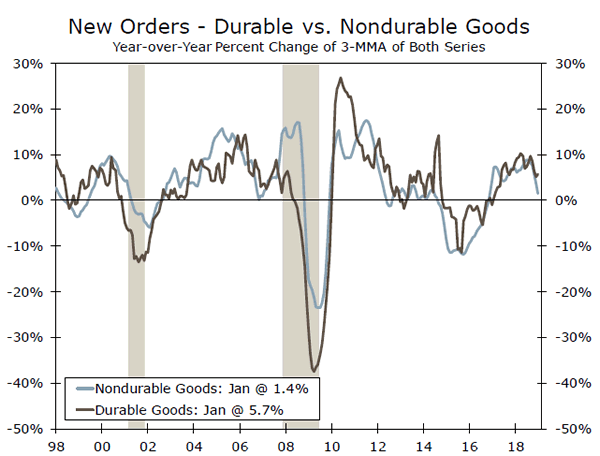
Slower growth at home and abroad, alongside lingering uncertainty surrounding trade policy, has put a damper on U.S. manufacturing activity. The advance durable goods report for February showed orders falling 1.6%. Nondefense capital goods orders ex-aircraft, an indicator of business investment in equipment, held up better, but have declined 3.4% on a three-month average annualized basis.
Monday's report will provide an updated estimate on February capex spending, but the new information in the report will be for orders and shipments for nondurable goods. Nondurables account for half of U.S. factory orders, and have come under pressure the past few months as energy prices, which influence the value of petroleum and chemical orders, have fallen. We look for a slight increase in nondurable orders in February, however, which should limit the decline in total factory orders to -0.6%.
Previous: 0.1% Wells Fargo: -0.6% Consensus: -0.5%
Consumer Price Index • Wednesday
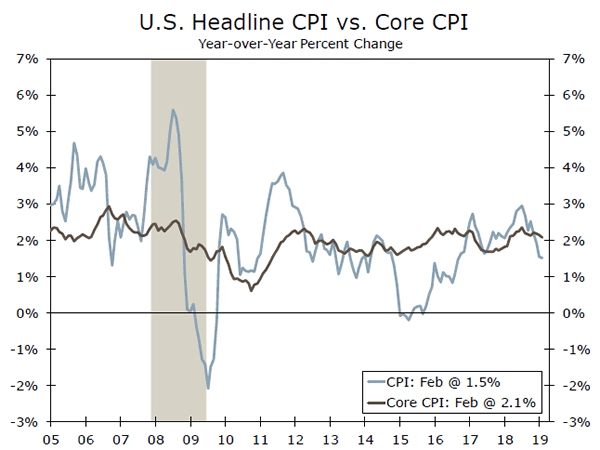
Consumer price inflation remained tame in February with headline prices increasing 0.2%, and core prices advancing just 0.1%. We expect price growth to heat up a bit in March. Gas prices according to AAA rose more than 9% last month, which should help lift headline inflation to 0.4%. Meanwhile, core prices are expected to increase 0.2%, driven in part by a rebound in medical care costs.
Even with a pickup in March, the overall trend in inflation should be little changed. Core inflation is expected to remain at 2.1% on a yearago basis, which is close to the Fed's goal. An upside surprise to the core index would suggest that inflation is picking up on trend and reduce market expectations for a Fed rate cut later this year. A downside miss on core inflation, however, would give the FOMC another reason to be patient in adjusting rates despite continued strength in the labor market.
Previous: 0.2% Wells Fargo: 0.4% Consensus: 0.3% (Month-over-Month)
Producer Price Index • Thursday
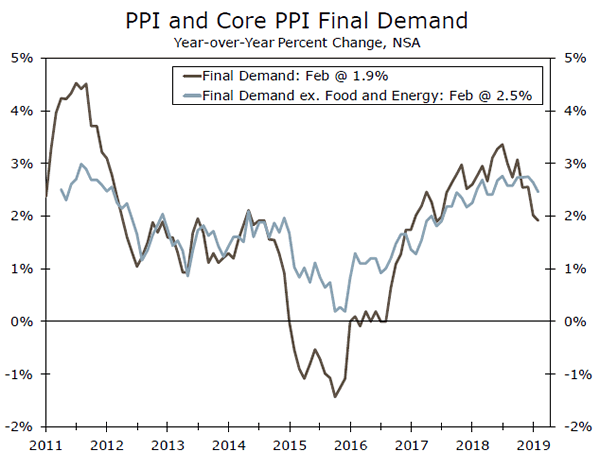
Producer price inflation has weakened since the start of the year, with the PPI for final demand easing to 1.9% year-over-year from more than 3% as recently as October. The slowdown partly reflects weaker energy prices since last fall, but PPI inflation for non-food and energy goods has moderated, as has price growth for services.
We look for energy prices to lift the headline index 0.3% in March. Core inflation is also expected to rise faster than in February as weakness from the volatile trade services component, which is measured by margins, not selling prices, reverses. The duration of the upturn will likely be limited, however, as growth in input prices for goods and services, even when excluding food and energy, has weakened recently.
Previous: 0.1% Wells Fargo: 0.3% Consensus: 0.3% (Month-over-Month)
Global Review
Stronger PMI Readings Temper Global Growth Fears
- Stronger-than-expected readings on purchasing manager indices in China and the United Kingdom kicked off the week on a positive note.
- A solid retail sales print in the Eurozone was also encouraging, although the divergence between the service and manufacturing sectors appeared to widen further.
- Like many of the other major central banks around the world, the Reserve Bank of India took a dovish turn this week, cutting its main policy rate 25 basis points.
Stronger PMI Readings Temper Global Growth Fears
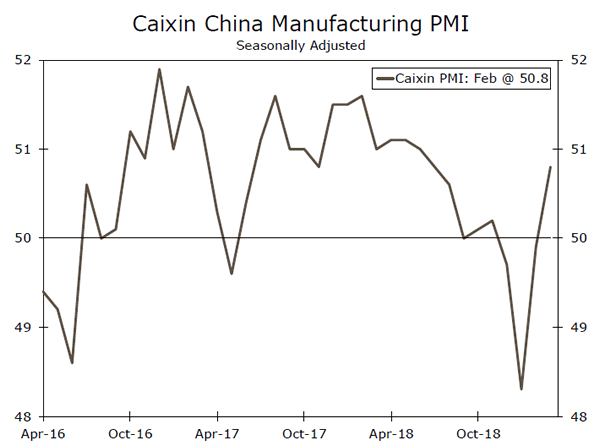
Stronger-than-expected readings on purchasing manager indices (PMIs) in China and the United Kingdom kicked off the week on a positive note. China's Caixin Manufacturing PMI rose to 50.8 in March, up from 49.9 in February and a multi-year low of 48.3 in January (see chart on front page). While the reading was still fairly soft on an absolute basis, the improvement over the past couple months offers some signs that the monetary and fiscal stimulus enacted by Chinese policymakers is beginning to take hold.
A few hours later, PMI data for the United Kingdom's manufacturing sector also topped expectations, rising to 55.1 in March compared to expectations for a slight decline to 51.2. Although we are skeptical of such a strong reading (see the Global Outlook section for more), the positive back-to-back prints assuaged some fears about the global slowdown and helped spark a general rally in risk assets over the course of the week.
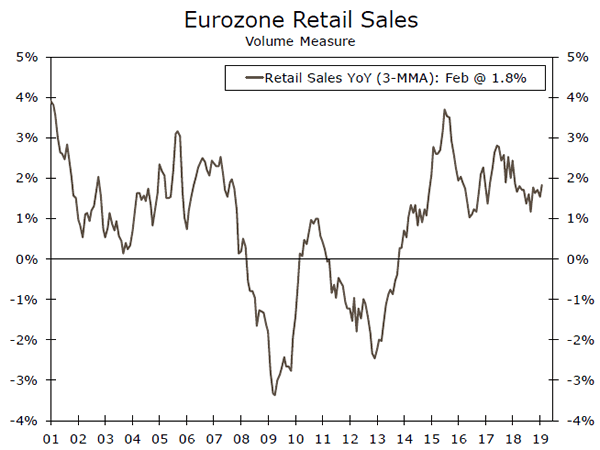
Retail sales data for the Eurozone were also encouraging. Real retail sales climbed 0.4% in February, bringing the year-over-year change to 2.8%. Although retail sales growth has clearly slowed over the past couple years, it has shown signs of stabilizing of late (top chart). This pick-up suggests the consumer sector in Europe remains in decent shape even as the factory sector has struggled. To that point, the final March PMI readings for the Eurozone showed an upward revision to services (to 53.3 from 52.7) but continued weakness in manufacturing (to 47.5 from 47.6).
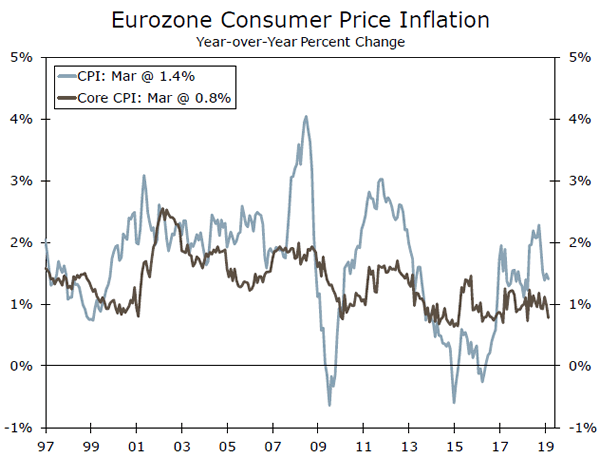
As economic growth has slowed in the Eurozone, price growth has also cooled. Data released this week showed core consumer price inflation in the Eurozone was just 0.8% year-over-year in March, the lowest reading in almost a year. In the foreword to its annual report released on April 1, European Central Bank (ECB) President Mario Draghi noted that "substantial monetary policy stimulus remains essential to ensure continued build-up of domestic price pressures over the medium term."
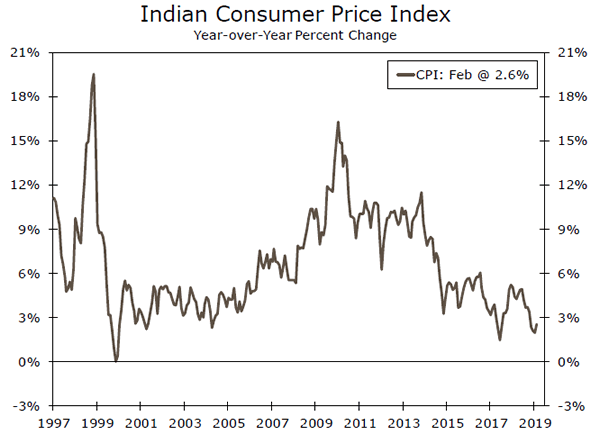
Like many of the other major central banks around the world, the Reserve Bank of India (RBI) took a dovish turn this week, cutting its main policy rates 25 basis points. The RBI noted that the domestic economy is "facing headwinds, especially on the global front." Though economic growth remains robust compared to most countries, real GDP growth in India has slowed over the past couple quarters, and private investment growth has been sluggish. In addition, inflation pressures have been fairly muted, as the consumer price index was up just 2.6% in February, at the low end of the RBI's target of 4% with a tolerable band +/- 2% (middle chart). While the data appear weak enough to justify some policy easing, the timing comes on the eve of national elections in India. Given the recent questions surrounding possible political interference in the RBI, the recent policy move is unlikely to ease concerns about the central bank's independence.
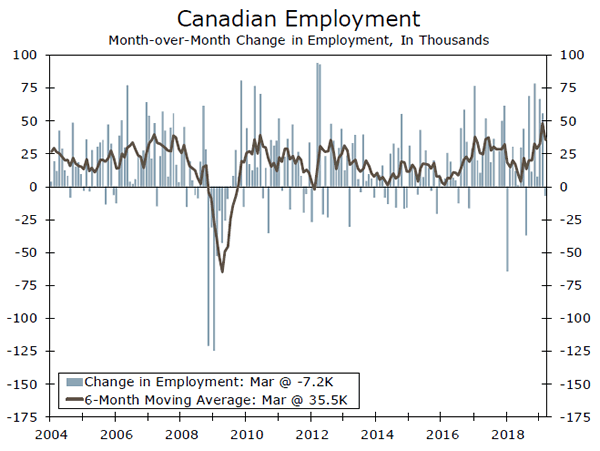
Canadian employment rounded out the week with a negative print. Employment fell by 7,200 in March, though this came on the heels of a strong February reading. Trend employment growth remains solid in Canada (bottom chart), and we believe this should help drive the Bank of Canada to hike rates once again later this year.
Global Outlook
Mexico Gross Fixed Investment • Monday
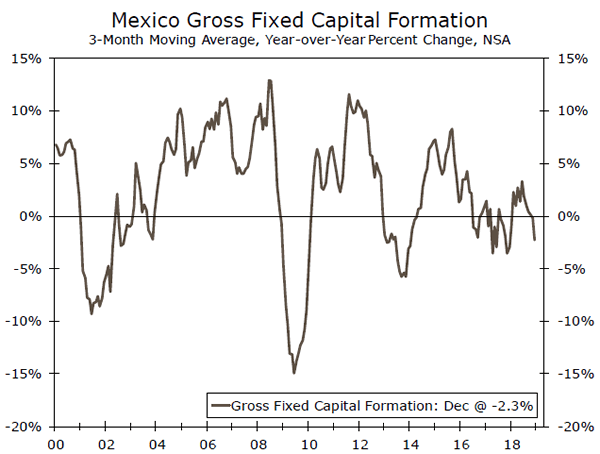
Gross fixed capital formation growth has been weak in Mexico over the past few years, as trade uncertainty and high real interest rates have weighed on capital investment. Next week's release will offer the first monthly data on capital formation in Mexico in 2019.
As we discussed in a recent special report on the outlook for Mexico's economy, fixed capital formation is perhaps what the Mexican economy needs the most at present. Mexico's oil industry has badly lagged behind its robust counterpart in the United States. It's production of petroleum peaked at nearly 3.5 million barrels per day in the mid-2000s, and has since declined by 50%, to about 1.6 million barrels per day at present. While solving the oil energy's woes would likely not be enough for a full reversal of the Mexican economy, steady growth in capital investment is key to faster productivity growth. Without it, it will be much harder for Mexico to return to its historically high rates of economic growth.
Previous: -6.8% (Year-over-Year)
U.K. Industrial Production • Wednesday
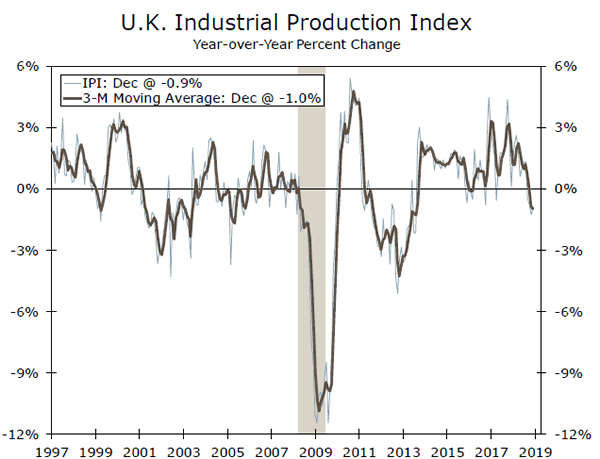
The U.K. economy has been surprisingly resilient despite uncertainty around Brexit, at least when the data are taken at face value. GDP growth rebounded in January with a 0.5% month-over-month gain amid strong manufacturing output, while retail sales beat expectations in the first two months of 2019. In March, the U.K. manufacturing PMI jumped to 55.1, the highest in nearly a year.
While this strength is encouraging, particularly as it relates to consumer demand, it appears that at least some of the recent strength has been the result of inventory building as manufacturers prepare for a potential no-deal Brexit. On a year-over-year basis, the trend in industrial production is hardly encouraging (see chart to left). While stockpiling activity may boost Q1 real GDP growth in the U.K., there may be some payback over the second and third quarters. Were a no-deal Brexit to occur, a drag on growth from inventories would likely be the last thing the U.K. economy needs.
Previous: -0.9% (Year-over-Year) Consensus: -0.8%
European Central Bank• Wednesday
We do not expect any major policy changes from the European Central Bank (ECB) at its meeting next week, though we may get some additional details on the next phase of targeted longer-term refining operations (TLTROs). As was discussed in the global review section, growth and inflation in the Eurozone remain tepid, and this in turn has pushed back any plans the ECB had in regards to tightening monetary policy in 2019.
We continue to expect Eurozone economic growth and inflation to stabilize over the next couple quarters, and this should help forestall any additional outright easing by the central bank. Even if things stabilize, however, the ECB will likely proceed with caution. Some Eurozone economies like Italy are either in or close to recessions, and core consumer price inflation has been below 1.5% since August 2012. Unless economic conditions improve significantly, we think the first rate hike from the ECB will not occur until at least Q1-2020.
Previous: -0.40% (Deposit Rate) Consensus: -0.40%
Point of View
Interest Rate Watch
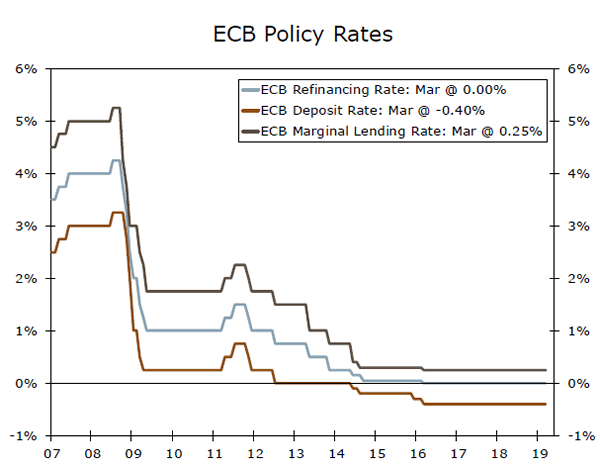
ECB On Hold for Foreseeable Future
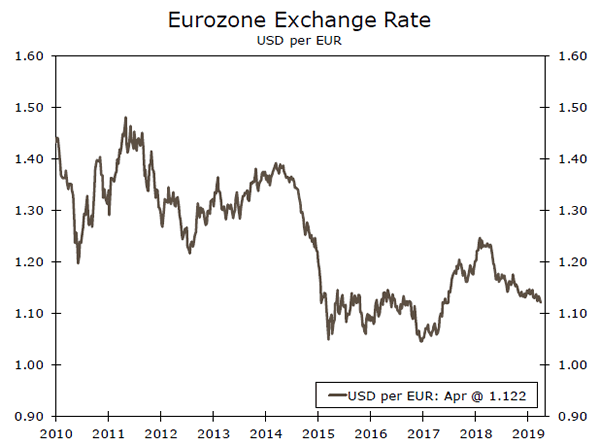
The European Central Bank released the minutes of its March 7 policy meeting this week, which offered some further insights into the current thinking of the Governing Council. As communicated in the March 7 policy announcement, the Governing Council pushed out the timing of when it expects to start raising rates, which have been held at historically low levels for three years (top chart). ECB policymakers had expected that its three main policy rates would remain unchanged through summer 2019. However, due to recent signs of economic weakness that "pointed to a sizeable moderation in the pace of the economic expansion that would extend into the current year" as well as "the persistence of uncertainties," the Governing Council now thinks that rates will be on hold through at least the end of this year. As discussed on page 5, we think the first rate hike from the ECB will not occur until at least Q1-2020. Consequently, we believe that the value of the euro vis-à-vis the U.S. dollar will remain roughly unchanged for the foreseeable future (middle chart).
Brexit & the Bank of England
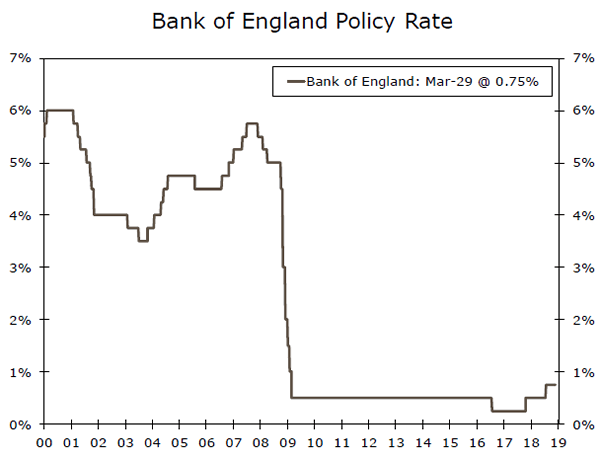
The Bank of England does not hold a policy meeting until May 2. But the uncertainty associated with the ongoing Brexit saga means that the Monetary Policy Committee (MPC) likely will continue to keep its main policy rate unchanged at 0.75% for the time being (bottom chart). As discussed on page 4, the uncertainty of the economic outlook showed up in the March PMIs which were released this week. Although the British parliament voted this week to take the option of a "hard" Brexit off of the table, economic uncertainty remains. The new rules that will govern the economic and financial relationship between the United Kingdom and the remaining 27 members of the European Union still need to be negotiated. We have been assuming that a "hard" Brexit would be avoided, but we recently downgraded our GDP growth forecast for 2019 to 1.3% from 1.5%. Consequently, we believe that the MPC will be on hold until this August, when we look for it to nudge up its main policy rate another 25 bps and then remain on hold through the end of the year.
Credit Market Insights
Banking Sector Resilient to Real Estate Price Declines
Financial institutions of all sizes have exposure to real estate through their lending portfolios, suggesting that a significant decline in property prices could spell trouble for the banking sector and possibly feed through to a tightening in credit throughout the economy. We have written that a downturn in commercial real estate prices would not likely be the catalyst for the next recession, and the Fed's most recent stress test results largely support this conclusion. The largest financial institutions are much better capitalized than they were during the lead up to the financial crisis—the last time that property prices reached all-time highs—and stress test results suggest that they would be able to continue lending in spite of loan portfolio losses. Yet smaller banks that are not subject to Fed stress tests, which collectively comprise about 20% of the banking sector, tend to rely relatively more on real estate lending and benefit less from geographic diversification. Despite this heightened exposure, new research from the San Francisco Fed indicates that only around one percent of these smaller banks would be undercapitalized as a result of the most severe portfolio loss scenarios specified under the Fed stress tests.
Despite broad-based price appreciation across both commercial and residential real estate, the banking sector, which tightened lending standards and increased capital cushions in the aftermath of the financial crisis, is not overly exposed to a downturn in prices. Therefore, we do not expect—for now—the epicenter of the next recession to be the real estate sector.
Topic of the Week
Fallout from a Potential Border Closure
President Trump had threatened to close the U.S.-Mexico border, or at least parts of it, due to the surge of Central American migrants that have streamed into the country. While recent comments suggest the threat of a border closure has lessened, the possibility remains. Not only would a border closure stop many migrants from entering the country, but it also could have disruptive effects on trade flows. In a recent special report, we discuss some of the economic implications if the president were to carry through with this threat.
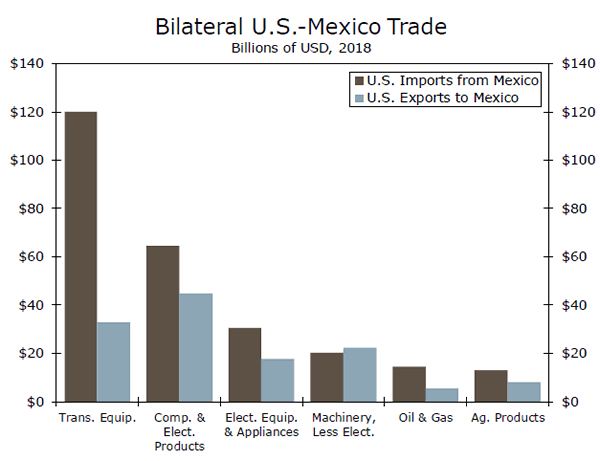
Last year, American exports of goods to Mexico totaled $265 billion while imports of goods exceeded $346 billion. Intra-industry trade in transportation equipment was especially intensive. As shown in the top chart, the United States sent $33 billion worth of transportation goods south of the border last year while it received $120 billion from Mexico, the vast majority of which were auto imports. About $64 billion of these auto imports were finished vehicles, but roughly $50 billion were auto parts. Consequently, a closure of the border could have a crippling effect on the U.S. auto industry.
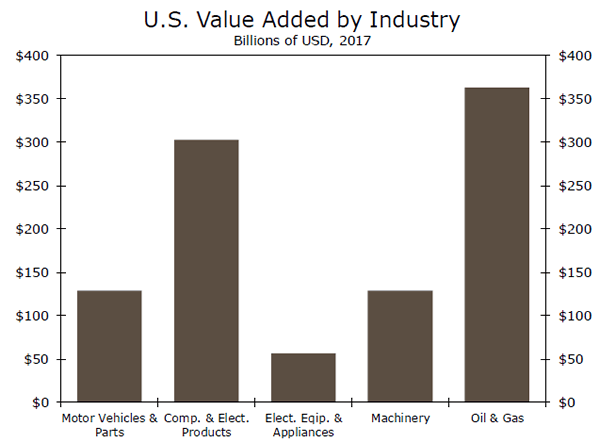
How big of an impact could this have on the U.S. economy? As shown in the bottom chart, real value added in the motor vehicle industry totaled almost $130 billion in 2017, which represented 0.7% of all the real value added in the U.S. economy in that year. Under the extreme assumption that a closure of the border would cause all motor vehicle production in the United States to come to a complete halt, then the direct hit to the U.S. economy would be about $2.5 billion per week. But there would be multiplier effects if idle auto workers pared back their purchases of goods and services. In terms of employment, the American auto industry employs roughly one million people, which represents 0.7% of total payrolls, and the computer industry employs a comparable amount. These workers could be idled under the extreme assumption that production in these industries completely shuts down.
Realistically, however, a closure of the southern border likely would not be disruptive enough to cause a recession in the United States. But the costs to growth could start to add up if the border were to remain closed for an extended period of time.
The Weekly Bottom Line: Labor Market Strength Back on Display in March
U.S. Highlights
- Progress on U.S.-China trade negotiations helped support risk appetite this week, with equity prices and yields up.
- February retail sales fell 0.2% month-on-month, but an upgrade to January made it more palatable. On the other hand, the job market bounced back in March (+196k), confirming that the weakness in February was but a speed bump.
- The pace of job gains is expected to slow to around 150k per month on average over the remainder of the 2019 – slower than last year, but still decent and more than sufficient to keep downward pressure on the unemployment rate.
Canadian Highlights
- It was a solid risk-on week in Canadian financial markets, as optimism on global growth and trade lifted equities and led to a selloff in fixed income.
- The Canadian job market finally returned to earth in March, shedding a modest 7.2k jobs following outsized gains in the previous two months. The unemployment rate remained unchanged at 5.8%
- Bank of Canada governor, Stephen Poloz gave a speech in Iqaluit this week, noting the structural challenges to Canadian goods exports, but also lauding the gains in services. In comments after his speech, he noted that the recent inversion in the yield curve was an "innocent" one and not indicative in his mind of a looming recession.
U.S. - Labor Market Strength Back on Display in March
Progress on U.S.-China trade negotiations helped support risk appetite in financial markets this week. Major U.S. stock indices, such as the S&P 500 – up 2% on the week – had a strong run. As money flowed into equities, Treasuries sold off, boosting bond yields, particularly for longer maturities. This helped keep the spread between long-term and short-term yields in positive territory, easing some of last week's anxiety about any recession signal from the yield curve's inversion.
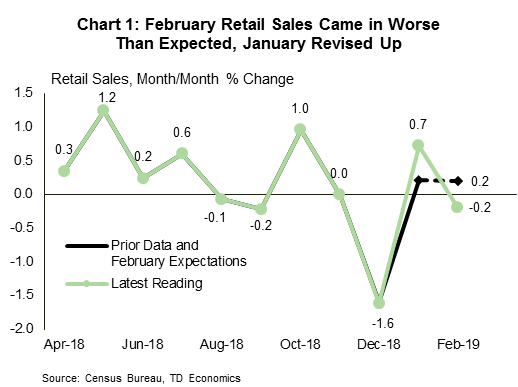
Economic data, though not entirely positive, was broadly supportive. February retail sales undershot market expectations, falling by 0.2% m/m, instead of rising by a commensurate amount. The miss on the sign in the headline print seemed like a cruel April Fools' joke. But, the hefty upward revision to January mitigates the downside to 19Q1 spending (Chart 1). Proving more constructive was a strong bounce-back in auto sales in March to 17.5 million, after two consecutive monthly declines. But, even with a decent showing in March, first-quarter consumption growth is unlikely to surpass 1% annualized. This soft performance is really no surprise given the drag from 'residual seasonality' and the government shutdown.
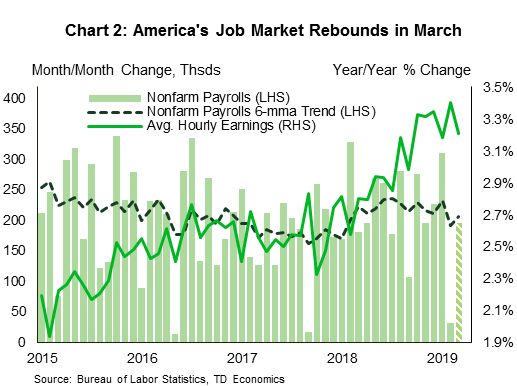
Lower interest rates and a steady Fed, together with a robust labor market, should continue to shore up spending in the months ahead. On the employment front, the payrolls report did not disappoint, with job gains making a comeback in March (Chart 2). The economy added 196k new jobs last month, while the unemployment rate managed to hold on to a low 3.8%. In addition, the prior two months of data were revised up by 14k combined. Other details were less rosy, such as the participation rate ticking down 0.2 ppts to 63% and wage growth easing a touch.
The March jobs data confirms that the weak February print was but a speed bump. That said, we still expect a tightening labor market to curtail the pace of job gains to below 150k per month on average through the remainder of 2019. This is slower than last year, but still decent – a theme that aligns with the broader economic narrative of GDP growth slowing to just above 2% this year.
The recent performance of manufacturing and service industries supports this view. The ISM indices have decelerated on a trend basis from last year's highs, but both remain well in expansionary territory. In March, the two indices diverged, with the non-manufacturing index undershooting expectations (-3.6 points to 56.1) and the manufacturing index surprising on the upside (+1.1 points to 55.3). Still, both signal an economy expanding at a healthy pace.
The resilience of the U.S. manufacturing sector has been remarkable, given the slump in activity elsewhere. Although manufacturing improved in China and a few regional partners in March, it remained in contraction in the Euro Area. The Old Continent is going through a rough patch, and, with economic growth expected to clock in at a low 1.3% this year, it remains a source of downside risk to the global economic outlook (see here).
Canada - Job Market Returns to Earth
It was a risk-on week in Canadian financial markets, as optimism about global growth and prospects for a trade deal between China and the U.S. boosted equity prices and brought bond yields along for the ride. Economic data was relatively sparse, but the much awaited labour force survey landed with a thud, showing job growth returning to earth after several months of gravity defying gains.
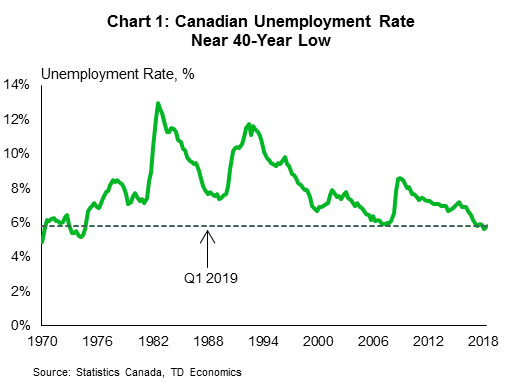
Indeed, the seemingly-unflappable Canadian job market wobbled in March, shedding 7.2k jobs. The pullback in job was matched with a similarly modest outflow of people from the labour force (-11.3k), leaving the unemployment rate unchanged at 5.8%.
Looking across the country, job losses were concentrated in central Canada, with both Quebec and Ontario shedding jobs after strong growth in the prior two months. In Ontario, the losses were enough to push the unemployment rate up two ticks to 5.9%, while in Quebec the rate fell a tick to 5.2%, as people left the labour force.
While disappointing perhaps, the data was ripe for a reversal. Job growth in the preceding two months seemed completely divorced from the broader economic narrative of slowing activity. Even while losing jobs in March, the three month average for gains is 38.5k (or 2.5% annualized). Judging the threshold for job growth required to keep the unemployment rate steady is more difficult these days given the acceleration in Canadian population growth, but there is little doubt the recent trend has been above it. Job growth in the neighborhood of 10k a month is still a good estimate for trend, and unless growth slows below this rate, we see little reason to worry about the health of the labour market.
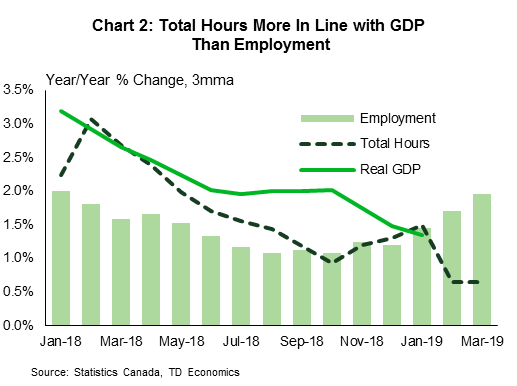
Another reason to look past the headline job number is that total hours worked went in the opposite direction in March, rising 1% and partially reversing three months of weakness. By this metric, the labor market performance has been less impressive over the start of this year, but more consistent with a modest pace of economic growth.
Bank of Canada governor Poloz's speech this week in Iqualiut offered yet another reason for the seeming disconnect between the job market and economic data, noting that growth has been concentrated in service-industries where measurement is more difficult. This may not be the most satisfying explanation, but it has merit. Nearly 30% of the jobs created over the past year in Canada have been in professional, scientific and technical services - relatively high paying service-sector jobs . This is a positive signal that once through near-term challenges, Canada is adapting to the new economy.
Still, as long as the global outlook remains uncertain, Canada's trade engine is sputtering, and households highly sensitive to changes in interest rates, the policy stance required to keep us on the straight and narrow is likely to remain accommodative and the overnight rate to stay put at 1.75%.
U.S.: Upcoming Key Economic Releases
U.S. Consumer Price Index - March
- Release Date: April 10, 2019
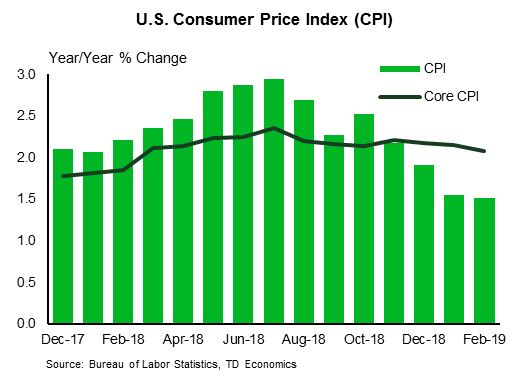
- Previous: 0.2% m/m, 1.5% y/y; core 0.1% m/m
- TD Forecast: 0.4% m/m, 1.9% y/y; core 0.2% m/m
- Consensus: 0.3% m/m, 1.8% y/y; core 0.2% m/m
We look for headline CPI to pick up to 1.9% from 1.5%, reflecting a strong 0.4% seasonally adjusted m/m increase. The main driver is a sharp pickup in gasoline prices (+7.7% m/m). In the core index, we expect a 0.2% m/m print, but on the weak side. OER is likely to moderate this month after its outsized 0.33% m/m gain in the prior month. This should be partially offset by a rebound in core services ex-shelter, allowing overall core services to print a steady 0.2% increase. Core goods prices should normalize after a fairly sharp decline in February, but we are hesitant to expect a strong rebound thanks to weak imported goods prices. Upward tariff-related impacts have likely faded by now as well.
February CPI and our forecast for March suggests that the downward trajectory in core PCE inflation will continue through March. Recall that core PCE disappointed at 1.8% y/y in January, down from an upwardly revised 2.0% in December. We expect core PCE to hold at 1.8% y/y in February (but fall on an unrounded basis) and slide further to 1.7% in March. A slip to 1.7% by February cannot be ruled out.
Canada: Upcoming Key Economic Releases
Canadian Housing Starts - March
- Release Date: April 8, 2019
- Previous: 173k
- TD Forecast: 190k
- Consensus: 194k
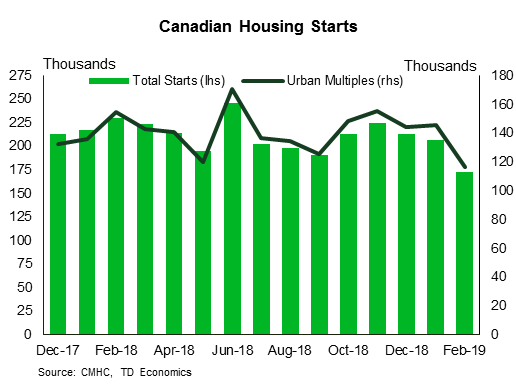
Housing starts are forecast to remain subdued at a 190k pace in March for a modest pickup from the post-crisis lows of 173k the prior month. Multi-unit starts fell by an annualized 30k in February despite sustained strength in permit issuance which points towards some recovery in March; previous declines of a similar magnitude have seen a 60% correction the following month. However, employment data has shown a sharp decline in construction hours worked through early 2019 and single family permit issuance continues to trend lower, which points towards further weakness ahead.
Dollar Rises on Strong US Jobs Data
The US dollar is higher across the board against major pairs on Friday. The greenback got a boost from the March U.S. non-farm payrolls (NFP) report that showed the economy added 196,000 jobs and an upward revision to the February numbers. The wage component did not do as well with a lower than expected gain at 0.1 percent that validates the dovish stance of the U.S. Federal Reserve. The central bank has taken off the board all interest rate hikes that were forecasted last year. The immediate market reaction after the report triggered a rise in risk appetite with investors selling the dollar after President Trump once again pressured the Fed to lower rates.
The Fed will release the minutes from its March FOMC meeting on Wednesday, with no surprises expected but they will make for a dovish reading of the economy as Fed speaker speeches has been full of patient language. The dollar on Friday as once again its crown as a safe haven remains untouched and going into the weekend investors reduce their exposures in their portfolios.
Pound Under Pressure as EU Decides on Extension
The GBP/USD wrapped up the trading week nearly flat on a weekly basis despite all the Brexit drama that unfolded this week. Lack of consensus will most likely result in an extension for the UK divorce from the European Union, that in a shock twist might see them stop the proceedings. British PM Theresa May is pushing for her deal going so far as crossing party lines to ask for the opposition’s support. The gambit is unlikely to succeed, but after offering her resignation to members of her own party failed it was the only option available.
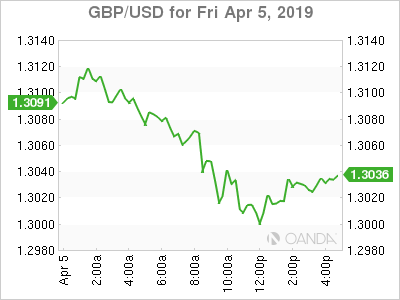
April 12 is the new deadline that needs to be extended. The EU leaders will meet to debate whether to grant the extension or trigger a hard exit. Economic data will be plentiful in the UK with GDP and manufacturing data the biggest highlights. Brexit has had negative impact on growth that is now forecasted to slowdown to 0.2 percent on monthly basis. Global companies have begun to shift their investment out of the UK as the process is not expected to be wrapped up one way or another in the short term.
Supply Disruptions Push Oil Prices Higher
Oil rose on Friday despite the dollar getting a boost from a stronger than expected NFP report. Oil has continued to rally after US sanctions against Iran and Venezuela have combined with the OPEC+ efforts to limit production. US production is forecasted to ramp up after a brief pause and one of the biggest hurdles for energy prices this quarter.
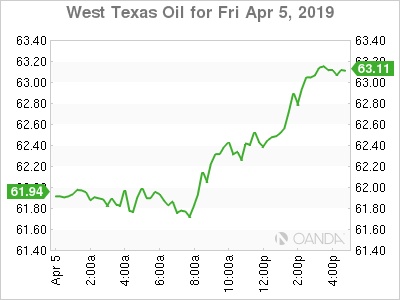
OPEC will meet this week in Vienna, but with the cancellation of the OPEC+ ministerial meeting last month, the focus is now on the larger group as an extension to the production cut agreement has been signalled by Saudi Arabia and Russia.
US-China trade negotiations have been crude positive, but with so few details it could easily turn to negative if talks face something larger than this week’s speed bump. Comments from both sides have mentioned progress, but so far there is little in the way of details on how close the two really are.
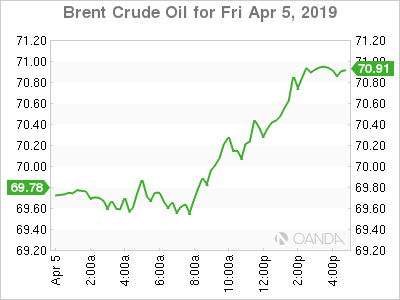
A potential supply disruption as the situation in Libya escalates that before long could end up in a full-blown civil war. Supply disruptions will keep prices at current levels, but a correction could be in the works as stability and higher US production threaten the oil rally in the second half of the year.
Yellow Metal Rebounds Before Weekend
Gold rose 0.12 percent on Friday but did not manage to climb out of the red for the week registering a 0.21 percent loss. The yellow metal could not overcome the combination of strong US economic indicators and a rise in risk appetite that drove investors to look beyond the safety of gold.
Gold remains a viable diversification asset for investors as uncertainty still surrounds Brexit and the US-China trade. The metal is back as a refuge during volatile trading sessions and with the Fed on pause the US dollar could lose momentum in the second half of the year if risk events gets sorted before then.
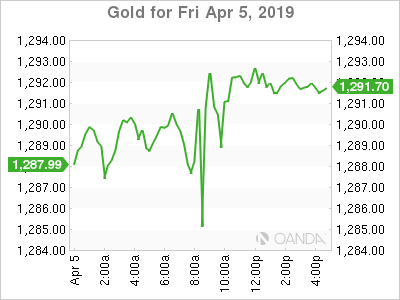
The White House is putting pressure on the Fed to cut rates which could turn into a positive for gold as geopolitical headwinds will continue to dampen global growth and put a more dovish slant to central banks.
US-China Trade Sparks Equities
Trade optimism drove stock indices higher during the first week of April. Global growth concerns are easing as the two largest economies seem on the verge of striking a deal, even if details remain scarce. Both sides have made encouraging comments and a summit could be announced in the short term.
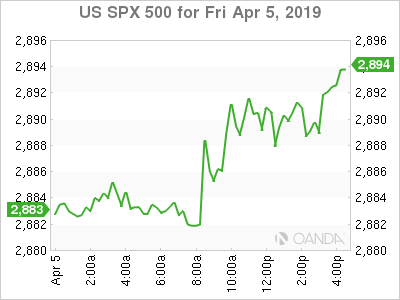
Fed minutes to be released this week will complete the dovish picture being painted by the U.S. Federal Reserve. The central bank has stressed patience as it put the brakes on its attempt to normalize interest rates. Macro headwinds have slowed down the American and global economies, but the opportunity to turn things around remains, which is why equities have rebounded awaiting news on the US-China trade deal.
China Weekly Letter – From Misery to Optimism: Trade Deal and Rebound in Sight
- Donald Trump: US and China agree to some of the 'toughest things' in trade talks.
- Stronger Chinese data lead to cautious optimism.
- Trade deal or not, US and China tensions are set to continue on most other fronts.
Trade deal in sight
More progress has been made in the trade talks as we enter the 'end-game'. However, as Trump's trade adviser Peter Navarro said on Thursday, the last mile of a marathon is also 'the longest and the hardest'.
High-level talks continued in Washington , with the highlight being US President Trump meeting China's top negotiator Vice-Premier Liu He in the White House on Thursday (see CNBC , 4 April). While no announcement of a summit between Trump and China's President Xi Jinping was announced,, the message was still one of optimism. Referring to a trade deal, Trump said 'This is the granddaddy of them all' and added 'It's got a very very good chance of happening'. He also stated that they had already agreed to some of the toughest things.
Xi has generally been much less vocal regarding the negotiations. However, an article from the Chinese news agency Xinhua on Thursday said Xi had delivered a message to Trump that substantial new progress has been made and that he encouraged the two sides to conclude the deal as soon as possible.
At a press meeting in the Oval Office, Trump praised China for delivering on its promise to clamp down on the flow of Fentanyl from China to the U.S. This was a promise made by Xi as part of the ceasefire deal on 1 December 2018 (see CNBC , 1 April).
Comment : We still believe it is more a matter of when than if we will see a trade deal. The timing is uncertain but, judging from Trump's comments, we will have to wait another month or so for an announcement of a summit after the deal is done. One of the outstanding points is how many of the US tariffs will be lifted immediately and how many will stay on for some time.
A lot of scepticism will probably prevail after a deal with expectations that the trade war could flare up again if China fails to deliver on its promises. However, we believe China is keen to make a deal that solves the problems on a more permanent basis and will strive to meet the requirements. Stability and minimising uncertainty are key elements in Chinese policy. A deal that only puts the trade war on pause would not remove the uncertainty that is currently holding back Chinese business investments and consumer spending. This is also a reason the talks are dragging out. Both sides want to get it right the first time and avoid a flare-up of the trade war in 2020. We also doubt Trump would want to restart a trade war this side of the 2020 election, as it would be damaging for US equity markets.
More firm signs of a turn in the Chinese cycle
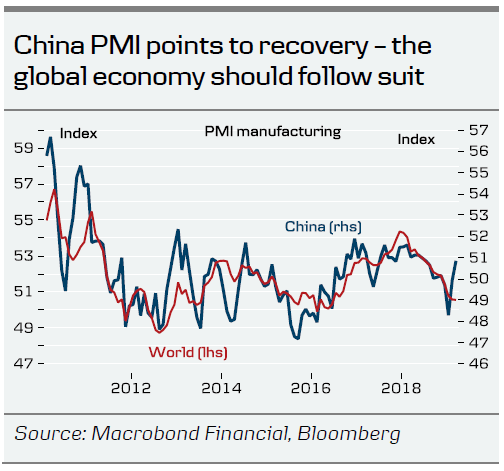
PMI manufacturing for March from both Caixin and official statistics surprised strongly on the upside. Both indices are now back above the 50 line. The rebound adds to the picture of a moderate recovery, as has been signalled in metal markets for some time. The details were also positive, as new orders and export orders moved higher.
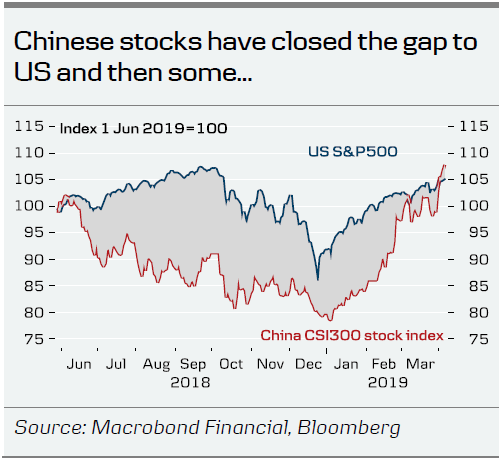
The growing optimism gave another boost to Chinese stock markets, which jumped higher this week, taking the cumulative increase for the year to 35%. Chinese stocks have actually overtaken US equities if measured from when the trade war started. This is a big change from the summer months of 2018, when Trump boasted how US markets were strong while Chinese stocks declined sharply (see for example this tweet from August).
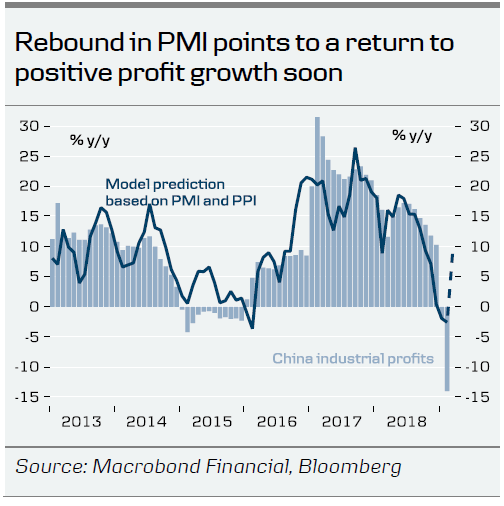
Comment: We have been looking for a bottom in Q1 in the Chinese cycle for some time and we see increasing evidence that this unfolded (see China Leading Indicators – Clearer signs of recovery, 2 April). We believe the drivers are easing on a broad range of fronts: easing trade tensions, easing monetary policy, easing fiscal policy and easing of the downward pressure from the reduction in inventories that we believe companies undertook in Q4. When strong headwinds fade at the same time as stepping harder on the gas, the economy can move forward again. We believe this is happening in China. The coming trade deal and increasing effects of the stimulus in 2018 should allow China to stage a moderate economic recovery.
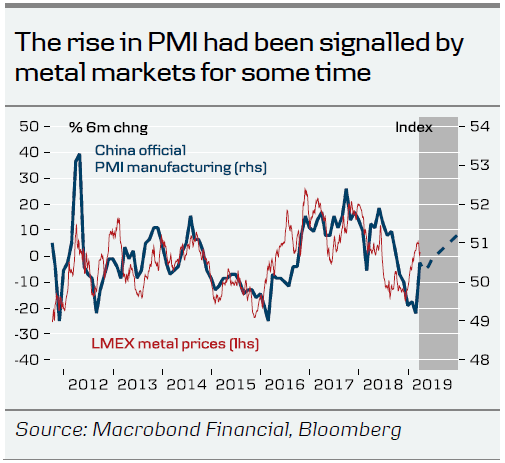
The recovery in China should also spill over into a global recovery (see the chart on the front page). China has been the epicentre of the global slowdown and a rebound is set to spread to the rest of the world.
US-China tensions running high on most other fronts
While optimism is growing regarding a trade deal, the US-China tensions continue on most other fronts. On Wednesday, Vice-President Mike Pence spoke at Nato's 70-year anniversary saying, 'Perhaps the greatest challenge NATO will face in the coming decades is how we must all adjust to the rise of the People's Republic of China' (see speech). Tensions also heated up over Taiwan, as Chinese fighter jets crossed the so-called median line, fuelling a strong response from US National Security Adviser John Bolton.
Comment: We expect the US-China rivalry to continue in many areas. When it comes to trade, the two sides depend on each other. However, we believe the tech war is likely to continue, along with tensions regarding security, Taiwan, the South China Sea and China's Belt and Road Initiative.
Other selected China news of the week
Is the US beefing up its own industrial policy in response to China? US semiconductor firms have called for more backing from Washington to stay ahead of China (see SCMP 3 April).
China has stumbled in its push to internationalise the currency. The Financial Times writes how the use of the CNY in global payments has stalled since the capital outflow crisis four years ago.
Chinese Premier Li Keqiang is heading to Europe for the EU-China summit on 9 April. This comes shortly after Xi visited Europe, meeting both French President Emmanuel Macron, German Chancellor Angela Merkel and EU President Jean-Claude Juncker.
Copying works both ways these days, with US companies looking to China for 'inspiration'. This opinion piece in SCMP describes how Facebook looks to WeChat for ideas on developing its own digital ecosystem.
Forward Guidance: Global Politics Dominates in a Quiet Week for Data
This week gave us some positive news on the global trade front, with the US and China inching closer to a deal that could be finalized within a month. Next week we’ll get more clarity on another major issue clouding the global outlook: Brexit. It’s crunch time again with the UK scheduled to leave the EU on April 12th unless another extension can be agreed. After beginning talks with the Opposition, PM May this week proposed an extension to June 30th, while the EU prefers a longer “flextension”—perhaps up to a year. Any new deadline will have to be approved at an emergency European Council summit on Wednesday. If an extension can’t be agreed, risk assets are likely to take a hit—while sterling would suffer most, the Canadian dollar would also be under pressure.
On the data front, Canada’s trickle of monthly housing indicators continues next week. We’ll have to wait until the following week for the headliner, CREA’s March resale report, but this week did give us a view of how major markets fared in the month. Sales rose in Toronto but activity in Vancouver remained at multi-year lows. Both followed subdued sales in February, when wintry weather likely kept some would-be homebuyers indoors. We think weather was also a factor behind the slowdown in homebuilding in February, and expect starts rebounded to 220,000 annualized units in March. We’ll also get building permits data for February (always a month behind starts), with the recent upward trend in permit issuance supporting our expectation that last month’s decline in housing starts was transitory.
In the US, March CPI is the highlight with headline inflation expected to tick up to 1.8% as the drag from lower gasoline prices eases. We’ll also get minutes of what was a surprisingly dovish March FOMC meeting, when committee members lowered their expectations for rate hikes this year (a majority now seeing no need for a rate increase in 2019). We’ll be looking for context around the shift to a more neutral bias, what it might take to see further rate hikes, and whether policymakers are evaluating the need for a cut. The Fed’s dovish tone was one of the factors that led us to revise our forecast and we now think the Fed will be on hold through 2020.
Australia & New Zealand Weekly: Federal Budget Unlikely to Deter RBA from Shifting to an Easing Bias in May
Week beginning 8 April 2019
- Federal Budget unlikely to deter RBA from shifting to an easing bias in May.
- RBA: Deputy Governor Debelle speaks, Financial Stability Review.
- Australia: Westpac-MI Consumer Sentiment, housing finance.
- NZ: REINZ house sales and prices, retail card spending.
- China: trade balance, CPI, new loans.
- Europe: ECB meeting, EU summit on Brexit.
- US: CPI, FOMC minutes.
- Key economic & financial forecasts.
Information contained in this report current as at 5 April 2019.
Federal Budget Unlikely to Deter RBA from Shifting to an Easing Bias in May
On Tuesday we noted a significant change in the Statement by the Reserve Bank Governor:
"Our research showed that there has been a very significant change in the Governor's Statement for this month. Recall that Governor Lowe has not changed monetary policy since he became Governor in September 2016. Also note that the key concluding sentence, which has been used in every Statement since October 2016 has been "the Board judged that holding the stance of monetary policy unchanged at this meeting would be consistent with sustainable growth in the economy and achieving the inflation target over time". The clear implication behind that statement is an expectation that policy was likely to be on hold for a considerable period. As we have seen, that was an accurate assessment.
In the April Statement, he has changed that language for the first time ever. He still notes that "the Board judged that it was appropriate to hold the stance of policy unchanged at this meeting". However, he then changes tact with a new sentence.
"The Board will continue to monitor developments and set monetary policy to support sustainable growth in the economy and achieve the inflation target over time". Although, a cursory glance at this sentence might not indicate any change in stance, it does give greater emphasis to the fluidity of the current situation. If this change was not intended, then clearly he would have continued with the approach that has marked his time as Governor.
Therefore this change appears to be a very clear intention to signal that policy is much more 'live' than has been the case since the Governor was appointed.
This signal is consistent with Westpac's expectation that the Board is likely to adopt an easing bias following the May Board meeting. Our thinking behind that approach has been that the Statement on Monetary Policy for May will include a downward revision of the Bank's growth forecasts. Further support for this view is apparent in the exclusion of the RBA's current growth forecasts in the April Governor's Statement. Arguably, this indicates an uneasiness with the 3 per cent for 2019 and the 2¾ per cent for 2020."
This Statement was released before the announcement later in the day of the Federal Budget.
In our note last week, "What impact will the Federal Budget have on monetary Policy" we calculated that the Government would have up to $3bn for a potential cash payout in 2018/19. We also estimated scope in 2019/20 for a spending boost of $7.5bn ($2.5bn from MYEFO's "allocated but not announced" and $5bn from an improved Budget position in 2019/20). That equates to 0.15% of GDP in 2018/19 and 0.37% in 2019/20.
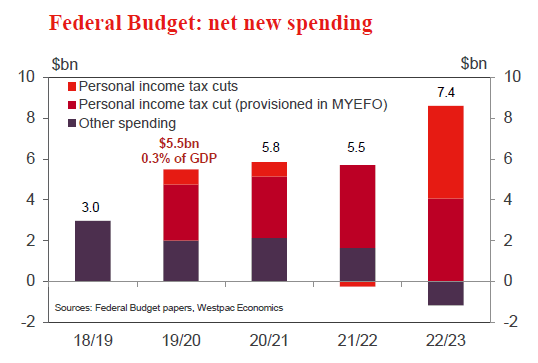
Ultimately, the announcement of the Budget came in a little less compared to our expectation with net new spending decided at $5.5bn in 2019/20 – 0.27% of GDP.
Given the current headwinds facing the consumer of weak income growth and a negative wealth effect, the most significant issue pertaining to monetary policy decision making is any immediate boost for the household sector.
In that respect, the hallmark spending initiative of the Budget is an expansion to last year's Personal Income Tax Plan. The additional tax cuts will amount to $19.5bn over the four year forward estimate period to 2022/23, but an already $13.8bn had been put aside in MYEFO.
It's worth remembering $8.6bn of the $19.5bn personal income tax cut plan expansion does not occur until the final year of 2022/23. In the near-term, the Low and Middle Income Tax Offset (LMITO) will put only $3.5bn (0.27% of disposable income) in consumers' pockets in 2019/20 when they file their 2018/19 tax returns. Measures included in Budget 2018 offer households a further benefit of $3.8bn (0.29% of disposable income) impacting in the 2019/20 year, though this is funded by other measures, primarily combatting illicit tobacco use.
In Bill Shorten's budget reply, he offered a higher LMITO - the base increased to $350 from $255 and the maximum benefit kept at $1080 - but it only adds an extra $1bn over four years.
So in any case, we believe this income boost is not large enough to offset falling house prices, low wages growth, rising savings rates and softening global growth.
In regards to any Budget "cash splash", the result was a decidedly underwhelming total payment in 2018/19 of $360mn. The programme sees payments of $125 per couple (pensioners and others) and $75 per individual, and has now been extended to Newstart recipients. That compares with $500 offered by the Howard government in 2007, to a strong economy where there was little justification for a 'splash'.
Overall, new measures aside, we need to keep the big picture in mind – the Budget is shifting from a deficit of $4.2bn to a surplus of $7.1bn. Using the aggregate individual tax intake and our disposable income growth forecast of 4.0% in 2019/20, personal income tax as a share of disposable income declines to 17.9% in 2019/20 from 18.1% in 2018/19 – a decrease, but only a modest one.
In assessing any immediate impact to consumer spending, the total LMITO directly amounts to 0.6% of annual household disposable income in 2019/20. The refunds will likely be received early in 2019/20 for last year's tax returns and are skewed towards low to middle income households who typically have a higher marginal propensity to consume.
However, as our Westpac-MI Consumer Sentiment survey deteriorated in March to its lowest level since September 2017, we believe the consumer will be cautious, corresponding to a relatively low spending rate of the tax cuts which limits the overall impact. Our post Budget survey released on 10 April will be important to assess if the mood has changed.
Outside of these direct initiatives for household incomes in the coming financial year, other major new spending programmes centre on infrastructure and health. While we acknowledge this will provide much needed services for a growing population, in assessing the immediate impact on the economy, their effect is protracted and will have a more minor influence on 2019/20.
The upcoming Federal election – reportedly set to take place on May 11 – represents an unknown given the potential for a bidding war to emerge. Major changes to announced policy by the government would appear unlikely and the RBA is likely to see any bidding war as a temporary "sugar hit" that will not generate sustained higher income growth. The RBA is also likely to look through the near-term personal income tax relief and cash payouts for energy bills.
As such, Westpac sees fiscal policy as having only a modest impact in the near term and continues to expect cash rate cuts in August and November to cushion the economy against the headwinds of 2019.
The week that was
Fiscal policy came to the fore this week in Australia, as Budget 2019 and the opposition's reply were delivered. Offshore, data was mixed, and the Brexit saga continued – with no end in sight.
Unsurprisingly, with an election imminent, Budget 2019 focused on short and medium-term income support for households and long-term infrastructure investment while still promising a lasting return to surplus from 2019/20. Please see the essay on the first page detailing the Budget and its implications for monetary policy as well as a video of Our analysis on Westpac IQ.
Turning to the Australian data released this week. On the positive side, Australia's trade balance reached a record high in February on the back of the elevated iron ore price; and similarly, retail sales and dwelling approvals for February also beat expectations. That being said, the trend for retail sales remains weak, and for dwelling approvals, the upside surprise was solely due to a surge in high-rise apartment approvals that is unlikely to be repeated – note all other approval components were well below expectations. CoreLogic house price data for March meanwhile highlighted that the house price correction is still a fair way from stabilising.
Across the Tasman in New Zealand, Westpac has changed its view on the RBNZ outlook. We are now calling for a cut at the May 2019 meeting and another a year later in May 2020. The justification for this view is the clear concern that the RBNZ has shown over the global backdrop; inflation struggling to return to the 2.0%yr target; and our New Zealand team's long-held concerns over the economic outlook in the early-2020's. These rate cuts would take the RBNZ cash rate to 1.25% at May 2020. See the next page for further detail.
Further afield in Asia, the data flow has been constructive, with both the NBS and Caixin manufacturing PMI's rising above 50 once again – signalling growth for industry. The services sector meanwhile has continued to grow at a solid pace, pointing to still-robust momentum within China's domestic economy despite external headwinds. We continue to hold a positive view on China, believing that fixed asset investment growth will slowly strengthen and broaden across the economy during 2019. GDP growth will however still be at the lower end of authorities 6.0-6.5% target range for this year, as the softer employment growth of the past year affects consumption.
For China and the broader Asian region, the focus of markets this week has not been the above data but rather signs that a trade agreement between the US and China may (finally) be close. Anecdotes from authorities have been positive, and there have also been press reports of agreement over some terms, including China purchasing more goods from the US over the coming decade – to reduce the US' trade deficit.
For the US, the headline data print of the week, the employment report, is still to come. Other data has been mixed, with consumer spending and inflation soft, but business sector detail robust. We remain of the view that US GDP growth will end 2019 near trend despite a soft start to the year, in part due to the December/ January Government shutdown.
Finally to Europe and the UK. Updates on the European economy this week confirm a general softness in activity but also underscore sectoral divergence in the economy. While retail sales volumes were shown to be tracking at 2.8%yr and the services and construction PMI's imply continued steadiness, the manufacturing industry remains in the doldrums. Most notably, German factory orders plunged 4.2% in February and the European manufacturing PMI was revised down to be at lows since 2013.
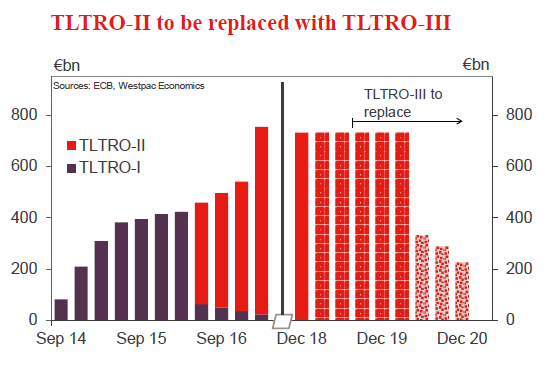
With the latter front of mind, along with geopolitical uncertainty, the ECB are concerned about the economic outlook, as confirmed in the release of the March meeting minutes. Not much was offered in these minutes in regards to TLTRO-III incentives and the possibility of a tiered deposit rate. It is unlikely that a decision will be made on incentives at next week's April meeting, but we expect an update in June.
A key uncertainty weighing on Europe regards the UK and Brexit. We are not surprised that little progress was made this week. While PM May and Labour's Corbyn began negotiations – and reports are that they were "constructive" – a compromise is still yet to be found ahead of the April 12 Brexit date.
At next week's EU Summit on April 10, the UK will need to present a withdrawal deal to EU-27 leaders or provide guidance on a plan for the way forward. Given the resistance against leaving without a deal, this plan is likely to call for another extension to the Brexit negotiation process. However, this will need to factor in European Parliament elections scheduled for May 23-26.
Chart of the week: Australian Federal Budget
The 2019 Federal Budget has achieved credible surpluses; meaningful tax cuts; and a comprehensive infrastructure plan
The forecast underlying cash balance of $7.1 billion in 2019/20 follows 11 consecutive years of deficit and marks the first surplus since 2007/08.
Overall, new spending in the near term is relatively modest and falls short of a meaningful boost to an economy that slowed to an annualised pace of just 1 per cent in the second half of last year whilst being buffeted by unprecedented house price falls.
The net impact of new spending and tax policy measures is only $9.9bn across the four years to 2021/22 (or $19.7bn if provisions from MYEFO are also included), a relatively modest boost in the context of a $2 trillion economy.
New Zealand: week ahead & data wrap
Starting with a bang
In its April OCR Review, the RBNZ surprised by advising that "more likely direction of the next OCR move is down." This announcement was followed by broad-based weakness in Tuesday's Quarterly Survey of Business Confidence. We now expect the RBNZ to cut the OCR in May – the first decision by the newly appointed Monetary Policy Committee. On the back of this change in view we have revised our interest rate and exchange rate forecasts.
We now expect the RBNZ to cut the OCR to 1.5% at its next meeting in May. In its April Statement, the RBNZ was clearly getting nervous about the global economic outlook. The fact that foreign central banks are moving towards more dovish monetary policy stances has been particularly important. If New Zealand fails to follow suit, the RBNZ is worried that the exchange rate could rise, putting downward pressure on inflation which is already struggling to reach the 2% mid-point of the RBNZ's target band.
The RBNZ is also becoming increasingly doubtful that New Zealand GDP growth will accelerate to the extent it is forecasting in 2019. Recent data on that has been mixed.
Consumer spending and construction data has been strong but this week's Quarterly Survey of Business Opinion was weak. Not only did headline business confidence fall near September's 9-year low, but there was also a broad-based deterioration across most key activity and investment indicators. Profits are being squeezed by rising costs and a perceived inability to pass these on to customers, increasing the chances that weak confidence will become self-fulfilling. The survey suggests March quarter GDP growth is likely to be around 0.5%. That's weaker than the RBNZ's forecast of 0.8%, and is consistent with an economy that is ticking over rather than picking up.
The labour market leg of the RBNZ's dual mandate gives less basis for cutting the OCR – unemployment is low and as we saw in this week's QSBO, firms continued to report that both skilled and unskilled workers remain hard to come by. And while there has been limited upward pressure on wage growth to date, with the unemployment rate expected to linger around its maximum sustainable level for some time yet, we are expecting to see stronger wage growth this year. But with the maximum sustainable level of employment still relatively uncertain, the employment target is unlikely to get in the way if a modest OCR reduction is warranted on inflation grounds.
The May OCR decision will be the first made by the RBNZ's newly formed Monetary Policy Committee, making this something of a "blank slate" decision. Could a fresh committee conclude that a lower OCR is the way to go? We think yes. Critically, inflation has been below two percent for 7 years (aside from a one quarter petrol induced spike in 2017). And while measures of core inflation are rising, they are still only around 1.5% to 1.7%.
Looking ahead, there remains more risk of inflation undershooting the target than overshooting. The big risk with cutting the OCR is the housing market. An OCR reduction could cause mortgage rates to fall even further, increasing the risk of stoking the housing market which is already booming in many regions beyond Auckland. Which option to go with is a matter of judgement. But with nationwide house price inflation currently at 2.6% and inflation flagging, it is now looking more reasonable to opt for a modestly lower OCR than it looked last year.
Following our forecast cut in May, we expect the RBNZ will leave the door open to a follow-up cut. There is a risk that they follow through on that, but it is more likely that they will keep the OCR at 1.5% for the remainder of 2019.
By the second half of the year the New Zealand economy will be showing clearer signs of improvement due to fiscal stimulus, lower petrol prices and strong construction activity in Auckland. Sentiment about the global growth outlook should also be improving. In addition, the sharp fall in interest rates we've seen in recent weeks is set to put downward pressure on mortgage rates which will be a very large stimulus for the housing market.
While we don't think a second OCR cut in 2019 will be justified, by the early 2020s the introduction of a capital gains tax, the end of the construction boom, and slowing population growth will likely see that change, justifying a lower level of the OCR. We have pencilled in a second cut for May 2020, which would take the OCR down to 1.25%.
This new outlook for interest rates means we now see the outlook for the NZ dollar and longer term interest rates differently. The NZ dollar fell sharply following the RBNZ's dovish shift. The NZD/USD is currently around 67.50. We expect it to fall further in the coming months and are forecasting 65c by the end of June. However, with markets pricing in a high likelihood of two rate cuts by the end of the year, there's scope for disappointment (and a slightly stronger NZD/USD) if the RBNZ fails to deliver a second rate cut – as we expect. We forecast the NZD/USD to temporarily rebound in late 2019 before heading south again by the middle of next year as the RBNZ cuts once more.
Data Previews
Aus Feb housing finance (no.)
- Apr 9, Last: –1.2%, WBC f/c: 1.0%
- Mkt f/c: 0.5%, Range: -3.1% to 1.8%
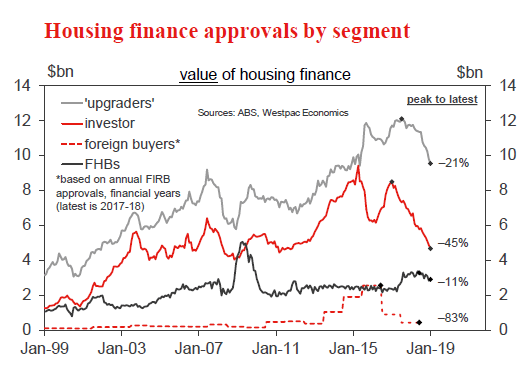
Housing finance approvals posted a further decline in Jan, albeit a slightly milder one than in previous months for owner occupiers, the number of approvals ex refi down 1.2% vs average declines of 1.6% over the second half of 2018. The value of investor loans ex refi posted a larger 4.1% fall.
Industry data covering the major banks suggests Feb was a touch firmer. We expect the number of owner occupier loans to edge 1% higher. However, the value of investor loans is expected to see further softening.
Aus Apr Westpac-MI Consumer Sentiment
- Apr 10 Last: 98.8
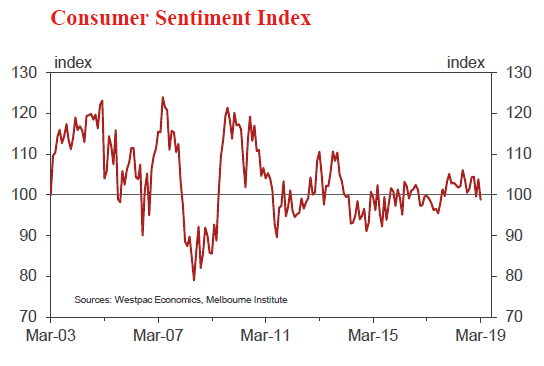
The Westpac Melbourne Institute Index fell 4.8% in March, the consumer mood clearly jolted by the disappointing December quarter national accounts released in the survey week. At 98.8, the March read is the lowest since September 2017, although this 'cautiously pessimistic' level is still above the average recorded in 2017.
The April survey is in the field from April 1-6 and will capture reactions to the Federal Budget, which included additional tax relief measures for households. Concerns around the economic outlook are likely to linger. Other factors that may impact include: a continued lift in the ASX, now up nearly 10% from its late 2018 levels; but negatives around petrol prices (average pump prices nationally up 18c/l since early Feb) and continued declines in house prices.
NZ Feb REINZ house sales and prices
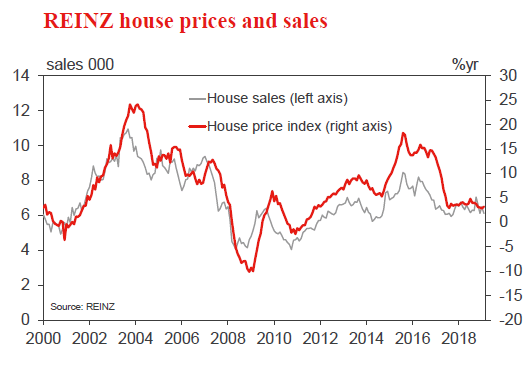
- Apr 8 – 13 (tbc), Sales last: -5.8%, Prices last: 3.2%yr
Over the past year house prices have been falling slowly in Auckland and Canterbury, and rising very rapidly in most other places. The pace of nationwide price inflation has picked up a little in recent months.
We expect a mixed report this month. Over the past two months, sales have dropped sharply and available stock has increased in Auckland. This suggests Auckland prices will soon weaken further. But elsewhere, prices are expected to keep rising rapidly.
Mortgage rates are plunging, which will stimulate the market later this year. But the Government may announce a capital gains tax, which will have the opposite effect.
NZ Feb retail card spending
- April 12, Last: +0.9%, WBC : +0.4
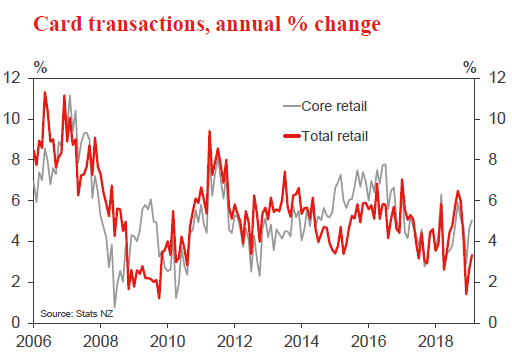
Retail spending rose by 0.9% in February. That marked a return to trend for retail spending after some sharp swings in previous months. February's gain was supported by the reversal of earlier sharp oil price increases that dampened spending last year. Retail spending has also been boosted by the increases in government spending now rippling through the economy (including transfers to households as part of the Governments' Families Package).
We're expecting a moderate 0.4% rise in retail spending in March, with only a small 0.1% gain in core (ex-fuel) categories. Recent increases in petrol prices will dampen spending in other areas. There has also been softness in the housing market that will dampen spending appetites. On top of those factors, March saw a softening in consumer confidence.
Europe Apr ECB meeting
- April 10
April's meeting follows a significant dovish shift in March. While before, the ECB held steady in their confidence that the growth slowdown would be temporary, in March they have factored in weakness persisting through H1 2019.
All up, this saw large downward revisions in the economic projections, the extension of interest rate policy forward guidance to rates expected to be on hold at least through the end of 2019, and the announcement of a new Targeted Long-Term Refinancing Operations (TLTRO) package in response to the upcoming maturities.
Full detail of TLTRO-III is to be announced. At first glance TLTRO-III appears less favourable than its predecessor, but the ECB have indicated that there will be incentives (as did TLTRO-II). We expect an announcement in June with April's discussion providing valuable clues. Of secondary importance will be discussion on side effects of negative interest rates and the potential for a tiered deposit rate.
Week Ahead – Euro and Pound in Focus as ECB Meets and EU Leaders Hold Emergency Brexit Summit
Economic data will take a backseat in the coming week as the biggest risk events that are being anticipated are the European Central Bank’s policy meeting and an emergency summit by the European Union to discuss the Brexit crisis. But while UK and EU politics may grab most of the headlines, there will also be some key releases to keep an eye on. Export numbers out of China and Germany will be watched to assess global trading conditions as trade tensions ease. UK monthly GDP figures and US price indicators will also be important, while the minutes of the Fed’s March policy meeting should attract some attention too.
Chinese exports expected to bounce back
Shipments from China slumped by 20.7% year-on-year in February, fuelling fears that the trade dispute with the US is starting to significantly damage the country’s trade prospects. However, the poor performance was partially attributed to the timing of the Lunar New Year holiday compared with last year and exports are expected to post a decent rebound in March. Exports are forecast to have increased by 7.3% y/y in March, though imports are predicted to have slipped further for a fourth straight month, declining by 1.3% y/y.
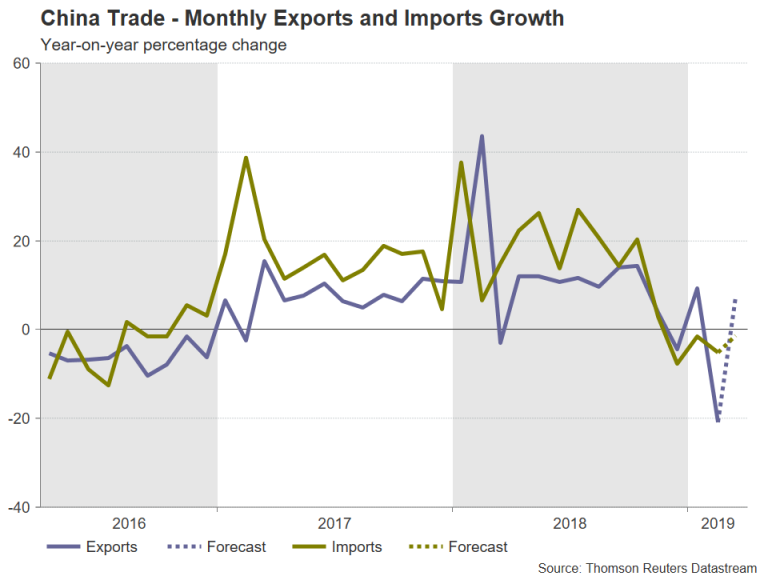
The trade numbers are due on Friday, and ahead of that, inflation data will be watched, with both the consumer price index (CPI) and produce price index (PPI) due on Thursday.
The Australian dollar is likely to bear the brunt of any shocks in the trade data, though markets would possibly see through any negative surprises given the progress being made in the trade negotiations between the US and China in recent weeks.
Japanese machinery orders eyed
Machinery orders out of Japan will be another important gauge for global trade on Wednesday. Core orders – a forward looking indicator for capital spending – fell by 5.4% y/y in January. Another big drop in February would further darken the outlook for corporate Japan. A quarterly survey by the Bank of Japan published earlier this week showed business sentiment deteriorating in the first three months of the year amid a continued slowdown in Japan’s main trading partners.
In addition to machinery orders, corporate goods prices for March will also be released on Wednesday. A weak set of figures from Japan could act as an additional drag on the yen, which has been under pressure this week on the back of improving risk appetite, led by growing expectations that the US and China are closing in on a trade deal.
Spotlight on May-Corbyn talks ahead of emergency EU summit
Sterling is headed for another rollercoaster week as the Brexit crisis shows no sign of abating and the extended deadline for Britain to leave the EU looms on April 12. After two rounds of indicative votes for Parliament to set the Brexit agenda failed to produce a majority on any of the alternative options, the UK prime minister, Theresa May, decided to hold talks with the Labour opposition leader, Jeremy Corbyn, to try and find a way forward that could win Labour support.
May has until April 10, when EU leaders will gather for an emergency summit, to reach some sort of an agreement on a revised Brexit deal with Corbyn. If May accepts Labour demands for a customs union and a deal is passed, the UK would be in a position to leave on May 22 – a day before EU member states elect new members of the European Parliament. But if the two leaders are unable to come to any agreement, a longer extension that could involve the UK taking part in the upcoming election would become likely. However, another extension is not guaranteed as the EU may decide it’s had enough of British lawmakers’ indecisiveness and accept that a crash UK exit may be the only way out from the crisis. Hence, a disorderly Brexit cannot be completely ruled out even after UK MPs moved swiftly this week to pass a legislation that blocks the government from leaving without a deal and requires it to seek further extensions to Article 50 if there is no consensus on the Withdrawal Agreement.
The pound is likely to remain choppy within its current range of $1.2950-$1.3350 if next week’s events don’t provide any clarity for investors as to where Brexit is headed. However, if it starts to become inevitable that the UK would have to stay in a customs union in order to break the impasse, an upside break above this range would be an easy feat for the pound.
There could be a more muted response, though, to a barrage of UK data out on Wednesday. February numbers on GDP growth, industrial and manufacturing output and trade could prove a temporary distraction for traders. But with signs that the all-important services sector is taking a significant hit from the ongoing Brexit uncertainty, any weakness in the monthly GDP readings could weigh on sterling.
ECB to stand pat in April
After catching markets off guard by pushing back the projected timing of a rate hike as early as at the March meeting, the ECB’s April meeting will probably be a quieter affair with no change in policy or the forward guidance expected. Nevertheless, there will still be plenty to keep investors interested. The surprise big upward revision in the Eurozone’s services PMI in March may positively influence policymakers’ outlook and analysts will be on alert for the possibility of less cautious views on the economy by Mario Draghi in his post-meeting press conference.
Markets will also want to see whether there was any discussion of introducing a tiered system for the ECB’s negative deposit rate, which has been having a damaging effect on Eurozone banks’ profitability. While excluding some banks’ cash reserves from being charged negative rates would be good for the health of the banking system, markets could perceive it as a dovish move as it would indicate a prolonged period of below zero deposit rate.
The ECB will announce its decision on Wednesday and the euro will be on standby for more dovish tilts by the central bank. In addition to the policy meeting, euro traders will also be watching German February export figures and the Eurozone sentix index for April on Monday, as well as February industrial production numbers for the region on Friday.
US inflation and Fed minutes may struggle to excite the dollar
The US economic calendar will be one of the busier ones next week, though the data may fail to generate much of a response in the forex market. Factory orders will start the week on Monday. After managing only meager growth of 0.1% month-on-month in December and January, factory orders are forecast to have reversed course in February to decrease by 0.6%.
On Wednesday, attention will shift to the FOMC minutes of the March meeting and on inflation as the CPI report is released. Headline inflation is expected to have accelerated to 1.8% y/y in March from 1.5% before, while the core rate is forecast to have held steady at 2.1% y/y.
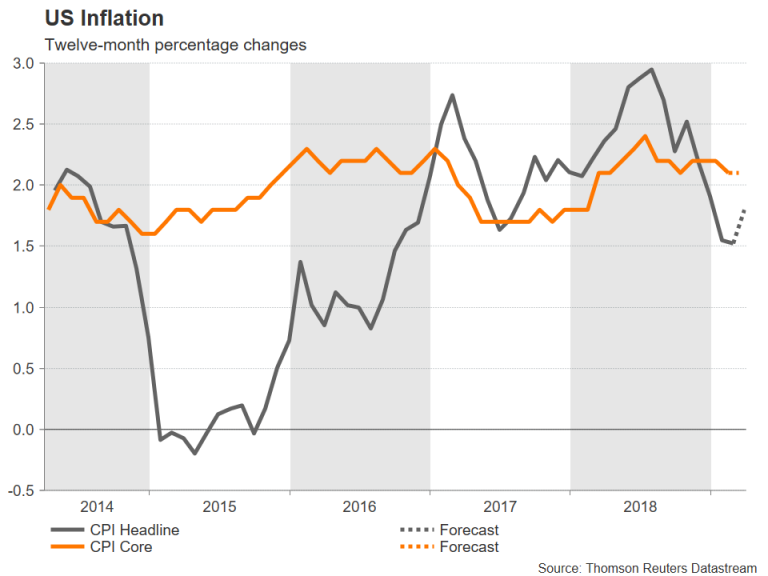
Any rise in the CPI rate from current levels is unlikely to alarm the Fed, especially as their targeted price measure, the core PCE price index, remains contained around 2%. The Fed will probably reinforce its neutral stance in its March meeting minutes when FOMC members signalled they’re not planning to raise rates at all in 2019. The language coming from Fed policymakers has been fairly consistent in recent months, so no surprises are being anticipated from the minutes. As a result, the US dollar is more likely to be driven by trade headlines and risk sentiment.
In other data from the US, March producer prices will follow on Thursday and the University of Michigan’s preliminary reading of the consumer sentiment index for April will round up the week on Friday.
Weekly Focus: Another Crucial Brexit Deadline Looms
Market movers ahead
- We believe the UK and EU will manage to agree another Brexit extension before the new deadline next Friday but it is by no means certain this will happen.
- We are unlikely to get new signals from the ECB at the meeting on Wednesday - global indicators have improved but European indicators have not, broadly speaking.
- Look out for the FOMC minutes, which should provide more details behind the dovish shift in March.
- Export data are set to give some hard data on the strength of China's rebound in March, while trade negotiations are nearing a conclusion.
- It is likely inflation in Sweden was again well below target in March and we believe Norwegian inflation may have slowed a bit.
Weekly wrap-up
- March PMIs gave clear signs of a recovery in China but not in Europe.
- The Chinese recovery is visible in commodity prices, stock markets and, to some extent, bond markets, supported by optimism about trade negotiations.
- The British government is now trying to reach a deal with Labour on Brexit, as the House of Commons continues to reject every version of Brexit imaginable.
- Swedish manufacturing remains surprisingly robust despite the slowdown in Germany but the overall picture of the economy is still one of below-trend growth.
Sunset Market Commentary
Markets
Global core bonds lose ground today. US Treasuries fell overnight as China and the US claimed to be close to a trade deal, giving core bonds a downward bias at the start of the day. German industrial production data for February printed stronger than expected, weighing some more on German Bunds. The losses remained limited with yesterday’s disastrous factory orders still in mind. US Treasuries continued their downward trend throughout the day, lacking guidance ahead of the US payrolls report. The US payrolls printed stronger than expected, while the wage data for March printed below expectations. After some volatility, the US 10-yr Note paired the intraday losses. However, the reaction remained limited overall. The German yield curve is moving higher with changes up to 1.6 bps (30-yr). The US yield curve remains near opening levels, with changes limited to 1.0 bp (10-yr). Italian BTP futures hardly reacted on news that the government approved a series of measures to boost the economy, while Italy’s statistics office said its sees a potential end to contraction for the Italian economy. BTP’s moved higher. Greek bonds advanced too as euro-area finance ministers agreed to disburse €1bn. Peripheral spreads are tightening with Greece (-8 bps) and Italy (-4 bps) outperforming.
EUR/USD trading showed little directional dynamics. This morning, the euro gained marginal ground on a positive risk sentiment and better than expected German industrial production. However, gains were negligible. The pair settled in a very tight range in the 1.1230 area , awaiting the US payrolls. US job growth was solid (196 000) and the unemployment rate printed unchanged at 3.8%. However, wage growth disappointed at 0.1% M/M and 3.2 % Y/Y. The latter only confirms that the Fed has no reason at all to change its wait-and-see stance in the foreseeable future. US yields and the dollar temporary declined a few ticks up-on the release. However, it was almost immediately clear that the report was no game-changer for USD trading. EUR/USD is changing hands in the 1.1235 area. USD/JPY is trading in the 111.65 area.
Sterling traders today couldn’t but keep a close eye on the ongoing stream of Brexit headlines. UK PM May continues her negotiations with the Labour opposition. At the same time, she asked the EU for an extension of the Brexit-delay till June 30. EU’s Juncker proposed a longer delay of a year. For now, there is no concrete news from the negotiations between Labour and the Conservative party. However, this exchange of proposals at least suggests that both the EU and UK PM May still see a substantial risk that no Brexit deal will be approved in time in the UK Parliament. Sterling temporarily gained a few ticks, but the gains soon evaporated. EUR/GBP is again testing the 0.86 big figure. Cable failed to sustain north of the 1.31 handle. Today’s sterling loss remains limited. Even so, the multiple political event risk on Brexit next week (both in the UK and in EU) warrants some caution on sterling long exposure.
News Headlines
The US economy added 196k jobs in March, compared to 177k consensus. The January and February numbers faced a combined 14k upward revision. Earnings grew by 0.1% M/M and 3.2% Y/Y, falling short of expectations (0.3% M/M and 3.4% Y/Y). The unemployment rate stabilized near cycle lows (3.8%), but the participation rate unexpectedly fell from 63.2% to 63%.
German industrial production rebounded more than expected in February (0.7% M/M), but the key manufacturing sector remains weak. The bounce was mainly triggered by strong construction figures.
Canadian payrolls showed a 7.2k decline in March, following a strong February figure (55.9k) and printing below consensus (6k). Details showed a setback in both full time (-6.4k) and part time (-0.9k) employment. The unemployment rate stabilized at 5.8% while hourly wages accelerated from 2.2% Y/Y to 2.3% Y/Y. The combination of US and Canadian payrolls lifted USD/CAD higher into the higher end of the 1.33 big figure.