

Sample Category Title
Q2 Outlook – EUR/USD: Below 1.10 On The Cards, EU Economy To Remain Weak Link In Slowing Global Economy
This could potentiallybe digested as a bizarre headline for the Euro, but the risks of the EURUSD hitting levels close to parity in 2019 are arguably just as strong now as they were a few years back when anticipation had reached fever pitch that the Euro would fall to 1:1 against the USD. This long-awaited move never occurred, but we should not discount the concerns over the health of the EU economy, with recent data showing that there is limited reason to be optimistic on the Euro.
Europe to stand at epicenter of global economy fears
The chorus of concerns around slowing world growth is getting louder by the day, and Europe is going to stand at the epicenter of fears that a world economic slowdown is approaching. What makes matters worse for Euro investors is that when the slowdown in Europe becomes apparent, there is little to nothing that the European Central Bank (ECB) will be able to do at this stage to reinvigorate economic momentum.
Similarly to the Bank of Japan (BoJ), the ECB has little ammunition left to ease monetary policy and any attempts to do so will only make the market even more concerned over the level of worry that ECB officials have on the economy.
When you combine this pessimistic outlook with the unknowns around what the future of the ECB will look like once President Mario Draghi steps down later in 2019, alongside prolonged anxiety that the face of Europe is set to change with Merkel’s days as German Chancellor numbered and more than 18 weeks of consecutive protests in France, there is very little reason to be optimistic on the Euro.
EURUSD rallies reliant on Dollar weakness
The second quarter of 2019 is probably going to continue on much of the same theme from the previous quarter, where bounces higher in the Euro will be dependent on rounds of softness in the Greenback. This represents a dangerous position for potential Euro bulls, because there are limited buyers in the market.
Europe not only has its own political risks and structural issues, but the economy also stands in the crossfire of the protracted trade tensions between the United States and China. Another aspect that appears as left-field but nonetheless needs to be taken into account, is that the EU economy is near equally as unprepared to face negative repercussions from a potential no-deal Brexit as the United Kingdom.
Resilience of Dollar represents headache for EURUSD ahead
One additional spanner in the works for the EURUSD is that global economic concerns have historically benefited the Greenback. I will not rule out the possibility that the Dollar Index will attempt to climb to a new 2019 high, perhaps even back towards the 100 level in the event of a global economic downturn.
While there has been a near-term shock on the Dollar following the Federal Reservespectacularly making a U-turn from its interest rate ambitions during its March policy meeting, few have yet to speculate that the reversal from the Federal Reserve could be because they are aware of something that is coming our way, which we are yet to see.
Technical outlook shows bears remain in driver’s seat below 1.15
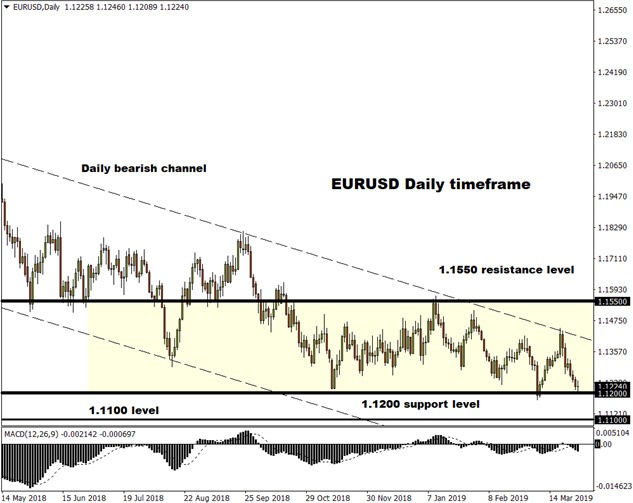
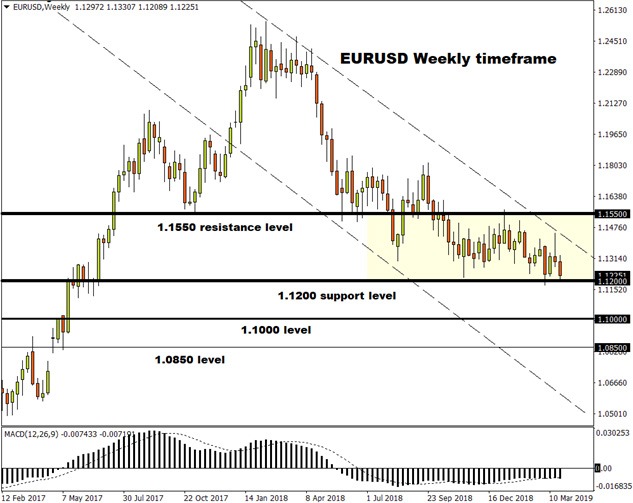
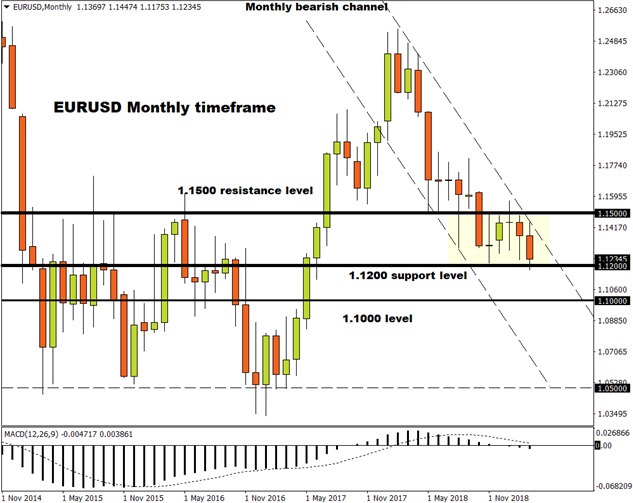
Focusing on the technical picture, the EURUSD remains in a steady downtrend on the monthly charts with consistent lower lows and lower highs evident. The EURUSD has overall traded in a very narrow range between 1.15 and 1.11 since October 2018.
A potential weekly close below 1.1150 could be viewed as an indication that the EURUSD would be at threat to weakness below 1.10 for the first time since May 2017.
If the EURUSD manages to close below 1.10 on a monthly basis, this could encourage a series of headlines that bearish acceleration in the Euro might meet a speed not seen since initial concerns years back that the Euro would fall to parity against the USD.
Q2 Outlook – USD/JPY: 106 Possible, But Do Not Underestimate USD Resilience During Global Economic Downturn Fears
Persistent global growth concerns and ongoing headlines that the world economy has approached another downturn suggest that there is limited upside to world stock markets. Investors have certainly become nervous that the world economy is at a crossroads and that the risks associated with the uncertain external backdrop of multiple headwinds are impacting economic sentiment in a negative direction, meaning that the case to keep close to safe haven instruments during the second quarter remains compelling. Both Gold and the Japanese Yen are two assets that have historically shown an ability to benefit from market uncertainty and I see the potential for the Yen to benefit in Q2.
Election risks in emerging markets not only limited to Turkey
Away from global economic concerns that will remain in the conversation for a long time to come, what can also be looked upon for potential support in the Yen and other safe havens are the number of election risks to take place in emerging markets. Elections are scheduled throughout a wide range of developing markets this year, but the next couple of months will see markets like the Philippines, Indonesia and South Africa go to the polls. Elections in both developed and developing markets in recent times have concluded with unexpected outcomes and when you consider how much foreign investor capital is kept in emerging markets, investors might adopt a more conservative tone towards their investments until the outcome of these event risks become clear.
We have already seen in the run-up to the local elections in Turkey at the end of March what impact political risks can have on the Turkish currency and in turn, contagion fears for other emerging markets. I will not be surprised if investors use upcoming emerging market election risks as a reason to remain close to instruments like the Yen and Gold over the coming quarter.
US-China breakthrough would be welcome news for USDJPY bulls
While there is no shortage of pessimistic opinions on the global economy increasing in volume, the contrarian would speak out that in spite of all the negativity, there are some potential lifelines that can help lift market sentiment.
The prime contender for improved risk appetite would be a successful conclusion to the ongoing US-China trade negotiations, where optimism does remain that a signing summit between President Trump and senior Chinese officials will be called at some point during the second quarter. Skepticism over what exactly the potential signing summit unveils will be there, but the finer details of what is potentially going to be signed should not matter for investors.
All those in the market will want to know is that bilateral relations between the United States and China are improving after what has been nearly a year of protracted headlines and uncertainty in the market.
Dollar to pick up support if global fears accelerate
One important element that potential USDJPY buyers will refuse to rule out, is that if a global economic downturn does materialize, this can be supportive to USD demand.
We already see the roots of this trend beginning to appear at the end of March with the USD picking up momentumdespite the Federal Reserve making a spectacular U-turn on the monetary policy outlook in the United States. Even if the United States economy gets caught in the headwinds of global health fears, it would not be a surprise if the Dollar remains in demand over the course of Q2.
I personally doubt that the USDJPY may not be able to rise above 112 any time soon unless Dollar demand goes into hyper mode, however a steady USD will help draw a line in the sand for USDJPY support.
Technical pictures points to ongoing tug-of-war
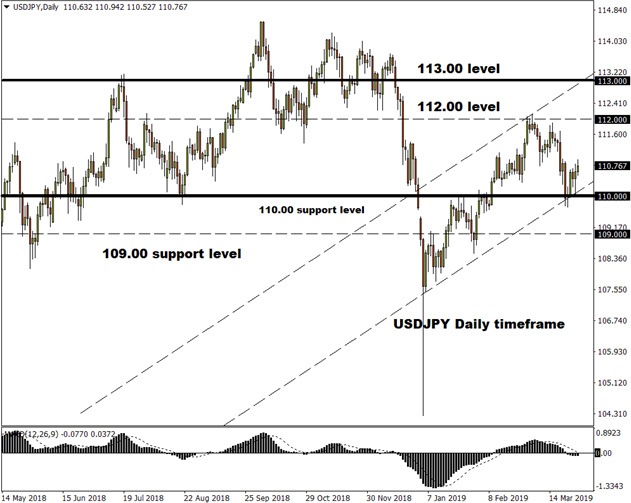
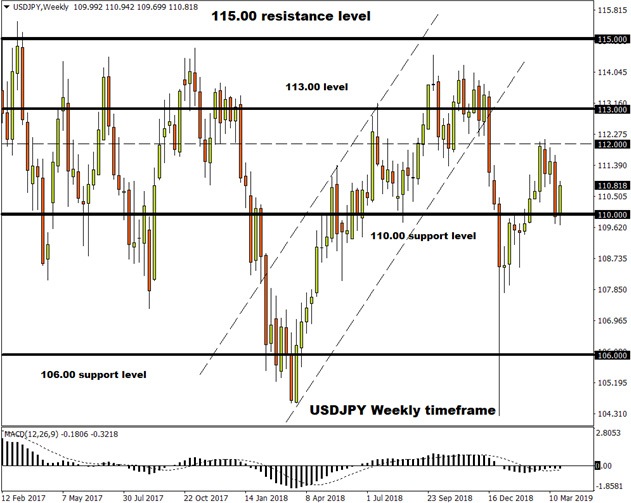
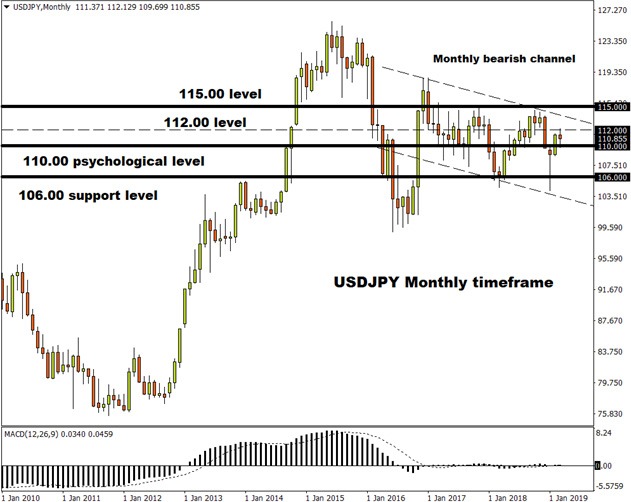
In regards to the technical picture, the USDJPY experienced a rebound during the first quarter of 2019 following the famous flash crash that kicked off the year, with prices eventually managing to push back above the 110 level.
The currency pair remains in a bearish channel on the monthly timeframe, with 110.00 acting as a pivotal point. If this level proves to be reliable support to prevent further selling, the next key point of interest for the USDJPY will be around 112.00.
However, a breakdown back below 110.00 risks the downtrend in the USDJPY resuming and likely testing 107.30 and 106.00.
While USDJPY may notbe able to rise above 112.00 any time soon, a possible break above this point will open doors towards 113.00 and 115.00.
EUR/JPY Passes Resistances Cluster
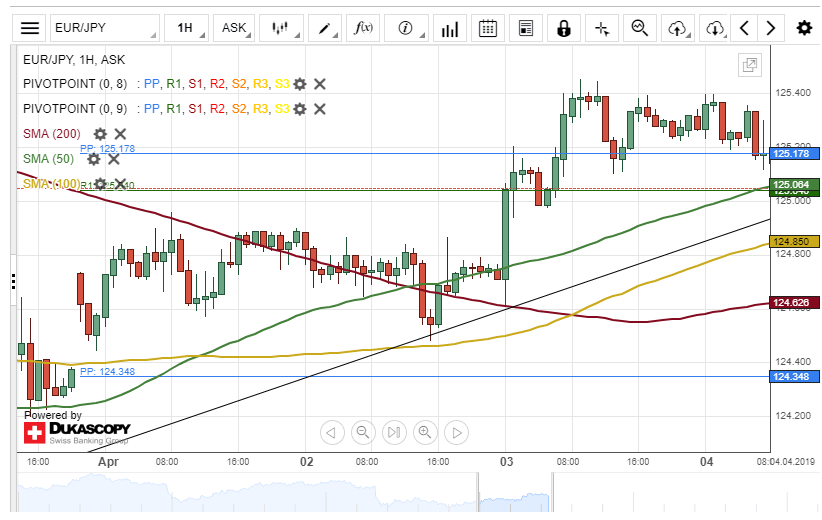
The common European currency appreciated about 84 base points against the Japanese Yen on Wednesday. The currency pair was guided up by the 50-hour simple moving average during Wednesday's trading session.
As for the near future, it is likely that the currency exchange rate will continue its upside movement and potentially targets the monthly resistance level at 125.70 within this session.
On the other hand, bears could push the EUR/JPY exchange rate down towards a support level formed by the lower boundary of a junior ascending channel at 124.87 today.
AUD/USD Set For Breakout
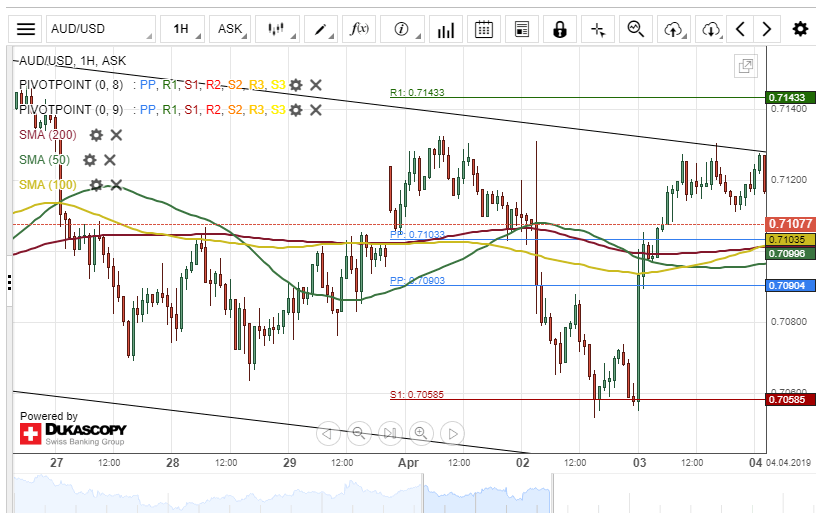
The Australian Dollar appreciated about 72 base points against the US Dollar on Friday. The currency pair tested the upper boundary of a descending channel pattern at 0.7129 at the end of Wednesday's trading session.
Most likely, the exchange rate will move towards the weekly pivot point at 0.7090 within this session.
However, given that the currency exchange rate is trading near the upper boundary of the descending channel pattern, a breakout could be expected during the following trading session.
USD/CAD Tested Upper Band Of Descending Channel
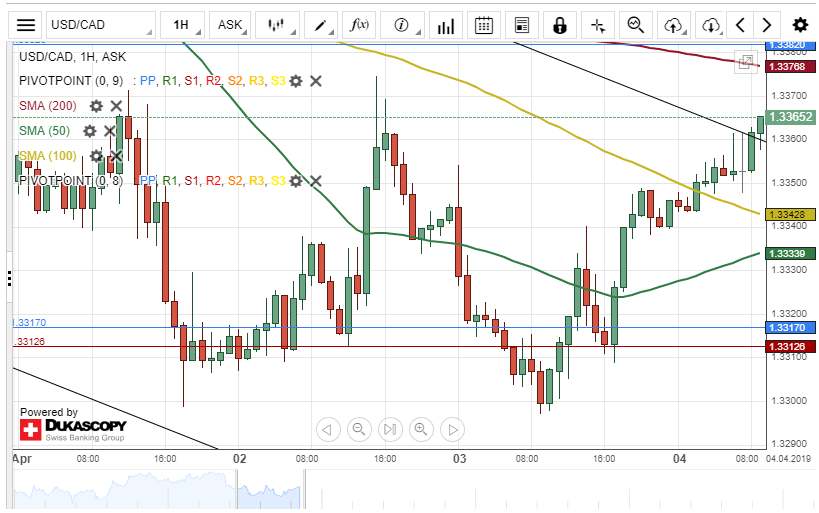
The US Dollar versus the Canadian Dollar tested the upper boundary of a junior descending channel pattern at 1.3360 during the morning hours of Thursday's trading session.
Given that the exchange rate is closer to the upper border of the descending channel, a breakout could be expected within this session.
If this breakout occurred, the currency exchange rate will aim for a resistance cluster formed by the 200-hour SMA and the weekly pivot point at 1.3382 today.
However, if the channel pattern holds, the pair will continue its movement in the descending channel pattern in the shorter term.
NZD/USD Decline Likely To Continue
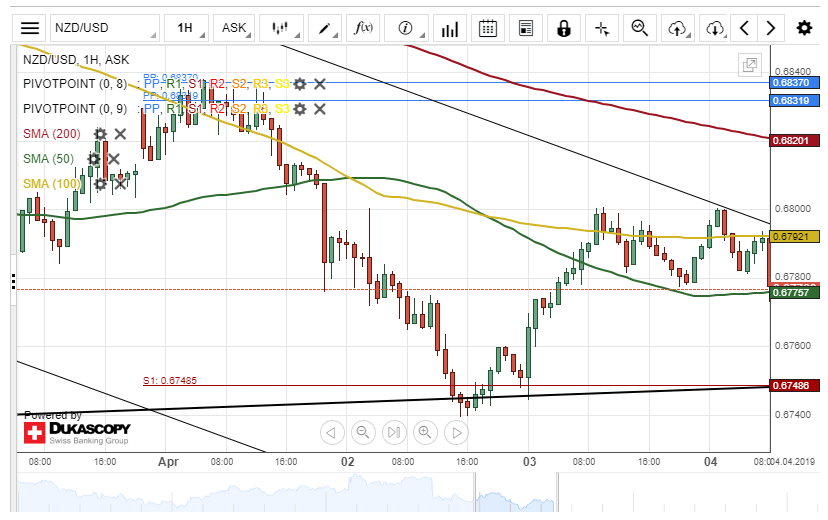
The New Zealand Dollar appreciated about 55 base points against the US Dollar on Wednesday. The currency pair tested the upper boundary of a descending channel pattern at 0.6800 during the first half of today's trading session.
After hitting the upper border of the descending channel pattern, the exchange rate began to decline. By the middle of the European trading session, the pair had breached the 50– and 100-hour SMAs at 0.6792/0.6775.
By and large, it is likely that the decline continues within this session. The potential downside targets for bearish traders will be near the bottom border of a dominant ascending channel at 0.6740.
Forex Technical Analysis: EUR/USD, USD/JPY, GBP/USD
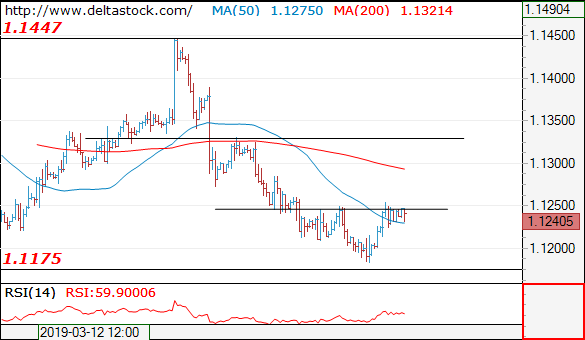
EUR/USD
Current level - 1.1240
My outlook is positive, for a break through 1.1250 resistance, towards 1.1330 area. Key support is projected at 1.1210.
| Resistance | Support | ||
| intraday | intraweek | intraday | intraweek |
| 1.1250 | 1.1570 | 1.1175 | 1.1175 |
| 1.1330 | 1.1830 | 1.1175 | 1.0860 |
USD/JPY
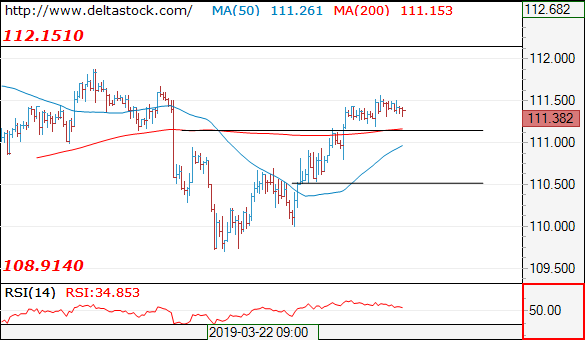
Current level - 111.36
The uptrend is intact, supported at 111.15, heading towards 112.15 resistance.
| Resistance | Support | ||
| intraday | intraweek | intraday | intraweek |
| 111.50 | 113.00 | 111.15 | 108.90 |
| 112.15 | 114.50 | 110.50 | 107.40 |
GBP/USD
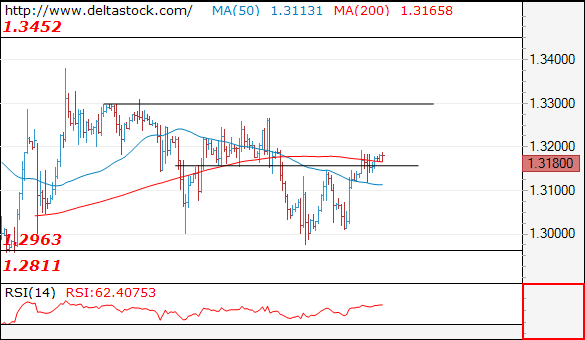
Current level - 1.3180
The outlook is rather positive, for an advance towards 1.3300, en route to 1.3450 zone. Initial support lies at 1.3100.
| Resistance | Support | ||
| intraday | intraweek | intraday | intraweek |
| 1.3300 | 1.3450 | 1.3100 | 1.2820 |
| 1.3300 | 1.3450 | 1.2960 | 1.2610 |
Market Lull Won’t Last
Market lull won't last
Financial markets are rather quiet this morning. The FX market remains under the influence of both Sino-American trade talks and Brexit while the drop in German February manufacturing orders has also a significant impact on the European stock market. According to latest news, it appears that US President Donald Trump and Chinese Vice Premier Liu He are expected to meet today in order to put final conclusions on the negotiated trade deal ahead of the long-awaited Trump-Xi meeting that is assumed to be announced today.
Indeed, it seems that the US has finally tempered its tone as the enforcement mechanism is supposed to provide China with a more realistic deadline (around 2025) for implementing the necessary structural reforms the US claims, thus adding optimism in the marketplace. Interestingly, the British pound gains traction this week against the greenback (wee-to-date: +1.06%), although risk of a hard Brexit is rising. The short-term deadline provided by the EU at 12 April did not provide the expected outcome, as UK MPs voted down PM May's Withdrawal Agreement for a third time and the House of Commons second attempt to agree on an alternative to May's brexit deal failed. Yet the recent request made by the UK parliament to request May negotiating an additional extension period to Brussels will most probably not bode well as any alternatives suggested by the EU to the House of commons will be not be convincing for most MPs. We therefore remain very careful on the outcome as EU Parliament elections of 23 May will be at the centre of attention – and whether the UK is willing to take part of it (and contribute to EU budget as well) might be a game changer on whether the extension process (most likely a longer extension) will work.. or if a hard Brexit should take place instead.
Currently trading at 1.3150, GBP/USD is heading along 1.3120 short-term.
Q2 Outlook – GBPUSD: Risk Of A No-Deal Brexit Dangerously Underpriced
The British Pound performed unexpectedly well during the first quarter of 2019 despite the chronic uncertainty, growing confusion and chaos revolving around Brexit.
Much of the positivity seen in the Pound has been encouraged by expectations that the United Kingdom is heading for a softer Brexit, a potential second referendum or, as some optimists would like to believe, no Brexit at all.
Investors guilty of complacency regarding no-deal Brexit risks
Given that at time of writing there have been multiple defeats and rejections of UK Prime Minister Theresa May’s Brexit deal, and that the latest headline from the EU Commission is that a no-deal Brexit on April 12 is “likely”, the upside in recent months for the Pound has been a mystery for most traders.
Market participants need to be aware of the risks over market complacency with Brexit uncertainty, because investors do not look like they are positioned at all for no-deal Brexit risks, or a disorderly Brexit.
In the event that United Kingdom politiciansare able to miraculously agree between themselves a new Brexit agreement before theApril 12 deadline at time of writing, further upside in the GBPUSD is likely limited to between 1.34 and 1.36.
However, the unexpected occurring and the risk of traders getting nervous on the edge of their seats over a no-deal Brexit holds the potential to suddenly send the GBPUSD to 1.25, if not lower.
Brexit uncertainty to remain the name of the game
The thirdrejection by the House of Commons on Theresa May’s Brexit deal has created another element of uncertainty and confusion at a critical period where investors are scrambling for clarity on Brexit. The United Kingdom now only has until April12to come up with an alternative plan, otherwise fears of a no-deal Brexit are set to rise in the foreign exchange markets. Will there be a second referendum, a general election, or even perhaps a longer delay to Brexit? Or, will the UK end up crashing out of the European Union without a deal in place? Where we go from here remains an open question, and this endless uncertainty should weigh on sentiment for the Sterling.
GBPUSD searching for catalyst to make next major move
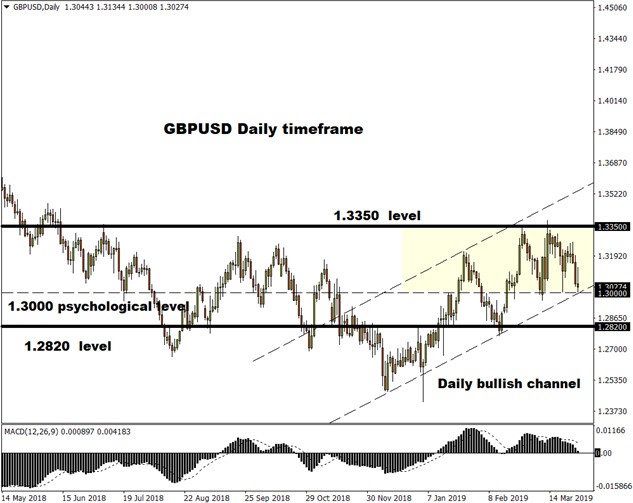
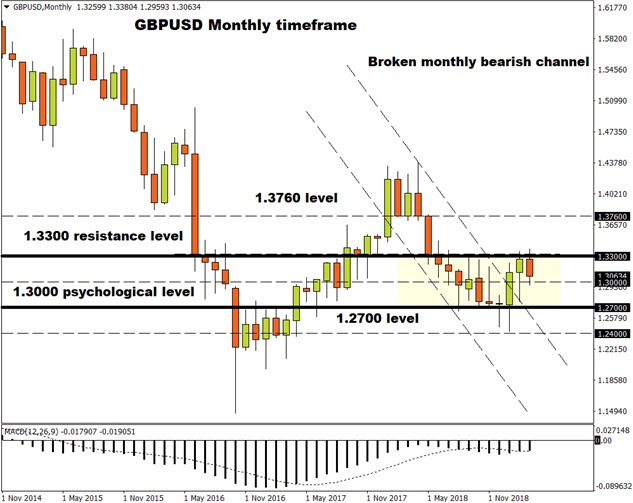
In regards to the technical picture, the GBPUSD is trading within a range on the monthly timeframe, with support found at 1.3000 and resistance at 1.3300. Although prices have breached the bearish channel, the downside is likely to resume if a monthly close below 1.3000 is achieved. Sustained weakness below this level would likely threaten opening a path towards 1.2820 and 1.2700, respectively.
In the event of a no-deal Brexit, the Sterling has the potential to tumble towards 1.2400, possibly even lower if investors panic.
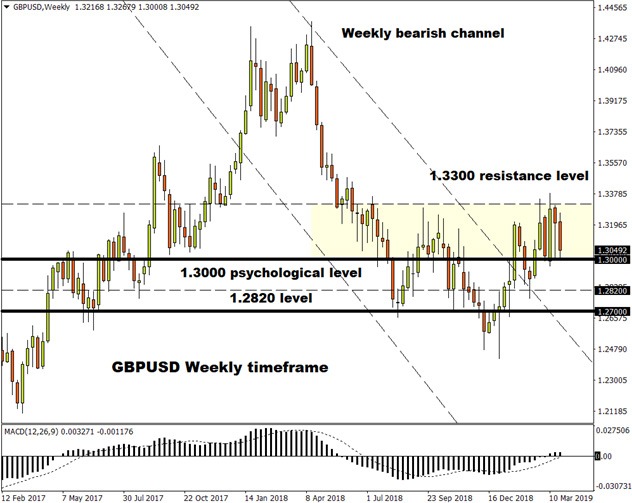
The weekly timeframe paints a similar picture to the monthly timeframe that 1.30 is a critical level for the Pound. For bullish sentiment to jump firmly back into the game, a decisive monthly close above 1.3350 would be encouraging for potential buyers. Such a move would likely open the doors towards 1.3470 and 1.3630.
Q2 Outlook – Introduction: Inversion Of US Yield Curve Not To Be Ignored, But Neither Should US-China Trade Negotiations
After a drastic final three months in 2018 and a dramatic flash crash to begin the new trading year, the first quarter of 2019 offered a welcome relief for equity investors.
Volatility declined by more than 40%, US and most European indices recorded double digit gains, and China became the best performing market, with the CSI300 Index rising above 28%. This performance can send its gratitude and thanks to major central banks pausing monetary monetization led by the Federal Reserve. The decision to abandon further tightening in monetary policy sent government debt with negative yields above $10 trillion, which is another reason why equities had a strong performance.
The post-economic crisis expansion has been a very long one according to historic norms, and whether it still has further room to run depends on what economic data has to say. Will it turn brighter or continue to head south? The inversion of the US yield curve, an environment in which long-term debt yield declines below the short-term ones has historically been an accurate predictor of economic recessions. This is why investors panicked when on March 22, the US 10-year Treasury Yield declined below the yields of three-month treasury bills for the first time since 2007.
Whether this inversion is going to be an exception to previous ones that led to an economic recession remains unknown, but it is certainly a warning signal.
Past yield curve inversions have tended to precede economic recessions by about 6 – 18 months. However, investors begin to sell risk assets well before a recession occurs. They don’t wait for a recession to hit. That’s why economic data releases in the first few weeks of the second quarter will play a significant role in determining whether to hold onto risk assets or begin liquidating positions. Equity investors may forgive a quarter or two of negative or slow earnings growth, but if it the trend resumes further, they might consider beginning to search for the exit doors.
While much attention will be focused on turningto economic data, investors also need to keep an eye on US-China trade negotiations. Although tensions between the world’s two largest economies eased significantly in Q1, we howeverstill don’t have a signed deal yet. The biggest concern among investors is that negotiations might break down and we return into a new period of prolonged uncertainty.
Our view on equities is neutral in Q2 with risks tilted to the downside. Special attention needs to be provided to earnings, not just for Q1 but the forward guidance offered for Q2 and beyond. While lower interest rates will provide a boost to profits, higher wages and diminished growth expectations will have a negative impact. Hence, expect to see more volatility going forward.
In such an environment of potential volatility, the Yen may outperform its major peers as investors seek safety in their portfolios. The Dollar also has further upside potential, given that the US economy continues to be in a better shape in comparison to its developed counterparts. Sterling will be the most volatile currency as negotiations around Brexit resumes however any good deal with Europe will provide a strong push to the currency.