Sample Category Title
Italy said to lower slash 2019 growth forecast, raise deficit target to 2.3-2.4% of GDP
It's widely reported today that Italy is going to cut 2019 growth forecast within this month. The government previously projected 1% growth this year and agreed to 2.04% budget deficit to GDP with EU.
Reuters said Italy will lower GDP growth forecast to just 0.3-0.4%. Bloomberg went further and said it could be revised down to just 0.1%. The budget deficit target, could then be raised up to 2.3-2.4% of GDP.
The final numbers will be approved by the Cabinet next week. But based on current situation, another clash with EU seems inevitable.
Markets Are For A Risk-On Mood
Stocks
Chinese indices jumped to 13-month highs. The China A50 added almost 9% for the week as part of the last rally. The S&P500 gained 0.2% at the close of trading session on Wednesday, but index futures are losing ground at the beginning of trading in Europe, reflecting the wary mood of market participants before important Friday data.
EURUSD
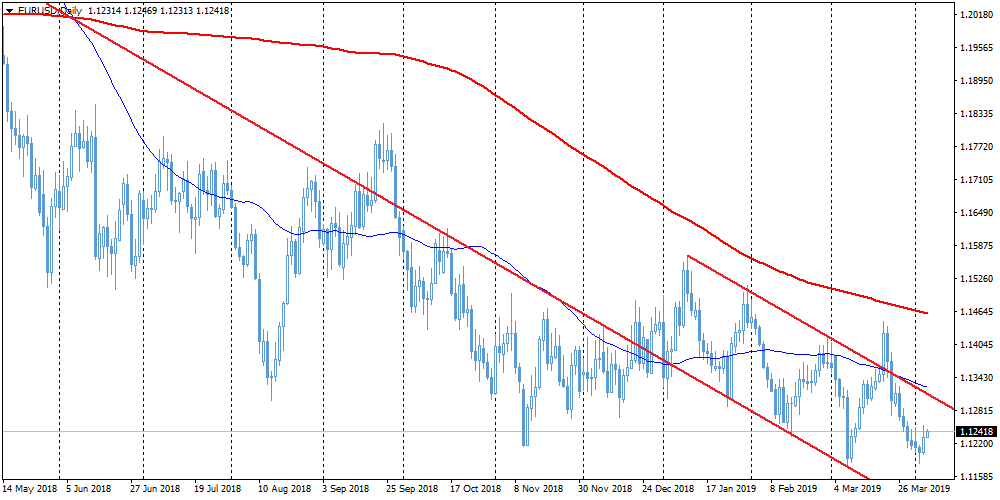
EURUSD rebounds from levels near 1.1200. The EUR growth on Thursday supported by an unexpected improvement of PMI estimates in the services sector for the eurozone countries, although during the previous months these publications over and over again became an unpleasant surprise for the euro. In turn, data from the United States caused disappointment, showing a decline in the growth impulse of the largest global economy: ADP showed private sector growth by 129K, worse than the expected level at 184K, and Non-Manufacturing ISM instead of growth from 59.7 to 58.1 declined to 8-month low at 56.1. At the moment, EURUSD trades at 1.1240 with the nearest important resistance level at 1.13, and local support levels are located far below, in the area of 1.07.
GBPUSD
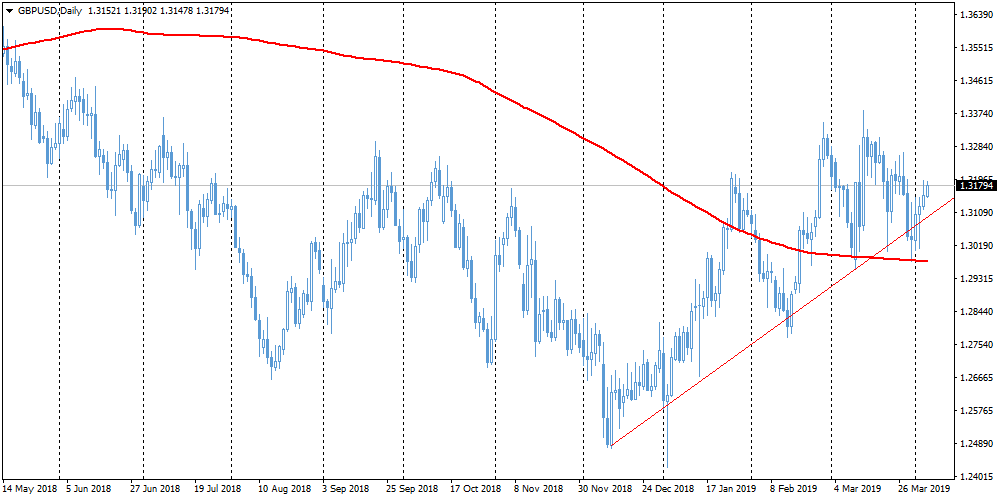
The British pound is growing thanks to Brexit news. GBPUSD is trading at 1.3170, offsetting the decline a week ago after the country's legislators rejected the option to exit without a deal. May and the opposition leader Corbin are looking for ways to compromise and intend to ask the EU for a longer postponement. Nevertheless, representatives of the European Union are increasingly insistently urging not to give a further delay, since this does not lead to any progress in the negotiations.
Brent
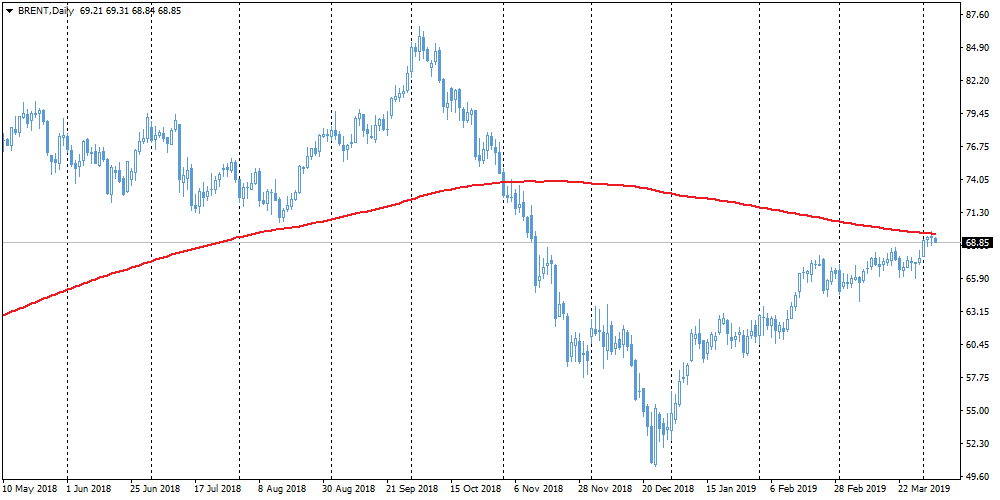
Brent crude stopped its growth. The sharp increase of US oil reserves at the same time with the new weekly production record of 12.2 million barrels/day was bad news for oil, not allowing Brent to consolidate above the 200-day average and stopping its growth in one step from $70. After failing to take important levels, a corrective pullback may well occur.
Gold
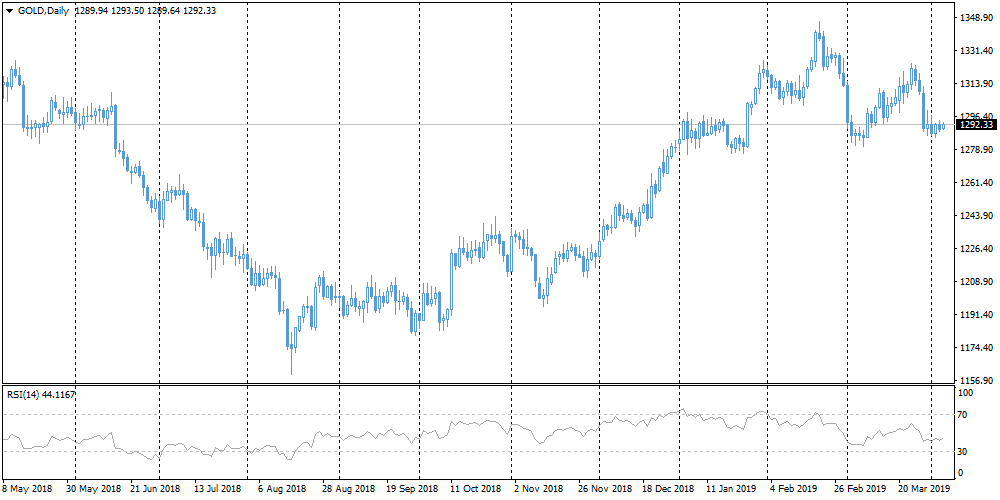
Gold was in the list of instruments that received short-term support. The precious metal cost is around 1290 from the end of last week. On the intraday charts, we see an increase in purchases from the area of 1285. The weakening of the dollar during recent days is an additional supporting factor. In the case of growth, the levels of 1300 (an important level) and 1308 (MA (50)) can become the short-term goal of a growth impulse.
Bitcoin
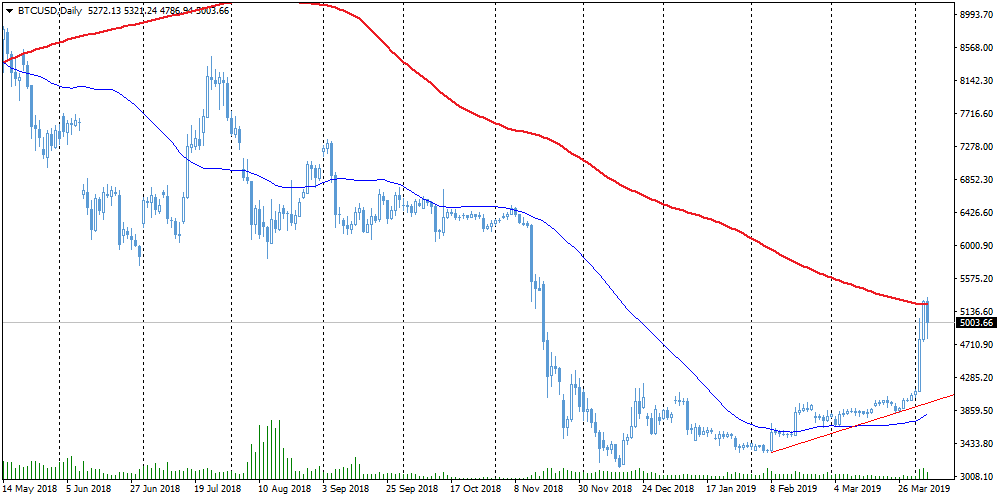
The cost of Bitcoin for the past day has updated highs since November, exceeding at some point the level of $5300. The 200-day moving average passes through this level. Apparently, many investors in Bitcoin focus on technical analysis to a greater extent than on the news background, so overcoming it from the bottom up can be a significant signal for market participants and will support further purchases. The next buyers target now is the level of $6200, around which the market consolidated from September to November.
EUR/USD – Euro Shrugs Off Dismal German Factory Orders
EUR/USD is unchanged in Thursday trade. Currently, the pair is trading at 1.1231, down 0.02% on the day. On the release front, German factory orders plunged 4.2%, nowhere near the estimate of 0.3%. Later in the day, the ECB posts the minutes of its March meeting. In the U.S., today’s highlight is unemployment claims, which is expected to rise to 215 thousand. On Friday, the U.S. releases wage growth and nonfarm payrolls, so traders should be prepared for movement from the pair.
German manufacturing numbers continue to point downwards. Factory orders were dismal in February, declining for a fourth successive month. The eurozone’s largest economy has slowed down as a result of the global trade war, with exports and manufacturing particularly hard-hit. Soft global demand could continue, and the Economy Ministry summed up the bleak situation, saying that “manufacturing momentum will continue to be subdued in the coming months, particularly due to lacking external demand”.
After disappointing manufacturing PMIs in March, there was better news from services PMI reports. German and eurozone indicators came in at 55.4, and 53.3, respectively. The PMIs point to continuing growth in the services sector, indicative of steady domestic demand. The same cannot be said about German manufacturing, with manufacturing PMIs losing ground for eight straight releases.
It’s been a disappointing week for U.S. numbers, and the trend continued on Wednesday. ADP nonfarm payrolls plunged to 129 thousand, down from 183 thousand in the previous release. Is this a precursor of what to expect on Friday? Nonfarm payrolls are projected at 175 thousand, a soft number in comparison to recent releases. ISM Non-Manufacturing PMI also stumbled on Wednesday, falling from 59.7 to 56.1 points.
GBP/JPY 4H Chart: Set For Breakout
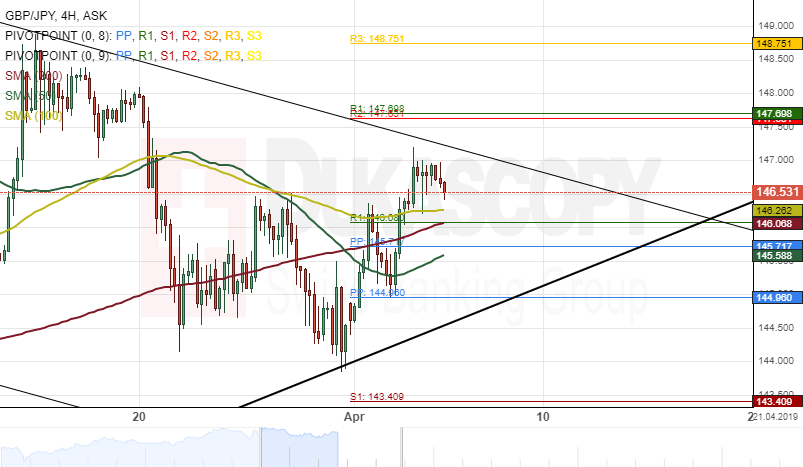
The Pound Sterling has appreciated about 328 base points against the Japanese Yen. The currency pair reached near the upper boundary of a descending channel pattern during yesterday's trading session.
Currently, the exchange rate is trading near the upper band of the descending channel at 146.79 and could be set for a breakout.
If this breakout occurs, the currency exchange rate could aim for a swing high of 148.75 during the following trading sessions.
However, a resistance cluster formed by the combination of the weekly and the monthly pivot points at 147.69 could hinder such movement.
AUD/JPY 4H Chart: Reveals New Junior Channel
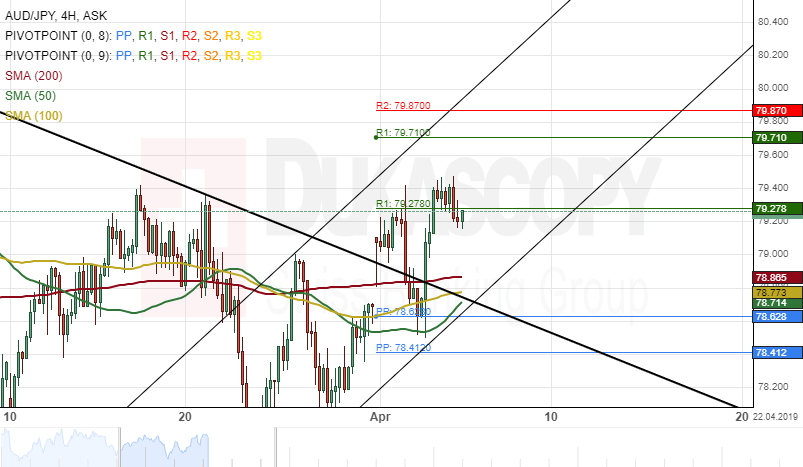
The Australian Dollar has appreciated about 1.95% in value against the Japanese Yen since March 28. A breakout occurred through the upper boundary of a dominant descending channel pattern during Monday's trading session.
A junior ascending channel is currently guiding the exchange rate towards a resistance cluster formed by the combination of the weekly and the monthly pivot points at 79.87.
Although, it is likely that the currency exchange rate makes a brief retracement towards a support level formed by the 100– and 200-hour simple moving averages near the 78.86 regions during the following trading sessions.
Forex Algorithmic Trading
Algorithmic trading is trading using so-called robots or advisers, mathematical algorithms that can predict the behaviour of a currency pair with high accuracy. Today trading advisers are all the rage because automated trading saves time, effort and nerves, does not require in-depth market knowledge and even beginners can use it easily. But can algorithmic trading be considered an ideal Forex earning tool? Let's find out.
Algorithmic Trading history
Algorithmic Trading begins in the 2000s. Curious to relate, but initially trading robots were created not to get the maximum profit but to automate the execution of large orders. Initially, investment and mutual funds, banks, and institutional investors, who could not afford the extra risks in dealing with vast amounts of money, used such algorithms. Previously, it was necessary to contact particular companies, where very experienced and qualified employees specialised in opening orders worked. But work through intermediaries was very inconvenient, and when programmers developed automatic engines for opening transactions, complex orders became much more convenient. And although the commission for using such an engine was higher than the cost of the services of intermediaries, it was still beneficial.
Then the industry of trading robots began to expand, and special programs that were already intended directly for trading on Forex appeared. These are trading robots based on some profitable strategy.
Today, there are two types of algorithmic trading: mechanical and automated. Mechanical algorithmic trading is a way to trade when, based on market analysis, the robot gives trading signals, and the trader himself decides whether to follow them or not. Automated trading involves the complete elimination of the trader from the process of trading: the adviser does everything itself - opens and closes positions based on the algorithm incorporated in it.
Algorithmic trading advantages
1. Round-the-clock work
Obviously, the trader can not constantly trade. No matter how hardy a person is, he needs at least 8 hours for healthy sleep and rest. And if to add work, household chores, communication with family, etc., it turns out that there is very little time left for trading. But after all, Forex has favourable situations for making profitable trades, and most traders simply miss them. But the trading robot works 24 hours a day. It has no other business, and it does not need to take a break, so even if at 3 a.m. there is an excellent opportunity to open a good deal, the adviser will certainly take advantage of it.
2. No emotions
Every trader depends on emotions to a greater or lesser degree. Fear, insecurity, or vice versa, self-confidence, excitement, greed - this is what prevents to achieve success in trade. Algorithmic trading allows excluding the human factor because the automatic system acts exclusively according to the rules of the strategy on which it is based. In general, if there is the most disciplined trader in the world, then this is a trading adviser.
3. Wide opportunities
An ordinary trader is difficult to work with a variety of indicators and currency pairs; you have to choose 1-2 market assets and some of the most convenient technical analysis tools. Algorithmic trading greatly expands earning opportunities, since the robot can work with indicators and currency pairs in any quantity. The only nuance is that it is necessary to set the correct settings and adjust algorithmic trading strategies from time to time.
4. No experience is needed
Even those who still do not have sufficient knowledge in the field of trading can start earning with the help of advisers. After all, automatic systems do everything instead of a trader who does not have to delve into all the trading nuances.
Algorithmic trading disadvantages
But, of course, not everything is so smooth and simple, and algorithmic trading has its pitfalls as well.
First, the robot can not readopt. It works well in those periods when the market situation does not change, but as soon as something unexpected happens, the algorithm fails. When fundamental rather than technical factors come to the fore, the adviser continues to work in the same way, which is no longer effective under new market conditions. The adviser's profitability decreases when unexpectedly good or bad economic data are published when political changes occur in the country, when natural disasters occur, which also affect the exchange rate, and so on. In these cases, a sharp human mind is much more preferable.
Secondly, it is not easy to find a truly reliable trading robot. According to statistics, out of the entire mass of offers on the Internet, only 10-15% are worthy, the rest is either non-working advisers or simply fraudulent schemes. Therefore, if you want to use a trading robot, then select only those offered by reliable developers.
By the way, there is a widespread opinion that paid advisers are a priori better than free ones: after all, quality always costs money. However, in practice, it is not so as usual. There are cases when free advisers, based on a fairly simple strategy with proper configuration give good results. And it also happens that expensive robots quickly lose the deposit.
And what is more important, many Forex brokers forbid trading with expert advisers. It is inconvenient to find a new broker seeking for an opportunity to trade with your algorithms. But it can be put right. For example, JustForex broker allows trading in any style and with any strategy.
So is it worth to use algorithms for trading?
Obviously, with all the advantages of advisers, you cannot fully rely on them, so experts do not recommend constantly trading in automatic mode. The best option is to combine manual and algorithmic trading and use robots as a hint and tool to diversify risks. Still, no mathematical model can completely replace a person, his mind, knowledge and ability to quickly navigate in a volatile market environment.
WTI Oil Outlook: Oil Price Eases From New 5-Month High On O/B Studies And Rise In US Oil Stocks
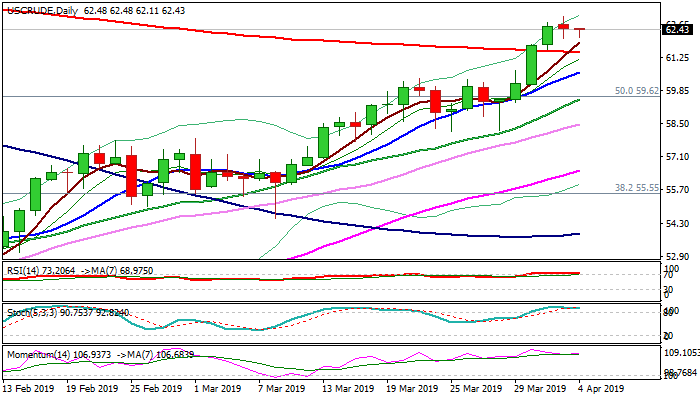
WTI oil price eases further from new five-month high at $62.96 as bulls were hit by surprise build in US crude inventories (EIA report on Wednesday showed build of 7.2 mln bls vs forecasted draw of 0.4 mln bls and previous week’s build of 2.8mln bls).
Bulls also faced strong headwinds from weekly cloud base ($63.00) with corrective easing being also signaled by strongly overbought daily stochastic.
Overall picture remains positive on OPEC+ action in reducing output, US sanctions and fresh positive signal about continuation of US/China trade talks that reduces concerns about global demand.
Current easing is seen as positioning for fresh upside with broken 200SMA ($61.45) expected to ideally contain and prevent deeper pullback on break.
Rising 10SMA marks next significant support at $60.63, where extended dips should find ground and keep bulls in play for fresh attempt towards target at $63.69 (Fibo 61.8% of $76.88/$42.36).
Res: 62.96, 63.69, 63.87, 64.43
Sup: 62.04, 61.88, 61.45, 60.63
USD/JPY Outlook: Bulls Struggle To Clear 200SMA, US Jobs Data Eyed For Fresh Signals
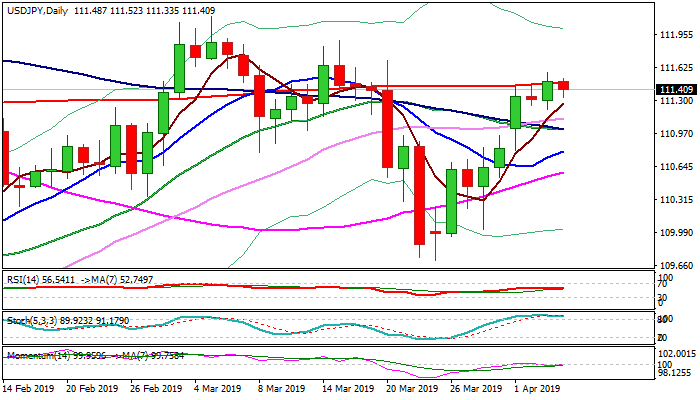
The pair maintains bullish bias but faces strong headwinds from 200SMA (111.47), as upside attempts stay capped here for the fourth straight dat.
Wednesday's marginal close above 200SMA (1 pip) was minor positive signal, as bulls see no help from flat momentum, but strongly overbought stochastic weighs.
Extended consolidation under 200SMA could belikely scenario in coming sessions as US jobs data on Friday come in focus and expected to provide fresh direction signals.
Bullish bias is expected to persist above 111.00 (converged 100/20SMA's), while break lower would sideline bears and risk dip towards rising daily cloud top (110.45).
Eventual break above 200SMA would open way towards key med-term support at 112.13 (2019 high posted on 5 Mar).
Res: 111.47, 111.70, 111.90, 112.13
Sup: 111.27, 111.12, 111.00, 110.79
EURUSD 1.1216 Crucial Support
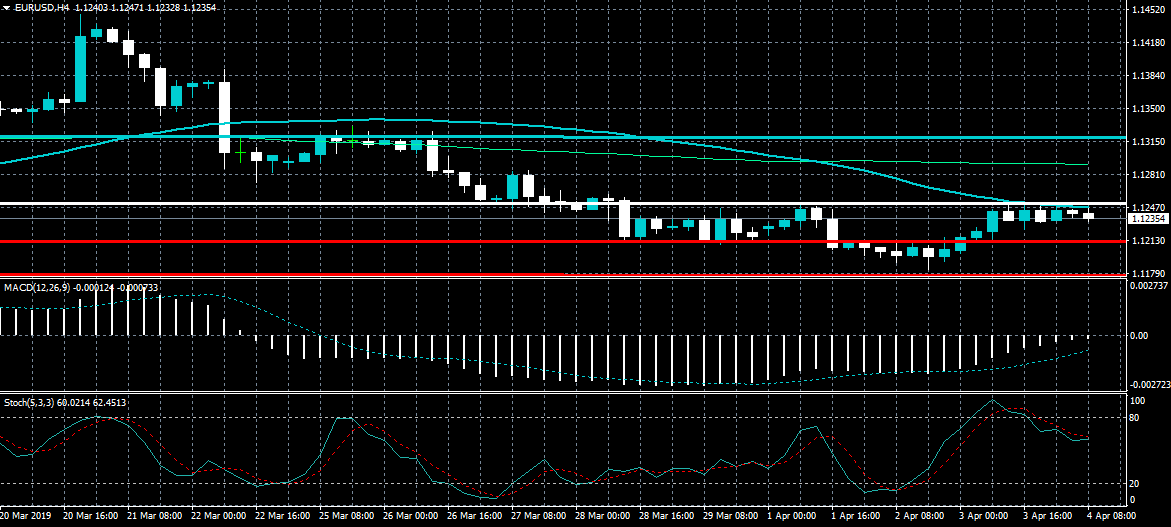
The euro currency has come under slight downside pressure against the US dollar during the European trading session after more weaker than expected data from the German economy. The EURUSD pair may start to weaken towards the 1.1216 support level if selling pressures start to increase below the 1.1230 area. Technical indicators on the four-hour time frame are starting to move lower as the EURUSD pair declines.
The EURUSD pair is bearish while trading below the 1.1250 level, key technical support remains at the 1.1216 and 1.1170 levels.
If the EURUSD pair trades above the 1.1250 level, buyers may test back towards the 1.1290 and 1.1330 resistance levels.
GBPUSD 1.3180 Strong Resistance
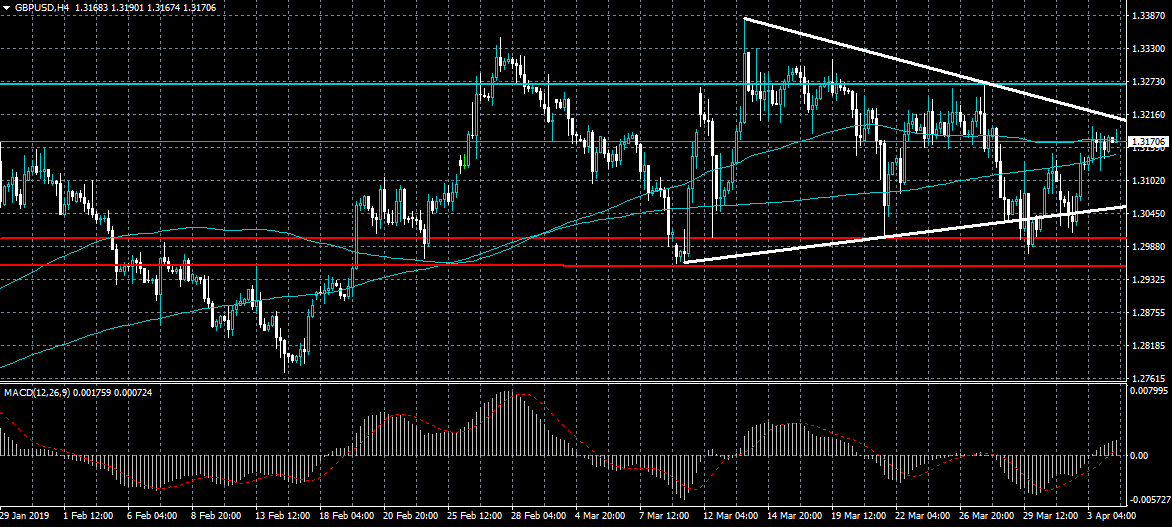
The British pound is struggling to move above the 1.3180 level against the US dollar as traders await the latest Brexit developments coming from UK Parliament. The 1.3100 support area offers the strongest form of intraday support before the bottom of the triangle pattern, at 1.3050. Traders should note that the top of the triangle pattern on the four-hour time frame is currently located at the 1.3200 level.
The GBPUSD pair is bullish while trading above the 1.3180 level, key resistance is found at the 1.3200 and 1.3270 levels.
If the GBPUSD pair trades below the 1.3150 level, key support is found at the 1.3100 and 1.3055 levels.