

Sample Category Title
Confirmatory Brexit referendum to be included as option in May’s deal with Corbyn
UK Prime Minister Theresa May and opposition Labour leader Jeremy Corbyn held another day of productive (as described by Conservatives) and technical ( as described by Labour) talks on Brexit. No conclusion was made yet and discussions will continue on Friday. May will need to bring back her plans to a EU summit on April 10, just two days before the April 12 cliff edge, if UK is to avoid no-deal Brexit.
Corbyn told Labour MPs that "agenda items were customs arrangements, single market alignment including rights and protections, agencies and programmes, internal security, legal underpinning to any agreements and confirmatory vote." It's reported that in accordance with Labour's demands an option on confirmatory referendum on any Brexit deal would be tabled in any vote next week. That would be included in May's letter to Corbyn on Friday, outlining the agreement. But such a move would definitely trigger blackslashes from pro-Brexit Conservatives.
In the House of Lords, Pro-Brexit members were accused of filibustering to block the bill that blocks no-deal Brexit. The Yvette Cooper bill, which would require the PM to request an article 50 extension and avoid a no-deal Brexit, will remain with the Lords until Monday. It was originally intended to be fast-tracked through the Lords by the end of Thursday.
GOLD And CRUDE Oil Price At Risk Of More Losses
Gold price declined recently and traded below the $1,300 support area. Crude oil price seems to be forming a short term top below $63.00 and it could decline below $62.00
Important Takeaways for Gold and Oil
- Gold price started a major drop and traded below the $1,300 support level against the US Dollar.
- There is a key connecting bearish trend line in place with resistance near $1,292 on the hourly chart of gold.
- Crude oil price broke a significant ascending channel with support at $62.60 on the hourly chart of XTI/USD.
- The price is currently at a risk of more losses below the $62.00 and $61.60 support levels.
Gold Price Technical Analysis
Gold price started a major downside move after it failed to stay above the $1,315 support level against the US Dollar. The price declined below the $1,308 and $1,305 support levels to move into a bearish zone.
Finally, the price broke the $1,300 support and settled below the 50 hourly simple moving average. The decline gained pace below $1,295 and the price even broke the $1,290 support. A new swing low was formed at $1,281 on FXOpen and the price recently recovered higher.
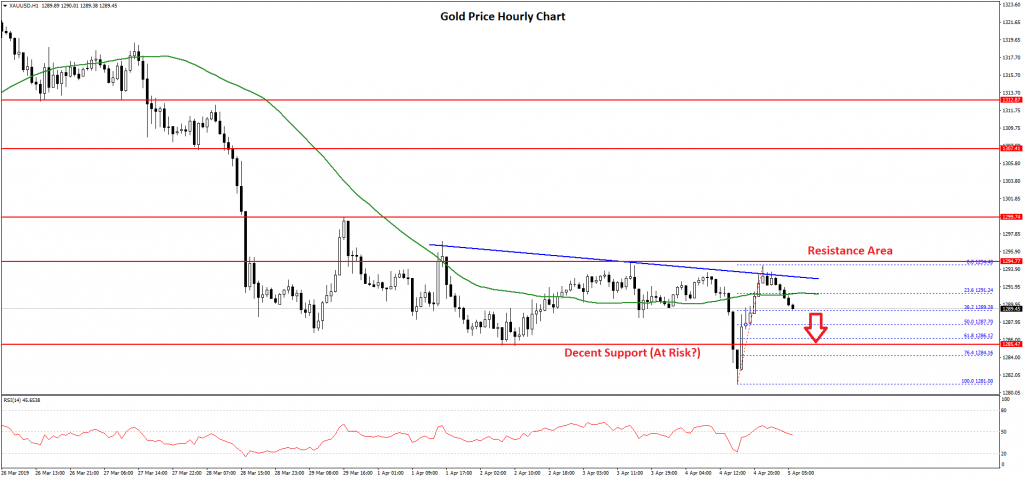
It moved above the $1,290 level, but sellers defended the $1,294 resistance area. There is also a key connecting bearish trend line in place with resistance near $1,292 on the hourly chart of gold.
The price is moving lower again and is currently trading below the $1,290 level and the 50 hourly simple moving average. It is likely to test the 50% Fib retracement level of the recent wave from the $1,281 low to $1,294 high.
However, the main support is near the $1,285 level and the 61.8% Fib retracement level of the recent wave from the $1,281 low to $1,294 high. If there is a break below the $1,285 support area, the price is likely to test the $1,280 level.
Should sellers remain in control, the price may even test the $1,272 level. On the upside, the price must settle above the trend line resistance and the $1,295 level to start a decent rebound in the near term.
Oil Price Technical Analysis
Crude oil price started a nasty upward move from the $58.30 swing low against the US Dollar. The price rallied steadily and broke the $60.00 and $62.00 resistance levels.
The price even broke the $62.50 level, but it struggled to gain momentum above the $63.00 resistance level. Later, it started a downside move and broke the key $62.50 support. Besides, there was a break below a significant ascending channel with support at $62.60 on the hourly chart of XTI/USD.
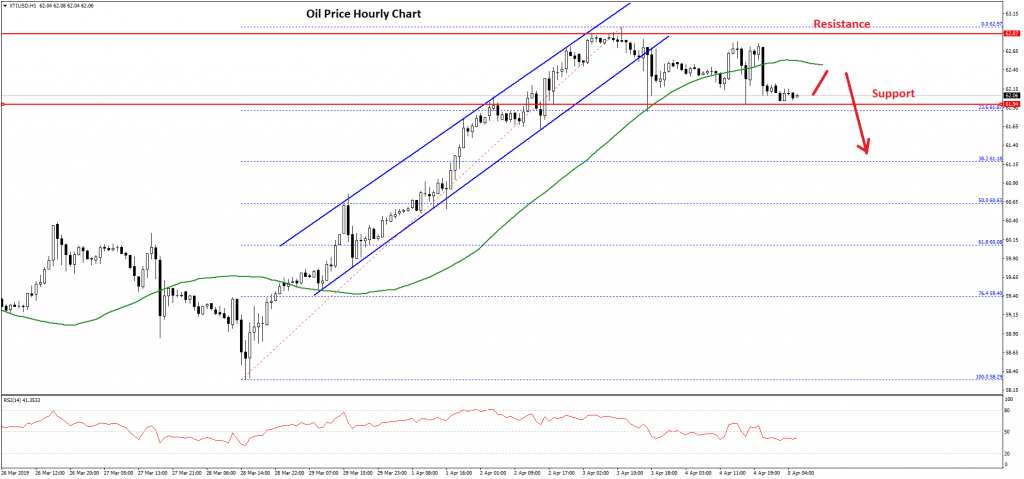
The price traded below the $62.40 level and the 50 hourly simple moving average. It tested the 23.6% Fib retracement level of the recent wave from the $58.29 low to $62.97 high.
If there is a downside break below the $62.00 support area, the price may move into a short term bearish zone. The next support is near the $61.50 level. If there are more losses, the price may even test the $60.60 support.
The 50% Fib retracement level of the recent wave from the $58.29 low to $62.97 high is also near the $60.60 level. On the other hand, if buyers protect the $62.00 support, the price could bounce back above $62.50 and it may even break the $63.00 resistance.
Market Morning Briefing: Euro-Yen Is Slowly Rising
STOCKS
Equities broadly remains bullish as the increased optimism on the US-China trade deal keeps the sentiment positive. Dow, DAX and Nikkei can rise further in the coming sessions. But the Indian indices, the Sensex and the Nifty 50 look weaker than its peers and are vulnerable for a fall in the near term.
Dow (26,384.63, +166.50, +0.64%) has breached the key resistance level of 26250 and looks to be gearing up to test 27000 and 27200.
DAX (11988.01, +33.61, +0.28%) remains bullish and can test 12100 and 12200 in the near term. The region around 12200 is a key resistance and a corrective fall from there to 12000 and 11800 cannot be ruled out.
Nikkei (21781.55, +56.60, +0.26%) inching higher towards 21900-22000 as expected. Inability to breach 22000 can trigger a fall to 21500 again. But a strong break above 22000 will pave way for a test of 22600 or even higher levels.
Sensex (36684.72, -192.40, -0.49%) and Nifty 50 (11598, -45.95, -0.39%) fell yesterday as expected. While Sensex trades below 36850,a fall to 36500 and 36350 is possible. Nifty can fall to 11450-11420 while it remains below 11650.
Shanghai (3246.57, +30.28, +0.94%) is closed today on account of a public holiday.
COMMODITIES
Commodities like gold, silver and copper may broadly trade sideways for some time before we get a clear cue on the next move. Oil can dip in the near term before resuming its uptrend.
Gold (1290) and Silver (15.12) keeps our view intact for a sideways between 1280-1305 and 15.0-15.2 respectively. The outcome of the US non-farm payroll could be a possible trigger for gold and silver to break this range and set the direction of the next move.
Copper (2.92) has been oscillating between 2.90 and 2.95. If it sustains above 2.90, a bounce-back to 2.95 and 2.97 is possible again. But, a break below 2.90 can trigger a fresh fall to 2.85. Copper has to breach 2.97 decisively to resume its overall uptrend to 3.0 and higher levels.
WTI (62.1) seems to lack strong follow-through buyers above 62. The 200-day moving average support at 61.40 can be tested in the near term. A strong bounce from there can take WTI higher to 63.5 and 64. But a break below 61.4 can drag the prices to 60.35.
Brent (69.17) is struggling to breach 70. As mentioned yesterday, a dip to 68 is possible while below 70. A key support is at 67.80 - the 21-day moving average. A break below it will see Brent extending its downmove to 67 and 66.8 thereafter. A decisive break above 70 is needed to take the prices higher to 72.
FOREX
Dollar-Index (97.29) has bounced from 97 and if the bounce continues, it could test 97.50 on the upside. The index could remain stable today. Preference is for a fall towards 96.75 with extension towards 95.75 in the medium term.
Euro (1.1225) could possibly test 1.1250-1.1280 before coming off from there. Scope of testing lower levels of 1.11 is still on the cards for the longer run.
Euro-Yen (125.40) is slowly rising. Trading near our expected 125.40, it could move up gradually to test 126.0-126.8 levels on the upside. Near term looks bullish.
Dollar Yen (111.72) is almost stable near levels seen yesterday. As mentioned yesterday, 111.5-112.0 is a near term resistance above current levels and while that holds, the pair could see a corrective fall from there. On a break above 112, we could consider a rise towards 112.50-113.00 in the medium term.
Aussie (0.7123) is stuck below 0.715 resistance and could probably see sideways movement in the 0.715-0.705 region for a few sessions before moving sharply on either side. While 0.7150 holds strong, it could even push Aussie to levels below 0.705, targeting 0.6950 in the medium term.
Pound (1.3079) is holding below immediate daily trend resistance at 1.32 and while that holds, Pound could fall towards 1.3050-1.3000 in the near term. View is bearish.
USDCNY (6.7166) is likely to remain below 7.73 and could fall towards 6.70 or lower in the coming sessions.
Dollar-Rupee (69.17) could dip towards 68.80 today if 69.25 holds just now. On break above 69.25, we would consider the rally to continue towards 69.50/60.
INTEREST RATES
The US Yields continue to move up. The 30Yr (2.94%) is up 1bps and could target 3% in the near term. The 10YR yield (2.53%) has scope of testing 2.58-2.60% in the near term.
The 10Yr GOI (7.5124%) rose sharply yesterday to rise from levels near 7.3415% to 7.5124%. Now if the rise holds, we could see it rise further towards 7.55/60%. But at 7.555 it could face some rejection leading to a corrective fall towards 7.45% again.
The UK-US 10YR (-1.44%) could fall towards -1.50% before bouncing again from there. Immediate view is of a fall from current levels.
Trump: China trade deal in four weeks, or maybe less, maybe more
While there seems to be progress made in US-China trade negotiations, they've yet reached a concluding stage. No Trump-Xi summit was announced at the meeting in the Oval Office with Chinese Vice Premier Liu He. Trump said: "We're getting very close to making a deal. That doesn't mean a deal is made, because it's not, but we're certainly getting a lot closer."
At the time same, he repeated his vague languages regarding the timing of a deal. "And I would think with, oh, within the next four weeks or maybe less, maybe more, whatever it takes, something very monumental could be announced.
Trump added that "some of the toughest things have been agreed to", and "we've agreed to far more than we have left to agree to". "We have to make sure there's enforcement. I think we'll get that done. We've discussed it at length," he added..
It's equally vague on the Chinese side. President Xi Jinping told Trump, through Liu, that "I hope the two sides' trade teams can continue working in the spirit of mutual respect, equality, and mutual benefit to resolve each other's concerns, and finish negotiations on the text of the China-U.S. trade agreement soon." Yet, there was no indication on how "soon" is being soon.
Can USD/JPY Surpass The Key 112.00 Resistance?
Key Highlights
- The US Dollar climbed higher and broke the 111.00 resistance against the Japanese Yen.
- USD/JPY broke a major bearish trend line at 111.15 on the 4-hours chart.
- The US Initial Jobless Claims for the week ending March 30, 2019 declined to 202K from 212K.
- The US Nonfarm Payrolls in March 2019 could rise from 20K to 180K.
USDJPY Technical Analysis
After forming a support base above 110.20, the US Dollar steadily climbed higher against the Japanese Yen. The USD/JPY pair surpassed the 111.00 resistance, but it is facing a tough hurdle near 112.00.
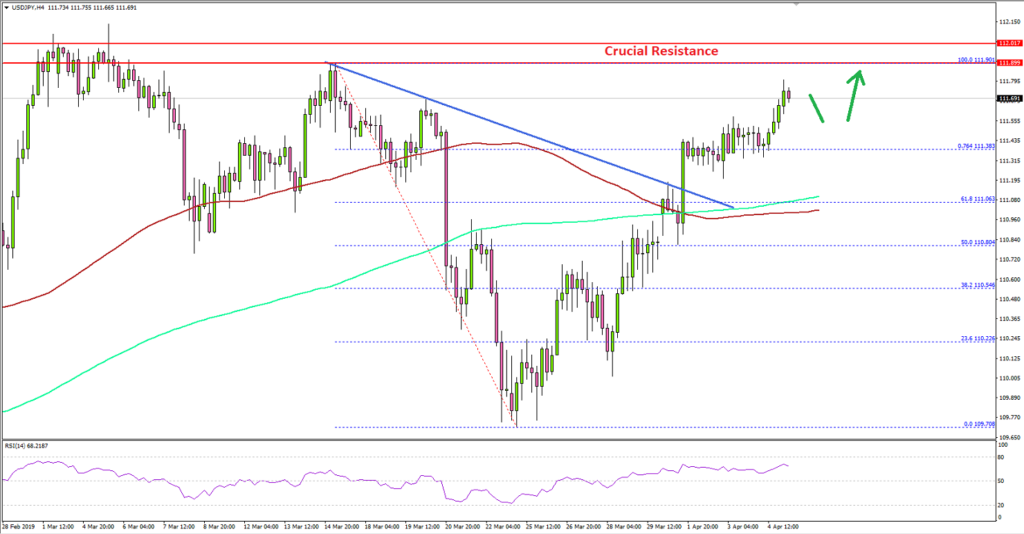
Looking at the 4-hours chart, the pair started a fresh increase from the 109.70 low. It broke the 110.50 and 111.00 resistance levels to move into a positive zone. There was a close above the 111.00 level, the 100 simple moving average (4-hours, red), and the 200 simple moving average (4-hours, green).
Besides, the pair broke a major bearish trend line at 111.15 on the same chart. There was also a break above the 61.8% Fib retracement level of the last decline from the 111.90 high to 109.70 low.
The pair climbed above the 111.50 level recently, but there is a strong resistance near the 112.00 and 112.10 levels. The 112.00-112.10 area acted as a barrier on many occasions and it may once again stop the recent rise. However, if today's NFP release in the US exceeds the market forecast, there are chances of an upside break above 112.00.
Fundamentally, the US Initial Jobless Claims for the week ending March 30, 2019 was released by the US Department of Labor. The market was looking for a minor rise in claims from 211K to 216K.
The actual result was better than the forecast, as the US Initial Jobless Claims declined to 202K. On the other hand, the last reading was revised up from 211K to 212K.
The report added:
The 4-week moving average was 213,500, a decrease of 4,000 from the previous week's revised average. The previous week's average was revised up by 250 from 217,250 to 217,500.
Overall, the US dollar bulls remain in control as EUR/USD and GBP/USD continues to slide. More importantly, this time there are chances of an upside break above 112.00 in USD/JPY.
Economic Releases to Watch Today
- US Nonfarm Payrolls March 2019 – Forecast 180K, versus 20K previous.
- US Unemployment Rate March 2019 – Forecast 3.8%, versus 3.8% previous.
- Canada's employment Change payrolls March 2019 – Forecast 1.0K, versus 55.9K previous.
- Canada's Unemployment Rate March 2019 – Forecast 5.8%, versus 5.8% previous.
Daily Markets Broadcast
Wall Street rally continues
Reported progress in the US-China trade talks kept most US indices supported, though the NAS100 index was dragged lower by Tesla, after disappointing Q1 deliveries.
US30USD Daily Chart
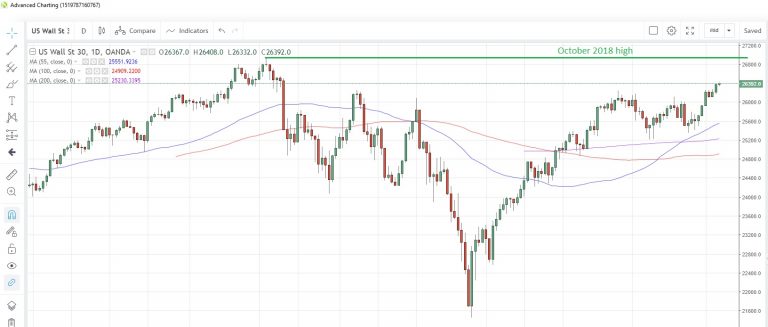
The US30 index continues to edge higher this morning, touching the highest since October 10
The next possible resistance point could be the October 2018 high of 26,940
March nonfarm payrolls data are due today and the economy is seen adding 180,000 jobs, the latest survey of economists shows. The unemployment rate is expected to hold steady at 3.8%.
DE30EUR Daily Chart
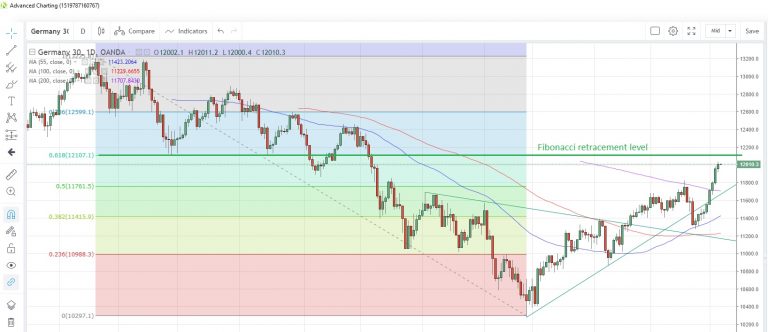
The Germany30 index extended its current rally to nine days yesterday as hopes for a US-China trade deal grew
The index touched the highest in almost six months yesterday and is eyeing the 61.8% Fibonacci retracement of last year’s May-December drop at 12,107
German factory orders fell more than expected in February. This could influence today’s release of industrial production data for the same month, which is currently expected to rise 0.5% m/m following a 0.8% decline in January.
WTICOUSD Daily Chart
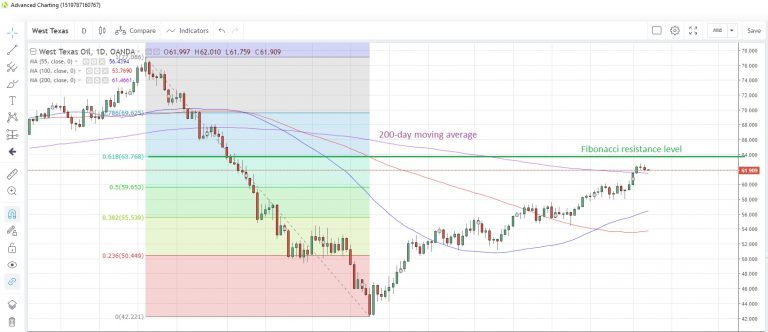
WTI edged lower for a second day yesterday after the EIA reported Wednesday the biggest weekly inventory build in two months
WTI appears to be shying away from Fibonacci resistance at 63.768, which is 61.8% retracement of the October-December drop. The 200-day moving average, which was breached to the upside on Tuesday, is at 61.466
7.24 million barrels were added to crude oil stockpiles in the week to March 29, according to EIA data. that’s the biggest add since the week of January 25 while expectations were for a drawdown of 0.43 million barrels.
Dollar Higher On US-China Trade Anxiety
The US dollar is higher against major pairs on Thursday. The greenback bounced back on the back of lower unemployment claims data as the U.S. non-farm payrolls (NFP) awaits. The US-China trade deal narrative got some turbulence with non-committal statements from the US ambassador to China. The dollar is advancing despite a dovish U.S. Federal Reserve who continues to stress patience after it has paused its interest rate hike plans.
US employment has been the strongest pillar since the crisis, but weather and the government shutdown made for a disappointing report last month. American jobs are expected to rebound with a 180,000 job gain. Investors will also be looking at the average hourly earnings for signals of inflationary pressure. Given the rise in number of positions, wages are forecasted lower at a 0.2 percent rise. The dollar is mixed against majors in the first week of April as Brexit irresolution has brought high and lows to the pound.
Global growth forecasts remain under pressure as the two largest economies have not reached a full agreement and there is a lower probability of a summit being announced in the short term. The US dollar has risen as a safe haven as geopolitics keeps having a negative impact on economic growth.
Brexit Drama Pressures Pound
The GBP/USD fell 0.54 percent on Thursday after a marathon session between the Conservative and Labour teams said little on the nature of the talks other than they will be ongoing. Some sources are pointing out that the talks have not been constructive, which remains a Brexit syndrome with a fast approaching deadline.
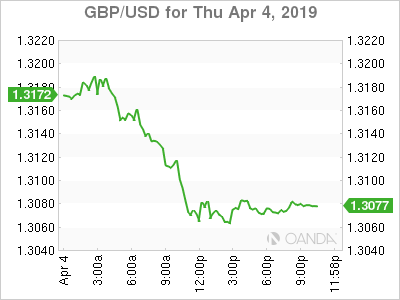
A Brexit extension is the most likely scenario from here, the length of which could be decided by Labour backing Theresa May’s deal in which case it would be a short one, or no deal passed and the UK asking for a longer extension the length of which would have to be decided by the EU and which could be the end of Brexit if a new referendum, new elections or both are likely scenarios.
Brexit uncertainty is weighing heavily on the currency and with geopolitical risk on the rise the US dollar has appreciated as a safe haven in order for investors to limit their exposures.
Oil Lower as Us-China Trade Hits Speed Bump
Oil prices fell on Thursday as the US dollar gained strength on positive jobs data, but also the US-China talks hitting a speed bump triggering anxiety amongst investors. Despite rumours that a summit date would be announced today officials from the White Housed denied those speculations. A summit in April is looking unlikely despite the comments from both sides on how well the negotiations are going. After much talk there is still nothing to show for it, which is once again putting downward pressure on energy demand going forward.
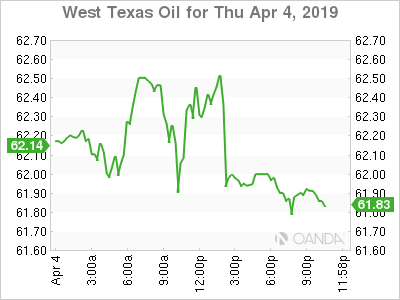
Oil traded lower despite Libya about to engage in armed conflict and the ongoing sanctions against Venezuela and Iran further reducing supply. The OPEC+ has been the major stabilizing factor of energy prices with their production cut agreement. The group is looking to extend the supply restrictions in order to soak up excess crude in the market. 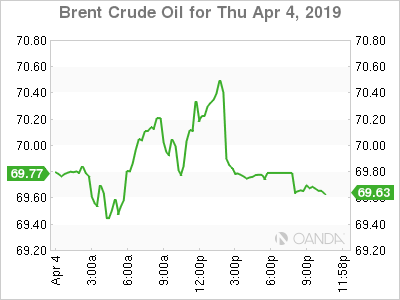
Growing US shale production could force OPEC+ to extend their deal beyond the end of 2019, but it remains to be seen how much longer the energy producing members can limit their revenue.
Gold Gains Slightly Despite US Dollar Strength
Gold managed to eke out a gain on Thursday despite the US dollar having a moment ahead of the release of the U.S. non-farm payrolls (NFP). The report is expected to show a strong gain after last month’s disappointing data with the government shutdown and poor data to blame for the underperformance.
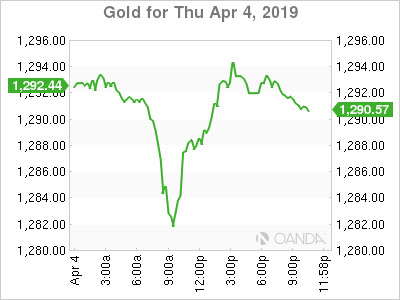
With the US-China trade hitting a small speed bump and Brexit drama affecting the market, gold remains bid as investors see it as a safe haven. The Fed will remain out of the picture for 2019 as market forces and White House pressure will keep it in the sidelines. The yellow metal is supported by major risk events that remain unsolved and with little details for investors to trade on with is a positive for the metal at the moment.
Stocks Mixed on Trade Anxiety
Global stocks were mostly on positive territory ahead of the last trading session of the week. The US-China trade talks remain a decisive factor, and while this week’s setback could be a minor delay the comments from both sides has been positive that a deal is within striking distance. President Trump said that while trade talks are coming along well, if it’s not a great deal, he won’t agree to it.
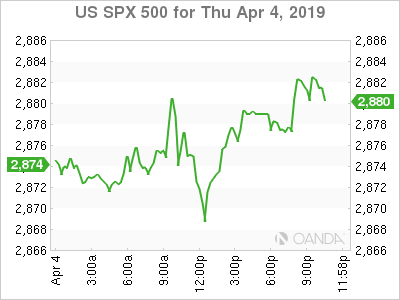
Tesla traded lower after disclosing delivery numbers that showed there was a slowdown in its efforts to meet client orders. The stock lost 9 percent as there are mounting concerns that the electric auto maker can meet the logistical challenges of having a popular, but lower priced product.
Ford sales disappointed as it struggled to move certain car models in its portfolio. Trucks, vans and SUVs continued to gain at a healthy pace, but sedans suffered and put in question the ability of the automaker to recover its record setting pace. Ford is looking to adapt by cutting its lower cost offerings and focus on higher priced, more tech heavy packages.
Eco Data 4/5/19
[php_everywhere instance="1"]
Risk Appetite Increases on Trade War Breakthrough Hope
Equities are rallying and sovereign bond prices have been falling in week one of Q2. Investor optimism has been supported by stronger China PMI data and on the news that China and the U.S maybe on the cusp of a trade deal. It’s believed that most issues have been resolved between the world’s two largest economies. President Trump is expected to meet the trade delegations Thursday. Will he be able to announce a summit soon?
Earnings season begins next Friday (April 12) with JP Morgan kicking things off. The market has already priced in a poor first quarter, with earnings on S&P 500 stocks seen declining by low-single digits.
Central banks
The Reserve Bank of Australia (RBA) left the cash rate target unchanged at +1.50% this week as expected. Policy makers omitted its prior comment noting “central scenario was still for the Australian economy to grow by around +3.0% in 2019.” But instead, inserted “to set policy to support sustainable growth and achieve the inflation target over time.”
The Reserve Bank of India (RBI) cut its key policy rate by -25 bps to +6%. The central bank said since its last meeting in February, “global economic activity has been losing pace,” both in the U.S. and developed markets and emerging markets. The “domestic economy is facing headwinds, especially on the global front. The need is to strengthen domestic growth impulses by spurring private investment which has remained sluggish,” the bank said in a statement. Hence the necessity to cut key rates to aid the sluggish economy ahead of the upcoming elections.
In Europe, the ECB policymakers debated the risk that ultra-low interest rates pose to banks. The effects of persistently low rates could depress banks’ interest margins and profitability, with negative effects on banks intermediation and financial stability in the longer run.
Brexit and more Brexit
U.K PM Theresa May announced a cross-party approach to break the impasse in parliament over Brexit. The PM has indicated she would look for Labour support for a new Brexit deal. However, there is no guarantee that Labour and the PM would agree terms on the Brexit path, nevertheless, the fact that she is willing to cross the floor is a clear shift in her party’s stance towards a ‘softer’ Brexit.
PM May still insists that her withdrawal agreement – which was voted down last week – would remain part of the deal. The U.K requires an extension and PM May has said she wanted the extension to be “as short as possible” – before 22 May so the UK does not have to take part in European elections.
The UK has until 12 April to propose a plan – which must be accepted by the EU – or it will leave without a deal. However, if the UK can approve the withdrawal agreement with a viable majority before next week’s summit, the EU will agree to a short extension up to May 22. On Wednesday, U.K lawmakers passed a vote by a majority of one to block a potentially destructive no-deal Brexit. This means that if a stalemate on exiting the E.U persists until the April 12 deadline; the PM will be forced to ask the EU for a long extension to the process.
Data this week showed that Brexit worries has caused the dominant services sector to contract for the first time in nearly three-years, in fact, since the Brexit referendum.
On the Economic Calendar, no releases are scheduled for this weekend.
**DST – clocks go forward in Australia and New Zealand on the weekend
Market concerns:
- U.K/Brexit fallout
- US-China trade deal – details may emerge
- Trans-Atlantic trade tensions to intensify
- OPEC, Saudis, Venezuela & Trump
- Venezuela/Russia/U.S tension
- Geo-political concerns in Russia, Ukraine & France
- India/Pakistan – tension remains high amongst two nuclear nations
- U.S ramps up trade talks with India and Turkey
- Spanish snap elections expected to be full of surprises April 28
Next week: GBP GDP & manufacturing product, ECB monetary policy statement, USD CPI & FOMC meeting minutes (Apr 10).
Central Banks Monetary Policy decisions for April 2019
- 2-Apr AUD Australia Reserve Bank of Australia
- 3-Apr PLN Poland National Bank of Poland
- 4-Apr INR India Reserve Bank of India
- 10-Apr EUR Euro area European Central Bank
- 24-Apr CAD Canada Bank of Canada
- 25-Apr JPY Japan Bank of Japan
- 25-Apr SEK Sweden Sveriges Riksbank
- 25-Apr TRY Turkey Central Bank of Republic of Turkey
- 30-Apr HUF Hungary Central Bank of Hungary
Monetary policy snapshot 2019:
- Fed: changes tune to patience and flexible – Jan. 2019
- ECB: Growth and inflation doubts raise questions about first-rate hike
- BoE: Waiting for Brexit
- PBoC: Expect further RRR cuts to save private firms
- BoJ: Only speculation
- SNB: No hikes expected before 2020
- Norges: Higher rates ahead, but upside may be capped
- Riksbank: Still very ‘dovish’
- BoC: Hawkish stance opens door to two or more hikes in 2019, will take cue from Fed
- RBA: Still relaxed
- RBNZ: Upside surprise
- BoM: Hawkish stance opens door to two more hikes in 2019, but data dependent.
Yen Subdued ahead of Japanese Consumer Spending
USD/JPY is showing little movement on Thursday. In the North American session, the pair is trading at 111.58, up 0.08% on the day. On the release front, U.S. unemployment claims impressed, dropping to 202 thousand. This was below the forecast of 215 thousand. Later in the day, Japan releases household spending, which is expected to tick lower to 1.9%. On Friday, the focus will be on U.S. employment data, with the release of nonfarm payrolls and wage growth.
It’s been a disappointing week for U.S. numbers, and the trend continued on Wednesday. ADP nonfarm payrolls plunged to 129 thousand, down from 183 thousand in the previous release. Is this a precursor of what to expect on Friday? Nonfarm payrolls are projected at 175 thousand, a soft number in comparison to recent releases. ISM Non-Manufacturing PMI also stumbled on Wednesday, falling from 59.7 to 56.1 points.
Japanese manufacturing has been struggling, and this was underlined in the Tankan manufacturing index for Q4, which dropped to 12, down from 19 in the third quarter. This marked the weakest score since 2013. The steep drop in manufacturing was expected, as less global demand for Japanese exports has taken a bite out of manufacturing activity. However, things could improve if the U.S. and China can reach a deal, after a bruising trade war which has rocked the global economy. The sides have made substantial progress, with reports that an agreement between the world’s two largest economies is 90% complete. The outstanding issues include enforcement mechanisms and the removal of trade tariffs. There has been positive news out of China this week, as manufacturing PMI posted a 14-month high, and the China 50 index has climbed to its highest level since March 2018.